

ASTM F2334-18
(Guide)Standard Guide for Above Ground Public Use Skatepark Facilities
General Information
- Abstract
ABSTRACT
This guide establishes the safety, performance and maintenance requirements pertaining to above-ground (indoor/outdoor), public-use skatepark facilities and any elements included therein that are intended to be used in the performance of the sports including skateboarding, inline skating, and BMX biking. The skatepark elements covered here are guardrails (including return guardrails and adjoining resting deck guardrails), protective edging/surfaces, riding surfaces, copings, approaches/thresholds, stairs, and portable and stand-alone elements. Items such as fencing, lighting, and operational structures are not addressed here.
SCOPE
1.1 This guide covers safety and performance guidelines pertaining to public skatepark facilities and any element included therein. These guidelines pertain to any elements intended to be used in the performance of the sports including skateboarding, inline skating, and BMX biking. Items such as fencing, lighting, and operational structures are not intended to be a part of this guide.
1.2 This guide applies to above-ground (indoor/outdoor) skatepark elements, intended for recreational use.
1.3 The text of this standard references notes and footnotes which provide explanatory material. These notes and footnotes (excluding those in tables and figures) shall not be considered as requirements of the standard.
1.4 Tolerances – General Measures, Tolerances, and Conversions—The general dimensional tolerances for this specification (unless otherwise noted) are as follows:
Dimension
Tolerance
X in. or ft
±0.5 in. or ft
X.X in. or ft
±0.05 in. or ft
X.XX in. or ft
±0.005 in. or ft
Note 1: These tolerances still apply to a dimension even when terms like greater than, less than, minimum, or maximum are used.
1.5 The values stated in inch-pound units are to be regarded as standard. The values given in parentheses are mathematical conversions to SI units that are provided for information only and are not considered standard.
Note 2: The conversion factor from inch-pound to SI units is 1 in. = 25.4 mm, and 1 lb = 0.45359 kg.
1.6 This standard does not purport to address all of the safety concerns, if any, associated with its use. It is the responsibility of the user of this standard to establish appropriate safety, health, and environmental practices and determine the applicability of regulatory limitations prior to use.
1.7 This international standard was developed in accordance with internationally recognized principles on standardization established in the Decision on Principles for the Development of International Standards, Guides and Recommendations issued by the World Trade Organization Technical Barriers to Trade (TBT) Committee.
- Status
- Published
- Publication Date
- 31-Mar-2018
- Technical Committee
- F08 - Sports Equipment, Playing Surfaces, and Facilities
- Drafting Committee
- F08.66 - Sports Facilities
Overview
ASTM F2334-18: Standard Guide for Above Ground Public Use Skatepark Facilities provides comprehensive safety, performance, and maintenance guidelines for the design, construction, and operation of above-ground skateparks intended for public use. This standard, issued by ASTM International, is applicable to both indoor and outdoor facilities supporting sports such as skateboarding, inline skating, and BMX biking. ASTM F2334-18 focuses specifically on elements like guardrails, protective edging, riding surfaces, copings, approaches, stairs, as well as portable and stand-alone skatepark features. The guide does not address requirements for fencing, lighting, or operational structures.
Key Topics
ASTM F2334-18 outlines detailed considerations for ensuring the safety, durability, and usability of skatepark elements, including:
- Safety Requirements: Guidelines for guardrails, performance edges, and signage to minimize injury risk for users, including specifications for minimum heights and fall prevention features.
- Performance Specifications: Instructions for surface uniformity, allowable elevation differences, and copings to maintain consistent riding conditions.
- Material and Construction: Recommendations on material selection for durability and corrosion resistance, especially for outdoor installations.
- Element Design: Requirements for the installation and arrangement of elements such as stairs, decks, copings, approaches, and thresholds.
- Maintenance Guidance: Provisions for owner/operator responsibilities related to maintenance routines, inspection, record-keeping, and hazard removal.
- Signage: Mandates for clear communication about rules, safety information, and emergency contacts, along with warnings about activity risks.
- Dimensional Tolerances: General tolerances for construction, ensuring accuracy in the placement and sizing of elements.
Applications
ASTM F2334-18 is valuable for a range of stakeholders involved in the planning, development, and operation of public-use above-ground skatepark facilities. Typical applications include:
- Municipalities and Parks Departments: Utilizing the standard to plan and commission new skateparks that meet recognized safety and performance criteria.
- Designers and Architects: Applying dimensional tolerances and assembly requirements to produce robust, compliant facilities.
- Skatepark Equipment Manufacturers: Ensuring products such as ramps, rails, copings, and portable elements are built to standard specifications.
- Facility Owners and Operators: Implementing maintenance and inspection routines as detailed in the standard to sustain safe operation and minimize liability.
- Community and Youth Organizations: Selecting compliant facilities to provide a safer environment for recreational skateboarding, inline skating, and BMX biking.
By following ASTM F2334-18, stakeholders help ensure that skatepark users experience safe, durable, and enjoyable facilities.
Related Standards
Implementing ASTM F2334-18 may require consulting related guidelines and standards, such as:
- ASTM F2480: Guide for In-ground Concrete Skatepark, addressing requirements for below-ground facilities.
- International Building Codes (IBC): Particularly Sections 1013.2 and 1013.3 around guardrail design and construction.
- Local Safety Codes and Best Practices: Additional requirements may be applicable based on regional regulatory contexts.
For updated references and for purchasing the full text, please visit the ASTM website at www.astm.org.
Keywords: above ground skatepark, public use skatepark, ASTM F2334-18, skateboarding safety, BMX biking standards, inline skating, skatepark maintenance, skatepark design, riding surfaces, guardrails, ASTM standards.
Relations
- Effective Date
- 01-Apr-2018
- Effective Date
- 01-Apr-2018
- Effective Date
- 01-Apr-2017
- Effective Date
- 01-Jul-2012
- Effective Date
- 01-Nov-2006
Frequently Asked Questions
ASTM F2334-18 is a guide published by ASTM International. Its full title is "Standard Guide for Above Ground Public Use Skatepark Facilities". This standard covers: ABSTRACT This guide establishes the safety, performance and maintenance requirements pertaining to above-ground (indoor/outdoor), public-use skatepark facilities and any elements included therein that are intended to be used in the performance of the sports including skateboarding, inline skating, and BMX biking. The skatepark elements covered here are guardrails (including return guardrails and adjoining resting deck guardrails), protective edging/surfaces, riding surfaces, copings, approaches/thresholds, stairs, and portable and stand-alone elements. Items such as fencing, lighting, and operational structures are not addressed here. SCOPE 1.1 This guide covers safety and performance guidelines pertaining to public skatepark facilities and any element included therein. These guidelines pertain to any elements intended to be used in the performance of the sports including skateboarding, inline skating, and BMX biking. Items such as fencing, lighting, and operational structures are not intended to be a part of this guide. 1.2 This guide applies to above-ground (indoor/outdoor) skatepark elements, intended for recreational use. 1.3 The text of this standard references notes and footnotes which provide explanatory material. These notes and footnotes (excluding those in tables and figures) shall not be considered as requirements of the standard. 1.4 Tolerances – General Measures, Tolerances, and Conversions—The general dimensional tolerances for this specification (unless otherwise noted) are as follows: Dimension Tolerance X in. or ft ±0.5 in. or ft X.X in. or ft ±0.05 in. or ft X.XX in. or ft ±0.005 in. or ft Note 1: These tolerances still apply to a dimension even when terms like greater than, less than, minimum, or maximum are used. 1.5 The values stated in inch-pound units are to be regarded as standard. The values given in parentheses are mathematical conversions to SI units that are provided for information only and are not considered standard. Note 2: The conversion factor from inch-pound to SI units is 1 in. = 25.4 mm, and 1 lb = 0.45359 kg. 1.6 This standard does not purport to address all of the safety concerns, if any, associated with its use. It is the responsibility of the user of this standard to establish appropriate safety, health, and environmental practices and determine the applicability of regulatory limitations prior to use. 1.7 This international standard was developed in accordance with internationally recognized principles on standardization established in the Decision on Principles for the Development of International Standards, Guides and Recommendations issued by the World Trade Organization Technical Barriers to Trade (TBT) Committee.
ABSTRACT This guide establishes the safety, performance and maintenance requirements pertaining to above-ground (indoor/outdoor), public-use skatepark facilities and any elements included therein that are intended to be used in the performance of the sports including skateboarding, inline skating, and BMX biking. The skatepark elements covered here are guardrails (including return guardrails and adjoining resting deck guardrails), protective edging/surfaces, riding surfaces, copings, approaches/thresholds, stairs, and portable and stand-alone elements. Items such as fencing, lighting, and operational structures are not addressed here. SCOPE 1.1 This guide covers safety and performance guidelines pertaining to public skatepark facilities and any element included therein. These guidelines pertain to any elements intended to be used in the performance of the sports including skateboarding, inline skating, and BMX biking. Items such as fencing, lighting, and operational structures are not intended to be a part of this guide. 1.2 This guide applies to above-ground (indoor/outdoor) skatepark elements, intended for recreational use. 1.3 The text of this standard references notes and footnotes which provide explanatory material. These notes and footnotes (excluding those in tables and figures) shall not be considered as requirements of the standard. 1.4 Tolerances – General Measures, Tolerances, and Conversions—The general dimensional tolerances for this specification (unless otherwise noted) are as follows: Dimension Tolerance X in. or ft ±0.5 in. or ft X.X in. or ft ±0.05 in. or ft X.XX in. or ft ±0.005 in. or ft Note 1: These tolerances still apply to a dimension even when terms like greater than, less than, minimum, or maximum are used. 1.5 The values stated in inch-pound units are to be regarded as standard. The values given in parentheses are mathematical conversions to SI units that are provided for information only and are not considered standard. Note 2: The conversion factor from inch-pound to SI units is 1 in. = 25.4 mm, and 1 lb = 0.45359 kg. 1.6 This standard does not purport to address all of the safety concerns, if any, associated with its use. It is the responsibility of the user of this standard to establish appropriate safety, health, and environmental practices and determine the applicability of regulatory limitations prior to use. 1.7 This international standard was developed in accordance with internationally recognized principles on standardization established in the Decision on Principles for the Development of International Standards, Guides and Recommendations issued by the World Trade Organization Technical Barriers to Trade (TBT) Committee.
ASTM F2334-18 is classified under the following ICS (International Classification for Standards) categories: 97.220.10 - Sports facilities. The ICS classification helps identify the subject area and facilitates finding related standards.
ASTM F2334-18 has the following relationships with other standards: It is inter standard links to ASTM F2334-09(2017), ASTM F2480-18, ASTM F2480-06(2017), ASTM F2480-06(2012), ASTM F2480-06. Understanding these relationships helps ensure you are using the most current and applicable version of the standard.
ASTM F2334-18 is available in PDF format for immediate download after purchase. The document can be added to your cart and obtained through the secure checkout process. Digital delivery ensures instant access to the complete standard document.
Standards Content (Sample)
This international standard was developed in accordance with internationally recognized principles on standardization established in the Decision on Principles for the
Development of International Standards, Guides and Recommendations issued by the World Trade Organization Technical Barriers to Trade (TBT) Committee.
Designation: F2334 − 18 An American National Standard
Standard Guide for
Above Ground Public Use Skatepark Facilities
This standard is issued under the fixed designation F2334; the number immediately following the designation indicates the year of
original adoption or, in the case of revision, the year of last revision. A number in parentheses indicates the year of last reapproval. A
superscript epsilon (´) indicates an editorial change since the last revision or reapproval.
1. Scope ization established in the Decision on Principles for the
Development of International Standards, Guides and Recom-
1.1 This guide covers safety and performance guidelines
mendations issued by the World Trade Organization Technical
pertaining to public skatepark facilities and any element
Barriers to Trade (TBT) Committee.
included therein. These guidelines pertain to any elements
intended to be used in the performance of the sports including
2. Referenced Documents
skateboarding, inline skating, and BMX biking. Items such as
2.1 ASTM Standards:
fencing, lighting, and operational structures are not intended to
F2480 Guide for In-ground Concrete Skatepark
be a part of this guide.
2.2 International Building Codes (IBC):
1.2 This guide applies to above-ground (indoor/outdoor)
2009 IBC Sections 1013.2 and 1013.3
skatepark elements, intended for recreational use.
1.3 The text of this standard references notes and footnotes
3. Terminology
which provide explanatory material. These notes and footnotes
3.1 Definitions of Terms Specific to This Standard:
(excluding those in tables and figures) shall not be considered
3.1.1 access stairs, n—stairs used to gain access to
as requirements of the standard.
elements, and not used as performance elements.
1.4 Tolerances – General Measures, Tolerances, and
3.1.2 approaches/thresholds, n—connection or transition
Conversions—The general dimensional tolerances for this
component between base and riding surfaces.
specification (unless otherwise noted) are as follows:
3.1.3 base, n—concrete, asphalt, or similar rigid, uniform,
Dimension Tolerance
or stable surface upon which elements are positioned.
X in. or ft ±0.5 in. or ft
X.X in. or ft ±0.05 in. or ft
3.1.3.1 Discussion—For more information on finish, surface
X.XX in. or ft ±0.005 in. or ft
flatness, levelness, expansion and control joints for concrete
NOTE 1—These tolerances still apply to a dimension even when terms
base surfaces, see Guide F2480.
like greater than, less than, minimum, or maximum are used.
3.1.4 coping, n—circular pipe or other material installed on
1.5 The values stated in inch-pound units are to be regarded
some elements. Pool coping is excluded from this terminology.
as standard. The values given in parentheses are mathematical
3.1.5 element, n—sports and recreational equipment having
conversions to SI units that are provided for information only
a level, inclined, or curved solid surface on which the user of
and are not considered standard.
skateboards, inline skates, and BMX bicycles can maneuver.
NOTE 2—The conversion factor from inch-pound to SI units is 1 in. =
3.1.6 element riding surface, n—surface on which it is
25.4 mm, and 1 lb = 0.45359 kg.
intended the user be in contact with.
1.6 This standard does not purport to address all of the
3.1.7 guardrails, n—barrier designed to keep users and their
safety concerns, if any, associated with its use. It is the
riding equipment from falling off the rear or sides of resting/
responsibility of the user of this standard to establish appro-
roll-out decks.
priate safety, health, and environmental practices and deter-
3.1.8 performance decks, n—flat areas found within the
mine the applicability of regulatory limitations prior to use.
skatepark intended for continuous movement and that do not
1.7 This international standard was developed in accor-
require the use of guardrails.
dance with internationally recognized principles on standard-
1 2
This guide is under the jurisdiction of ASTM Committee F08 on Sports For referenced ASTM standards, visit the ASTM website, www.astm.org, or
Equipment, Playing Surfaces, and Facilities and is the direct responsibility of contact ASTM Customer Service at service@astm.org. For Annual Book of ASTM
Subcommittee F08.66 on Sports Facilities. Standards volume information, refer to the standard’s Document Summary page on
Current edition approved April 1, 2018. Published April 2018. Originally the ASTM website.
approved in 2009. Last previous edition approved in 2017 as F2334 – 09 (2017). Available from International Code Council (ICC), 500 New Jersey Ave., NW,
DOI: 10.1520/F2334-18. 6th Floor, Washington, DC 20001-2070, http://www.iccsafe.org.
Copyright © ASTM International, 100 Barr Harbor Drive, PO Box C700, West Conshohocken, PA 19428-2959. United States
F2334 − 18
3.1.9 performance edge, n—durable material placed on the 4.1.4 Woodenmaterialsforoutdoororindooruseshallmeet
accessible edge or surface of intersecting and terminating the Environmental Protection Agency and State requirements.
planes on elements used for performance purposes.
5. Performance Requirements
3.1.10 performance stairs, n—stairs within the skatepark
intended to be used as performance elements.
5.1 Guardrails:
5.1.1 Guardrails shall be designed to minimize the likeli-
3.1.11 permanent element, n—any element not intended to
be moved or re-positioned. hood of climbing, shall be a minimum of 42 in. (1067 mm)
high and prevent passage of a sphere equal to or greater than
3.1.12 portable element, n—any element that can be moved
4.0 in. (102 mm) outside diameter. (Reference: 2009 IBC
and is not anchored.
Sections1013.2and1013.3).Guardrailsshallbeconstructedin
3.1.13 protective edging/surface, n—durable material that
a manner that does not allow a skateboard underneath and
protects accessible edges or surfaces of intersecting and
through the opening between the bottom of the rail and the
terminating planes on the riding surfaces for the purposes of
resting deck. Resting/Roll-out decks with an elevation of 38 in.
reducing wear.
(965 mm) and above shall be equipped with guardrails. An
3.1.14 resting/roll-out decks, n—horizontal elements where
elevated surface is exempt from these requirements if a
riding is beginning or terminating.
guardrail would interfere with the intended use of the element.
See Fig. 1.
3.1.15 semi-permanent element, n—any element that can be
5.1.2 Return guardrails shall terminate a maximum of 24 in.
moved and is anchored.
(610 mm) from the leading edge of the resting deck,. Corners
3.1.16 skatepark, n—element or group of elements within a
at the leading edge shall be free of sharp edges and contain a
defined boundary for use by skateboarders, inline skaters, or
maximum radius or miter of 12 in. (305 mm). See Fig. 1.
BMX bikers.
5.1.3 Adjoining Resting Deck Guardrails—Guardrails span-
ning adjoining resting decks of different elevations shall be
4. Materials and Manufacture
constructed in a manner that shall prevent inadvertent falls
4.1 General Requirements:
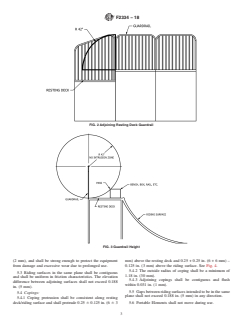
from one deck over the adjoining guardrail. See Fig. 2.
4.1.1 Skatepark elem
...
This document is not an ASTM standard and is intended only to provide the user of an ASTM standard an indication of what changes have been made to the previous version. Because
it may not be technically possible to adequately depict all changes accurately, ASTM recommends that users consult prior editions as appropriate. In all cases only the current version
of the standard as published by ASTM is to be considered the official document.
Designation: F2334 − 09 (Reapproved 2017) F2334 − 18 An American National Standard
Standard Guide for
Above Ground Public Use Skatepark Facilities
This standard is issued under the fixed designation F2334; the number immediately following the designation indicates the year of
original adoption or, in the case of revision, the year of last revision. A number in parentheses indicates the year of last reapproval. A
superscript epsilon (´) indicates an editorial change since the last revision or reapproval.
1. Scope
1.1 This guide covers safety and performance guidelines pertaining to public skatepark facilities and any element included
therein. These guidelines pertain to any elements intended to be used in the performance of the sports including skateboarding,
inline skating, and BMX biking. Items such as fencing, lighting, and operational structures are not intended to be a part of this
guide.
1.2 This guide applies to above-ground (indoor/outdoor) skatepark elements, intended for recreational use.
1.3 The text of this standard references notes and footnotes which provide explanatory material. These notes and footnotes
(excluding those in tables and figures) shall not be considered as requirements of the standard.
1.4 Tolerances – General Measures, Tolerances, and Conversions—The general dimensional tolerances for this specification
(unless otherwise noted) are as follows:
Dimension Tolerance
X in. or ft ±0.5 in. or ft
X.X in. or ft ±0.05 in. or ft
X.XX in. or ft ±0.005 in. or ft
NOTE 1—These tolerances still apply to a dimension even when terms like greater than, less than, minimum, or maximum are used.
1.5 The values stated in inch-pound units are to be regarded as standard. The values given in parentheses are mathematical
conversions to SI units that are provided for information only and are not considered standard.
NOTE 2—The conversion factor from inch-pound to SI units is 1 in. = 25.4 mm, and 1 lb = 0.45359 kg.
1.6 This standard does not purport to address all of the safety concerns, if any, associated with its use. It is the responsibility
of the user of this standard to establish appropriate safety safety, health, and healthenvironmental practices and determine the
applicability of regulatory limitations prior to use.
1.7 This international standard was developed in accordance with internationally recognized principles on standardization
established in the Decision on Principles for the Development of International Standards, Guides and Recommendations issued
by the World Trade Organization Technical Barriers to Trade (TBT) Committee.
2. Referenced Documents
2.1 ASTM Standards:
F2480 Guide for In-ground Concrete Skatepark
2.2 International Building Codes (IBC):
2009 IBC Sections 1013.2 and 1013.3
3. Terminology
3.1 Definitions of Terms Specific to This Standard:
3.1.1 access stairs, n—stairs used to gain access to elements, and not used as performance elements.
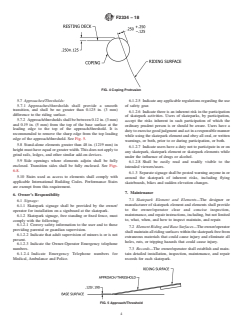
3.1.2 approaches/thresholds, n—connection or transition component between base and riding surfaces.
This guide is under the jurisdiction of ASTM Committee F08 on Sports Equipment, Playing Surfaces, and Facilities and is the direct responsibility of Subcommittee
F08.66 on Sports Facilities.
Current edition approved April 1, 2017April 1, 2018. Published April 2017April 2018. Originally approved in 2009. Last previous edition approved in 20092017 as
F2334 – 09.F2334 – 09 (2017). DOI: 10.1520/F2334-09R17.10.1520/F2334-18.
For referenced ASTM standards, visit the ASTM website, www.astm.org, or contact ASTM Customer Service at service@astm.org. For Annual Book of ASTM Standards
volume information, refer to the standard’s Document Summary page on the ASTM website.
Available from International Code Council (ICC), 500 New Jersey Ave., NW, 6th Floor, Washington, DC 20001-2070, http://www.iccsafe.org.
Copyright © ASTM International, 100 Barr Harbor Drive, PO Box C700, West Conshohocken, PA 19428-2959. United States
F2334 − 18
3.1.3 base, n—concrete, asphalt, or similar rigid, uniform, or stable surface upon which elements are positioned.
3.1.3.1 Discussion—
For more information on finish, surface flatness, levelness, expansion and control joints for concrete base surfaces, see Guide
F2480.
3.1.4 coping, n—circular pipe or other material installed on some elements. Pool coping is excluded from this terminology.
3.1.5 element, n—sports and recreational equipment having a level, inclined, or curved solid surface on which the user of
skateboards, inline skates, and BMX bicycles can maneuver.
3.1.6 element riding surface, n—surface on which it is intended the user be in contact with.
3.1.7 guardrails, n—barrier designed to keep users and their riding equipment from falling off the rear or sides of resting/roll-out
decks.
3.1.8 performance decks, n—flat areas found within the skatepark intended for continuous movement and that do not require
the use of guardrails.
3.1.9 performance edge, n—durable material placed on the accessible edge or surface of intersecting and terminating planes on
elements used for performance purposes.
3.1.10 performance stairs, n—stairs within the skatepark intended to be used as performance elements.
3.1.11 permanent element, n—any element not intended to be moved or re-positioned.
3.1.12 portable element, n—any element that can be moved and is not anchored.
3.1.13 protective edging/surface, n—durable material that protects accessible edges or surfaces of intersecting and terminating
planes on the riding surfaces for the purposes of reducing wear.
3.1.14 resting/roll-out decks, n—horizontal elements where riding is beginning or terminating.
3.1.15 semi-permanent element, n—any element that can be moved and is anchored.
3.1.16 skatepark, n—element or group of elements within a defined boundary for use by skateboarders, inline skaters, or BMX
bikers.
4. Materials and Manufacture
4.1 General Requirements:
4.1.1 Skatepark elements shall be manufactured, assembled, or constructed, or a combination thereof, using durable materials
fit for the use intended as specified by the manufacturer.
4.1.2 Materials shall be tested and documented for durability by the supplier or manufacturer.
4.1.3 Ferrous materials for outdoor use shall be inherently corrosion resistant or be provided with a corrosion resistant coating.
4.1.4 Wooden materials for outdoor or indoor use shall meet the Environmental Protection Agency and State requirements.
5. Performance Requirements
5.1 Guardrails:
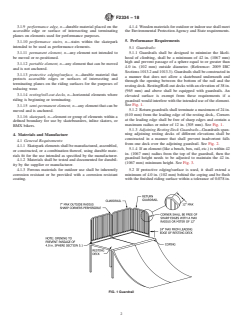
5.1.1 Guardrails shall be designed to minimize the likelihood of climbing, shall be a minimum of 42 in. (1067 mm) high and
prevent passage of a sphere equal to or greater than 4.0 in. (102 mm) outside diameter. (Reference: 2009 IBC Sections 1013.2 and
1013.3). Guardrails shall be constructed in a manner that does not allow a skateboard underneath and through the opening between
the bottom of the rail and the resting deck. Resting/Roll-out decks with an elevation of 38 in. (965 mm) and above shall be
equipped with guardrails. An elevated surface is exempt from these requirements if a guardrail would interfere with the intended
use of the element. See Fig. 1.
5.1.2 Return guardrails shall
...