

ASTM F3236-21a
(Specification)Standard Specification for High Intensity Radiated Field (HIRF) Protection in Small Aircraft
General Information
- Abstract
ABSTRACT
This specification applies to the high intensity radiated field (HIRF) protection aspects of airworthiness and design for ”small” aircraft. It establishes the Aircraft Type Code (ATC) compliance matrix based on airworthiness level, number of engines, type of engine(s), stall speed, cruise speed, meteorological conditions, altitude, and maneuvers. An ATC is defined by taking into account both the technical considerations regarding the design of the aircraft and the airworthiness level established based upon risk-based criteria. The requirements described by this specification for HIRF protection cover electrical and electronic systems that perform a function whose failure would prevent the continued safe flight and landing of the aircraft; electrical and electronic systems that perform a function whose failure would significantly reduce the capability of the aircraft or the ability of the flight crew to respond to an adverse operating condition; and the HIRF environments and equipment HIRF test levels for electrical and electronic systems.
SCOPE
1.1 This specification covers international standards for the high intensity radiated field (HIRF) protection aspects of airworthiness and design for “small” aircraft.
1.2 The applicant for a design approval must seek the individual guidance for their respective civil aviation authority (CAA) body concerning the use of this specification as part of a certification plan. For information on which CAA regulatory bodies have accepted this specification (in whole or in part) as a means of compliance to their Small Aircraft Airworthiness regulations (hereinafter referred to as “the Rules”), refer to ASTM F44 webpage (www.astm.org/committeee/F44.htm), which includes CAA website links. Annex A1 maps the Means of Compliance described in this specification to EASA CS-23, amendment 5, or later, and FAA 14 CFR Part 23, amendment 64, or later.
1.3 The values stated in SI units are to be regarded as standard. No other units of measurement are included in this standard.
1.4 This standard does not purport to address all of the safety concerns, if any, associated with its use. It is the responsibility of the user of this standard to establish appropriate safety, health, and environmental practices and determine the applicability of regulatory limitations prior to use.
1.5 This international standard was developed in accordance with internationally recognized principles on standardization established in the Decision on Principles for the Development of International Standards, Guides and Recommendations issued by the World Trade Organization Technical Barriers to Trade (TBT) Committee.
- Status
- Published
- Publication Date
- 31-Oct-2021
- Technical Committee
- F44 - General Aviation Aircraft
- Drafting Committee
- F44.50 - Systems and Equipment
Buy Documents
ASTM F3236-21a - Standard Specification for High Intensity Radiated Field (HIRF) Protection in Small Aircraft
REDLINE ASTM F3236-21a - Standard Specification for High Intensity Radiated Field (HIRF) Protection in Small Aircraft
Overview
ASTM F3236-21a – Standard Specification for High Intensity Radiated Field (HIRF) Protection in Small Aircraft defines international standards for ensuring that small aircraft are adequately protected against high intensity radiated fields (HIRF). By outlining requirements for the design and airworthiness of electrical and electronic systems, this ASTM standard helps safeguard critical flight operations from electromagnetic interference, which poses a significant risk to aircraft safety. The specification applies to aircraft of various types and operating conditions and is aligned with major aviation authority regulations such as those from the FAA and EASA.
Key Topics
- HIRF Protection Requirements:
The standard establishes criteria for protecting essential electrical and electronic systems that are vital for the continued safe flight and landing of small aircraft. - Assessment Matrix:
A compliance matrix based on Aircraft Type Code (ATC) takes into account airworthiness level, engine details, aircraft speeds, operating environment, altitude, and maneuvers to determine appropriate protection levels. - System Design:
Electrical and electronic systems must be designed to prevent failure when exposed to defined HIRF environments, including the ability to recover function automatically after exposure where operationally feasible. - Test Environments:
Several HIRF environments and test levels are identified, with specific field strength values and susceptibility test methods, ensuring comprehensive electromagnetic protection across a broad frequency spectrum. - International Alignment:
The standard harmonizes with EASA CS-23 and FAA 14 CFR Part 23 regulations, providing mapped means of compliance to regulatory requirements.
Applications
- Aircraft Certification & Compliance:
ASTM F3236-21a is essential for any manufacturer or operator seeking certification of small aircraft, both new and retrofitted, to prove compliance with HIRF protection rules as required by civil aviation authorities. - Design Guidance for Engineers:
The standard offers engineers a clear framework when designing or modifying electrical and electronic systems in small aircraft, ensuring that critical avionics maintain performance under electromagnetic interference conditions. - Integration Into Certification Plans:
Applicants must coordinate with their respective civil aviation authorities to use this specification as an accepted means of compliance within their certification plans, ensuring adherence to local and international regulations. - Risk Mitigation:
By following ASTM F3236-21a, operators and designers reduce the risk of electromagnetic events causing system failures, thereby enhancing passenger and crew safety.
Related Standards
- ASTM F3060:
Establishes terminology for aircraft, supporting clear interpretation of requirements in F3236-21a. - ASTM F3061/F3061M:
Covers systems and equipment specifications for small aircraft, including definitions and compliance guidance referenced in the HIRF protection standard. - EASA CS-23:
European certification standard for normal, utility, aerobatic, and commuter aeroplanes, with cross-referenced requirements in this ASTM specification. - FAA 14 CFR Part 23:
U.S. airworthiness standards for normal category airplanes, providing the regulatory basis for much of the HIRF protection guidance. - EUROCAE ED-107 and SAE ARP 5583:
Industry-recognized guides for certifying aircraft in HIRF environments, offering complementary methodologies and technical reference points.
Keywords: HIRF protection, high intensity radiated field, small aircraft, airworthiness, electromagnetic interference, ASTM F3236-21a, electrical system protection, aircraft certification.
Relations
- Effective Date
- 01-Oct-2023
- Effective Date
- 01-Jan-2020
- Effective Date
- 01-Nov-2019
- Effective Date
- 01-Jun-2019
- Effective Date
- 15-Feb-2017
- Effective Date
- 01-Dec-2016
- Effective Date
- 01-Nov-2016
- Effective Date
- 01-Aug-2016
- Effective Date
- 01-Apr-2016
- Effective Date
- 01-Feb-2016
- Effective Date
- 15-Sep-2015
- Effective Date
- 01-May-2015
- Effective Date
- 01-Mar-2015
- Effective Date
- 01-Mar-2015
- Effective Date
- 01-Dec-2014
Buy Documents
ASTM F3236-21a - Standard Specification for High Intensity Radiated Field (HIRF) Protection in Small Aircraft
REDLINE ASTM F3236-21a - Standard Specification for High Intensity Radiated Field (HIRF) Protection in Small Aircraft
Get Certified
Connect with accredited certification bodies for this standard

BSI Group
BSI (British Standards Institution) is the business standards company that helps organizations make excellence a habit.

Bureau Veritas
Bureau Veritas is a world leader in laboratory testing, inspection and certification services.

DNV
DNV is an independent assurance and risk management provider.
Sponsored listings
Frequently Asked Questions
ASTM F3236-21a is a technical specification published by ASTM International. Its full title is "Standard Specification for High Intensity Radiated Field (HIRF) Protection in Small Aircraft". This standard covers: ABSTRACT This specification applies to the high intensity radiated field (HIRF) protection aspects of airworthiness and design for ”small” aircraft. It establishes the Aircraft Type Code (ATC) compliance matrix based on airworthiness level, number of engines, type of engine(s), stall speed, cruise speed, meteorological conditions, altitude, and maneuvers. An ATC is defined by taking into account both the technical considerations regarding the design of the aircraft and the airworthiness level established based upon risk-based criteria. The requirements described by this specification for HIRF protection cover electrical and electronic systems that perform a function whose failure would prevent the continued safe flight and landing of the aircraft; electrical and electronic systems that perform a function whose failure would significantly reduce the capability of the aircraft or the ability of the flight crew to respond to an adverse operating condition; and the HIRF environments and equipment HIRF test levels for electrical and electronic systems. SCOPE 1.1 This specification covers international standards for the high intensity radiated field (HIRF) protection aspects of airworthiness and design for “small” aircraft. 1.2 The applicant for a design approval must seek the individual guidance for their respective civil aviation authority (CAA) body concerning the use of this specification as part of a certification plan. For information on which CAA regulatory bodies have accepted this specification (in whole or in part) as a means of compliance to their Small Aircraft Airworthiness regulations (hereinafter referred to as “the Rules”), refer to ASTM F44 webpage (www.astm.org/committeee/F44.htm), which includes CAA website links. Annex A1 maps the Means of Compliance described in this specification to EASA CS-23, amendment 5, or later, and FAA 14 CFR Part 23, amendment 64, or later. 1.3 The values stated in SI units are to be regarded as standard. No other units of measurement are included in this standard. 1.4 This standard does not purport to address all of the safety concerns, if any, associated with its use. It is the responsibility of the user of this standard to establish appropriate safety, health, and environmental practices and determine the applicability of regulatory limitations prior to use. 1.5 This international standard was developed in accordance with internationally recognized principles on standardization established in the Decision on Principles for the Development of International Standards, Guides and Recommendations issued by the World Trade Organization Technical Barriers to Trade (TBT) Committee.
ABSTRACT This specification applies to the high intensity radiated field (HIRF) protection aspects of airworthiness and design for ”small” aircraft. It establishes the Aircraft Type Code (ATC) compliance matrix based on airworthiness level, number of engines, type of engine(s), stall speed, cruise speed, meteorological conditions, altitude, and maneuvers. An ATC is defined by taking into account both the technical considerations regarding the design of the aircraft and the airworthiness level established based upon risk-based criteria. The requirements described by this specification for HIRF protection cover electrical and electronic systems that perform a function whose failure would prevent the continued safe flight and landing of the aircraft; electrical and electronic systems that perform a function whose failure would significantly reduce the capability of the aircraft or the ability of the flight crew to respond to an adverse operating condition; and the HIRF environments and equipment HIRF test levels for electrical and electronic systems. SCOPE 1.1 This specification covers international standards for the high intensity radiated field (HIRF) protection aspects of airworthiness and design for “small” aircraft. 1.2 The applicant for a design approval must seek the individual guidance for their respective civil aviation authority (CAA) body concerning the use of this specification as part of a certification plan. For information on which CAA regulatory bodies have accepted this specification (in whole or in part) as a means of compliance to their Small Aircraft Airworthiness regulations (hereinafter referred to as “the Rules”), refer to ASTM F44 webpage (www.astm.org/committeee/F44.htm), which includes CAA website links. Annex A1 maps the Means of Compliance described in this specification to EASA CS-23, amendment 5, or later, and FAA 14 CFR Part 23, amendment 64, or later. 1.3 The values stated in SI units are to be regarded as standard. No other units of measurement are included in this standard. 1.4 This standard does not purport to address all of the safety concerns, if any, associated with its use. It is the responsibility of the user of this standard to establish appropriate safety, health, and environmental practices and determine the applicability of regulatory limitations prior to use. 1.5 This international standard was developed in accordance with internationally recognized principles on standardization established in the Decision on Principles for the Development of International Standards, Guides and Recommendations issued by the World Trade Organization Technical Barriers to Trade (TBT) Committee.
ASTM F3236-21a is classified under the following ICS (International Classification for Standards) categories: 49.020 - Aircraft and space vehicles in general. The ICS classification helps identify the subject area and facilitates finding related standards.
ASTM F3236-21a has the following relationships with other standards: It is inter standard links to ASTM F3061/F3061M-23b, ASTM F3060-20, ASTM F3061/F3061M-19a, ASTM F3061/F3061M-19, ASTM F3061/F3061M-17, ASTM F3061/F3061M-16b, ASTM F3060-16a, ASTM F3061/F3061M-16a, ASTM F3060-16, ASTM F3061/F3061M-16, ASTM F3060-15b, ASTM F3060-15a, ASTM F3060-15, ASTM F3061/F3061M-15, ASTM F3060-14. Understanding these relationships helps ensure you are using the most current and applicable version of the standard.
ASTM F3236-21a is available in PDF format for immediate download after purchase. The document can be added to your cart and obtained through the secure checkout process. Digital delivery ensures instant access to the complete standard document.
Standards Content (Sample)
This international standard was developed in accordance with internationally recognized principles on standardization established in the Decision on Principles for the
Development of International Standards, Guides and Recommendations issued by the World Trade Organization Technical Barriers to Trade (TBT) Committee.
Designation: F3236 −21a
Standard Specification for
High Intensity Radiated Field (HIRF) Protection in Small
Aircraft
This standard is issued under the fixed designation F3236; the number immediately following the designation indicates the year of
original adoption or, in the case of revision, the year of last revision.Anumber in parentheses indicates the year of last reapproval.A
superscript epsilon (´) indicates an editorial change since the last revision or reapproval.
1. Scope able if shown to be equivalent to the listed revision, or if
otherwise formally accepted by the governing civil aviation
1.1 This specification covers international standards for the
authority; earlier revisions are not acceptable.
high intensity radiated field (HIRF) protection aspects of
airworthiness and design for “small” aircraft. 2.2 ASTM Standards:
F3060Terminology for Aircraft
1.2 The applicant for a design approval must seek the
F3061/F3061MSpecification for Systems and Equipment in
individual guidance for their respective civil aviation authority
Small Aircraft
(CAA) body concerning the use of this specification as part of
2.3 EASA Standard:
a certification plan. For information on which CAAregulatory
CS-23Normal,Utility,AerobaticandCommuterAeroplanes
bodies have accepted this specification (in whole or in part) as
a means of compliance to their Small Aircraft Airworthiness 2.4 EUROCAE Standard:
EUROCAE ED-107, Rev AGuide to Certification of Air-
regulations (hereinafter referred to as “the Rules”), refer to
ASTM F44 webpage (www.astm.org/committeee/F44.htm), craft in a High-Intensity Radiated Field (HIRF) Environ-
ment
whichincludesCAAwebsitelinks.AnnexA1mapstheMeans
of Compliance described in this specification to EASACS-23,
2.5 FAA Standards:
amendment 5, or later, and FAA 14 CFR Part 23, amendment
14 CFR Part 23Airworthiness Standards: Normal Category
64, or later.
Airplanes
FAA-S-8081-14B, Change 5Private Pilot Practical Test
1.3 The values stated in SI units are to be regarded as
Standards for Airplane
standard. No other units of measurement are included in this
2.6 SAE Standard:
standard.
SAEARP 5583, RevAGuide to Certification ofAircraft in
1.4 This standard does not purport to address all of the
a High-Intensity Radiated Field (HIRF) Environment
safety concerns, if any, associated with its use. It is the
responsibility of the user of this standard to establish appro-
3. Terminology
priate safety, health, and environmental practices and deter-
3.1 Terminology specific to this specification is provided
mine the applicability of regulatory limitations prior to use.
below. For general terminology, refer to Terminology F3060.
1.5 This international standard was developed in accor-
dance with internationally recognized principles on standard-
3.2 Definitions of Terms Specific to This Standard:
ization established in the Decision on Principles for the
3.2.1 aircraft type code, n—anAircraftType Code (ATC) is
Development of International Standards, Guides and Recom-
defined by considering both the technical considerations re-
mendations issued by the World Trade Organization Technical
garding the design of the aircraft and the airworthiness level
Barriers to Trade (TBT) Committee.
established based upon risk-based criteria; the method of
2. Referenced Documents
For referenced ASTM standards, visit the ASTM website, www.astm.org, or
2.1 Following is a list of external standards referenced
contact ASTM Customer Service at service@astm.org. For Annual Book of ASTM
through this document; the earliest revision acceptable for use
Standards volume information, refer to the standard’s Document Summary page on
is indicated. In all cases later document revisions are accept-
the ASTM website.
Available from European Union Aviation Safety Agency (EASA), Konrad-
Adenauer-Ufer 3, D-50668 Cologne, Germany, https://www.easa.europa.eu.
1 4
ThisspecificationisunderthejurisdictionofASTMCommitteeF44onGeneral Available from EUROCAE, 9-23 rue Paul Lafargue, “Le Triangle” building,
Aviation Aircraft and is the direct responsibility of Subcommittee F44.50 on 93200 Saint-Denis, France, https://www.eurocae.net.
Systems and Equipment. Available from Federal Aviation Administration (FAA), 800 Independence
Current edition approved Nov. 1, 2021. Published November 2021. Originally Ave., SW, Washington, DC 20591, http://www.faa.gov.
approved in 2017. Last previous edition approved in 2021 as F3236–21. DOI: AvailablefromSAEInternational(SAE),400CommonwealthDr.,Warrendale,
10.1520/F3236-21A. PA 15096, http://www.sae.org.
Copyright © ASTM International, 100 Barr Harbor Drive, PO Box C700, West Conshohocken, PA 19428-2959. United States
F3236 − 21a
defining an ATC applicable to this specification is defined in to HIRF Environment “I” as described in 4.2.1, unless the
Specification F3061/F3061M. system’srecoveryconflictswithotheroperationalorfunctional
requirements of the system.
3.2.2 continued safe flight and landing, n—continued safe
4.1.1.3 Inshowingcompliancewith4.1.1,eachelectricalor
flight and landing as applicable to this standard is defined in
electronic system must not be adversely affected during and
Specification F3061/F3061M.
afterthetimetheaircraftisexposedtoHIRFEnvironment“II”
4. High-Intensity Radiated Field (HIRF) Protection as described in 4.2.2.
NOTE 1—Table 1 provides correlation between various Aircraft Type
4.1.2 Each electrical and electronic system that performs a
Codesandtheindividualrequirementscontainedwithinthissection;refer
function whose failure would significantly reduce the capabil-
to 3.2.1. For each subsection, an indicator can be found under each ATC
ity of the aircraft or the ability of the flight crew to respond to
character field; three indicators are used:
an adverse operating condition must be designed and installed
An empty cell ( ) in all applicable ATC character field columns
indicates that an aircraft must meet the requirements of that subsection. so the system is not adversely affected when the equipment
Awhite circle (○) in multiple columns indicates that the requirements
providing the function is exposed to Equipment HIRF Test
of that subsection are not applicable to an aircraft only if all such ATC
Level 1 as described in 4.2.3 or Equipment HIRFTest Level 2
character fields are applicable.
as described in 4.2.4.
A mark-out (×) in any of the applicable ATC character field columns
4.1.3 When required by regulation, each electrical and
indicates that the requirements of that subsection are not applicable to an
aircraft if that ATC character field is applicable.
electronicsystemthatperformsafunctionwhosefailurewould
Example—AnaircraftwithanATCof1SRLLDLNisbeingconsidered.
reduce the capability of the aircraft or the ability of the flight
Since all applicable columns are empty for 4.2.1, that subsection is
crew to respond to an adverse operating condition must be
applicable to the aircraft. Since both the “L” stall speed column and the
designed and installed so the system is not adversely affected
“D” meteorological column for 4.1.1 contain white circles, then that
when the equipment providing the function is exposed to
subsection is not applicable; however, for an aircraft with an ATC of
1SRMLDLN,4.1.1wouldbeapplicablesincethe“M”stallspeedcolumn
Equipment HIRF Test Level 3 as described in 4.2.5.
does not contain a white circle.
4.2 HIRF Environments and Test Levels—4.2.1 – 4.2.5
NOTE 2—Guidance in addition to the following sections may be found
in either SAE ARP 5583 or EUROCAE ED-107. specify the HIRF environments and equipment HIRF test
levels for electrical and electronic systems. The field strength
4.1 Electrical and Electronic Systems HIRF Protection:
values for the HIRF environments and equipment HIRF test
4.1.1 Each electrical and electronic system that performs a
levels are expressed in root-mean-square units measured dur-
function whose failure would prevent the continued safe flight
ing the peak of the modulation cycle.
and landing of the aircraft must be designed and installed so
4.2.1 HIRF Environment “I” is specified in Table 2.
that it meets the requirements of 4.1.1.1 – 4.1.1.3.
4.2.2 HIRF Environment “II” is specified in Table 3.
4.1.1.1 Inshowingcompliancewith4.1.1,thefunctionmust
not be adversely affected during and after the time the aircraft 4.2.3 Equipment HIRFTest Level 1 is specified in 4.2.3.1
...
This document is not an ASTM standard and is intended only to provide the user of an ASTM standard an indication of what changes have been made to the previous version. Because
it may not be technically possible to adequately depict all changes accurately, ASTM recommends that users consult prior editions as appropriate. In all cases only the current version
of the standard as published by ASTM is to be considered the official document.
Designation: F3236 − 21 F3236 − 21a
Standard Specification for
High Intensity Radiated Field (HIRF) Protection in Small
Aircraft
This standard is issued under the fixed designation F3236; the number immediately following the designation indicates the year of
original adoption or, in the case of revision, the year of last revision. A number in parentheses indicates the year of last reapproval. A
superscript epsilon (´) indicates an editorial change since the last revision or reapproval.
1. Scope
1.1 This specification covers international standards for the high intensity radiated field (HIRF) protection aspects of airworthiness
and design for “small” aircraft.
1.2 The applicant for a design approval must seek the individual guidance for their respective civil aviation authority (CAA) body
concerning the use of this specification as part of a certification plan. For information on which CAA regulatory bodies have
accepted this specification (in whole or in part) as a means of compliance to their Small Aircraft Airworthiness regulations
(hereinafter referred to as “the Rules”), refer to ASTM F44 webpage (www.astm.org/committeee/F44.htm), which includes CAA
website links. Annex A1 maps the Means of Compliance described in this specification to EASA CS-23, amendment 5, or later,
and FAA 14 CFR Part 23, amendment 64, or later.
1.3 The values stated in SI units are to be regarded as standard. No other units of measurement are included in this standard.
1.4 This standard does not purport to address all of the safety concerns, if any, associated with its use. It is the responsibility
of the user of this standard to establish appropriate safety, health, and environmental practices and determine the applicability of
regulatory limitations prior to use.
1.5 This international standard was developed in accordance with internationally recognized principles on standardization
established in the Decision on Principles for the Development of International Standards, Guides and Recommendations issued
by the World Trade Organization Technical Barriers to Trade (TBT) Committee.
2. Referenced Documents
2.1 Following is a list of external standards referenced through this document; the earliest revision acceptable for use is indicated.
In all cases later document revisions are acceptable if shown to be equivalent to the listed revision, or if otherwise formally
accepted by the governing civil aviation authority; earlier revisions are not acceptable.
2.2 ASTM Standards:
F3060 Terminology for Aircraft
F3061/F3061M Specification for Systems and Equipment in Small Aircraft
2.3 EASA Standard:
CS-23 Normal, Utility, Aerobatic and Commuter Aeroplanes
This specification is under the jurisdiction of ASTM Committee F44 on General Aviation Aircraft and is the direct responsibility of Subcommittee F44.50 on Systems
and Equipment.
Current edition approved Sept. 1, 2021Nov. 1, 2021. Published September 2021November 2021. Originally approved in 2017. Last previous edition approved in 20172021
as F3236-17.–21. DOI: 10.1520/F3236-21.10.1520/F3236-21A.
For referenced ASTM standards, visit the ASTM website, www.astm.org, or contact ASTM Customer Service at service@astm.org. For Annual Book of ASTM Standards
volume information, refer to the standard’s Document Summary page on the ASTM website.
Available from European Union Aviation Safety Agency (EASA), Konrad-Adenauer-Ufer 3, D-50668 Cologne, Germany, https://www.easa.europa.eu.
Copyright © ASTM International, 100 Barr Harbor Drive, PO Box C700, West Conshohocken, PA 19428-2959. United States
F3236 − 21a
2.4 EUROCAE Standard:
EUROCAE ED-107, Rev A Guide to Certification of Aircraft in a High-Intensity Radiated Field (HIRF) Environment
2.5 FAA Standards:
14 CFR Part 23 Airworthiness Standards: Normal Category Airplanes
FAA-S-8081-14B, Change 5 Private Pilot Practical Test Standards for Airplane
2.6 SAE Standard:
SAE ARP 5583, Rev A Guide to Certification of Aircraft in a High-Intensity Radiated Field (HIRF) Environment
3. Terminology
3.1 Terminology specific to this specification is provided below. For general terminology, refer to Terminology F3060.
3.2 Definitions of Terms Specific to This Standard:
3.2.1 aircraft type code, n—an Aircraft Type Code (ATC) is defined by considering both the technical considerations regarding
the design of the aircraft and the airworthiness level established based upon risk-based criteria; the method of defining an ATC
applicable to this specification is defined in Specification F3061/F3061M.
3.2.2 continued safe flight and landing, n—continued safe flight and landing as applicable to this standard is defined in
Specification F3061/F3061M.
4. High-Intensity Radiated Field (HIRF) Protection
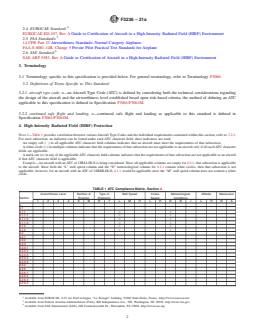
NOTE 1—Table 1 provides correlation between various Aircraft Type Codes and the individual requirements contained within this section; refer to 3.2.1.
For each subsection, an indicator can be found under each ATC character field; three indicators are used:
An empty cell ( ) in all applicable ATC character field columns indicates that an aircraft must meet the requirements of that subsection.
A white circle (○) in multiple columns indicates that the requirements of that subsection are not applicable to an aircraft only if all such ATC character
fields are applicable.
A mark-out (×) in any of the applicable ATC character field columns indicates that the requirements of that subsection are not applicable to an aircraft
if that ATC character field is applicable.
Example—An aircraft with an ATC of 1SRLLDLN is being considered. Since all applicable columns are empty for 4.2.1, that subsection is applicable
to the aircraft. Since both the “L” stall speed column and the “D” meteorological column for 4.1.1 contain white circles, then that subsection is not
applicable; however, for an aircraft with an ATC of 1SRMLDLN, 4.1.1 would be applicable since the “M” stall speed column does not contain a white
circle.
TABLE 1 ATC Compliance Matrix, Section 4
Airworthiness Level Number of Type of Stall Speed Cruise Meteorological Altitude Maneuvers
Section Engines Engine(s) Speed Conditions
1 2 3 4 S M R T L M H L H D N I L H N A
4.1
4.1.1 C C
4.1.1.1 C C
4.1.1.2 C C
4.1.1.3 C C
4.1.2 C C
4.1.3 C C
4.2
4.2.1
4.2.2
4.2.3
4.2.3.1
4.2.3.2
4.2.3.3
4.2.3.4
4.2.3.5
4.2.4
4.2.5
4.2.5.1
4.2.5.2
4.2.5.3
4.2.5.4
Available from EUROCAE, 9-23 rue Paul Lafargue, “Le Triangle” building, 93200 Saint-Denis, France, https://www.eurocae.net.
Available from Federal Aviation Administration (FAA), 800 Independence Ave., SW, Washington, DC 20591, http://www.faa.gov.
Available from SAE International (SAE), 400 Commonwealth Dr., Warrendale, PA 15096, http://www.sae.org.
F3236 − 21a
NOTE 2—Guidance in addition to the following sections may be found in either SAE ARP 5583 or EUROCAE ED-107.
4.1 Electrical and Electronic Systems HIRF Protection:
4.1.1 Each electrical and electronic system that performs a function whose failure would prevent the continued safe flight and
landing of the aircraft must be designed and installed so that it meets the requirements of 4.1.1.1 – 4.1.1.3.
4.1.1.1 In showing compliance with 4.1.1, the function must not be adversely affected during and after the time the aircraft is
exposed to HIRF Environment “I” as described in 4.2.1.
4.1.1.2 In showing compliance with 4.1.1, each electrical or electronic system must automatically recover normal operation of its
function, in a timely manner, after the aircraft is exposed to HIRF Environment “I” as described in 4.2.1, unless the system’s
recovery conflicts with other operational or functional requirements of the system.
4.1.1.3 In showing compliance with 4.1.1, each electrical or electronic system must not be adversely affected during and after the
time the aircraft is exposed to HIRF Environment “II” as described in 4.2.2.
4.1.2 Each electrical and electronic system that performs a function whose failure would significantly reduce the capability of the
aircraft or the ability of the flight crew to respond to an adverse operating condition must be designed and installed so the system
is not adversely affected when the equipment providing the function is exposed to Equipment HIRF Test Level 1 as described in
4.2.3 or Equipment HIRF Test Level 2 as described in 4.2.4.
4.1.3 Each When required by regulation, each electrical and electronic system that performs a function whose failure would reduce
the capability of the aircraft or the ability of the flight
...