

ASTM E666-21
(Practice)Standard Practice for Calculating Absorbed Dose From Gamma or X Radiation
General Information
- Abstract
SIGNIFICANCE AND USE
4.1 The absorbed dose is a more meaningful parameter than exposure for use in relating the effects of radiation on materials. It expresses the energy absorbed by the irradiated material per unit mass, whereas exposure is related to the amount of charge produced in air per unit mass. Absorbed dose, as referred to here, implies that the measurement is made under conditions of charged particle (electron) equilibrium (see Appendix X1). In practice, such conditions are not rigorously achievable but, under some circumstances, can be approximated closely.
4.2 Different materials, when exposed to the same radiation field, absorb different amounts of energy. Using the techniques of this standard, charged particle equilibrium must exist in order to relate the absorbed dose in one material to the absorbed dose in another. Also, if the radiation is attenuated by a significant thickness of an absorber, the energy spectrum of the radiation will be changed, and it will be necessary to correct for this.
Note 1: For comprehensive discussions of various dosimetry methods applicable to the radiation types and energies and absorbed dose rate ranges discussed in this method, see ICRU Reports 34 and 80.
SCOPE
1.1 This practice presents a technique for calculating the absorbed dose in a material from knowledge of the radiation field, the composition of the material, (1-5)2,3 and a related measurement. The procedure is applicable for X and gamma radiation provided the energy of the photons fall within the range from 0.01 to 20 MeV.
1.2 A method is given for calculating the absorbed dose in a material from the knowledge of the absorbed dose in another material exposed to the same radiation field. The procedure is restricted to homogeneous materials composed of the elements for which absorption coefficients have been tabulated. All 92 natural elements are tabulated in (2). It also requires some knowledge of the energy spectrum of the radiation field produced by the source under consideration. Generally, the accuracy of this method is limited by the accuracy to which the energy spectrum of the radiation field is known.
1.3 The results of this practice are only valid if charged particle equilibrium exists in the material and at the depth of interest. Thus, this practice is not applicable for determining absorbed dose in the immediate vicinity of boundaries between materials of widely differing atomic numbers. For more information on this topic, see Practice E1249.
1.4 Energy transport computer codes4 exist that are formulated to calculate absorbed dose in materials more precisely than this method. To use these codes, more effort, time, and expense are required. If the situation warrants, such calculations should be used rather than the method described here.
1.5 This standard does not purport to address all of the safety concerns, if any, associated with its use. It is the responsibility of the user of this standard to establish appropriate safety, health, and environmental practices and determine the applicability of regulatory limitations prior to use.
1.6 This international standard was developed in accordance with internationally recognized principles on standardization established in the Decision on Principles for the Development of International Standards, Guides and Recommendations issued by the World Trade Organization Technical Barriers to Trade (TBT) Committee.
- Status
- Published
- Publication Date
- 31-Jan-2021
- Technical Committee
- E10 - Nuclear Technology and Applications
Overview
ASTM E666-21: Standard Practice for Calculating Absorbed Dose from Gamma or X Radiation provides a validated methodology for determining the absorbed dose in materials exposed to photon radiation (gamma or X-rays). Absorbed dose is a key parameter for accurately assessing the effects of ionizing radiation on materials, as it represents the amount of energy absorbed per unit mass. This practice is applied in radiological physics, radiation dosimetry, and radiation effects testing for materials and devices. The standard applies when the energy of incident photons ranges from 0.01 to 20 MeV and is restricted to homogeneous materials where mass attenuation and absorption coefficients are tabulated for all elements.
Key Topics
Absorbed Dose vs. Exposure:
- Absorbed dose, measured in Gray (Gy), quantifies the energy deposited per unit mass and is more directly relevant to analyzing radiological effects on materials than exposure, which is based on ionization in air.
Charged Particle Equilibrium:
- Calculations assume charged particle (electron) equilibrium within the region of interest. The method is not valid near boundaries of materials with greatly differing atomic numbers.
Radiation Types and Materials:
- Applicable for both gamma and X-ray photon fields.
- Restricted to homogeneous materials (mixtures or compounds) composed of the 92 natural elements with tabulated coefficients.
- Requires knowledge of the energy spectrum of the photon field from the source.
Calculation Approach:
- Involves integrating the product of the energy fluence spectrum and the absorption coefficient over the relevant energy range.
- Provides methods for interpolating or combining data for composite materials.
Limitations and Accuracy:
- Method accuracy depends strongly on the accuracy of the known radiation energy spectrum.
- Not suitable for use at boundaries between dissimilar materials or when charged particle equilibrium cannot be established.
- More precise calculations may require specialized energy transport computer codes, which are outside the scope of this standard.
Applications
ASTM E666-21 is widely used in fields where quantifying absorbed radiation dose is essential for material safety, product qualification, or scientific research. Typical applications include:
Radiation Effects Testing:
- Used to estimate energy absorbed by electronics, polymers, structural materials, and biological samples during gamma or X-ray irradiation.
Dosimetry System Calibration:
- Facilitates conversion of readings from dosimeters (e.g., calibrated in air or silicon) to absorbed dose values in other relevant materials such as plastics, metals, or tissue substitutes.
Radiation Processing:
- Supports dose calculations in sterilization, food irradiation, and industrial processing, ensuring compliance with regulatory thresholds.
Nuclear and Medical Physics:
- Provides a framework for dose assessment in research, diagnostics, and radiological protection.
Shielding Evaluation:
- Aids in calculating dose attenuation through barriers and assessing absorbed dose behind shielding materials.
Related Standards
ASTM E666-21 references and complements several key documents and international standards, such as:
- ASTM E170: Terminology Relating to Radiation Measurements and Dosimetry
- ASTM E668: Practice for Application of Thermoluminescence Dosimetry (TLD) Systems
- ASTM E1249: Practice for Minimizing Dosimetry Errors in Radiation Hardness Testing of Silicon Electronic Devices
- ICRU Reports:
- Report 34: Dosimetry of Pulsed Radiation
- Report 80: Dosimetry Systems for Use in Radiation Processing
- Report 60: Fundamental Quantities and Units for Ionizing Radiation
These related standards provide foundational definitions, extended measurement methods, guidance on minimizing errors, and internationally recognized dosimetry practices.
Practical Value
By following ASTM E666-21, organizations can reliably calculate absorbed dose in any homogeneous material for known photon spectra, improve safety margins, and meet international dosimetric quality standards. The standard is indispensable for professionals engaged in radiation safety, quality assurance, material qualification, and regulatory compliance in nuclear, medical, defense, and industrial environments.
Keywords: absorbed dose calculation, radiation dosimetry, gamma radiation, X radiation, charged particle equilibrium, photon energy spectrum, ASTM E666-21, materials testing, radiation effects.
Relations
- Effective Date
- 01-Jul-2020
- Effective Date
- 01-Jun-2017
- Effective Date
- 01-Oct-2016
- Effective Date
- 15-Feb-2016
- Effective Date
- 01-Sep-2015
- Effective Date
- 15-Mar-2015
- Effective Date
- 15-Oct-2014
- Effective Date
- 01-Sep-2014
- Effective Date
- 01-Jan-2013
- Effective Date
- 01-Dec-2010
- Effective Date
- 01-Jun-2010
- Effective Date
- 01-Jun-2010
- Effective Date
- 15-Aug-2009
- Effective Date
- 15-Jun-2009
- Effective Date
- 01-Nov-2008
Get Certified
Connect with accredited certification bodies for this standard

BSMI (Bureau of Standards, Metrology and Inspection)
Taiwan's standards and inspection authority.
Sponsored listings
Frequently Asked Questions
ASTM E666-21 is a standard published by ASTM International. Its full title is "Standard Practice for Calculating Absorbed Dose From Gamma or X Radiation". This standard covers: SIGNIFICANCE AND USE 4.1 The absorbed dose is a more meaningful parameter than exposure for use in relating the effects of radiation on materials. It expresses the energy absorbed by the irradiated material per unit mass, whereas exposure is related to the amount of charge produced in air per unit mass. Absorbed dose, as referred to here, implies that the measurement is made under conditions of charged particle (electron) equilibrium (see Appendix X1). In practice, such conditions are not rigorously achievable but, under some circumstances, can be approximated closely. 4.2 Different materials, when exposed to the same radiation field, absorb different amounts of energy. Using the techniques of this standard, charged particle equilibrium must exist in order to relate the absorbed dose in one material to the absorbed dose in another. Also, if the radiation is attenuated by a significant thickness of an absorber, the energy spectrum of the radiation will be changed, and it will be necessary to correct for this. Note 1: For comprehensive discussions of various dosimetry methods applicable to the radiation types and energies and absorbed dose rate ranges discussed in this method, see ICRU Reports 34 and 80. SCOPE 1.1 This practice presents a technique for calculating the absorbed dose in a material from knowledge of the radiation field, the composition of the material, (1-5)2,3 and a related measurement. The procedure is applicable for X and gamma radiation provided the energy of the photons fall within the range from 0.01 to 20 MeV. 1.2 A method is given for calculating the absorbed dose in a material from the knowledge of the absorbed dose in another material exposed to the same radiation field. The procedure is restricted to homogeneous materials composed of the elements for which absorption coefficients have been tabulated. All 92 natural elements are tabulated in (2). It also requires some knowledge of the energy spectrum of the radiation field produced by the source under consideration. Generally, the accuracy of this method is limited by the accuracy to which the energy spectrum of the radiation field is known. 1.3 The results of this practice are only valid if charged particle equilibrium exists in the material and at the depth of interest. Thus, this practice is not applicable for determining absorbed dose in the immediate vicinity of boundaries between materials of widely differing atomic numbers. For more information on this topic, see Practice E1249. 1.4 Energy transport computer codes4 exist that are formulated to calculate absorbed dose in materials more precisely than this method. To use these codes, more effort, time, and expense are required. If the situation warrants, such calculations should be used rather than the method described here. 1.5 This standard does not purport to address all of the safety concerns, if any, associated with its use. It is the responsibility of the user of this standard to establish appropriate safety, health, and environmental practices and determine the applicability of regulatory limitations prior to use. 1.6 This international standard was developed in accordance with internationally recognized principles on standardization established in the Decision on Principles for the Development of International Standards, Guides and Recommendations issued by the World Trade Organization Technical Barriers to Trade (TBT) Committee.
SIGNIFICANCE AND USE 4.1 The absorbed dose is a more meaningful parameter than exposure for use in relating the effects of radiation on materials. It expresses the energy absorbed by the irradiated material per unit mass, whereas exposure is related to the amount of charge produced in air per unit mass. Absorbed dose, as referred to here, implies that the measurement is made under conditions of charged particle (electron) equilibrium (see Appendix X1). In practice, such conditions are not rigorously achievable but, under some circumstances, can be approximated closely. 4.2 Different materials, when exposed to the same radiation field, absorb different amounts of energy. Using the techniques of this standard, charged particle equilibrium must exist in order to relate the absorbed dose in one material to the absorbed dose in another. Also, if the radiation is attenuated by a significant thickness of an absorber, the energy spectrum of the radiation will be changed, and it will be necessary to correct for this. Note 1: For comprehensive discussions of various dosimetry methods applicable to the radiation types and energies and absorbed dose rate ranges discussed in this method, see ICRU Reports 34 and 80. SCOPE 1.1 This practice presents a technique for calculating the absorbed dose in a material from knowledge of the radiation field, the composition of the material, (1-5)2,3 and a related measurement. The procedure is applicable for X and gamma radiation provided the energy of the photons fall within the range from 0.01 to 20 MeV. 1.2 A method is given for calculating the absorbed dose in a material from the knowledge of the absorbed dose in another material exposed to the same radiation field. The procedure is restricted to homogeneous materials composed of the elements for which absorption coefficients have been tabulated. All 92 natural elements are tabulated in (2). It also requires some knowledge of the energy spectrum of the radiation field produced by the source under consideration. Generally, the accuracy of this method is limited by the accuracy to which the energy spectrum of the radiation field is known. 1.3 The results of this practice are only valid if charged particle equilibrium exists in the material and at the depth of interest. Thus, this practice is not applicable for determining absorbed dose in the immediate vicinity of boundaries between materials of widely differing atomic numbers. For more information on this topic, see Practice E1249. 1.4 Energy transport computer codes4 exist that are formulated to calculate absorbed dose in materials more precisely than this method. To use these codes, more effort, time, and expense are required. If the situation warrants, such calculations should be used rather than the method described here. 1.5 This standard does not purport to address all of the safety concerns, if any, associated with its use. It is the responsibility of the user of this standard to establish appropriate safety, health, and environmental practices and determine the applicability of regulatory limitations prior to use. 1.6 This international standard was developed in accordance with internationally recognized principles on standardization established in the Decision on Principles for the Development of International Standards, Guides and Recommendations issued by the World Trade Organization Technical Barriers to Trade (TBT) Committee.
ASTM E666-21 is classified under the following ICS (International Classification for Standards) categories: 17.240 - Radiation measurements. The ICS classification helps identify the subject area and facilitates finding related standards.
ASTM E666-21 has the following relationships with other standards: It is inter standard links to ASTM E668-20, ASTM E170-17, ASTM E170-16a, ASTM E170-16, ASTM E170-15a, ASTM E170-15, ASTM E170-14a, ASTM E170-14, ASTM E668-13, ASTM E1249-10, ASTM E668-10, ASTM E170-10, ASTM E170-09a, ASTM E170-09, ASTM E170-08d. Understanding these relationships helps ensure you are using the most current and applicable version of the standard.
ASTM E666-21 is available in PDF format for immediate download after purchase. The document can be added to your cart and obtained through the secure checkout process. Digital delivery ensures instant access to the complete standard document.
Standards Content (Sample)
This international standard was developed in accordance with internationally recognized principles on standardization established in the Decision on Principles for the
Development of International Standards, Guides and Recommendations issued by the World Trade Organization Technical Barriers to Trade (TBT) Committee.
Designation: E666 − 21
Standard Practice for
Calculating Absorbed Dose From Gamma or X Radiation
This standard is issued under the fixed designation E666; the number immediately following the designation indicates the year of
original adoption or, in the case of revision, the year of last revision.Anumber in parentheses indicates the year of last reapproval.A
superscript epsilon (´) indicates an editorial change since the last revision or reapproval.
This standard has been approved for use by agencies of the U.S. Department of Defense.
1. Scope than this method. To use these codes, more effort, time, and
expense are required. If the situation warrants, such calcula-
1.1 This practice presents a technique for calculating the
tions should be used rather than the method described here.
absorbed dose in a material from knowledge of the radiation
2,3
1.5 This standard does not purport to address all of the
field, the composition of the material, (1-5) and a related
safety concerns, if any, associated with its use. It is the
measurement. The procedure is applicable for X and gamma
responsibility of the user of this standard to establish appro-
radiation provided the energy of the photons fall within the
priate safety, health, and environmental practices and deter-
range from 0.01 to 20 MeV.
mine the applicability of regulatory limitations prior to use.
1.2 A method is given for calculating the absorbed dose in
1.6 This international standard was developed in accor-
a material from the knowledge of the absorbed dose in another
dance with internationally recognized principles on standard-
material exposed to the same radiation field. The procedure is
ization established in the Decision on Principles for the
restrictedtohomogeneousmaterialscomposedoftheelements
Development of International Standards, Guides and Recom-
for which absorption coefficients have been tabulated. All 92
mendations issued by the World Trade Organization Technical
natural elements are tabulated in (2). It also requires some
Barriers to Trade (TBT) Committee.
knowledge of the energy spectrum of the radiation field
produced by the source under consideration. Generally, the
2. Referenced Documents
accuracyofthismethodislimitedbytheaccuracytowhichthe
2.1 ASTM Standards:
energy spectrum of the radiation field is known.
E170Terminology Relating to Radiation Measurements and
1.3 The results of this practice are only valid if charged
Dosimetry
particle equilibrium exists in the material and at the depth of
E668Practice for Application of Thermoluminescence-
interest. Thus, this practice is not applicable for determining
Dosimetry (TLD) Systems for Determining Absorbed
absorbeddoseintheimmediatevicinityofboundariesbetween
DoseinRadiation-HardnessTestingofElectronicDevices
materials of widely differing atomic numbers. For more infor-
E1249Practice for Minimizing Dosimetry Errors in Radia-
mation on this topic, see Practice E1249.
tionHardnessTestingofSiliconElectronicDevicesUsing
1.4 Energy transport computer codes exist that are formu- Co-60 Sources
lated to calculate absorbed dose in materials more precisely
2.2 International Commission on Radiation Units and Mea-
surements (ICRU) Reports:
ICRUReport18SpecificationofHighActivityGamma-Ray
This practice is under the jurisdiction of ASTM Committee E10 on Nuclear
Sources
Technology and Applications and is the direct responsibility of Subcommittee
ICRUReport21RadiationDosimetry:ElectronswithInitial
E10.07 on Radiation Dosimetry for Radiation Effects on Materials and Devices.
Current edition approved Feb. 1, 2021. Published March 2021. Originally
Energies Between 1 and 50 MeV
approved in 1978. Last previous edition approved in 2014 as E666-14. DOI:
ICRU Report 34The Dosimetry of Pulsed Radiation
10.1520/E0666-21.
ICRUReport51RadiationQuantitiesandUnitsinRadiation
The boldface numbers in parentheses refer to the list of references appended to
this practice.
Protection Dosimetry
See also ICRU Report 80. For calculation of absorbed dose in dosimetry
ICRU Report 60Radiation Fundamental Quantities and
systemsandmaterialsusedinradiationprocessing,massattenuationcoefficientsand
Units for Ionizing Radiation
mass-energy absorption coefficients for key elements, compounds and materials
used in radiation processing dosimetry over the photon range from 100 keV to 20
MeV are given in Appendix 1 of that report.
4 5
Information on and packages of computer codes can be obtained from The For referenced ASTM standards, visit the ASTM website, www.astm.org, or
Radiation Safety Information Computational Center, Oak Ridge National contact ASTM Customer Service at service@astm.org. For Annual Book of ASTM
Laboratory, P.O. Box 2008, Oak Ridge, TN 37831-6362. This information center Standards volume information, refer to the standard’s Document Summary page on
collects, organizes, evaluates, and disseminates shielding information related to the ASTM website.
radiation from reactors, weapons, and accelerators and to radiation occurring in Available from International Commission on Radiation Units and Measure-
space. ments (ICRU), 7910 Woodmont Ave., Suite 400, Bethesda, MD 20841.
Copyright © ASTM International, 100 Barr Harbor Drive, PO Box C700, West Conshohocken, PA 19428-2959. United States
E666 − 21
ICRU Report 80Dosimetry Systems for Use in Radiation of energy over which ψ(E) is of a significant magnitude. If
Processing material intervenes between the source and the point of dose
ICRU Report 90Key Data for Ionizing-Radiation Dosim- determination, then the spectrum used in the calculation must
etry: Measurement Standards and Applications betheoutputspectrumofthesourcemodifiedbytheabsorbing
effects of the intervening material. The values of µ (E)/ρ are
en
3. Terminology
found in the tables of Ref 2.
3.1 energy fluence spectrum, ψ(E)—the product of the
NOTE 2—For units and terminology in reports of data, E170 and ICRU
particle fluence spectrum (see Terminology E170) and the
Reports 51 and 60 may be used as guides.
particle energy. In this standard, the particles referred to are
5.2 If the material in which the absorbed dose is to be
photons. The energy fluences spectrum is the same as the
calculated is a homogeneous combination of materials not
energy fluence per unit energy.
listed in the tables of Ref 2,µ (E)/ρ is determined as follows:
en
3.2 energy fluence, ψ—the integral of the energy fluence
i
5.2.1 From Ref 2, obtain values of µ ~E!/ρ for each
en
spectrum over the complete range of particle energies that are
component, i.
present.
5.2.2 Determine the mass fraction, w, for each component.
i
3.3 mass-depth and mass-thickness, t—the product of a
5.2.3 Calculate µ (E)/ρ from the following equation:
en
length traversed in a material and the mass density of the
material. The mass-depth and the mass-thickness have dimen-
i
µ E /ρ 5 w µ E /ρ (2)
~ ! @ ~ ! #
en ( i en
sions of mass per unit area.
i
5.2.4 Values of µ (E)/ρ must be determined for each value
4. Significance and Use en
of E for which ψ(E) is significant, where E is the photon
4.1 Theabsorbeddoseisamoremeaningfulparameterthan
energy.
exposure for use in relating the effects of radiation on materi-
5.3 The integral contained in Eq 1 is evaluated numerically.
als. It expresses the energy absorbed by the irradiated material
The values of µ (E)/ρ in Ref 2 are tabulated for specific
per unit mass, whereas exposure is related to the amount of
en
energies. In evaluation of the integral referred to in actual
charge produced in air per unit mass. Absorbed dose, as
practice, it is often desirable to choose energy intervals that
referred to here, implies that the measurement is made under
would not correspond to the tabulated values in Ref 2. In such
conditions of charged particle (electron) equilibrium (see
cases,theappropriatevalueofµ (E)/ρforthechosenenergies
Appendix X1). In practice, such conditions are not rigorously
en
shouldbedeterminedbyanacceptableinterpolationprocedure.
achievable but, under some circumstances, can be approxi-
The range of energy over the total photon spectrum is divided
mated closely.
into energy intervals or bins. The width of these bins is
4.2 Different materials, when exposed to the same radiation
somewhatflexiblebutshouldbechosensmallenoughsoasnot
field, absorb different amounts of energy. Using the techniques
to distort the shape of the spectrum. For the purpose of
of this standard, charged particle equilibrium must exist in
selecting appropriate values of µ (E)/ρ, the energy value
en
order to relate the absorbed dose in one material to the
selected for each energy interval can be taken either as that
absorbeddoseinanother.Also,iftheradiationisattenuatedby
energy at the beginning or midpoint of each energy interval
a significant thickness of an absorber, the energy spectrum of
over the entire spectrum.
the radiation will be changed, and it will be necessary to
correct for this. 5.4 The energy fluence spectrum, ψ(E), is commonly given
in arbitrary units and may be normalized to some source
NOTE1—Forcomprehensivediscussionsofvariousdosimetrymethods
parameter. If a standard or calibrated dosimeter is used, then
applicable to the radiation types and energies and absorbed dose rate
the integral in Eq 1 must be calculated for the material from
ranges discussed in this method, see ICRU Reports 34 and 80.
which this dosimeter is constructed. The value of I is then
5. Calculation of Absorbed Dose
given by the observed dose, D, measured by the dosimeter,
divided by the value of the integral.
5.1 The absorbed dose, D, at a point may be expressed as:
`
D 5 I ψ E @µ E /ρ#dE (1)
* ~ ! ~ !
en 6. Estimating the Absorbed Dose in One Material from
That Measured in Another Material
whereψ(E)istheenergyfluenceperunitenergyatthepoint
6.1 If the absorbed dose is known in one material, A, then
of interest; µ (E)/ρ is the mass energy absorption coefficient
en
the absorbed dose can be estimated in another material, B,
(2); and I is a normalizing factor. If all of the variables in Eq
using the method described in this section.
1 are expressed in SI units,I=1.In this case the units for D
–1 –2 2 –1
are Gy (J kg· ), ofψ(E), are m ,ofµ /ρ are m ·kg , and of 6.1.1 TheabsorbeddoseobservedinAoccursatsomedepth
en
E are J. For an alternative use of the normalizing factor I, see in the region of materialA; similarly, it is desired to know the
Appendix X2. For further information on the use of energy absorbed dose in material B at some depth in the region of
absorption coefficients to calculate absorbed dose see the material B. If it is presumed that we know the surface energy
discussion in Attix (1). The energy fluence spectrum, ψ(E), is fluence spectrum ψ (E) (the energy fluence spectrum incident
o
that which is incident at the point where the dose is to be on the surface of materials A and B) then the energy fluence
determined. In practice, the limits of integration are the limits spectrumψ(E)tobeusedinEq1mustberelatedtotheknown
E666 − 21
surface energy fluence spectrum ψ (E).Agood approximation 6.1.4.2 It is possible to determine the magnitude of the
o
to the attenuated energy fluence spectrum at mass-depth t is change which would have resulted had Eq 1 and Eq 5 been
given by used rather than using Eq 1 and Eq 3 in order to develop Eq 4.
The resulting change in the ratio D /D calculated by Eq 4 is
A B
ψ E 5 ψ E exp 2 µ E /ρ t (3)
~ ! ~ ! ~ @ ~ ! # !
t o en
related to the factor
−2
where t is the mass-depth (in kg·m ) of material between
B A
exp 2 µ E /ρ t exp 2 µ E /ρ t
~ @ ~ ! # ! ~ @ ~ ! # !
en B A
F E 5 (6)
the surface and the depth of interest, E is a particular energy ~ !
B A
exp 2 µ E /ρ t exp 2 µ E /ρ t
~ @ ~ ! # ! ~ @ ~ ! # !
B en A
representedinthespectrum,andψ(E)istheenergyfluenceper
t
If, over the energy range of interest, F(E) differs from unity
unit energy at mass-depth t. For a derivation of Eq 3 see
byapercentagewhichisgreaterthantheacceptabledosimetry
AppendixX4.Seealsothequalificationsof6.1.3and6.1.4.For
error, then the application of this practice may be inappropri-
a demonstration of the experimental plausibility of Eq 3, see
ate. In that case an appropriate transport calculation is recom-
Appendix X5.
mended (see 1.4).
6.1.2 UsingEq1and3,therelationshipbetweentheknown
6.1.4.3 Depending on the scattering geometry, it is possible
dose D and the desired dose D can be expressed as
A B
fortheabsorbeddosetobedifferentfromthatcalculatedusing
`
A A
either µ or µ . The use of µ in Eq 3 is an expedient device
@ψ ~E!exp~2@µ ~E!/ρ #t !#@µ ~E!/ρ #dE
*
o en A A en A en en
D
A
5 (4)
that is used as a means for yielding what is usually a
`
D B B
B
ψ E exp 2 µ E /ρ t µ E /ρ dE
* @ ~ ! ~ @ ~ ! # !#@ ~ ! #
o en B B en B
conservative value, so that exact calculation of the scattering
component can be circumvented. For an extensive discussion
A
where µ , ρ ,andt aretheenergyabsorptioncoefficient,the
en A A
of this and similar effects, see Ref 1.
density and the relevant mass-depth for materialA, and where
similar notation is used for material B. For further details on
7. Accuracy
the derivation of Eq 4, see Appendix X6. All the variables in
7.1 The accuracy of this practice depends primarily on the
Eq 4 are presumed to be known except the desired value for
accuracy to which the incident energy spectrum is known. In
D . The integrals in Eq 4 must be performed numerically.
B
general, even a poor estimate of a spectrum will give a better
estimate of the absorbed dose at a given location than one
6.1.3 The use of Eq 3 is based on the existence of charged
would get by assuming some sort of single“ effective photon
particle equilibrium (for further discussion see 1.3). This
60 137
energy.” Although Co and Cs have well-defined primary
condition may be reasonably well met when the region of
gamma-ray energies, the radiation energy spectrum from most
interest is at a sufficient distance from boundaries representing
practical sources contains a significant Compton scattered
changes in atomic number or material density (see Appendix
componentthatcouldleadtosignificanterrorsifneglected(see
X1).
ICRU Report 18).
6.1.4 Wide Beam versus Narrow Beam Approximation:
7.2 As stated in 1.3, the results of this practice are not valid
6.1.4.1 The use of the energy coefficient, µ ,in Eq 3 is
en
unless charged particle equilibrium conditions exist in the
based on the assumption that the irradiation approaches the
material at the depth of application. For depths less than that
“wide beam” as opposed to “narrow beam” condition. The
required for equilibrium, the absorbed dose could be higher or
wide beam and narrow beam conditions represent limiting
lower than this method would predict. At depths greater than
cases which are only approximately realized for real experi-
required for equilibrium, the accuracy of the results depends
ments. In the narrow beam case, photons which are scattered
primarily upon the accuracy of the attenuation correction
out of the narrow beam are assumed to be lost from the beam,
applied in Eq 3 and the knowledge of the incident energy
and are assumed to have no further importance to the experi-
spectrum.
ment. In the broad beam case, photons which are scattered out
of a given small region of the broad beam are presumed to be
7.3 The procedures used in this method neglect the possible
replaced by photons scattering in from adjacent regions of the
nonlocalityofenergydepositionbysecondaryelectronsbutdo
beam. For the narrow beam limiting case, Eq 3 should be
correct for production of bremsstrahlung by secondary elec-
replaced by
trons. For the energy range specified in this practice, these
considerations contribute about 5% or less to the overall
ψ ~E! 5 ψ ~E!exp~2@µ~E!/ρ#t! (5)
t o
uncertainty.
where µ is the photon attenuation coefficient. Values of
8. Keywords
µ(E)/ρ are found in the tables of Ref 2. For most practical
problems the results of photon attenuation lie between the
8.1 calculation of absorbed dose; charged particle equilib-
results of Eq 3 and Eq 5. rium; radiation dosimetry
E666 − 21
APPENDIXES
(Nonmandatory Information)
X1. CHARGED PARTICLE EQUILIBRIUM DEPTH
X1.1 Whenever a material is irradiated with X or gamma function of depth in a material. The absorbed dose of 0.85 is
rays, there is initially an increase in energy absorption as the used for illustration purposes only. Each source and absorbing
radiation penetrates the material. After some finite depth, the material combination will have its own characteristic curve.
radiation energy absorption reaches a maximum and then Whenever a specimen is irradiated from all sides, it is
decreases. The depth necessary to reach the maximum energy
...
This document is not an ASTM standard and is intended only to provide the user of an ASTM standard an indication of what changes have been made to the previous version. Because
it may not be technically possible to adequately depict all changes accurately, ASTM recommends that users consult prior editions as appropriate. In all cases only the current version
of the standard as published by ASTM is to be considered the official document.
Designation: E666 − 14 E666 − 21
Standard Practice for
Calculating Absorbed Dose From Gamma or X Radiation
This standard is issued under the fixed designation E666; the number immediately following the designation indicates the year of
original adoption or, in the case of revision, the year of last revision. A number in parentheses indicates the year of last reapproval. A
superscript epsilon (´) indicates an editorial change since the last revision or reapproval.
This standard has been approved for use by agencies of the U.S. Department of Defense.
1. Scope
1.1 This practice presents a technique for calculating the absorbed dose in a material from knowledge of the radiation field, the
2,3
composition of the material, (1-5) and a related measurement. The procedure is applicable for X and gamma radiation provided
the energy of the photons fall within the range from 0.01 to 20 MeV.
1.2 A method is given for calculating the absorbed dose in a material from the knowledge of the absorbed dose in another material
exposed to the same radiation field. The procedure is restricted to homogeneous materials composed of the elements for which
absorption coefficients have been tabulated. All 92 natural elements are tabulated in (2). It also requires some knowledge of the
energy spectrum of the radiation field produced by the source under consideration. Generally, the accuracy of this method is limited
by the accuracy to which the energy spectrum of the radiation field is known.
1.3 The results of this practice are only valid if charged particle equilibrium exists in the material and at the depth of interest. Thus,
this practice is not applicable for determining absorbed dose in the immediate vicinity of boundaries between materials of widely
differing atomic numbers. For more information on this topic, see Practice E1249.
1.4 Energy transport computer codes exist that are formulated to calculate absorbed dose in materials more precisely than this
method. To use these codes, more effort, time, and expense are required. If the situation warrants, such calculations should be used
rather than the method described here.
1.5 This standard does not purport to address all of the safety concerns, if any, associated with its use. It is the responsibility
of the user of this standard to establish appropriate safety safety, health, and healthenvironmental practices and determine the
applicability of regulatory limitations prior to use.
1.6 This international standard was developed in accordance with internationally recognized principles on standardization
established in the Decision on Principles for the Development of International Standards, Guides and Recommendations issued
by the World Trade Organization Technical Barriers to Trade (TBT) Committee.
This practice is under the jurisdiction of ASTM Committee E10 on Nuclear Technology and Applications and is the direct responsibility of Subcommittee E10.07 on
Radiation Dosimetry for Radiation Effects on Materials and Devices.
Current edition approved Jan. 1, 2014Feb. 1, 2021. Published February 2014March 2021. Originally approved in 1978. Last previous edition approved in 20092014 as
E666-09.-14. DOI: 10.1520/E0666-14.10.1520/E0666-21.
The boldface numbers in parentheses refer to the list of references appended to this practice.
See also ICRU Report 80. For calculation of absorbed dose in dosimetry systems and materials used in radiation processing, mass attenuation coefficients and mass-energy
absorption coefficients for key elements, compounds and materials used in radiation processing dosimetry over the photon range from 100 keV to 20 MeV are given in
Appendix 1 of that report.
Information on and packages of computer codes can be obtained from The Radiation Safety Information Computational Center, Oak Ridge National Laboratory, P.O.
Box 2008, Oak Ridge, TN 37831-6362. This information center collects, organizes, evaluates, and disseminates shielding information related to radiation from reactors,
weapons, and accelerators and to radiation occurring in space.
Copyright © ASTM International, 100 Barr Harbor Drive, PO Box C700, West Conshohocken, PA 19428-2959. United States
E666 − 21
2. Referenced Documents
2.1 ASTM Standards:
E170 Terminology Relating to Radiation Measurements and Dosimetry
E668 Practice for Application of Thermoluminescence-Dosimetry (TLD) Systems for Determining Absorbed Dose in
Radiation-Hardness Testing of Electronic Devices
E1249 Practice for Minimizing Dosimetry Errors in Radiation Hardness Testing of Silicon Electronic Devices Using Co-60
Sources
2.2 International Commission on Radiation Units and Measurements (ICRU) Reports:
ICRU Report 18 Specification of High Activity Gamma-Ray Sources
ICRU Report 21 Radiation Dosimetry: Electrons with Initial Energies Between 1 and 50 MeV
ICRU Report 34 The Dosimetry of Pulsed Radiation
ICRU Report 51 Radiation Quantities and Units in Radiation Protection Dosimetry
ICRU Report 60 Radiation Fundamental Quantities and Units for Ionizing Radiation
ICRU Report 34 The Dosimetry of Pulsed Radiation
ICRU Report 80 Dosimetry Systems for Use in Radiation Processing
ICRU Report 90 Key Data for Ionizing-Radiation Dosimetry: Measurement Standards and Applications
3. Terminology
3.1 energy fluence spectrum, ψ(E)—the product of the particle fluence spectrum (see Terminology E170) and the particle energy.
In this standard, the particles referred to are photons. The energy fluences spectrum is the same as the energy fluence per unit
energy.
3.2 energy fluence, ψ—the integral of the energy fluence spectrum over the complete range of particle energies that are present.
3.3 mass-depth and mass-thickness, t—the product of a length traversed in a material and the mass density of the material. The
mass-depth and the mass-thickness have dimensions of mass per unit area.
4. Significance and Use
4.1 The absorbed dose is a more meaningful parameter than exposure for use in relating the effects of radiation on materials. It
expresses the energy absorbed by the irradiated material per unit mass, whereas exposure is related to the amount of charge
produced in air per unit mass. Absorbed dose, as referred to here, implies that the measurement is made under conditions of charged
particle (electron) equilibrium (see Appendix X1). In practice, such conditions are not rigorously achievable but, under some
circumstances, can be approximated closely.
4.2 Different materials, when exposed to the same radiation field, absorb different amounts of energy. Using the techniques of this
standard, charged particle equilibrium must exist in order to relate the absorbed dose in one material to the absorbed dose in
another. Also, if the radiation is attenuated by a significant thickness of an absorber, the energy spectrum of the radiation will be
changed, and it will be necessary to correct for this.
NOTE 1—For comprehensive discussions of various dosimetry methods applicable to the radiation types and energies and absorbed dose rate ranges
discussed in this method, see ICRU Reports 34 and 80.
5. Calculation of Absorbed Dose
5.1 The absorbed dose, D, at a point may be expressed as:
`
D 5 I ψ~E!@µ ~E!/ρ#dE (1)
*
en
where ψ(E) is the energy fluence per unit energy at the point of interest; μ (E)/ρ is the mass energy absorption coefficient (2);
en
and I is a normalizing factor. If all of the variables in Eq 1 are expressed in SI units, I = 1. In this case the units for D are Gy (J
–1 –2 2 –1
kg· ), of ψ(E), are m , of μ /ρ are m ·kg , and of E are J. For an alternative use of the normalizing factor I, see Appendix X2.
en
For referenced ASTM standards, visit the ASTM website, www.astm.org, or contact ASTM Customer Service at service@astm.org. For Annual Book of ASTM Standards
volume information, refer to the standard’s Document Summary page on the ASTM website.
Available from International Commission on Radiation Units and Measurements (ICRU), 7910 Woodmont Ave., Suite 400, Bethesda, MD 20841.
E666 − 21
For further information on the use of energy absorption coefficients to calculate absorbed dose see the discussion in Attix (1). The
energy fluence spectrum, ψ(E), is that which is incident at the point where the dose is to be determined. In practice, the limits of
integration are the limits of energy over which ψ(E) is of a significant magnitude. If material intervenes between the source and
the point of dose determination, then the spectrum used in the calculation must be the output spectrum of the source modified by
the absorbing effects of the intervening material. The values of μ (E)/ρ are found in the tables of Ref 2.
en
NOTE 2—For units and terminology in reports of data, E170 and ICRU Reports 51 and 60 may be used as guides.
5.2 If the material in which the absorbed dose is to be calculated is a homogeneous combination of materials not listed in the tables
of Ref 2, μ (E)/ρ is determined as follows:
en
i
5.2.1 From Ref 2, obtain values of μ E /ρ for each component, i.
~ !
en
5.2.2 Determine the mass fraction, w , for each component.
i
5.2.3 Calculate μ (E)/ρ from the following equation:
en
i
µ E /ρ5 w @μ E /ρ# (2)
~ ! ~ !
en ( i en
i
5.2.4 Values of μ (E)/ρ must be determined for each value of E for which ψ(E) is significant, where E is the photon energy.
en
5.3 The integral contained in Eq 1 is evaluated numerically. The values of μ (E)/ρ in Ref 2 are tabulated for specific energies.
en
In evaluation of the integral referred to in actual practice, it is often desirable to choose energy intervals that would not correspond
to the tabulated values in Ref 2. In such cases, the appropriate value of μ (E)/ρ for the chosen energies should be determined by
en
an acceptable interpolation procedure. The range of energy over the total photon spectrum is divided into energy intervals or bins.
The width of these bins is somewhat flexible but should be chosen small enough so as not to distort the shape of the spectrum.
For the purpose of selecting appropriate values of μ (E)/ρ, the energy value selected for each energy interval can be taken either
en
as that energy at the beginning or midpoint of each energy interval over the entire spectrum.
5.4 The energy fluence spectrum, ψ(E), is commonly given in arbitrary units and may be normalized to some source parameter.
If a standard or calibrated dosimeter is used, then the integral in Eq 1 must be calculated for the material from which this dosimeter
is constructed. The value of I is then given by the observed dose, D, measured by the dosimeter, divided by the value of the integral.
6. Estimating the Absorbed Dose in One Material from That Measured in Another Material
6.1 If the absorbed dose is known in one material, A, then the absorbed dose can be estimated in another material, B, using the
method described in this section.
6.1.1 The absorbed dose observed in A occurs at some depth in the region of material A; similarly, it is desired to know the
absorbed dose in material B at some depth in the region of material B. If it is presumed that we know the surface energy fluence
spectrum ψ (E) (the energy fluence spectrum incident on the surface of materials A and B) then the energy fluence spectrum ψ(E)
o
to be used in Eq 1 must be related to the known surface energy fluence spectrum ψ (E). A good approximation to the attenuated
o
energy fluence spectrum at mass-depth t is given by
ψ ~E! 5 ψ ~E!exp~2@μ ~E!/ρ#t! (3)
t o en
−2
where t is the mass-depth (in kg·m ) of material between the surface and the depth of interest, E is a particular energy
represented in the spectrum, and ψ (E) is the energy fluence per unit energy at mass-depth t. For a derivation of Eq 3 see Appendix
t
X4. See also the qualifications of 6.1.3 and 6.1.4. For a demonstration of the experimental plausibility of Eq 3, see Appendix X5.
6.1.2 Using Eq 1 and 3, the relationship between the known dose D and the desired dose D can be expressed as
A B
`
A A
@ψ ~E!exp~2@μ ~E!/ρ #t !#@μ ~E!/ρ #dE
*
o en A A en A
D
A
5 (4)
`
D B B
B
ψ E exp 2 μ E /ρ t μ E /ρ dE
* @ ~ ! ~ @ ~ ! # !#@ ~ ! #
o en B B en B
A
where μ , ρ , and t are the energy absorption coefficient, the density and the relevant mass-depth for material A, and where
en A A
similar notation is used for material B. For further details on the derivation of Eq 4, see Appendix X6. All the variables in Eq 4
E666 − 21
are presumed to be known except the desired value for D . The integrals in Eq 4 must be performed numerically.
B
6.1.3 The use of Eq 3 is based on the existence of charged particle equilibrium (for further discussion see 1.3). This condition may
be reasonably well met when the region of interest is at a sufficient distance from boundaries representing changes in atomic
number or material density (see Appendix X1).
6.1.4 Wide Beam vs. Narrow Beam Approximation.Wide Beam versus Narrow Beam Approximation:
6.1.4.1 The use of the energy coefficient, μ , in Eq 3 is based on the assumption that the irradiation approaches the “wide beam”
en
as opposed to “narrow beam” condition. The wide beam and narrow beam conditions represent limiting cases which are only
approximately realized for real experiments. In the narrow beam case, photons which are scattered out of the narrow beam are
assumed to be lost from the beam, and are assumed to have no further importance to the experiment. In the broad beam case,
photons which are scattered out of a given small region of the broad beam are presumed to be replaced by photons scattering in
from adjacent regions of the beam. For the narrow beam limiting case, Eq 3 should be replaced by
ψ ~E! 5 ψ ~E!exp~2@μ~E!/ρ#t! (5)
t o
where μ is the photon attenuation coefficient. Values of μ(E)/ρ are found in the tables of Ref 2. For most practical problems the
results of photon attenuation lie between the results of Eq 3 and Eq 5.
6.1.4.2 It is possible to determine the magnitude of the change which would have resulted had Eq 1 and Eq 5 been used rather
than using Eq 1 and Eq 3 in order to develop Eq 4. The resulting change in the ratio D /D calculated by Eq 4 is related to the
A B
factor
B A
exp 2 μ E /ρ t exp 2 μ E /ρ t
~ @ ~ ! # ! ~ @ ~ ! # !
en B A
F E 5 (6)
~ !
B A
exp 2@μ E /ρ #t exp 2@μ E /ρ #t
~ ~ ! ! ~ ~ ! !
B en A
If, over the energy range of interest, F(E) differs from unity by a percentage which is greater than the acceptable dosimetry error,
then the application of this practice may be inappropriate. In that case an appropriate transport calculation is recommended (see
1.51.4).
6.1.4.3 Depending on the scattering geometry, it is possible for the absorbed dose to be different from that calculated using either
μ or μ . The use of μ in Eq 3 is an expedient device that is used as a means for yielding what is usually a conservative value,
en en
so that exact calculation of the scattering component can be circumvented. For an extensive discussion of this and similar effects,
see Ref 1.
7. Accuracy
7.1 The accuracy of this practice depends primarily on the accuracy to which the incident energy spectrum is known. In general,
even a poor estimate of a spectrum will give a better estimate of the absorbed dose at a given location than one would get by
60 137
assuming some sort of single“ effective photon energy.” Although Co and Cs have well-defined primary gamma-ray energies,
the radiation energy spectrum from most practical sources contains a significant Compton scattered component that could lead to
significant errors if neglected (see ICRU Report 18).
7.2 As stated in 1.3, the results of this practice are not valid unless charged particle equilibrium conditions exist in the material
at the depth of application. For depths less than that required for equilibrium, the absorbed dose could be higher or lower than this
method would predict. At depths greater than required for equilibrium, the accuracy of the results depends primarily upon the
accuracy of the attenuation correction applied in Eq 3 and the knowledge of the incident energy spectrum.
7.3 The procedures used in this method neglect the possible nonlocality of energy deposition by secondary electrons but do correct
for production of bremsstrahlung by secondary electrons. For the energy range specified in this practice, these considerations
contribute about 5 % or less to the overall uncertainty.
8. Keywords
8.1 calculation of absorbed dose; charged particle equilibrium; radiation dosimetry
E666 − 21
APPENDIXES
(Nonmandatory Information)
X1. CHARGED PARTICLE EQUILIBRIUM DEPTH
X1.1 Whenever a material is irradiated with X or gamma rays, there is initially an increase in energy absorption as the radiation
penetrates the material. After some finite depth, the radiation energy absorption reaches a maximum and then decreases. The depth
necessary to reach the maximum energy deposition is commonly called the “charged particle equilibrium” depth and is a function
of the radiation energy and the mass energy absorption coefficient of the material being irradiated.
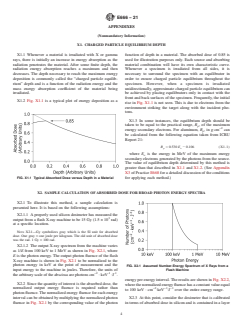
X1.2 Fig. X1.1 is a typical plot of energy deposition as a function of depth in a material. The absorbed dose of 0.85 is used for
illustration purposes only. Each source and absorbing material combination will have its own characteristic curve. Whenever a
specimen is irradiated from all sides, it is necessary to surround the specimen with an equilibrator in order to ensure charged
particle equilibrium throughout the specimen. However, when a specimen is irradiated unidirectionally, approximate charged
particle equilibrium can be achieved by placing equilibrators only in contact with the front and back surfaces of the specimen.
Frequently, the initial rise in Fig. X1.1 is not seen. This is due to electrons from the environment striking the target along with the
incident photons.
X1.3 In some instances, the equilibrium depth should be taken to be equal to the practical range, R , of the maximum energy
p
−2
secondary electrons. For aluminum, R , in g·cm can be calculated from the following equation taken from ICRU Report 21:
p
R 5 0.530 E 2 0.106 (X1.1)
p o
where E is the energy in MeV of the maximum energy secondary electrons generated by the photons from the source. The value
o
of equilibrium depth determined by this method is greater than that described in X1.1 and X1.2. (See Appendix X3 of Practice
E668 for a detailed discussio
...