

ASTM A905-19
(Specification)Standard Specification for Steel Wire, Pressure Vessel Winding
General Information
- Abstract
ABSTRACT
This specification covers high strength, cold drawn or cold rolled steel wire with rectangular cross-section and round mill edge. The wire is intended for use in pre-stressed vessel and press frame windings. The steel shall be manufactured by basic oxygen, electric furnace, or vacuum induction processes and produced as ingot cast or continuous cast. Materials shall be tested for contents of carbon, manganese, phosphorus, sulphur, and silicon. A tension tests shall also be performed to evaluate mechanical properties conformance. Guidelines for workmanship, finish, and appearance are stated, as well as the inspection, certification of reports, packaging, marking, and loading for shipment.
SCOPE
1.1 This specification covers requirements for a high strength drawn and cold rolled steel wire in two strength classes, with rectangular cross section, and round mill edge. This wire is intended for prestressed vessel and press frame windings.
1.2 The values stated in either inch-pound units or SI (metric) units are to be regarded separately as standards. Within the text and tables, the SI units are shown in parentheses. The values stated in each system are not exact equivalents. Therefore, each system must be used independent of the other. Combining values from the two systems may result in nonconformance with the specification.
1.3 This international standard was developed in accordance with internationally recognized principles on standardization established in the Decision on Principles for the Development of International Standards, Guides and Recommendations issued by the World Trade Organization Technical Barriers to Trade (TBT) Committee.
- Status
- Published
- Publication Date
- 31-Aug-2019
- Technical Committee
- A01 - Steel, Stainless Steel and Related Alloys
- Drafting Committee
- A01.03 - Steel Rod and Wire


Overview
ASTM A905-19: Standard Specification for Steel Wire, Pressure Vessel Winding establishes the requirements for high-strength, cold drawn or cold rolled steel wire with rectangular cross-section and round mill edge. Developed by ASTM International, this standard is intended for steel wire used in pre-stressed vessel and press frame windings. ASTM A905-19 ensures material consistency, mechanical strength, and safe application in critical industrial pressure vessel and structural settings.
This specification defines two strength classes, outlines permissible tolerances, prescribes the manufacturing process, and sets forth standards for chemical composition, mechanical properties, and surface finish. By adhering to ASTM A905-19, manufacturers and purchasers ensure product reliability and compliance with internationally recognized quality benchmarks.
Key Topics
- Material Requirements: Describes the use of high-strength steel wire produced via basic oxygen, electric furnace, or vacuum induction processes, with options for ingot or continuous casting.
- Mechanical Properties: Specifies minimum tensile and yield strength, including elongation requirements for two strength classes based on wire thickness.
- Chemical Composition: Details allowable limits for elements like carbon, manganese, phosphorus, sulphur, and silicon, supporting optimal steel performance and durability.
- Dimensional Tolerances: Outlines permissible variations in thickness and width critical for engineering applications that demand precision.
- Workmanship and Surface Quality: Emphasizes smooth, rust-free surfaces free from detrimental imperfections, tangles, or kinks, ensuring structural integrity.
- Testing and Certification: Includes mandatory tension tests for each coil, heat analysis, product analysis, and requires thorough inspection and certification reports.
- Packaging and Marking: Establishes requirements for secure packaging, clear labeling with order details, and shipment preparation in accordance with industry standards.
Applications
Steel wire produced under ASTM A905-19 is vital in industries that require exceptional mechanical strength and reliability, particularly in:
- Pressure Vessel Manufacturing: Used for pre-stressed winding of pressure vessels in chemical, petrochemical, or energy sectors, ensuring leak-tight, high-strength shells.
- Press Frame Construction: Provides reinforcement in large-scale hydraulic or mechanical press frames, boosting their load-bearing capacity and longevity.
- Infrastructure Components: Utilized where high-strength steel wire windings are crucial for maintaining structural stability under extreme forces.
- Specialty Industrial Equipment: Preferred in the fabrication of equipment exposed to high internal pressures, requiring robust containment solutions.
This standard enables confidence in sourcing and specifying steel wire for demanding engineering projects where safety and performance are paramount.
Related Standards
ASTM A905-19 references and aligns with several other key industry standards to provide a comprehensive guidance framework:
- ASTM A370: Test Methods and Definitions for Mechanical Testing of Steel Products
- ASTM A510/A510M: General Requirements for Wire Rods and Coarse Round Wire, Carbon Steel
- ASTM A700: Guide for Packaging, Marking, and Loading Methods for Steel Products for Shipment
- ASTM A751: Test Methods, Practices, and Terminology for Chemical Analysis of Steel Products
- ASTM E309: Practice for Eddy Current Examination of Steel Tubular Products Using Magnetic Saturation
- MIL-STD-163: Steel Mill Products, Preparation for Shipment and Storage (Military Applications)
- Fed. Std. No. 123: Marking for Shipment (Civil Agencies)
- AIAGB-5 02.00: Primary Metals Identification Tag Application Standard
By adhering to ASTM A905-19 and its referenced standards, organizations can ensure consistent steel wire quality, regulatory compliance, and suitability for high-performance applications in pressure vessel and structural engineering.
Keywords: ASTM A905-19, pressure vessel winding, steel wire, pre-stressed vessel, high-strength wire, mechanical properties, chemical composition, packaging, certification, structural steel, industrial standards.
Relations
- Effective Date
- 01-Sep-2019
- Effective Date
- 01-Mar-2024
- Effective Date
- 01-Nov-2019
- Effective Date
- 01-Jul-2019
- Refers
ASTM A370-17a - Standard Test Methods and Definitions for Mechanical Testing of Steel Products - Effective Date
- 15-Nov-2017
- Effective Date
- 01-Jan-2017
- Effective Date
- 01-Nov-2015
- Effective Date
- 01-Nov-2014
- Effective Date
- 15-May-2014
- Effective Date
- 01-Mar-2014
- Effective Date
- 15-Nov-2013
- Effective Date
- 01-Apr-2013
- Refers
ASTM A370-12a - Standard Test Methods and Definitions for Mechanical Testing of Steel Products - Effective Date
- 15-Oct-2012
- Effective Date
- 15-Mar-2012
- Effective Date
- 15-Dec-2011
Get Certified
Connect with accredited certification bodies for this standard

Element Materials Technology
Materials testing and product certification.

Inštitut za kovinske materiale in tehnologije
Institute of Metals and Technology. Materials testing, metallurgical analysis, NDT.
Sponsored listings
Frequently Asked Questions
ASTM A905-19 is a technical specification published by ASTM International. Its full title is "Standard Specification for Steel Wire, Pressure Vessel Winding". This standard covers: ABSTRACT This specification covers high strength, cold drawn or cold rolled steel wire with rectangular cross-section and round mill edge. The wire is intended for use in pre-stressed vessel and press frame windings. The steel shall be manufactured by basic oxygen, electric furnace, or vacuum induction processes and produced as ingot cast or continuous cast. Materials shall be tested for contents of carbon, manganese, phosphorus, sulphur, and silicon. A tension tests shall also be performed to evaluate mechanical properties conformance. Guidelines for workmanship, finish, and appearance are stated, as well as the inspection, certification of reports, packaging, marking, and loading for shipment. SCOPE 1.1 This specification covers requirements for a high strength drawn and cold rolled steel wire in two strength classes, with rectangular cross section, and round mill edge. This wire is intended for prestressed vessel and press frame windings. 1.2 The values stated in either inch-pound units or SI (metric) units are to be regarded separately as standards. Within the text and tables, the SI units are shown in parentheses. The values stated in each system are not exact equivalents. Therefore, each system must be used independent of the other. Combining values from the two systems may result in nonconformance with the specification. 1.3 This international standard was developed in accordance with internationally recognized principles on standardization established in the Decision on Principles for the Development of International Standards, Guides and Recommendations issued by the World Trade Organization Technical Barriers to Trade (TBT) Committee.
ABSTRACT This specification covers high strength, cold drawn or cold rolled steel wire with rectangular cross-section and round mill edge. The wire is intended for use in pre-stressed vessel and press frame windings. The steel shall be manufactured by basic oxygen, electric furnace, or vacuum induction processes and produced as ingot cast or continuous cast. Materials shall be tested for contents of carbon, manganese, phosphorus, sulphur, and silicon. A tension tests shall also be performed to evaluate mechanical properties conformance. Guidelines for workmanship, finish, and appearance are stated, as well as the inspection, certification of reports, packaging, marking, and loading for shipment. SCOPE 1.1 This specification covers requirements for a high strength drawn and cold rolled steel wire in two strength classes, with rectangular cross section, and round mill edge. This wire is intended for prestressed vessel and press frame windings. 1.2 The values stated in either inch-pound units or SI (metric) units are to be regarded separately as standards. Within the text and tables, the SI units are shown in parentheses. The values stated in each system are not exact equivalents. Therefore, each system must be used independent of the other. Combining values from the two systems may result in nonconformance with the specification. 1.3 This international standard was developed in accordance with internationally recognized principles on standardization established in the Decision on Principles for the Development of International Standards, Guides and Recommendations issued by the World Trade Organization Technical Barriers to Trade (TBT) Committee.
ASTM A905-19 is classified under the following ICS (International Classification for Standards) categories: 77.140.65 - Steel wire, wire ropes and link chains. The ICS classification helps identify the subject area and facilitates finding related standards.
ASTM A905-19 has the following relationships with other standards: It is inter standard links to ASTM A905-04(2017), ASTM A370-24, ASTM A700-14(2019), ASTM A370-19, ASTM A370-17a, ASTM A370-17, ASTM A370-15, ASTM A700-14, ASTM A370-14, ASTM A751-14, ASTM A370-13, ASTM A510/A510M-13, ASTM A370-12a, ASTM A370-12, ASTM A510/A510M-11. Understanding these relationships helps ensure you are using the most current and applicable version of the standard.
ASTM A905-19 is available in PDF format for immediate download after purchase. The document can be added to your cart and obtained through the secure checkout process. Digital delivery ensures instant access to the complete standard document.
Standards Content (Sample)
This international standard was developed in accordance with internationally recognized principles on standardization established in the Decision on Principles for the
Development of International Standards, Guides and Recommendations issued by the World Trade Organization Technical Barriers to Trade (TBT) Committee.
Designation:A905 −19
Standard Specification for
Steel Wire, Pressure Vessel Winding
This standard is issued under the fixed designation A905; the number immediately following the designation indicates the year of
original adoption or, in the case of revision, the year of last revision. A number in parentheses indicates the year of last reapproval. A
superscript epsilon (´) indicates an editorial change since the last revision or reapproval.
1. Scope* 2.2 Federal Standard:
Fed. Std. No. 123 Marking for Shipment (Civil Agencies)
1.1 This specification covers requirements for a high
strength drawn and cold rolled steel wire in two strength
3. Ordering Information
classes, with rectangular cross section, and round mill edge.
3.1 It shall be the responsibility of the purchaser to specify
This wire is intended for prestressed vessel and press frame
all requirements that are necessary for material under this
windings.
specification. Such requirements may include, but are not
1.2 The values stated in either inch-pound units or SI
limited to, the following:
(metric) units are to be regarded separately as standards.
3.1.1 Quantity (mass),
Within the text and tables, the SI units are shown in parenthe-
3.1.2 Name of material,
ses.The values stated in each system are not exact equivalents.
3.1.3 Dimensions (see Section 7),
Therefore, each system must be used independent of the other.
3.1.4 Finish (see Section 8),
Combining values from the two systems may result in noncon-
3.1.5 Packaging (see Section 11),
formance with the specification.
3.1.6 Cast or heat analysis report (see Section 5),
1.3 This international standard was developed in accor-
3.1.7 Number of certification or test reports required (see
dance with internationally recognized principles on standard-
Section 10),
ization established in the Decision on Principles for the
3.1.8 ASTM designation and year of issue, and
Development of International Standards, Guides and Recom-
3.1.9 Supplementary requirements, if any.
mendations issued by the World Trade Organization Technical
Barriers to Trade (TBT) Committee.
4. Material and Manufacture
4.1 The steel shall be produced by any of the following
2. Referenced Documents
primary processes: (1) basic oxygen, and (2) electric furnace or
2.1 ASTM Standards:
vacuum induction (VIM). The primary melting may incorpo-
A370 Test Methods and Definitions for Mechanical Testing
rate separate degassing or refining and may be followed by
of Steel Products
secondary melting by the electrode slag process (ESR) or the
A510/A510M Specification for General Requirements for
vacuum arc remelting process (VAR).
Wire Rods and Coarse Round Wire, Carbon Steel, and
4.1.1 The steel may be ingot cast or continuously cast.
Alloy Steel
4.2 The finished wire shall be free from detrimental pipe
A700 Guide for Packaging, Marking, and Loading Methods
and undue segregation.
for Steel Products for Shipment
4.3 The wire shall be cold drawn or cold rolled, or both, to
A751 Test Methods, Practices, and Terminology for Chemi-
cal Analysis of Steel Products produce the desired mechanical properties and dimensions
after subjecting it to the patenting treatment.
E309 Practice for Eddy Current Examination of Steel Tubu-
lar Products Using Magnetic Saturation
4.4 The width to thickness ratio of the wire cross section
shall not exceed 8.
This specification is under the jurisdiction of ASTM Committee A01 on Steel,
5. Chemical Composition
Stainless Steel and Related Alloys and is the direct responsibility of Subcommittee
A01.03 on Steel Rod and Wire. 5.1 Thesteelshallconformtotherequirementsforchemical
Current edition approved Sept. 1, 2019. Published September 2019. Originally
composition prescribed in Table 1.
approved in 1991. Last previous edition approved in 2017 as A905 – 04 (2017).
DOI: 10.1520/A0905-19.
For referenced ASTM standards, visit the ASTM website, www.astm.org, or
contact ASTM Customer Service at service@astm.org. For Annual Book of ASTM Available from Standardization Documents Order Desk, DODSSP, Bldg. 4,
Standards volume information, refer to the standard’s Document Summary page on Section D, 700 Robbins Ave., Philadelphia, PA 19111-5094, https://
the ASTM website. quicksearch.dla.mil.
*A Summary of Changes section appears at the end of this standard
Copyright © ASTM International, 100 Barr Harbor Drive, PO Box C700, West Conshohocken, PA 19428-2959. United States
A905−19
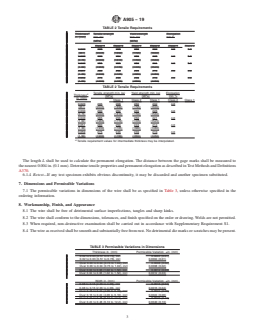
TABLE 1 Chemical Requirements
properties and permanent elongation as described in Test
Element Composition % Methods and Definitions A370.
Carbon 0.80–0.95 6.1.4 Retest—If any test specimen exhibits obvious
Manganese 0.30–0.60
discontinuity, it may be discarded and another specimen
Phosphorus 0.025
substituted.
Sulphur, max 0.020
Silicon 0.10–0.30
7. Dimensions and Permissible Variations
7.1 The permissible variations in dimensions of the wire
shall be as specified in Table 3, unless otherwise specified in
5.2 Heat Analysis—Each heat of steel shall be analyzed to
the ordering information.
determine the percentage of elements prescribed in Table 1.
This analysis shall be made from a test specimen preferably
8. Workmanship, Finish, and Appearance
taken during the pouring of the heat.When requested, this shall
8.1 The wire shall be free of detrimental surface
be reported to the purchaser and shall conform to the require-
imperfections, tangles and sharp kinks.
ments of Table 1.
8.2 The wire shall conform to the dimensions, tolerances,
5.3 Product Analysis—An analysis may be made by the
and finish specified on the order or drawing. Welds are not
purchaser from finished wire representing each heat of steel.
permitted.
The chemical composition thus determined, as to elements
required or restricted, shall conform to the product analysis
8.3 When required, non-destructive examination shall be
requirements specified in Table 10 of Sp
...
This document is not an ASTM standard and is intended only to provide the user of an ASTM standard an indication of what changes have been made to the previous version. Because
it may not be technically possible to adequately depict all changes accurately, ASTM recommends that users consult prior editions as appropriate. In all cases only the current version
of the standard as published by ASTM is to be considered the official document.
Designation: A905 − 04 (Reapproved 2017) A905 − 19
Standard Specification for
Steel Wire, Pressure Vessel Winding
This standard is issued under the fixed designation A905; the number immediately following the designation indicates the year of
original adoption or, in the case of revision, the year of last revision. A number in parentheses indicates the year of last reapproval. A
superscript epsilon (´) indicates an editorial change since the last revision or reapproval.
1. Scope Scope*
1.1 This specification covers requirements for a high strength drawn and cold rolled steel wire in two strength classes, with
rectangular cross section, and round mill edge. This wire is intended for prestressed vessel and press frame windings.
1.2 The values stated in either inch-pound units or SI (metric) units are to be regarded separately as standards. Within the text
and tables, the SI units are shown in parentheses. The values stated in each system are not exact equivalents. Therefore, each
system must be used independent of the other. Combining values from the two systems may result in nonconformance with the
specification.
1.3 This international standard was developed in accordance with internationally recognized principles on standardization
established in the Decision on Principles for the Development of International Standards, Guides and Recommendations issued
by the World Trade Organization Technical Barriers to Trade (TBT) Committee.
2. Referenced Documents
2.1 ASTM Standards:
A370 Test Methods and Definitions for Mechanical Testing of Steel Products
A510A510/A510M Specification for General Requirements for Wire Rods and Coarse Round Wire, Carbon Steel (Metric)
A0510_A0510M Steel, and Alloy Steel
A510M Specification for General Requirements for Wire Rods and Coarse Round Wire, Carbon Steel (Metric) (Withdrawn
2011)
A700 Guide for Packaging, Marking, and Loading Methods for Steel Products for Shipment
E30A751 Test Methods Methods, Practices, and Terminology for Chemical Analysis of Steel, Cast Iron, Open-Hearth Iron, and
Wrought IronSteel Products (Withdrawn 1995)
E309 Practice for Eddy Current Examination of Steel Tubular Products Using Magnetic Saturation
2.2 Military Standard:
MIL-STD-163 Steel Mill Products, Preparation for Shipment and Storage
2.2 Federal Standard:
Fed. Std. No. 123 Marking for Shipment (Civil Agencies)
2.4 AIAG Standard:
AIAGB-5 02.00 Primary Metals Identification Tag Application Standard
3. Ordering Information
3.1 It shall be the responsibility of the purchaser to specify all requirements that are necessary for material under this
specification. Such requirements may include, but are not limited to, the following:
3.1.1 Quantity (mass),
3.1.2 Name of material,
3.1.3 Dimensions (see Section 7),
This specification is under the jurisdiction of ASTM Committee A01 on Steel, Stainless Steel and Related Alloys and is the direct responsibility of Subcommittee A01.03
on Steel Rod and Wire.
Current edition approved Sept. 1, 2017Sept. 1, 2019. Published September 2017September 2019. Originally approved in 1991. Last previous edition approved in 20102017
as A905 – 04 (2010).(2017). DOI: 10.1520/A0905-04R17. 10.1520/A0905-19.
For referenced ASTM standards, visit the ASTM website, www.astm.org, or contact ASTM Customer Service at service@astm.org. For Annual Book of ASTM Standards
volume information, refer to the standard’s Document Summary page on the ASTM website.
The last approved version of this historical standard is referenced on www.astm.org.
Available from Standardization Documents Order Desk, DODSSP, Bldg. 4, Section D, 700 Robbins Ave., Philadelphia, PA 19111-509819111-5094, https://
quicksearch.dla.mil.
*A Summary of Changes section appears at the end of this standard
Copyright © ASTM International, 100 Barr Harbor Drive, PO Box C700, West Conshohocken, PA 19428-2959. United States
A905 − 19
3.1.4 Finish (see Section 8),
3.1.5 Packaging (see Section 11),
3.1.6 Cast or heat analysis report (see Section 5),
3.1.7 Number of certification or test reports required (see Section 10),
3.1.8 ASTM designation and year of issue, and
3.1.9 Supplementary requirements, if any.
4. Material and Manufacture
4.1 The steel shall be produced by any of the following primary processes: (1) basic oxygen, and (2) electric furnace or vacuum
induction (VIM). The primary melting may incorporate separate degassing or refining and may be followed by secondary melting
by the electrode slag process (ESR) or the vacuum arc remelting process (VAR).
4.1.1 The steel may be ingot cast or continuously cast.
4.2 The finished wire shall be free from detrimental pipe and undue segregation.
4.3 The wire shall be cold drawn or cold rolled, or both, to produce the desired mechanical properties and dimensions after
subjecting it to the patenting treatment.
4.4 The width to thickness ratio of the wire cross section shall not exceed 8.
5. Chemical Composition
5.1 The steel shall conform to the requirements for chemical composition prescribed in Table 1.
5.2 Heat Analysis—Each heat of steel shall be analyzed by the manufacturer to determine the percentage of elements prescribed
in Table 1. This analysis shall be made from a test specimen preferably taken during the pouring of the heat. When requested, this
shall be reported to the purchaser and shall conform to the requirements of Table 1.
5.3 Product Analysis—An analysis may be made by the purchaser from finished wire representing each heat of steel. The
chemical composition thus determined, as to elements required or restricted, shall conform to the product analysis requirements
specified in Table 10 of Specification A510A510/A510M or A510M.
5.4 For referee purposes, Test Methods Methods, Practices, and Terminology E30A751 shall be used.
6. Mechanical Requirements
6.1 Tension Test.
6.1.1 Requirements—The material as represented by tension test specimens shall conform to the requirements prescribed in
Table 2.
6.1.2 Number of Tests—One test specimen shall be taken from each end of every coil.
6.1.3 Test Method—The tension test shall be made in accordance with Test Methods and Definitions A370, except that the length
L for evaluation of the elongation shall be calculated from the following formula:
L 5 11.3=W·T
where
W = width of the wire, and
T = thickness of the wire.
TABLE 1 Chemical Requirements
Element Composition %
Carbon 0.80–0.95
Manganese 0.30–0.60
Phosphorus 0.025
Sulphur, max 0.020
Silicon 0.10–0.30
TABLE 1 Chemical Requirements
Element Composition %
Carbon 0.80–0.95
Manganese 0.30–0.60
Phosphorus 0.025
Sulphur, max 0.020
Silicon 0.10–0.30
A905 − 19
TABLE 2 Tensile Requirements
A
Thickness Tensile strength Yield strength Elongation
in. (mm)
min. ksi min. ksi min %
(MPa) (MPa)
Class 1 Class 2 Class 1 Class 2 Class 1 Class 2
0.020 296 268 260 232 4.0 5.0
(051) (2045) (1850) (1795) (1600)
0.030 290 262 255 226 4.0 5.0
(0.76) (2000) (1810) (1760) (1560)
0.040 285 256 250 221
...