

ASTM D4539-22
(Test Method)Standard Test Method for Filterability of Diesel Fuels by Low-Temperature Flow Test (LTFT)
General Information
- Abstract
SIGNIFICANCE AND USE
5.1 The Low Temperature Flow Test results are indicative of the low temperature flow performance of the test fuel in some diesel vehicles (according to CRC Report No. 528). The test method is especially useful for the evaluation of fuels containing flow improver additives.
5.2 The test method can be used to supplement other measurements of diesel fuel low temperature behavior (in accordance with Test Methods D97, D2500, and D3117).
SCOPE
1.1 This test method covers estimating the filterability of diesel fuels in some automotive equipment at low temperatures.
1.2 The values stated in SI units are to be regarded as standard. No other units of measurement are included in this standard.
1.3 Warning—Mercury has been designated by many regulatory agencies as a hazardous substance that can cause serious medical issues. Mercury, or its vapor, has been demonstrated to be hazardous to health and corrosive to materials. Use caution when handling mercury and mercury-containing products. See the applicable product Safety Data Sheet (SDS) for additional information. The potential exists that selling mercury or mercury-containing products, or both, is prohibited by local or national law. Users must determine legality of sales in their location.
1.4 This standard does not purport to address all of the safety concerns, if any, associated with its use. It is the responsibility of the user of this standard to establish appropriate safety, health, and environmental practices and determine the applicability of regulatory limitations prior to use. For specific warning statements, see 1.3, 9.1, 9.2.1, 9.3, 9.5, and Annex A1.
1.5 This international standard was developed in accordance with internationally recognized principles on standardization established in the Decision on Principles for the Development of International Standards, Guides and Recommendations issued by the World Trade Organization Technical Barriers to Trade (TBT) Committee.
- Status
- Published
- Publication Date
- 30-Nov-2022
- Technical Committee
- D02 - Petroleum Products, Liquid Fuels, and Lubricants
- Drafting Committee
- D02.07 - Flow Properties
Buy Documents
ASTM D4539-22 - Standard Test Method for Filterability of Diesel Fuels by Low-Temperature Flow Test (LTFT)
REDLINE ASTM D4539-22 - Standard Test Method for Filterability of Diesel Fuels by Low-Temperature Flow Test (LTFT)
Overview
ASTM D4539-22: Standard Test Method for Filterability of Diesel Fuels by Low-Temperature Flow Test (LTFT) is an internationally recognized ASTM standard designed to estimate the filterability of diesel fuels in automotive equipment at low temperatures. The LTFT method offers valuable insights into how diesel fuels perform under cold conditions, which is particularly critical for operators in colder climates and for the assessment of fuels containing flow improver additives. Compliance with this standard can enhance operational reliability and help prevent engine problems related to low-temperature filter plugging.
Key Topics
- Purpose and Scope: This test method evaluates the ability of diesel fuel to pass through a standardized filter under controlled low-temperature conditions, simulating real-world automotive challenges.
- Low Temperature Flow Performance: The main result is the Minimum LTFT Pass Temperature, indicating the lowest temperature at which a diesel fuel can be filtered within 60 seconds.
- Additive Effectiveness: The test is especially suitable for fuels containing cold flow improver additives, offering a means to measure additive performance in preventing wax crystallization and plugging.
- Supplement to Other Methods: LTFT test results can be used alongside other established methods such as ASTM D97 (Pour Point), D2500 (Cloud Point), and D3117 (Wax Appearance Point), providing a more complete understanding of diesel fuel low-temperature behavior.
- Precision and Safety: Only SI units are used, and the method includes detailed safety notes regarding hazardous materials such as mercury and solvents involved in the procedure.
- Standardized Equipment: Requirements for apparatus, including filter assemblies, programmable cooling systems, vacuum systems, and temperature measuring devices, are rigorously defined for reproducible results.
Applications
- Diesel Fuel Development and Quality Control: Refineries, additive producers, and fuel suppliers utilize the LTFT to develop and verify diesel fuels that meet low-temperature operability requirements with reduced risk of engine filter plugging.
- Fleet Operations in Cold Climates: Operators of diesel equipment can use data from this standard to select fuels less susceptible to low-temperature issues, reducing downtime and maintenance costs.
- Regulation and Specification Compliance: The LTFT method supports compliance with contractual and regulatory standards that may specify minimum low-temperature performance criteria for diesel fuels.
- Research and Comparative Testing: Laboratories and research organizations employ LTFT results to compare the effectiveness of different cold flow additives and formulations under identical test conditions.
- Supplemental Fuel Characterization: When used in conjunction with pour point and cloud point testing, the LTFT provides a comprehensive profile of a diesel fuel’s behavior at low temperatures, improving predictability in end-use applications.
Related Standards
- ASTM D97 - Test Method for Pour Point of Petroleum Products: Identifies the lowest temperature at which a fuel will pour.
- ASTM D2500 - Test Method for Cloud Point of Petroleum Products: Determines the temperature at which wax crystals first appear.
- ASTM D3117 - Test Method for Wax Appearance Point of Distillate Fuels (withdrawn): Previously used for wax crystallization evaluations.
- ASTM D975 - Specification for Diesel Fuel Oils: Defines the requirements for different grades of diesel fuel.
- CAN/CGSB-3.0, No. 140.1-M86 – Canadian equivalent to ASTM D4539, though minor differences in apparatus and procedure may exist.
- ASTM D4057 & D4177 - Practices for Sampling Petroleum and Petroleum Products: Ensure representative samples for testing.
Keywords: diesel fuel, filterability, low temperature, LTFT, cold flow, fuel quality, flow improver additives, ASTM standards, fuel testing, automotive diesel applications.
Relations
- Effective Date
- 15-Mar-2024
- Effective Date
- 15-Dec-2023
- Refers
ASTM D4175-23a - Standard Terminology Relating to Petroleum Products, Liquid Fuels, and Lubricants - Effective Date
- 15-Dec-2023
- Effective Date
- 01-Oct-2023
- Refers
ASTM D4175-23e1 - Standard Terminology Relating to Petroleum Products, Liquid Fuels, and Lubricants - Effective Date
- 01-Jul-2023
- Effective Date
- 01-Nov-2019
- Effective Date
- 01-May-2019
- Effective Date
- 01-Feb-2019
- Effective Date
- 01-Dec-2018
- Effective Date
- 01-Oct-2018
- Effective Date
- 01-May-2018
- Effective Date
- 01-Jan-2018
- Effective Date
- 15-Dec-2017
- Effective Date
- 01-Dec-2017
- Effective Date
- 01-May-2017
Buy Documents
ASTM D4539-22 - Standard Test Method for Filterability of Diesel Fuels by Low-Temperature Flow Test (LTFT)
REDLINE ASTM D4539-22 - Standard Test Method for Filterability of Diesel Fuels by Low-Temperature Flow Test (LTFT)
Get Certified
Connect with accredited certification bodies for this standard

Element Materials Technology
Materials testing and product certification.

ABS Group Brazil
ABS Group certification services in Brazil.

ABS Quality Evaluations Inc.
American Bureau of Shipping quality certification.
Sponsored listings
Frequently Asked Questions
ASTM D4539-22 is a standard published by ASTM International. Its full title is "Standard Test Method for Filterability of Diesel Fuels by Low-Temperature Flow Test (LTFT)". This standard covers: SIGNIFICANCE AND USE 5.1 The Low Temperature Flow Test results are indicative of the low temperature flow performance of the test fuel in some diesel vehicles (according to CRC Report No. 528). The test method is especially useful for the evaluation of fuels containing flow improver additives. 5.2 The test method can be used to supplement other measurements of diesel fuel low temperature behavior (in accordance with Test Methods D97, D2500, and D3117). SCOPE 1.1 This test method covers estimating the filterability of diesel fuels in some automotive equipment at low temperatures. 1.2 The values stated in SI units are to be regarded as standard. No other units of measurement are included in this standard. 1.3 Warning—Mercury has been designated by many regulatory agencies as a hazardous substance that can cause serious medical issues. Mercury, or its vapor, has been demonstrated to be hazardous to health and corrosive to materials. Use caution when handling mercury and mercury-containing products. See the applicable product Safety Data Sheet (SDS) for additional information. The potential exists that selling mercury or mercury-containing products, or both, is prohibited by local or national law. Users must determine legality of sales in their location. 1.4 This standard does not purport to address all of the safety concerns, if any, associated with its use. It is the responsibility of the user of this standard to establish appropriate safety, health, and environmental practices and determine the applicability of regulatory limitations prior to use. For specific warning statements, see 1.3, 9.1, 9.2.1, 9.3, 9.5, and Annex A1. 1.5 This international standard was developed in accordance with internationally recognized principles on standardization established in the Decision on Principles for the Development of International Standards, Guides and Recommendations issued by the World Trade Organization Technical Barriers to Trade (TBT) Committee.
SIGNIFICANCE AND USE 5.1 The Low Temperature Flow Test results are indicative of the low temperature flow performance of the test fuel in some diesel vehicles (according to CRC Report No. 528). The test method is especially useful for the evaluation of fuels containing flow improver additives. 5.2 The test method can be used to supplement other measurements of diesel fuel low temperature behavior (in accordance with Test Methods D97, D2500, and D3117). SCOPE 1.1 This test method covers estimating the filterability of diesel fuels in some automotive equipment at low temperatures. 1.2 The values stated in SI units are to be regarded as standard. No other units of measurement are included in this standard. 1.3 Warning—Mercury has been designated by many regulatory agencies as a hazardous substance that can cause serious medical issues. Mercury, or its vapor, has been demonstrated to be hazardous to health and corrosive to materials. Use caution when handling mercury and mercury-containing products. See the applicable product Safety Data Sheet (SDS) for additional information. The potential exists that selling mercury or mercury-containing products, or both, is prohibited by local or national law. Users must determine legality of sales in their location. 1.4 This standard does not purport to address all of the safety concerns, if any, associated with its use. It is the responsibility of the user of this standard to establish appropriate safety, health, and environmental practices and determine the applicability of regulatory limitations prior to use. For specific warning statements, see 1.3, 9.1, 9.2.1, 9.3, 9.5, and Annex A1. 1.5 This international standard was developed in accordance with internationally recognized principles on standardization established in the Decision on Principles for the Development of International Standards, Guides and Recommendations issued by the World Trade Organization Technical Barriers to Trade (TBT) Committee.
ASTM D4539-22 is classified under the following ICS (International Classification for Standards) categories: 75.160.20 - Liquid fuels. The ICS classification helps identify the subject area and facilitates finding related standards.
ASTM D4539-22 has the following relationships with other standards: It is inter standard links to ASTM D1655-24, ASTM D975-23a, ASTM D4175-23a, ASTM D1655-23a, ASTM D4175-23e1, ASTM E644-11(2019), ASTM E2877-12(2019), ASTM D975-19, ASTM D975-18a, ASTM D3699-18a, ASTM D3699-18, ASTM D1655-18, ASTM D975-17a, ASTM D1655-17a, ASTM D975-17. Understanding these relationships helps ensure you are using the most current and applicable version of the standard.
ASTM D4539-22 is available in PDF format for immediate download after purchase. The document can be added to your cart and obtained through the secure checkout process. Digital delivery ensures instant access to the complete standard document.
Standards Content (Sample)
This international standard was developed in accordance with internationally recognized principles on standardization established in the Decision on Principles for the
Development of International Standards, Guides and Recommendations issued by the World Trade Organization Technical Barriers to Trade (TBT) Committee.
Designation: D4539 − 22
Standard Test Method for
Filterability of Diesel Fuels by Low-Temperature Flow Test
(LTFT)
This standard is issued under the fixed designation D4539; the number immediately following the designation indicates the year of
original adoption or, in the case of revision, the year of last revision.Anumber in parentheses indicates the year of last reapproval.A
superscript epsilon (´) indicates an editorial change since the last revision or reapproval.
1. Scope* 2. Referenced Documents
1.1 This test method covers estimating the filterability of 2.1 ASTM Standards:
diesel fuels in some automotive equipment at low tempera- D97Test Method for Pour Point of Petroleum Products
tures. D975Specification for Diesel Fuel
D1655Specification for Aviation Turbine Fuels
1.2 The values stated in SI units are to be regarded as
D2500Test Method for Cloud Point of Petroleum Products
standard. No other units of measurement are included in this
and Liquid Fuels
standard.
D3117Test Method for Wax Appearance Point of Distillate
1.3 Warning—Mercuryhasbeendesignatedbymanyregu- 3
Fuels (Withdrawn 2010)
latoryagenciesasahazardoussubstancethatcancauseserious
D3699Specification for Kerosine
medicalissues.Mercury,oritsvapor,hasbeendemonstratedto
D4057Practice for Manual Sampling of Petroleum and
be hazardous to health and corrosive to materials. Use caution
Petroleum Products
when handling mercury and mercury-containing products. See
D4175Terminology Relating to Petroleum Products, Liquid
the applicable product Safety Data Sheet (SDS) for additional
Fuels, and Lubricants
information. The potential exists that selling mercury or
D4177Practice for Automatic Sampling of Petroleum and
mercury-containing products, or both, is prohibited by local or
Petroleum Products
national law. Users must determine legality of sales in their
D7962Practice for Determination of Minimum Immersion
location.
Depth and Assessment of Temperature Sensor Measure-
1.4 This standard does not purport to address all of the
ment Drift
safety concerns, if any, associated with its use. It is the
E1Specification for ASTM Liquid-in-Glass Thermometers
responsibility of the user of this standard to establish appro- E644Test Methods for Testing Industrial Resistance Ther-
priate safety, health, and environmental practices and deter-
mometers
mine the applicability of regulatory limitations prior to use. E2251Specification for Liquid-in-Glass ASTM Thermom-
For specific warning statements, see 1.3, 9.1, 9.2.1, 9.3, 9.5,
eters with Low-Hazard Precision Liquids
and Annex A1. E2877Guide for Digital Contact Thermometers
1.5 This international standard was developed in accor-
2.2 Coordinating Research Council, Inc.
dance with internationally recognized principles on standard-
CRC Report No. 528Diesel Fuel Low-Temperature Oper-
ization established in the Decision on Principles for the
ability Field Test
Development of International Standards, Guides and Recom-
mendations issued by the World Trade Organization Technical
Barriers to Trade (TBT) Committee.
For referenced ASTM standards, visit the ASTM website, www.astm.org, or
contact ASTM Customer Service at service@astm.org. For Annual Book of ASTM
This test method is under the jurisdiction of Committee D02 on Petroleum Standards volume information, refer to the standard’s Document Summary page on
Products, Liquid Fuels, and Lubricants and is the direct responsibility of Subcom- the ASTM website.
mittee D02.07 on Flow Properties. The last approved version of this historical standard is referenced on
Current edition approved Dec. 1, 2022. Published December 2022. Originally www.astm.org.
approved in 1985. Last previous edition approved in 2017 as D4539–17. DOI: Available from Coordinating Research Council, Inc., 219 Perimeter Center
10.1520/D4539-22. Parkway, Atlanta, GA 30346.
*A Summary of Changes section appears at the end of this standard
Copyright © ASTM International, 100 Barr Harbor Drive, PO Box C700, West Conshohocken, PA 19428-2959. United States
D4539 − 22
FIG. 1 LTFT Sample Filtration Assembly
2.3 Canadian General Standards Board: until a minimum LTFT pass temperature is obtained. The
CAN/CGSB-3.0,No. 140.1-M86, Low Temperature Flow minimum LTFT pass temperature is the lowest temperature,
Test (LTFT) for Diesel Fuels expressed as a multiple of 1°C, at which a test specimen can
be filtered in 60 s or less.
NOTE 1—CAN/CGSB-3.0, No. 140.1-M86 is essentially equivalent to
Test Method D4539, but the differences in apparatus and procedures may
4.2 Alternatively, a single specimen may be cooled as
or may not yield different results.
described under 4.1 and tested at a specified temperature to
determine whether it passes or fails at that temperature.
3. Terminology
3.1 Definitions:
5. Significance and Use
3.1.1 For definitions of terms used in this test method, refer
5.1 TheLowTemperatureFlowTestresultsareindicativeof
to Terminology D4175.
the low temperature flow performance of the test fuel in some
3.1.2 digital contact thermometer (DCT), n—an electronic
diesel vehicles (according to CRC Report No. 528). The test
device consisting of a digital display and associated tempera-
method is especially useful for the evaluation of fuels contain-
ture sensing probe.
ing flow improver additives.
3.1.2.1 Discussion—This device consists of a temperature
5.2 The test method can be used to supplement other
sensor connected to a measuring instrument; this instrument
measurements of diesel fuel low temperature behavior (in
measures the temperature-dependent quantity of the sensor,
accordance with Test Methods D97, D2500, and D3117).
computes the temperature from the measured quantity, and
provides a digital output. This digital output goes to a digital
6. Apparatus
displayand/orrecordingdevicethatmaybeinternalorexternal
6.1 Glass Specimen Vessels, (Borosilicate heat-resistant
to the device. These devices are sometimes referred to as a
glass or equivalent) several 300mL, clear, heat resistant,
“digital thermometer.”
wide-mouthed glass bottles having markings indicating
3.1.2.2 Discussion—PET is an acronym for portable elec-
200mL 6 10 mL and 50mm to 60 mm ID or clear, heat
tronic thermometers, a subset of digital contact thermometers
resistant, tall form beakers with no pour spouts and equivalent
(DCT).
dimensions.
4. Summary of Test Method
6.2 Glass Receiver Vessels, clear, heat resistant, glass con-
4.1 The temperature of a series of test specimens of fuel is tainers graduated through 180 mL in 10mL 6 2 mL incre-
lowered at a prescribed cooling rate. Commencing at a desired
ments.
test temperature and at each 1°C interval thereafter, a separate
6.3 Filtering Assembly (see Fig. 1), including a storage lid
specimen from the series is filtered through a 17µm screen
orsomeotherformofcover,glasstubing,flexiblefuelresistant
tubing, pinch clamp or valve, and rubber stopper, or other
Available from CGSB Sales Centre, Ottawa, Canada K1A 1G6. means to provide a vacuum seal.
D4539 − 22
FIG. 2 LTFT Filter Assembly
6.4 Filter Assembly , as shown in detail in Fig. 2, for each 6.6 Stop Watch or Electric Timer, capable of measuring
sample container (300mLbeaker). 304SS sintered screen is a
tenths of a second.
twill Dutch weave mesh with a nominal filtration rating of
6.7 Vacuum System, capable of maintaining a constant
17µm. The mesh is 65 wires/cm by 303/315 wires/cm. The
vacuum of 20.0kPa 6 0.2 kPa below atmospheric pressure at
wire strands have diameters of 0.0071 cm and 0.0046 cm,
the receiver for the duration of each determination.
respectively. The nominal filtration rating indicates a 98%
removalbymassweightofallparticlesequaltoorgreaterthan
6.8 Temperature Measuring Device—Either a liquid-in-
17 µm.
glass thermometer as described in 6.8.1 or a Digital Contact
6.5 Programmable Cooling System,capableofcoolingmul- Thermometer (DCT) meeting the requirements described in
tiple specimens to the desired temperature at a mean rate of 6.8.2.
1.0°C per hour between +10°C and −30°C. Absolute devia-
6.8.1 Liquid-in-glass Temperature Measuring Device—
tion of any single temperature point along the prescribed ramp
Conforming to specifications for ASTM Thermometer 114C
functionmustnotexceed0.5°Cinanyspecimen.Thesystem’s
for air baths. For liquid baths use either ASTM Thermometer
size and shape are optional. Either liquid or air baths are
5C in accordance with Specification E1, or ASTM Thermom-
acceptable.
eter S5C in accordance with Specification E2251,oran
alternative liquid-in-glass thermometer with equal or better
accuracy and equal temperature response.
Thesolesourceofsupplyofsuitablefilterclothknowntothecommitteeatthis
th
timeisPallAerospaceCo.,PallAeropowerCorp.,630149 St.N,PinellasPark,FL
33781. If you are aware of alternative suppliers, please provide this information to
ASTM International Headquarters. Your comments will receive careful consider-
ation at a meeting of the responsible technical committee , which you may attend.
D4539 − 22
6.8.2 Digital Contact Thermometer Requirements: 7.2 Heptane—Reagent grade. (Warning—Flammable. See
A1.2.)
Parameter Requirement
DCT Guide E2877 Class F or better
7.3 Acetone—Reagent grade. (Warning—Flammable. See
Nominal Temperature –38 °C to +50 °C for liquid bath
A1.1.)
A
Range
–80 °C to 20 °C for air bath
8. Sampling
Display Resolution 0.1 °C, minimum
8.1 Obtain a sample in accordance with Practice D4057,or
B
Accuracy ±500 mK (±0.5 °C) by Practice D4177.
8.2 Each specimen test requires a minimum of 200 mL.
Sensor Type Platinum Resistance Thermometer (PRT)
Ensure that sufficient sample is obtained to perform the
C
Sensor Sheath 4.2 mm OD maximum
subsequent series of test specimens according to the procedure
D
Sensor Length Less than 18 mm followed (see Section 4).
E
Immersion Depth Less than 40 mm per Practice D7962
9. Procedure
E
Measurement Drift Less than 500 mK (0.5 °C) per year
9.1 Filter a fresh specimen of test fuel at 15°C or higher,
F
through dry, lintless filter paper, having a nominal filtration
Response Time Less than or equal to 4 s per Footnote F
ratingoflessthan17µm.(Warning—Combustibleliquid.See
Calibration Error Less than 500 mK (0.5 °C) over the range of intended
A1.3.)
use.
NOTE 5—The purpose of this filtration step is to remove any contami-
Calibration Range Consistent with temperature range of use
nants that interfere with the effectiveness of low temperature flow
improveradditives.However,thispre-filtrationstepmayremovecontami-
Calibration Data Four data points evenly distributed over the calibration
range that is consistent with the range of use. The cali- nants that affect the low temperature flow properties of the fuel in actual
bration data is to be included in calibration report.
service. Users of this test method may find it helpful to run the test with
and without the pre-filtration step to compare results and in recognition
Calibration Report From a calibration laboratory with demonstrated compe-
thattheprecisionofthetestmethodwillnotapplyifthepre-filtrationstep
tency in temperature calibration which is traceable to a
is not carried out.
national calibration laboratory or metrology standards
body.
9.2 Clean and inspect the filter assembly before each test.
Filters obtained from the manufacturer are already standard-
ized.AppendixX1providesaprocedureforcheckingthefilter
A
The nominal temperature range may be different from the values shown provided
performance, if desired.
the calibration and accuracy criteria are met.
B
Accuracy is the combined accuracy of the DCT unit which is the display and
9.2.1 Clean the assembled filter with two solvents using a
sensor.
C vacuum to draw the solvents through the screen. Begin with
Sensor sheath is the tube that holds the sensing element. The value is the
outside diameter of the sheath segment containing the sensor element.
three successive washes of at least 50 mL of heptane
D
The physical length of the temperature sensing element.
(Warning—Flammable. See A1.2). Follow with three succes-
E
As determined by Practice D7962 or an equivalent procedure.
F
sive washes of at least 50 mL of acetone (Warning—
Response Time—The time for a DCT to respond to a step change in temperature.
The response time is 63.2 % of the step change time as determined per Section 9
Extremely flammable. See A1.1). Air dry the filters after
of Test Method E644. The step change evaluation begins at 20 °C ± 5 °C air to
washing.
77 °C ± 5 °C with water circulating at 0.9 m ⁄s ± 0.09 m ⁄s past the sensor.
9.2.2 Visually inspect each filter assembly for screen dam-
NOTE 2—A DCT display mounted on the end to the probe’s sheath is
age or the presence of particulates. Discard any damaged filter
likely not suita
...
This document is not an ASTM standard and is intended only to provide the user of an ASTM standard an indication of what changes have been made to the previous version. Because
it may not be technically possible to adequately depict all changes accurately, ASTM recommends that users consult prior editions as appropriate. In all cases only the current version
of the standard as published by ASTM is to be considered the official document.
Designation: D4539 − 17 D4539 − 22
Standard Test Method for
Filterability of Diesel Fuels by Low-Temperature Flow Test
(LTFT)
This standard is issued under the fixed designation D4539; the number immediately following the designation indicates the year of
original adoption or, in the case of revision, the year of last revision. A number in parentheses indicates the year of last reapproval. A
superscript epsilon (´) indicates an editorial change since the last revision or reapproval.
1. Scope*
1.1 This test method covers estimating the filterability of diesel fuels in some automotive equipment at low temperatures.
1.2 The values stated in SI units are to be regarded as standard. No other units of measurement are included in this standard.
1.3 Warning—Mercury has been designated by EPA and many stateregulatory agencies as a hazardous materialsubstance that can
cause central nervous system, kidney, and liver damage. serious medical issues. Mercury, or its vapor, may has been demonstrated
to be hazardous to health and corrosive to materials. Caution should be taken Use caution when handling mercury and
mercury-containing products. See the applicable product Material Safety Data Sheet (MSDS) for details and EPA’s website
(http://www.epa.gov/mercury/faq.htm) for additional information. Users should be aware (SDS) for additional information. The
potential exists that selling mercury or mercury-containing products, or both, in your state may be prohibited by state law.is
prohibited by local or national law. Users must determine legality of sales in their location.
1.4 This standard does not purport to address all of the safety concerns, if any, associated with its use. It is the responsibility
of the user of this standard to establish appropriate safety, health, and environmental practices and determine the applicability of
regulatory limitations prior to use. For specific warning statements, see 1.3, 9.1, 9.2.1, 9.3, 9.5, and Annex A1.
1.5 This international standard was developed in accordance with internationally recognized principles on standardization
established in the Decision on Principles for the Development of International Standards, Guides and Recommendations issued
by the World Trade Organization Technical Barriers to Trade (TBT) Committee.
2. Referenced Documents
2.1 ASTM Standards:
D97 Test Method for Pour Point of Petroleum Products
D975 Specification for Diesel Fuel
D1655 Specification for Aviation Turbine Fuels
D2500 Test Method for Cloud Point of Petroleum Products and Liquid Fuels
D3117 Test Method for Wax Appearance Point of Distillate Fuels (Withdrawn 2010)
D3699 Specification for Kerosine
D4057 Practice for Manual Sampling of Petroleum and Petroleum Products
This test method is under the jurisdiction of Committee D02 on Petroleum Products, Liquid Fuels, and Lubricants and is the direct responsibility of Subcommittee D02.07
on Flow Properties.
Current edition approved Dec. 1, 2017Dec. 1, 2022. Published January 2018December 2022. Originally approved in 1985. Last previous edition approved in 20162017
as D4539 – 16.D4539 – 17. DOI: 10.1520/D4539-17.10.1520/D4539-22.
For referenced ASTM standards, visit the ASTM website, www.astm.org, or contact ASTM Customer Service at service@astm.org. For Annual Book of ASTM Standards
volume information, refer to the standard’s Document Summary page on the ASTM website.
The last approved version of this historical standard is referenced on www.astm.org.
*A Summary of Changes section appears at the end of this standard
Copyright © ASTM International, 100 Barr Harbor Drive, PO Box C700, West Conshohocken, PA 19428-2959. United States
D4539 − 22
D4175 Terminology Relating to Petroleum Products, Liquid Fuels, and Lubricants
D4177 Practice for Automatic Sampling of Petroleum and Petroleum Products
D7962 Practice for Determination of Minimum Immersion Depth and Assessment of Temperature Sensor Measurement Drift
E1 Specification for ASTM Liquid-in-Glass Thermometers
E644 Test Methods for Testing Industrial Resistance Thermometers
E2251 Specification for Liquid-in-Glass ASTM Thermometers with Low-Hazard Precision Liquids
E2877 Guide for Digital Contact Thermometers
2.2 Coordinating Research Council, Inc.
CRC Report No. 528 Diesel Fuel Low-Temperature Operability Field Test
2.3 Canadian General Standards Board:
CAN/CGSB-3.0, No. 14.01-M86,140.1-M86, Low Temperature Flow Test (LTFT) for Diesel Fuels
NOTE 1—CAN/CGSB-3.0, No. 140.1-M86 is essentially equivalent to Test Method D4539, but the differences in apparatus and procedures may or may
not yield different results.
3. Terminology
3.1 Definitions:
3.1.1 For definitions of terms used in this test method, refer to Terminology D4175.
3.1.2 digital contact thermometer (DCT), n—an electronic device consisting of a digital display and associated temperature
sensing probe.
3.1.2.1 Discussion—
This device consists of a temperature sensor connected to a measuring instrument; this instrument measures the temperature-
dependent quantity of the sensor, computes the temperature from the measured quantity, and provides a digital output. This digital
output goes to a digital display and/or recording device that may be internal or external to the device. These devices are sometimes
referred to as a “digital thermometer.”
3.1.2.2 Discussion—
PET is an acronym for portable electronic thermometers, a subset of digital contact thermometers (DCT).
4. Summary of Test Method
4.1 The temperature of a series of test specimens of fuel is lowered at a prescribed cooling rate. Commencing at a desired test
temperature and at each 1 °C interval thereafter, a separate specimen from the series is filtered through a 17 μm screen until a
minimum LTFT pass temperature is obtained. The minimum LTFT pass temperature is the lowest temperature, expressed as a
multiple of 1 °C, at which a test specimen can be filtered in 60 s or less.
4.2 Alternatively, a single specimen may be cooled as described under 4.1 and tested at a specified temperature to determine
whether it passes or fails at that temperature.
5. Significance and Use
5.1 The Low Temperature Flow Test results are indicative of the low temperature flow performance of the test fuel in some diesel
vehicles (according to CRC Report No. 528). The test method is especially useful for the evaluation of fuels containing flow
improver additives.
5.2 The test method can be used to supplement other measurements of diesel fuel low temperature behavior (in accordance with
Test Methods D97, D2500, and D3117).
6. Apparatus
6.1 Glass Specimen Vessels, (Borosilicate heat-resistant glass or equivalent) several 300 mL, clear, heat resistant, wide-mouthed
glass bottles having markings indicating 200 mL 6 10 mL and 50 mm to 60 mm ID or clear, heat resistant, tall form beakers with
no pour spouts and equivalent dimensions.
Available from Coordinating Research Council, Inc., 219 Perimeter Center Parkway, Atlanta, GA 30346.
Available from CGSB Sales Centre, Ottawa, Canada K1A 1G6.
D4539 − 22
FIG. 1 LTFT Sample Filtration Assembly
6.2 Glass Receiver Vessels, clear, heat resistant, glass containers graduated through 180 mL in 10 mL 6 2 mL increments.
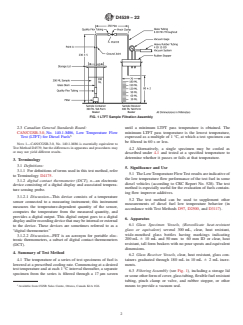
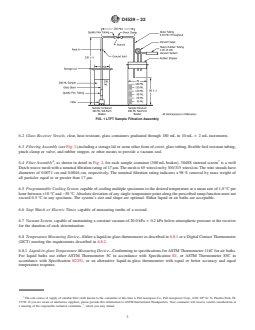
6.3 Filtering Assembly (see Fig. 1),including a storage lid or some other form of cover, glass tubing, flexible fuel resistant tubing,
pinch clamp or valve, and rubber stopper, or other means to provide a vacuum seal.
6 7
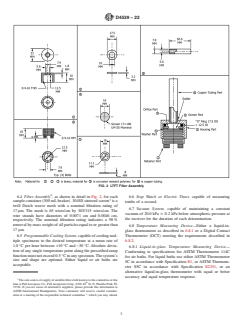
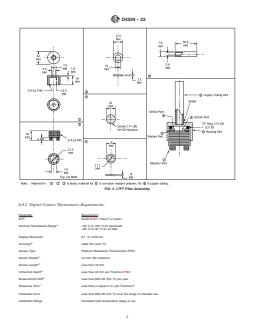
6.4 Filter Assembly , as shown in detail in Fig. 2, for each sample container (300 mL beaker). 304SS sintered screen is a twill
Dutch weave mesh with a nominal filtration rating of 17 μm. The mesh is 65 wires/cm by 303/315 wires/cm. The wire strands have
diameters of 0.0071 cm and 0.0046 cm, respectively. The nominal filtration rating indicates a 98 % removal by mass weight of
all particles equal to or greater than 17 μm.
6.5 Programmable Cooling System, capable of cooling multiple specimens to the desired temperature at a mean rate of 1.0 °C per
hour between +10 °C and −30 °C. Absolute deviation of any single temperature point along the prescribed ramp function must not
exceed 0.5 °C in any specimen. The system’s size and shape are optional. Either liquid or air baths are acceptable.
6.6 Stop Watch or Electric Timer, capable of measuring tenths of a second.
6.7 Vacuum System, capable of maintaining a constant vacuum of 20.0 kPa 6 0.2 kPa below atmospheric pressure at the receiver
for the duration of each determination.
6.8 Temperature Measuring Device—Either a liquid-in-glass thermometer as described in 6.8.1 or a Digital Contact Thermometer
(DCT) meeting the requirements described in 6.8.2.
6.8.1 Liquid-in-glass Temperature Measuring Device—Conforming to specifications for ASTM Thermometer 114C for air baths.
For liquid baths use either ASTM Thermometer 5C in accordance with Specification E1, or ASTM Thermometer S5C in
accordance with Specification E2251, or an alternative liquid-in-glass thermometer with equal or better accuracy and equal
temperature response.
th
The sole source of supply of suitable filter cloth known to the committee at this time is Pall Aerospace Co., Pall Aeropower Corp., 6301 49 St. N, Pinellas Park, FL
33781. If you are aware of alternative suppliers, please provide this information to ASTM International Headquarters. Your comments will receive careful consideration at
a meeting of the responsible technical committee , which you may attend.
D4539 − 22
FIG. 2 LTFT Filter Assembly
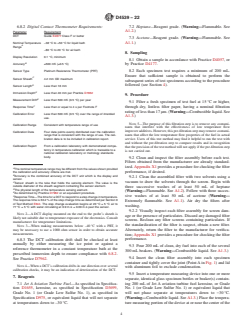
6.8.2 Digital Contact Thermometer Requirements:
Parameter Requirement
DCT Guide E2877 Class F or better
A
Nominal Temperature Range –38 °C to +50 °C for liquid bath
–80 °C to 20 °C for air bath
Display Resolution 0.1 °C, minimum
B
Accuracy ±500 mK (±0.5 °C)
Sensor Type Platinum Resistance Thermometer (PRT)
C
Sensor Sheath 4.2 mm OD maximum
D
Sensor Length Less than 18 mm
E
Immersion Depth Less than 40 mm per Practice D7962
E
Measurement Drift Less than 500 mK (0.5 °C) per year
F
Response Time Less than or equal to 4 s per Footnote F
Calibration Error Less than 500 mK (0.5 °C) over the range of intended use.
Calibration Range Consistent with temperature range of use
D4539 − 22
Calibration Data Four data points evenly distributed over the calibration range that is consistent with the range of use. The calibration
data is to be included in calibration report.
Calibration Report From a calibration laboratory with demonstrated competency in temperature calibration which is traceable to a na-
tional calibration laboratory or metrology standards body.
A
The nominal temperature range may be different from the values shown provided the calibration and accuracy criteria are met.
B
Accuracy is the combined accuracy of the DCT unit which is the display and sensor.
C
Sensor sheath is the tube that holds the sensing element. The value is the outside diameter of the sheath segment containing the sensor element.
D
The physical length of the temperature sensing element.
E
As determined by Practice D7962 or an equivalent procedure.
F
Response Time—The time for a DCT to respond to a step change in temperature. The response time is 63.2 % of the step change time as determined per Section 9 of
Test Method E644. The step change evaluation begins at 20 °C ± 5 °C air to 77 °C ± 5 °C with water circulating at 0.9 m ⁄s ± 0.09 m ⁄s past the sensor.
NOTE 2—A DCT display mounted on the end to the probe’s sheath is likely not suitable due to temperature exposure of the electronics. Consult
manufacturer for temperature limitations.
NOTE 3—When making measurements below –40 °C with a PRT, it may be necessary to use a 1000 ohm sensor in order to obtain accurate measurements.
6.8.3 The DCT calibration drift shall be checked at least annually by either measuring the ice point or against a reference
thermometer in a constant temperature bath at the prescribed immersion depth to ensure compliance with 6.8.2. See Practice
D7962.
NOTE 4—When a DCT’s calibration drifts in one direction over several calibration checks, it may be an indication of deterioration of the DCT.
7. Reagents
7.1 Jet A Aviation Turbine Fuel—As specified in Specification D1655, kerosine, as specified in Specification D3699, Grade No.
1 (or Grade Low Sulfur No. 1), as specified in Specification D975, or equivalent liquid that will not separate at temperatures down
to –30 °C.
7.2 Heptane—Reagent grade. (Warning—Flammable. See A1.2.)
7.3 Acetone—Reagent grade. (Warning—Flammable. See A1.1.)
8. Sampling
8.1 Obtain a sample in accordance with Practice D4057, or by Practice D4177.
8.2 Each specimen test requires a minimum of 200 mL. Ensure that sufficient sample is obtained to perform the subsequent series
of test specimens according to the procedure followed (see Section 4).
9. Procedure
9.1 Filter a fresh specimen of test fuel at 15 °C or higher, through dry, lintless filter paper, having a nominal filtration rating of
less than 17 μm. (Warning—Combustible liquid. See A1.3.)
NOTE 5—The purpose of this filtration step is to remove any contaminants that interfere with the effectiveness of low temperature flow improver additives.
However, this pre-filtration step may remove contaminants that affect the low temperature flow properties of the fuel in actual service. Users of this test
method may find it
...