

ASTM A887-20
(Specification)Standard Specification for Borated Stainless Steel Plate, Sheet, and Strip for Nuclear Application
General Information
- Abstract
ABSTRACT
This specification covers chromium-nickel stainless steel plate, sheet, and strip, modified by the addition of natural or enriched boron, for nuclear application. The austenitic chromium-nickel steels shall be solution annealed to meet the mechanical property requirements. The chemical analysis of representative material shall be performed to determine the required percentage of chemical elements. The tensile and hardness property requirements of the materials are presented. In the case of sheet or strip produced in coil form, two or more hardness test; one impact test, when required; and one or more tension test shall be made on specimens taken from each coil. In the case of sheet, strip, or plate produced in cut lengths, one tension test; one impact test, when required; and one or more hardness tests shall be made on each 100 or less pieces of the same heat and nominal thickness rolled separately or continuously and heat treated within the same operating period, either as a lot or continuously.
SCOPE
1.1 This specification covers chromium-nickel stainless steel plate, sheet, and strip, modified by the addition of natural or enriched boron, for nuclear application.
1.2 Borated stainless steels covered by this specification, because of their particular alloy content and specialized properties, may require special care in their fabrication and welding. Specific procedures are of fundamental importance, and it is presupposed that all parameters will be in accordance with approved methods capable of producing the desired properties in the finished fabrication.
1.3 The values stated in inch-pound units are to be regarded as standard. The values given in parentheses are mathematical conversions to SI units that are provided for information only and are not considered standard.
1.4 This standard does not purport to address all of the safety concerns, if any, associated with its use. It is the responsibility of the user of this standard to establish appropriate safety, health and environmental practices and determine the applicability of regulatory limitations prior to use.
1.5 This international standard was developed in accordance with internationally recognized principles on standardization established in the Decision on Principles for the Development of International Standards, Guides and Recommendations issued by the World Trade Organization Technical Barriers to Trade (TBT) Committee.
- Status
- Published
- Publication Date
- 30-Jun-2020
- Technical Committee
- A01 - Steel, Stainless Steel and Related Alloys
- Drafting Committee
- A01.17 - Flat-Rolled and Wrought Stainless Steel
Buy Documents


ASTM A887-20 - Standard Specification for Borated Stainless Steel Plate, Sheet, and Strip for Nuclear Application
REDLINE ASTM A887-20 - Standard Specification for Borated Stainless Steel Plate, Sheet, and Strip for Nuclear Application
Overview
ASTM A887-20: Standard Specification for Borated Stainless Steel Plate, Sheet, and Strip for Nuclear Application establishes requirements for chromium-nickel stainless steel flat products enhanced with natural or enriched boron. These specialty austenitic steels are primarily used in nuclear applications due to their neutron-absorbing properties. ASTM A887-20 outlines specifications for chemical composition, mechanical properties, fabrication considerations, and testing methods to ensure safety, consistency, and performance in nuclear environments.
Key Topics
- Material Scope: Applies to plate, sheet, and strip forms of chromium-nickel stainless steel modified with boron to improve neutron absorption, crucial for nuclear safety.
- Grades and Chemical Composition: Specifies several UNS designations (e.g., S30460 through S30467), each with defined levels of boron and limits on major alloying elements and impurities.
- Mechanical Properties: Establishes minimum tensile strength, yield strength, elongation, and maximum hardness requirements according to product grade.
- Heat Treatment: Requires solution annealing at a minimum of 1900°F (1040°C) followed by rapid cooling to achieve the specified mechanical properties.
- Testing and Inspection: Mandates chemical analysis, tensile and hardness testing, and (if required) Charpy V-notch impact tests. Testing frequencies differ for coil and cut-length products.
- Fabrication and Welding: Highlights the need for special care due to boron’s influence on properties and weldability. Compliant procedures must ensure integrity in nuclear environments.
- Marking and Certification: Each product must be legibly marked for traceability, and test reports confirming compliance with specification must accompany shipments.
Applications
Borated stainless steel manufactured in accordance with ASTM A887-20 is primarily used in nuclear applications where neutron-absorbing properties are essential for safety and control. Typical uses include:
- Control Rods: Used in nuclear reactors to regulate the fission process.
- Spent Fuel Storage and Transportation: Liners, baskets, and racks fabricated from borated stainless steel help safely store and move spent nuclear fuel.
- Shielding Components: Neutron shielding panels in nuclear facilities, hospitals, and research labs.
- Radiation Protection: Construction of barriers and containment structures in environments with significant neutron flux.
The specific requirements for chemical composition and mechanical performance ensure that each product reliably performs its intended function and withstands the challenging conditions encountered in nuclear settings.
Related Standards
- ASTM A370 - Test Methods and Definitions for Mechanical Testing of Steel Products: Referenced for tensile, impact, and hardness testing procedures.
- ASTM A480/A480M - General Requirements for Flat-Rolled Stainless and Heat-Resisting Steel Plate, Sheet, and Strip: Specifies general delivery, dimension, and quality requirements.
- ASTM A751 - Test Methods, Practices, and Terminology for Chemical Analysis of Steel Products: Provides guidance for chemical analysis and reporting.
- Nuclear Safety Standards: While ASTM A887-20 addresses material specification, integration with broader nuclear safety protocols and regulatory guidelines is essential for full application compliance.
Adherence to ASTM A887-20 ensures the supplied borated stainless steel meets the stringent demands of nuclear industry stakeholders and supports safety, reliability, and regulatory compliance. For detailed technical requirements and latest updates, consulting the full ASTM A887-20 standard is recommended.
Relations
- Effective Date
- 01-Mar-2024
- Effective Date
- 01-Nov-2023
- Effective Date
- 01-Sep-2019
- Effective Date
- 01-Jul-2019
- Effective Date
- 01-Sep-2018
- Refers
ASTM A370-17a - Standard Test Methods and Definitions for Mechanical Testing of Steel Products - Effective Date
- 15-Nov-2017
- Effective Date
- 01-Nov-2017
- Effective Date
- 01-Jan-2017
- Effective Date
- 01-Dec-2016
- Effective Date
- 15-Apr-2016
- Effective Date
- 01-Feb-2016
- Effective Date
- 01-Nov-2015
- Effective Date
- 01-Sep-2015
- Effective Date
- 15-May-2014
- Effective Date
- 01-May-2014
Buy Documents
ASTM A887-20 - Standard Specification for Borated Stainless Steel Plate, Sheet, and Strip for Nuclear Application
REDLINE ASTM A887-20 - Standard Specification for Borated Stainless Steel Plate, Sheet, and Strip for Nuclear Application
Get Certified
Connect with accredited certification bodies for this standard

Element Materials Technology
Materials testing and product certification.

Inštitut za kovinske materiale in tehnologije
Institute of Metals and Technology. Materials testing, metallurgical analysis, NDT.
Sponsored listings
Frequently Asked Questions
ASTM A887-20 is a technical specification published by ASTM International. Its full title is "Standard Specification for Borated Stainless Steel Plate, Sheet, and Strip for Nuclear Application". This standard covers: ABSTRACT This specification covers chromium-nickel stainless steel plate, sheet, and strip, modified by the addition of natural or enriched boron, for nuclear application. The austenitic chromium-nickel steels shall be solution annealed to meet the mechanical property requirements. The chemical analysis of representative material shall be performed to determine the required percentage of chemical elements. The tensile and hardness property requirements of the materials are presented. In the case of sheet or strip produced in coil form, two or more hardness test; one impact test, when required; and one or more tension test shall be made on specimens taken from each coil. In the case of sheet, strip, or plate produced in cut lengths, one tension test; one impact test, when required; and one or more hardness tests shall be made on each 100 or less pieces of the same heat and nominal thickness rolled separately or continuously and heat treated within the same operating period, either as a lot or continuously. SCOPE 1.1 This specification covers chromium-nickel stainless steel plate, sheet, and strip, modified by the addition of natural or enriched boron, for nuclear application. 1.2 Borated stainless steels covered by this specification, because of their particular alloy content and specialized properties, may require special care in their fabrication and welding. Specific procedures are of fundamental importance, and it is presupposed that all parameters will be in accordance with approved methods capable of producing the desired properties in the finished fabrication. 1.3 The values stated in inch-pound units are to be regarded as standard. The values given in parentheses are mathematical conversions to SI units that are provided for information only and are not considered standard. 1.4 This standard does not purport to address all of the safety concerns, if any, associated with its use. It is the responsibility of the user of this standard to establish appropriate safety, health and environmental practices and determine the applicability of regulatory limitations prior to use. 1.5 This international standard was developed in accordance with internationally recognized principles on standardization established in the Decision on Principles for the Development of International Standards, Guides and Recommendations issued by the World Trade Organization Technical Barriers to Trade (TBT) Committee.
ABSTRACT This specification covers chromium-nickel stainless steel plate, sheet, and strip, modified by the addition of natural or enriched boron, for nuclear application. The austenitic chromium-nickel steels shall be solution annealed to meet the mechanical property requirements. The chemical analysis of representative material shall be performed to determine the required percentage of chemical elements. The tensile and hardness property requirements of the materials are presented. In the case of sheet or strip produced in coil form, two or more hardness test; one impact test, when required; and one or more tension test shall be made on specimens taken from each coil. In the case of sheet, strip, or plate produced in cut lengths, one tension test; one impact test, when required; and one or more hardness tests shall be made on each 100 or less pieces of the same heat and nominal thickness rolled separately or continuously and heat treated within the same operating period, either as a lot or continuously. SCOPE 1.1 This specification covers chromium-nickel stainless steel plate, sheet, and strip, modified by the addition of natural or enriched boron, for nuclear application. 1.2 Borated stainless steels covered by this specification, because of their particular alloy content and specialized properties, may require special care in their fabrication and welding. Specific procedures are of fundamental importance, and it is presupposed that all parameters will be in accordance with approved methods capable of producing the desired properties in the finished fabrication. 1.3 The values stated in inch-pound units are to be regarded as standard. The values given in parentheses are mathematical conversions to SI units that are provided for information only and are not considered standard. 1.4 This standard does not purport to address all of the safety concerns, if any, associated with its use. It is the responsibility of the user of this standard to establish appropriate safety, health and environmental practices and determine the applicability of regulatory limitations prior to use. 1.5 This international standard was developed in accordance with internationally recognized principles on standardization established in the Decision on Principles for the Development of International Standards, Guides and Recommendations issued by the World Trade Organization Technical Barriers to Trade (TBT) Committee.
ASTM A887-20 is classified under the following ICS (International Classification for Standards) categories: 77.140.50 - Flat steel products and semi-products. The ICS classification helps identify the subject area and facilitates finding related standards.
ASTM A887-20 has the following relationships with other standards: It is inter standard links to ASTM A370-24, ASTM A480/A480M-23b, ASTM A480/A480M-19, ASTM A370-19, ASTM A480/A480M-18, ASTM A370-17a, ASTM A480/A480M-17, ASTM A370-17, ASTM A480/A480M-16b, ASTM A480/A480M-16a, ASTM A480/A480M-16, ASTM A370-15, ASTM A480/A480M-15, ASTM A370-14, ASTM A480/A480M-14a. Understanding these relationships helps ensure you are using the most current and applicable version of the standard.
ASTM A887-20 is available in PDF format for immediate download after purchase. The document can be added to your cart and obtained through the secure checkout process. Digital delivery ensures instant access to the complete standard document.
Standards Content (Sample)
This international standard was developed in accordance with internationally recognized principles on standardization established in the Decision on Principles for the
Development of International Standards, Guides and Recommendations issued by the World Trade Organization Technical Barriers to Trade (TBT) Committee.
Designation: A887 − 20
Standard Specification for
Borated Stainless Steel Plate, Sheet, and Strip for Nuclear
Application
This standard is issued under the fixed designation A887; the number immediately following the designation indicates the year of
original adoption or, in the case of revision, the year of last revision. A number in parentheses indicates the year of last reapproval. A
superscript epsilon (´) indicates an editorial change since the last revision or reapproval.
1. Scope* A480/A480M Specification for General Requirements for
Flat-Rolled Stainless and Heat-Resisting Steel Plate,
1.1 This specification covers chromium-nickel stainless
Sheet, and Strip
steel plate, sheet, and strip, modified by the addition of natural
A751 Test Methods and Practices for Chemical Analysis of
or enriched boron, for nuclear application.
Steel Products
1.2 Borated stainless steels covered by this specification,
because of their particular alloy content and specialized
3. General Requirements
properties, may require special care in their fabrication and
3.1 The following requirements for orders for material
welding. Specific procedures are of fundamental importance,
furnished under this specification shall conform to the appli-
and it is presupposed that all parameters will be in accordance
cable requirements of the current edition of Specification
with approved methods capable of producing the desired
A480/A480M.
properties in the finished fabrication.
3.1.1 Definitions,
1.3 The values stated in inch-pound units are to be regarded
3.1.2 General requirements for delivery,
as standard. The values given in parentheses are mathematical
3.1.3 Ordering information,
conversions to SI units that are provided for information only
3.1.4 Process,
and are not considered standard.
3.1.5 Dimensions and permissible variations,
1.4 This standard does not purport to address all of the
3.1.6 Workmanship, finish, and appearance,
safety concerns, if any, associated with its use. It is the
3.1.7 Retreatment,
responsibility of the user of this standard to establish appro-
3.1.8 Inspection,
priate safety, health, and environmental practices and deter-
3.1.9 Rejection and rehearing,
mine the applicability of regulatory limitations prior to use.
3.1.10 Material test report,
1.5 This international standard was developed in accor-
3.1.11 Certification, and
dance with internationally recognized principles on standard-
3.1.12 Packaging, marking, and loading.
ization established in the Decision on Principles for the
Development of International Standards, Guides and Recom-
4. Heat Treatment
mendations issued by the World Trade Organization Technical
4.1 The austenitic chromium-nickel steels shall be solution-
Barriers to Trade (TBT) Committee.
annealed to meet the mechanical property requirements of this
specification. Solution-annealing shall consist of heating the
2. Referenced Documents
material to a temperature of 1900 °F (1040 °C) minimum for
2.1 ASTM Standards:
an appropriate time followed by water quenching or rapidly
A370 Test Methods and Definitions for Mechanical Testing
cooling by other means.
of Steel Products
5. Chemical Composition
5.1 The chemical analysis of representative material shall be
This specification is under the jurisdiction of ASTM Committee A01 on Steel,
performed, as agreed upon between the purchaser and supplier,
Stainless Steel and Related Alloys and is the direct responsibility of Subcommittee
A01.17 on Flat-Rolled and Wrought Stainless Steel.
to determine the percentages of the elements identified in Table
Current edition approved July 1, 2020. Published July 2020. Originally approved
1. The chemical composition thus determined shall be reported
in 1988. Last previous edition approved in 2014 as A887 – 89 (2014). DOI:
to the purchaser, or his representative, and shall conform to the
10.1520/A0887-20.
For referenced ASTM standards, visit the ASTM website, www.astm.org, or requirements specified in Table 1.
contact ASTM Customer Service at service@astm.org. For Annual Book of ASTM
5.2 When a product (check or verification) analysis is
Standards volume information, refer to the standard’s Document Summary page on
the ASTM website. performed, the chemical composition thus determined may
*A Summary of Changes section appears at the end of this standard
Copyright © ASTM International, 100 Barr Harbor Drive, PO Box C700, West Conshohocken, PA 19428-2959. United States
A887 − 20
A
TABLE 1 Chemical Requirements Composition
UNS Other
Type Carbon Manganese Phosphorous Sulfur Silicon Chromium Nickel Boron
B
Designation Elements
S30460 304B 0.08 2.00 0.045 0.030 0.75 18.00–20.00 12.00–15.00 0.20–0.29 N 0.10 max
S30461 304B1 0.08 2.00 0.045 0.030 0.75 18.00–20.00 12.00–15.00 0.30–0.49 N 0.10 max
S30462 304B2 0.08 2.00 0.045 0.030 0.75 18.00–20.00 12.00–15.00 0.50–0.74 N 0.10 max
S30463 304B3 0.08 2.00 0.045 0.030 0.75 18.00–20.00 12.00–15.00 0.75–0.99 N 0.10 max
S30464 304B4 0.08 2.00 0.045 0.030 0.75 18.00–20.00 12.00–15.00 1.00–1.24 N 0.10 max
S30465 304B5 0.08 2.00 0.045 0.030 0.75 18.00–20.00 12.00–15.00 1.25–1.49 N 0.10 max
S30466 304B6 0.08 2.00 0.045 0.030 0.75 18.00–20.00 12.00–15.00 1.50–1.74 N 0.10 max
S30467 304B7 0.08 2.00 0.045 0.030 0.75 18.00–20.00 12.00–15.00 1.75–2.25 N 0.10 max
A
Maximum, unless range or minimum is indicated.
B
Cobalt concentration shall be limited to 0.2 maximum, unless a lower concentration is agreed upon between the purchaser and the supplier.
vary from the specified limits by the amounts shown in Table 7.2 Charpy V-notch impact testing is not required unless it is
1, Product Analysis Tolerances, of Specification A480/A480M. specified on the purchase order. If so specified, impact testing
shall be performed in accordance with Test Methods and
5.3 Methods and practices relating to chemical analysis
Definitions A370. The impact test results thus determined shall
required by this specification shall be in accordance with Test
be reported to the purchaser, or his representative, and shall
Methods, Practices, and Terminology A751.
conform to the requirements specified in Table 3. If subsize
5.4 Boron determination not covered in Test Methods,
impact test specimens are used, the applicable requirements
Practices, and Terminology A751 shall be made as agreed upon
shall be agreed upon between the purchaser and the suppli
...
This document is not an ASTM standard and is intended only to provide the user of an ASTM standard an indication of what changes have been made to the previous version. Because
it may not be technically possible to adequately depict all changes accurately, ASTM recommends that users consult prior editions as appropriate. In all cases only the current version
of the standard as published by ASTM is to be considered the official document.
Designation: A887 − 89 (Reapproved 2014) A887 − 20
Standard Specification for
Borated Stainless Steel Plate, Sheet, and Strip for Nuclear
Application
This standard is issued under the fixed designation A887; the number immediately following the designation indicates the year of
original adoption or, in the case of revision, the year of last revision. A number in parentheses indicates the year of last reapproval. A
superscript epsilon (´) indicates an editorial change since the last revision or reapproval.
1. Scope Scope*
1.1 This specification covers chromium-nickel stainless steel plate, sheet, and strip, modified by the addition of natural or
enriched boron, for nuclear application.
1.2 Borated stainless steels covered by this specification, because of their particular alloy content and specialized properties,
may require special care in their fabrication and welding. Specific procedures are of fundamental importance, and it is presupposed
that all parameters will be in accordance with approved methods capable of producing the desired properties in the finished
fabrication.
1.3 The values stated in inch-pound units are to be regarded as standard. The values given in parentheses are mathematical
conversions to SI units that are provided for information only and are not considered standard.
1.4 This standard does not purport to address all of the safety concerns, if any, associated with its use. It is the responsibility
of the user of this standard to establish appropriate safety, health and environmental practices and determine the applicability of
regulatory limitations prior to use.
1.5 This international standard was developed in accordance with internationally recognized principles on standardization
established in the Decision on Principles for the Development of International Standards, Guides and Recommendations issued
by the World Trade Organization Technical Barriers to Trade (TBT) Committee.
2. Referenced Documents
2.1 ASTM Standards:
A370 Test Methods and Definitions for Mechanical Testing of Steel Products
A480/A480M Specification for General Requirements for Flat-Rolled Stainless and Heat-Resisting Steel Plate, Sheet, and Strip
A751 Test Methods, Practices, and Terminology for Chemical Analysis of Steel Products
3. Terminology
3.1 Definitions of Terms Specific to This Standard:
3.1.1 plate—material ⁄16 in. (4.8 mm) and over in thickness and over 10 in. (250 mm) in width.
3.1.2 sheet—material under ⁄16 in. (5.0 mm) in thickness and 24 in. (600 mm) and over in width.
3.1.3 strip—material under ⁄16 in. (5.0 mm) in thickness and under 24 in. (600 mm) in width.
4. Ordering Information
4.1 Orders for material under this specification shall include the information specified in the Ordering Information section of
Specification A480/A480M.
3. Process General Requirements
5.1 If a specific type of melting is required by the purchaser, it shall be stated on the purchase order.
This specification is under the jurisdiction of ASTM Committee A01 on Steel, Stainless Steel and Related Alloys and is the direct responsibility of Subcommittee A01.17
on Flat-Rolled and Wrought Stainless Steel.
Current edition approved March 1, 2014July 1, 2020. Published April 2014July 2020. Originally approved in 1988. Last previous edition approved in 20092014 as
A887 – 89 (2009).A887 – 89 (2014). DOI: 10.1520/A0887-89R14.10.1520/A0887-20.
For referenced ASTM standards, visit the ASTM website, www.astm.org, or contact ASTM Customer Service at service@astm.org. For Annual Book of ASTM Standards
volume information, refer to the standard’s Document Summary page on the ASTM website.
*A Summary of Changes section appears at the end of this standard
Copyright © ASTM International, 100 Barr Harbor Drive, PO Box C700, West Conshohocken, PA 19428-2959. United States
A887 − 20
3.1 When specified on the purchase order, or when a specific type of melting has been specified on the purchase order, the
material manufacturer shall indicate on the test report the type of meltingThe following requirements for orders for material
furnished under this specification shall conform to the applicable requirements of the current edition of Specification
A480/A480Mused to produce the material. .
3.1.1 Definitions,
3.1.2 General requirements for delivery,
3.1.3 Ordering information,
3.1.4 Process,
3.1.5 Dimensions and permissible variations,
3.1.6 Workmanship, finish, and appearance,
3.1.7 Retreatment,
3.1.8 Inspection,
3.1.9 Rejection and rehearing,
3.1.10 Material test report,
3.1.11 Certification, and
3.1.12 Packaging, marking, and loading.
4. Heat Treatment
4.1 The austenitic chromium-nickel steels shall be solution-annealed to meet the mechanical property requirements of this
specification. Solution-annealing shall consist of heating the material to a temperature of 1900°F (1040°C)1900 °F (1040 °C)
minimum for an appropriate time followed by water quenching or rapidly cooling by other means.
7. Material Test Report
7.1 A report of the results of all tests required by this specification and the type of melting used shall be supplied to the
purchaser.
5. Chemical Composition
5.1 The chemical analysis of representative material shall be performed, as agreed upon between the purchaser and supplier, to
determine the percentages of the elements identified in Table 1. The chemical composition thus determined shall be reported to
the purchaser, or his representative, and shall conform to the requirements specified in Table 1.
5.2 When a product (check or verification) analysis is performed, the chemical composition thus determined may vary from the
specified limits by the amounts shown in Table 1, Product Analysis Tolerances, of Specification A480/A480M.
5.3 Methods and practices relating to chemical analysis required by this specification shall be in accordance with Test Methods,
Practices, and Terminology A751.
5.4 Boron determination not covered in Test Methods, Practices, and Terminology A751 shall be made as agreed upon between
the purchaser and the supplier.
6. Mechanical Properties
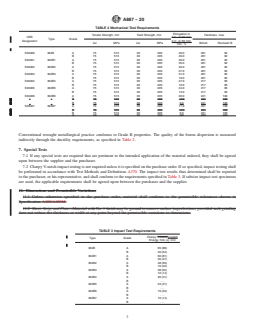
6.1 Tensile Properties—The material shall conform to the tensile property requirements specified in Table 2.
6.2 Hardness—The material shall conform to the hardness requirements as specified in Table 2.
6.3 Grade—The grade of the material is defined by the uniformity of the dispersion of the boron within the melt. Grade A
corresponds to the near-optimal dispersion, while Grade B corresponds to a less-than-optimal dispersion of the boron.
A
TABLE 1 Chemical Requirements Composition
UNS Other
Type Carbon Manganese Phosphorous Sulfur Silicon Chromium Nickel Boron
B
Designation Elements
S30460 304B 0.08 2.00 0.045 0.030 0.75 18.00–20.00 12.00–15.00 0.20–0.29 N 0.10 max
S30461 304B1 0.08 2.00 0.045 0.030 0.75 18.00–20.00 12.00–15.00 0.30–0.49 N 0.10 max
S30462 304B2 0.08 2.00 0.045 0.030 0.75 18.00–20.00 12.00–15.00 0.50–0.74 N 0.10 max
S30463 304B3 0.08 2.00 0.045 0.030 0.75 18.00–20.00 12.00–15.00 0.75–0.99 N 0.10 max
S30464 304B4 0.08 2.00 0.045 0.030 0.75 18.00–20.00 12.00–15.00 1.00–1.24 N 0.10 max
S30465 304B5 0.08 2.00 0.045 0.030 0.75 18.00–20.00 12.00–15.00 1.25–1.49 N 0.10 max
S30466 304B6 0.08 2.00 0.045 0.030 0.75 18.00–20.00 12.00–15.00 1.50–1.74 N 0.10 max
S30467 304B7 0.08 2.00 0.045 0.030 0.75 18.00–20.00 12.00–15.00 1.75–2.25 N 0.10 max
A
Maximum, unless range or minimum is indicated.
B
Cobalt concentration shall be limited to 0.2 max,maximum, unless a lower concentration is agreed upon between the purchaser and the supplier.
A887 − 20
TABLE 2 Mechanical Test Requirements
Elongation in
Tensile Strength, min Yield Strength, min Hardness, max
UNS 2 in. or 50 mm,
Type Grade
Designation 2 in. or 50 mm,
ksi MPa ksi MPa Brinell Rockwell B
min, %
S30460 304B A 75 515 30 205 40.0 201 92
B 75 515 30 205 40.0 201 92
S30461 304B1 A 75 515 30 205 40.0 201 92
B 75 515 30 205 35.0 201 92
S30462 304B2 A 75 515 30 205 35.0 201 92
B 75 515 30 205 27.0 201 92
S30463 304B3 A 75 515 30 205 31.0 201 92
B 75 515 30 205 19.0 201 92
S30464 304B4 A 75 515 30 205 27.0 217 95
B 75 515 30 205 16.0 217 95
S30465 304B5 A 75 515 30 205 24.0 217 95
B 75 515 30 205 13.0 217 95
S30466 304B6 A 75 515 30 205 20.0 241 100
B 75 515 30 205 9.0 241 100
B 75 515 30 205 9.0 241 100
S30467 304B7 A 75 515 30 205 17.0 241 100
B 75 515 30 205 6.0 241 100
B 75 515 30 205 6.0 241 100
Conventional wrought metallurgical practice conforms to Grade B properties. The quality of the boron dispersion is measured
indirectly through the ductility requirements, as specified in Table 2.
7. Special Tests
7.1 If any special tests are required that are pertinent to the intended application of the material ordered, they shall be agreed
upon between the supplier and the purchaser.
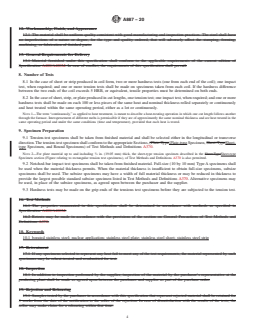
7.2 Charpy V-notch impact testing is not required unless it is specified on the purchase orde
...