

ASTM D5178-21
(Test Method)Standard Test Method for Mar Resistance of Organic Coatings
General Information
- Abstract
SIGNIFICANCE AND USE
5.1 In some situations, marring of coatings applied to substrates under typical use conditions is unacceptable. This test method has been found useful in differentiating the degree of marring of coatings on substrates. It is most useful in providing relative ratings for a series of coated panels exhibiting significant differences in marring.
5.2 In a limited laboratory study, meaningful mar results were impossible when powder coatings were tested. The mar marking, that is, scratches, became less perceptible with time. Therefore, powder coatings may not be applicable coatings for this test method.
SCOPE
1.1 This test method covers the determination of the mar resistance on smooth, flat surfaces. Results are expressed in terms of force-to-mar films of organic coatings such as paint, varnish, and lacquer when applied to smooth, flat planar panel surfaces.
1.2 Units—The values stated in inch-pound units are to be regarded as standard. The values given in parentheses are mathematical conversions to SI units that are provided for information only and are not considered standard.
1.3 This standard does not purport to address all of the safety concerns, if any, associated with its use. It is the responsibility of the user of this standard to establish appropriate safety, health, and environmental practices and determine the applicability of regulatory limitations prior to use.
1.4 This international standard was developed in accordance with internationally recognized principles on standardization established in the Decision on Principles for the Development of International Standards, Guides and Recommendations issued by the World Trade Organization Technical Barriers to Trade (TBT) Committee.
- Status
- Published
- Publication Date
- 31-May-2021
- Technical Committee
- D01 - Paint and Related Coatings, Materials, and Applications
- Drafting Committee
- D01.23 - Physical Properties of Applied Paint Films

Overview
ASTM D5178-21 - Standard Test Method for Mar Resistance of Organic Coatings establishes an internationally recognized procedure for measuring the mar resistance of organic coatings such as paint, varnish, and lacquer, applied to smooth, flat surfaces. By evaluating the ability of a coating to resist damage caused by light abrasion, this standard supports manufacturers, quality assurance teams, and materials engineers in quantifying surface durability and optimizing product performance.
Mar resistance is an important indicator of a coating’s ability to maintain aesthetic and protective properties during use. Marred surfaces can compromise not only appearance but sometimes function or longevity of the coated substrate.
Key Topics
- Mar Resistance Definition: The ability of a coating to withstand permanent deformation caused by dynamic mechanical force, such as scratching or light abrasion.
- Test Method Procedure: Organic coatings are applied with uniform thickness to test panels, conditioned, and then subjected to increasing or decreasing loads using a loop stylus on a balanced beam mar tester until visible marring occurs.
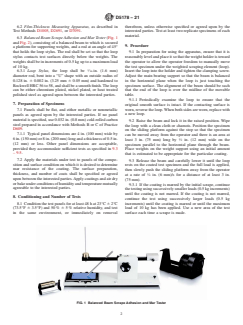
- Standardized Testing Apparatus: Balanced beam scrape adhesion and mar tester equipped with a precise loop stylus, consistent with ASTM protocols, allows for objective mar resistance measurement.
- Test Panel Preparation: Includes recommended practices for panel dimensions, surface preparation, humidity, and temperature control, referencing relevant associated standards.
- Precision and Repeatability: The method specifies procedures for determining critical load at failure and provides statistical guidance for repeatability and reproducibility among different operators and laboratories.
- Applicability: The method is best suited for comparing the mar resistance of different coatings on similar panel surfaces. It is not recommended for powder coatings, as their scratch markings may become less perceptible over time.
Applications
ASTM D5178-21 is widely used across industries where appearance and surface durability are critical, such as:
- Automotive: Evaluating mar resistance of car body paints and clearcoats to ensure long-lasting, high-quality finishes.
- Consumer Electronics: Ensuring resistance to everyday handling and abrasion on painted or varnished device surfaces.
- Appliances and Furniture: Assessing durability of coatings exposed to regular use and cleaning.
- Architectural and Industrial Coatings: Comparing performance of coatings on doors, windows, and machinery panels.
- Quality Control and R&D: Informing product development, selection of coating systems, and customer specifications by providing comparative data on mar resistance.
The standard aids in verifying compliance with contract requirements, improving product performance, and reducing warranty claims associated with surface defects.
Related Standards
ASTM D5178-21 makes reference to and is often used in conjunction with several other key ASTM standards relevant to organic coatings and paint testing:
- ASTM D609: Practice for Preparation of Cold-Rolled Steel Panels for Testing Paint, Varnish, Conversion Coatings, and Related Coating Products.
- ASTM D823: Practices for Producing Films of Uniform Thickness of Paint, Coatings and Related Products on Test Panels.
- ASTM D1005: Test Method for Measurement of Dry-Film Thickness of Organic Coatings Using Micrometers.
- ASTM D7091: Practice for Nondestructive Measurement of Dry Film Thickness of Nonmagnetic Coatings Applied to Ferrous and Nonferrous Metals.
- ASTM E177 and ASTM E691: Practices related to the precision and bias of ASTM test methods and conducting interlaboratory studies.
Together, these standards form a comprehensive framework for evaluating and optimizing the performance of organic coatings in diverse applications, supporting reliability and consistency across industries.
Keywords: mar resistance, organic coatings, abrasion testing, ASTM D5178, paint durability, lacquer, varnish, balanced beam mar tester, surface protection, coating performance.
Relations
- Effective Date
- 01-Jun-2020
- Effective Date
- 01-Dec-2017
- Effective Date
- 01-May-2014
- Effective Date
- 01-May-2013
- Effective Date
- 01-May-2013
- Effective Date
- 01-Nov-2012
- Effective Date
- 01-Jun-2012
- Effective Date
- 01-Apr-2012
- Effective Date
- 01-Nov-2011
- Effective Date
- 01-Oct-2010
- Effective Date
- 01-Oct-2008
- Effective Date
- 01-Oct-2008
- Effective Date
- 01-Nov-2007
- Effective Date
- 01-Jun-2007
- Refers
ASTM E177-06b - Standard Practice for Use of the Terms Precision and Bias in ASTM Test Methods - Effective Date
- 15-Nov-2006
Get Certified
Connect with accredited certification bodies for this standard

DVS-ZERT GmbH
German welding certification society.
CARES (UK Certification Authority for Reinforcing Steels)
UK certification for reinforcing steels and construction.
EWF/IIW (European/International Welding Federation)
International welding personnel certification.
Sponsored listings
Frequently Asked Questions
ASTM D5178-21 is a standard published by ASTM International. Its full title is "Standard Test Method for Mar Resistance of Organic Coatings". This standard covers: SIGNIFICANCE AND USE 5.1 In some situations, marring of coatings applied to substrates under typical use conditions is unacceptable. This test method has been found useful in differentiating the degree of marring of coatings on substrates. It is most useful in providing relative ratings for a series of coated panels exhibiting significant differences in marring. 5.2 In a limited laboratory study, meaningful mar results were impossible when powder coatings were tested. The mar marking, that is, scratches, became less perceptible with time. Therefore, powder coatings may not be applicable coatings for this test method. SCOPE 1.1 This test method covers the determination of the mar resistance on smooth, flat surfaces. Results are expressed in terms of force-to-mar films of organic coatings such as paint, varnish, and lacquer when applied to smooth, flat planar panel surfaces. 1.2 Units—The values stated in inch-pound units are to be regarded as standard. The values given in parentheses are mathematical conversions to SI units that are provided for information only and are not considered standard. 1.3 This standard does not purport to address all of the safety concerns, if any, associated with its use. It is the responsibility of the user of this standard to establish appropriate safety, health, and environmental practices and determine the applicability of regulatory limitations prior to use. 1.4 This international standard was developed in accordance with internationally recognized principles on standardization established in the Decision on Principles for the Development of International Standards, Guides and Recommendations issued by the World Trade Organization Technical Barriers to Trade (TBT) Committee.
SIGNIFICANCE AND USE 5.1 In some situations, marring of coatings applied to substrates under typical use conditions is unacceptable. This test method has been found useful in differentiating the degree of marring of coatings on substrates. It is most useful in providing relative ratings for a series of coated panels exhibiting significant differences in marring. 5.2 In a limited laboratory study, meaningful mar results were impossible when powder coatings were tested. The mar marking, that is, scratches, became less perceptible with time. Therefore, powder coatings may not be applicable coatings for this test method. SCOPE 1.1 This test method covers the determination of the mar resistance on smooth, flat surfaces. Results are expressed in terms of force-to-mar films of organic coatings such as paint, varnish, and lacquer when applied to smooth, flat planar panel surfaces. 1.2 Units—The values stated in inch-pound units are to be regarded as standard. The values given in parentheses are mathematical conversions to SI units that are provided for information only and are not considered standard. 1.3 This standard does not purport to address all of the safety concerns, if any, associated with its use. It is the responsibility of the user of this standard to establish appropriate safety, health, and environmental practices and determine the applicability of regulatory limitations prior to use. 1.4 This international standard was developed in accordance with internationally recognized principles on standardization established in the Decision on Principles for the Development of International Standards, Guides and Recommendations issued by the World Trade Organization Technical Barriers to Trade (TBT) Committee.
ASTM D5178-21 is classified under the following ICS (International Classification for Standards) categories: 25.220.60 - Organic coatings. The ICS classification helps identify the subject area and facilitates finding related standards.
ASTM D5178-21 has the following relationships with other standards: It is inter standard links to ASTM D1005-95(2020), ASTM D823-17, ASTM E177-14, ASTM E177-13, ASTM E691-13, ASTM D823-95(2012), ASTM D609-00(2012), ASTM D7091-12, ASTM E691-11, ASTM E177-10, ASTM E691-08, ASTM E177-08, ASTM D1005-95(2007), ASTM D823-95(2007), ASTM E177-06b. Understanding these relationships helps ensure you are using the most current and applicable version of the standard.
ASTM D5178-21 is available in PDF format for immediate download after purchase. The document can be added to your cart and obtained through the secure checkout process. Digital delivery ensures instant access to the complete standard document.
Standards Content (Sample)
This international standard was developed in accordance with internationally recognized principles on standardization established in the Decision on Principles for the
Development of International Standards, Guides and Recommendations issued by the World Trade Organization Technical Barriers to Trade (TBT) Committee.
Designation: D5178 − 21
Standard Test Method for
Mar Resistance of Organic Coatings
This standard is issued under the fixed designation D5178; the number immediately following the designation indicates the year of
original adoption or, in the case of revision, the year of last revision. A number in parentheses indicates the year of last reapproval. A
superscript epsilon (´) indicates an editorial change since the last revision or reapproval.
1. Scope* Thickness of Coatings on Wood Products (Withdrawn
1992)
1.1 This test method covers the determination of the mar
D7091 Practice for Nondestructive Measurement of Dry
resistance on smooth, flat surfaces. Results are expressed in
Film Thickness of Nonmagnetic Coatings Applied to
terms of force-to-mar films of organic coatings such as paint,
Ferrous Metals and Nonmagnetic, Nonconductive Coat-
varnish, and lacquer when applied to smooth, flat planar panel
ings Applied to Non-Ferrous Metals
surfaces.
E177 Practice for Use of the Terms Precision and Bias in
1.2 Units—The values stated in inch-pound units are to be
ASTM Test Methods
regarded as standard. The values given in parentheses are
E691 Practice for Conducting an Interlaboratory Study to
mathematical conversions to SI units that are provided for
Determine the Precision of a Test Method
information only and are not considered standard.
3. Terminology
1.3 This standard does not purport to address all of the
3.1 Definitions:
safety concerns, if any, associated with its use. It is the
3.1.1 mar resistance, n—the ability of a coating to resist
responsibility of the user of this standard to establish appro-
damage caused by light abrasion; it is a resistance of the
priate safety, health, and environmental practices and deter-
surface of the coating to permanent deformation, resulting
mine the applicability of regulatory limitations prior to use.
from the application of a dynamic mechanical force.
1.4 This international standard was developed in accor-
dance with internationally recognized principles on standard-
4. Summary of Test Method
ization established in the Decision on Principles for the
4.1 Thematerialsundertestareappliedatuniformthickness
Development of International Standards, Guides and Recom-
to flat panels of uniform surface texture. After drying/curing,
mendations issued by the World Trade Organization Technical
the mar resistance is determined by pushing the panels beneath
Barriers to Trade (TBT) Committee.
a loop stylus at a constant normal load. Increasing (decreasing)
loads are applied to the stylus until the coating is marred (not
2. Referenced Documents
marred).
2.1 ASTM Standards:
5. Significance and Use
D609 Practice for Preparation of Cold-Rolled Steel Panels
for Testing Paint, Varnish, Conversion Coatings, and
5.1 In some situations, marring of coatings applied to
Related Coating Products
substrates under typical use conditions is unacceptable. This
D823 Practices for Producing Films of Uniform Thickness
test method has been found useful in differentiating the degree
of Paint, Coatings and Related Products on Test Panels
of marring of coatings on substrates. It is most useful in
D1005 Test Method for Measurement of Dry-Film Thick- providing relative ratings for a series of coated panels exhib-
ness of Organic Coatings Using Micrometers
iting significant differences in marring.
D2691 Method for Microscopical Measurement of Dry Film
5.2 In a limited laboratory study, meaningful mar results
were impossible when powder coatings were tested. The mar
marking, that is, scratches, became less perceptible with time.
This test method is under the jurisdiction of ASTM Committee D01 on Paint
Therefore, powder coatings may not be applicable coatings for
and Related Coatings, Materials, andApplications and is the direct responsibility of
this test method.
Subcommittee D01.23 on Physical Properties of Applied Paint Films.
Current edition approved June 1, 2021. Published June 2021. Originally
6. Apparatus
approved in 1991. Last previous edition approved in 2016 as D5178 – 16. DOI:
10.1520/D5178-21.
6.1 Application Equipment, as described in Practices D823.
For referenced ASTM standards, visit the ASTM website, www.astm.org, or
contact ASTM Customer Service at service@astm.org. For Annual Book of ASTM
Standards volume information, refer to the standard’s Document Summary page on The last approved version of this historical standard is referenced on
the ASTM website. www.astm.org.
*A Summary of Changes section appears at the end of this standard
Copyright © ASTM International, 100 Barr Harbor Drive, PO Box C700, West Conshohocken, PA 19428-2959. United States
D5178 − 21
6.2 Film-Thickness Measuring Apparatus, as described in therefrom, unless otherwise specified or agreed upon by the
Test Methods D1005, D2691,or D7091. interested parties. Test at least two replicate specimens of each
material.
6.3 Balanced Beam Scrape Adhesion and Mar Tester (Fig. 1
and Fig. 2), consisting of a balanced beam to which is secured
9. Procedure
a platform for supporting weights, and a rod at an angle of 45°
that holds the loop stylus. The rod shall be set so that the loop 9.1 In preparation for using the apparatus, ensure that it is
stylus contacts test surfaces directly below the weights. The reasonablylevelandplaceitsothattheweightholderistoward
weights shall be in increments of 0.5 kg up to a maximum load the operator to allow the operator freedom to manually move
of 10 kg. the test specimen under the weighted scraping element (loop).
6.3.1 Loop Stylus, the loop shall be ⁄16 in. (1.6 mm) Insert the loop into the holder and tighten the clamping screw.
diameter rod, bent into a “U” shape with an outside radius of Adjust the main bearing support so that the beam is balanced
0.128 in. 6 0.002 in. (3.25 mm 6 0.05 mm) and hardened to in the horizontal plane when the loop is just touching the
Rockwell HRC 56 to 58, and shall be a smooth finish.The loop specimen surface. The alignment of the beam should be such
can be either chromium plated, nickel plated, or heat treated that the end of the loop is over the midline of the movable
polished steel as agreed upon between the interested parties. table.
9.1.1 Periodically examine the loop to ensure that the
7. Preparation of Specimens
original smooth surface is intact. If the contacting surface is
worn, reverse the loop.When both sides are worn, replace with
7.1 Panels shall be flat, and either metallic or nonmetallic
a new loop.
panels as agreed upon by the interested parties. If no panel
material is specified, use 0.032 in. (0.8 mm) cold-rolled carbon
9.2 Raise the beam and lock it in the raised position. Wipe
steel prepared in accordance with Methods B or C of Practice
the loop with a clean cloth or chamois. Position the specimen
D609.
on the sliding platform against the stop so that the specimen
7.1.1 Typical panel dimensions are 4 in. (100 mm) wide by
can be moved away from the operator and there is an area at
6in.(150mm)or8in.(200mm)longandathicknessof0.5 in. 1
least 3 in. (75 mm) long by ⁄2 in. (12 mm) wide on the
(12 mm) or less. Other panel dimensions are acceptable,
specimen parallel to the horizontal plane through the beam.
provided they accommodate sufficient tests as specified in 9.3
Place weights on the weight support using an initial amount
– 9.5.
that is estimated to be appropriate for the particular coating.
7.2 Apply the materials under test to panels of the compo-
9.3 Release the beam and carefully lower it until the loop
sition and surface condition on which it is desired to determine
rests on the coated test specimen and the full load is applied,
mar resistance of the coating. The surface preparation,
then slowly push the sliding platform away from the operator
thickness, and number of coats shall be specified or agreed
at a rate of ⁄4 in. (6 mm)/s for a distance of at least 3 in.
upon between the interested parties.Apply coatings and air dry
(75 mm).
orbakeunderconditionsofhumidityandtemperaturemutually
9.3.1 If the coating is marred by the initial scrape, continue
agreeable to the interested parties.
thetestingusingsuccessivelysmallerloads(0.5kgincrements)
until the coating is not marred. If the coating is not m
...
This document is not an ASTM standard and is intended only to provide the user of an ASTM standard an indication of what changes have been made to the previous version. Because
it may not be technically possible to adequately depict all changes accurately, ASTM recommends that users consult prior editions as appropriate. In all cases only the current version
of the standard as published by ASTM is to be considered the official document.
Designation: D5178 − 16 D5178 − 21
Standard Test Method for
Mar Resistance of Organic Coatings
This standard is issued under the fixed designation D5178; the number immediately following the designation indicates the year of
original adoption or, in the case of revision, the year of last revision. A number in parentheses indicates the year of last reapproval. A
superscript epsilon (´) indicates an editorial change since the last revision or reapproval.
1. Scope Scope*
1.1 This test method covers the determination of the mar resistance on smooth, flat surfaces. Results are expressed in terms of
force-to-mar films of organic coatings such as paint, varnish, and lacquer when applied to smooth, flat planar panel surfaces.
1.2 Units—The values stated in inch-pound units are to be regarded as standard. The values given in parentheses are mathematical
conversions to SI units that are provided for information only and are not considered standard.
1.3 This standard does not purport to address all of the safety concerns, if any, associated with its use. It is the responsibility
of the user of this standard to establish appropriate safety safety, health, and healthenvironmental practices and determine the
applicability of regulatory limitations prior to use.
1.4 This international standard was developed in accordance with internationally recognized principles on standardization
established in the Decision on Principles for the Development of International Standards, Guides and Recommendations issued
by the World Trade Organization Technical Barriers to Trade (TBT) Committee.
2. Referenced Documents
2.1 ASTM Standards:
D609 Practice for Preparation of Cold-Rolled Steel Panels for Testing Paint, Varnish, Conversion Coatings, and Related Coating
Products
D823 Practices for Producing Films of Uniform Thickness of Paint, Coatings and Related Products on Test Panels
D1005 Test Method for Measurement of Dry-Film Thickness of Organic Coatings Using Micrometers
D1186D2691 Test Methods Method for NondestructiveMicroscopical Measurement of Dry Film Thickness of Nonmagnetic
Coatings Applied to a Ferrous BaseCoatings on Wood Products (Withdrawn 2006)1992)
D1400D7091 Test Method Practice for Nondestructive Measurement of Dry Film Thickness of Nonmagnetic Coatings Applied
to Ferrous Metals and Nonmagnetic, Nonconductive Coatings Applied to a Nonferrous Metal BaseNon-Ferrous Metals
(Withdrawn 2006)
D2691 Method for Microscopical Measurement of Dry Film Thickness of Coatings on Wood Products (Withdrawn 1992)
E177 Practice for Use of the Terms Precision and Bias in ASTM Test Methods
E691 Practice for Conducting an Interlaboratory Study to Determine the Precision of a Test Method
3. Terminology
3.1 Definitions:
This test method is under the jurisdiction of ASTM Committee D01 on Paint and Related Coatings, Materials, and Applications and is the direct responsibility of
Subcommittee D01.23 on Physical Properties of Applied Paint Films.
Current edition approved Dec. 1, 2016June 1, 2021. Published January 2017June 2021. Originally approved in 1991. Last previous edition approved in 20132016 as
D5178 – 13.D5178 – 16. DOI: 10.1520/D5178-16.10.1520/D5178-21.
For referenced ASTM standards, visit the ASTM website, www.astm.org, or contact ASTM Customer Service at service@astm.org. For Annual Book of ASTM Standards
volume information, refer to the standard’s Document Summary page on the ASTM website.
The last approved version of this historical standard is referenced on www.astm.org.
*A Summary of Changes section appears at the end of this standard
Copyright © ASTM International, 100 Barr Harbor Drive, PO Box C700, West Conshohocken, PA 19428-2959. United States
D5178 − 21
3.1.1 mar resistance, n—the ability of a coating to resist damage caused by light abrasion. As just defined, abrasion; it is a
resistance of the surface of the coating to permanent deformation, resulting from the application of a dynamic mechanical force.
4. Summary of Test Method
4.1 The materials under test are applied at uniform thickness to flat panels of uniform surface texture. After drying/curing, the mar
resistance is determined by pushing the panels beneath a rounded stylus or loop that is loaded in increasing amounts loop stylus
at a constant normal load. Increasing (decreasing) loads are applied to the stylus until the coating is marred. marred (not marred).
5. Significance and Use
5.1 In some situations, marring of coatings applied to substrates under typical use conditions is unacceptable. This test method
has been found useful in differentiating the degree of marring of coatings on substrates. It is most useful in providing relative
ratings for a series of coated panels exhibiting significant differences in marring.
5.2 In a limited laboratory study, meaningful mar results were impossible when powder coatings were tested. The mar marking,
that is, scratches, became less perceptible with time. Therefore, powder coatings may not be applicable coatings for this test
method.
6. Apparatus
6.1 Application Equipment, as described in Practices D823.
6.2 Film-Thickness Measuring Apparatus, as described in Test Methods D1005, D1186D2691, D1400, or D2691D7091.
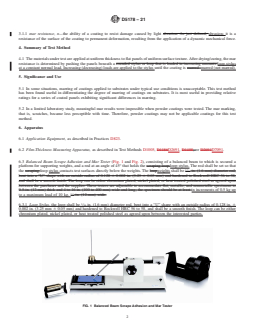
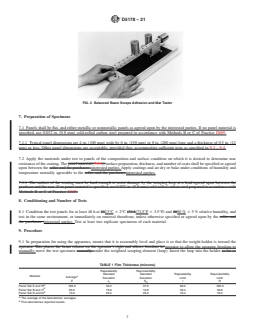
6.3 Balanced Beam Scrape Adhesion and Mar Tester (Fig. 1 and Fig. 2), consisting of a balanced beam to which is secured a
platform for supporting weights, and a rod at an angle of 45° that holds the scraping loop.loop stylus. The rod shall be set so that
the scraping loop stylus contacts test surfaces directly below the weights. The loopweights shall be ⁄16-in. (1.6 mm) diameter rod,
bent into a “U” shape with an outside radius of 0.128 6 0.002 in. (3.25 6 0.05 mm) and hardened to Rockwell HRC 56 to 58,
and shall be a smooth finish. The loop can be either chromium plated, nickel plated, or heat treated polished steel as agreed upon
between the purchaser and the supplier. These testers are adjustable to accommodate flat, metallic, and nonmetallic specimens to
0.5-in. (12-mm) thick and 4 to 16 in. (100 to 400 mm) wide and long; the specimen should be at least in increments of 0.5 kg up
to a maximum load of 10 kg. ⁄2-in. (12-mm) wide.
6.3.1 Loop Stylus, the loop shall be ⁄16 in. (1.6 mm) diameter rod, bent into a “U” shape with an outside radius of 0.128 in. 6
0.002 in. (3.25 mm 6 0.05 mm) and hardened to Rockwell HRC 56 to 58, and shall be a smooth finish. The loop can be either
chromium plated, nickel plated, or heat treated polished steel as agreed upon between the interested parties.
FIG. 1 Balanced Beam Scrape Adhesion and Mar Tester
D5178 − 21
FIG. 2 Balanced Beam Scrape Adhesion and Mar Tester
7. Preparation of Specimens
7.1 Panels shall be flat, and either metallic or nonmetallic panels as agreed upon by the interested parties. If no panel material is
specified, use 0.032 in. (0.8 mm) cold-rolled carbon steel prepared in accordance with Methods B or C of Practice D609.
7.1.1 Typical panel dimensions are 4 in. (100 mm) wide by 6 in. (150 mm) or 8 in. (200 mm) long and a thickness of 0.5 in. (12
mm) or less. Other panel dimensions are acceptable, provided they accommodate sufficient tests as specified in 9.3 – 9.5.
7.2 Apply the materials under test to panels of the composition and surface condition on which it is desired to determine mar
resistance of the coating. The panel material (7.1.1), surface preparation, thickness, and number of coats shall be specified or agreed
upon between the seller and the purchaser. interested parties. Apply coatings and air dry or bake under conditions of humidity and
temperature mutually agreeable to the seller and the purchaser.interested parties.
7.1.1 The surface of the coating must be hard enough to resist damage by the scraping loop at a load agreed upon between the
producer and the user. If no panel material is specified, use 0.032-in. (0.8-mm) cold-rolled carbon steel prepared in accordance with
Methods B or C of Practice D609.
8. Conditioning and Number of Tests
8.1 Condition the test panels for at least 48 h at 2323°C 6 2°C (73.5(73.5°F 6 3.5°F) and 5050 % 6 5 % relative humidity, and
test in the same environment, or immediately on removal therefrom, unless otherwise specified or agreed upon by the seller and
the purchaser. interested parties. Test at least two replicate specimens of each material.
9. Procedure
9.1 In preparation for using the apparatus, ensure that it is reasonably level and place it so that the weight holder is toward the
operator. This places the beam release on the operator’s right and allows freedom to operator to allow the operator freedom to
manually move the test specimen manually under the weighted scraping element (loop). Insert the loop into the holder as far as
TABLE 1 Film Thickness (microns)
Repeatability Reproducibility
Standard Standard Repeatability Reproducibility
Material A
Average
Deviation Deviation Limit Limit
¯
X s S r R
r R
B
Panel Set E and R 109.9 32.2 37.5 90.2 105.0
B
Panel Set B and H 93.3 10.9 10.9 30.4 30.6
B
Panel Set D and G 74.0 25.2 25.2 70.4 70.4
A
The average of the laboratories’ averages.
B
Five laboratories reported results.
D5178 − 21
TABLE 2 Load at the Mar Failure End Point (kg)
Repeatability Reproducibility
Standard Standard Repeatability Reproducibility
Material A
Average
Deviation Deviation Limit Limit
¯
X s S r R
r R
B
Panel Set E and R 7.05 0.88 1.98 2.46 5.55
B
Panel Set B and H 1.52 1.34 1.34 3.75 3.75
Panel Set D and G 1.25 0.93 0.93 2.60 2.60
A
The average of the laboratories’ averages.
B
...