

ASTM B528-16(2020)e1
(Test Method)Standard Test Method for Transverse Rupture Strength of Powder Metallurgy (PM) Specimens
General Information
- Abstract
SIGNIFICANCE AND USE
4.1 This test method is used to measure the strength of sintered, including post-treated, specimens. Transverse rupture strength is not a design value. For many sintered materials, transverse rupture strength is approximately twice the ultimate tensile strength.
SCOPE
1.1 This test method covers determination of the transverse rupture strength of sintered, including post-treated, powder metallurgy test specimens by subjecting them to a uniformly increasing transverse force under controlled conditions. The term “transverse rupture strength” as used herein, defines the stress, calculated from the flexure formula required to break a specimen as a simple beam supported near the ends and applying the force midway between the fixed line center of the supports.
1.2 Limitations—The transverse rupture test is only applicable to relatively brittle materials. In cases where a ductile specimen is being tested and the permanent deflection as a result of testing exceeds 0.02 in. (0.5 mm), the test results may be questionable.
1.3 Test Method B406 should be consulted for determining the transverse rupture strength of cemented carbides.
1.4 The values stated in inch-pound units are to be regarded as standard. The values given in parentheses are mathematical conversions to SI units that are provided for information only and are not considered standard.
1.5 This standard does not purport to address all of the safety concerns, if any, associated with its use. It is the responsibility of the user of this standard to establish appropriate safety, health, and environmental practices and determine the applicability of regulatory limitations prior to use.
1.6 This international standard was developed in accordance with internationally recognized principles on standardization established in the Decision on Principles for the Development of International Standards, Guides and Recommendations issued by the World Trade Organization Technical Barriers to Trade (TBT) Committee.
- Status
- Published
- Publication Date
- 30-Sep-2020
- Technical Committee
- B09 - Metal Powders and Metal Powder Products
- Drafting Committee
- B09.05 - Structural Parts


Overview
ASTM B528-16(2020)e1, titled "Standard Test Method for Transverse Rupture Strength of Powder Metallurgy (PM) Specimens," establishes a widely recognized procedure for determining the transverse rupture strength (TRS) of sintered and post-treated powder metallurgy (PM) specimens. Developed by ASTM International, this test method is essential for quality assurance in the production of brittle PM materials. The standard ensures accurate and consistent measurement of PM strength under transverse loading, serving industries that require reliable assessment of mechanical properties of sintered metals.
The transverse rupture strength determined by this standard is not intended as a design value. Many sintered PM materials possess a TRS that is roughly double their ultimate tensile strength, providing valuable comparative strength data for materials evaluation and control.
Key Topics
- Purpose and Scope: Outlines the method for evaluating the TRS of sintered and post-treated PM specimens using a standardized three-point bending test.
- Applicability: Best suited for brittle materials; ductile specimens that show significant permanent deflection may yield unreliable results.
- Test Methodology:
- Specimen Preparation: Specimens are pressed and sintered or machined from finished PM products following standardized shapes and dimensions.
- Testing Apparatus: Includes a micrometer for precise measurements, a transverse rupture strength fixture, and a compression testing machine.
- Procedure: The specimen is loaded at a controlled speed until rupture, and the maximum force is recorded.
- Calculation: TRS is calculated using a flexure formula accounting for force, specimen width, thickness, and support distance.
- Limitations:
- Primarily applies to brittle sintered PM materials.
- Not suitable where permanent deflection exceeds 0.02 in. (0.5 mm).
- Reporting: Requires the average of at least three tests and thorough documentation of material characteristics.
Applications
- Quality Control: Ensures consistency in the mechanical properties of powder metallurgy components, aiding manufacturers in maintaining product standardization.
- Material Evaluation: Widely used in materials laboratories to characterize and compare the inherent strength of sintered metals and alloys.
- Research & Development: Supports development of novel PM materials and treatments by providing a reproducible method for mechanical assessment.
- Industry Sectors:
- Automotive: Evaluation of PM parts such as gears, bushings, and structural components.
- Aerospace: Qualification of lightweight, high-strength sintered metal parts.
- Electronics and Tools: Assessment of brittle PM parts used in various assemblies and tooling.
Related Standards
To ensure comprehensive understanding and implementation, ASTM B528 references and is closely associated with several other important standards, including:
- ASTM B243: Standard Terminology of Powder Metallurgy
- ASTM B312: Test Method for Green Strength of Specimens Compacted from Metal Powders
- ASTM B406: Test Method for Transverse Rupture Strength of Cemented Carbides (specific to carbides)
- ASTM B925: Practices for Production and Preparation of Powder Metallurgy Test Specimens
- ASTM E691: Practice for Conducting an Interlaboratory Study to Determine the Precision of a Test Method
Summary
The ASTM B528 test method is a critical tool for determining the transverse rupture strength of brittle PM specimens, facilitating material comparison, process control, and research. Its standardized approach, reproducibility, and integration with related ASTM standards make it a preferred choice for industries relying on powder metallurgy technologies. This method helps ensure reliable, high-quality PM products that meet stringent industrial demands.
Keywords: transverse rupture strength, powder metallurgy, PM specimens, ASTM B528, sintered materials, mechanical testing, material evaluation, quality control, flexural strength, standard test method.
Relations
- Refers
ASTM B312-20 - Standard Test Method for Green Strength of Specimens Compacted from Metal Powders - Effective Date
- 01-Apr-2020
- Effective Date
- 01-Oct-2018
- Effective Date
- 01-Jul-2016
- Refers
ASTM B312-14 - Standard Test Method for Green Strength of Specimens Compacted from Metal Powders - Effective Date
- 01-Jun-2014
- Effective Date
- 01-Nov-2013
- Effective Date
- 01-May-2013
- Effective Date
- 15-Jul-2012
- Effective Date
- 15-Nov-2011
- Effective Date
- 01-Nov-2011
- Refers
ASTM B406-96(2010) - Standard Test Method for Transverse Rupture Strength of Cemented Carbides - Effective Date
- 01-Sep-2010
- Effective Date
- 15-Jan-2010
- Effective Date
- 15-Dec-2009
- Refers
ASTM B312-09 - Standard Test Method for Green Strength of Specimens Compacted from Metal Powders - Effective Date
- 01-May-2009
- Effective Date
- 01-Jan-2009
- Effective Date
- 01-Oct-2008
Get Certified
Connect with accredited certification bodies for this standard

Element Materials Technology
Materials testing and product certification.

Inštitut za kovinske materiale in tehnologije
Institute of Metals and Technology. Materials testing, metallurgical analysis, NDT.
Sponsored listings
Frequently Asked Questions
ASTM B528-16(2020)e1 is a standard published by ASTM International. Its full title is "Standard Test Method for Transverse Rupture Strength of Powder Metallurgy (PM) Specimens". This standard covers: SIGNIFICANCE AND USE 4.1 This test method is used to measure the strength of sintered, including post-treated, specimens. Transverse rupture strength is not a design value. For many sintered materials, transverse rupture strength is approximately twice the ultimate tensile strength. SCOPE 1.1 This test method covers determination of the transverse rupture strength of sintered, including post-treated, powder metallurgy test specimens by subjecting them to a uniformly increasing transverse force under controlled conditions. The term “transverse rupture strength” as used herein, defines the stress, calculated from the flexure formula required to break a specimen as a simple beam supported near the ends and applying the force midway between the fixed line center of the supports. 1.2 Limitations—The transverse rupture test is only applicable to relatively brittle materials. In cases where a ductile specimen is being tested and the permanent deflection as a result of testing exceeds 0.02 in. (0.5 mm), the test results may be questionable. 1.3 Test Method B406 should be consulted for determining the transverse rupture strength of cemented carbides. 1.4 The values stated in inch-pound units are to be regarded as standard. The values given in parentheses are mathematical conversions to SI units that are provided for information only and are not considered standard. 1.5 This standard does not purport to address all of the safety concerns, if any, associated with its use. It is the responsibility of the user of this standard to establish appropriate safety, health, and environmental practices and determine the applicability of regulatory limitations prior to use. 1.6 This international standard was developed in accordance with internationally recognized principles on standardization established in the Decision on Principles for the Development of International Standards, Guides and Recommendations issued by the World Trade Organization Technical Barriers to Trade (TBT) Committee.
SIGNIFICANCE AND USE 4.1 This test method is used to measure the strength of sintered, including post-treated, specimens. Transverse rupture strength is not a design value. For many sintered materials, transverse rupture strength is approximately twice the ultimate tensile strength. SCOPE 1.1 This test method covers determination of the transverse rupture strength of sintered, including post-treated, powder metallurgy test specimens by subjecting them to a uniformly increasing transverse force under controlled conditions. The term “transverse rupture strength” as used herein, defines the stress, calculated from the flexure formula required to break a specimen as a simple beam supported near the ends and applying the force midway between the fixed line center of the supports. 1.2 Limitations—The transverse rupture test is only applicable to relatively brittle materials. In cases where a ductile specimen is being tested and the permanent deflection as a result of testing exceeds 0.02 in. (0.5 mm), the test results may be questionable. 1.3 Test Method B406 should be consulted for determining the transverse rupture strength of cemented carbides. 1.4 The values stated in inch-pound units are to be regarded as standard. The values given in parentheses are mathematical conversions to SI units that are provided for information only and are not considered standard. 1.5 This standard does not purport to address all of the safety concerns, if any, associated with its use. It is the responsibility of the user of this standard to establish appropriate safety, health, and environmental practices and determine the applicability of regulatory limitations prior to use. 1.6 This international standard was developed in accordance with internationally recognized principles on standardization established in the Decision on Principles for the Development of International Standards, Guides and Recommendations issued by the World Trade Organization Technical Barriers to Trade (TBT) Committee.
ASTM B528-16(2020)e1 is classified under the following ICS (International Classification for Standards) categories: 77.160 - Powder metallurgy. The ICS classification helps identify the subject area and facilitates finding related standards.
ASTM B528-16(2020)e1 has the following relationships with other standards: It is inter standard links to ASTM B312-20, ASTM B243-18, ASTM B243-16, ASTM B312-14, ASTM B243-13, ASTM E691-13, ASTM B243-12, ASTM B243-11, ASTM E691-11, ASTM B406-96(2010), ASTM B243-10, ASTM B243-09a, ASTM B312-09, ASTM B243-09, ASTM E691-08. Understanding these relationships helps ensure you are using the most current and applicable version of the standard.
ASTM B528-16(2020)e1 is available in PDF format for immediate download after purchase. The document can be added to your cart and obtained through the secure checkout process. Digital delivery ensures instant access to the complete standard document.
Standards Content (Sample)
This international standard was developed in accordance with internationally recognized principles on standardization established in the Decision on Principles for the
Development of International Standards, Guides and Recommendations issued by the World Trade Organization Technical Barriers to Trade (TBT) Committee.
´1
Designation: B528 − 16 (Reapproved 2020)
Standard Test Method for
Transverse Rupture Strength of Powder Metallurgy (PM)
Specimens
This standard is issued under the fixed designation B528; the number immediately following the designation indicates the year of
original adoption or, in the case of revision, the year of last revision. A number in parentheses indicates the year of last reapproval. A
superscript epsilon (´) indicates an editorial change since the last revision or reapproval.
ε NOTE—An editorial change was made to 10.1 in October 2020.
1. Scope* 2. Referenced Documents
2.1 ASTM Standards:
1.1 This test method covers determination of the transverse
rupture strength of sintered, including post-treated, powder B243 Terminology of Powder Metallurgy
B312 Test Method for Green Strength of Specimens Com-
metallurgy test specimens by subjecting them to a uniformly
increasing transverse force under controlled conditions. The pacted from Metal Powders
B406 Test Method for Transverse Rupture Strength of Ce-
term “transverse rupture strength” as used herein, defines the
stress, calculated from the flexure formula required to break a mented Carbides
B925 Practices for Production and Preparation of Powder
specimen as a simple beam supported near the ends and
applying the force midway between the fixed line center of the Metallurgy (PM) Test Specimens
E691 Practice for Conducting an Interlaboratory Study to
supports.
Determine the Precision of a Test Method
1.2 Limitations—The transverse rupture test is only appli-
cable to relatively brittle materials. In cases where a ductile
3. Terminology
specimen is being tested and the permanent deflection as a
3.1 Definitions—For definitions of terms in this test method,
result of testing exceeds 0.02 in. (0.5 mm), the test results may
see Terminology B243.
be questionable.
1.3 Test Method B406 should be consulted for determining 4. Significance and Use
the transverse rupture strength of cemented carbides.
4.1 This test method is used to measure the strength of
sintered, including post-treated, specimens. Transverse rupture
1.4 The values stated in inch-pound units are to be regarded
as standard. The values given in parentheses are mathematical strength is not a design value. For many sintered materials,
transverse rupture strength is approximately twice the ultimate
conversions to SI units that are provided for information only
and are not considered standard. tensile strength.
1.5 This standard does not purport to address all of the
5. Apparatus
safety concerns, if any, associated with its use. It is the
5.1 Micrometer, capable of measuring with a resolution of
responsibility of the user of this standard to establish appro-
0.0001 in. (0.002 mm).
priate safety, health, and environmental practices and deter-
mine the applicability of regulatory limitations prior to use.
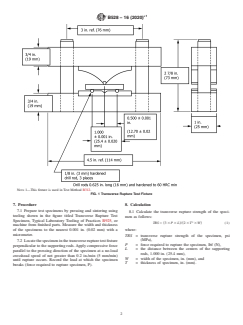
5.2 Transverse Rupture Strength Fixture,asshowninFig.1.
1.6 This international standard was developed in accor-
5.3 Compression Testing Machine, readable to within 0.1 %
dance with internationally recognized principles on standard-
of full scale reading. Use the lowest testing range that can
ization established in the Decision on Principles for the
provide a measurable result.
Development of International Standards, Guides and Recom-
mendations issued by the World Trade Organization Technical
6. Test Specimen
Barriers to Trade (TBT) Committee.
6.1 The thin test specimen shall have the shape and dimen-
sions shown in the figure titled PM Transverse Rupture
Strength Test Specimen of Practices B925.
This test method is under the jurisdiction of ASTM Committee B09 on Metal
Powders and Metal Powder Products and is the direct responsibility of Subcommit-
tee B09.05 on Structural Parts. For referenced ASTM standards, visit the ASTM website, www.astm.org, or
Current edition approved Oct. 1, 2020. Published October 2020. Originally contact ASTM Customer Service at service@astm.org. For Annual Book of ASTM
approved in 1970. Last previous edition approved in 2016 as B528 – 16. DOI: Standards volume information, refer to the standard’s Document Summary page on
10.1520/B0528-16R20E01. the ASTM website.
*A Summary of Changes section appears at the end of this standard
Copyright © ASTM International, 100 Barr Harbor Drive, PO Box C700, West Conshohocken, PA 19428-2959. United States
´1
B528 − 16 (2020)
NOTE 1—This fixture is used in Test Method B312.
FIG. 1 Transverse Rupture Test Fixture
7. Procedure 8. Calculation
7.1 Prepare test specimens by pressing and sintering using
8.1 Calculate the transverse rupture strength of the speci-
tooling shown in the figure titled Transverse Rupture Test
men as follows:
Specimen, Typical Laboratory Tooling of Practices B925,or
TRS 5 3 3 P 3 L / 2 3 T 3 W (1)
~ ! ~ !
machine from finished parts. Measure the width and thickness
of the specimens to the nearest 0.001 in. (0.02 mm) with a where:
micrometer.
TRS = transverse rupture strength of the specimen, psi
(MPa),
7.2 Locat
...