


ASTM D4985-10(2015)
(Specification)Standard Specification for Low Silicate Ethylene Glycol Base Engine Coolant for Heavy Duty Engines Requiring a Pre-Charge of Supplemental Coolant Additive (SCA)
Standard Specification for Low Silicate Ethylene Glycol Base Engine Coolant for Heavy Duty Engines Requiring a Pre-Charge of Supplemental Coolant Additive (SCA)
ABSTRACT
This specification covers the requirements for low silicate ethylene glycol base engine coolants for cooling systems of heavy-duty engines. Such engines are typically used in off-highway machinery for agriculture, mining, earth-moving, and construction; Class 5 to 8 over the road trucks and buses; high output stationary engine installations; and locomotive and marine installations. Prediluted coolants shall be prepared using deionized Ethylene glycol base engine coolant concentrates or prediluted ethylene glycol base engine coolants shall be formulated with ethylene glycol. The coolants shall conform to the prescribed physical, chemical, and performance requirements, which include relative density, freezing point, boiling point, ash content, pH, reserve alkalinity, water content, chloride ion content, silicon content, corrosion in glassware, simulated service test, foaming, and cavitation. The color and effect of nonmetals of the coolant shall be evaluated. Prediluted coolant shall also meet the required content of sulfate and iron. Its CaCO3 content shall be tested to determine its hardness.
SCOPE
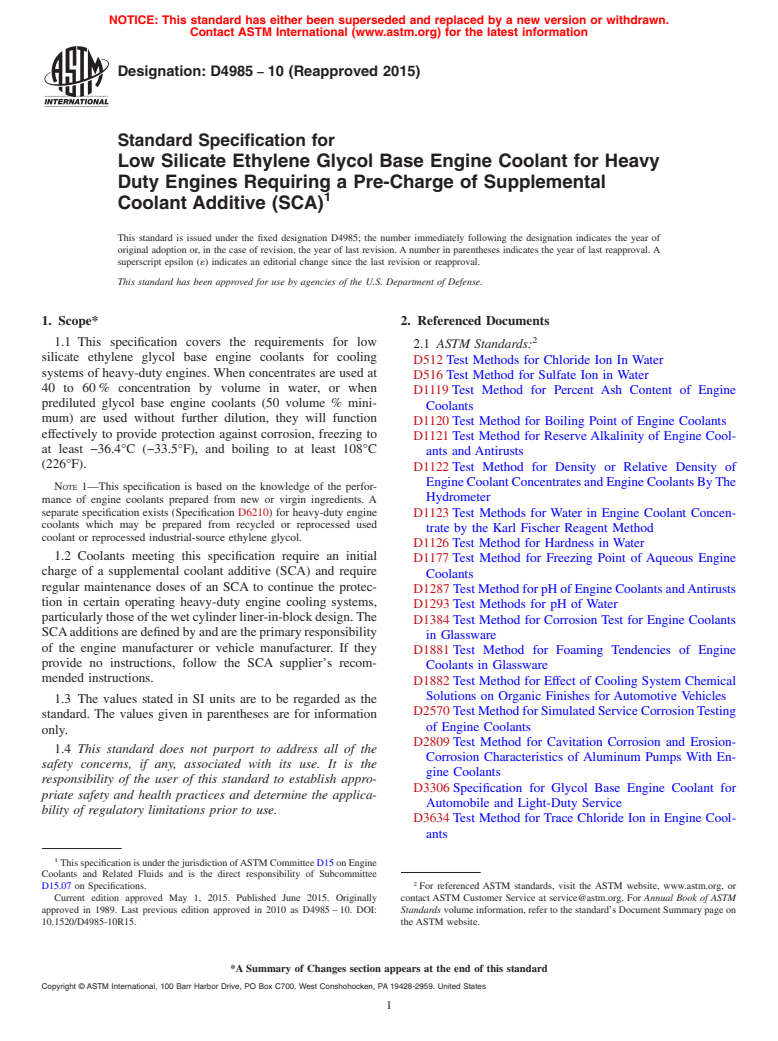
1.1 This specification covers the requirements for low silicate ethylene glycol base engine coolants for cooling systems of heavy-duty engines. When concentrates are used at 40 to 60 % concentration by volume in water, or when prediluted glycol base engine coolants (50 volume % minimum) are used without further dilution, they will function effectively to provide protection against corrosion, freezing to at least −36.4°C (−33.5°F), and boiling to at least 108°C (226°F).
Note 1: This specification is based on the knowledge of the performance of engine coolants prepared from new or virgin ingredients. A separate specification exists (Specification D6210) for heavy-duty engine coolants which may be prepared from recycled or reprocessed used coolant or reprocessed industrial-source ethylene glycol.
1.2 Coolants meeting this specification require an initial charge of a supplemental coolant additive (SCA) and require regular maintenance doses of an SCA to continue the protection in certain operating heavy-duty engine cooling systems, particularly those of the wet cylinder liner-in-block design. The SCA additions are defined by and are the primary responsibility of the engine manufacturer or vehicle manufacturer. If they provide no instructions, follow the SCA supplier's recommended instructions.
1.3 The values stated in SI units are to be regarded as the standard. The values given in parentheses are for information only.
1.4 This standard does not purport to address all of the safety concerns, if any, associated with its use. It is the responsibility of the user of this standard to establish appropriate safety and health practices and determine the applicability of regulatory limitations prior to use.
General Information
Buy Standard
Standards Content (Sample)
NOTICE: This standard has either been superseded and replaced by a new version or withdrawn.
Contact ASTM International (www.astm.org) for the latest information
Designation: D4985 − 10 (Reapproved 2015)
Standard Specification for
Low Silicate Ethylene Glycol Base Engine Coolant for Heavy
Duty Engines Requiring a Pre-Charge of Supplemental
Coolant Additive (SCA)
This standard is issued under the fixed designation D4985; the number immediately following the designation indicates the year of
original adoption or, in the case of revision, the year of last revision. A number in parentheses indicates the year of last reapproval. A
superscript epsilon (´) indicates an editorial change since the last revision or reapproval.
This standard has been approved for use by agencies of the U.S. Department of Defense.
1. Scope* 2. Referenced Documents
1.1 This specification covers the requirements for low
2.1 ASTM Standards:
silicate ethylene glycol base engine coolants for cooling
D512 Test Methods for Chloride Ion In Water
systems of heavy-duty engines. When concentrates are used at
D516 Test Method for Sulfate Ion in Water
40 to 60 % concentration by volume in water, or when
D1119 Test Method for Percent Ash Content of Engine
prediluted glycol base engine coolants (50 volume % mini-
Coolants
mum) are used without further dilution, they will function
D1120 Test Method for Boiling Point of Engine Coolants
effectively to provide protection against corrosion, freezing to
D1121 Test Method for Reserve Alkalinity of Engine Cool-
at least −36.4°C (−33.5°F), and boiling to at least 108°C
ants and Antirusts
(226°F).
D1122 Test Method for Density or Relative Density of
Engine Coolant Concentrates and Engine Coolants By The
NOTE 1—This specification is based on the knowledge of the perfor-
Hydrometer
mance of engine coolants prepared from new or virgin ingredients. A
separate specification exists (Specification D6210) for heavy-duty engine
D1123 Test Methods for Water in Engine Coolant Concen-
coolants which may be prepared from recycled or reprocessed used
trate by the Karl Fischer Reagent Method
coolant or reprocessed industrial-source ethylene glycol.
D1126 Test Method for Hardness in Water
1.2 Coolants meeting this specification require an initial
D1177 Test Method for Freezing Point of Aqueous Engine
charge of a supplemental coolant additive (SCA) and require
Coolants
regular maintenance doses of an SCA to continue the protec-
D1287 Test Method for pH of Engine Coolants and Antirusts
tion in certain operating heavy-duty engine cooling systems,
D1293 Test Methods for pH of Water
particularly those of the wet cylinder liner-in-block design. The
D1384 Test Method for Corrosion Test for Engine Coolants
SCA additions are defined by and are the primary responsibility
in Glassware
of the engine manufacturer or vehicle manufacturer. If they
D1881 Test Method for Foaming Tendencies of Engine
provide no instructions, follow the SCA supplier’s recom-
Coolants in Glassware
mended instructions.
D1882 Test Method for Effect of Cooling System Chemical
Solutions on Organic Finishes for Automotive Vehicles
1.3 The values stated in SI units are to be regarded as the
D2570 Test Method for Simulated Service Corrosion Testing
standard. The values given in parentheses are for information
of Engine Coolants
only.
D2809 Test Method for Cavitation Corrosion and Erosion-
1.4 This standard does not purport to address all of the
Corrosion Characteristics of Aluminum Pumps With En-
safety concerns, if any, associated with its use. It is the
gine Coolants
responsibility of the user of this standard to establish appro-
D3306 Specification for Glycol Base Engine Coolant for
priate safety and health practices and determine the applica-
Automobile and Light-Duty Service
bility of regulatory limitations prior to use.
D3634 Test Method for Trace Chloride Ion in Engine Cool-
ants
This specification is under the jurisdiction of ASTM Committee D15 on Engine
Coolants and Related Fluids and is the direct responsibility of Subcommittee
D15.07 on Specifications. For referenced ASTM standards, visit the ASTM website, www.astm.org, or
Current edition approved May 1, 2015. Published June 2015. Originally contact ASTM Customer Service at service@astm.org. For Annual Book of ASTM
approved in 1989. Last previous edition approved in 2010 as D4985 – 10. DOI: Standards volume information, refer to the standard’s Document Summary page on
10.1520/D4985-10R15. the ASTM website.
*A Summary of Changes section appears at the end of this standard
Copyright © ASTM International, 100 Barr Harbor Drive, PO Box C700, West Conshohocken, PA 19428-2959. United States
D4985 − 10 (2015)
D4327 Test Method for Anions in Water by Suppressed Ion formulated with ethylene glycol meeting Specification E1177,
Chromatography water, and shall contain suitable corrosion inhibitors, dye, and
D4725 Terminology for Engine Coolants and Related Fluids a foam suppressor. Other glycols, such as propylene and
D5827 Test Method for Analysis of Engine Coolant for diethylene, may be included in concentrates up to a maximum
Chloride and Other Anions by Ion Chromatography of 15 % (7.5 % for prediluted coolants) if the physical and
D5931 Test Method for Density and Relative Density of chemical properties in Table 1 are met.
Engine Coolant Concentrates and Aqueous Engine Cool-
4.2 All ethylene glycol base engine coolants shall conform
ants by Digital Density Meter
to the general requirements in Table 2.
D6129 Test Method for Silicon in Engine Coolant Concen-
4.3 Prediluted coolants shall be prepared using deionized
trates by Atomic Absorption Spectroscopy
water that meets the following requirements:
D6130 Test Method for Determination of Silicon and Other
Property Specific Values ASTM Test Method
Elements in Engine Coolant by Inductively Coupled
Plasma-Atomic Emission Spectroscopy
Chlorides, µg/g (ppm (grains/gal)) 25 (1.5) max D5827, D512, D4327
D6210 Specification for Fully-Formulated Glycol Base En-
Sulfate, µg/g (ppm (grains/gal)) 50 (3.0) max D5827, D516, D4327
Hardness, as CaCO , 20 (1.2) max D6130, D1126
gine Coolant for Heavy-Duty Engines 3
µg/g (ppm (grains/gal))
D6660 Test Method for Freezing Point of Aqueous Ethylene
pH 5.5 to 8.5 D1287, D1293
Glycol Base Engine Coolants by Automatic Phase Tran-
Iron, µg/g (ppm (grains/gal)) 1.0 (0.06) max D6130, E394
sition Method
NOTE 2—Prediluted coolants are intended for direct addition to an
E29 Practice for Using Significant Digits in Test Data to
engine cooling system with no further dilution.
Determine Conformance with Specifications
This practice minimizes the formation of hard water scale
E394 Test Method for Iron in Trace Quantities Using the
and avoids the introduction of mineral components, such as
1,10-Phenanthroline Method
E1177 Specification for Engine Coolant Grade Glycol
2.2 Other Document: TABLE 1 Physical and Chemical Requirements
Federal Method 2540B Total Dissolved Solids Dried at
Specific Values
103–105°C
ASTM Test
Property Concentrate Predilute
Method
3. Terminology Relative density, 15.5/15.5°C 1.110 to 1.145 1.065 min D1122, D5931
(60/60°F)
3.1 Definitions of Terms Specific to This Standard:
A
Freezing point, °C (°F): D1177, D6660
3.1.1 heavy duty engine—a diesel, gasoline, or similarly
50 vol % in DI water −36.4 (−33.5)
fueled internal combustion engine, having operating character-
max
istics of a long duty cycle at or near maximum rated conditions.
Undiluted −36.4 (−33.5)
max
Such engines are typically used in off-highway machinery for
agriculture, mining, earth-moving, and construction; Class 5 to
B
Boiling point, °C (°F): D1120
8 over the road trucks and buses; high output stationary engine
Undiluted 163 (325) min 108 (226) min
50 vol % in DI water 108 (226) min
installations; and locomotive and marine installations. (See
Specification D3306 for coolant requirements for automobiles,
Ash content, mass % 5 max 2.5 max D1119
vans, and pickup class trucks.)
pH: D1287
3.1.2 supplemental coolant additive (SCA)—a material
50 vol % in DI water 7.5 to 11
added to the cooling system of a heavy-duty engine to provide
Undiluted 7.5 to 11
additional cavitation protection and corrosion inhibition and to
C C
Reserve alkalinity, mL report report D1121
minimize deposits on heat transfer surfaces.
Water, mass % 5 max not applicable D1123
3.2 Definitions:
3.2.1 other glycols, n—in ethylene glycol base engine D
Chloride ion, µg/g 25 max 25 max D3634, D5827
coolant, diethylene glycol, triethylene glycol, tetraethylene
Silicon, µg/g 250 max 125 max D6129, D6130
glycol, propylene glycol, dipropylene glycol, tripropylene
E
glycol, and 1,3-propanediol.
Effect on engine or vehicle finish no effect no effect D1882
A
For purposes of determining conformance with this specification, an observed
3.2.2 For definitions of other terms used in this
value shall be rounded “to the nearest unit” in the last right-hand digit used in
specification, refer to Terminology D4725.
expressing the specification limit, in accordance with the rounding method of
Practice E29.
B
4. General Requirements Some precipitate may be observed at the end of the test method. This should not
be cause for rejection.
C
4.1 Ethylene glycol base engine coolant concentrates or
Value as agreed upon between the supplier and the customer.
D
In case of dispute, Test Method D3634 shall be the preferred test method.
prediluted ethylene glycol base engine coolants shall be
E
Currently, many heavy-duty engine manufacturers and vehicle manufacturers
that use these engines prepare test panels using the specific paint finishes
employed on their actual products. Coolant suppliers and equipment builders
Standard Methods for the Examination of Water and Wastewater. American
should agree on the exact test procedures and acceptance criteria on an individual
Public Health Association, et al, 801 I Street, N.W. Washington, DC 20001, case basis.
http://www.apha.org.
D4985 − 10 (2015)
A
TABLE 2 General Requirements TABLE 3 Performance Requirements
ASTM Test Solution
Property Specific Values ASTM Test Method
Specific
Property Test Concentration,
Color distinctive . . .
Values
Method vol % Glycol
Effect on nonmetals no adverse effect under consideration
B
Corrosion in glassware D1384 33
Weight loss, mg/specimen:
copper 10 max
chlorides and sulfates, which can increase the corrosion rate of
solder 30 max
aluminum and iron. The use of Type IV reagent water also brass 10 max
steel 10 max
minimizes interferences that may cause coolant instability or
cast iron 10 max
SCA compatibility problems.
aluminum 30 max
C
Simulated service test D2570 44
4.4 When diluting engine coolant concentrates for actual
weight loss, mg/specimen:
service, municipal (treated) or a low-mineral content well
copper 20 max
solder 60 max
water should be used (see Appendix X1, Table X1.1).
brass 20 max
4.5 Diluted coolant concentrates or prediluted coolants, steel 20 max
cast iron 20 max
when mixed with SCA in accordance with the engine manu-
aluminum 60 max
facturer’s recommendations and those on the product label, D
Foaming: D1881 33
Volume, mL 150 max
shall be suitable for use in a properly maintained cooling
Break time, s 5 max
system in normal service for a minimum of one year (see
E
Cavitation-Erosion 8 min D2809 17
Appendix X1).
Rating for pitting, cavitation, and
erosion of the water pump
5. Detailed Requirements
A
For engine coolant concentrates, test solutions shall be prepared in accordance
with the directions provided in the individual ASTM test methods. For prediluted
5.1 Ethylene glycol base engine coolant concentrate shall
engine coolants, prepare the test solutions using the directions provided in
conform to the physical and chemical requirements in Table 1
Footnotes B through E.
B
and the performance requirements in Table 3. For prediluted coolants, prepare the test solution by mixing 67 volume % of the
adjusted (see 4.5) prediluted product with 33 volume % ASTM Type IV reagent
5.2 Prediluted aqueous ethylene glycol base engine coolants
water. Add 99 mg of sodium sulfate, 110 mg of sodium chloride, and 92 mg of
sodium bicarbonate per litre of test solution.
(50 volume % minimum) shall conform to the physical and
C
For prediluted coolants, prepare the test solution by mixing 88 volume % of the
chemical property requirements in Table 1. The requirements
adjusted (see 4.5) prediluted product with 12 volume % ASTM Type IV reagent
listed in Table 1 for prediluted coolants are prescribed for the
water. Add 83 mg of sodium sulfate, 92 mg of sodium chloride, and 77 mg of
sodium bicarbonate per litre of test solution.
coolant as packaged, without further dilution or adjustment.
D
For prediluted coolants, prepare the test solution by mixing 67 volume % of the
adjusted (see 4.5) prediluted product with 33 volume % ASTM Type II reagent
5.3 The freezing point of prediluted aqueous ethylene glycol
water.
base engine coolants, as packaged, shall be −36.4°C (−33.5°F)
E
For prediluted coolants, prepare the test solution by mixing 33 volume % of the
or lower.
adjusted (see 4.5) prediluted product with 67 volume % ASTM Type IV reagent
water. Add 123 mg of sodium sulfate, 137 mg of sodium chloride, and 115 mg of
5.4 If necessary, adjust the freezing point of the prediluted
sodium bicarbonate per litre of test solution.
aqueous coolant to −36.4°C (−33.5°F) with deionized water
before proceeding with performance testing.
5.5 Prediluted aqueous ethylene glycol base engine coolants
shall conform to the performance requirements prescribed in
Table 3, after any needed concentration adjustment.
6. Keywords
6.1 coolant requiring SCA pre-charge; engine coolant; eth-
ylene glycol; heavy duty engine coolant; heavy duty engine
service; low silicate engine coolant; prediluted
D4985 − 10 (2015)
APPENDIX
(Nonmandatory Information)
X1. COOLANT MAINTENANCE FOR HEAVY DUTY ENGINES
X1.1 Engine Coolant—Cooling system fill for a heavy-duty X1.1.4 Supplemental Coolant Additive (SCA)—The SCAs
engine consists either of water, coolant concentrate (antifreeze) are used to provide additional protection against deposits,
and supplemental coolant additive (SCA), or prediluted engine corrosion, and pitting which may not be provided by the
coolant and SCA. additives in coolant concentrates or prediluted engine coolants.
The SCAs also extend the life of the coolant by adding to and
X1.1.1 Water:
replenishing the additives that deplete during normal operation.
X1.1.1.1 Water quality affects the efficiency of coolant
SCAs, however, do not extend the freeze protection provided
additives. When untreated, all water is corrosive. Water having
by the coolant concentrate or the prediluted coolant.
a high mineral content or corrosive materials is unfit for
cooling system use.
X1.1.5 Nonvirgin Coolants:
X1.1.1.2 When prepar
...
This document is not an ASTM standard and is intended only to provide the user of an ASTM standard an indication of what changes have been made to the previous version. Because
it may not be technically possible to adequately depict all changes accurately, ASTM recommends that users consult prior editions as appropriate. In all cases only the current version
of the standard as published by ASTM is to be considered the official document.
Designation: D4985 − 10 D4985 − 10 (Reapproved 2015)
Standard Specification for
Low Silicate Ethylene Glycol Base Engine Coolant for Heavy
Duty Engines Requiring a Pre-Charge of Supplemental
Coolant Additive (SCA)
This standard is issued under the fixed designation D4985; the number immediately following the designation indicates the year of
original adoption or, in the case of revision, the year of last revision. A number in parentheses indicates the year of last reapproval. A
superscript epsilon (´) indicates an editorial change since the last revision or reapproval.
This standard has been approved for use by agencies of the U.S. Department of Defense.
1. Scope*
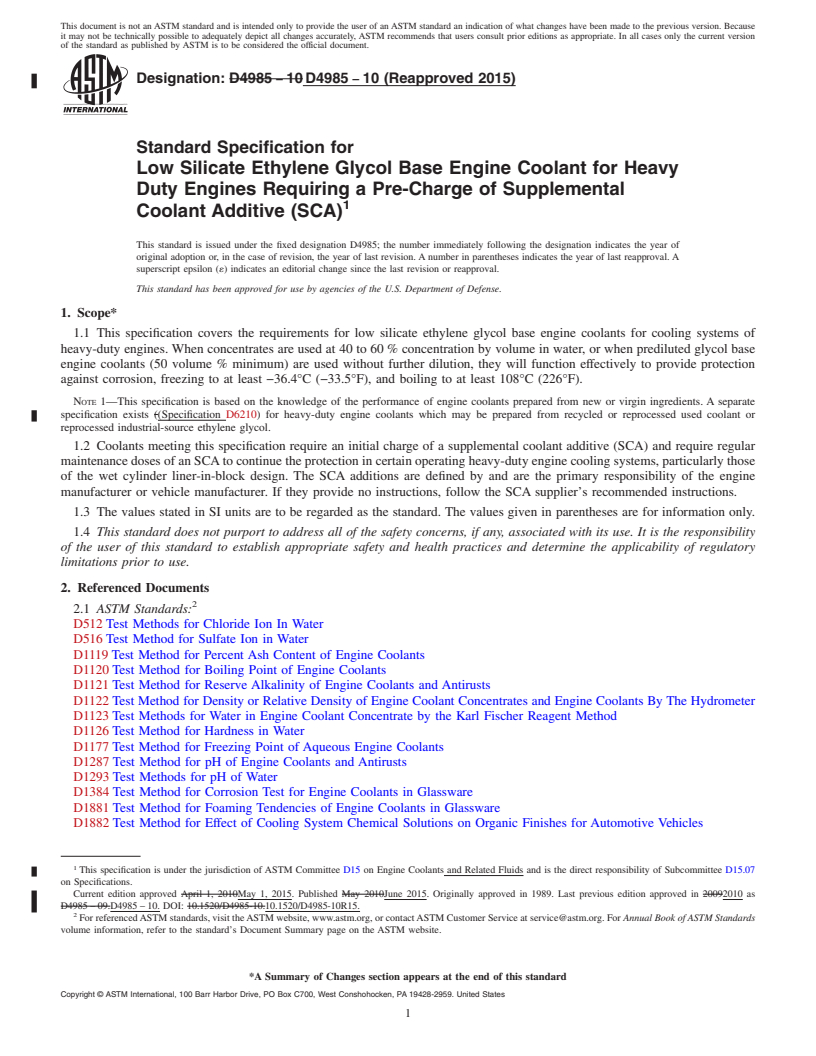
1.1 This specification covers the requirements for low silicate ethylene glycol base engine coolants for cooling systems of
heavy-duty engines. When concentrates are used at 40 to 60 % concentration by volume in water, or when prediluted glycol base
engine coolants (50 volume % minimum) are used without further dilution, they will function effectively to provide protection
against corrosion, freezing to at least −36.4°C (−33.5°F), and boiling to at least 108°C (226°F).
NOTE 1—This specification is based on the knowledge of the performance of engine coolants prepared from new or virgin ingredients. A separate
specification exists ((Specification D6210) for heavy-duty engine coolants which may be prepared from recycled or reprocessed used coolant or
reprocessed industrial-source ethylene glycol.
1.2 Coolants meeting this specification require an initial charge of a supplemental coolant additive (SCA) and require regular
maintenance doses of an SCA to continue the protection in certain operating heavy-duty engine cooling systems, particularly those
of the wet cylinder liner-in-block design. The SCA additions are defined by and are the primary responsibility of the engine
manufacturer or vehicle manufacturer. If they provide no instructions, follow the SCA supplier’s recommended instructions.
1.3 The values stated in SI units are to be regarded as the standard. The values given in parentheses are for information only.
1.4 This standard does not purport to address all of the safety concerns, if any, associated with its use. It is the responsibility
of the user of this standard to establish appropriate safety and health practices and determine the applicability of regulatory
limitations prior to use.
2. Referenced Documents
2.1 ASTM Standards:
D512 Test Methods for Chloride Ion In Water
D516 Test Method for Sulfate Ion in Water
D1119 Test Method for Percent Ash Content of Engine Coolants
D1120 Test Method for Boiling Point of Engine Coolants
D1121 Test Method for Reserve Alkalinity of Engine Coolants and Antirusts
D1122 Test Method for Density or Relative Density of Engine Coolant Concentrates and Engine Coolants By The Hydrometer
D1123 Test Methods for Water in Engine Coolant Concentrate by the Karl Fischer Reagent Method
D1126 Test Method for Hardness in Water
D1177 Test Method for Freezing Point of Aqueous Engine Coolants
D1287 Test Method for pH of Engine Coolants and Antirusts
D1293 Test Methods for pH of Water
D1384 Test Method for Corrosion Test for Engine Coolants in Glassware
D1881 Test Method for Foaming Tendencies of Engine Coolants in Glassware
D1882 Test Method for Effect of Cooling System Chemical Solutions on Organic Finishes for Automotive Vehicles
This specification is under the jurisdiction of ASTM Committee D15 on Engine Coolants and Related Fluids and is the direct responsibility of Subcommittee D15.07
on Specifications.
Current edition approved April 1, 2010May 1, 2015. Published May 2010June 2015. Originally approved in 1989. Last previous edition approved in 20092010 as
D4985 – 09.D4985 – 10. DOI: 10.1520/D4985-10.10.1520/D4985-10R15.
For referenced ASTM standards, visit the ASTM website, www.astm.org, or contact ASTM Customer Service at service@astm.org. For Annual Book of ASTM Standards
volume information, refer to the standard’s Document Summary page on the ASTM website.
*A Summary of Changes section appears at the end of this standard
Copyright © ASTM International, 100 Barr Harbor Drive, PO Box C700, West Conshohocken, PA 19428-2959. United States
D4985 − 10 (2015)
D2570 Test Method for Simulated Service Corrosion Testing of Engine Coolants
D2809 Test Method for Cavitation Corrosion and Erosion-Corrosion Characteristics of Aluminum Pumps With Engine Coolants
D3306 Specification for Glycol Base Engine Coolant for Automobile and Light-Duty Service
D3634 Test Method for Trace Chloride Ion in Engine Coolants
D4327 Test Method for Anions in Water by Suppressed Ion Chromatography
D4725 Terminology for Engine Coolants and Related Fluids
D5827 Test Method for Analysis of Engine Coolant for Chloride and Other Anions by Ion Chromatography
D5931 Test Method for Density and Relative Density of Engine Coolant Concentrates and Aqueous Engine Coolants by Digital
Density Meter
D6129 Test Method for Silicon in Engine Coolant Concentrates by Atomic Absorption Spectroscopy
D6130 Test Method for Determination of Silicon and Other Elements in Engine Coolant by Inductively Coupled Plasma-Atomic
Emission Spectroscopy
D6210 Specification for Fully-Formulated Glycol Base Engine Coolant for Heavy-Duty Engines
D6660 Test Method for Freezing Point of Aqueous Ethylene Glycol Base Engine Coolants by Automatic Phase Transition
Method
E29 Practice for Using Significant Digits in Test Data to Determine Conformance with Specifications
E394 Test Method for Iron in Trace Quantities Using the 1,10-Phenanthroline Method
E1177 Specification for Engine Coolant Grade Glycol
2.2 Other Documents::Document:
Federal Method 2540B Total Dissolved Solids Dried at 103–105°C
3. Terminology
3.1 Definitions of Terms Specific to This Standard:
3.1.1 heavy duty engine—a diesel, gasoline, or similarly fueled internal combustion engine, having operating characteristics of
a long duty cycle at or near maximum rated conditions. Such engines are typically used in off-highway machinery for agriculture,
mining, earth-moving, and construction; Class 5 to 8 over the road trucks and buses; high output stationary engine installations;
and locomotive and marine installations. (See Specification D3306 for coolant requirements for automobiles, vans, and pickup
class trucks.)
3.1.2 supplemental coolant additive (SCA)—a material added to the cooling system of a heavy-duty engine to provide additional
cavitation protection and corrosion inhibition and to minimize deposits on heat transfer surfaces.
3.2 Definitions:
3.2.1 other glycols, n—in ethylene glycol base engine coolant, diethylene glycol, triethylene glycol, tetraethylene glycol,
propylene glycol, dipropylene glycol, tripropylene glycol, and 1,3-propanediol.
3.2.2 For definitions of other terms used in this specification, refer to Terminology D4725.
4. General Requirements
4.1 Ethylene glycol base engine coolant concentrates or prediluted ethylene glycol base engine coolants shall be formulated with
ethylene glycol meeting Specification E1177, water, and shall contain suitable corrosion inhibitors, dye, and a foam suppressor.
Other glycols, such as propylene and diethylene, may be included in concentrates up to a maximum of 15 % (7.5 % for prediluted
coolants) if the physical and chemical properties in Table 1 are met.
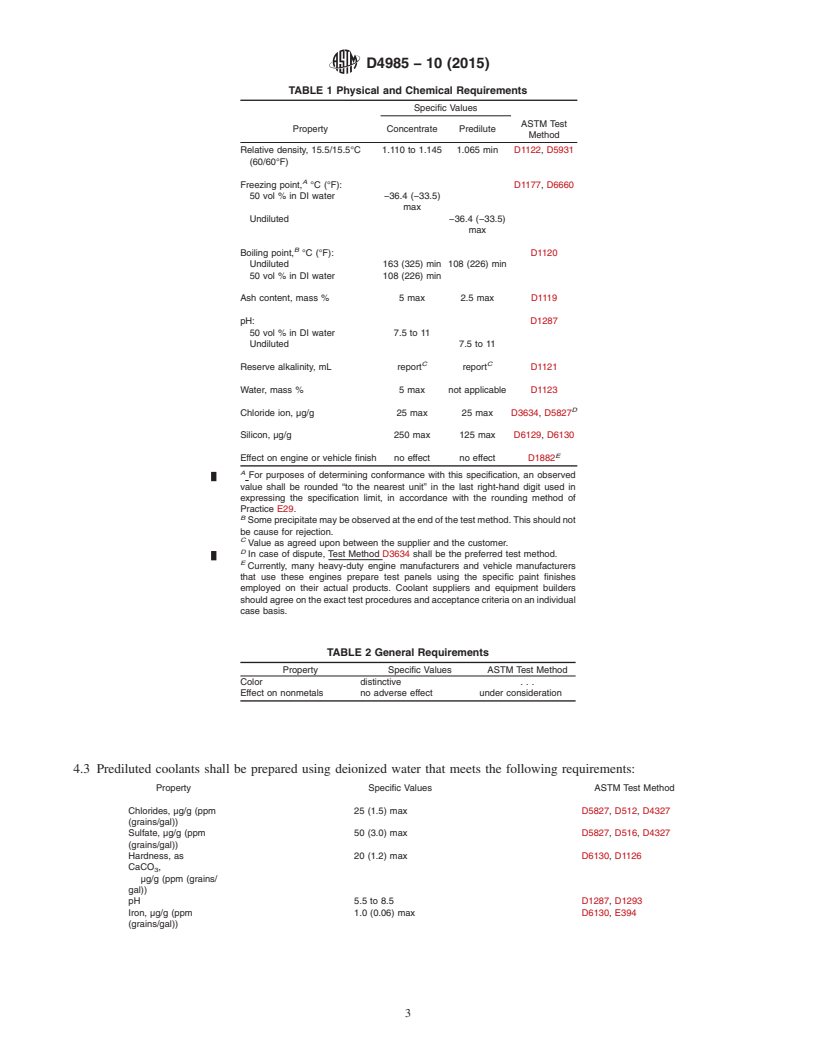
4.2 All ethylene glycol base engine coolants shall conform to the general requirements in Table 2.
Standard MethodMethods for the Examination of Water and Wastewater. American Public Health Association, et al, 1015 15th801 I Street, N.W. Washington, DC
20005.20001, http://www.apha.org.
D4985 − 10 (2015)
TABLE 1 Physical and Chemical Requirements
Specific Values
ASTM Test
Property Concentrate Predilute
Method
Relative density, 15.5/15.5°C 1.110 to 1.145 1.065 min D1122, D5931
(60/60°F)
A
Freezing point, °C (°F): D1177, D6660
50 vol % in DI water −36.4 (−33.5)
max
Undiluted −36.4 (−33.5)
max
B
Boiling point, °C (°F): D1120
Undiluted 163 (325) min 108 (226) min
50 vol % in DI water 108 (226) min
Ash content, mass % 5 max 2.5 max D1119
pH: D1287
50 vol % in DI water 7.5 to 11
Undiluted 7.5 to 11
C C
Reserve alkalinity, mL report report D1121
Water, mass % 5 max not applicable D1123
D
Chloride ion, μg/g 25 max 25 max D3634, D5827
Silicon, μg/g 250 max 125 max D6129, D6130
E
Effect on engine or vehicle finish no effect no effect D1882
A
For purposes of determining conformance with this specification, an observed
value shall be rounded “to the nearest unit” in the last right-hand digit used in
expressing the specification limit, in accordance with the rounding method of
Practice E29.
B
Some precipitate may be observed at the end of the test method. This should not
be cause for rejection.
C
Value as agreed upon between the supplier and the customer.
D
In case of dispute, Test Method D3634 shall be the preferred test method.
E
Currently, many heavy-duty engine manufacturers and vehicle manufacturers
that use these engines prepare test panels using the specific paint finishes
employed on their actual products. Coolant suppliers and equipment builders
should agree on the exact test procedures and acceptance criteria on an individual
case basis.
TABLE 2 General Requirements
Property Specific Values ASTM Test Method
Color distinctive . . .
Effect on nonmetals no adverse effect under consideration
4.3 Prediluted coolants shall be prepared using deionized water that meets the following requirements:
Property Specific Values ASTM Test Method
Chlorides, μg/g (ppm 25 (1.5) max D5827, D512, D4327
(grains/gal))
Sulfate, μg/g (ppm 50 (3.0) max D5827, D516, D4327
(grains/gal))
Hardness, as 20 (1.2) max D6130, D1126
CaCO ,
μg/g (ppm (grains/
gal))
pH 5.5 to 8.5 D1287, D1293
Iron, μg/g (ppm 1.0 (0.06) max D6130, E394
(grains/gal))
D4985 − 10 (2015)
Property Specific Values ASTM Test Method
Chlorides, μg/g (ppm (grains/gal)) 25 (1.5) max D5827, D512, D4327
Sulfate, μg/g (ppm (grains/gal)) 50 (3.0) max D5827, D516, D4327
Hardness, as CaCO , 20 (1.2) max D6130, D1126
μg/g (ppm (grains/gal))
pH 5.5 to 8.5 D1287, D1293
Iron, μg/g (ppm (grains/gal)) 1.0 (0.06) max D6130, E394
NOTE 2—Prediluted coolants are intended for direct addition to an engine cooling system with no further dilution.
This practice minimizes the formation of hard water scale and avoids the introduction of mineral components, such as chlorides
and sulfates, which can increase the corrosion rate of aluminum and iron. The use of Type IV reagent water also minimizes
interferences that may cause coolant instability or SCA compatibility problems.
4.4 When diluting engine coolant concentrates for actual service, municipal (treated) or a low-mineral content well water should
be used (see Appendix X1, Table X1.1).
4.5 Diluted coolant concentrates or prediluted coolants, when mixed with SCA in accordance with the engine manufacturer’s
recommendations and those on the product label, shall be suitable for use in a properly maintained cooling system in normal
service for a minimum of one year (see Appendix X1).
5. Detailed Requirements
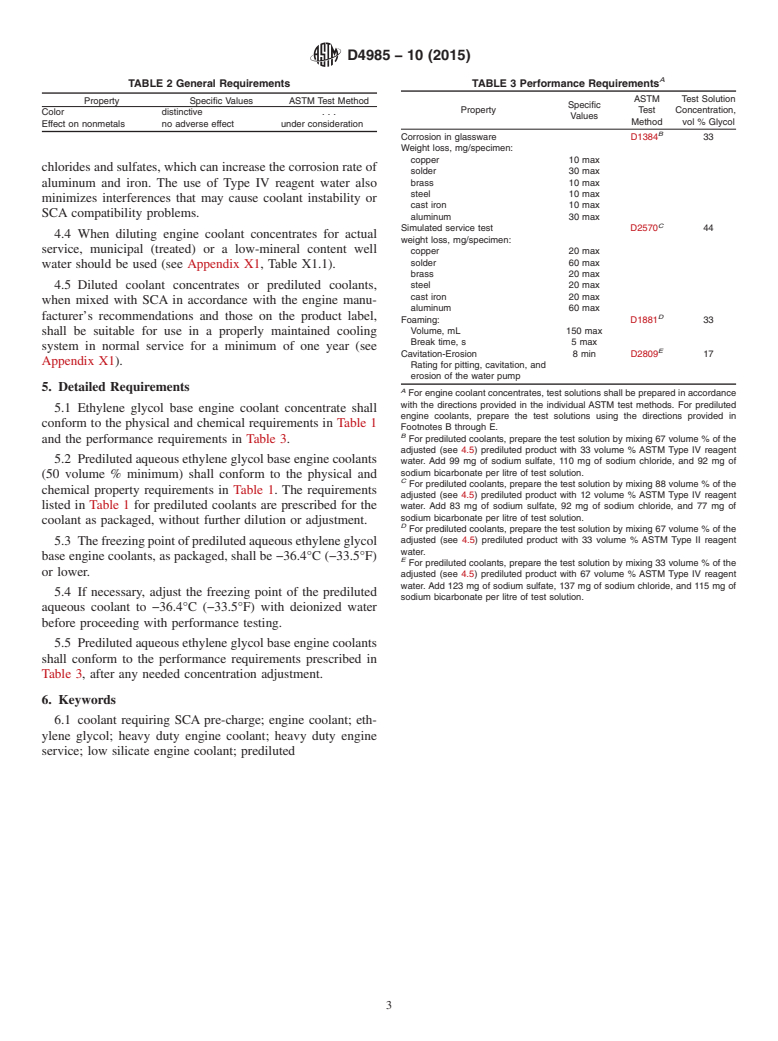
5.1 Ethylene glycol base engine coolant concentrate shall conform to the physical and chemical requirements in Table 1 and
the performance requirements in Table 3.
A
TABLE 3 Performance Requirements
ASTM Test Solution
Specific
Property Test Concentration,
Values
Method vol % Glycol
B
Corrosion in glassware D1384 33
Weight loss, mg/specimen:
copper 10 max
solder 30 max
brass 10 max
steel 10 max
cast iron 10 max
aluminum 30 max
C
Simulated service test D2570 44
weight loss, mg/specimen:
copper 20 max
solder 60 max
brass 20 max
steel 20 max
cast iron 20 max
aluminum 60 max
D
Foaming: D1881 33
Volume, mL 150 max
Break time, s 5 max
E
Cavitation-Erosion 8 min D2809 17
Rating for pitting, cavitation, and
erosion of the water pump
A
For engine coolant concentrates, test solutions shall be prepared in accordance
with the directions provided in the individual ASTM test methods. For prediluted
engine coolants, prepare the test solutions using the directions provided in
Footnotes B through E.
B
For prediluted coolants, prepare the test solution by mixing 67 volume % of the
adjusted (see 4.5) prediluted product with 33 volume % ASTM Type IV reagent
water. Add 99 mg of sodium sulfate, 110 mg of sodium chloride, and 92 mg of
sodium bicarbonate per litre of test solution.
C
For prediluted coolants, prepare the test solution by mixing 88 volume % of the
adjusted (see 4.5) prediluted product with 12 volume % ASTM Type IV reagent
water. Add 83 mg of sodium sulfate, 92 mg of sodium chloride, and 77 mg of
sodium bicarbonate per litre of test solution.
D
For prediluted coolants, prepare the test solution by mixing 67 volume % of the
adjusted (see 4.5) prediluted product with 33 volume % ASTM Type II reagent
water.
E
For prediluted coolants, prepare the test solution by mixing 33 volume % of the
adjusted (see 4.5) prediluted product with 67 volume % ASTM Type IV reagent
water. Add 123 mg of sodium sulfate, 137 mg of sodium chloride, and 115 mg of
sodium bicarbonate per litre of test solution.
D4985 − 10 (2015)
5.2 Prediluted aqueous ethylene glycol base engine coolants (50 volume % minimum) shall conform to the physical and
chemical property requirements in Table 1. The requirements listed in Table 1 for prediluted coolants are prescribed for the coolant
as packaged, without further dilution or adjustment.
5.3 The freezing point of prediluted aqueous ethylene glycol base engine coolants, as packaged, shall be −36.4°C (−33.5°F) or
lower.
5.4 If necessary, adjust the freezing point of the prediluted aqueous coolant to −36.4°C (−33.5°F) with deionized water before
proceeding with performance testing.
5.5 Prediluted aqueous ethylene glycol base engine coolants shall conform to the performance requirements prescribed in Table
3, after any needed concentration adjustment.
6. Keywords
6.1 coolant requiring SCA pre-charge; engine coolant; ethylene glycol; heavy duty engine coolant; heavy duty engine service;
low silicate engine coolant; prediluted
APPENDIX
(Nonmandatory Information)
X1. COOLANT MAINTENANCE FOR HEAVY DUTY ENGINES
X1.1 Engine Coolant—Cooling system fill for a heavy-duty engine consists either of water, coolant concentrate (antifreeze) and
supplemental coolant additive (SCA), or prediluted engine coolant and SCA.
X1.1.1 Water:
X1.1.
...
Questions, Comments and Discussion
Ask us and Technical Secretary will try to provide an answer. You can facilitate discussion about the standard in here.