

ASTM D5596-03(2021)
(Test Method)Standard Test Method for Microscopic Evaluation of the Dispersion of Carbon Black in Polyolefin Geosynthetics
General Information
- Abstract
SIGNIFICANCE AND USE
5.1 Carbon black is added to many polymers to provide long-term resistance to ultraviolet-induced degradation. To achieve this, carbon black should be dispersed uniformly throughout the as-manufactured geosynthetic material. This test method is used to evaluate the uniformity of carbon black dispersion.
5.2 This test method is suitable only for those geosynthetics that can be sampled using a rotary or sledge microtome. The geometry, stiffness (hardness), or elasticity of some geosynthetic products precludes their being sampled with a micro-tome. The cross-sectional area of the geosynthetic must be composed of a continuous solid polyolefin material to be sampled using a microtome.
5.3 Extruded and oriented geogrids will require that microtome specimens be cut from the non-oriented bars of uniaxial products and the non-oriented nodes of biaxial products.
SCOPE
1.1 This test method covers equipment, specimen preparation techniques, and procedures for evaluating the dispersion of carbon black in polyolefin geosynthetics containing less than 5 % carbon black by weight.
1.2 This test method allows for a qualitative evaluation of carbon black agglomerates and other inclusions in polyolefin geosynthetics. This evaluation is based on carbon black dispersion size calculated area within microscopic fields of view.
1.3 The values stated in SI units are to be regarded as the standard. The values given in parentheses are for information only.
1.4 This standard does not purport to address all of the safety concerns, if any, associated with its use. It is the responsibility of the user of this standard to establish appropriate safety, health, and environmental practices and determine the applicability of regulatory limitations prior to use.
Note 1: This test method is for the evaluation of carbon black dispersion. This test method does not support or evaluate the distribution of carbon black.
1.5 This international standard was developed in accordance with internationally recognized principles on standardization established in the Decision on Principles for the Development of International Standards, Guides and Recommendations issued by the World Trade Organization Technical Barriers to Trade (TBT) Committee.
- Status
- Published
- Publication Date
- 30-Apr-2021
- Technical Committee
- D35 - Geosynthetics
- Drafting Committee
- D35.02 - Endurance Properties


Overview
ASTM D5596-03(2021) is the international standard test method for the microscopic evaluation of the dispersion of carbon black in polyolefin geosynthetics. Published by ASTM International, this standard provides a qualitative method to assess the uniformity of carbon black dispersion in geosynthetics containing less than 5% carbon black by weight. Uniform dispersion is vital, as carbon black acts as a protective agent against ultraviolet-induced degradation, extending the service life of polyolefin geosynthetic products used in civil engineering and environmental applications.
Key Topics
- Purpose: To evaluate the uniformity of carbon black dispersion in as-manufactured polyolefin geosynthetics.
- Scope: Applies to materials that can be sampled using a rotary or sledge microtome and have a continuous solid polyolefin cross-section.
- Limitations: Not suitable for products whose geometry, stiffness, or elasticity prevents microtome sampling.
- Test Method Overview:
- Preparation of thin sections (8-20 µm) from the geosynthetic sample using a microtome.
- Microscopic examination of these sections under magnifications between 50× and 200×.
- Qualitative evaluation of carbon black agglomerates and inclusions by assessing their size within defined microscopic fields of view.
- Key Definitions:
- Carbon black: Near-spherical colloidal particles of elemental carbon.
- Agglomerate: Physically bound cluster of carbon black aggregates.
- Dispersion: The even distribution of carbon black within a polyolefin matrix.
Applications
The ASTM D5596-03(2021) standard is instrumental for:
- Quality Control: Ensuring that polyolefin geosynthetics such as geomembranes, geogrids, geonets, and geocomposites have a uniform dispersion of carbon black. This directly impacts product durability and resistance to UV degradation.
- Product Development: Supporting manufacturers in optimizing processing methods to achieve the desired level of carbon black dispersion in polyolefin matrices.
- Material Certification: Supplying third-party laboratories and quality assurance teams with a consistent procedure to verify product compliance with industry requirements.
- Research and Testing: Offering a reproducible testing protocol for laboratories evaluating the microstructure of black-pigmented polyolefin geosynthetics.
Typical users include manufacturers of geosynthetics, quality control laboratories, civil engineering companies, and compliance auditors.
Related Standards
- ASTM D4439: Terminology for Geosynthetics
- ASTM D3053: Terminology Relating to Carbon Black
- ASTM D883: Terminology Relating to Plastics
- ASTM E7: Terminology Relating to Metallography
These referenced documents provide complementary definitions and context essential for consistent interpretation and application of ASTM D5596-03(2021) in industrial and laboratory settings.
Keywords: ASTM D5596, carbon black dispersion, polyolefin geosynthetics, microscopic evaluation, UV resistance, geosynthetic testing, quality control, standard test method, ASTM standard, material durability, laboratory method.
Relations
- Effective Date
- 01-Feb-2024
- Effective Date
- 01-Feb-2024
- Effective Date
- 15-Dec-2023
- Effective Date
- 01-Nov-2023
- Effective Date
- 01-Jan-2020
- Effective Date
- 01-Aug-2019
- Effective Date
- 15-Apr-2019
- Effective Date
- 01-Feb-2019
- Effective Date
- 01-Dec-2018
- Effective Date
- 01-Nov-2018
- Effective Date
- 01-Jun-2018
- Effective Date
- 15-Apr-2018
- Effective Date
- 01-Dec-2017
- Effective Date
- 01-Dec-2017
- Effective Date
- 01-Oct-2017
Get Certified
Connect with accredited certification bodies for this standard

Control Union Certifications
Global certification for agriculture and sustainability.

Hohenstein Institut
Textile testing and certification.

Bureau Veritas Bangladesh
Bureau Veritas certification services in Bangladesh.
Sponsored listings
Frequently Asked Questions
ASTM D5596-03(2021) is a standard published by ASTM International. Its full title is "Standard Test Method for Microscopic Evaluation of the Dispersion of Carbon Black in Polyolefin Geosynthetics". This standard covers: SIGNIFICANCE AND USE 5.1 Carbon black is added to many polymers to provide long-term resistance to ultraviolet-induced degradation. To achieve this, carbon black should be dispersed uniformly throughout the as-manufactured geosynthetic material. This test method is used to evaluate the uniformity of carbon black dispersion. 5.2 This test method is suitable only for those geosynthetics that can be sampled using a rotary or sledge microtome. The geometry, stiffness (hardness), or elasticity of some geosynthetic products precludes their being sampled with a micro-tome. The cross-sectional area of the geosynthetic must be composed of a continuous solid polyolefin material to be sampled using a microtome. 5.3 Extruded and oriented geogrids will require that microtome specimens be cut from the non-oriented bars of uniaxial products and the non-oriented nodes of biaxial products. SCOPE 1.1 This test method covers equipment, specimen preparation techniques, and procedures for evaluating the dispersion of carbon black in polyolefin geosynthetics containing less than 5 % carbon black by weight. 1.2 This test method allows for a qualitative evaluation of carbon black agglomerates and other inclusions in polyolefin geosynthetics. This evaluation is based on carbon black dispersion size calculated area within microscopic fields of view. 1.3 The values stated in SI units are to be regarded as the standard. The values given in parentheses are for information only. 1.4 This standard does not purport to address all of the safety concerns, if any, associated with its use. It is the responsibility of the user of this standard to establish appropriate safety, health, and environmental practices and determine the applicability of regulatory limitations prior to use. Note 1: This test method is for the evaluation of carbon black dispersion. This test method does not support or evaluate the distribution of carbon black. 1.5 This international standard was developed in accordance with internationally recognized principles on standardization established in the Decision on Principles for the Development of International Standards, Guides and Recommendations issued by the World Trade Organization Technical Barriers to Trade (TBT) Committee.
SIGNIFICANCE AND USE 5.1 Carbon black is added to many polymers to provide long-term resistance to ultraviolet-induced degradation. To achieve this, carbon black should be dispersed uniformly throughout the as-manufactured geosynthetic material. This test method is used to evaluate the uniformity of carbon black dispersion. 5.2 This test method is suitable only for those geosynthetics that can be sampled using a rotary or sledge microtome. The geometry, stiffness (hardness), or elasticity of some geosynthetic products precludes their being sampled with a micro-tome. The cross-sectional area of the geosynthetic must be composed of a continuous solid polyolefin material to be sampled using a microtome. 5.3 Extruded and oriented geogrids will require that microtome specimens be cut from the non-oriented bars of uniaxial products and the non-oriented nodes of biaxial products. SCOPE 1.1 This test method covers equipment, specimen preparation techniques, and procedures for evaluating the dispersion of carbon black in polyolefin geosynthetics containing less than 5 % carbon black by weight. 1.2 This test method allows for a qualitative evaluation of carbon black agglomerates and other inclusions in polyolefin geosynthetics. This evaluation is based on carbon black dispersion size calculated area within microscopic fields of view. 1.3 The values stated in SI units are to be regarded as the standard. The values given in parentheses are for information only. 1.4 This standard does not purport to address all of the safety concerns, if any, associated with its use. It is the responsibility of the user of this standard to establish appropriate safety, health, and environmental practices and determine the applicability of regulatory limitations prior to use. Note 1: This test method is for the evaluation of carbon black dispersion. This test method does not support or evaluate the distribution of carbon black. 1.5 This international standard was developed in accordance with internationally recognized principles on standardization established in the Decision on Principles for the Development of International Standards, Guides and Recommendations issued by the World Trade Organization Technical Barriers to Trade (TBT) Committee.
ASTM D5596-03(2021) is classified under the following ICS (International Classification for Standards) categories: 59.080.70 - Geotextiles. The ICS classification helps identify the subject area and facilitates finding related standards.
ASTM D5596-03(2021) has the following relationships with other standards: It is inter standard links to ASTM D883-24, ASTM D4439-24, ASTM D3053-23a, ASTM D883-23, ASTM D883-20, ASTM D883-19c, ASTM D883-19a, ASTM D883-19, ASTM D883-18a, ASTM D883-18, ASTM D3053-18, ASTM D4439-18, ASTM D3053-17a, ASTM D3053-17ae1, ASTM D3053-17. Understanding these relationships helps ensure you are using the most current and applicable version of the standard.
ASTM D5596-03(2021) is available in PDF format for immediate download after purchase. The document can be added to your cart and obtained through the secure checkout process. Digital delivery ensures instant access to the complete standard document.
Standards Content (Sample)
This international standard was developed in accordance with internationally recognized principles on standardization established in the Decision on Principles for the
Development of International Standards, Guides and Recommendations issued by the World Trade Organization Technical Barriers to Trade (TBT) Committee.
Designation: D5596 −03 (Reapproved 2021)
Standard Test Method for
Microscopic Evaluation of the Dispersion of Carbon Black
in Polyolefin Geosynthetics
This standard is issued under the fixed designation D5596; the number immediately following the designation indicates the year of
original adoption or, in the case of revision, the year of last revision.Anumber in parentheses indicates the year of last reapproval.A
superscript epsilon (´) indicates an editorial change since the last revision or reapproval.
1. Scope D4439Terminology for Geosynthetics
E7Terminology Relating to Metallography
1.1 This test method covers equipment, specimen prepara-
tiontechniques,andproceduresforevaluatingthedispersionof
3. Terminology
carbon black in polyolefin geosynthetics containing less than
3.1 Definitions:
5% carbon black by weight.
3.1.1 carbon black, n—a material consisting essentially of
1.2 This test method allows for a qualitative evaluation of
elemental carbon black in the form of near spherical colloidal
carbon black agglomerates and other inclusions in polyolefin
particles and coalesced particle aggregates of colloidal size,
geosynthetics. This evaluation is based on carbon black dis-
obtained by partial combustion or thermal decomposition of
persion size calculated area within microscopic fields of view.
hydrocarbons. (D3053)
1.3 The values stated in SI units are to be regarded as the
3.1.2 carbon black agglomerate, n—a cluster of physically
standard. The values given in parentheses are for information
bound and entangled aggregates. (D3053)
only.
3.1.3 geosynthetic, n—a planar product manufactured from
1.4 This standard does not purport to address all of the
polymeric material used with soil, rock, earth, or other geo-
safety concerns, if any, associated with its use. It is the
technical engineering-related material as an integral part of a
responsibility of the user of this standard to establish appro-
man-made project, structure, or system. (D4439)
priate safety, health, and environmental practices and deter-
3.1.4 micrograph, n—a graphic reproduction of an object as
mine the applicability of regulatory limitations prior to use.
seen through the microscope or equivalent optical instrument,
NOTE 1—This test method is for the evaluation of carbon black
atmagnificationsgreaterthantendiameters(micrograph). (E7)
dispersion. This test method does not support or evaluate the distribution
3.1.5 microtome, n (that is, sliding microtome)—an appara-
of carbon black.
tus capable of cutting thin slices (less than 20 µm in thickness)
1.5 This international standard was developed in accor-
of various geosynthetic samples.
dance with internationally recognized principles on standard-
3.1.6 polyolefin, n—a polymer prepared by the polymeriza-
ization established in the Decision on Principles for the
tion of an olefin(s) as the sole monomer(s). (D883)
Development of International Standards, Guides and Recom-
mendations issued by the World Trade Organization Technical
3.1.7 dispersion, n—a polyolefin product formulated with
Barriers to Trade (TBT) Committee. carbon black.
3.1.8 distribution, n—a property of a carbon black formu-
2. Referenced Documents
lated polyolefin product that refers to the existence of streaks,
2.1 ASTM Standards:
light or dark, within a microsectioned sample.
D883Terminology Relating to Plastics
4. Summary of Test Method
D3053Terminology Relating to Carbon Black
4.1 This test method consists of two parts: (1) microtome
specimen preparation, and (2) microscopic evaluation.
This test method is under the jurisdiction of ASTM Committee D35 on
4.1.1 Microtome Specimen Preparation—A sample is
Geosynthetics and is the direct responsibility of Subcommittee D35.02 on Endur-
clamped in the sample holder, which can be raised or lowered
ance Properties.
precisely in increments of approximately 1 µm.Arigid knife is
Current edition approved May 1, 2021. Published May 2021. Originally
slid manually across the sample so that the specimens range in
approved in 1994. Last previous edition approved in 2016 as D5596 – 03 (2016).
DOI: 10.1520/D5596-03R21.
thickness from 8 to 20 µm.
For referenced ASTM standards, visit the ASTM website, www.astm.org, or
4.1.2 Microtome Specimen Examination—These thin sec-
contact ASTM Customer Service at service@astm.org. For Annual Book of ASTM
tions are evaluated microscopically calculating the largest
Standards volume information, refer to the standard’s Document Summary page on
the ASTM website. agglomerate or inclusion in each random field of view (Rf).
Copyright © ASTM International, 100 Barr Harbor Drive, PO Box C700, West Conshohocken, PA 19428-2959. United States
D5596 − 03 (2021)
The associated carbon dispersion chart can be used to assist to 6.4 Microscope Accessories—A calibrated reticle (eyepiece
determining shape and area micrometer) positioned in one of the eyepieces between the
eyepiece lens and the objective is required.
5. Significance and Use
6.5 Light Source—An external white light source with
5.1 Carbon black is added to many polymers to provide
variable intensity is required.
long-term resistance to ultraviolet-induced degradation. To
6.6 Microscope Slides and Cover Slides, required.
achieve this, carbon black should be dispersed uniformly
6.7 Balsam Cement or suitable, clear substitute (for
throughout the as-manufactured geosynthetic material. This
example, clear nail polish), required (Note 2).
test method is used to evaluate the uniformity of carbon black
dispersion.
NOTE 2—This clear, adhesive medium should not dissolve or chemi-
cally interact otherwise with the thin section.
5.2 This test method is suitable only for those geosynthetics
that can be sampled using a rotary or sledge microtome. The
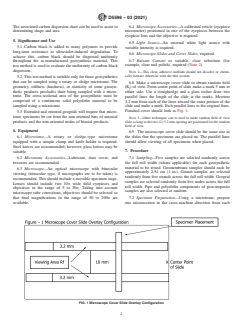
6.8 Make a microscope cover slide to obtain random field
geometry, stiffness (hardness), or elasticity of some geosyn-
(R) of view. From center point of slide make a mark 5 mm to
f
thetic products precludes their being sampled with a micro-
either side. Use a straightedge and a glass etcher draw two
tome. The cross-sectional area of the geosynthetic must be
parallel lines the length of the slide at the marks. Measure
composed of a continuous solid polyolefin material to be
3.2mm from each of the lines toward the outer portion of the
sampled using a microtome.
slide and make a mark. Etch parallel lines to the original lines.
Finished cover should look as Fig. 1.
5.3 Extruded and oriented geogrids will require that micro-
tome specimens be cut from the non-oriented bars of uniaxial
NOTE 3—Other techniques can to used to make random field of view
products and the non-oriented nodes of biaxial products.
slideaslongasthetwo(2)3.2mmopeningarepositionedfortherandom
field of view.
6. Equipment
6.9 The microscope cover slide should be the same size as
the slides that the specimens are placed on. The parallel lines
6.1 Microtome—A rotary or sledge-type microtome
should allow viewing of all specimens whe
...