

ASTM D2624-22
(Test Method)Standard Test Methods for Electrical Conductivity of Aviation and Distillate Fuels
General Information
- Abstract
SIGNIFICANCE AND USE
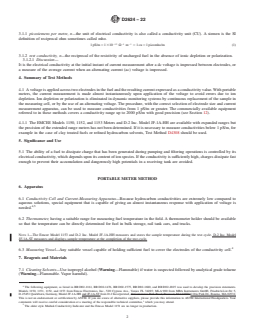
5.1 The ability of a fuel to dissipate charge that has been generated during pumping and filtering operations is controlled by its electrical conductivity, which depends upon its content of ion species. If the conductivity is sufficiently high, charges dissipate fast enough to prevent their accumulation and dangerously high potentials in a receiving tank are avoided.
SCOPE
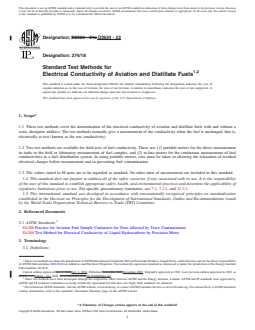
1.1 These test methods cover the determination of the electrical conductivity of aviation and distillate fuels with and without a static dissipator additive. The test methods normally give a measurement of the conductivity when the fuel is uncharged, that is, electrically at rest (known as the rest conductivity).
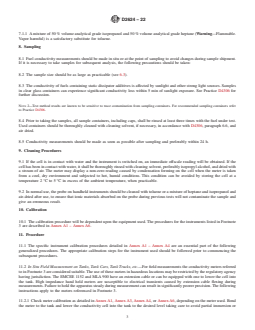
1.2 Two test methods are available for field tests of fuel conductivity. These are: (1) portable meters for the direct measurement in tanks or the field or laboratory measurement of fuel samples, and (2) in-line meters for the continuous measurement of fuel conductivities in a fuel distribution system. In using portable meters, care must be taken in allowing the relaxation of residual electrical charges before measurement and in preventing fuel contamination.
1.3 The values stated in SI units are to be regarded as standard. No other units of measurement are included in this standard.
1.4 This standard does not purport to address all of the safety concerns, if any, associated with its use. It is the responsibility of the user of this standard to establish appropriate safety, health, and environmental practices and determine the applicability of regulatory limitations prior to use. For specific precautionary statements, see 7.1, 7.1.1, and 11.2.1.
1.5 This international standard was developed in accordance with internationally recognized principles on standardization established in the Decision on Principles for the Development of International Standards, Guides and Recommendations issued by the World Trade Organization Technical Barriers to Trade (TBT) Committee.
- Status
- Published
- Publication Date
- 30-Sep-2022
- Technical Committee
- D02 - Petroleum Products, Liquid Fuels, and Lubricants
- Drafting Committee
- D02.J0.04 - Additives and Electrical Properties
Buy Documents
ASTM D2624-22 - Standard Test Methods for Electrical Conductivity of Aviation and Distillate Fuels
REDLINE ASTM D2624-22 - Standard Test Methods for Electrical Conductivity of Aviation and Distillate Fuels
Overview
ASTM D2624-22, titled "Standard Test Methods for Electrical Conductivity of Aviation and Distillate Fuels," is a crucial standard developed by ASTM International. This standard specifies procedures for measuring the electrical conductivity of aviation and distillate fuels, both with and without static dissipator additives. Electrical conductivity is a key property influencing the fuel’s ability to dissipate static electricity accumulated during typical fuel handling operations, such as pumping and filtering. Proper measurement and control of conductivity help prevent the build-up of potentially hazardous static charges in storage and transportation systems.
Key Topics
Purpose and Importance
- Electrical conductivity indicates fuel’s capability to safely dissipate static charges.
- Prevents accumulation of electrical charge, reducing the risk of fires or explosions during handling and storage.
Test Methods
- Portable Meters: Used for direct measurement in tanks or in the field/laboratory on fuel samples. Ensures in-situ accuracy but requires careful sample handling to avoid contamination and erroneous results.
- In-Line Meters: Allow for continuous monitoring of fuel conductivity in distribution systems, enabling real-time process control and safety management.
Measurement Considerations
- Readings are typically made on uncharged (rest) fuel to ensure accuracy.
- The results are affected by fuel temperature and the presence of static dissipator additives.
- Precision and repeatability are addressed, with calibration procedures outlined for widely used meters.
Sampling and Handling
- Proper sampling procedures must be followed to avoid contamination and conductivity loss, especially for fuel formulations containing additives.
- Storage, light exposure, and container cleanliness can directly affect test results.
Applications
Aviation Fuels:
- Monitoring and control of electrical conductivity during production, storage, and distribution to ensure safety.
- Essential for compliance with international fuel handling guidelines and best practices at airports and fuel farms.
Distillate Fuels:
- Used by refineries and terminal operators to verify that distillate fuels meet safety and performance requirements regarding static electricity hazards.
Fuel Supply Chain Safety:
- Implementation of ASTM D2624-22 helps fuel suppliers, transporters, and end-users mitigate the risk of static discharge incidents.
Quality Assurance and Regulatory Compliance:
- Ensures fuels meet industry and regulatory safety standards for electrical properties.
- Supports due diligence documentation for audits, certifications, and inspections.
Related Standards
Organizations working with ASTM D2624-22 should also consider these relevant standards for comprehensive fuel quality management:
- ASTM D4306: Practice for Aviation Fuel Sample Containers for Tests Affected by Trace Contamination
- ASTM D4308: Test Method for Electrical Conductivity of Liquid Hydrocarbons by Precision Meter
- API RP 2003: Protection Against Ignitions Arising Out of Static, Lightning, and Stray Currents
- EI/IP 274: Equivalent methods adopted by the Energy Institute (London) for electrical conductivity measurement
Conclusion
ASTM D2624-22 is essential for safety and quality in the handling of aviation and distillate fuels. By standardizing the measurement of electrical conductivity, this method helps prevent dangerous static electricity build-up during fuel movement, enabling industry stakeholders to achieve operational safety, regulatory compliance, and quality control. Routine application of ASTM D2624 ensures more reliable fuel distribution, storage, and delivery across the global aviation and energy sectors.
Keywords: electrical conductivity test, fuel safety, aviation fuel standards, distillate fuel testing, static dissipator additive, ASTM D2624-22, in-line fuel measurement, portable fuel meter, fuel quality assurance, fuel storage safety.
Relations
- Effective Date
- 01-Oct-2015
- Effective Date
- 01-Dec-2012
- Effective Date
- 01-Dec-2012
- Effective Date
- 01-Jun-2012
- Effective Date
- 15-Apr-2012
- Effective Date
- 01-Feb-2012
- Effective Date
- 01-Oct-2010
- Effective Date
- 15-Feb-2010
- Effective Date
- 01-Jul-2007
- Effective Date
- 01-Jun-2005
- Effective Date
- 10-Aug-2001
- Effective Date
- 10-Aug-2001
- Effective Date
- 01-Jan-2000
- Effective Date
- 01-Jan-2000
- Effective Date
- 01-Jan-2000
Buy Documents
ASTM D2624-22 - Standard Test Methods for Electrical Conductivity of Aviation and Distillate Fuels
REDLINE ASTM D2624-22 - Standard Test Methods for Electrical Conductivity of Aviation and Distillate Fuels
Get Certified
Connect with accredited certification bodies for this standard

Element Materials Technology
Materials testing and product certification.

ABS Group Brazil
ABS Group certification services in Brazil.

ABS Quality Evaluations Inc.
American Bureau of Shipping quality certification.
Sponsored listings
Frequently Asked Questions
ASTM D2624-22 is a standard published by ASTM International. Its full title is "Standard Test Methods for Electrical Conductivity of Aviation and Distillate Fuels". This standard covers: SIGNIFICANCE AND USE 5.1 The ability of a fuel to dissipate charge that has been generated during pumping and filtering operations is controlled by its electrical conductivity, which depends upon its content of ion species. If the conductivity is sufficiently high, charges dissipate fast enough to prevent their accumulation and dangerously high potentials in a receiving tank are avoided. SCOPE 1.1 These test methods cover the determination of the electrical conductivity of aviation and distillate fuels with and without a static dissipator additive. The test methods normally give a measurement of the conductivity when the fuel is uncharged, that is, electrically at rest (known as the rest conductivity). 1.2 Two test methods are available for field tests of fuel conductivity. These are: (1) portable meters for the direct measurement in tanks or the field or laboratory measurement of fuel samples, and (2) in-line meters for the continuous measurement of fuel conductivities in a fuel distribution system. In using portable meters, care must be taken in allowing the relaxation of residual electrical charges before measurement and in preventing fuel contamination. 1.3 The values stated in SI units are to be regarded as standard. No other units of measurement are included in this standard. 1.4 This standard does not purport to address all of the safety concerns, if any, associated with its use. It is the responsibility of the user of this standard to establish appropriate safety, health, and environmental practices and determine the applicability of regulatory limitations prior to use. For specific precautionary statements, see 7.1, 7.1.1, and 11.2.1. 1.5 This international standard was developed in accordance with internationally recognized principles on standardization established in the Decision on Principles for the Development of International Standards, Guides and Recommendations issued by the World Trade Organization Technical Barriers to Trade (TBT) Committee.
SIGNIFICANCE AND USE 5.1 The ability of a fuel to dissipate charge that has been generated during pumping and filtering operations is controlled by its electrical conductivity, which depends upon its content of ion species. If the conductivity is sufficiently high, charges dissipate fast enough to prevent their accumulation and dangerously high potentials in a receiving tank are avoided. SCOPE 1.1 These test methods cover the determination of the electrical conductivity of aviation and distillate fuels with and without a static dissipator additive. The test methods normally give a measurement of the conductivity when the fuel is uncharged, that is, electrically at rest (known as the rest conductivity). 1.2 Two test methods are available for field tests of fuel conductivity. These are: (1) portable meters for the direct measurement in tanks or the field or laboratory measurement of fuel samples, and (2) in-line meters for the continuous measurement of fuel conductivities in a fuel distribution system. In using portable meters, care must be taken in allowing the relaxation of residual electrical charges before measurement and in preventing fuel contamination. 1.3 The values stated in SI units are to be regarded as standard. No other units of measurement are included in this standard. 1.4 This standard does not purport to address all of the safety concerns, if any, associated with its use. It is the responsibility of the user of this standard to establish appropriate safety, health, and environmental practices and determine the applicability of regulatory limitations prior to use. For specific precautionary statements, see 7.1, 7.1.1, and 11.2.1. 1.5 This international standard was developed in accordance with internationally recognized principles on standardization established in the Decision on Principles for the Development of International Standards, Guides and Recommendations issued by the World Trade Organization Technical Barriers to Trade (TBT) Committee.
ASTM D2624-22 is classified under the following ICS (International Classification for Standards) categories: 75.160.20 - Liquid fuels. The ICS classification helps identify the subject area and facilitates finding related standards.
ASTM D2624-22 has the following relationships with other standards: It is inter standard links to ASTM D4306-15, ASTM D4308-12, ASTM D4306-12c, ASTM D4306-12b, ASTM D4306-12a, ASTM D4306-12, ASTM D4308-10, ASTM D4308-95(2010), ASTM D4306-07, ASTM D4308-95(2005), ASTM D4306-97, ASTM D4306-01, ASTM D4308-95, ASTM D4308-95(2000)e1, ASTM D4308-95(2000). Understanding these relationships helps ensure you are using the most current and applicable version of the standard.
ASTM D2624-22 is available in PDF format for immediate download after purchase. The document can be added to your cart and obtained through the secure checkout process. Digital delivery ensures instant access to the complete standard document.
Standards Content (Sample)
This international standard was developed in accordance with internationally recognized principles on standardization established in the Decision on Principles for the
Development of International Standards, Guides and Recommendations issued by the World Trade Organization Technical Barriers to Trade (TBT) Committee.
Designation: D2624 − 22
Designation: 274/18
Standard Test Methods for
1,2
Electrical Conductivity of Aviation and Distillate Fuels
This standard is issued under the fixed designation D2624; the number immediately following the designation indicates the year of
original adoption or, in the case of revision, the year of last revision.Anumber in parentheses indicates the year of last reapproval.A
superscript epsilon (´) indicates an editorial change since the last revision or reapproval.
This standard has been approved for use by agencies of the U.S. Department of Defense.
1. Scope* mendations issued by the World Trade Organization Technical
Barriers to Trade (TBT) Committee.
1.1 These test methods cover the determination of the
electrical conductivity of aviation and distillate fuels with and
2. Referenced Documents
without a static dissipator additive. The test methods normally
give a measurement of the conductivity when the fuel is 2.1 ASTM Standards:
uncharged, that is, electrically at rest (known as the rest D4306Practice for Aviation Fuel Sample Containers for
conductivity). Tests Affected by Trace Contamination
D4308Test Method for Electrical Conductivity of Liquid
1.2 Two test methods are available for field tests of fuel
Hydrocarbons by Precision Meter
conductivity. These are: (1) portable meters for the direct
measurementintanksorthefieldorlaboratorymeasurementof
3. Terminology
fuel samples, and (2) in-line meters for the continuous mea-
surementoffuelconductivitiesinafueldistributionsystem.In 3.1 Definitions:
using portable meters, care must be taken in allowing the 3.1.1 picosiemens per metre, n—the unit of electrical con-
relaxation of residual electrical charges before measurement ductivity is also called a conductivity unit (CU). A siemen is
and in preventing fuel contamination. the SI definition of reciprocal ohm sometimes called mho.
212 21 21
1.3 The values stated in SI units are to be regarded as 1 pS/m 51 310 Ω m 51cu 51 picomho/m (1)
standard. No other units of measurement are included in this
3.1.2 rest conductivity, n—thereciprocaloftheresistivityof
standard.
uncharged fuel in the absence of ionic depletion or polariza-
1.4 This standard does not purport to address all of the tion.
3.1.2.1 Discussion—It is the electrical conductivity at the
safety concerns, if any, associated with its use. It is the
responsibility of the user of this standard to establish appro- initial instant of current measurement after a dc voltage is
impressed between electrodes, or a measure of the average
priate safety, health, and environmental practices and deter-
mine the applicability of regulatory limitations prior to use. current when an alternating current (ac) voltage is impressed.
For specific precautionary statements, see 7.1, 7.1.1, and
11.2.1. 4. Summary of Test Methods
1.5 This international standard was developed in accor-
4.1 Avoltageisappliedacrosstwoelectrodesinthefueland
dance with internationally recognized principles on standard-
the resulting current expressed as a conductivity value. With
ization established in the Decision on Principles for the
portable meters, the current measurement is made almost
Development of International Standards, Guides and Recom-
instantaneously upon application of the voltage to avoid errors
duetoiondepletion.Iondepletionorpolarizationiseliminated
These test methods are under the jurisdiction ofASTM International Commit- in dynamic monitoring systems by continuous replacement of
tee D02 on Petroleum Products, Liquid Fuels, and Lubricants and are the direct
thesampleinthemeasuringcell,orbytheuseofanalternating
responsibility of ASTM Subcommittee D02.J0.04 on Additives and Electrical
voltage. The procedure, with the correct selection of electrode
Properties. The technically equivalent standard as referenced is under the jurisdic-
size and current measurement apparatus, can be used to
tion of the Energy Institute Subcommittee SC-B-8.
Current edition approved Oct. 1, 2022. Published November 2022. Originally
approved in 1967. Last previous edition approved in 2021 as D2624–21a. DOI:
10.1520/D2624-22.
2 3
Thesetestmethodshavebeendevelopedthroughthecooperativeeffortbetween For referenced ASTM standards, visit the ASTM website, www.astm.org, or
ASTMandtheEnergyInstitute,London.ASTMandIPstandardswereapprovedby contact ASTM Customer Service at service@astm.org. For Annual Book of ASTM
ASTMandEItechnicalcommitteesasbeingtechnicallyequivalentbutthatdoesnot Standards volume information, refer to the standard’s Document Summary page on
imply both standards are identical. the ASTM website.
*A Summary of Changes section appears at the end of this standard
Copyright © ASTM International, 100 Barr Harbor Drive, PO Box C700, West Conshohocken, PA 19428-2959. United States
D2624 − 22
measure conductivities from 1 pS/m or greater. The commer- 7.1.1 Amixture of 50% volume analytical grade isopropa-
cially available equipment referred to in these methods covers nol and 50% volume analytical grade heptane (Warning—
aconductivityrangeupto2000pS/mwithgoodprecision(see Flammable. Vapor harmful) is a satisfactory substitute for
Section 12). toluene.
4.1.1 The EMCEE Models 1150, 1152, and 1153 Meters
8. Sampling
and D-2 Inc. Model JF-1A-HH are available with expanded
ranges but the precision of the extended range meters has not
8.1 Fuel conductivity measurements should be made in situ
been determined. If it is necessary to measure conductivities
or at the point of sampling to avoid changes during sample
below 1 pS/m, for example in the case of clay treated fuels or
shipment. If it is necessary to take samples for subsequent
refined hydrocarbon solvents, Test Method D4308 should be
analysis, the following precautions should be taken:
used.
8.2 The sample size should be as large as practicable (see
6.3).
5. Significance and Use
8.3 The conductivity of fuels containing static dissipator
5.1 The ability of a fuel to dissipate charge that has been
additives is affected by sunlight and other strong light sources.
generatedduringpumpingandfilteringoperationsiscontrolled
Samples in clear glass containers can experience significant
by its electrical conductivity, which depends upon its content
conductivity loss within 5 min of sunlight exposure. See
of ion species. If the conductivity is sufficiently high, charges
Practice D4306 for further discussion.
dissipate fast enough to prevent their accumulation and dan-
NOTE 2—Test method results are known to be sensitive to trace
gerously high potentials in a receiving tank are avoided.
contamination from sampling containers. For recommended sampling
containers refer to Practice D4306.
PORTABLE METER METHOD
8.4 Prior to taking the samples, all sample containers,
includingcaps,shallberinsedatleastthreetimeswiththefuel
6. Apparatus
under test. Used containers should be thoroughly cleaned with
cleaning solvent, if necessary, in accordance with D4306,
6.1 Conductivity Cell and Current-Measuring Apparatus—
paragraph 6.6, and air dried.
Because hydrocarbon conductivities are extremely low com-
paredtoaqueoussolutions,specialequipmentthatiscapableof 8.5 Conductivity measurements should be made as soon as
giving an almost instantaneous response with application of
possible after sampling and preferably within 24 h.
4,5
voltage is needed.
9. Cleaning Procedures
6.2 Thermometer,havingasuitablerangeformeasuringfuel
9.1 If the cell is in contact with water and the instrument is
temperature in the field. A thermometer holder should be
switchedon,animmediateoffscalereadingwillbeobtained.If
availablesothatthetemperaturecanbedirectlydeterminedfor
the cell has been in contact with water, it shall be thoroughly
fuel in bulk storage, rail tank cars, and trucks.
rinsed with cleaning solvent, preferably isopropyl alcohol, and
NOTE 1—The Emcee Model 1153 and D-2 Inc. Model JF-1A-HH
dried with a stream of air. The meter may display a non-zero
measuresandstoresthesampletemperatureduringthetestcycle.D-2Inc.
reading caused by condensation forming on the cell when the
Model JF-1A-ST measures and displays sample temperature at the
meter is taken from a cool, dry environment and subjected to
completion of the test cycle.
hot, humid conditions. This condition can be avoided by
6.3 Measuring Vessel—Anysuitablevesselcapableofhold-
storing the cell at a temperature 2°C to 5°C in excess of the
ing sufficient fuel to cover the electrodes of the conductivity
4 ambient temperature, when practicable.
cell.
9.2 In normal use, the probe on handheld instruments
should be cleaned with toluene or a mixture of heptane and
7. Reagents and Materials
isopropanol and air-dried after use, to ensure that ionic
7.1 Cleaning Solvents—Use isopropyl alcohol (Warning—
materials absorbed on the probe during previous tests will not
Flammable) if water is suspected followed by analytical grade
contaminate the sample and give an erroneous result.
toluene (Warning—Flammable. Vapor harmful).
10. Calibration
10.1 The calibration procedure will be dependent upon the
The following equipment, as listed in RR:D02-1161, RR:D02-1476, RR:D02-
equipment used. The procedures for the instruments listed in
1575, RR:D02-1680, and RR:D02-2025 was used to develop the precision state-
Footnote 3 are described in Annex A1 – Annex A6.
ments. Models 1150, 1151, 1152, and 1153 from Emcee Electronics, Inc., 520
Cypress Ave., Venice FL 34285; MLA 900 from MBA Instruments GmbH,
Friedrich-List-Str 5, D-25451 Quickborn, Germany, Model JF-1A-HH and JF-
11. Procedure
1A-ST from D-2 Incorporated, 6 Otis Park Dr., Bourne, MA02532. This is not an
11.1 The specific instrument calibration procedures detailed
endorsement or certification by ASTM. If you are aware of alternative suppliers,
please provide this information to ASTM International Headquarters. Your com-
in AnnexA1 – AnnexA4 are an essential part of the following
ments will receive careful consideration at a meeting of the responsible technical
generalized procedures. The appropriate calibration steps for
committee, which you may attend.
the instrument used should be followed prior to commencing
The older style Maihak Conductivity Indicator and the Emcee Model 1151 are
no longer in production. the subsequent procedures.
D2624 − 22
11.2 In Situ Field Measurement on Tanks, Tank Cars, Tank oneoftheconductivitymetersreferencedinFootnote3isused,
Trucks, etc.—For field measurements the conductivity meters follow these instructions: Rinse the cell concurrently with the
referred to in Footnote 3 are considered suitable. The use of rinsing of the measuring vessel.Then transfer the sample to be
these meters in hazardous locations may be restricted by the tested to the clean, rinsed measuring vessel. Check meter
regulatory agency having jurisdiction. The EMCEE 1152 and calibration as detailed in AnnexA1, AnnexA4,or AnnexA6,
MLA900haveanextensioncableorcanbeequippedwithone depending on the meter used. Fully immerse the conductivity
to lower the cell into the tank. High impedance hand held cell into the test fuel and measure the conductivity following
meters are susceptible to electrical transients caused by exten- the procedure in 11.2.2 and the appropriateAnnex. Record the
sion cable flexing during measurements. Failure to hold the fuel temperature.
apparatussteadyduringmeasurementcanresultinsignificantly
NOTE 4—In order to avoid erroneous readings, it is important to ensure
poorer precision. The following instructions apply to the
that the bottom of the conductivity cell does not touch the sample
meters referenced in Footnote 3.
container. This is applicable to all containers, whatever the material of
construction.
11.2.1 Check meter calibration as detailed in Annex A1,
NOTE 5—With the Emcee Model 1152 Digital Meter and the MLA900
Annex A3, Annex A4,or Annex A6, depending on the meter
Meter, measurements exceeding the range of the meter are indicated by a
used. Bond the meter to the tank and lower the conductivity
single digit “1” in the left side of the display where 1000s are shown.The
cellintothetanktothedesiredleveltakingcaretoavoidpartial
D-2ModelJF-1A-HHandJF-1A-STreporttothedisplaythetext,“Value
immersion or contact with tank water bottoms, if present. is Over Range.” A qualitative conductivity estimate (for which precision
hasnotbeenestablished)canbemadebyinsertingtheprobeinthesample
Move the conductivity cell in an up-and-down motion to
to the first set of holes closest to the tip, which are at the mid point of the
remove previous fuel residues. (Warning—To prevent static
sensingportionoftheprobe.Sincethedisplayedconductivityisinversely
discharge between a charged fuel and a conductive probe
proportionaltothedepthofimmersion,thevaluedisplayed,ifany,should
inserted into a tank, the appropriate safety precautions of
be doubled. Conductivities less than 1 pS/m up to 20 000 pS/m can be
bondingandwaitingforchargedissipationshouldbeobserved. determinedusingTestMethodD4308.WhenusingtheEmceeModel1153
Digital Meter, measurements exceeding the range of the meter “OVER”
For example, the American Petroleum Institute in RP 2003
will be displayed.
recommends that a 30-min interval be allowed after pumping
into a storage tank before an operator mounts a tank to insert
12. Report
a sampling device. This will also ensure that the fuel is
12.1 Report the electrical conductivity of the fuel and the
electrically at rest.)
fuel temperature at which measurement was made. If the
11.2.2 After flushing the cell, hold it steady and after
electrical conductivity reads zero on the meter, report less than
activatingtheinstrumentrecordthehighestreadingafterinitial
1 pS/m.
stabilization. This should occur within 3 s. Record the fuel
temperature.
NOTE6—Itisrecognizedthattheelectricalconductivityofafuelvaries
significantly with temperature and that the relationship differs for various
NOTE 3—The Emcee Model 1153 automatically measures and records
types of aviation and distillate fuel. If it is necessary to correct conduc-
the reading at 3 s. The D-2 Model JF-1A-HH samples 10 times upon
tivity readings to a particular temperature, each laboratory would have to
activation.Allowthecenterbarindicatoronthedisplaytocometocenter,
establish this relationship for the fuels and temperature range of interest.
indicating the current reading has repeated. Once repeated, press the
RefertoAppendixX2foradditionalinformationoftheeffecttemperature
sample button again to display the conductivity, temperature data and
has on the electrical conductivity of fuels.
store the data to the instruments memory. The JF-1A-ST powers and
indicates ‘Ready’ when ready to sample. Once probe is immersed into a
13. Precision and Bias
sample, the user presses the sample button a second time to activate
sampling and 10 determinations are made indicated by a completion bar.
13.1 Astheprecisionwasdeterminedfromresultsobtained
Whencomplete,theresultisaveragedfromdatacollectedandtheaverage
at a single location, the reproducibility value may not be
result is displayed alternately with sample temperature.
comparable when results obtained at different times and
11.3 Laboratory and Field Measurements on Sampled Fu-
locations are compared, due to changes in the property of
els:
interest: sampling, shipping, storage and environmental condi-
11.3.1 Preparation of Containers (Metal or Glass)—Priorto
tions. The precision data generated for Table 1 did not include
taking samples, take extreme care to ensure that all containers
any gasolines or solvents.
and measuring vessels have been thoroughly cleaned. It is
preferable that containers are laboratory cleaned prior to
shipment to the field for sampling (see Section 8).
Supporting data have been filed atASTM International Headquarters and may
11.3.2 Measurement—Rinse the conductivity cell thor-
beobtainedbyrequestingResearchReportsRR:D02-1013,RR:D02-1476,RR:D02-
1161, RR:D02-1680, and RR:D02-1799. RR:D02-1161 gives details of data by the
oughly with the fuel under test to remove fuel residues
IP which resulted in the data in Table 1 for the Emcee Digital Conductivity Meter.
remaining on the cell from previous tests. Transfer the fuel to
The data in RR:D02-2025 support the precision for the MLA-900. The data in
the measuring vessel and record the conductivity of the fuel
RR:D02-2040 support the precision for the D-2 Model JF-1A-HH and D-2 Model
using the procedure applicable to the particular apparatus. If JF-1A-ST.
D2624 − 22
A 6
TABLE 1 Precision of Emcee Models 1150, 1152, and 1153
twenty.
Repeatability = 0.697*(x^0.6386)
13.2 In 1987, a test program was carried out to investigate
Reproducibility, Single Site = 1.174*(x^0.6386)
Conductivity, reproducibility of results when samples are shipped between
Repeatability Reproducibility
pS/m
laboratories. (See Appendix X1.) While repeatability values
11 1
weresimilartothoseinTable1,itwasconcludedthatadequate
15 4 7
20 5 8 reproducibility values were not obtained due to changes in
30 6 10
conductivity of samples during shipment and storage. In the
50 8 14
event of dispute or concern regarding shipped sample
70 11 18
100 13 22 conductivity, it is recommended that operators come to the
200 21 35
bulk fuel storage site to measure conductivity on bulk fuel or
300 27 45
on freshly obtained samples according to cited procedures.
500 37 62
700 46 77
Thisassuresthatasampleidenticaltothebulksupplyistested
1000 57 97
by either or both parties and the precision data shown in Table
1500 74 125
1 shall apply.
A
The precision limits in Table 1 are applicable at room temperatures; significantly
higher precision (×2) may be applicable at temperatures near −20 °C.
13.3 TheMLA900EmceeModel1153,andD-2Inc.Model
JF-1A-HH meters provide a sample temperature measurement.
PrecisionoftheMLA900isshowninTable2.Precisionofthe
NOTE7—AnILSprecisionprogram wasconductedtodevelopasingle
D-2 Inc. Model JF-1A-HH and JF-1A-STis shown in Table 3.
precisionstatementforallEmceeElectronics,Inc.meterslistedinthistest
13.4 Bias—Since there is no accepted reference material or
method. The manufacturers of other meters listed in this test method
elected not to participate.
test method for determining the bias of the procedure in Test
Methods D2624 for measuring electrical conductivity, bias
13.1.1 Single site ILS(s) were approved by the subcommit-
cannot be determined.
tee and carried out for the following reasons: fuel conductivity
isanunstablepropertythatcanchangewithtime,temperature,
storage, shipping, and environmental conditions.
13.1.2 Repeatability—The difference between successive
measured conductivity values obtained by the same operator Supporting data have been filed atASTM International Headquarters and may
beobtainedbyrequestingResearchReportRR:D02-1235.ContactASTMCustomer
withthesameapparatusunderconstantoperatingconditionson
Service at service@astm.org.
identical test material at the same fuel temperature would, in
the long run, in the normal and correct operation of the test
A 6
TABLE 2 Precision of MLA 900 Meter
method, exceed the values in Table 1 only in one case in
Repeatability = 0.2104*(x^ 0.802)
twenty.
Reproducibility, Single Site = 0.2406*(x^ 0.802)
13.1.3 Reproducibility, Single Site—The difference between Conductivity,
Repeatability Reproducibility
pS/m
two single and independent measurements of conductivity
obtained within a 4h time period by different operators using
10 0
different instruments working at the same location (13.2)on
15 2 2
20 2 3
identical test material at the same fuel temperature would, in
30 3 4
the long run, in the normal and correct operation of the test
50 5 6
method, exceed the values in Table 1 only in one case in 70 6 7
100 8 10
200 15 17
300 20 23
The following continuous measuring equipment has been found to meet the
500 31 35
statedprecisionforthistestmethod:Model1150StaticonConductivityMonitorand
700 40 46
Injection System, manufactured by Emcee Electronics, 520 Cypress Ave., Venice,
1000 54 61
FL34285.SupportingdatahavebeenfiledatASTMInternationalHeadquartersand
1500 74 85
may be obtained by requesting Research Report RR:D02-1799. If you are aware of
A
alternative suppliers, please provide this information to ASTM International
The precision limits in Table 2 are applicable at room temperature; significantly
Headquarters.Your comments will receive careful consideration at a meeting of the
higher precision (×2) may be applicable at temperatures near −20 °C.
responsible technical committee, which you may attend.
D2624 − 22
A 6
TABLE 3 Precision of D-2 Incorporated JF-1A-HH, JF-1A-ST
recommendation. Too fast or too slow a flow will result in
Repeatability = 0.840*(x^0.5218) (when x is <420), = 0.07764*(x^ 0.9158)
inaccuracies in the conductivity measurement.
(when x is$420)
Reproducibility, Single Site = 1.57*(x^0.5218)
18. Measurement
Conductivity,
Repeatability Reproducibility
pS/m
18.1 After calibration, select the instrument scale of the
11 2
approximate range anticipated for the fuel stream and initiate
15 3 6
continuous measurements of fuel conductivity. Make measure-
20 4 8
30 5 9
ments at the test cell temperature (indicated by the installed
50 6 12
thermometer), which should approximate the temperature of
70 8 14
100 9 17 the fuel in the system.
200 13 25
300 16 31
19. Report
500 23 40
19.1 Report the electrical conductivity of the fuel and the
700 31 48
1000 43 58
fuel temperature at which measurement was made.
1500 63 72
A
The precision limits in Table 3 are applicable at room temperature; significantly 20. Precision and Bias
higher precision (×2) may be applicable at temperatures near –20 °C.
20.1 Repeatability—Repeatability of the continuous meter
has been established to be within the range given for the
portable instruments (see 13.1.2).
CONTINUOUS IN-LINE CONDUCTIVITY
20.2 Reproducibility, Single Site—Reproducibility was es-
14. Apparatus 7
tablished during an ILS performed in October 2012.
14.1 The Emcee Staticon System has the capability of
20.3 Bias—Since there is no accepted reference material or
measuringandrecordingtheconductivityandtemperatureofa
test method for determining the bias of the procedure in this
fuel stream.
test method, bias cannot be determined.
14.2 Continuous measurements may be made where suit-
21. Apparatus
able precautions have been taken to remove static charges
before the representative fuel stream is passed through the 21.1 Continuous measurements can be made using a sensor
in-line measuring cell. A controlled, continuous flow through that utilized alternating current measurement technique. In this
the cell prevents ion depletion, thereby providing the equiva- type of instrument, the constant rotation of the applied electric
lentofrestconductivityasacontinuousmeasurement.Further, field prevents the formation of polarization impedances on the
measuringtheconductivitywiththeuseofasidestreamsensor electrodes. The sensor then yields the equivalent of dc-type
with constant flow renders conductivity insensitive to the resting conductivity readings.
actual flow rate of the fuel stream being sampled.
22. Installation
15. Installation
22.1 The JF-1A sensor should be used as specified in the
“Installation and Safe Use Manual, Ref. A440–010” that is
15.1 In general, the equipment is designed for permanent
provided with the instrument. The JF-1A has an integral
installation in the fuel distribution system. Follow the manu-
temperature measurement channel.
facturer’s recommendations concerning installation and flow
control, particularly with respect to the provision of adequate
23. Calibration
relaxation time. Install the sample tapping point at least 30 m
23.1 The specific calibration procedure
...
This document is not an ASTM standard and is intended only to provide the user of an ASTM standard an indication of what changes have been made to the previous version. Because
it may not be technically possible to adequately depict all changes accurately, ASTM recommends that users consult prior editions as appropriate. In all cases only the current version
of the standard as published by ASTM is to be considered the official document.
Designation: D2624 − 21a D2624 − 22
Designation: 274/18
Standard Test Methods for
1,2
Electrical Conductivity of Aviation and Distillate Fuels
This standard is issued under the fixed designation D2624; the number immediately following the designation indicates the year of
original adoption or, in the case of revision, the year of last revision. A number in parentheses indicates the year of last reapproval. A
superscript epsilon (´) indicates an editorial change since the last revision or reapproval.
This standard has been approved for use by agencies of the U.S. Department of Defense.
1. Scope*
1.1 These test methods cover the determination of the electrical conductivity of aviation and distillate fuels with and without a
static dissipator additive. The test methods normally give a measurement of the conductivity when the fuel is uncharged, that is,
electrically at rest (known as the rest conductivity).
1.2 Two test methods are available for field tests of fuel conductivity. These are: (1) portable meters for the direct measurement
in tanks or the field or laboratory measurement of fuel samples, and (2) in-line meters for the continuous measurement of fuel
conductivities in a fuel distribution system. In using portable meters, care must be taken in allowing the relaxation of residual
electrical charges before measurement and in preventing fuel contamination.
1.3 The values stated in SI units are to be regarded as standard. No other units of measurement are included in this standard.
1.4 This standard does not purport to address all of the safety concerns, if any, associated with its use. It is the responsibility
of the user of this standard to establish appropriate safety, health, and environmental practices and determine the applicability of
regulatory limitations prior to use. For specific precautionary statements, see 7.1, 7.1.1, and 11.2.1.
1.5 This international standard was developed in accordance with internationally recognized principles on standardization
established in the Decision on Principles for the Development of International Standards, Guides and Recommendations issued
by the World Trade Organization Technical Barriers to Trade (TBT) Committee.
2. Referenced Documents
2.1 ASTM Standards:
D4306 Practice for Aviation Fuel Sample Containers for Tests Affected by Trace Contamination
D4308 Test Method for Electrical Conductivity of Liquid Hydrocarbons by Precision Meter
3. Terminology
3.1 Definitions:
These test methods are under the jurisdiction of ASTM International Committee D02 on Petroleum Products, Liquid Fuels, and Lubricants and are the direct responsibility
of ASTM Subcommittee D02.J0.04 on Additives and Electrical Properties. The technically equivalent standard as referenced is under the jurisdiction of the Energy Institute
Subcommittee SC-B-8.
Current edition approved Oct. 1, 2021Oct. 1, 2022. Published November 2021November 2022. Originally approved in 1967. Last previous edition approved in 2021 as
D2624 – 21.D2624 – 21a. DOI: 10.1520/D2624-21A.10.1520/D2624-22.
These test methods have been developed through the cooperative effort between ASTM and the Energy Institute, London. ASTM and IP standards were approved by
ASTM and EI technical committees as being technically equivalent but that does not imply both standards are identical.
For referenced ASTM standards, visit the ASTM website, www.astm.org, or contact ASTM Customer Service at service@astm.org. For Annual Book of ASTM Standards
volume information, refer to the standard’s Document Summary page on the ASTM website.
*A Summary of Changes section appears at the end of this standard
Copyright © ASTM International, 100 Barr Harbor Drive, PO Box C700, West Conshohocken, PA 19428-2959. United States
D2624 − 22
3.1.1 picosiemens per metre, n—the unit of electrical conductivity is also called a conductivity unit (CU). A siemen is the SI
definition of reciprocal ohm sometimes called mho.
212 21 21
1 pS/m5 1310 Ω m 5 1 cu 5 1 picomho/m (1)
3.1.2 rest conductivity, n—the reciprocal of the resistivity of uncharged fuel in the absence of ionic depletion or polarization.
3.1.2.1 Discussion—
It is the electrical conductivity at the initial instant of current measurement after a dc voltage is impressed between electrodes, or
a measure of the average current when an alternating current (ac) voltage is impressed.
4. Summary of Test Methods
4.1 A voltage is applied across two electrodes in the fuel and the resulting current expressed as a conductivity value. With portable
meters, the current measurement is made almost instantaneously upon application of the voltage to avoid errors due to ion
depletion. Ion depletion or polarization is eliminated in dynamic monitoring systems by continuous replacement of the sample in
the measuring cell, or by the use of an alternating voltage. The procedure, with the correct selection of electrode size and current
measurement apparatus, can be used to measure conductivities from 1 pS/m or greater. The commercially available equipment
referred to in these methods covers a conductivity range up to 2000 pS/m with good precision (see Section 12).
4.1.1 The EMCEE Models 1150, 1152, and 1153 Meters and D-2 Inc. Model JF-1A-HH are available with expanded ranges but
the precision of the extended range meters has not been determined. If it is necessary to measure conductivities below 1 pS/m, for
example in the case of clay treated fuels or refined hydrocarbon solvents, Test Method D4308 should be used.
5. Significance and Use
5.1 The ability of a fuel to dissipate charge that has been generated during pumping and filtering operations is controlled by its
electrical conductivity, which depends upon its content of ion species. If the conductivity is sufficiently high, charges dissipate fast
enough to prevent their accumulation and dangerously high potentials in a receiving tank are avoided.
PORTABLE METER METHOD
6. Apparatus
6.1 Conductivity Cell and Current-Measuring Apparatus—Because hydrocarbon conductivities are extremely low compared to
aqueous solutions, special equipment that is capable of giving an almost instantaneous response with application of voltage is
4,5
needed.
6.2 Thermometer, having a suitable range for measuring fuel temperature in the field. A thermometer holder should be available
so that the temperature can be directly determined for fuel in bulk storage, rail tank cars, and trucks.
NOTE 1—The Emcee Model 1153 and D-2 Inc. Model JF-1A-HH measures and stores the sample temperature during the test cycle. D-2 Inc. Model
JF-1A-ST measures and displays sample temperature at the completion of the test cycle.
6.3 Measuring Vessel—Any suitable vessel capable of holding sufficient fuel to cover the electrodes of the conductivity cell.
7. Reagents and Materials
7.1 Cleaning Solvents—Use isopropyl alcohol (Warning—Flammable) if water is suspected followed by analytical grade toluene
(Warning—Flammable. Vapor harmful).
The following equipment, as listed in RR:D02-1161, RR:D02-1476, RR:D02-1575, RR:D02-1680, and RR:D02-2025 was used to develop the precision statements.
Models 1150, 1151, 1152, and 1153 from Emcee Electronics, Inc., 520 Cypress Ave., Venice FL 34285; MLA 900 from MBA Instruments GmbH, Friedrich-List-Str 5,
D-25451 Quickborn, Germany, Model JF-1A-HH and JF-1A-ST from D-2 Incorporated, 19 Commerce Park Road, Pocasset, MA 02559.6 Otis Park Dr., Bourne, MA 02532.
This is not an endorsement or certification by ASTM. If you are aware of alternative suppliers, please provide this information to ASTM International Headquarters. Your
comments will receive careful consideration at a meeting of the responsible technical committee, which you may attend.
The older style Maihak Conductivity Indicator and the Emcee Model 1151 are no longer in production.
D2624 − 22
7.1.1 A mixture of 50 % volume analytical grade isopropanol and 50 % volume analytical grade heptane (Warning—Flammable.
Vapor harmful) is a satisfactory substitute for toluene.
8. Sampling
8.1 Fuel conductivity measurements should be made in situ or at the point of sampling to avoid changes during sample shipment.
If it is necessary to take samples for subsequent analysis, the following precautions should be taken:
8.2 The sample size should be as large as practicable (see 6.3).
8.3 The conductivity of fuels containing static dissipator additives is affected by sunlight and other strong light sources. Samples
in clear glass containers can experience significant conductivity loss within 5 min of sunlight exposure. See Practice D4306 for
further discussion.
NOTE 2—Test method results are known to be sensitive to trace contamination from sampling containers. For recommended sampling containers refer
to Practice D4306.
8.4 Prior to taking the samples, all sample containers, including caps, shall be rinsed at least three times with the fuel under test.
Used containers should be thoroughly cleaned with cleaning solvent, if necessary, in accordance with D4306, paragraph 6.6, and
air dried.
8.5 Conductivity measurements should be made as soon as possible after sampling and preferably within 24 h.
9. Cleaning Procedures
9.1 If the cell is in contact with water and the instrument is switched on, an immediate offscale reading will be obtained. If the
cell has been in contact with water, it shall be thoroughly rinsed with cleaning solvent, preferably isopropyl alcohol, and dried with
a stream of air. The meter may display a non-zero reading caused by condensation forming on the cell when the meter is taken
from a cool, dry environment and subjected to hot, humid conditions. This condition can be avoided by storing the cell at a
temperature 2 °C to 5 °C in excess of the ambient temperature, when practicable.
9.2 In normal use, the probe on handheld instruments should be cleaned with toluene or a mixture of heptane and isopropanol and
air-dried after use, to ensure that ionic materials absorbed on the probe during previous tests will not contaminate the sample and
give an erroneous result.
10. Calibration
10.1 The calibration procedure will be dependent upon the equipment used. The procedures for the instruments listed in Footnote
3 are described in Annex A1 – Annex A6.
11. Procedure
11.1 The specific instrument calibration procedures detailed in Annex A1 – Annex A4 are an essential part of the following
generalized procedures. The appropriate calibration steps for the instrument used should be followed prior to commencing the
subsequent procedures.
11.2 In Situ Field Measurement on Tanks, Tank Cars, Tank Trucks, etc.—For field measurements the conductivity meters referred
to in Footnote 3 are considered suitable. The use of these meters in hazardous locations may be restricted by the regulatory agency
having jurisdiction. The EMCEE 1152 and MLA 900 have an extension cable or can be equipped with one to lower the cell into
the tank. High impedance hand held meters are susceptible to electrical transients caused by extension cable flexing during
measurements. Failure to hold the apparatus steady during measurement can result in significantly poorer precision. The following
instructions apply to the meters referenced in Footnote 3.
11.2.1 Check meter calibration as detailed in Annex A1, Annex A3, Annex A4, or Annex A6, depending on the meter used. Bond
the meter to the tank and lower the conductivity cell into the tank to the desired level taking care to avoid partial immersion or
D2624 − 22
contact with tank water bottoms, if present. Move the conductivity cell in an up-and-down motion to remove previous fuel residues.
(Warning—To prevent static discharge between a charged fuel and a conductive probe inserted into a tank, the appropriate safety
precautions of bonding and waiting for charge dissipation should be observed. For example, the American Petroleum Institute in
RP 2003 recommends that a 30-min interval be allowed after pumping into a storage tank before an operator mounts a tank to insert
a sampling device. This will also ensure that the fuel is electrically at rest.)
11.2.2 After flushing the cell, hold it steady and after activating the instrument record the highest reading after initial stabilization.
This should occur within 3 s. Record the fuel temperature.
NOTE 3—The Emcee Model 1153 automatically measures and records the reading at 3 s. The D-2 Model JF-1A-HH Samplessamples 10 times upon
activation, allowactivation. Allow the center bar indicator on the display to come to center which indicates center, indicating the current reading has
repeated, once repeatedrepeated. Once repeated, press the sample button again to display the conductivity, temperature data and store the data to the
instruments memory. The JF-1A-ST powers and indicates ‘Ready’ when ready to sample. Once probe is immersed into a sample, the user presses the
sample button a second time to activate sampling and 10 determinations are made indicated by a completion bar. When complete, the result is averaged
from data collected and the average result is displayed alternately with sample temperature.
11.3 Laboratory and Field Measurements on Sampled Fuels:
11.3.1 Preparation of Containers (Metal or Glass)—Prior to taking samples, take extreme care to ensure that all containers and
measuring vessels have been thoroughly cleaned. It is preferable that containers are laboratory cleaned prior to shipment to the field
for sampling (see Section 8).
11.3.2 Measurement—Rinse the conductivity cell thoroughly with the fuel under test to remove fuel residues remaining on the cell
from previous tests. Transfer the fuel to the measuring vessel and record the conductivity of the fuel using the procedure applicable
to the particular apparatus. If one of the conductivity meters referenced in Footnote 3 is used, follow these instructions: Rinse the
cell concurrently with the rinsing of the measuring vessel. Then transfer the sample to be tested to the clean, rinsed measuring
vessel. Check meter calibration as detailed in Annex A1, Annex A4, or Annex A6, depending on the meter used. Fully immerse
the conductivity cell into the test fuel and measure the conductivity following the procedure in 11.2.2 and the appropriate Annex.
Record the fuel temperature.
NOTE 4—In order to avoid erroneous readings, it is important to ensure that the bottom of the conductivity cell does not touch the sample container. This
is applicable to all containers, whatever the material of construction.
NOTE 5—With the Emcee Model 1152 Digital Meter and the MLA 900 Meter, measurements exceeding the range of the meter are indicated by a single
digit “1” in the left side of the display where 1000s are shown. The D-2 Model JF-1A reports JF-1A-HH and JF-1A-ST report to the display the text,
“Reading Out of“Value is Over Range.” A qualitative conductivity estimate (for which precision has not been established) can be made by inserting the
probe in the sample to the first set of holes closest to the tip, which are at the mid point of the sensing portion of the probe. Since the displayed conductivity
is inversely proportional to the depth of immersion, the value displayed, if any, should be doubled. Conductivities less than 1 pS/m up to 20 000 pS/m
can be determined using Test Method D4308. When using the Emcee Model 1153 Digital Meter, measurements exceeding the range of the meter “OVER”
will be displayed.
12. Report
12.1 Report the electrical conductivity of the fuel and the fuel temperature at which measurement was made. If the electrical
conductivity reads zero on the meter, report less than 1 pS/m.
NOTE 6—It is recognized that the electrical conductivity of a fuel varies significantly with temperature and that the relationship differs for various types
of aviation and distillate fuel. If it is necessary to correct conductivity readings to a particular temperature, each laboratory would have to establish this
relationship for the fuels and temperature range of interest. Refer to Appendix X2 for additional information of the effect temperature has on the electrical
conductivity of fuels.
13. Precision and Bias
13.1 The precision of this test method as determined by statistical analysis of test results obtained by operator–instrument pairs
at a common test site is as follows. The precision data generated for As the precision was determined from results obtained at a
Supporting data have been filed at ASTM International Headquarters and may be obtained by requesting Research Reports RR:D02-1013, RR:D02-1476, RR:D02-1161,
RR:D02-1680, and RR:D02-1799. RR:D02-1161 gives details of data by the IP which resulted in the data in Table 1 for the Emcee Digital Conductivity Meter. The data in
RR:D02-2025 support the precision for the MLA-900. The data in RR:D02-1680RR:D02-2040 support the precision for the D-2 Model JF-1A-HH.JF-1A-HH and D-2 Model
JF-1A-ST.
D2624 − 22
single location, the reproducibility value may not be comparable when results Table 1 did not include any gasolines or solvents.
The precision data given inobtained at different times and locations are compared, due to changes in the Table 1 are presented
inproperty of interest: sampling, Fig. 1 for ease of use.shipping, storage and environmental conditions.
A
TABLE 1 Precision of Emcee Models 1150, 1152, and 1153
Conductivity,
Repeatability Reproducibility
pS/m
1 1 1
15 4 7
20 5 8
30 6 10
50 8 14
70 11 18
100 13 22
200 21 35
300 27 45
500 37 62
700 46 77
1000 57 97
1500 74 125
A
The precision limits in Table 1 are applicable at room temperatures; significantly higher precision (×2) may be applicable at temperatures near −20 °C.
The precision data generated for Table 1 did not include any gasolines or solvents.
A 6
TABLE 1 Precision of Emcee Models 1150, 1152, and 1153
Repeatability = 0.697*(x^0.6386)
Reproducibility, Single Site = 1.174*(x^0.6386)
Conductivity,
Repeatability Reproducibility
pS/m
1 1 1
15 4 7
20 5 8
30 6 10
50 8 14
70 11 18
100 13 22
200 21 35
300 27 45
500 37 62
700 46 77
1000 57 97
1500 74 125
FIG. 1 Graphic Presentation of Table 1’s Precision
A
The precision limits in Table 1 are applicable at room temperatures; significantly
higher precision (×2) may be applicable at temperatures near −20 °C.
D2624 − 22
NOTE 7—An ILS precision program was conducted to develop a single precision statement for all Emcee Electronics, Inc. meters listed in this test
method. The manufacturers of other meters listed in this test method elected not to participate.
13.1.1 Single site ILS(s) were approved by the subcommittee and carried out for the following reasons: fuel conductivity is an
unstable property that can change with time, temperature, storage, shipping, and environmental conditions.
13.1.2 Repeatability—The difference between successive measured conductivity values obtained by the same operator with the
same apparatus under constant operating conditions on identical test material at the same fuel temperature would, in the long run,
in the normal and correct operation of the test method, exceed the values in Table 1 only in one case in twenty.
13.1.3 Reproducibility—Reproducibility, Single Site—The difference between two single and independent measurements of
conductivity obtained within a 4 h time period by different operators using different instruments working at the same location
(13.2) on identical test material at the same fuel temperature would, in the long run, in the normal and correct operation of the test
method, exceed the values in Table 1 only in one case in twenty.
13.2 In 1987, a test program was carried out to investigate reproducibility of results when samples are shipped between
laboratories. (See Appendix X1.) While repeatability values were similar to those in Table 1, it was concluded that adequate
reproducibility values were not obtained due to changes in conductivity of samples during shipment and storage. In the event of
dispute or concern regarding shipped sample conductivity, it is recommended that operators come to the bulk fuel storage site to
measure conductivity on bulk fuel or on freshly obtained samples according to cited procedures. This assures that a sample
identical to the bulk supply is tested by either or both parties and the precision data shown in Table 1 shall apply.
13.3 The MLA 900 Emcee Model 1153, and D-2 Inc. Model JF-1A-HH meters provide a sample temperature measurement.
Precision of the MLA 900 is shown in Table 2. Precision of the D-2 Inc. Model JF-1A-HH and JF-1A-ST is shown in Table 3.
13.4 Bias—Since there is no accepted reference material or test method for determining the bias of the procedure in Test Methods
D2624 for measuring electrical conductivity, bias cannot be determined.
A 6
TABLE 2 Precision of MLA 900 Meter
Conductivity,
Repeatability Reproducibility
pS/m
Repeatability = 0.2104*(x^ 0.802)
Reproducibility, Single Site = 0.2406*(x^ 0.802)
Conductivity,
Repeatability Reproducibility
pS/m
1 0 0
15 2 2
20 2 3
30 3 4
50 5 6
70 6 7
100 8 10
200 15 17
300 20 23
500 31 35
700 40 46
1000 54 61
1500 74 85
A
The precision limits in Table 2 are applicable at room temperature; significantly
higher precision (×2) may be applicable at temperatures near −20 °C.
The following continuous measuring equipment has been found to meet the stated precision for this test method: Model 1150 Staticon Conductivity Monitor and Injection
System, manufactured by Emcee Electronics, 520 Cypress Ave., Venice, FL 34285. Supporting data have been filed at ASTM International Headquarters and may be obtained
by requesting Research Report RR:D02-1799. If you are aware of alternative suppliers, please provide this information to ASTM International Headquarters. Your comments
will receive careful consideration at a meeting of the responsible technical committee, which you may attend.
Supporting data have been filed at ASTM International Headquarters and may be obtained by requesting Research Report RR:D02-1235. Contact ASTM Customer
Service at service@astm.org.
D2624 − 22
A 6
TABLE 3 Precision of D-2 Incorporated JF-1A-HH
Conductivity,
Repeatability Reproducibility
pS/m
1 1 1
15 6 6
20 7 7
30 8 8
50 10 10
70 12 12
100 15 15
200 21 21
300 26 26
500 33 33
700 39 39
1000 47 47
1500 57 57
A 6
TABLE 3 Precision of D-2 Incorporated JF-1A-HH, JF-1A-ST
Repeatability = 0.840*(x^0.5218) (when x is <420), = 0.07764*(x^ 0.9158)
(when x is $420)
Reproducibility, Single Site = 1.57*(x^0.5218)
Conductivity,
Repeatability Reproducibility
pS/m
1 1 2
15 3 6
20 4 8
30 5 9
50 6 12
70 8 14
100 9 17
200 13 25
300 16 31
500 23 40
700 31 48
1000 43 58
1500 63 72
A
The precision limits in Table 3 are applicable at room temperature; significantly
higher precision (×2) may be applicable at temperatures near –20 °C.
CONTINUOUS IN-LINE CONDUCTIVITY
14. Apparatus
14.1 The Emcee Staticon System has the capability of measuring and recording the conductivity and temperature of a fuel stream.
14.2 Continuous measurements may be made where suitable precautions have been taken to remove static charges before the
representative fuel stream is passed through the in-line measuring cell. A controlled, continuous flow through the cell prevents ion
depletion, thereby providing the equivalent of rest conductivity as a continuous measurement. Further, measuring the conductivity
with the use of a side stream sensor with constant flow renders conductivity insensitive to the actual flow rate of the fuel stream
being sampled.
15. Installation
15.1 In general, the equipment is designed for permanent installation in the fuel distribution system. Follow the manufacturer’s
recommendations concerning installation and flow control, particularly with respect to the provision of adequate relaxation time.
Install the sample tapping point at least 30 m downstream of any additive injection system, unless a mixing device is used which
has been shown to give adequate mixing of the additive concerned prior to sampling.
16. Calibration
16.1 The specific calibration procedure detailed in Annex A3 is an essential part of the general procedure and should be completed
prior to initiating automatic monitoring and control of continuous fuel streams. If fitted, the high- and low-level alarm circuits
should be calibrated as recommended by the manufacturer.
D2624 − 22
17. Procedure
17.1 Flush the cell thoroughly by initiating a controlled flow of the fuel to be measured. Purging of air from the cell and adequate
flushing is normally achieved in a few minutes but a longer flush is recommended when calibrating the instrument. The controlled
flow must conform to the manufacturer’s recommendation. Too fast or too slow a flow will result in inaccuracies in the
conductivity measurement.
18. Measurement
18.1 After calibration, select the instrument scale of the approximate range anticipated for the fuel s
...