

ASTM C1409-12(2018)
(Guide)Standard Guide for Measuring and Estimating Quantities of Insulated Piping and Components
General Information
- Abstract
SIGNIFICANCE AND USE
5.1 This guide establishes procedures to help parties involved in unit price piping insulation contracts reach agreement as to what components will be counted for pricing purposes.
SCOPE
1.1 This guide defines the components of an insulated piping system to be measured or counted to determine quantities and pricing for unit price contracts or extra work.
1.2 Pricing may be done through unit pricing for each item by pipe size, type of insulation system, insulation thickness, double or multilayer insulation, type of weatherproofing or jacketing, and pressure rating (if necessary) or through component (fitting) factor or multipliers.
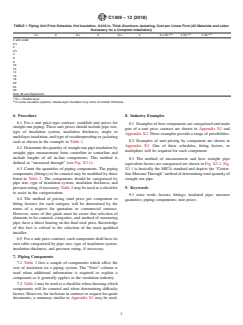
1.2.1 Component (fitting) factors or multipliers, which are multipliers times the straight length of piping as shown in Table 1, determine relative prices for each component not within the scope of this guide. These factors or multipliers are to be determined by the insulating contractor relative to the given situation and insulation system specification.
1.2.2 It is suggested that only one type of pricing be used on a project.
1.2.3 The values stated in inch-pound units are to be regarded as the standard.
1.3 This international standard was developed in accordance with internationally recognized principles on standardization established in the Decision on Principles for the Development of International Standards, Guides and Recommendations issued by the World Trade Organization Technical Barriers to Trade (TBT) Committee.
- Status
- Published
- Publication Date
- 31-Oct-2018
- Technical Committee
- C16 - Thermal Insulation
- Drafting Committee
- C16.40 - Insulation Systems
Overview
ASTM C1409-12(2018): Standard Guide for Measuring and Estimating Quantities of Insulated Piping and Components serves as a comprehensive guide for identifying, measuring, and pricing the components of insulated piping systems. Developed by ASTM International in accordance with globally recognized principles, this standard streamlines the process for parties involved in unit price piping insulation contracts. By providing structured procedures and terminologies, ASTM C1409-12(2018) helps stakeholders clearly define which piping system components are counted for estimating quantities and costs, minimizing ambiguities and disputes in commercial contracts.
Key Topics
ASTM C1409-12(2018) focuses on several essential elements for measuring and pricing insulated piping systems:
- Component Categorization: Defines what constitutes a component or fitting in an insulated piping system, including straight piping, bends, elbows, valves, flanges, tees, reducers, expansion joints, supports, and more.
- Unit Pricing Methods: Outlines procedures for establishing unit prices based on factors such as pipe size, insulation type and thickness, multi-layered insulation, and type of weatherproofing or jacketing.
- Component Multipliers and Factors: Introduces the concept of applying multipliers to the measured lengths of straight piping to account for components not directly covered in the standard.
- Measurement Procedures: Describes established methods such as “measured through” for straight pipe runs, using centerline-to-centerline measurements for accurate quantity estimation.
- Checklist for Components: Provides sample tables to help contractors and specifiers select which fittings and components to include in pricing and to assess complexity.
- Contract Integration: Recommends that only one consistent method of pricing be used in any given project to avoid confusion and ensure clarity.
Applications
ASTM C1409-12(2018) is widely applicable for:
- Contract Specification: Used by engineers, contractors, and procurement professionals to standardize how insulated piping quantities are measured and priced in unit price contracts and supplemental work.
- Project Estimation: Enables accurate estimation of material and labor costs by clearly identifying each contributing component, minimizing the risk of under- or over-estimation.
- Bid Preparation: Offers guidance for preparing clear, comprehensive bids that specify which piping system elements are included, supporting transparent and fair contract negotiation.
- Cost Management: Helps project managers and contractors control costs by standardizing pricing methods and reducing misinterpretation of contract terms.
- Quality Assurance: Facilitates consistent project documentation and verification during review and inspection phases.
This ASTM guide is especially beneficial in industrial and commercial construction projects involving thermal insulation systems, such as power plants, refineries, manufacturing facilities, and building infrastructure.
Related Standards
ASTM C1409-12(2018) works in conjunction with several related industry standards and resources:
- ASTM C168 – Terminology Relating to Thermal Insulation: Provides official definitions for terms and phrases used in ASTM C1409 and related insulation standards.
- MICA Standards – The Midwest Insulation Contractors Association standards, referenced throughout ASTM C1409, offer additional detail and support for measurement and pricing methodologies.
- ASTM International Standards – Additional ASTM standards in the C16 series focus on best practices for various aspects of thermal insulation systems.
- Global Standards – Developed in line with World Trade Organization (WTO) Technical Barriers to Trade (TBT) Committee principles for the development of international standards.
Keywords: ASTM C1409, insulated piping, piping insulation measurement, unit price contracts, piping component pricing, thermal insulation, project estimation, industrial insulation standards, insulation system specifications.
Relations
- Effective Date
- 01-Nov-2018
- Effective Date
- 15-Apr-2024
- Effective Date
- 15-Apr-2018
- Effective Date
- 01-Jun-2017
- Effective Date
- 15-Oct-2015
- Effective Date
- 01-Jun-2015
- Effective Date
- 01-Apr-2013
- Effective Date
- 01-Jan-2010
- Effective Date
- 15-Dec-2008
- Effective Date
- 01-Sep-2008
- Effective Date
- 01-Jun-2008
- Effective Date
- 01-Nov-2005
- Effective Date
- 01-Jun-2005
- Effective Date
- 10-Apr-2003
- Effective Date
- 10-Jul-2002
Get Certified
Connect with accredited certification bodies for this standard

Institut za varilstvo d.o.o. (Welding Institute)
Slovenia's leading welding institute since 1952. ISO 3834, EN 1090, pressure equipment certification, NDT personnel, welder qualification. Only IIW Au
Sponsored listings
Frequently Asked Questions
ASTM C1409-12(2018) is a guide published by ASTM International. Its full title is "Standard Guide for Measuring and Estimating Quantities of Insulated Piping and Components". This standard covers: SIGNIFICANCE AND USE 5.1 This guide establishes procedures to help parties involved in unit price piping insulation contracts reach agreement as to what components will be counted for pricing purposes. SCOPE 1.1 This guide defines the components of an insulated piping system to be measured or counted to determine quantities and pricing for unit price contracts or extra work. 1.2 Pricing may be done through unit pricing for each item by pipe size, type of insulation system, insulation thickness, double or multilayer insulation, type of weatherproofing or jacketing, and pressure rating (if necessary) or through component (fitting) factor or multipliers. 1.2.1 Component (fitting) factors or multipliers, which are multipliers times the straight length of piping as shown in Table 1, determine relative prices for each component not within the scope of this guide. These factors or multipliers are to be determined by the insulating contractor relative to the given situation and insulation system specification. 1.2.2 It is suggested that only one type of pricing be used on a project. 1.2.3 The values stated in inch-pound units are to be regarded as the standard. 1.3 This international standard was developed in accordance with internationally recognized principles on standardization established in the Decision on Principles for the Development of International Standards, Guides and Recommendations issued by the World Trade Organization Technical Barriers to Trade (TBT) Committee.
SIGNIFICANCE AND USE 5.1 This guide establishes procedures to help parties involved in unit price piping insulation contracts reach agreement as to what components will be counted for pricing purposes. SCOPE 1.1 This guide defines the components of an insulated piping system to be measured or counted to determine quantities and pricing for unit price contracts or extra work. 1.2 Pricing may be done through unit pricing for each item by pipe size, type of insulation system, insulation thickness, double or multilayer insulation, type of weatherproofing or jacketing, and pressure rating (if necessary) or through component (fitting) factor or multipliers. 1.2.1 Component (fitting) factors or multipliers, which are multipliers times the straight length of piping as shown in Table 1, determine relative prices for each component not within the scope of this guide. These factors or multipliers are to be determined by the insulating contractor relative to the given situation and insulation system specification. 1.2.2 It is suggested that only one type of pricing be used on a project. 1.2.3 The values stated in inch-pound units are to be regarded as the standard. 1.3 This international standard was developed in accordance with internationally recognized principles on standardization established in the Decision on Principles for the Development of International Standards, Guides and Recommendations issued by the World Trade Organization Technical Barriers to Trade (TBT) Committee.
ASTM C1409-12(2018) is classified under the following ICS (International Classification for Standards) categories: 23.040.01 - Pipeline components and pipelines in general. The ICS classification helps identify the subject area and facilitates finding related standards.
ASTM C1409-12(2018) has the following relationships with other standards: It is inter standard links to ASTM C1409-12, ASTM C168-24, ASTM C168-18, ASTM C168-17, ASTM C168-15a, ASTM C168-15, ASTM C168-13, ASTM C168-10, ASTM C168-08b, ASTM C168-08a, ASTM C168-08, ASTM C168-05a, ASTM C168-05, ASTM C168-03, ASTM C168-02. Understanding these relationships helps ensure you are using the most current and applicable version of the standard.
ASTM C1409-12(2018) is available in PDF format for immediate download after purchase. The document can be added to your cart and obtained through the secure checkout process. Digital delivery ensures instant access to the complete standard document.
Standards Content (Sample)
This international standard was developed in accordance with internationally recognized principles on standardization established in the Decision on Principles for the
Development of International Standards, Guides and Recommendations issued by the World Trade Organization Technical Barriers to Trade (TBT) Committee.
Designation: C1409 − 12 (Reapproved 2018)
Standard Guide for
Measuring and Estimating Quantities of Insulated Piping
and Components
This standard is issued under the fixed designation C1409; the number immediately following the designation indicates the year of
original adoption or, in the case of revision, the year of last revision. A number in parentheses indicates the year of last reapproval. A
superscript epsilon (´) indicates an editorial change since the last revision or reapproval.
INTRODUCTION
Acommittee ofASTM International initiated this guide to improve industry-wide understanding of
thecomponentsinaninsulatedpipingsystemthataffecttheinstalledcostofinsulatingthesystem.The
method of measurement standard used as a bias for this guide is the National Commercial and
Industrial Standards.
ASTM International defines a guide as a series of options or instructions that does not recommend
a specific course of action. A guide only suggests a course of action. Its purpose is to offer guidance
based on a consensus of viewpoints, but not to establish a fixed procedure. A guide is intended to
increase the awareness of the user to available techniques in a given subject area and to provide
information from which subsequent evaluation and standardization can be derived.
It is the intention that this guide will help gain wider acceptance and understanding of the concepts
in the MICA standard.
1. Scope 1.3 This international standard was developed in accor-
dance with internationally recognized principles on standard-
1.1 This guide defines the components of an insulated
ization established in the Decision on Principles for the
piping system to be measured or counted to determine quan-
Development of International Standards, Guides and Recom-
tities and pricing for unit price contracts or extra work.
mendations issued by the World Trade Organization Technical
1.2 Pricing may be done through unit pricing for each item
Barriers to Trade (TBT) Committee.
by pipe size, type of insulation system, insulation thickness,
2. Referenced Documents
double or multilayer insulation, type of weatherproofing or
jacketing, and pressure rating (if necessary) or through com-
2.1 ASTM Standards:
ponent (fitting) factor or multipliers. C168 Terminology Relating to Thermal Insulation
1.2.1 Component (fitting) factors or multipliers, which are
3. Terminology
multipliers times the straight length of piping as shown in
3.1 Definitions—For definitions of terms used in this guide,
Table 1, determine relative prices for each component not
see Terminology C168.
within the scope of this guide. These factors or multipliers are
to be determined by the insulating contractor relative to the
4. Summary of Guide
given situation and insulation system specification.
4.1 This guide lists examples of components of piping
1.2.2 It is suggested that only one type of pricing be used on
systems which effect insulation cost. From this list, compo-
a project.
nents to be counted are selected by the involved parties.
1.2.3 The values stated in inch-pound units are to be
regarded as the standard.
5. Significance and Use
5.1 This guide establishes procedures to help parties in-
volved in unit price piping insulation contracts reach agree-
This guide is under the jurisdiction of ASTM Committee C16 on Thermal
ment as to what components will be counted for pricing
Insulation and is the direct responsibility of Subcommittee C16.40 on Insulation
purposes.
Systems.
Current edition approved Nov. 1, 2018. Published December 2018. Originally
approved in 1998. Last previous edition approved in 2012 as C1409 – 12. DOI: For referenced ASTM standards, visit the ASTM website, www.astm.org, or
10.1520/C1409-12R18. contact ASTM Customer Service at service@astm.org. For Annual Book of ASTM
Further information is available from the Midwest Insulation ContractorsAssn. Standards volume information, refer to the standard’s Document Summary page on
(MICA), 2017 S. 139th Circle, Omaha, NE. the ASTM website.
Copyright © ASTM International, 100 Barr Harbor Drive, PO Box C700, West Conshohocken, PA 19428-2959. United States
C1409 − 12 (2018)
TABLE 1 Piping Unit Price Schedule, Hot Insulation, 0.016-in. Thick Aluminum Jacketing, Cost per Linear Foot (All Materials and Labor
Necessary for a Complete Installation)
1 1 1 1 A,B A,B A,B
1 ⁄2 22 ⁄2 33 ⁄2 43 ⁄2 DL 4DL 4DL
2 and under
2 ⁄2
3 ⁄2
Over 30 and Equipment
A
DL = Double layer.
B
In some insulation systems, double-layer insulation may occur at smaller thickness.
6. Procedure 8. Industry Examples
6.1 For a unit price-type contract, establish unit prices for
8.1 Examples of how components are categorized and made
straight run piping. These unit prices should include pipe size,
part of a unit price contract are shown in Appendix X1 and
type of insulation system, insulation thickness, single or
Appendix X2. These examples provide a range of possibilities.
multilayer insulation, and type of weatherproofing or jacketing
8.2 Examples of unit pricing by component are shown in
such as shown in the example in Table 1.
Appendix X3. One of these schedules, fitting factors, or
6.2 Determine the quantity of straight run pipe insulation by
multipliers will be required for each component.
straight pipe measurement from centerline to centerline and
include lengths of all in-line components. This method is
8.3 The method of measurement and how straight pipe
defined as “measured through” (see Fig. X3.1).
equivalent factors are categorized are shown in Fig. X3.1. Fig.
X3.1 is basically the MICA standard and depicts the “Center-
6.3 Count the quantities of piping components. The piping
lineMeasureThrough”methodofdeterminingtotalquantityof
components (fittings) to be counted may be modified by those
listed in Table 2. The components should be categorized by straight run pipe.
pipe size, type of insulation system, insulation thickness, and
pressure rating, if necessary. Table 2 may be used as a checklist
9. Keywords
to assist in the categorization.
9.1 extra work; factors; fittings; insulated pipe; measure
6.4 The method of pricing (unit price per component or
quantities; piping components; unit prices
fitting factors) for each category will be determined by the
terms of a request for quotation or commercial contract.
However, users of this guide must be aware that selection of
elements to be counted, categories, and method of measuring
pipe, have a direct bearing on the final total price. Knowledge
of this fact is critical to the selection of the most qualified
installer.
6.5 For a unit price contract, each component shall have its
own table categorized by pipe size, type of insulation system,
insulation thickness, and pressure rating, if necessary.
7. Piping Components
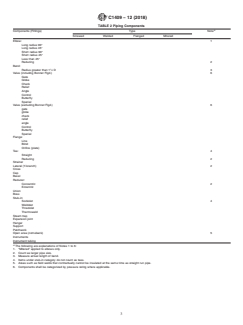
7.1 Table 2 lists a sample of components which affect the
cost of insulation on a piping system. The “Note” column is
used when additional information is required to explain a
component as it generally applies to the insulation industry.
7.2 Table2maybeusedasachecklistwhenchoosingwhich
components will be counted and when determining difficulty
factors. However, for inclusion in contract or request for quote
documents, a summary similar to Appendix X1 may be used.
C1409 − 12 (2018)
TABLE 2 Piping Components
A
Components (Fittings) Type Note
Screwed Welded Flanged Mitered
Elbow: 1
Long radius 90°
Long radius 45°
Short radius 90°
Short radius 45°
Less than 45°
Reducing 2
Bend:
Radius greater than 1 ⁄2 D 3
Valve (including Bonnet Flgd.) 6
Gate
Globe
Check
Relief
Angle
Control
Butterfly
Special
Valve (excluding Bonnet Flgd.)
...