

ASTM C1921/C1921M-22
(Test Method)Standard Test Method for Comparative Impact Testing of Gypsum Panel Outside 90° Corner Systems
General Information
- Abstract
SIGNIFICANCE AND USE
5.1 This test method provides a repeatable methodology for evaluating outside 90° corner systems.
SCOPE
1.1 This test method details the method for a laboratory-based evaluation of aesthetic damage caused to a non-structural gypsum panel outside 90° corner system when impacted by a hard body. This test’s purpose is to provide comparative information on different gypsum panel corner systems to demonstrate aesthetic robustness and durability by minimizing initial damage.
1.2 There is no known ISO equivalent to this standard.
1.3 Units—The values stated in either SI units or inch-pound units are to be regarded separately as standard. The values stated in each system are not necessarily exact equivalents; therefore, to ensure conformance with the standard, each system shall be used independently of the other, and values from the two systems shall not be combined.
1.4 This standard does not purport to address all of the safety concerns, if any, associated with its use. It is the responsibility of the user of this standard to establish appropriate safety, health, and environmental practices and determine the applicability of regulatory limitations prior to use.
1.5 This international standard was developed in accordance with internationally recognized principles on standardization established in the Decision on Principles for the Development of International Standards, Guides and Recommendations issued by the World Trade Organization Technical Barriers to Trade (TBT) Committee.
- Status
- Published
- Publication Date
- 30-Sep-2022
- Technical Committee
- C11 - Gypsum and Related Building Materials and Systems
Buy Documents
ASTM C1921/C1921M-22 - Standard Test Method for Comparative Impact Testing of Gypsum Panel Outside 90° Corner Systems
REDLINE ASTM C1921/C1921M-22 - Standard Test Method for Comparative Impact Testing of Gypsum Panel Outside 90° Corner Systems
Overview
ASTM C1921/C1921M-22 is the standard test method for comparative impact testing of gypsum panel outside 90° corner systems. Developed by ASTM International, this method offers a repeatable, laboratory-based procedure to assess the aesthetic damage and comparative performance of non-structural gypsum panel outside 90° corners when subjected to impact by a hard body. The goal is to evaluate and compare the robustness and durability of various gypsum panel corner systems, with a focus on minimizing initial visible damage. This standard is widely cited for applications in building construction, renovation, and product development in the gypsum board industry.
Key Topics
Comparative Testing Methodology
Establishes a repeatable procedure for evaluating the performance of outside 90° corner systems when impacted, emphasizing consistency and traceability in sample preparation and testing.System-Based Assessment
Considers the full corner assembly, including gypsum panels, steel studs, fasteners, corner trims, joint compounds, and attachment methods - ensuring real-world relevance in determining aesthetic robustness.Impact Evaluation and Damage Measurement
Tests use specified weights and drop heights to impart energy to the corner apex, with damage measured via calibrated instruments to provide objective data on impact resistance.Variety of Corner Configurations
Addresses different corner constructions, such as single-layer, double-layer, overlapped, mitered, and hollow corners, enabling comparative performance benchmarking across common gypsum board installations.Result Reporting
Mandates thorough documentation of all system components, test settings, environmental conditions, measurements, and qualitative observations to ensure reliability and reproducibility of results.
Applications
The ASTM C1921/C1921M-22 standard test method is crucial for:
Building Product Manufacturers
Evaluating and optimizing gypsum panel corner systems for improved impact performance and market differentiation.Quality Assurance and Control
Enabling consistent, objective testing of corner system durability for both product development and manufacturing quality checks.Specifiers and Architects
Providing reliable data for selecting and specifying gypsum panel systems in projects where durability of corner finishes is important, such as high-traffic commercial or institutional buildings.Construction and Drywall Contractors
Comparing different corner protection products during project planning and ensuring compliance with project performance criteria.Standards and Regulatory Bodies
Supporting the development of construction guidelines and codes that address impact resistance and durability of wall corner systems.
Related Standards
Professionals using ASTM C1921/C1921M-22 may also reference the following related standards:
- ASTM C11 - Terminology Relating to Gypsum and Related Building Materials and Systems
- ASTM C475/C475M - Specification for Joint Compound and Joint Tape for Finishing Gypsum Board
- ASTM C645 - Specification for Nonstructural Steel Framing Members
- ASTM C754 - Specification for Installation of Steel Framing Members to Receive Screw-Attached Gypsum Panel Products
- ASTM C954 & C1002 - Specifications for Screws for Gypsum Panel Installations
- ASTM C1047 - Specification for Accessories for Gypsum Wallboard
- ASTM C1396/C1396M - Specification for Gypsum Board
- AISI S220 - North American Standard for Cold-Formed Steel Framing – Non-Structural Members
- GA-214 & GA-216 (Gypsum Association) - Levels of Finish and Application Guidelines
Practical Value
By using ASTM C1921/C1921M-22, industry professionals gain:
- Objective Comparison of gypsum panel outside 90° corner systems' resistance to aesthetic damage
- Improved Product Development through reliable, laboratory-based test data
- Informed System Specification for increased performance and longevity of interior wall finishes
- Benchmarking Capacity for accessory and materials suppliers in an increasingly performance-driven construction market
Keywords: gypsum panel, impact testing, 90 degree corner, corner protection, ASTM C1921/C1921M-22, drywall durability, wall system performance, construction standards.
Relations
- Effective Date
- 01-May-2020
- Refers
ASTM C1047-19 - Standard Specification for Accessories for Gypsum Wallboard and Gypsum Veneer Base - Effective Date
- 01-Nov-2019
- Effective Date
- 01-Oct-2019
- Refers
ASTM C11-18a - Standard Terminology Relating to Gypsum and Related Building Materials and Systems - Effective Date
- 01-Oct-2018
- Effective Date
- 01-Jun-2018
- Refers
ASTM C11-18 - Standard Terminology Relating to Gypsum and Related Building Materials and Systems - Effective Date
- 01-Jun-2018
- Effective Date
- 01-Apr-2018
- Refers
ASTM C11-17a - Standard Terminology Relating to Gypsum and Related Building Materials and Systems - Effective Date
- 01-Oct-2017
- Refers
ASTM C11-17 - Standard Terminology Relating to Gypsum and Related Building Materials and Systems - Effective Date
- 15-May-2017
- Effective Date
- 01-Jan-2017
- Effective Date
- 01-Nov-2016
- Refers
ASTM C11-16 - Standard Terminology Relating to Gypsum and Related Building Materials and Systems - Effective Date
- 15-May-2016
- Refers
ASTM C11-15a - Standard Terminology Relating to Gypsum and Related Building Materials and Systems - Effective Date
- 01-Oct-2015
- Effective Date
- 01-Jun-2015
- Effective Date
- 01-Jun-2015
Buy Documents
ASTM C1921/C1921M-22 - Standard Test Method for Comparative Impact Testing of Gypsum Panel Outside 90° Corner Systems
REDLINE ASTM C1921/C1921M-22 - Standard Test Method for Comparative Impact Testing of Gypsum Panel Outside 90° Corner Systems
Get Certified
Connect with accredited certification bodies for this standard

DIBt (Deutsches Institut für Bautechnik)
German Institute for Building Technology.
DIN CERTCO
DIN Group product certification.

Aboma Certification B.V.
Specialized in construction, metal, and transport sectors.
Sponsored listings
Frequently Asked Questions
ASTM C1921/C1921M-22 is a standard published by ASTM International. Its full title is "Standard Test Method for Comparative Impact Testing of Gypsum Panel Outside 90° Corner Systems". This standard covers: SIGNIFICANCE AND USE 5.1 This test method provides a repeatable methodology for evaluating outside 90° corner systems. SCOPE 1.1 This test method details the method for a laboratory-based evaluation of aesthetic damage caused to a non-structural gypsum panel outside 90° corner system when impacted by a hard body. This test’s purpose is to provide comparative information on different gypsum panel corner systems to demonstrate aesthetic robustness and durability by minimizing initial damage. 1.2 There is no known ISO equivalent to this standard. 1.3 Units—The values stated in either SI units or inch-pound units are to be regarded separately as standard. The values stated in each system are not necessarily exact equivalents; therefore, to ensure conformance with the standard, each system shall be used independently of the other, and values from the two systems shall not be combined. 1.4 This standard does not purport to address all of the safety concerns, if any, associated with its use. It is the responsibility of the user of this standard to establish appropriate safety, health, and environmental practices and determine the applicability of regulatory limitations prior to use. 1.5 This international standard was developed in accordance with internationally recognized principles on standardization established in the Decision on Principles for the Development of International Standards, Guides and Recommendations issued by the World Trade Organization Technical Barriers to Trade (TBT) Committee.
SIGNIFICANCE AND USE 5.1 This test method provides a repeatable methodology for evaluating outside 90° corner systems. SCOPE 1.1 This test method details the method for a laboratory-based evaluation of aesthetic damage caused to a non-structural gypsum panel outside 90° corner system when impacted by a hard body. This test’s purpose is to provide comparative information on different gypsum panel corner systems to demonstrate aesthetic robustness and durability by minimizing initial damage. 1.2 There is no known ISO equivalent to this standard. 1.3 Units—The values stated in either SI units or inch-pound units are to be regarded separately as standard. The values stated in each system are not necessarily exact equivalents; therefore, to ensure conformance with the standard, each system shall be used independently of the other, and values from the two systems shall not be combined. 1.4 This standard does not purport to address all of the safety concerns, if any, associated with its use. It is the responsibility of the user of this standard to establish appropriate safety, health, and environmental practices and determine the applicability of regulatory limitations prior to use. 1.5 This international standard was developed in accordance with internationally recognized principles on standardization established in the Decision on Principles for the Development of International Standards, Guides and Recommendations issued by the World Trade Organization Technical Barriers to Trade (TBT) Committee.
ASTM C1921/C1921M-22 is classified under the following ICS (International Classification for Standards) categories: 91.100.10 - Cement. Gypsum. Lime. Mortar. The ICS classification helps identify the subject area and facilitates finding related standards.
ASTM C1921/C1921M-22 has the following relationships with other standards: It is inter standard links to ASTM C754-20, ASTM C1047-19, ASTM C1047-14a(2019), ASTM C11-18a, ASTM C645-18, ASTM C11-18, ASTM C754-18, ASTM C11-17a, ASTM C11-17, ASTM C754-17, ASTM C1002-16, ASTM C11-16, ASTM C11-15a, ASTM C954-15, ASTM C475/C475M-15. Understanding these relationships helps ensure you are using the most current and applicable version of the standard.
ASTM C1921/C1921M-22 is available in PDF format for immediate download after purchase. The document can be added to your cart and obtained through the secure checkout process. Digital delivery ensures instant access to the complete standard document.
Standards Content (Sample)
This international standard was developed in accordance with internationally recognized principles on standardization established in the Decision on Principles for the
Development of International Standards, Guides and Recommendations issued by the World Trade Organization Technical Barriers to Trade (TBT) Committee.
Designation: C1921/C1921M − 22
Standard Test Method for
Comparative Impact Testing of Gypsum Panel Outside 90°
Corner Systems
This standard is issued under the fixed designation C1921/C1921M; the number immediately following the designation indicates the
year of original adoption or, in the case of revision, the year of last revision. A number in parentheses indicates the year of last
reapproval. A superscript epsilon (´) indicates an editorial change since the last revision or reapproval.
1. Scope C475/C475MSpecification for Joint Compound and Joint
Tape for Finishing Gypsum Board
1.1 This test method details the method for a laboratory-
C645Specification for Nonstructural Steel Framing Mem-
basedevaluationofaestheticdamagecausedtoanon-structural
bers
gypsum panel outside 90° corner system when impacted by a
C754Specification for Installation of Steel Framing Mem-
hard body. This test’s purpose is to provide comparative
bers to Receive Screw-Attached Gypsum Panel Products
information on different gypsum panel corner systems to
C954SpecificationforSteelDrillScrewsfortheApplication
demonstrate aesthetic robustness and durability by minimizing
of Gypsum Panel Products or Metal Plaster Bases to Steel
initial damage.
Studs from 0.033 in. (0.84 mm) to 0.112 in. (2.84 mm) in
1.2 There is no known ISO equivalent to this standard.
Thickness
1.3 Units—The values stated in either SI units or inch- C1002Specification for Steel Self-Piercing Tapping Screws
for Application of Gypsum Panel Products or Metal
pound units are to be regarded separately as standard. The
values stated in each system are not necessarily exact equiva- Plaster Bases to Wood Studs or Steel Studs
C1047Specification forAccessories for Gypsum Wallboard
lents; therefore, to ensure conformance with the standard, each
system shall be used independently of the other, and values and Gypsum Veneer Base
C1396/C1396MSpecification for Gypsum Board
from the two systems shall not be combined.
F879SpecificationforStainlessSteelSocketButtonandFlat
1.4 This standard does not purport to address all of the
Countersunk Head Cap Screws
safety concerns, if any, associated with its use. It is the
2.2 AISI Standard:
responsibility of the user of this standard to establish appro-
S220NorthAmericanStandardforCold-formedSteelFram-
priate safety, health, and environmental practices and deter-
ing – non-structural members
mine the applicability of regulatory limitations prior to use.
1.5 This international standard was developed in accor- 2.3 Eurogypsum Standard:
dance with internationally recognized principles on standard- Drywall Jointing & Finishing SurfaceQuality Level Classi-
ization established in the Decision on Principles for the fications
Development of International Standards, Guides and Recom-
2.4 Gypsum Association Standards:
mendations issued by the World Trade Organization Technical
GA-214Recommended Levels of Finish: Gypsum Board,
Barriers to Trade (TBT) Committee.
Glass Mat & Fiber-Reinforced Gypsum Panels
GA-216Application and Finishing of Gypsum Panel Prod-
2. Referenced Documents 5
ucts
2.1 ASTM Standards:
3. Terminology
C11Terminology Relating to Gypsum and Related Building
Materials and Systems
3.1 Definitions—Definitions shall be in accordance with
Terminology C11 unless otherwise indicated.
3.2 Definitions of Terms Specific to This Standard:
ThistestmethodisunderthejurisdictionofASTMCommitteeC11onGypsum
and Related Building Materials and Systems and is the direct responsibility of
3.2.1 corner attachment method, n—as per the manufactur-
Subcommittee C11.02 on Specifications and Test Methods for Accessories and
er’s instructions and may be specific to the type of corner
Related Products.
Current edition approved Oct. 1, 2022. Published October 2022. Originally
approved in 2021. Last previous edition approved in 2021 as C1921/C1921M–21.
DOI: 10.1520/C1921_C1921M-22. Available from the American Iron and Steel Institute, 25 Massachusetts Ave.,
For referenced ASTM standards, visit the ASTM website, www.astm.org, or NW, Suite 800, Washington, DC 20001, shop.steel.org.
contact ASTM Customer Service at service@astm.org. For Annual Book of ASTM Available from eurogypsum.org.
Standards volume information, refer to the standard’s Document Summary page on Available from the Gypsum Association, 962 Wayne Ave., Suite 620, Silver
the ASTM website. Spring, MD 20910, gypsum.org.
Copyright © ASTM International, 100 Barr Harbor Drive, PO Box C700, West Conshohocken, PA 19428-2959. United States
C1921/C1921M − 22
protection, the most common methods of which include: 6. Interferences
embedding, nailing, clinching, and stapling.
6.1 The build consistency of the test specimens greatly
3.2.2 corner protection, n—product designed to provide
influences the result. Creating a fixture to support the sample
some additional protection to a gypsum panel partition wall
for application of the corner protection provides greater con-
corner structure, which may be in stick/trim or roll format.
sistency. Batch details of all components should be recorded
for traceability.
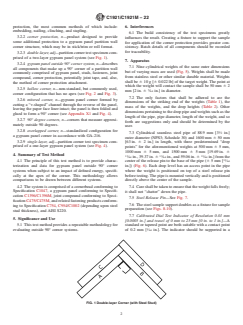
3.2.3 double-layer, adj—partitioncornertestspecimencom-
prised of a two-layer gypsum panel system (see Fig. 1).
7. Apparatus
3.2.4 gypsum panel outside 90° corner system, n—describes
7.1 Nine cylindrical weights of the same outer dimensions
all components that make up a 90° corner of a partition wall
but of varying mass are used (Fig. 5). Weights shall be made
commonly comprised of gypsum panel, studs, fasteners, joint
from stainless steel or other similar durable material. Weights
compound, corner protection, potentially joint tape, and, also,
shall be 6 10 g [6 0.022 lb] of the target weight. The point at
the method of corner protection attachment.
which the weight will contact the sample shall be 50mm 6 2
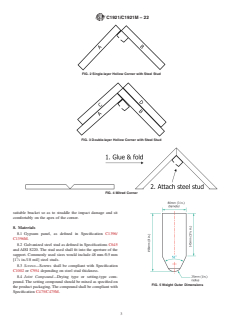
3.2.5 hollow corner, n—non-standard, but commonly used,
mm [2in. 6 ⁄64 in.] in diameter.
corner configuration that has no apex (see Fig. 2 and Fig. 3).
7.2 The only factors that shall be adhered to are the
3.2.6 mitered corner, n—gypsum panel corner formed by
dimensions of the striking end of the weights (Table 1), the
cutting a “v-shaped” channel through the reverse of the panel,
mass of the weights, and the drop heights (Table 2). Other
leaving the paper face liner intact; the panel is then folded and
dimensions pertaining to the drop pipe and weights such as the
glued to form a 90° corner (see Appendix X1 and Fig. 4).
length of the pipe, pipe diameter, length of the weight, and so
3.2.7 90° degree corners, n—corners that measure approxi-
forth are suggestions only and should be determined by the
mately outside 90 degrees.
user.
3.2.8 overlapped corner, n—standardized configuration for
7.3 Cylindrical seamless steel pipe of 88.9 mm [3 ⁄2 in.]
a gypsum panel corner in accordance with GA-216.
outer diameter (NPS3; Schedule 30) and 1600mm 6 50 mm
3.2.9 single-layer, adj—partition corner test specimen com-
[63in. 6 2 in.] in length, with three predetermined “drop
prised of a one-layer gypsum panel system (see Fig. 4).
points” for the aforementioned weights at 500mm 6 5mm,
1000mm 6 5mm, and 1500mm 6 5mm [19.69in. 6
4. Summary of Test Method
13 13 13
⁄64in., 39.37in. 6 ⁄64in., and 59.06in. 6 ⁄64 in.] from the
4.1 The principle of this test method is to provide charac- center of the release pin to the base of the pipe (65mm[ ⁄64
terization and data for gypsum panel outside 90° corner
in.]) (Fig. 6). Each drop level has an access point in the pipe
systems when subject to an impact of defined energy, specifi- where the weight is positioned on top of a steel release pin
cally at the apex of the corner. This methodology allows
beforetesting.Thepipeismountedverticallyandispositioned
comparisons to be drawn between different systems. directly above the center of the sample.
4.2 The system is comprised of a cornerbead conforming to 7.4 Careshallbetakentoensurethattheweightfallsfreely;
Specification C1047, a gypsum panel conforming to Specifi-
it shall not “chatter” down the pipe.
cation C1396/C1396M, joint compound conforming to Speci-
7.5 Steel Release Pin—See Fig. 7.
ficationC475/C475M,andrelatedfasteningproductsconform-
7.6 Thesteelsamplesupportdoublesasafixtureforsample
ing to Specification C754, C954/C1002 (depending upon steel
preparation (see Figs. 8-10).
stud thickness), and AISI S220.
7.7 Calibrated Dial Test Indicator of Resolution 0.01 mm
5. Significance and Use
[0.0005 in.] and travel of 0 mm to 25 mm [0 in. to 1 in.]—A
5.1 This test method provides a repeatable methodology for standard or tapered point are both suitable with a contact point
evaluating outside 90° corner systems. of 0.2 mm [ ⁄64 in.]. The indicator should be supported in a
FIG. 1 Double-layer Corner (with Steel Stud)
C1921/C1921M − 22
FIG. 2 Single-layer Hollow Corner with Steel Stud
FIG. 3 Double-layer Hollow Corner with Steel Stud
FIG. 4 Mitred Corner
suitable bracket so as to straddle the impact damage and sit
comfortably on the apex of the corner.
8. Materials
8.1 Gypsum panel, as defined in Specification C1396/
C1396M.
8.2 Galvanized steel stud as defined in Specifications C645
andAISI S220. The stud used shall fit into the aperture of the
support. Commonly used sizes would include 48mm⁄0.5mm
[1 ⁄8 in./18 mil] steel studs.
8.3 Screws—Screws shall be compliant with Specification
C1002 or C954 depending on steel stud thickness.
8.4 Joint Compound—Drying type or setting-type com-
pound. The setting compound should be mixed as specified on
FIG. 5 Weight Outer Dimensions
the product packaging.The compound shall be compliant with
Specification C475/C475M.
C1921/C1921M − 22
TABLE 1 Weight Dimensions
9.1.3 Attach the steel stud to gypsum panel PieceAnext to
mm [in.] the long (320 mm [12 ⁄2 in.]) edge on the back side of the
Diameter 80 ± 0.5 [3 ± ⁄64 ] panel.Fixthroughthestudusingtwoscrewsapproximately10
Total length 198±2[8± ⁄64 ] 3
mm [ ⁄8 in.] in from each edge.
1 5
Length of cylinder section 145±2[5 ⁄2 ± ⁄64 ]
9.1.4 Position gypsum panel Piece B so it overlaps gypsum
Radius of striking end (mandatory) 25±1[1± ⁄64 ]
panel Piece A to create a flush corner. Fix with two screws
approximately 10 mm [ ⁄8 in.] in from each edge of gypsum
NOTE 1—The weights and drop heights shown have been calculated in panel Piece B.
order to achieve impact energies from5Jto100Jin5J increments.Thus
9.1.5 Cut corner protection to 320 mm [12 ⁄2 in.] in length.
it is a more regular scale than the ft.lbs conversion.
9.1.6 Attach the corner protection as directed by the manu-
TABLE 2 Matrix for Test Selection: Drop Height and Drop Weight
facturer’s instructions and coat the sample with your com-
Settings (Mandatory)
pound of choice (two coats may be required).
Energy imparted to sample in Joules, metric weights and heights
9.1.7 Once dry, finish to Level 3 (as defined in GA-214) or
Drop height, millimetres
500 1000 1500
Q2 (as defined in Eurogypsum Drywall Jointing & Finishing
1 5 10 15
Surface Quality Level Classifications).
3 153045
9.1.8 Samples should be allowed to dry for at least three
4 204060
5 255075
days and then conditioned for at least 24 h before testing
Weight,
5.5 255580
(23°C 6 2°C [72°F 6 3°F] and 50% 6 5 % relative
kg
5.75 30 55 85
humidity).
6 306090
6.5 306595
9.2 Double-layer Corner Sample:
7 35 70 100
9.2.1 Cut four pieces of gypsum panel: PieceA: 320mm ×
Energy imparted to sample in ft-lb, Imperial weights and heights
Drop height, inches 1
200 mm [12 ⁄2in. × 8 in.], Piece B: 320 mm× 200mm
19.69 39.37 59.06
[12 ⁄2in. × 8 in.] + thickness of the panel, Piece C: 320mm ×
2.2 4 7 11
200 mm [12 ⁄2in. × 8 in.], and Piece D: 320mm × 200mm
6.6 11 22 32
8.8 142943 1
[12 ⁄2in. × 8 in.] + thickness of the panel.
11.0 18 36 54
Weight,
9.2.2 Cut steel stud to 320 mm [12 ⁄2 in.] in length.
12.0 204059
lbs
12.7 214162 9.2.3 Assemblethefirstlayerofthecornerasshownin9.1.3
13.2 224365
and 9.1.4.
14.3 234770
9.2.4 Place gypsum panel Piece D
...
This document is not an ASTM standard and is intended only to provide the user of an ASTM standard an indication of what changes have been made to the previous version. Because
it may not be technically possible to adequately depict all changes accurately, ASTM recommends that users consult prior editions as appropriate. In all cases only the current version
of the standard as published by ASTM is to be considered the official document.
Designation: C1921/C1921M − 21 C1921/C1921M − 22
Standard Test Method for
Comparative Impact Testing of Gypsum Panel Outside 90°
Corner Systems
This standard is issued under the fixed designation C1921/C1921M; the number immediately following the designation indicates the
year of original adoption or, in the case of revision, the year of last revision. A number in parentheses indicates the year of last
reapproval. A superscript epsilon (´) indicates an editorial change since the last revision or reapproval.
1. Scope
1.1 This test method details the method for a laboratory-based evaluation of aesthetic damage caused to a non-structural gypsum
panel outside 90° corner system when impacted by a hard body. This test’s purpose is to provide comparative information on
different gypsum panel corner systems to demonstrate aesthetic robustness and durability by minimizing initial damage.
1.2 There is no known ISO equivalent to this standard.
1.3 Units—The values stated in either SI units or inch-pound units are to be regarded separately as standard. The values stated in
each system are not necessarily exact equivalents; therefore, to ensure conformance with the standard, each system shall be used
independently of the other, and values from the two systems shall not be combined.
1.4 This standard does not purport to address all of the safety concerns, if any, associated with its use. It is the responsibility
of the user of this standard to establish appropriate safety, health, and environmental practices and determine the applicability of
regulatory limitations prior to use.
1.5 This international standard was developed in accordance with internationally recognized principles on standardization
established in the Decision on Principles for the Development of International Standards, Guides and Recommendations issued
by the World Trade Organization Technical Barriers to Trade (TBT) Committee.
2. Referenced Documents
2.1 ASTM Standards:
C11 Terminology Relating to Gypsum and Related Building Materials and Systems
C475/C475M Specification for Joint Compound and Joint Tape for Finishing Gypsum Board
C645 Specification for Nonstructural Steel Framing Members
C754 Specification for Installation of Steel Framing Members to Receive Screw-Attached Gypsum Panel Products
C954 Specification for Steel Drill Screws for the Application of Gypsum Panel Products or Metal Plaster Bases to Steel Studs
from 0.033 in. (0.84 mm) to 0.112 in. (2.84 mm) in Thickness
C1002 Specification for Steel Self-Piercing Tapping Screws for Application of Gypsum Panel Products or Metal Plaster Bases
to Wood Studs or Steel Studs
C1047 Specification for Accessories for Gypsum Wallboard and Gypsum Veneer Base
C1396/C1396M Specification for Gypsum Board
This test method is under the jurisdiction of ASTM Committee C11 on Gypsum and Related Building Materials and Systems and is the direct responsibility of
Subcommittee C11.02 on Specifications and Test Methods for Accessories and Related Products.
Current edition approved Dec. 1, 2021Oct. 1, 2022. Published December 2021October 2022. Originally approved in 2021. Last previous edition approved in 2021 as
C1921/C1921M – 21. DOI: 10.1520/C1921-21.10.1520/C1921_C1921M-22.
For referenced ASTM standards, visit the ASTM website, www.astm.org, or contact ASTM Customer Service at service@astm.org. For Annual Book of ASTM Standards
volume information, refer to the standard’s Document Summary page on the ASTM website.
Copyright © ASTM International, 100 Barr Harbor Drive, PO Box C700, West Conshohocken, PA 19428-2959. United States
C1921/C1921M − 22
F879 Specification for Stainless Steel Socket Button and Flat Countersunk Head Cap Screws
2.2 AISI Standard:
S220 North American Standard for Cold-formed Steel Framing – non-structural members
2.3 Eurogypsum Standard:
Drywall Jointing & Finishing Surface Quality Level Classifications
2.4 Gypsum Association Standards:
GA-214 Recommended Levels of Finish: Gypsum Board, Glass Mat & Fiber-Reinforced Gypsum Panels
GA-216 Application and Finishing of Gypsum Panel Products
3. Terminology
3.1 Definitions—Definitions shall be in accordance with Terminology C11 unless otherwise indicated.
3.2 Definitions of Terms Specific to This Standard:
3.2.1 corner attachment method, n—as per the manufacturer’s instructions and may be specific to the type of corner protection,
the most common methods of which include: embedding, nailing, clinching, and stapling.
3.2.2 corner protection, n—product designed to provide some additional protection to a gypsum panel partition wall corner
structure, which may be in stick/trim or roll format.
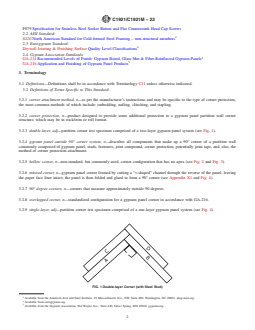
3.2.3 double-layer, adj—partition corner test specimen comprised of a two-layer gypsum panel system (see Fig. 1).
3.2.4 gypsum panel outside 90° corner system, n—describes all components that make up a 90° corner of a partition wall
commonly comprised of gypsum panel, studs, fasteners, joint compound, corner protection, potentially joint tape, and, also, the
method of corner protection attachment.
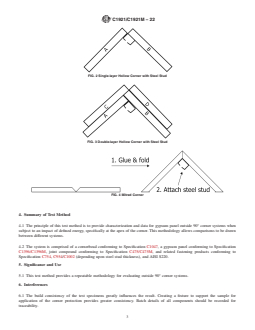
3.2.5 hollow corner, n—non-standard, but commonly used, corner configuration that has no apex (see Fig. 2 and Fig. 3).
3.2.6 mitered corner, n—gypsum panel corner formed by cutting a “v-shaped” channel through the reverse of the panel, leaving
the paper face liner intact; the panel is then folded and glued to form a 90° corner (see Appendix X1 and Fig. 4).
3.2.7 90° degree corners, n—corners that measure approximately outside 90 degrees.
3.2.8 overlapped corner, n—standardized configuration for a gypsum panel corner in accordance with GA-216.
3.2.9 single-layer, adj—partition corner test specimen comprised of a one-layer gypsum panel system (see Fig. 4).
FIG. 1 Double-layer Corner (with Steel Stud)
Available from the American Iron and Steel Institute, 25 Massachusetts Ave., NW, Suite 800, Washington, DC 20001, shop.steel.org.
Available from eurogypsum.org.
Available from the Gypsum Association, 962 Wayne Ave., Suite 620, Silver Spring, MD 20910, gypsum.org.
C1921/C1921M − 22
FIG. 2 Single-layer Hollow Corner with Steel Stud
FIG. 3 Double-layer Hollow Corner with Steel Stud
FIG. 4 Mitred Corner
4. Summary of Test Method
4.1 The principle of this test method is to provide characterization and data for gypsum panel outside 90° corner systems when
subject to an impact of defined energy, specifically at the apex of the corner. This methodology allows comparisons to be drawn
between different systems.
4.2 The system is comprised of a cornerbead conforming to Specification C1047, a gypsum panel conforming to Specification
C1396/C1396M, joint compound conforming to Specification C475/C475M, and related fastening products conforming to
Specification C754, C954/C1002 (depending upon steel stud thickness), and AISI S220.
5. Significance and Use
5.1 This test method provides a repeatable methodology for evaluating outside 90° corner systems.
6. Interferences
6.1 The build consistency of the test specimens greatly influences the result. Creating a fixture to support the sample for
application of the corner protection provides greater consistency. Batch details of all components should be recorded for
traceability.
C1921/C1921M − 22
7. Apparatus
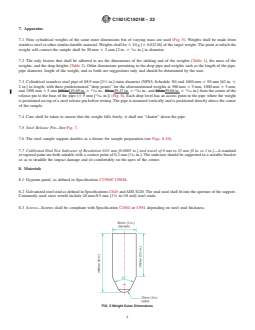
7.1 Nine cylindrical weights of the same outer dimensions but of varying mass are used (Fig. 5). Weights shall be made from
stainless steel or other similar durable material. Weights shall be 6 10 g [6 0.022 lb] of the target weight. The point at which the
weight will contact the sample shall be 50 mm 6 2 mm [2 in. 6 ⁄64 in.] in diameter.
7.2 The only factors that shall be adhered to are the dimensions of the striking end of the weights (Table 1), the mass of the
weights, and the drop heights (Table 2). Other dimensions pertaining to the drop pipe and weights such as the length of the pipe,
pipe diameter, length of the weight, and so forth are suggestions only and should be determined by the user.
7.3 Cylindrical seamless steel pipe of 88.9 mm [3 ⁄2 in.] outer diameter (NPS3; Schedule 30) and 1600 mm 6 50 mm [63 in. 6
2 in.] in length, with three predetermined “drop points” for the aforementioned weights at 500 mm 6 5 mm, 1000 mm 6 5 mm,
13 13 13
and 1500 mm 6 5 mm [20 in.[19.69 in. 6 ⁄64 in., 39 in.39.37 in. 6 ⁄64 in., and 59 in.59.06 in. 6 ⁄64 in.] from the center of the
release pin to the base of the pipe (6 5 mm [ ⁄64 in.]) (Fig. 6). Each drop level has an access point in the pipe where the weight
is positioned on top of a steel release pin before testing. The pipe is mounted vertically and is positioned directly above the center
of the sample.
7.4 Care shall be taken to ensure that the weight falls freely; it shall not “chatter” down the pipe.
7.5 Steel Release Pin—See Fig. 7.
7.6 The steel sample support doubles as a fixture for sample preparation (see Figs. 8-10).
7.7 Calibrated Dial Test Indicator of Resolution 0.01 mm [0.0005 in.] and travel of 0 mm to 25 mm [0 in. to 1 in.]—A standard
or tapered point are both suitable with a contact point of 0.2 mm [ ⁄64 in.]. The indicator should be supported in a suitable bracket
so as to straddle the impact damage and sit comfortably on the apex of the corner.
8. Materials
8.1 Gypsum panel, as defined in Specification C1396/C1396M.
8.2 Galvanized steel stud as defined in Specifications C645 and AISI S220. The stud used shall fit into the aperture of the support.
Commonly used sizes would include 48 mm ⁄0.5 mm [1 ⁄8 in./18 mil] steel studs.
8.3 Screws—Screws shall be compliant with Specification C1002 or C954 depending on steel stud thickness.
FIG. 5 Weight Outer Dimensions
C1921/C1921M − 22
TABLE 1 Weight Dimensions
mm [in.]
Diameter 80 ± 0.5 [3 ± ⁄64 ]
Total length 198 ± 2 [8 ± ⁄64 ]
1 5
Length of cylinder section 145 ± 2 [5 ⁄2 ± ⁄64 ]
Radius of striking end (mandatory) 25 ± 1 [1 ± ⁄64 ]
NOTE 1—The weights and drop heights shown have been calculated in
order to achieve impact energies from 5 J to 100 J in 5 J increments. Thus
it is a more regular scale than the ft.lbs conversion.
TABLE 2 Matrix for Test Selection: Drop Height and Drop Weight
Settings (Mandatory)
Energy imparted to sample in Joules, metric weights and heights
Drop height, millimetres
500 1000 1500
1 5 10 15
3 15 30 45
4 20 40 60
5 25 50 75
Weight,
5.5 25 55 80
kg
5.75 30 55 85
6 30 60 90
6.5 30 65 95
7 35 70 100
Energy imparted to sample in ft-lb, Imperial weights and heights
Drop height, inches
19.50 39.50 59.00
19.69 39.37 59.06
2.2 4 7 11
6.6 11 22 32
8.8 14 29 43
11.0 18 36 54
Weight,
12.0 20 40 59
lbs
12.7 21 41 62
13.2 22 43 65
14.3 23 47 70
15.4 25 50 76
TABLE 3 Weights Required (Mandatory)
kg lb
1 2.2
3 6.6
4 8.8
5 11.0
5.5 12.0
5.75 12.7
6 13.2
6.5 14.3
7 15.4
8.4 Joint Compound—Drying type or setting-type compound. The setting compound should be mixed as specified on the product
packaging. The compound shall be compliant with Specification C475/C475M.
8.5 Corner Protection—Corner tape or rigid corner trim (metal, various plastics, or laminate construction) as defined in
Specification C1047.
8.6 Materials for the Attachment of the Corner Trim to the Gypsum Panel Corner—Determined by corner manufacturers
installation guidelines.
8.7 Glue—Solvent-based adhesive appropriate for gypsum panels.
C1921/C1921M − 22
FIG. 6 Pipe Apparatus
FIG. 7 Steel Release Pin
9. Sampling, Test Specimens, and Test Units
9.1 Single-layer Corner Sample:
1 1
9.1.1 Cut two pieces of gypsum panel: Piece A: 320 mm × 200 mm [12 ⁄2 in. × 8 in.] and Piece B: 320 mm × 200 mm [12 ⁄2 in.
× 8 in.] + thickness of the gypsum panel.
9.1.2 Cut steel stud to 320 mm [12 ⁄2 in.] in length.
9.1.3 Attach the steel stud to gypsum panel Piece A next to the long (320 mm [12 ⁄2 in.]) edge on the back side of the panel. Fix
through the stud using two screws approximately 10 mm [ ⁄8 in.] in from each edge.
9.1.4 Position gypsum panel Piece B so it overlaps gypsum panel Piece A to create a flush corner. Fix with two screws
approximately 10 mm [ ⁄8 in.] in from each edge of gypsum panel Piece B.
C1921/C1921M − 22
FIG. 8 Sample Support
NOTE 1—The s
...