

ASTM C1681-23
(Test Method)Standard Test Method for Evaluating the Tear Resistance of a Sealant Under Constant Strain
General Information
- Abstract
SIGNIFICANCE AND USE
5.1 This test method is intended to determine if a joint that is subjected to a mechanically induced cut will resist tear propagation during normal joint movement.
Note 1: A sealant with a high resistance to tear propagation may perform better than a sealant with a low resistance to tear propagation.
SCOPE
1.1 This test method evaluates the impact of an induced tear on a sealant specimen that is dimensioned, cured according to the guidelines in Test Method C719 and then subjected to a constant strain. It is effective in differentiating between sealants that are used in dynamic joints subject to abrasion, punctures, tears, or combination thereof.
1.2 Since this test method is for the evaluation of tear propagation, an adhesive failure to the substrates provides no usable data regarding tear propagation. This would be considered a failed test and that data would be discarded, or at least separated from the other data from specimens that did not experience an adhesive failure.
1.3 This standard does not purport to address all of the safety concerns, if any, associated with its use. It is the responsibility of the user of this standard to establish appropriate safety, health, and environmental practices and determine the applicability of regulatory limitations prior to use.
1.4 This standard is similar in concept to European Technical Approval Guidelines (ETAG) 002, Part 1, Section 5.1.4.6.4—Resistance To Tearing.
1.5 This international standard was developed in accordance with internationally recognized principles on standardization established in the Decision on Principles for the Development of International Standards, Guides and Recommendations issued by the World Trade Organization Technical Barriers to Trade (TBT) Committee.
- Status
- Published
- Publication Date
- 31-May-2023
- Technical Committee
- C24 - Building Seals and Sealants
- Drafting Committee
- C24.20 - General Test Methods
Buy Documents
ASTM C1681-23 - Standard Test Method for Evaluating the Tear Resistance of a Sealant Under Constant Strain
REDLINE ASTM C1681-23 - Standard Test Method for Evaluating the Tear Resistance of a Sealant Under Constant Strain
Overview
ASTM C1681-23: Standard Test Method for Evaluating the Tear Resistance of a Sealant Under Constant Strain is a critical international standard developed by ASTM International. This test method determines the ability of building sealants to resist the propagation of a mechanically induced tear during normal joint movement. As dynamic joints in construction are frequently subjected to cuts, abrasion, and tears, evaluating tear resistance is essential for ensuring the long-term performance and durability of sealants used in these demanding applications.
ASTM C1681-23 complements other sealant performance tests by focusing specifically on resistance to tear growth, providing valuable information for both manufacturers and end-users in the selection and quality assurance of sealants.
Key Topics
- Tear Propagation Resistance: The primary focus is determining if a sealant specimen, once cut, can withstand continued movement without significant propagation of the tear. This ensures that the sealant can maintain its protective properties even after mechanical damage.
- Test Methodology: The method involves curing a sealant specimen (as per ASTM C719), inducing a controlled cut, then subjecting the sample to a constant strain. Measurements are taken at defined intervals (0, 24, and 168 hours) to assess changes in the length and width of the tear, both at standard laboratory temperature and at sub-zero conditions (-26°C).
- Applicability: The procedure is designed to differentiate between sealants suitable for dynamic joints, particularly those exposed to physical stresses like abrasion or puncturing.
- Data Integrity: Any adhesive failure (sealant loss of adhesion to the substrate) is not considered relevant data for tear propagation and is excluded from results.
Applications
ASTM C1681-23 is widely applicable to the building and construction industry, especially where the integrity of joints and weatherproofing is essential. Its practical value includes:
- Quality Control and Product Development: Manufacturers rely on this standard to evaluate and improve the tear resistance of new and existing sealant formulations, ensuring high performance under real-world conditions.
- Specifying Sealants: Project specifiers and architects use ASTM C1681-23 data to select sealants appropriate for dynamic joints in building façades, expansion joints, curtain walls, and industrial flooring.
- Performance Verification: Testing to ASTM C1681-23 provides documentation for regulatory compliance and client assurance, supporting bids and warranty claims.
- Comparative Testing: The standard allows for straightforward comparison between products, making it easier to identify and specify sealants with superior resistance to tear propagation.
Related Standards
For comprehensive evaluation of sealant performance, the following related standards are often referenced alongside ASTM C1681-23:
- ASTM C719: Test Method for Adhesion and Cohesion of Elastomeric Joint Sealants Under Cyclic Movement. This method is required for curing the sealant specimens before tear testing.
- ASTM C717: Terminology of Building Seals and Sealants. Provides essential definitions to ensure consistency in testing and reporting.
- ETAG 002, Part 1, Section 5.1.4.6.4: This European guideline offers a comparable framework for resistance to tearing in sealants used in building and facade applications.
Practical Value
Incorporating ASTM C1681-23 into sealant specification and quality assurance practices enhances the reliability of construction joints, reduces maintenance costs, and optimizes long-term building envelope performance. By evaluating sealant tear resistance under constant strain, stakeholders can make informed decisions, ensuring that only sealants with proven durability and resilience are used in critical applications.
Keywords: ASTM C1681-23, tear resistance of sealant, constant strain testing, building joint sealants, tear propagation, construction standards, sealant performance, quality assurance, dynamic joints, test method.
Relations
- Effective Date
- 01-Mar-2019
- Effective Date
- 01-Mar-2018
- Effective Date
- 01-Nov-2017
- Effective Date
- 01-Jan-2017
- Effective Date
- 15-Nov-2016
- Effective Date
- 01-Sep-2016
- Effective Date
- 15-Jul-2014
- Effective Date
- 01-May-2014
- Effective Date
- 01-Feb-2014
- Effective Date
- 01-Nov-2013
- Effective Date
- 15-Jun-2013
- Effective Date
- 01-Dec-2012
- Effective Date
- 01-May-2012
- Effective Date
- 15-Jan-2012
- Effective Date
- 01-Mar-2011
Buy Documents
ASTM C1681-23 - Standard Test Method for Evaluating the Tear Resistance of a Sealant Under Constant Strain
REDLINE ASTM C1681-23 - Standard Test Method for Evaluating the Tear Resistance of a Sealant Under Constant Strain
Get Certified
Connect with accredited certification bodies for this standard

Institut za varilstvo d.o.o. (Welding Institute)
Slovenia's leading welding institute since 1952. ISO 3834, EN 1090, pressure equipment certification, NDT personnel, welder qualification. Only IIW Au
Sponsored listings
Frequently Asked Questions
ASTM C1681-23 is a standard published by ASTM International. Its full title is "Standard Test Method for Evaluating the Tear Resistance of a Sealant Under Constant Strain". This standard covers: SIGNIFICANCE AND USE 5.1 This test method is intended to determine if a joint that is subjected to a mechanically induced cut will resist tear propagation during normal joint movement. Note 1: A sealant with a high resistance to tear propagation may perform better than a sealant with a low resistance to tear propagation. SCOPE 1.1 This test method evaluates the impact of an induced tear on a sealant specimen that is dimensioned, cured according to the guidelines in Test Method C719 and then subjected to a constant strain. It is effective in differentiating between sealants that are used in dynamic joints subject to abrasion, punctures, tears, or combination thereof. 1.2 Since this test method is for the evaluation of tear propagation, an adhesive failure to the substrates provides no usable data regarding tear propagation. This would be considered a failed test and that data would be discarded, or at least separated from the other data from specimens that did not experience an adhesive failure. 1.3 This standard does not purport to address all of the safety concerns, if any, associated with its use. It is the responsibility of the user of this standard to establish appropriate safety, health, and environmental practices and determine the applicability of regulatory limitations prior to use. 1.4 This standard is similar in concept to European Technical Approval Guidelines (ETAG) 002, Part 1, Section 5.1.4.6.4—Resistance To Tearing. 1.5 This international standard was developed in accordance with internationally recognized principles on standardization established in the Decision on Principles for the Development of International Standards, Guides and Recommendations issued by the World Trade Organization Technical Barriers to Trade (TBT) Committee.
SIGNIFICANCE AND USE 5.1 This test method is intended to determine if a joint that is subjected to a mechanically induced cut will resist tear propagation during normal joint movement. Note 1: A sealant with a high resistance to tear propagation may perform better than a sealant with a low resistance to tear propagation. SCOPE 1.1 This test method evaluates the impact of an induced tear on a sealant specimen that is dimensioned, cured according to the guidelines in Test Method C719 and then subjected to a constant strain. It is effective in differentiating between sealants that are used in dynamic joints subject to abrasion, punctures, tears, or combination thereof. 1.2 Since this test method is for the evaluation of tear propagation, an adhesive failure to the substrates provides no usable data regarding tear propagation. This would be considered a failed test and that data would be discarded, or at least separated from the other data from specimens that did not experience an adhesive failure. 1.3 This standard does not purport to address all of the safety concerns, if any, associated with its use. It is the responsibility of the user of this standard to establish appropriate safety, health, and environmental practices and determine the applicability of regulatory limitations prior to use. 1.4 This standard is similar in concept to European Technical Approval Guidelines (ETAG) 002, Part 1, Section 5.1.4.6.4—Resistance To Tearing. 1.5 This international standard was developed in accordance with internationally recognized principles on standardization established in the Decision on Principles for the Development of International Standards, Guides and Recommendations issued by the World Trade Organization Technical Barriers to Trade (TBT) Committee.
ASTM C1681-23 is classified under the following ICS (International Classification for Standards) categories: 23.040.80 - Seals for pipe and hose assemblies. The ICS classification helps identify the subject area and facilitates finding related standards.
ASTM C1681-23 has the following relationships with other standards: It is inter standard links to ASTM C717-19, ASTM C717-18, ASTM C717-17a, ASTM C717-17, ASTM C717-16a, ASTM C717-16, ASTM C719-14, ASTM C717-14a, ASTM C717-14, ASTM C717-13, ASTM C719-13, ASTM C717-12b, ASTM C717-12a, ASTM C717-12, ASTM C717-11a. Understanding these relationships helps ensure you are using the most current and applicable version of the standard.
ASTM C1681-23 is available in PDF format for immediate download after purchase. The document can be added to your cart and obtained through the secure checkout process. Digital delivery ensures instant access to the complete standard document.
Standards Content (Sample)
This international standard was developed in accordance with internationally recognized principles on standardization established in the Decision on Principles for the
Development of International Standards, Guides and Recommendations issued by the World Trade Organization Technical Barriers to Trade (TBT) Committee.
Designation: C1681 − 23
Standard Test Method for
Evaluating the Tear Resistance of a Sealant Under Constant
Strain
This standard is issued under the fixed designation C1681; the number immediately following the designation indicates the year of
original adoption or, in the case of revision, the year of last revision. A number in parentheses indicates the year of last reapproval. A
superscript epsilon (´) indicates an editorial change since the last revision or reapproval.
1. Scope C719 Test Method for Adhesion and Cohesion of Elasto-
meric Joint Sealants Under Cyclic Movement (Hockman
1.1 This test method evaluates the impact of an induced tear
Cycle)
on a sealant specimen that is dimensioned, cured according to
the guidelines in Test Method C719 and then subjected to a
3. Terminology
constant strain. It is effective in differentiating between seal-
3.1 Definitions—Refer to Terminology C717 for definitions
ants that are used in dynamic joints subject to abrasion,
of terms used in this standard, including but not limited to the
punctures, tears, or combination thereof.
following: adhesive failure, casting spacers, cohesive failure,
1.2 Since this test method is for the evaluation of tear
separators, standard conditions.
propagation, an adhesive failure to the substrates provides no
usable data regarding tear propagation. This would be consid-
4. Summary of Test Method
ered a failed test and that data would be discarded, or at least
4.1 Test specimens are fabricated and cured in accordance
separated from the other data from specimens that did not
with Test Method C719. At the end of the 21-day cure period,
experience an adhesive failure.
an induced tear is created in the specimens by making a cut
1.3 This standard does not purport to address all of the
with a sharp blade in the midpoint of the joint. The specimens
safety concerns, if any, associated with its use. It is the
are then extended to a specified strain at both standard
responsibility of the user of this standard to establish appro-
conditions and at –26 °C 6 2 °C (–15 °F 6 3 °F). Propagation
priate safety, health, and environmental practices and deter-
of the induced tear is measured at 0, 24, and 168 h.
mine the applicability of regulatory limitations prior to use.
1.4 This standard is similar in concept to European Techni-
5. Significance and Use
cal Approval Guidelines (ETAG) 002, Part 1, Section
5.1 This test method is intended to determine if a joint that
5.1.4.6.4—Resistance To Tearing.
is subjected to a mechanically induced cut will resist tear
1.5 This international standard was developed in accor-
propagation during normal joint movement.
dance with internationally recognized principles on standard-
NOTE 1—A sealant with a high resistance to tear propagation may
ization established in the Decision on Principles for the
perform better than a sealant with a low resistance to tear propagation.
Development of International Standards, Guides and Recom-
mendations issued by the World Trade Organization Technical
6. Apparatus and Materials
Barriers to Trade (TBT) Committee.
6.1 A device capable of extending the test specimens to the
specified strain.
2. Referenced Documents
6.2 Freezer, to maintain a constant temperature of –26°C 6
2.1 ASTM Standards:
2°C.
C717 Terminology of Building Seals and Sealants
6.3 A suitable measuring device such as calipers able to
measure the induced tears to 0.01 mm.
This test method is under the jurisdiction of ASTM Committee C24 on Building 6.4 #17 Knife Blade, 9 mm (0.375 in.) wide.
Seals and Sealants and is the direct responsibility of Subcommittee C24.20 on
6.5 Spatulas, for use in applying the sealant.
General Test Methods.
Current edition approved June 1, 2023. Published July 2023. Originally approved
6.6 Caulking Gun, for extruding sealant from cartridges
in 2009. Last previous edition approved in 2018 as C1681 – 18. DOI: 10.1520/
when applicable.
C1681-23.
For referenced ASTM standards, visit the ASTM website, www.astm.org, or
6.7 Substrates, twelve substrates, with minimum dimen-
contact ASTM Customer Service at service@astm.org. For Annual Book of ASTM
sions of 25.4 mm by 76.2 mm (1 by 3 in.) of the same finish are
Standards volume information, refer to the standard’s Document Summary page on
the ASTM website. required for each product to be tested. Glass is the default
Copyright © ASTM International, 100 Barr Harbor Drive, PO Box C700, West Conshohocken, PA 19428-2959. United States
C1681 − 23
substrate, however as mentioned in the scope, this is not an compound. In the case of a pourable-type compound, use
adhesion test, therefore the sealant must exhibit excellent masking or any other suitable tape to retain the compound.
adhesion to the substrate. Other rigid substrates in the above
7.2 Clean the test substrates using the methods suggested in
noted dimension are acceptable. Substrate blocks or plates
Test Method C719. Fabricate the joints using the casting
should be of adequate thickness or reinforced such that they do
spacers. Mask off the top of the substrate edges, extrude the test
not flex or break during the testing.
sealant into the cavity taking care to fill in the all of the corners,
6.8 Casting Spacers, provide joint dimensions of 12.7 mm tool the top surface flat, and remove the masking tape.
by 12.7 mm by 50.8 mm (0.5 by 0.5 by 2 in.). See Fig. 5 in Test
7.3 Single-Component Sealants—Prepare six test specimens
Method C719.
as described in 7.1 except that no mixing of components is
6.9 Separators, to provide a constant strain on the specimen required. Condition the sealed cartridge or bulk container at
while maintaining parallel bond surfaces.
standard conditions at least 24 h before use.
6.10 Substrate Cleaning Material. 7.4 Cure specimens made with multicomponent sealants for
14 days at standard conditions. During the second week of the
6.11 Primer, if required on the substrates.
curing period, free the compound from the casting spacers at
6.12 A suitable measuring device, such as calipers, capable
the ends and bottom without damaging the sealant bead.
of measuring the induced cut in the sealant and additional
Reference Test Method C719 for information on how to
changes, if any, in the cut to 0.01 mm.
proceed if specimens are damaged during casting spacer
6.13 Marker, to identify the exact placement of the induced removal.
cut.
7.5 Cure specimens made with single-component sealants
6.14 A device which holds a #17 knife blade 9 mm
for a total of 21 days at standard conditions. See 7.6.1.
(0.375 in.) wide to induce the cut into the test specimens. See
7.6 Separate the casting spacers from the sealant as soon as
Fig. 1.
practical during the curing period without damaging the
sealant. Fourteen days is typically necessary. Reference Test
7. Conditioning
Method C719 for information on how to proceed if specimens
7.1 Multicomponent Sealants—Prepare six test specimens
are damaged during casting spacer removal.
for each type of substrate that is to be used in the test. After
7.6.1 The producer may request conditions other than those
maintaining the unopened sample for at least 24 h at standard
specified in 7.5 for the curing period of single-component
conditions, mix thoroughly for 5 min at least 250 g of base
sealants provided they meet the following requirements: (1)
compound with the appropriate amount of curing agent.
The curing period shall extend for 21 days; and (2) The
Extrude the sealant 12.7 mm by 12.7 mm by 50.8 mm (0.5 by
temperature during the curing period shall not exceed 50 °C
0.5 by 2 in.) between parallel 25.4 mm by 76.2 mm (1 by 3 in.)
(122 °F).
surfaces of similar blocks or plates of the selected substrate.
Use the appropriate casting spacers to form the proper size of
8. Procedure
the bead. Use adhesive tape, rubber bands, or clamps to hold
8.1 Within 8 h after the cure period (14 days for multicom-
the test assembly together before and after filling it with the
ponent or 21 days for single component products), mark the
exact location for the induced cut with a permanent marker and
then induce a cut, 9 mm (0.375 in.) in length, and 12.7 mm
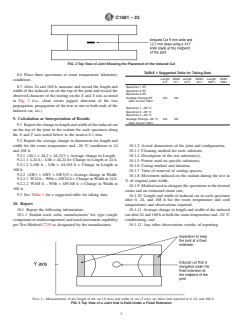
(0.5 in.) deep with the #17 knife blade. See Fig. 2. Make the cut
as parallel as possible to the long direction of the sample,
located directly on the midpoint and go perpendicularly
through the
...
This document is not an ASTM standard and is intended only to provide the user of an ASTM standard an indication of what changes have been made to the previous version. Because
it may not be technically possible to adequately depict all changes accurately, ASTM recommends that users consult prior editions as appropriate. In all cases only the current version
of the standard as published by ASTM is to be considered the official document.
Designation: C1681 − 18 C1681 − 23
Standard Test Method for
Evaluating the Tear Resistance of a Sealant Under Constant
Strain
This standard is issued under the fixed designation C1681; the number immediately following the designation indicates the year of
original adoption or, in the case of revision, the year of last revision. A number in parentheses indicates the year of last reapproval. A
superscript epsilon (´) indicates an editorial change since the last revision or reapproval.
1. Scope
1.1 This test method evaluates the impact of an induced tear on a sealant specimen that is dimensioned, cured according to the
guidelines in Test Method C719 and then subjected to a constant strain. It is effective in differentiating between sealants that are
used in dynamic joints subject to abrasion, punctures, tears, or combination thereof.
1.2 Since this test method is for the evaluation of tear propagation, an adhesive failure to the substrates provides no usable data
regarding tear propagation. This would be considered a failed test and that data would be discarded, or at least separated from the
other data from specimens that did not experience an adhesive failure.
1.3 This standard does not purport to address all of the safety concerns, if any, associated with its use. It is the responsibility
of the user of this standard to establish appropriate safety, health, and environmental practices and determine the applicability of
regulatory limitations prior to use.
1.4 The committee with jurisdiction over this standard is not aware of any comparable standards published by other organizations.
This standard is similar in concept to European Technical Approval Guidelines (ETAG) 002, Part 1, Section 5.1.4.6.4—Resistance
To Tearing.
1.5 This international standard was developed in accordance with internationally recognized principles on standardization
established in the Decision on Principles for the Development of International Standards, Guides and Recommendations issued
by the World Trade Organization Technical Barriers to Trade (TBT) Committee.
2. Referenced Documents
2.1 ASTM Standards:
C717 Terminology of Building Seals and Sealants
C719 Test Method for Adhesion and Cohesion of Elastomeric Joint Sealants Under Cyclic Movement (Hockman Cycle)
3. Terminology
3.1 Definitions—Refer to Terminology C717 for definitions of terms used in this standard, including but not limited to the
following: adhesive failure, casting spacers, cohesive failure, separators, standard conditions.
This test method is under the jurisdiction of ASTM Committee C24 on Building Seals and Sealants and is the direct responsibility of Subcommittee C24.20 on General
Test Methods.
Current edition approved Jan. 1, 2018June 1, 2023. Published January 2018July 2023. Originally approved in 2009. Last previous edition approved in 20142018 as
C1681C1681 – 18.-14. DOI: 10.1520/C1681-18.10.1520/C1681-23.
For referenced ASTM standards, visit the ASTM website, www.astm.org, or contact ASTM Customer Service at service@astm.org. For Annual Book of ASTM Standards
volume information, refer to the standard’s Document Summary page on the ASTM website.
Copyright © ASTM International, 100 Barr Harbor Drive, PO Box C700, West Conshohocken, PA 19428-2959. United States
C1681 − 23
4. Summary of Test Method
4.1 Test specimens are fabricated and cured in accordance with Test Method C719. At the end of the 21-day cure period, an
induced tear is created in the specimens by making a cut with a sharp blade in the midpoint of the joint. The specimens are then
extended to a specified strain at both standard conditions and at –26 6 2°C (–15 6 3°F).–26 °C 6 2 °C (–15 °F 6 3 °F).
Propagation of the induced tear is measured at 0, 24, and 168 h.
5. Significance and Use
5.1 This test method is intended to determine if a joint that is subjected to a mechanically induced cut will resist tear propagation
during normal joint movement. A sealant with a high resistance to tear propagation will typically perform better than a sealant with
a low resistance to tear propagation.
NOTE 1—A sealant with a high resistance to tear propagation may perform better than a sealant with a low resistance to tear propagation.
6. Apparatus and Materials
6.1 A device capable of extending the test specimens to the specified strain.
6.2 Freezer, to maintain a constant temperature of –26°C 6 2°C.
6.3 A suitable measuring device such as calipers able to measure the induced tears to 0.01 mm.
6.4 #17 Knife Blade, 9 mm (0.375 in.) wide.
6.5 Spatulas, for use in applying the sealant.
6.6 Caulking Gun, for extruding sealant from cartridges when applicable.
6.7 Substrates, twelve substrates, with minimum dimensions of 25.4 mm by 76.2 mm (1 by 3 in.) of the same finish are required
for each product to be tested. Glass is the default substrate, however as mentioned in the scope, this is not an adhesion test,
therefore the sealant must exhibit excellent adhesion to the substrate. Other rigid substrates in the above noted dimension are
acceptable. Substrate blocks or plates should be of adequate thickness or reinforced such that they do not flex or break during the
testing.
6.8 Casting Spacers, provide joint dimensions of 12.7 mm by 12.7 mm by 50.8 mm (0.5 by 0.5 by 2 in.). See Fig. 5 in Test Method
C719.
6.9 Separators, to provide a constant strain on the specimen while maintaining parallel bond surfaces.
6.10 Substrate Cleaning Material.
6.11 Primer, if required on the substrates.
6.12 A suitable measuring device, such as calipers, capable of measuring the induced cut in the sealant and additional changes,
if any, in the cut to 0.01 mm.
6.13 Marker, to identify the exact placement of the induced cut.
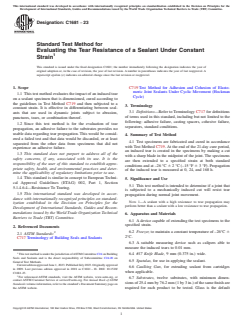
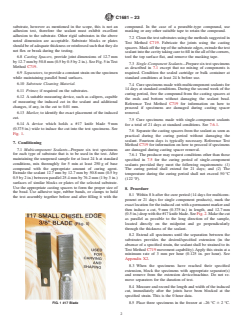
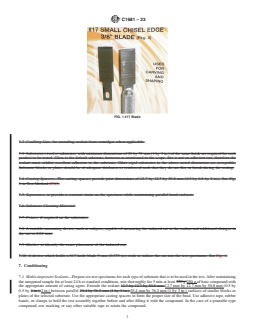
6.14 A device which holds a #17 knife blade 9 mm (0.375 in.) wide to induce the cut into the test specimens. See Fig. 1.
7. Reagents and Materials
7.1 Spatulas, for use in applying the sealant.
C1681 − 23
FIG. 1 #17 Blade
7.2 Caulking Gun, for extruding sealant from cartridges when applicable.
7.3 Substrates—twelve substrates, with minimum dimensions of 25 by 75 mm (1 by 3 in.) of the same finish are required for each
product to be tested. Glass is the default substrate, however as mentioned in the scope, this is not an adhesion test, therefore the
sealant must exhibit excellent adhesion to the substrate. Other rigid substrates in the above noted dimension are acceptable.
Substrate blocks or plates should be of adequate thickness or reinforced such that they do not flex or break during the testing.
7.4 Casting Spacers—The casting spacers provide joint dimensions of 12.7 by 12.7 by 50.8 mm (0.5 by 0.5 by 2 in.). See Fig.
5 in Test Method C719.
7.5 Separators, to provide a constant strain on the specimen while maintaining parallel bond surfaces.
7.6 Substrate Cleaning Material.
7.7 Primer, if required on the substrates.
7.8 A suitable measuring device, such as calipers, capable of measuring the induced cut in the sealant and additional changes in
the cut to 0.01 mm.
7.9 Marker, to identify the exact placement of the induced cut.
7.10 A device which holds a #17 knife blade 9 mm (0.375 in.) wide to induce the cut into the test specimens. See Fig. 1.
7. Conditioning
7.1 Multicomponent Sealants—Prepare six test specimens for each type of substrate that is to be used in the test. After maintaining
the unopened sample for at least 24 h at standard conditions, mix thoroughly for 5 min at least 250 g 250 g of base compound with
the appropriate amount of curing agent. Extrude the sealant 12.7 by 12.7 by 50.8 mm 12.7 mm by 12.7 mm by 50.8 mm (0.5 by
0.5 by 2 in.) 2 in.) between parallel 25.4 by 76.2 mm (1 by 3 in.) 25.4 mm by 76.2 mm (1 by 3 in.) surfaces of similar blocks or
plates of the selected substrate. Use the appropriate casting spacers to form the proper size of the bead. Use adhesive tape, rubber
bands, or clamps to hold the test assembly together before and after filling it with the compound. In the case of a pourable-type
compound, use masking or any other suitable tape to retain the compound.
C1681 − 23
7.2 Clean the test substrates using the methods suggested in Test Method C719. Fabricate the joints using the casting spacers.
Mask off the top of the substrate edges, extrude the test sealant into the cavity taking care to fill in the all of the corners, tool the
top surface flat, and remove the masking tape.
7.3 Single-Component Sealants—Prepare six test specimens as described in 8.17.1 except that no mixing of components is
required. Condition the sealed cartridge or bulk container at standard conditions at least 24 h before use.
7.4 Cure specimens made with multicomponent sealants for 14 days at standard conditions. During the second week of the curing
period, free the compound from the casting spacers at the ends and bottom without damaging the sealant bead. Reference Test
Method C719 for information on how to proceed if specimens are damaged during casting spacer removal.
7.5 Cure specimens made with single-component sealants for a total of 21 days at standard conditions. See 8.6.17.6.1.
7.6 Separate the casting spacers from the sealant as soon as practical during the curing period without damaging the sealant.
Fourteen days is typically necessary. Reference Test Method C719 for information on
...