

ASTM A909/A909M-06(2021)
(Specification)Standard Specification for Steel Forgings, Microalloy, for General Industrial Use
General Information
- Abstract
SCOPE
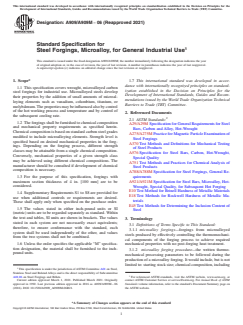
1.1 This specification covers wrought, microalloyed carbon steel forgings for industrial use. Microalloyed steels develop their properties by the addition of small amounts of microalloying elements such as vanadium, columbium, titanium, or molybdenum. The properties may be influenced also by control of the hot working process and temperature and by control of the subsequent cooling rate.
1.2 The forgings shall be furnished to chemical composition and mechanical property requirements as specified herein. Chemical composition is based on standard carbon steel grades modified to include microalloying elements. Strength level is specified based on desired mechanical properties in the forgings. Depending on the forging process, different strength classes may be attainable from a single chemical composition. Conversely, mechanical properties of a given strength class may be achieved using different chemical compositions. The manufacturer should be consulted if development of chemical composition is necessary.
1.3 For the purpose of this specification, forgings with maximum section thickness of 4 in. [100 mm] are to be considered.
1.4 Supplementary Requirements S1 to S8 are provided for use when additional controls or requirements are desired. These shall apply only when specified on the purchase order.
1.5 The values stated in either inch-pound units or SI (metric) units are to be regarded separately as standard. Within the text and tables, SI units are shown in brackets. The values stated in each system are not necessarily exact equivalents; therefore, to ensure conformance with the standard, each system shall be used independently of the other, and values from the two systems shall not be combined.
1.6 Unless the order specifies the applicable “M” specification designation, the material shall be furnished to the inch-pound units.
1.7 This international standard was developed in accordance with internationally recognized principles on standardization established in the Decision on Principles for the Development of International Standards, Guides and Recommendations issued by the World Trade Organization Technical Barriers to Trade (TBT) Committee.
- Status
- Published
- Publication Date
- 28-Feb-2021
- Technical Committee
- A01 - Steel, Stainless Steel and Related Alloys
- Drafting Committee
- A01.06 - Steel Forgings and Billets

Overview
ASTM A909/A909M-06(2021), issued by ASTM International, is a standard specification for steel forgings made from microalloyed carbon steel, intended for general industrial use. This standard details the requirements for chemical composition, mechanical properties, manufacturing process controls, and permissible supplementary requirements for wrought steel forgings containing microalloying elements such as vanadium, columbium (niobium), titanium, or molybdenum. The focus is on achieving desired mechanical properties through alloy selection and controlled hot working processes rather than post-forging heat treatments.
Key Topics
- Scope and Materials: Covers hot-wrought, microalloyed carbon steel forgings up to a maximum section thickness of 4 inches (100 mm).
- Microalloying Elements: Specifies the use of small quantities of microalloying elements, allowing flexibility in achieving target mechanical properties.
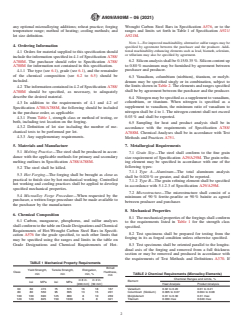
- Mechanical and Chemical Requirements: Mandates conformance to specified chemical compositions and mechanical properties, with multiple strength classes possible.
- Manufacturing Controls: Emphasizes thermomechanical processing, including controlled forging temperature and cooling rates to optimize final properties.
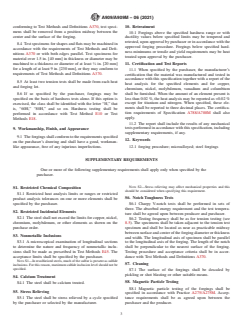
- Supplementary Requirements: Offers optional controls such as restricted chemical composition, notch toughness tests, calcium treatment, magnetic particle testing, and stress relieving, which can be specified in the purchase order for increased assurance of quality.
- Dual Units: Provides data in both inch-pound and SI (metric) units, which must be used independently and not intermixed.
Applications
ASTM A909/A909M is widely recognized for use in industrial manufacturing where high-strength, reliable steel forgings are essential. Key practical applications include:
- Automotive and Transportation: Components like connecting rods, crankshafts, and gear blanks benefit from the improved strength and fatigue resistance achieved through microalloying and controlled forging.
- Heavy Machinery and Equipment: Structural parts and bearing housings leveraging enhanced mechanical properties without post-forging heat treatment.
- Agricultural and Construction Equipment: Use of robust steel forgings in demanding environments requiring high performance and durability.
- General Industrial Uses: Any context where precise mechanical properties and consistent performance of steel forgings are required.
The specification enables manufacturers and end-users to tailor the selection of microalloyed steel forgings to specific industrial needs, often reducing costs and processing time due to the elimination of extensive heat treatment processes.
Related Standards
ASTM A909/A909M references and aligns with several important standards in the steel manufacturing sector:
- ASTM A29/A29M: Specification for General Requirements for Steel Bars, Carbon and Alloy, Hot-Wrought.
- ASTM A788/A788M: General requirements for steel forgings.
- ASTM A576: Specification for Steel Bars, Carbon, Hot-Wrought, Special Quality.
- ASTM A370: Test Methods and Definitions for Mechanical Testing of Steel Products.
- ASTM A751: Test Methods and Practices for Chemical Analysis of Steel Products.
- ASTM E10 / E18: Test Methods for Brinell and Rockwell Hardness of Metallic Materials.
- ASTM E45: Methods for Determining the Inclusion Content of Steel.
- ASTM A921/A921M: Specification for Microalloy, Hot-Wrought Steel Bars for forging.
These related standards provide the foundational testing and analysis methodologies as well as general requirements that support compliance with ASTM A909/A909M.
Conclusion
Adherence to ASTM A909/A909M supports the production of high-quality, microalloyed steel forgings for a broad range of industrial applications. The standard’s focus on mechanical property optimization, flexibility in microalloying, and alignment with other key ASTM standards ensures consistent, reliable performance and broad usability in modern manufacturing environments. For organizations seeking robust, industry-recognized specifications for steel forging procurement, ASTM A909/A909M offers comprehensive guidance and practical value.
Relations
- Effective Date
- 01-Mar-2024
- Effective Date
- 01-Nov-2023
- Effective Date
- 01-Nov-2023
- Effective Date
- 01-Nov-2023
- Effective Date
- 01-Jul-2019
- Effective Date
- 01-May-2019
- Effective Date
- 01-Nov-2018
- Effective Date
- 01-Sep-2018
- Effective Date
- 01-Jul-2018
- Effective Date
- 01-Mar-2018
- Refers
ASTM A370-17a - Standard Test Methods and Definitions for Mechanical Testing of Steel Products - Effective Date
- 15-Nov-2017
- Effective Date
- 01-Nov-2017
- Effective Date
- 01-Nov-2017
- Effective Date
- 01-Jul-2017
- Effective Date
- 01-May-2017
Get Certified
Connect with accredited certification bodies for this standard

Element Materials Technology
Materials testing and product certification.

Inštitut za kovinske materiale in tehnologije
Institute of Metals and Technology. Materials testing, metallurgical analysis, NDT.
Sponsored listings
Frequently Asked Questions
ASTM A909/A909M-06(2021) is a technical specification published by ASTM International. Its full title is "Standard Specification for Steel Forgings, Microalloy, for General Industrial Use". This standard covers: SCOPE 1.1 This specification covers wrought, microalloyed carbon steel forgings for industrial use. Microalloyed steels develop their properties by the addition of small amounts of microalloying elements such as vanadium, columbium, titanium, or molybdenum. The properties may be influenced also by control of the hot working process and temperature and by control of the subsequent cooling rate. 1.2 The forgings shall be furnished to chemical composition and mechanical property requirements as specified herein. Chemical composition is based on standard carbon steel grades modified to include microalloying elements. Strength level is specified based on desired mechanical properties in the forgings. Depending on the forging process, different strength classes may be attainable from a single chemical composition. Conversely, mechanical properties of a given strength class may be achieved using different chemical compositions. The manufacturer should be consulted if development of chemical composition is necessary. 1.3 For the purpose of this specification, forgings with maximum section thickness of 4 in. [100 mm] are to be considered. 1.4 Supplementary Requirements S1 to S8 are provided for use when additional controls or requirements are desired. These shall apply only when specified on the purchase order. 1.5 The values stated in either inch-pound units or SI (metric) units are to be regarded separately as standard. Within the text and tables, SI units are shown in brackets. The values stated in each system are not necessarily exact equivalents; therefore, to ensure conformance with the standard, each system shall be used independently of the other, and values from the two systems shall not be combined. 1.6 Unless the order specifies the applicable “M” specification designation, the material shall be furnished to the inch-pound units. 1.7 This international standard was developed in accordance with internationally recognized principles on standardization established in the Decision on Principles for the Development of International Standards, Guides and Recommendations issued by the World Trade Organization Technical Barriers to Trade (TBT) Committee.
SCOPE 1.1 This specification covers wrought, microalloyed carbon steel forgings for industrial use. Microalloyed steels develop their properties by the addition of small amounts of microalloying elements such as vanadium, columbium, titanium, or molybdenum. The properties may be influenced also by control of the hot working process and temperature and by control of the subsequent cooling rate. 1.2 The forgings shall be furnished to chemical composition and mechanical property requirements as specified herein. Chemical composition is based on standard carbon steel grades modified to include microalloying elements. Strength level is specified based on desired mechanical properties in the forgings. Depending on the forging process, different strength classes may be attainable from a single chemical composition. Conversely, mechanical properties of a given strength class may be achieved using different chemical compositions. The manufacturer should be consulted if development of chemical composition is necessary. 1.3 For the purpose of this specification, forgings with maximum section thickness of 4 in. [100 mm] are to be considered. 1.4 Supplementary Requirements S1 to S8 are provided for use when additional controls or requirements are desired. These shall apply only when specified on the purchase order. 1.5 The values stated in either inch-pound units or SI (metric) units are to be regarded separately as standard. Within the text and tables, SI units are shown in brackets. The values stated in each system are not necessarily exact equivalents; therefore, to ensure conformance with the standard, each system shall be used independently of the other, and values from the two systems shall not be combined. 1.6 Unless the order specifies the applicable “M” specification designation, the material shall be furnished to the inch-pound units. 1.7 This international standard was developed in accordance with internationally recognized principles on standardization established in the Decision on Principles for the Development of International Standards, Guides and Recommendations issued by the World Trade Organization Technical Barriers to Trade (TBT) Committee.
ASTM A909/A909M-06(2021) is classified under the following ICS (International Classification for Standards) categories: 77.140.85 - Iron and steel forgings. The ICS classification helps identify the subject area and facilitates finding related standards.
ASTM A909/A909M-06(2021) has the following relationships with other standards: It is inter standard links to ASTM A370-24, ASTM E45-18a(2023), ASTM A275/A275M-23, ASTM A576-23, ASTM A370-19, ASTM A788/A788M-19, ASTM A788/A788M-18b, ASTM A788/A788M-18a, ASTM E18-18, ASTM A788/A788M-18, ASTM A370-17a, ASTM A788/A788M-17a, ASTM A576-17, ASTM E18-17, ASTM A788/A788M-17. Understanding these relationships helps ensure you are using the most current and applicable version of the standard.
ASTM A909/A909M-06(2021) is available in PDF format for immediate download after purchase. The document can be added to your cart and obtained through the secure checkout process. Digital delivery ensures instant access to the complete standard document.
Standards Content (Sample)
This international standard was developed in accordance with internationally recognized principles on standardization established in the Decision on Principles for the
Development of International Standards, Guides and Recommendations issued by the World Trade Organization Technical Barriers to Trade (TBT) Committee.
Designation: A909/A909M −06 (Reapproved 2021)
Standard Specification for
Steel Forgings, Microalloy, for General Industrial Use
This standard is issued under the fixed designationA909/A909M; the number immediately following the designation indicates the year
of original adoption or, in the case of revision, the year of last revision. A number in parentheses indicates the year of last reapproval.
A superscript epsilon (´) indicates an editorial change since the last revision or reapproval.
1. Scope* 1.7 This international standard was developed in accor-
dance with internationally recognized principles on standard-
1.1 This specification covers wrought, microalloyed carbon
ization established in the Decision on Principles for the
steel forgings for industrial use. Microalloyed steels develop
Development of International Standards, Guides and Recom-
their properties by the addition of small amounts of microal-
mendations issued by the World Trade Organization Technical
loying elements such as vanadium, columbium, titanium, or
Barriers to Trade (TBT) Committee.
molybdenum.Thepropertiesmaybeinfluencedalsobycontrol
of the hot working process and temperature and by control of
2. Referenced Documents
the subsequent cooling rate.
2.1 ASTM Standards:
1.2 The forgings shall be furnished to chemical composition
A29/A29M SpecificationforGeneralRequirementsforSteel
and mechanical property requirements as specified herein.
Bars, Carbon and Alloy, Hot-Wrought
Chemical composition is based on standard carbon steel grades
A275/A275M Practice for Magnetic Particle Examination of
modified to include microalloying elements. Strength level is
Steel Forgings
specified based on desired mechanical properties in the forg-
A370 Test Methods and Definitions for Mechanical Testing
ings. Depending on the forging process, different strength
of Steel Products
classes may be attainable from a single chemical composition.
A576 Specification for Steel Bars, Carbon, Hot-Wrought,
Conversely, mechanical properties of a given strength class
Special Quality
may be achieved using different chemical compositions. The
A751 Test Methods and Practices for Chemical Analysis of
manufacturer should be consulted if development of chemical
Steel Products
composition is necessary.
A788/A788M Specification for Steel Forgings, General Re-
1.3 For the purpose of this specification, forgings with
quirements
maximum section thickness of 4 in. [100 mm] are to be A921/A921M Specification for Steel Bars, Microalloy, Hot-
considered.
Wrought, Special Quality, for Subsequent Hot Forging
E10 Test Method for Brinell Hardness of Metallic Materials
1.4 Supplementary Requirements S1 to S8 are provided for
E18 Test Methods for Rockwell Hardness of Metallic Ma-
use when additional controls or requirements are desired.
terials
These shall apply only when specified on the purchase order.
E45 Test Methods for Determining the Inclusion Content of
1.5 The values stated in either inch-pound units or SI
Steel
(metric) units are to be regarded separately as standard. Within
the text and tables, SI units are shown in brackets. The values
3. Terminology
stated in each system are not necessarily exact equivalents;
3.1 Definitions of Terms Specific to This Standard:
therefore, to ensure conformance with the standard, each
3.1.1 microalloy forgings—forgings from microalloyed
system shall be used independently of the other, and values
steels produced by effectively controlling the thermomechani-
from the two systems shall not be combined.
cal components of the forging process to achieve required
1.6 Unless the order specifies the applicable “M” specifica-
mechanical properties with no post-forging heat treatment.
tion designation, the material shall be furnished to the inch-
3.1.2 microalloy forging procedure—the written thermo-
pound units.
mechanical processing parameters to be followed during the
production of a microalloy forging. It would include, but is not
limited to: starting stock size; chemical composition, including
This specification is under the jurisdiction of ASTM Committee A01 on Steel,
Stainless Steel and Related Alloys and is the direct responsibility of Subcommittee
A01.06 on Steel Forgings and Billets. For referenced ASTM standards, visit the ASTM website, www.astm.org, or
Current edition approved March 1, 2021. Published March 2021. Originally contact ASTM Customer Service at service@astm.org. For Annual Book of ASTM
approved in 1992. Last previous edition approved in 2016 as A909/A909M – 06 Standards volume information, refer to the standard’s Document Summary page on
(2016). DOI: 10.1520/A0909_A0909M-06R21. the ASTM website.
*A Summary of Changes section appears at the end of this standard
Copyright © ASTM International, 100 Barr Harbor Drive, PO Box C700, West Conshohocken, PA 19428-2959. United States
A909/A909M − 06 (2021)
any optional microalloying additions; reheat practice; forging Wrought Carbon Steel Bars in Specification A576,ortothe
temperature range; method of heating; cooling methods; and ranges and limits set forth in Table 1 of Specification A921/
lot size definition. A921M.
NOTE 1—For improved machinability, alternative sulfur ranges may be
4. Ordering Information
specified by agreement between the purchaser and the producer. Addi-
tional machinability-enhancing elements such as lead, bismuth, selenium,
4.1 Orders for material supplied to this specification should
or tellurium may also be specified by agreement.
include the information specified in 4.1 of Specification A788/
6.2 Silicon analysis shall be 0.15/0.35 %. Silicon content up
A788M. The purchaser should refer to Specification A788/
to 0.80 % maximum may be furnished by agreement between
A788M for information not contained in this specification.
purchaser and producer.
4.1.1 The type (see 6.1), grade (see 6.1), and the remainder
of the chemical composition (see 6.2 to 6.5) should be
6.3 Vanadium, columbium (niobium), titanium, or molyb-
included.
denum may be specified singly or in combination, subject to
the limits shown in Table 2. The elements and ranges specified
4.2 The information contained in 4.2 of Specification A788/
shall be by agreement between the purchaser and the producer.
A788M should be specified, as necessary, to adequately
describe the desired material.
6.4 Nitrogenmaybespecifiedasasupplementtovanadium,
columbium, or titanium. When nitrogen is specified as a
4.3 In addition to the requirements of 4.1 and 4.2 of
supplement to vanadium, the minimum ratio of vanadium to
Specification A788/A788M, the following should be included
nitrogen shall be 4 to 1. The nitrogen content shall not exceed
in the purchase order, as applicable:
0.03 % and shall be reported.
4.3.1 From Table 1, strength class or method of testing, or
both, including test location on the forging.
6.5 Sampling for heat and product analysis shall be in
4.3.2 Definition of lot size including the number of me-
accordance with the requirements of Specification A788/
chanical tests to be performed per lot.
A788M. Chemical Analyses shall be in accordance with Test
4.3.3 Any supplementary requirements.
Methods and Practices A751.
5. Materials and Manufacture
7. Metallurgical Requirements
5.1 Melting Practice—The steel shall be produced in accor-
7.1 Grain Size—The steel shall conform to the fine grain
dance with the applicable methods for primary and secondary
size requirement of Specification A29/A29M. The grain refin-
melting outlines in Specification A788/A788M.
ing element may be specified in accordance with one of the
following types:
5.2 The steel shall be killed.
7.1.1 Type A—Aluminum—The total aluminum analysis
5.3 Hot Forging—The forging shall be brought as close as
shall be 0.020 % or greater, and shall be reported.
practical to finish size by hot mechanical working. Controlled
7.1.2 Type B—The grain refining element shall be specified
hot working and cooling practices shall be applied to develop
in accordance with 5.1.2.3 of Specification A29/A29M.
specified mechanical properties.
7.2 Microstructure—The microstructure shall consist of a
5.4 Microalloy Forge Procedure—When requested by the
minimum
...