

ASTM D1106-21
(Test Method)Standard Test Method for Acid-Insoluble Lignin in Wood,
General Information
- Abstract
SIGNIFICANCE AND USE
4.1 Wood contains approximately 20 to 30 % lignin. Removal of the lignin is the primary objective of pulping and bleaching procedures. Determination of the lignin content provides information for the evaluation and application of these processes.
SCOPE
1.1 This test method3 covers the determination of the acid-insoluble lignin content of wood.
1.2 This standard does not purport to address all of the safety concerns, if any, associated with its use. It is the responsibility of the user of this standard to establish appropriate safety, health, and environmental practices and determine the applicability of regulatory limitations prior to use. Specific precautionary statements are given in 6.1.
1.3 This international standard was developed in accordance with internationally recognized principles on standardization established in the Decision on Principles for the Development of International Standards, Guides and Recommendations issued by the World Trade Organization Technical Barriers to Trade (TBT) Committee.
- Status
- Published
- Publication Date
- 31-Jan-2021
- Technical Committee
- D07 - Wood
- Drafting Committee
- D07.01 - Fundamental Test Methods and Properties
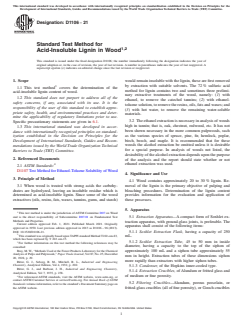
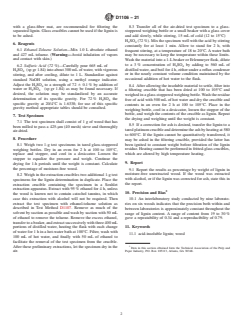


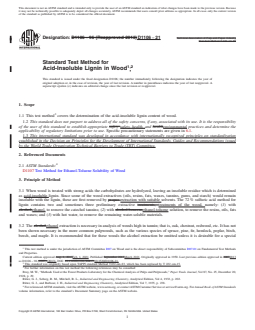
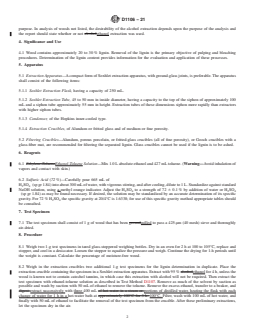


Overview
ASTM D1106-21: Standard Test Method for Acid-Insoluble Lignin in Wood establishes a reliable procedure for determining the acid-insoluble lignin content in wood samples. Lignin constitutes about 20 to 30 percent of wood and is a key factor in wood processing industries, especially in the production of pulp and paper. Accurate determination of lignin content is critical for evaluating pulping efficiency, bleaching procedures, and overall wood quality. This standardized test method, developed by ASTM, ensures consistency, repeatability, and comparability in lignin analysis across laboratories globally.
Key Topics
- Lignin Content in Wood: Lignin is a complex organic polymer that strengthens cell walls and impacts chemical processing. Its removal is a primary goal in pulping and bleaching within the paper industry.
- Method Principle: The method involves removing extractives from wood with solvents, then hydrolyzing carbohydrates using strong acids, leaving acid-insoluble lignin as a measurable residue.
- Apparatus and Safety: Utilizes Soxhlet extraction, filtering crucibles, and precise handling of reagents like ethanol-toluene and sulfuric acid. The method recommends strict adherence to safety, health, and environmental procedures given the chemicals involved.
- Sample Preparation: Wood is milled to a specific fineness, air-dried, and subjected to sequential solvent extractions and acid treatments to isolate lignin.
- Reporting Results: Lignin is reported as a percentage of the moisture-free wood sample, specifying any applied corrections (e.g., ash correction, use of alcohol extraction).
- Precision and Bias: Proven high repeatability and reproducibility, ensuring reliable lignin quantification across different laboratories and wood types.
Applications
- Pulp and Paper Industry: Commonly used to assess raw material quality and monitor pulping and bleaching effectiveness, guiding process optimization.
- Wood Chemistry: Essential for research on wood composition, plant biology, and genetic modification for improved lignin traits.
- Quality Control: Supports routine quality testing for wood supply chains, ensuring specifications align with end-user requirements.
- Environmental and Regulatory Compliance: Provides credible data for regulatory submissions and international trade, particularly where chemical content and processing residues are regulated.
Related Standards
- ASTM D1107: Test Method for Ethanol-Toluene Solubility of Wood - details procedures for solvent extractions referenced in ASTM D1106-21.
- TAPPI T 222 om-15: Technical Association of the Pulp and Paper Industry method for acid-insoluble lignin, the basis for ASTM D1106.
- Other Pulpwood Analysis Standards: Related standards cover cellulose, hemicellulose, extractives, and additional wood components important to comprehensive wood analysis.
Keywords: acid-insoluble lignin, wood, lignin determination, pulp and paper, wood processing, ASTM D1106-21, lignin content test, wood chemistry, Soxhlet extraction, ethanol-toluene extraction
By following ASTM D1106-21, laboratories and industry professionals ensure accuracy and comparability in measuring acid-insoluble lignin in wood, supporting critical applications in manufacturing, research, and quality assurance. For further information or related methodologies, consult the latest editions of referenced ASTM and TAPPI standards.
Relations
- Effective Date
- 01-Apr-2007
- Effective Date
- 10-Sep-2001
- Effective Date
- 10-Sep-1996
Get Certified
Connect with accredited certification bodies for this standard

Gozdarski inštitut Slovenije
Slovenian Forestry Institute. Forest management certification support, timber testing.
Sponsored listings
Frequently Asked Questions
ASTM D1106-21 is a standard published by ASTM International. Its full title is "Standard Test Method for Acid-Insoluble Lignin in Wood<sup>,</sup >". This standard covers: SIGNIFICANCE AND USE 4.1 Wood contains approximately 20 to 30 % lignin. Removal of the lignin is the primary objective of pulping and bleaching procedures. Determination of the lignin content provides information for the evaluation and application of these processes. SCOPE 1.1 This test method3 covers the determination of the acid-insoluble lignin content of wood. 1.2 This standard does not purport to address all of the safety concerns, if any, associated with its use. It is the responsibility of the user of this standard to establish appropriate safety, health, and environmental practices and determine the applicability of regulatory limitations prior to use. Specific precautionary statements are given in 6.1. 1.3 This international standard was developed in accordance with internationally recognized principles on standardization established in the Decision on Principles for the Development of International Standards, Guides and Recommendations issued by the World Trade Organization Technical Barriers to Trade (TBT) Committee.
SIGNIFICANCE AND USE 4.1 Wood contains approximately 20 to 30 % lignin. Removal of the lignin is the primary objective of pulping and bleaching procedures. Determination of the lignin content provides information for the evaluation and application of these processes. SCOPE 1.1 This test method3 covers the determination of the acid-insoluble lignin content of wood. 1.2 This standard does not purport to address all of the safety concerns, if any, associated with its use. It is the responsibility of the user of this standard to establish appropriate safety, health, and environmental practices and determine the applicability of regulatory limitations prior to use. Specific precautionary statements are given in 6.1. 1.3 This international standard was developed in accordance with internationally recognized principles on standardization established in the Decision on Principles for the Development of International Standards, Guides and Recommendations issued by the World Trade Organization Technical Barriers to Trade (TBT) Committee.
ASTM D1106-21 is classified under the following ICS (International Classification for Standards) categories: 79.040 - Wood, sawlogs and sawn timber. The ICS classification helps identify the subject area and facilitates finding related standards.
ASTM D1106-21 has the following relationships with other standards: It is inter standard links to ASTM D1107-96(2007), ASTM D1107-96(2001), ASTM D1107-96. Understanding these relationships helps ensure you are using the most current and applicable version of the standard.
ASTM D1106-21 is available in PDF format for immediate download after purchase. The document can be added to your cart and obtained through the secure checkout process. Digital delivery ensures instant access to the complete standard document.
Standards Content (Sample)
This international standard was developed in accordance with internationally recognized principles on standardization established in the Decision on Principles for the
Development of International Standards, Guides and Recommendations issued by the World Trade Organization Technical Barriers to Trade (TBT) Committee.
Designation: D1106 − 21
Standard Test Method for
1,2
Acid-Insoluble Lignin in Wood
This standard is issued under the fixed designation D1106; the number immediately following the designation indicates the year of
original adoption or, in the case of revision, the year of last revision. A number in parentheses indicates the year of last reapproval. A
superscript epsilon (´) indicates an editorial change since the last revision or reapproval.
1. Scope would remain insoluble with the lignin, these are first removed
by extraction with suitable solvents. The 72 % sulfuric acid
1.1 This test method covers the determination of the
method for lignin contains two and sometimes three prelimi-
acid-insoluble lignin content of wood.
nary extractive treatments of the wood, namely: (1) with
1.2 This standard does not purport to address all of the
ethanol, to remove the catechol tannins; (2) with ethanol-
safety concerns, if any, associated with its use. It is the
toluene solution, to remove the resins, oils, fats and waxes; and
responsibility of the user of this standard to establish appro-
(3) with hot water, to remove the remaining water-soluble
priate safety, health, and environmental practices and deter-
materials.
mine the applicability of regulatory limitations prior to use.
3.2 The ethanol extraction is necessary in analysis of woods
Specific precautionary statements are given in 6.1.
high in tannin; that is, oak, chestnut, redwood, etc. It has not
1.3 This international standard was developed in accor-
been shown necessary in the more common pulpwoods, such
dance with internationally recognized principles on standard-
as the various species of spruce, pine, fir, hemlock, poplar,
ization established in the Decision on Principles for the
birch, beech, and maple. It is recommended that for these
Development of International Standards, Guides and Recom-
woods the alcohol extraction be omitted unless it is desirable
mendations issued by the World Trade Organization Technical
for a special purpose. In analysis of woods not listed, the
Barriers to Trade (TBT) Committee.
desirability of the alcohol extraction depends upon the purpose
2. Referenced Documents of the analysis and the report should state whether or not
4 ethanol extraction was used.
2.1 ASTM Standards:
D1107 Test Method for Ethanol-Toluene Solubility of Wood
4. Significance and Use
3. Principle of Method
4.1 Wood contains approximately 20 to 30 % lignin. Re-
3.1 When wood is treated with strong acids the carbohy- moval of the lignin is the primary objective of pulping and
drates are hydrolyzed, leaving an insoluble residue which is bleaching procedures. Determination of the lignin content
determined as acid-insoluble lignin. Since some of the wood provides information for the evaluation and application of
extractives (oils, resins, fats, waxes, tannins, gums, and starch) these processes.
5. Apparatus
This test method is under the jurisdiction of ASTM Committee D07 on Wood
5.1 Extraction Apparatus—A compact form of Soxhlet ex-
and is the direct responsibility of Subcommittee D07.01 on Fundamental Test
Methods and Properties.
traction apparatus, with ground-glass joints, is preferable. The
Current edition approved Feb. 1, 2021. Published March 2021. Originally
apparatus shall consist of the following items:
approved in 1950. Last previous edition approved in 2013 as D1106 – 96 (2013).
DOI: 10.1520/D1106-21. 5.1.1 Soxhlet Extraction Flask, having a capacity of 250
This standard was originally based upon TAPPI standard Method T222-om-83,
mL.
which has been replaced by T 222 om-15.
5.1.2 Soxhlet Extraction Tube, 45 to 50 mm in inside
For further information on this test method the following references may be
consulted: diameter, having a capacity to the top of the siphon of
Bray, M. W., “Methods Used at the Forest Products Laboratory for the Chemical
approximately 100 mL and a siphon tube approximately 55
Analysis of Pulps and Pulpwoods,”PaperTradeJournal,Vol 87, No. 25, December
mm in height. Extraction tubes of these dimensions siphon
20, 1928, p. 29.
more rapidly than extractors with higher siphon tubes.
Ritter, G. J., Seborg, R. M., Mitchell, R. L., Industrial and Engineering
Chemistry, Analytical Edition, Vol 4, 1932, p. 202.
5.1.3 Condenser, of the Hopkins inner-cooled type.
Ritter, G. J., and Barbour, J. H., Industrial and Engineering Chemistry,
5.1.4 Extraction Crucibles, of Alundum or fritted glass and
Analytical Edition, Vol 7, 1935, p. 238.
of medium or fine porosity.
For referenced ASTM standards, visit the ASTM website, www.astm.org, or
contact ASTM Customer Service at service@astm.org. For Annual Book of ASTM
5.2 Filtering Crucibles—Alundum, porous porcelain, or
Standards volume information, refer to the standard’s Document Summary page on
the ASTM website. fritted-glass crucibles (all of fine porosity), or Gooch crucibles
Copyright © ASTM International, 100 Barr Harbor Drive, PO Box C700, West Conshohocken, PA 19428-2959. United States
D1106 − 21
with a glass-fiber mat, are recommended for filtering the 8.3 Transfer all of the air-dried test specimen to a glass-
separated lignin. Glass crucibles cannot be used if the lignin is stoppered weighing bottle or a small beaker with a glass cover
to be ashed. and add slowly, while stirring, 15 mL of cold (12 to 15°C)
H SO (72 %). Mix the specimen well with the acid by stirring
2 4
6. Reagents
constantly for at least 1 min. Allow to stand for 2 h, with
6.
...
This document is not an ASTM standard and is intended only to provide the user of an ASTM standard an indication of what changes have been made to the previous version. Because
it may not be technically possible to adequately depict all changes accurately, ASTM recommends that users consult prior editions as appropriate. In all cases only the current version
of the standard as published by ASTM is to be considered the official document.
Designation: D1106 − 96 (Reapproved 2013) D1106 − 21 Technical Association of Pulp and Paper Industry
Standard Method T 222-om-83
Standard Test Method for
1,2
Acid-Insoluble Lignin in Wood
This standard is issued under the fixed designation D1106; the number immediately following the designation indicates the year of
original adoption or, in the case of revision, the year of last revision. A number in parentheses indicates the year of last reapproval. A
superscript epsilon (´) indicates an editorial change since the last revision or reapproval.
1. Scope
1.1 This test method covers the determination of the acid-insoluble lignin content of wood.
1.2 This standard does not purport to address all of the safety concerns, if any, associated with its use. It is the responsibility
of the user of this standard to establish appropriate safety safety, health, and healthenvironmental practices and determine the
applicability of regulatory limitations prior to use. Specific precautionary statements are given in 6.1.
1.3 This international standard was developed in accordance with internationally recognized principles on standardization
established in the Decision on Principles for the Development of International Standards, Guides and Recommendations issued
by the World Trade Organization Technical Barriers to Trade (TBT) Committee.
2. Referenced Documents
2.1 ASTM Standards:
D1107 Test Method for Ethanol-Toluene Solubility of Wood
3. Principle of Method
3.1 When wood is treated with strong acids the carbohydrates are hydrolyzed, leaving an insoluble residue which is determined
as acid-insoluble lignin. Since some of the wood extractives (oils, resins, fats, waxes, tannins, gums, and starch) would remain
insoluble with the lignin, these are first removed by proper extraction with suitable solvents. The 72 % sulfuric acid method for
lignin contains two and sometimes three preliminary extractive treatments, treatments of the wood, namely: (1) with
alcohol,ethanol, to remove the catechol tannins; (2) with alcohol-benzeneethanol-toluene solution, to remove the resins, oils, fats
and waxes; and (3) with hot water, to remove the remaining water-soluble materials.
3.2 The alcoholethanol extraction is necessary in analysis of woods high in tannin; that is, oak, chestnut, redwood, etc. It has not
been shown necessary in the more common pulpwoods, such as the various species of spruce, pine, fir, hemlock, poplar, birch,
beech, and maple. It is recommended that for these woods the alcohol extraction be omitted unless it is desirable for a special
This test method is under the jurisdiction of ASTM Committee D07 on Wood and is the direct responsibility of Subcommittee D07.01 on Fundamental Test Methods
and Properties.
Current edition approved Aug. 1, 2013Feb. 1, 2021. Published September 2013March 2021. Originally approved in 1950. Last previous edition approved in 20072013
as D1106 – 96 (2007).(2013). DOI: 10.1520/D1106-96R13.10.1520/D1106-21.
This standard was originally based upon TAPPI standard Method T222-om-83, which has been replaced by T 222 om-15.
For further information on this test method the following references may be consulted:
Bray, M. W., “Methods Used at the Forest Products Laboratory for the Chemical Analysis of Pulps and Pulpwoods,” Paper Trade Journal, Vol 87, No. 25, December 20,
1928, p. 29.
Ritter, G. J., Seborg, R. M., Mitchell, R. L., Industrial and Engineering Chemistry, Analytical Edition, Vol 4, 1932, p. 202.
Ritter, G. J., and Barbour, J. H., Industrial and Engineering Chemistry, Analytical Edition, Vol 7, 1935, p. 238.
For referenced ASTM standards, visit the ASTM website, www.astm.org, or contact ASTM Customer Service at service@astm.org. For Annual Book of ASTM Standards
volume information, refer to the standard’s Document Summary page on the ASTM website.
Copyright © ASTM International, 100 Barr Harbor Drive, PO Box C700, West Conshohocken, PA 19428-2959. United States
D1106 − 21
purpose. In analysis of woods not listed, the desirability of the alcohol extraction depends upon the purpose of the analysis and
the report should state whether or not alcoholethanol extraction was used.
4. Significance and Use
4.1 Wood contains approximately 20 to 30 % lignin. Removal of the lignin is the primary objective of pulping and bleaching
procedures. Determination of the lignin content provides information for the evaluation and application of these processes.
5. Apparatus
5.1 Extraction Apparatus—A compact form of Soxhlet extraction apparatus, with ground-glass joints, is preferable. The apparatus
shall consist of the following items:
5.1.1 Soxhlet Extraction Flask, having a capacity of 250 mL.
5.1.2 Soxhlet Extraction Tube, 45 to 50 mm in inside diameter, having a capacity to the top of the siphon of approximately 100
mL and a siphon tube approximately 55 mm in height. Extraction tubes of these dimensions siphon more rapidly than extractors
with higher siphon tubes.
5.1.3 Condenser, of the Hopkins inner-cooled type.
5.1.4 Extraction Crucibles, of Alundum or fritted glass and of medium or fine porosity.
5.2 Filtering Crucibles—Alundum, porous porcelain, or fritted-glass crucibles (all of fine porosity), or Gooch crucibles with a
glass-fiber mat, are recommended for filtering the separated lignin. Glass crucibles cannot be used if the lignin is to be ashed.
6. Reagents
6.1 Ethylene-TolueneEthanol-Toluene Solution—Mix 1.0 L absolute ethanol and 427 mL toluene. (Warning—Avoid inhalation of
vapors and contact with skin.)
6.2 Sulfuric Acid (72 %)—Carefully pour 665 mL of
H SO (sp gr 1.84) into about 300 mL
...