

ASTM D3658-01(2016)
(Test Method)Standard Test Method for Determining the Torque Strength of Ultraviolet (UV) Light-Cured Glass/Metal Adhesive Joints
General Information
- Abstract
SIGNIFICANCE AND USE
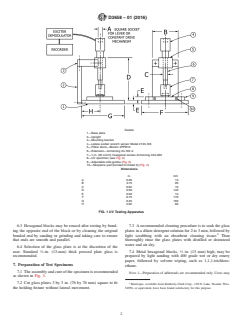
4.1 This test method provides reasonably accurate information with regard to the ability of UV curing adhesives to withstand torsional shearing forces. It may be used to determine the effect of environment on torsional shear strength.
SCOPE
1.1 This test method covers the simplistic comparison of strengths of glass/metal joints when the adhesive is cured by ultraviolet (UV) radiation and standard specimens are used and tested under specified conditions of preparation, radiation, and load.
1.2 This test method involves torque loading UV-bonded hexagonal metal blocks to glass plates.
1.3 This test method may be used to obtain comparative torque strength-to-failure data for other bonded joint systems, radiation cured or not.
1.4 The values stated in inch-pound units are to be regarded as standard. The values given in parentheses are mathematical conversions to SI units that are provided for information only and are not considered standard.
1.5 This standard does not purport to address all of the safety concerns, if any, associated with its use. It is the responsibility of the user of this standard to establish appropriate safety and health practices and determine the applicability of regulatory limitations prior to use.
- Status
- Published
- Publication Date
- 30-Apr-2016
- Technical Committee
- D14 - Adhesives
- Drafting Committee
- D14.80 - Metal Bonding Adhesives

Overview
ASTM D3658-01(2016), issued by ASTM International, is the established standard test method for determining the torque strength of ultraviolet (UV) light-cured glass/metal adhesive joints. This test method offers a reliable approach for comparing the torsional shear strength of adhesives that are cured using UV radiation, specifically in glass-to-metal bonding applications. The procedure delivers valuable insights into the adhesive’s capability to withstand torsional loading and helps assess environmental impacts on adhesive joint performance.
Key Topics
- Purpose: Provides a means to measure and compare the torque strength of UV-cured adhesive joints between glass and metal, including the effect of environmental conditions.
- Test Procedure: Involves bonding hexagonal metal blocks to glass plates using a UV-curing adhesive and subjecting the assembly to controlled torque until failure occurs.
- Specimen Preparation:
- Glass and metal surfaces are thoroughly cleaned and prepared to ensure consistent and accurate results.
- Hexagonal metal blocks and glass plates are joined using specified adhesives and cured under controlled UV radiation.
- Data Reporting: Requires detailed reporting on adhesive and substrate identification, preparation methods, curing conditions, specimen counts, conditioning, and results including load at failure and types of failure observed.
- Units of Measurement: Standard values are in inch-pound units, with SI units provided for reference.
Applications
The ASTM D3658-01(2016) standard is broadly applied in industries utilizing UV-curable adhesives, particularly where glass-to-metal bonding is required. Key applications include:
- Quality control and product development for manufacturers of adhesives, glass assemblies, electronic devices, optical instruments, and automotive components.
- Material selection and validation for engineering teams needing comparative strength data on different adhesive systems.
- Environmental resistance assessment for product designers evaluating adhesive joint performance under varying humidity, temperature, or weathering conditions.
- Research and innovation where new adhesive formulations or substrates are being tested for optimized performance in glass/metal joints.
- Process verification for companies implementing UV curing processes or transitioning from traditional bonding methods.
This method can also serve comparative purposes for other bonded systems, whether or not they utilize radiation curing, by providing standardized torque strength-to-failure data.
Related Standards
Several ASTM standards relate closely to ASTM D3658-01(2016), ensuring harmonized procedures and terminology in adhesive testing:
- ASTM D907: Standard Terminology of Adhesives
- ASTM D1002: Test Method for Apparent Shear Strength of Single-Lap-Joint Adhesively Bonded Metal Specimens by Tension Loading
- ASTM B36/B36M: Specification for Brass Plate, Sheet, Strip, and Rolled Bar
- ASTM B152/B152M: Specification for Copper Sheet, Strip, Plate, and Rolled Bar
- ASTM B209: Specification for Aluminum and Aluminum-Alloy Sheet and Plate
- ASTM B265: Specification for Titanium and Titanium Alloy Strip, Sheet, and Plate
- ASTM A109/A109M: Specification for Steel, Strip, Carbon (Cold-Rolled)
Familiarity with these related standards ensures accurate test setup, consistent specimen preparation, and credible strength comparisons across adhesive joint applications.
Keywords: torque strength, UV light-cured adhesives, glass/metal joints, ASTM D3658, torsional shear, adhesive testing, environmental resistance, ultraviolet curing, bonded assemblies, shear strength.
Relations
- Effective Date
- 01-May-2016
- Effective Date
- 01-Mar-2024
- Effective Date
- 01-Oct-2023
- Refers
ASTM B265-20a - Standard Specification for Titanium and Titanium Alloy Strip, Sheet, and Plate - Effective Date
- 01-Apr-2020
- Effective Date
- 01-Jan-2020
- Effective Date
- 01-Oct-2019
- Effective Date
- 01-Apr-2019
- Effective Date
- 01-Nov-2018
- Effective Date
- 01-Oct-2018
- Effective Date
- 01-Sep-2016
- Effective Date
- 01-Nov-2015
- Effective Date
- 01-Nov-2015
- Effective Date
- 01-May-2014
- Effective Date
- 01-Oct-2013
- Effective Date
- 01-Oct-2013
Get Certified
Connect with accredited certification bodies for this standard

DIN CERTCO
DIN Group product certification.

Smithers Quality Assessments
US management systems and product certification.
Sponsored listings
Frequently Asked Questions
ASTM D3658-01(2016) is a standard published by ASTM International. Its full title is "Standard Test Method for Determining the Torque Strength of Ultraviolet (UV) Light-Cured Glass/Metal Adhesive Joints". This standard covers: SIGNIFICANCE AND USE 4.1 This test method provides reasonably accurate information with regard to the ability of UV curing adhesives to withstand torsional shearing forces. It may be used to determine the effect of environment on torsional shear strength. SCOPE 1.1 This test method covers the simplistic comparison of strengths of glass/metal joints when the adhesive is cured by ultraviolet (UV) radiation and standard specimens are used and tested under specified conditions of preparation, radiation, and load. 1.2 This test method involves torque loading UV-bonded hexagonal metal blocks to glass plates. 1.3 This test method may be used to obtain comparative torque strength-to-failure data for other bonded joint systems, radiation cured or not. 1.4 The values stated in inch-pound units are to be regarded as standard. The values given in parentheses are mathematical conversions to SI units that are provided for information only and are not considered standard. 1.5 This standard does not purport to address all of the safety concerns, if any, associated with its use. It is the responsibility of the user of this standard to establish appropriate safety and health practices and determine the applicability of regulatory limitations prior to use.
SIGNIFICANCE AND USE 4.1 This test method provides reasonably accurate information with regard to the ability of UV curing adhesives to withstand torsional shearing forces. It may be used to determine the effect of environment on torsional shear strength. SCOPE 1.1 This test method covers the simplistic comparison of strengths of glass/metal joints when the adhesive is cured by ultraviolet (UV) radiation and standard specimens are used and tested under specified conditions of preparation, radiation, and load. 1.2 This test method involves torque loading UV-bonded hexagonal metal blocks to glass plates. 1.3 This test method may be used to obtain comparative torque strength-to-failure data for other bonded joint systems, radiation cured or not. 1.4 The values stated in inch-pound units are to be regarded as standard. The values given in parentheses are mathematical conversions to SI units that are provided for information only and are not considered standard. 1.5 This standard does not purport to address all of the safety concerns, if any, associated with its use. It is the responsibility of the user of this standard to establish appropriate safety and health practices and determine the applicability of regulatory limitations prior to use.
ASTM D3658-01(2016) is classified under the following ICS (International Classification for Standards) categories: 83.180 - Adhesives. The ICS classification helps identify the subject area and facilitates finding related standards.
ASTM D3658-01(2016) has the following relationships with other standards: It is inter standard links to ASTM D3658-01(2008), ASTM A109/A109M-24, ASTM B36/B36M-23, ASTM B265-20a, ASTM B265-20, ASTM B152/B152M-19, ASTM D1002-10(2019), ASTM A109/A109M-16(2018), ASTM B36/B36M-18, ASTM A109/A109M-16, ASTM B265-15, ASTM A109/A109M-15, ASTM A109/A109M-14, ASTM B36/B36M-13, ASTM A109/A109M-13. Understanding these relationships helps ensure you are using the most current and applicable version of the standard.
ASTM D3658-01(2016) is available in PDF format for immediate download after purchase. The document can be added to your cart and obtained through the secure checkout process. Digital delivery ensures instant access to the complete standard document.
Standards Content (Sample)
This international standard was developed in accordance with internationally recognized principles on standardization established in the Decision on Principles for the
Development of International Standards, Guides and Recommendations issued by the World Trade Organization Technical Barriers to Trade (TBT) Committee.
Designation: D3658 − 01 (Reapproved 2016)
Standard Test Method for
Determining the Torque Strength of Ultraviolet (UV) Light-
Cured Glass/Metal Adhesive Joints
This standard is issued under the fixed designation D3658; the number immediately following the designation indicates the year of
original adoption or, in the case of revision, the year of last revision. A number in parentheses indicates the year of last reapproval. A
superscript epsilon (´) indicates an editorial change since the last revision or reapproval.
1. Scope B152/B152M Specification for Copper Sheet, Strip, Plate,
and Rolled Bar
1.1 This test method covers the simplistic comparison of
B209 Specification for Aluminum and Aluminum-Alloy
strengths of glass/metal joints when the adhesive is cured by
Sheet and Plate
ultraviolet (UV) radiation and standard specimens are used and
B265 Specification for Titanium and Titanium Alloy Strip,
tested under specified conditions of preparation, radiation, and
Sheet, and Plate
load.
D907 Terminology of Adhesives
1.2 This test method involves torque loading UV-bonded
D1002 Test Method for Apparent Shear Strength of Single-
hexagonal metal blocks to glass plates.
Lap-Joint Adhesively Bonded Metal Specimens by Ten-
sion Loading (Metal-to-Metal)
1.3 This test method may be used to obtain comparative
torque strength-to-failure data for other bonded joint systems,
3. Terminology
radiation cured or not.
3.1 Definitions—Many of the terms in this test method are
1.4 The values stated in inch-pound units are to be regarded
defined in Terminology D907.
as standard. The values given in parentheses are mathematical
conversions to SI units that are provided for information only
4. Significance and Use
and are not considered standard.
4.1 This test method provides reasonably accurate informa-
1.5 This standard does not purport to address all of the
tion with regard to the ability of UV curing adhesives to
safety concerns, if any, associated with its use. It is the
withstand torsional shearing forces. It may be used to deter-
responsibility of the user of this standard to establish appro-
mine the effect of environment on torsional shear strength.
priate safety and health practices and determine the applica-
5. Apparatus
bility of regulatory limitations prior to use.
5.1 Test system consisting of apparatus capable of transfer-
2. Referenced Documents
ring a uniform and continuous torque to the bonded hexagonal
2.1 ASTM Standards:
block (schematically shown in Fig. 1), and a safety shield or
A109/A109M Specification for Steel, Strip, Carbon (0.25
other safety device to prevent injury from possible shattering
Maximum Percent), Cold-Rolled
glass.
A167 Specification for Stainless and Heat-Resisting
5.2 An accurate and reliable means of recording load to
Chromium-Nickel Steel Plate, Sheet, and Strip (With-
failure, that is, x-y or strip chart recorder, should also be part of
drawn 2014)
the test system.
B36/B36M Specification for Brass Plate, Sheet, Strip, And
Rolled Bar
6. Test Specimens
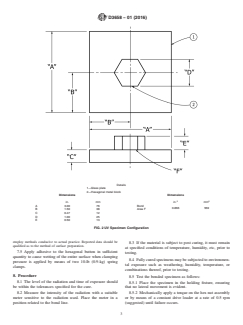
6.1 Recommended specimens are as shown in Fig. 2.
This test method is under the jurisdiction of ASTM Committee D14 on
6.2 Selection of the test metal for hexagonal blocks is at the
Adhesives and is the direct responsibility of Subcommittee D14.80 on Metal
discretion of the user; however, the following grades are
Bonding Adhesives.
Current edition approved May 1, 2016. Published May 2016. Originally recommended (see Test Method D1002):
approved in 1978. Last previous edition approved in 2008 as D3658 – 01 (2008).
Metal Specification
DOI: 10.1520/D3658-01R16.
Brass B36/B36M, Alloy 8
For referenced ASTM standards, visit the ASTM website, www.astm.org, or
Copper B152/B152M, Type A
contact ASTM Customer Service at service@astm.org. For Annual Book of ASTM
Aluminum B209, Alloy 2024, T3 Temper
Standards volume information, refer to the standard’s Document Summary page on
Steel A109/A109M, Grade 2
the ASTM website.
Corrosion-resisting steel A167, Type 302
The last approved version of this historical standard is referenced on
Titanium B265
www.astm.org.
Copyright © ASTM International, 100 Barr Harbor Drive, PO Box C700, West Conshohocken, PA 19428-2959. United States
D3658 − 01 (2016)
Details
1—Base plate
2—Upright
3—Mounting bracket
4—Lebow socket wrench sensor Model 2133-103
5—Pillow block—Boston #PPB10
6—Extension—Armstrong #4-105 A
7—1-in. (25.4-mm) hexagonal socket–Armstrong #A4-632
8—UV specimen (see Fig. 2)
9—Adjustable side guides (Fig. 2)
10—Neoprene pad (bonded to Detail 9) (Fig. 2)
Dimensions
in. mm
A 0.50 13
B 3.75 95
C 0.62 16
D 5.50 140
E 0.50 13
F 6.75 170
G 6.25 160
H 2.62 66
FIG. 1 UV Testing Apparatus
6.3 Hexagonal blocks may be reused after testing by bond- 7.3 Arecommended cleaning procedure is to soak the glass
ing the opposite end of the block or by cleaning the original plates in a dilute detergent solution for 2 to 3 min, followed by
bonded end by sanding or grinding and taking care to ensure light scrubbing with an absorbent cleaning tissue. Then
that ends are smooth and parallel. thoroughly rinse the glass plates with distilled or de
...