

ASTM D2919-01(2023)
(Test Method)Standard Test Method for Determining Durability of Adhesive Joints Stressed in Shear by Tension Loading
General Information
- Abstract
SIGNIFICANCE AND USE
4.1 The combination of stress and moisture decreases the durability of most adhesive joints. Stresses in the presence of water or water vapor may cause some adhesive joints to fail at some small fraction of the stress required to break the dry joint. The time to failure for a given adhesive joint generally decreases with increasing stress, temperature, and relative humidity.
4.2 This test method may be used as an accelerated screening test for assessing the durability of adhesive joints. It may be used to measure durability of adhesive joints exposed outdoors or to environmental conditions experienced by adhesive joints in service. The tests may also be used to determine the effects of various surface preparations or substrates on durabilities of adhesive joints.
4.3 The durability performance of various adhesives may be compared by using this test method under uniform sets of conditions. To assess the overall durability of a given adhesive, lap-shear joints should be tested under a range of stress, relative humidity, and temperature. For a specific end use it may be possible to obtain the needed durability data using only one set of test conditions.
SCOPE
1.1 This test method covers data for assessing the durability of adhesive lap-shear joints while stressed in contact with air, air in equilibrium with certain solutions, water, aqueous solutions, or other environments at various temperatures.
1.2 This standard does not purport to address all of the safety concerns, if any, associated with its use. It is the responsibility of the user of this standard to establish appropriate safety, health, and environmental practices and determine the applicability of regulatory limitations prior to use. Specific precautionary statements are given in 7.4.
1.3 The values stated in SI units are considered to be the standard. The values in parentheses are for information only.
1.4 This international standard was developed in accordance with internationally recognized principles on standardization established in the Decision on Principles for the Development of International Standards, Guides and Recommendations issued by the World Trade Organization Technical Barriers to Trade (TBT) Committee.
- Status
- Published
- Publication Date
- 31-Dec-2022
- Technical Committee
- D14 - Adhesives
- Drafting Committee
- D14.80 - Metal Bonding Adhesives

Overview
ASTM D2919-01(2023) is the ASTM International standard test method for determining the durability of adhesive joints stressed in shear by tension loading. The method specifically addresses how adhesive lap-shear joints perform when simultaneously exposed to stress and environmental conditions such as moisture, temperature variation, and differing humidity levels. By applying these combined factors, the standard provides a basis for predicting adhesive joint longevity under actual service conditions.
Understanding adhesive durability is critical for ensuring the structural integrity of bonded assemblies in various industries, including aerospace, automotive, construction, and electronics. This test method serves as an essential tool for manufacturers, engineers, and quality assurance professionals aiming to assess, compare, and improve adhesive formulations and bonding technologies.
Key Topics
- Combined Stress and Moisture Effects: The test method identifies that the combination of mechanical stress and moisture (liquid water or water vapor) can significantly decrease the durability of most adhesive joints. Joints often fail at lower stress levels when exposed to moisture compared to dry conditions.
- Accelerated Screening: The standard is designed as an accelerated screening test to rapidly assess adhesive joint durability. This is especially valuable for product development and quality control.
- Versatile Testing Conditions: Testing environments can include exposure to air, water, aqueous solutions, salt fog, and controlled humidity at various temperatures, making the method broadly applicable to real-world service conditions.
- Specimen Preparation: The durability evaluation depends on the preparation of consistent, high-quality lap-shear joints, with dimensions and materials agreed upon by the user and supplier.
- Comparative Analysis: The method supports comparative performance assessment of various adhesives under uniform conditions, allowing for selection of appropriate adhesives and substrates for intended applications.
- Data Reporting: The standard details the necessary information to report, such as adhesive and adherend details, surface preparations, test conditions, and measured durability outcomes.
Applications
ASTM D2919-01(2023) is widely used across industries where adhesives must perform under mechanical loads in challenging environments. Key applications include:
- Outdoor Exposure Testing: Evaluate the durability of adhesive joints in products exposed to outdoor conditions, such as building panels, transportation components, and outdoor electronics.
- Environmental Resistance Assurance: Assess how adhesives hold up under cycling humidity, temperature extremes, and contact with solutions, providing critical data for automotive, marine, and aerospace assemblies.
- Manufacturing Quality Control: Serve as a screening tool for verifying batches of adhesives, surface preparations, or substrate materials to ensure joint performance meets required standards.
- Adhesive Selection and Development: Compare candidate adhesives for new product designs or qualifying changes in materials or processes, supporting data-driven decisions in R&D and process engineering.
- Compliance and Certification: Use in meeting regulatory or customer requirements, particularly when durability in environmental conditions must be documented.
Related Standards
- ASTM D1002: Standard Test Method for Apparent Shear Strength of Single-Lap-Joint Adhesively Bonded Metal Specimens by Tension Loading
- ASTM D3165: Standard Test Method for Strength Properties of Adhesives in Shear by Tension Loading of Single-Lap-Joint Laminated Assemblies
- ASTM D2294: Test Method for Creep Properties of Adhesives in Shear by Tension Loading
- ASTM D1828: Practice for Atmospheric Exposure of Adhesive-Bonded Joints and Structures
- ASTM E4: Practices for Force Calibration and Verification of Testing Machines
- ASTM D907: Terminology of Adhesives
Implementing ASTM D2919-01(2023) provides a robust framework for verifying the long-term performance of adhesive joints, ensuring products and structures remain reliable and safe when exposed to real-world stresses and environmental conditions.
Relations
- Effective Date
- 01-Apr-2019
- Effective Date
- 01-Jun-2014
- Effective Date
- 01-Jul-2012
- Effective Date
- 01-May-2012
- Effective Date
- 01-Dec-2011
- Effective Date
- 01-Jan-2011
- Effective Date
- 01-Jun-2010
- Effective Date
- 01-Nov-2009
- Effective Date
- 01-Apr-2009
- Effective Date
- 01-Dec-2008
- Effective Date
- 01-Oct-2008
- Effective Date
- 15-Aug-2008
- Effective Date
- 01-Apr-2008
- Effective Date
- 01-Mar-2008
- Effective Date
- 01-Oct-2007
Get Certified
Connect with accredited certification bodies for this standard

DIN CERTCO
DIN Group product certification.

Smithers Quality Assessments
US management systems and product certification.
Sponsored listings
Frequently Asked Questions
ASTM D2919-01(2023) is a standard published by ASTM International. Its full title is "Standard Test Method for Determining Durability of Adhesive Joints Stressed in Shear by Tension Loading". This standard covers: SIGNIFICANCE AND USE 4.1 The combination of stress and moisture decreases the durability of most adhesive joints. Stresses in the presence of water or water vapor may cause some adhesive joints to fail at some small fraction of the stress required to break the dry joint. The time to failure for a given adhesive joint generally decreases with increasing stress, temperature, and relative humidity. 4.2 This test method may be used as an accelerated screening test for assessing the durability of adhesive joints. It may be used to measure durability of adhesive joints exposed outdoors or to environmental conditions experienced by adhesive joints in service. The tests may also be used to determine the effects of various surface preparations or substrates on durabilities of adhesive joints. 4.3 The durability performance of various adhesives may be compared by using this test method under uniform sets of conditions. To assess the overall durability of a given adhesive, lap-shear joints should be tested under a range of stress, relative humidity, and temperature. For a specific end use it may be possible to obtain the needed durability data using only one set of test conditions. SCOPE 1.1 This test method covers data for assessing the durability of adhesive lap-shear joints while stressed in contact with air, air in equilibrium with certain solutions, water, aqueous solutions, or other environments at various temperatures. 1.2 This standard does not purport to address all of the safety concerns, if any, associated with its use. It is the responsibility of the user of this standard to establish appropriate safety, health, and environmental practices and determine the applicability of regulatory limitations prior to use. Specific precautionary statements are given in 7.4. 1.3 The values stated in SI units are considered to be the standard. The values in parentheses are for information only. 1.4 This international standard was developed in accordance with internationally recognized principles on standardization established in the Decision on Principles for the Development of International Standards, Guides and Recommendations issued by the World Trade Organization Technical Barriers to Trade (TBT) Committee.
SIGNIFICANCE AND USE 4.1 The combination of stress and moisture decreases the durability of most adhesive joints. Stresses in the presence of water or water vapor may cause some adhesive joints to fail at some small fraction of the stress required to break the dry joint. The time to failure for a given adhesive joint generally decreases with increasing stress, temperature, and relative humidity. 4.2 This test method may be used as an accelerated screening test for assessing the durability of adhesive joints. It may be used to measure durability of adhesive joints exposed outdoors or to environmental conditions experienced by adhesive joints in service. The tests may also be used to determine the effects of various surface preparations or substrates on durabilities of adhesive joints. 4.3 The durability performance of various adhesives may be compared by using this test method under uniform sets of conditions. To assess the overall durability of a given adhesive, lap-shear joints should be tested under a range of stress, relative humidity, and temperature. For a specific end use it may be possible to obtain the needed durability data using only one set of test conditions. SCOPE 1.1 This test method covers data for assessing the durability of adhesive lap-shear joints while stressed in contact with air, air in equilibrium with certain solutions, water, aqueous solutions, or other environments at various temperatures. 1.2 This standard does not purport to address all of the safety concerns, if any, associated with its use. It is the responsibility of the user of this standard to establish appropriate safety, health, and environmental practices and determine the applicability of regulatory limitations prior to use. Specific precautionary statements are given in 7.4. 1.3 The values stated in SI units are considered to be the standard. The values in parentheses are for information only. 1.4 This international standard was developed in accordance with internationally recognized principles on standardization established in the Decision on Principles for the Development of International Standards, Guides and Recommendations issued by the World Trade Organization Technical Barriers to Trade (TBT) Committee.
ASTM D2919-01(2023) is classified under the following ICS (International Classification for Standards) categories: 83.180 - Adhesives. The ICS classification helps identify the subject area and facilitates finding related standards.
ASTM D2919-01(2023) has the following relationships with other standards: It is inter standard links to ASTM D1002-10(2019), ASTM E4-14, ASTM D907-12a, ASTM D907-12, ASTM D907-11a, ASTM D907-11, ASTM E4-10, ASTM E4-09a, ASTM E4-09, ASTM E4-08, ASTM D907-08b, ASTM D907-08a, ASTM D2294-96(2008), ASTM D907-08, ASTM D3165-07. Understanding these relationships helps ensure you are using the most current and applicable version of the standard.
ASTM D2919-01(2023) is available in PDF format for immediate download after purchase. The document can be added to your cart and obtained through the secure checkout process. Digital delivery ensures instant access to the complete standard document.
Standards Content (Sample)
This international standard was developed in accordance with internationally recognized principles on standardization established in the Decision on Principles for the
Development of International Standards, Guides and Recommendations issued by the World Trade Organization Technical Barriers to Trade (TBT) Committee.
Designation: D2919 − 01 (Reapproved 2023)
Standard Test Method for
Determining Durability of Adhesive Joints Stressed in Shear
by Tension Loading
This standard is issued under the fixed designation D2919; the number immediately following the designation indicates the year of
original adoption or, in the case of revision, the year of last revision. A number in parentheses indicates the year of last reapproval. A
superscript epsilon (´) indicates an editorial change since the last revision or reapproval.
This standard has been approved for use by agencies of the U.S. Department of Defense.
1. Scope D3165 Test Method for Strength Properties of Adhesives in
Shear by Tension Loading of Single-Lap-Joint Laminated
1.1 This test method covers data for assessing the durability
Assemblies
of adhesive lap-shear joints while stressed in contact with air,
E4 Practices for Force Calibration and Verification of Test-
air in equilibrium with certain solutions, water, aqueous
ing Machines
solutions, or other environments at various temperatures.
2.2 ASTM Adjuncts:
1.2 This standard does not purport to address all of the
Durability Test Apparatus Drawings
safety concerns, if any, associated with its use. It is the
responsibility of the user of this standard to establish appro-
3. Terminology
priate safety, health, and environmental practices and deter-
mine the applicability of regulatory limitations prior to use.
3.1 Definitions—Definitions of terms in this test method
Specific precautionary statements are given in 7.4.
may be found in Terminology D907.
1.3 The values stated in SI units are considered to be the
standard. The values in parentheses are for information only.
4. Significance and Use
1.4 This international standard was developed in accor-
4.1 The combination of stress and moisture decreases the
dance with internationally recognized principles on standard-
durability of most adhesive joints. Stresses in the presence of
ization established in the Decision on Principles for the
water or water vapor may cause some adhesive joints to fail at
Development of International Standards, Guides and Recom-
some small fraction of the stress required to break the dry joint.
mendations issued by the World Trade Organization Technical
The time to failure for a given adhesive joint generally
Barriers to Trade (TBT) Committee.
decreases with increasing stress, temperature, and relative
humidity.
2. Referenced Documents
4.2 This test method may be used as an accelerated screen-
2.1 ASTM Standards:
ingtestforassessingthedurabilityofadhesivejoints.Itmaybe
D907 Terminology of Adhesives
used to measure durability of adhesive joints exposed outdoors
D1002 Test Method for Apparent Shear Strength of Single-
or to environmental conditions experienced by adhesive joints
Lap-Joint Adhesively Bonded Metal Specimens by Ten-
in service. The tests may also be used to determine the effects
sion Loading (Metal-to-Metal)
of various surface preparations or substrates on durabilities of
D1828 Practice for Atmospheric Exposure of Adhesive-
adhesive joints.
Bonded Joints and Structures
D2294 Test Method for Creep Properties of Adhesives in
4.3 The durability performance of various adhesives may be
Shear by Tension Loading (Metal-to-Metal)
compared by using this test method under uniform sets of
conditions.To assess the overall durability of a given adhesive,
lap-shear joints should be tested under a range of stress,
This test method is under the jurisdiction of ASTM Committee D14 on
relative humidity, and temperature. For a specific end use it
Adhesives and is the direct responsibility of Subcommittee D14.80 on Metal
may be possible to obtain the needed durability data using only
Bonding Adhesives.
one set of test conditions.
Current edition approved Jan. 1, 2023. Published January 2023. Originally
approved in 1971. Last previous edition approved in 2014 as D2919 – 01 (2014).
DOI: 10.1520/D2919-01R23.
For referenced ASTM standards, visit the ASTM website, www.astm.org, or
contact ASTM Customer Service at service@astm.org. For Annual Book of ASTM Detailed working drawings for the construction of the durability test apparatus
Standards volume information, refer to the standard’s Document Summary page on are available from ASTM International Headquarters. Order Adjunct No.
the ASTM website. ADJD2919. Original adjunct produced in 1980.
Copyright © ASTM International, 100 Barr Harbor Drive, PO Box C700, West Conshohocken, PA 19428-2959. United States
D2919 − 01 (2023)
5. Apparatus 5.3 Outdoor Weathering Racks (Standard) are recom-
3 mended (Practice D1828), but any stable frame may be used
5.1 Fixture, as shown in Fig. 1, is required for this test
(for example, galvanized pipe or painted steel channel). No
method, although a fixture such as described in Test Method
other special apparatus is required for outdoor tests.
D2294 may also be suitable for the performance of this test.
5.2 Testing Machine, or other suitable machine capable of
6. Test Specimens
applying measured compressive loads. Force measurements
have an accuracy of 61 % of any reading when calibrated in 6.1 The successful use of this test method depends on
preparing good quality lap-shear joints. The test joints must be
compliance with Practices E4 requirements. Machine that is
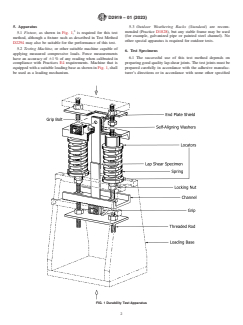
equipped with a suitable loading base as shown in Fig. 1, shall prepared carefully in accordance with the adhesive manufac-
be used as a loading mechanism. turer’s directions or in accordance with some other specified
FIG. 1 Durability Test Apparatus
D2919 − 01 (2023)
TABLE 1 Standard Test Environments
set of conditions agreed upon between the manufacturer and
the purchaser. It is recommended that the test joints be Test Environment
A B
Temperature Moisture Conditions
Number
prepared in accordance with Test Method D1002, except that
1 23 °C (73.4 °F) imme
...