

ASTM E477-20
(Test Method)Standard Test Method for Laboratory Measurements of Acoustical and Airflow Performance of Duct Liner Materials and Prefabricated Silencers
General Information
- Abstract
SIGNIFICANCE AND USE
5.1 Specimens tested using this standard, for example, duct silencers, are used to control sound propagation through ventilation ducts. The results gathered from testing specimens to this standard can be used to estimate the reduction in fan sound levels in ducted airflow systems caused by including a sound attenuating device in the system. The device can be a component in a source-path-receiver analysis where calculations are performed to determine the resultant sound level in an occupied space. Correct selection of a sound attenuating device can enable a designer to achieve in-space background noise criteria.
5.2 The insertion loss of a silencer varies with frequency and with the direction and speed of airflow. Because silencers partially obstruct the air path and provide resistance to airflow, two other effects must be quantified: pressure drop and airflow-generated noise. Both increase with increasing air speeds; thus data are required for several airflows to correctly characterize performance.
5.3 The aerodynamic results from testing specimens to the standard can be used as information for the system design engineer to determine the amount of static pressure drop resistance to be overcome by the system fan(s). Guidelines for appropriate maximum allowable pressure drop for a sound attenuating element have been established in the design community and are based on the procedures described herein.
5.4 As stated previously in 1.4 of this test method, the actual performance of a sound attenuating device as installed in an air duct system may be significantly different than reported based on the test procedure herein. This standard does not provide guidance to the user on these system effects.
5.5 Silencers are often designed to be used under conditions which do not duplicate the test set-ups of this standard. Mock-ups and specialized test set-ups to determine performance of sound attenuating devices in non-standard configurations may be based on this test...
SCOPE
1.1 This test method covers the laboratory testing of some of the acoustical properties of sound attenuating devices including duct liner materials, integral ducts, and in-duct absorptive straight and elbow silencers used in the ventilation systems of buildings. Procedures are described for the measurement of acoustical insertion loss, airflow generated noise, and pressure drop as a function of airflow.
1.2 Excluded from the scope are reactive mufflers and those designed for uses other than in ventilation systems, such as automobile mufflers.
1.3 This test method includes a provision for a simulated semi-reflective plenum to fit around thin-walled duct and silencer test specimens, since the acoustical environments around such thin-walled specimens can affect the measured insertion loss.
1.4 This method tests the performance of the specimen in well-defined and controlled conditions. If the specimen is installed in the field in any different manner, the results may be different. This standard does not provide estimating procedures for determining the actual installed performance of the specimen under field conditions.
1.5 The values stated in SI units are to be regarded as standard. The values in parentheses are provided for information only.
1.6 This standard does not purport to address all of the safety concerns, if any, associated with its use. It is the responsibility of the user of this standard to establish appropriate safety, health, and environmental practices and determine the applicability of regulatory limitations prior to use.
1.7 This international standard was developed in accordance with internationally recognized principles on standardization established in the Decision on Principles for the Development of International Standards, Guides and Recommendations issued by the World Trade Organization Technical Barriers to Trade (TBT) Committee.
- Status
- Published
- Publication Date
- 30-Jun-2020
- Technical Committee
- E33 - Building and Environmental Acoustics
- Drafting Committee
- E33.08 - Mechanical and Electrical System Noise
Buy Documents
ASTM E477-20 - Standard Test Method for Laboratory Measurements of Acoustical and Airflow Performance of Duct Liner Materials and Prefabricated Silencers
REDLINE ASTM E477-20 - Standard Test Method for Laboratory Measurements of Acoustical and Airflow Performance of Duct Liner Materials and Prefabricated Silencers
Overview
ASTM E477-20 is the Standard Test Method for Laboratory Measurements of Acoustical and Airflow Performance of Duct Liner Materials and Prefabricated Silencers. Developed by ASTM International, this standard provides comprehensive procedures for evaluating the acoustical properties and airflow characteristics of sound attenuating devices, such as duct liners and silencers, commonly used in building ventilation systems. By delivering standardized laboratory test methods, ASTM E477-20 supports engineers, manufacturers, and designers in selecting and validating the performance of components that manage noise and airflow in HVAC ductwork.
Key Topics
- Acoustical Insertion Loss: This standard details how to measure the reduction in sound level (insertion loss) when a duct liner or silencer is installed in a ventilation duct, factoring in frequency and direction of airflow.
- Airflow Generated Noise: The method accounts for sound generated by air turbulence as it passes through attenuating devices, ensuring accurate measurement of overall noise emissions.
- Pressure Drop Measurement: ASTM E477-20 describes how to determine the static pressure resistance introduced by duct liners and silencers, a critical factor impacting overall HVAC system performance.
- Test Conditions: The standard is limited to controlled laboratory conditions, emphasizing that actual field performance may differ due to variations in installation and environmental factors.
- Frequency Dependence: It is recognized that insertion loss and airflow noise vary with both frequency and airflow rates, necessitating testing across a range of conditions for accurate characterization.
Applications
The practical value of ASTM E477-20 lies in its application in building acoustics and HVAC design:
- Ventilation System Design: Engineers use its results to estimate fan noise reduction and ensure compliance with in-space background noise criteria.
- Product Performance Validation: Manufacturers of duct liners and silencers rely on this standard to objectively demonstrate the sound attenuation and airflow impacts of their products.
- System Analysis: The data generated can be integrated into source-path-receiver analyses to predict resulting sound levels in occupied spaces.
- Selection of Noise Control Solutions: Designers can make informed decisions when choosing or specifying sound attenuating devices for specific building environments, balancing noise reduction with acceptable airflow resistance.
- Custom Installations: While the standard sets laboratory procedures, its methodologies also provide a reference for constructing mock-ups or customized test setups when devices are to be used in non-standard configurations.
Related Standards
ASTM E477-20 references and aligns with several key standards and guidelines within the field of acoustics and ventilation system testing:
- ASTM C634 – Terminology Relating to Building and Environmental Acoustics
- ANSI S1.1-2013 – Acoustical Terminology
- ANSI S1.11-2014 / IEC 61260-1-2014 – Octave and Fractional-Octave Band Filters
- ANSI S1.43 – Integrating-Averaging Sound Level Meters
- ANSI/ASHRAE 41.2-2018 – Standard Methods for Air Velocity and Airflow Measurement
- ANSI/ASHRAE 41.3-2014 – Standard Method for Pressure Measurement
- IEC 61672-1:2013 – Sound Level Meters
- ISO 3741:2010 – Determination of Sound Power Levels of Noise Sources Using Sound Pressure
Summary
ASTM E477-20 is an essential standard for testing the acoustical and airflow performance of duct liners and silencers for building ventilation systems. It provides reliable, repeatable methodologies for measuring insertion loss, airflow-generated noise, and pressure drop, helping stakeholders ensure HVAC noise control solutions meet both performance and regulatory requirements in building environments. Adhering to this standard makes it possible to compare products objectively and design effective, quiet, and efficient ventilation systems.
Relations
- Effective Date
- 01-Sep-2013
- Effective Date
- 01-Dec-2011
- Effective Date
- 01-Sep-2010
- Effective Date
- 01-Jun-2010
- Effective Date
- 01-Apr-2009
- Effective Date
- 01-Sep-2008
- Effective Date
- 15-Mar-2008
- Effective Date
- 10-Apr-2002
- Effective Date
- 10-Apr-2002
- Effective Date
- 10-Jun-2001
- Effective Date
- 10-Jun-2001
Buy Documents
ASTM E477-20 - Standard Test Method for Laboratory Measurements of Acoustical and Airflow Performance of Duct Liner Materials and Prefabricated Silencers
REDLINE ASTM E477-20 - Standard Test Method for Laboratory Measurements of Acoustical and Airflow Performance of Duct Liner Materials and Prefabricated Silencers
Get Certified
Connect with accredited certification bodies for this standard

DIBt (Deutsches Institut für Bautechnik)
German Institute for Building Technology.
DIN CERTCO
DIN Group product certification.

Aboma Certification B.V.
Specialized in construction, metal, and transport sectors.
Sponsored listings
Frequently Asked Questions
ASTM E477-20 is a standard published by ASTM International. Its full title is "Standard Test Method for Laboratory Measurements of Acoustical and Airflow Performance of Duct Liner Materials and Prefabricated Silencers". This standard covers: SIGNIFICANCE AND USE 5.1 Specimens tested using this standard, for example, duct silencers, are used to control sound propagation through ventilation ducts. The results gathered from testing specimens to this standard can be used to estimate the reduction in fan sound levels in ducted airflow systems caused by including a sound attenuating device in the system. The device can be a component in a source-path-receiver analysis where calculations are performed to determine the resultant sound level in an occupied space. Correct selection of a sound attenuating device can enable a designer to achieve in-space background noise criteria. 5.2 The insertion loss of a silencer varies with frequency and with the direction and speed of airflow. Because silencers partially obstruct the air path and provide resistance to airflow, two other effects must be quantified: pressure drop and airflow-generated noise. Both increase with increasing air speeds; thus data are required for several airflows to correctly characterize performance. 5.3 The aerodynamic results from testing specimens to the standard can be used as information for the system design engineer to determine the amount of static pressure drop resistance to be overcome by the system fan(s). Guidelines for appropriate maximum allowable pressure drop for a sound attenuating element have been established in the design community and are based on the procedures described herein. 5.4 As stated previously in 1.4 of this test method, the actual performance of a sound attenuating device as installed in an air duct system may be significantly different than reported based on the test procedure herein. This standard does not provide guidance to the user on these system effects. 5.5 Silencers are often designed to be used under conditions which do not duplicate the test set-ups of this standard. Mock-ups and specialized test set-ups to determine performance of sound attenuating devices in non-standard configurations may be based on this test... SCOPE 1.1 This test method covers the laboratory testing of some of the acoustical properties of sound attenuating devices including duct liner materials, integral ducts, and in-duct absorptive straight and elbow silencers used in the ventilation systems of buildings. Procedures are described for the measurement of acoustical insertion loss, airflow generated noise, and pressure drop as a function of airflow. 1.2 Excluded from the scope are reactive mufflers and those designed for uses other than in ventilation systems, such as automobile mufflers. 1.3 This test method includes a provision for a simulated semi-reflective plenum to fit around thin-walled duct and silencer test specimens, since the acoustical environments around such thin-walled specimens can affect the measured insertion loss. 1.4 This method tests the performance of the specimen in well-defined and controlled conditions. If the specimen is installed in the field in any different manner, the results may be different. This standard does not provide estimating procedures for determining the actual installed performance of the specimen under field conditions. 1.5 The values stated in SI units are to be regarded as standard. The values in parentheses are provided for information only. 1.6 This standard does not purport to address all of the safety concerns, if any, associated with its use. It is the responsibility of the user of this standard to establish appropriate safety, health, and environmental practices and determine the applicability of regulatory limitations prior to use. 1.7 This international standard was developed in accordance with internationally recognized principles on standardization established in the Decision on Principles for the Development of International Standards, Guides and Recommendations issued by the World Trade Organization Technical Barriers to Trade (TBT) Committee.
SIGNIFICANCE AND USE 5.1 Specimens tested using this standard, for example, duct silencers, are used to control sound propagation through ventilation ducts. The results gathered from testing specimens to this standard can be used to estimate the reduction in fan sound levels in ducted airflow systems caused by including a sound attenuating device in the system. The device can be a component in a source-path-receiver analysis where calculations are performed to determine the resultant sound level in an occupied space. Correct selection of a sound attenuating device can enable a designer to achieve in-space background noise criteria. 5.2 The insertion loss of a silencer varies with frequency and with the direction and speed of airflow. Because silencers partially obstruct the air path and provide resistance to airflow, two other effects must be quantified: pressure drop and airflow-generated noise. Both increase with increasing air speeds; thus data are required for several airflows to correctly characterize performance. 5.3 The aerodynamic results from testing specimens to the standard can be used as information for the system design engineer to determine the amount of static pressure drop resistance to be overcome by the system fan(s). Guidelines for appropriate maximum allowable pressure drop for a sound attenuating element have been established in the design community and are based on the procedures described herein. 5.4 As stated previously in 1.4 of this test method, the actual performance of a sound attenuating device as installed in an air duct system may be significantly different than reported based on the test procedure herein. This standard does not provide guidance to the user on these system effects. 5.5 Silencers are often designed to be used under conditions which do not duplicate the test set-ups of this standard. Mock-ups and specialized test set-ups to determine performance of sound attenuating devices in non-standard configurations may be based on this test... SCOPE 1.1 This test method covers the laboratory testing of some of the acoustical properties of sound attenuating devices including duct liner materials, integral ducts, and in-duct absorptive straight and elbow silencers used in the ventilation systems of buildings. Procedures are described for the measurement of acoustical insertion loss, airflow generated noise, and pressure drop as a function of airflow. 1.2 Excluded from the scope are reactive mufflers and those designed for uses other than in ventilation systems, such as automobile mufflers. 1.3 This test method includes a provision for a simulated semi-reflective plenum to fit around thin-walled duct and silencer test specimens, since the acoustical environments around such thin-walled specimens can affect the measured insertion loss. 1.4 This method tests the performance of the specimen in well-defined and controlled conditions. If the specimen is installed in the field in any different manner, the results may be different. This standard does not provide estimating procedures for determining the actual installed performance of the specimen under field conditions. 1.5 The values stated in SI units are to be regarded as standard. The values in parentheses are provided for information only. 1.6 This standard does not purport to address all of the safety concerns, if any, associated with its use. It is the responsibility of the user of this standard to establish appropriate safety, health, and environmental practices and determine the applicability of regulatory limitations prior to use. 1.7 This international standard was developed in accordance with internationally recognized principles on standardization established in the Decision on Principles for the Development of International Standards, Guides and Recommendations issued by the World Trade Organization Technical Barriers to Trade (TBT) Committee.
ASTM E477-20 is classified under the following ICS (International Classification for Standards) categories: 91.120.20 - Acoustics in building. Sound insulation. The ICS classification helps identify the subject area and facilitates finding related standards.
ASTM E477-20 has the following relationships with other standards: It is inter standard links to ASTM C634-13, ASTM C634-11, ASTM C634-10a, ASTM C634-10, ASTM C634-09, ASTM C634-08a, ASTM C634-08, ASTM C634-02, ASTM C634-02e1, ASTM C634-01, ASTM C634-00. Understanding these relationships helps ensure you are using the most current and applicable version of the standard.
ASTM E477-20 is available in PDF format for immediate download after purchase. The document can be added to your cart and obtained through the secure checkout process. Digital delivery ensures instant access to the complete standard document.
Standards Content (Sample)
This international standard was developed in accordance with internationally recognized principles on standardization established in the Decision on Principles for the
Development of International Standards, Guides and Recommendations issued by the World Trade Organization Technical Barriers to Trade (TBT) Committee.
Designation: E477 −20
Standard Test Method for
Laboratory Measurements of Acoustical and Airflow
Performance of Duct Liner Materials and Prefabricated
Silencers
This standard is issued under the fixed designation E477; the number immediately following the designation indicates the year of
original adoption or, in the case of revision, the year of last revision. A number in parentheses indicates the year of last reapproval. A
superscript epsilon (´) indicates an editorial change since the last revision or reapproval.
1. Scope Development of International Standards, Guides and Recom-
mendations issued by the World Trade Organization Technical
1.1 This test method covers the laboratory testing of some
Barriers to Trade (TBT) Committee.
of the acoustical properties of sound attenuating devices
including duct liner materials, integral ducts, and in-duct
2. Referenced Documents
absorptive straight and elbow silencers used in the ventilation
2.1 ASTM Standards:
systems of buildings. Procedures are described for the mea-
C634 Terminology Relating to Building and Environmental
surement of acoustical insertion loss, airflow generated noise,
Acoustics
and pressure drop as a function of airflow.
2.2 ANSI Standards:
1.2 Excluded from the scope are reactive mufflers and those
S1.1-2013 Acoustical Terminology
designed for uses other than in ventilation systems, such as
S1.11-2014/Part 1/IEC 61260:1-2014 Electroacoustics –
automobile mufflers.
Octave-Band and Fractional-Octave-Band Filters – Part 1:
1.3 This test method includes a provision for a simulated
Specifications
semi-reflective plenum to fit around thin-walled duct and
S12.5-2016/ISO 6926-2016 Requirements for the Perfor-
silencer test specimens, since the acoustical environments
mance and Calibration of Reference Sound Sources Used
around such thin-walled specimens can affect the measured
for the Determination of Sound Power Levels
insertion loss.
S12.51-2012/ISO 3741:2010 (R2017) Acoustics-Determina-
tion of Sound Power Levels of Noise Sources Using
1.4 This method tests the performance of the specimen in
Sound Pressure-Precision Method for Reverberation
well-defined and controlled conditions. If the specimen is
Rooms
installed in the field in any different manner, the results may be
2.3 ASHRAE Documents and Standards:
different.This standard does not provide estimating procedures
2017 ASHRAE Handbook Fundamentals, Chapter 37, Mea-
for determining the actual installed performance of the speci-
surement and Instruments
men under field conditions.
ANSI/ASHRAE 41.2-2018 Standard Methods forAirVeloc-
1.5 The values stated in SI units are to be regarded as
ity and Airflow Measurement
standard. The values in parentheses are provided for informa-
ANSI/ASHRAE 41.3-2014 Standard Method for Pressure
tion only.
Measurement
1.6 This standard does not purport to address all of the 5
2.4 IEC Standards:
safety concerns, if any, associated with its use. It is the
61672-1:2013 Electroacoustics – Sound Level Meters – Part
responsibility of the user of this standard to establish appro-
1: Specifications
priate safety, health, and environmental practices and deter-
mine the applicability of regulatory limitations prior to use.
For referenced ASTM standards, visit the ASTM website, www.astm.org, or
1.7 This international standard was developed in accor-
contact ASTM Customer Service at service@astm.org. For Annual Book of ASTM
dance with internationally recognized principles on standard-
Standards volume information, refer to the standard’s Document Summary page on
ization established in the Decision on Principles for the
the ASTM website.
Available from American National Standards Institute (ANSI), 25 W. 43rd St.,
4th Floor, New York, NY 10036, http://www.ansi.org.
1 4
ThistestmethodisunderthejurisdictionofASTMCommitteeE33onBuilding Available from American Society of Heating, Refrigerating, and Air-
and Environmental Acoustics and is the direct responsibility of Subcommittee Conditioning Engineers, Inc. (ASHRAE), 1791 Tullie Circle, NE, Atlanta, GA
E33.08 on Mechanical and Electrical System Noise. 30329, http://www.ashrae.org.
Current edition approved July 1, 2020. Published October 2020. Originally Available from International Electrotechnical Commission (IEC), 3, rue de
ε1
approved in 1973. Last previous edition approved in 2013 as E477 – 13 . DOI: Varembé, 1st floor, P.O. Box 131, CH-1211, Geneva 20, Switzerland, https://
10.1520/E0477-20. www.iec.ch.
Copyright © ASTM International, 100 Barr Harbor Drive, PO Box C700, West Conshohocken, PA 19428-2959. United States
E477 − 20
2.5 NAIMA Documents and Standards: 3.2.14 sound source chamber —an enclosure, near one end
Fibrous Glass Duct Liner Standard Publication AH124, of the duct system, in which one or more sources are located
Third Edition, 2002 for the purpose of generating sound, which is transmitted
through the duct system to the reverberation room, located at
the other end.
3. Terminology
3.2.15 standard air density (d )—1.202 kg/m . This corre-
3.1 Definitions—The acoustical terms used in this method
s
sponds approximately to dry air at 21°C and 101.3 kPa.
are consistent with Terminology C634, and ANSI S1.1.
3.2.16 static pressure at a plane of traverse, (P ),Pa—the
3.2 Definitions of Terms Specific to This Standard:
s
arithmetic average of the static pressure at points in the plane
3.2.1 acoustical duct liner material—a material that has
of traverse.
soundabsorptivepropertiesandisattachedtotheinsidewallof
a duct to attenuate the sound that propagates down that section
3.2.17 static pressure at a point, (P' ), Pa—the pressure
s
of duct.
measured by the static connection of a pitot tube pointed
upstream at that point.
3.2.2 airflow generated noise—the sound created by aero-
dynamic turbulence caused by air flowing through a device.
3.2.18 test run—pertains to all measurements and calcula-
3.2.3 background noise—the total sound pressure level of tions at any one setting of the airflow throttling device.
all noise sources of interference in a system used for the
3.2.19 thin-walledduct—a duct or silencer whose wall mass
production, detection, measurement, or recording of a signal,
or stiffness are low enough to allow significant energy to
independent of the presence of the signal.
escape into the surrounding environment. This term applies to
3.2.4 dynamic insertion loss—insertion loss measured with ducts whose walls are thinner than 0.6 mm, or are flexible, or
are of rigid glass fiber construction.
air flowing through the test specimen.
3.2.5 empty duct measurements—acoustical measurements 3.2.20 total pressure at a plane of traverse, (P), Pa—the
t
of sound propagation through the duct system when no test algebraic sum of the velocity pressure at the plane of traverse
specimen is inserted in this system. and the static pressure at the plane of traverse.
3.2.6 end reflection loss (ERL)—sound energy reflected 3.2.21 traverse—aseriesofmeasurementsmadewithapitot
back into the duct at the termination of duct into a large space. tubeinacrosssectionofthetestduct,perpendiculartotheduct
length, in accordance with the ASHRAE Fundamentals Hand-
3.2.7 equivalent diameter of rectangular ducts—
1/2
book Chapter on Measurement and Instruments.
{4(W×H)/Π} , where W and H are the width and height of
the duct specimen connection, respectively. 3.2.22 velocitypressureataplaneoftraverse,(P ), Pa—the
v
square of the average of the square roots of the velocity
3.2.8 forward flow (+)—(a) the condition where air flows
pressures at points in the plane of traverse.
through a sound attenuating device in the same direction as the
propagation of sound; (b) the airflow from the sound source
3.2.23 velocity pressure at a point, (P' ), Pa—the pressure
v
chamber to the reverberation room (through the duct system).
measured by the differential measurement of a pitot tube
pointed upstream at that point.
3.2.9 in-ductsound-attenuatingdevices—adeviceorsystem
intendedtoreducethesoundpowerpropagatinginsidetheduct
4. Summary of Test Method
from one duct section to another.
3.2.10 insertion loss (IL)—the reduction in sound power 4.1 Insertion loss is measured by comparing the change in
level, in decibels, due to the placement of a sound-attenuating soundpressurelevelduetotheinsertionofatestspecimeninto
device in the path of transmission, for example, the test duct a duct system connecting a reverberation room to a sound
system, between a sound source and the given location-which source chamber. When insertion loss is measured with air
in this standard is the reverberation room. flowing through the test specimen, the measured quantity is
dynamic insertion loss.The sound signal is created by asystem
3.2.11 integral duct—a duct formed from an integral com-
of loudspeakers within the sound source chamber and trans-
posite of materials, typically having a porous inner layer to
mitted through the system ductwork to the reverberation room.
provide sound absorption, with an impervious outer surface.
The intent of the method is that the airborne path through the
3.2.12 reference sound source (RSS)—a portable, aerody-
duct is the dominant means of sound transmission between the
namic sound source that produces a known stable broadband
sound source chamber and the reverberation room. Measure-
sound power output.
ments are made in a series of frequency bands because
3.2.13 reverse flow (−)—(a) the condition where air flows
insertion loss is a function of frequency.
through a sound attenuating device in the opposite direction to
4.2 Noise generated by air flowing through the test speci-
thepropagationofsound;(b)theairflowfromthereverberation
men is measured in the reverberation room and expressed in
room to the sound source chamber (through the duct system).
terms of a computed sound power level within each frequency
band.
4.3 Pressure drop performance is obtained by measuring the
Available from North American Insulation Manufacturers Association
static pressure at designated locations upstream and down-
(NAIMA), 44 Canal Center Plaza, Suite 310, Alexandria, VA 22314, http://
www.naima.org. stream of the test specimen at various airflow settings. The
E477 − 20
pressure drop and airflow may be measured with a variety of 5.4 Asstatedpreviouslyin1.4ofthistestmethod,theactual
standard acceptable instrumentation such as piezometer rings, performance of a sound attenuating device as installed in an air
flow nozzles, orifices, etc. However, the method described duct system may be significantly different than reported based
herein is the pitot tube and manometer method. on the test procedure herein. This standard does not provide
guidance to the user on these system effects.
4.4 It is the intent of this test method that corrections due to
background and flanking noise be eliminated or minimized as 5.5 Silencers are often designed to be used under conditions
much as possible. Where corrections are unavoidable, the data
which do not duplicate the test set-ups of this standard.
are to be marked as corrected and shall indicate the magnitude Mock-ups and specialized test set-ups to determine perfor-
of the corrections made as described in Sections 9 and 10.
mance of sound attenuating devices in non-standard configu-
rations may be based on this test method but cannot be
5. Significance and Use
considered to be in full conformance with this test method. See
Annex A2 for further information regarding such tests.
5.1 Specimens tested using this standard, for example, duct
silencers, are used to control sound propagation through
6. Test Facilities
ventilation ducts. The results gathered from testing specimens
to this standard can be used to estimate the reduction in fan
6.1 The test facility shall consist of a sound source chamber
sound levels in ducted airflow systems caused by including a
and a reverberation room coupled together by means of a
sound attenuating device in the system. The device can be a
length of straight or elbow duct. Provisions shall be made in
component in a source-path-receiver analysis where calcula-
theductsystemforinsertingeitheratestspecimen,orasection
tions are performed to determine the resultant sound level in an
of empty duct having the same interior cross-sectional dimen-
occupiedspace.Correctselectionofasoundattenuatingdevice
sions at the duct connection points, length, and shape (for
can enable a designer to achieve in-space background noise
elbow testing) as the test specimen. An example of a facility
criteria.
set-uptoaccommodatestraightsilencertestingisshowninFig.
1. An example of a facility set-up to accommodate elbow
5.2 The insertion loss of a silencer varies with frequency
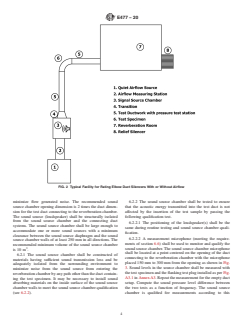
and with the direction and speed of airflow. Because silencers silencer testing (at various angles) is shown in Fig. 2. Airflow
and sound source chamber may be at a fixed or a mobile
partially obstruct the air path and provide resistance to airflow,
two other effects must be quantified: pressure drop and location within the test facility to accommodate straight and/or
elbow silencer testing.
airflow-generated noise. Both increase with increasing air
speeds; thus data are required for several airflows to correctly
6.2 Signal Source Chamber—The sound source chamber
characterize performance.
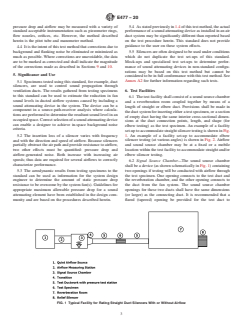
shall be a device (as shown schematically in Fig. 1) containing
5.3 The aerodynamic results from testing specimens to the two openings if testing will be conducted with airflow through
standard can be used as information for the system design the test specimen. One opening connects to the test duct and
engineer to determine the amount of static pressure drop the reverberation chamber, and the other opening connects to
resistance to be overcome by the system fan(s). Guidelines for the duct from the fan system. The sound source chamber
appropriate maximum allowable pressure drop for a sound openings for these two ducts shall have the same dimensions
attenuating element have been established in the design com- (or larger) as the connecting duct. It is recommended that a
munity and are based on the procedures described herein. flared (tapered) opening be provided for the test duct to
FIG. 1 Typical Facility for Rating Straight Duct Silencers With or Without Airflow
E477 − 20
FIG. 2 Typical Facility for Rating Elbow Duct Silencers With or Without Airflow
minimize flow generated noise. The recommended sound 6.2.2 The sound source chamber shall be tested to ensure
source chamber opening dimension is 2 times the duct dimen- that the acoustic energy transmitted into the test duct is not
sion for the test duct connecting to the reverberation chamber.
affected by the insertion of the test sample by passing the
The sound source (loudspeaker) shall be structurally isolated
following qualification test.
from the sound source chamber and the connecting duct
6.2.2.1 The positioning of the loudspeaker(s) shall be the
systems. The sound source chamber shall be large enough to
same during routine testing and sound source chamber quali-
accommodate one or more sound sources with a minimum
fication.
clearance between the sound source diaphragm and the sound
6.2.2.2 A measurement microphone (meeting the require-
source chamber walls of at least 250 mm in all directions. The
ments of section 6.6) shall be used to monitor and qualify the
recommended minimum volume of the sound source chamber
sound source chamber. The sound source chamber microphone
is 10 m .
shall be located at a point centered on the opening of the duct
6.2.1 The sound source chamber shall be constructed of
connecting to the reverberation chamber with the microphone
materials having sufficient sound transmission loss and be
placed 150 mm to 300 mm from the opening as shown in Fig.
adequately isolated from the surrounding environment to
3. Sound levels in the source chamber shall be measured with
minimize noise from the sound source from entering the
the test specimen and the flanking test plug installed as per Fig.
reverberation chamber by any path other than the duct contain-
A3.1 in AnnexA3. Repeat the measurement for the empty duct
ing the test specimen. It may be necessary to install sound
absorbing materials on the inside surface of the sound source setup. Compute the sound pressure level difference between
chamber walls to meet the sound source chamber qualification the two tests as a function of frequency. The sound source
(see 6.2.2). chamber is qualified for measurements according to this
E477 − 20
FIG. 3 Sound Source Chamber Microphone Location
standard if the difference between the two sound pressure system shall be smooth and have a low sound absorption
levels is less than 2 dB in each one-third octave band. coefficient in the frequency range of interest.
6.2.2.3 If the sound source chamber fails to meet the
6.3.1 The length of the duct system is primarily determined
specified tolerance in one or more frequency bands, modifica-
by the requirements of air-flow measurements and is shown in
tions to the sound source chamber design are required. Im-
Fig.4.Thetestductlengthupstream,regardlessoftheshapeof
provements that may be required include adding sound absorp-
the test specimen and layout of test facility, shall be not less
tive materials to the sound source chamber walls, increasing
than five equivalent diameters from the entrance to the test
the size (volume) of the sound source chamber, or reposition-
specimen. Similarly downstream, it shall be not less than ten
ing the loudspeakers(s).
duct diameters from the exit of the specimen to the reverberant
room, not including the length of any transitions, if airflow is
6.3 System (Between Sound Source Chamber and Rever-
being measured. If airflow is not measured, the downstream
beration Room)—The construction of the duct system shall be
lengthshallbenotlessthanfiveequivalentductdiameters.The
of adequate mass (1.897 mm or heavier steel) so that any
test specimen shall remain in the same position for both the
environmental or flanking noises entering the duct system have
insertion loss and airflow measurements.
a negligible effect on the measurements. When testing high
insertionlosssilencers,itmaybenecessarytoapplyadamping 6.3.2 The upstream and downstream sections shall have the
material to the outside of the duct walls or increase the same cross-sectional dimensions as the entrance and discharge
transmission loss, or both, by adding one or more layers of of the test specimen. Any transitions required to connect the
gypsum board to the exterior. The interior surface of the duct duct system to the sound source chamber and reverberation
FIG. 4 Test Specimen with Duct and Transition Requirements
E477 − 20
room shall be made upstream and downstream of the required diaphragm and at a known frequency. The class of Calibrator
ductlengthandshallhaveanincludedangleofnotgreaterthan shall be class 1 per ANSI S1.40 or IEC 60942
15° (slope no greater than 7.5°).
6.7 Bandwidth—The overall frequency response of the fil-
6.3.3 There are occasions when a silencer designed to be
ters used to analyze the microphone signals shall, for each test
used at the termination of a duct system must be tested.Testing
band, conform to the specifications in ANSI S1.11 for a
of such silencers, mounted at the termination of the duct
one-third octave band filter set, class 1 or better.
system or in the reverberation room, shall be considered a
6.8 Standard Test Frequencies—Measurements shall be
special circumstance, and shall be noted as an exception to this
made in all one-third octave bands with mid band frequencies
test standard in the test report. Full details concerning the
specified in ANSI S1.11 from 50 to 10000 Hz.
mounting and testing must also be included.
7. Apparatus and Methods of Measurement for Airflow
6.4 Reverberation Room—The acoustic and physical envi-
and Pressure Drop
ronment of the reverberation room shall be qualified by test to
meet the requirements of ANSI Standard S12.51-2012/ISO
7.1 The measurement of airflow may be accomplished by
3741:2010 (R2017) Section 5.1, 5.5, Annex A, Annex C and
employing a venturi, nozzle or orifice, or any other calibrated
Annex E.
flowmeter instrument. A pitot traverse may also be used (see
2.3). Airflow measurements shall be accurate to within 5% of
6.5 Test Signal—The test signal delivered by the loud-
values determined by a pitot traverse in accordance with
speaker system for these tests shall be random pink noise with
ANSI/ASHRAE Standard 41.2-2018 at the pressure measure-
a continuous frequency spectrum and with equal power per
ment location between the source chamber and the test
constant percentage bandwidth.
specimen for each airflow setting.
6.5.1 The sound source in the sound source chamber should
7.1.1 The following information is required prior to each
be a loudspeaker system mounted in a baffle capable of
test and once every 2 h during the test to ensure accurate
reproducing the lowest test frequency with adequate power.
airflow setting and measurements: barometric pressure, dry-
When more than one loudspeaker is used they should be
bulb temperature and relative humidity in the reverberation
electrically coupled so that they act in phase or in unison in
room. The airflow is to be recalculated each time new data are
response to a given signal. The loudspeaker should be placed
taken.
on one side of the sound source chamber such that it does not
beam directly into the duct system. 7.2 Pressure drop measurements of the test specimen shall
6.5.2 Afixed sound source chamber monitoring microphone be made for at least three airflow settings in accordance with
ANSI/ASHRAE Standard 41.3-2014. These airflow settings
meeting the requirements of section 6.6, shall be placed in the
sound source chamber to simultaneously monitor the sound shall be broad enough to cover the full design operating range
of the specimen.
pressure levels throughout the insertion loss measurements.
The sound source chamber monitoring microphone shall be the 7.2.1 The pressure measurements shall be made at planes at
same location as the sound source chamber qualification test. least two and a half duct diameters (or equivalent diameters for
rectangular ducts) upstream from the inlet to the test specimen
6.5.3 Power shall be applied to the loudspeaker system for
and at least five duct diameters downstream from the outlet of
a sufficient time to stabilize theloudspeaker system output to
the test specimen. A piezometer ring or pitot traverse shall be
meet the requirements of 6.5.2.
used to ensure accurate pressure measurements.
6.6 Acoustical Measurement Apparatus—Use microphones
7.3 Pitot tubes and other flow measuring devices mounted
that are stable and substantially omni-directional in the fre-
between the test specimen and the reverberation room shall be
quency range of measurement, with a known frequency re-
removed from the duct system during airflow generated noise
sponse for a random incidence sound field. (A12 mm random-
measurements if their empty duct noise levels in any one-third
incidence condenser microphone is recommended.)
octave band are within 10 dB of the airflow noise level of the
Specifically, microphones, amplifiers, and electronic circuitry
test specimen.
to process microphone signals must satisfy the requirements of
IEC 61672 for class 1 sound level meters, except thatA, B, and
7.4 The total pressure drop across the silencing element
C weighting networks are not required since one-third octave
shall be calculated from the upstream and downstream total
filters are used. All microphones used in testing according to
pressures measured directly or calculated from static and
this method shall be of the same type.
velocity pressures measured at the plane of the transverse.This
6.6.1 Calibration—Calibrate each microphone over the calculation shall be made and reported without correcting for
whole range of test frequencies as often as necessary to ensure
the pressure drop of the substitution duct.
the required accuracy (seeANSI S1.10).Arecord shall be kept
8. Test Specimen
of the calibration data and the dates of calibration.
6.6.2 Calibration checks of the entire measurement system 8.1 Installation:
for at least one frequency shall be made at the beginning and 8.1.1 The test specimen shall be installed in the duct system
end of each day of testing, and if any mechanical, electrical, or in a manner normally specified for intended use with the
environmental changes have occurred. Make the calibration specimen, with the air inlet oriented toward the sound source
check of the measurement system using an acoustic calibrator chamber for forward flow tests. For reverse flow tests, the air
that generates a known sound pressure level at the microphone inlet shall be oriented toward the reverberation room. Unless
E477 − 20
length used in actual installations.
the run of duct, in shape and length is the same on both sides
of the test specimen, the results for both tests, forward and
9. Measurement of Insertion Loss (With or Without
reverse, may depend on the system. The cross section of the
Airflow)
duct system at each connection shall conform to the geometry
of the inlet and outlet of the specimen.
9.1 The purpose of the measurement is to find the change in
8.1.1.1 To reduce the effects of structural flanking, the test
sound power delivered to the reverberation room before and
specimen shall be decoupled from the inlet and outlet duct
after the test specimen is inserted into the duct system under
sections. This can be accomplished by applying a 12 mm bead
conditions of forward and reverse airflow or without airflow.
of mastic material (for example, building duct and conduit
Since the absorption of the reverberation room is the same
sealingcompound,rubbergaskets,orsimilarmaterial)between
during the two measurements, the change in sound power level
the flanges that connect the test specimen to the inlet and outlet
is equal to the change in average sound pressure level in the
duct sections. The duct system duct sections may also be
reverberation room and, by definition, equal to the insertion
decoupledinasimilarmannerandseparatedbyatleasta6mm
loss. A sample calculation for each required calculation is
gapbetweentheflangesaftertheyhavebeenboltedorclamped
provided in Annex A4.
together and the resulting gap between flanges sealed.
9.2 With the sound source on, and for each condition of test
8.2 The substitution duct shall be the same sheet metal gage
(that is, with and without the test specimen in the duct system,
as the system duct except for lined duct specimen tests. In this
and with and without airflow), measure the average one-third-
case, the substitution duct shall be constructed of the same
octave band sound pressure level in the reverberation room
sheet metal gage as the specimen. If the test specimen is an
(L and L ) and the sound source chamber to the
p,s p,empty duct
elbow silencer, the substitution elbow duct shall have the same
nearest 0.1 dB.All microphone locations used for qualification
bend angle as the test specimen. In order to minimize attenu-
and sound level measurements shall be the same.
ation effects, the substitution elbow duct shall be a radius
9.2.1 SoundSourceChamberMonitoringMicrophone—The
geometry according to: measured average sound levels in the source chamber with and
without the test specimen installed shall not exceed the level
r 5 w (1)
inner duct
differencespecifiedinsection6.2.2.2.Ifthedifferenceinlevels
r 5 2 3w (2)
outer duct
exceed these values the system shall be modified until the
measurement requirements are satisfied.
where:
9.2.2 Reverberation Room Microphone(s)—No microphone
r = inner radius,
inner
positionorpointonatraverseshallbelessthan1.5mfromany
r = outer radius, and
outer
reverberationroomsurfaceorlessthan0.5mfromanydiffuser
w = duct width.
duct
surface.
8.3 Duct liner materials should be applied to another duct as
9.2.2.1 MicrophoneTraverse—If a traversing microphone is
a separate assembly which then becomes a test specimen.
used, the space averaging of the sound data shall be measured
Application should conform to the generally accepted trade
using a microphone traversing at a constant speed, not to
methods used (NAIMA) and shall be specified in the report.
exceed1m/s,overapathlengthgreaterthanorequalto10.3m.
8.3.1 The free (inside) area of the lined duct section shall be
The microphone traverse path shall not lie in any plane within
the same as the free area of the removable duct section; that is,
10° of any room surface.Awhole number of traverses shall be
the outside dimensions of the lined duct will be larger than the
completed during the analyzer measurement time interval.
unlined.
9.2.2.2 Fixed Microphones—If a fixed microphone or mi-
8.4 Size:
crophones are used, measurements shall be made at 6 or more
8.4.1 The smallest dimension should be not less than 610 locations that are spaced at least 3.4 m from each other. The
mm, and may not be less than 150 mm except for prefabricated entire array of microphones shall not share a common plane.
duct, where the smallest dimension may be that which is 9.2.3 The averaging time for each one-third-octave band
normally supplied by the manufacturer.The largest dimensions measurement shall be at least 30 s.
of the test specimen shall not exceed the limits of the test 9.2.4 Asufficient number of measurements shall be taken so
facility. Transition ducts for the purpose of mating the test that the 95% confidence interval of the average sound pressure
specimen geometry to the laboratory duct system geometry level is not more than 1 dB in all frequency bands, except for
may be used, provided that the requirements of 6.3.2 are met. the bands centered at 50, 63 and 80 Hz for which it shall not be
If inlet and outlet transition elements form a part of the test more than 2 dB. If a rotating microphone boom is used to
...
This document is not an ASTM standard and is intended only to provide the user of an ASTM standard an indication of what changes have been made to the previous version. Because
it may not be technically possible to adequately depict all changes accurately, ASTM recommends that users consult prior editions as appropriate. In all cases only the current version
of the standard as published by ASTM is to be considered the official document.
´1
Designation: E477 − 13 E477 − 20
Standard Test Method for
Laboratory Measurements of Acoustical and Airflow
Performance of Duct Liner Materials and Prefabricated
Silencers
This standard is issued under the fixed designation E477; the number immediately following the designation indicates the year of
original adoption or, in the case of revision, the year of last revision. A number in parentheses indicates the year of last reapproval. A
superscript epsilon (´) indicates an editorial change since the last revision or reapproval.
ε NOTE—Equations 9 and 10 were editorially corrected in September 2015.
1. Scope
1.1 This test method covers the laboratory testing of some of the acoustical properties of sound attenuating devices including duct
liner materials, integral ducts, and in-duct absorptive straight and elbow silencers used in the ventilation systems of buildings.
Procedures are described for the measurement of acoustical insertion loss, airflow generated noise, and pressure drop as a function
of airflow.
1.2 Excluded from the scope are reactive mufflers and those designed for uses other than in ventilation systems, such as
automobile mufflers.
1.3 This test method includes a provision for a simulated semi-reflective plenum to fit around thin-walled duct and silencer test
specimens, since the acoustical environments around such thin-walled specimens can affect the measured insertion loss.
1.4 This method tests the performance of the specimen in well-defined and controlled conditions. If the specimen is installed in
the field in any different manner, the results may be different. This standard does not provide estimating procedures for determining
the actual installed performance of the specimen under field conditions.
1.5 The values stated in SI units are to be regarded as standard. The values in parentheses are provided for information only.
1.6 This standard does not purport to address all of the safety concerns, if any, associated with its use. It is the responsibility
of the user of this standard to establish appropriate safety safety, health, and healthenvironmental practices and determine the
applicability of regulatory limitations prior to use.
1.7 This international standard was developed in accordance with internationally recognized principles on standardization
established in the Decision on Principles for the Development of International Standards, Guides and Recommendations issued
by the World Trade Organization Technical Barriers to Trade (TBT) Committee.
2. Referenced Documents
2.1 ASTM Standards:
This test method is under the jurisdiction of ASTM Committee E33 on Building and Environmental Acoustics and is the direct responsibility of Subcommittee E33.08
on Mechanical and Electrical System Noise.
Current edition approved June 1, 2013July 1, 2020. Published August 2013October 2020. Originally approved in 1973. Last previous edition approved in 20062013 as
ε1
E477 – 06a.E477 – 13 . DOI: 10.1520/E0477-13E0110.1520/E0477-20.
For referenced ASTM standards, visit the ASTM website, www.astm.org, or contact ASTM Customer Service at service@astm.org. For Annual Book of ASTM Standards
volume information, refer to the standard’s Document Summary page on the ASTM website.
Copyright © ASTM International, 100 Barr Harbor Drive, PO Box C700, West Conshohocken, PA 19428-2959. United States
E477 − 20
C634 Terminology Relating to Building and Environmental Acoustics
2.2 ANSI Standards:
S1.1–1994(R2004)S1.1-2013 Acoustical Terminology
S1.11–2004(R2009)S1.11-2014/Part 1/IEC 61260:1-2014 Specification Octave, Half-Octave and Third-Octave Band Filter
SetsElectroacoustics – Octave-Band and Fractional-Octave-Band Filters – Part 1: Specifications
S1.43-1997(R2007) Specifications for Integrating-Averaging Sound Level Meters
S12.5-2006/ISO 6926:1999(R2011)S12.5-2016/ISO 6926-2016 Requirements for the Performance and Calibration of Reference
Sound Sources Used for the Determination of Sound Power Levels
S12.51–2012/ISOS12.51-2012/ISO 3741:2010 (R2017) Acoustics-Determination of Sound Power Levels of Noise Sources
Using Sound Pressure-Precision Method for Reverberation Rooms
2.3 ASHRAE Documents and Standards:
20092017 ASHRAE Handbook,Handbook Fundamentals,Chapter 36, Fundamentals, Chapter 37, Measurement and Instruments
ANSI/ASHRAE 41.2-2018 Standard Methods for Air Velocity and Airflow Measurement
ANSI/ASHRAE 41.3-198941.3-2014 Standard Method for Pressure Measurement (plus errata dated 5 January 1998)
2.4 IEC Standards:
61672-1:2013 Electroacoustics – Sound Level Meters – Part 1: Specifications
2.5 NAIMA Documents and Standards:
Fibrous Glass Duct Liner Standard,Standard Publication AH124, Third Edition, 2002
3. Terminology
3.1 Definitions—The acoustical terms used in this method are consistent with Terminology C634, and ANSI S1.1.
3.2 Definitions of Terms Specific to This Standard:
3.2.1 acoustical duct liner material—a material that has sound absorptive properties and is attached to the inside wall of a duct
to attenuate the sound that propagates down that section of duct.
3.2.2 airflow generated noise—the sound created by aerodynamic turbulence caused by air flowing through a device.
3.2.3 background noise—the total sound pressure level of all noise sources of interference in a system used for the production,
detection, measurement, or recording of a signal, independent of the presence of the signal.
3.2.4 dynamic insertion loss—insertion loss measured with air flowing through the test specimen.
3.2.5 empty duct measurements—acoustical measurements of sound propagation through the duct system when no test specimen
is inserted in this system.
3.2.6 end reflection loss (ERL)—sound energy reflected back into the duct at the termination of duct into a large space.
1/2
3.2.7 equivalent diameter of rectangular ducts— {4(W × H)/Π} , where W and H are the width and height of the duct specimen
connection, respectively.
3.2.8 forward flow ( + )—(a) the condition where air flows through a sound attenuating device in the same direction as the
propagation of sound; (b) the airflow from the sound source chamber to the reverberation room (through the duct system).
3.2.9 in-duct sound-attenuating devices—a device or system intended to reduce the sound power propagating inside the duct from
one duct section to another.
3.2.10 insertion loss (IL)—the reduction in sound power level, in decibels, due to the placement of a sound-attenuating device in
the path of transmission, for example, the test duct system, between a sound source and the given location-which in this standard
is the reverberation room.
Available from American National Standards Institute (ANSI), 25 W. 43rd St., 4th Floor, New York, NY 10036, http://www.ansi.org.
Available from American Society of Heating, Refrigerating, and Air-Conditioning Engineers, Inc. (ASHRAE), 1791 Tullie Circle, NE, Atlanta, GA 30329,
http://www.ashrae.org.
Available from International Electrotechnical Commission (IEC), 3, rue de Varembé, 1st floor, P.O. Box 131, CH-1211, Geneva 20, Switzerland, https://www.iec.ch.
Available from North American Insulation Manufacturers Association (NAIMA), 44 Canal Center Plaza, Suite 310, Alexandria, VA 22314, http://www.naima.org.
E477 − 20
3.2.11 integral duct—a duct formed from an integral composite of materials, typically having a porous inner layer to provide
sound absorption, with an impervious outer surface.
3.2.12 reference sound source (RSS)—a portable, aerodynamic sound source that produces a known stable broadband sound power
output.
3.2.13 reverse flow (−)—(a) the condition where air flows through a sound attenuating device in the opposite direction to the
propagation of sound; (b) the airflow from the reverberation room to the sound source chamber (through the duct system).
3.2.14 sound source chamber —an enclosure, near one end of the duct system, in which one or more sources are located for the
purpose of generating sound, which is transmitted through the duct system to the reverberation room, located at the other end.
3.2.15 standard air density (d )—1.202 kg/m . This corresponds approximately to dry air at 21°C and 101.3 kPa.
s
3.2.16 static pressure at a plane of traverse, (P ),Pa—the arithmetic average of the static pressure at points in the plane of traverse.
s
3.2.17 static pressure at a point, (P' ), Pa—the pressure measured by the static connection of a pitot tube pointed upstream at that
s
point.
3.2.18 test run—pertains to all measurements and calculations at any one setting of the airflow throttling device.
3.2.19 thin-walled duct—a duct or silencer whose wall mass or stiffness are low enough to allow significant energy to escape into
the surrounding environment. This term applies to ducts whose walls are thinner than 0.6 mm, or are flexible, or are of rigid glass
fiber construction.
3.2.20 total pressure at a plane of traverse, (P ), Pa—the algebraic sum of the velocity pressure at the plane of traverse and the
t
static pressure at the plane of traverse.
3.2.21 traverse—a series of measurements made with a pitot tube in a cross section of the test duct, perpendicular to the duct
length, in accordance with the ASHRAE Fundamentals Handbook Chapter on Measurement and Instruments.
3.2.22 velocity pressure at a plane of traverse, (P ), Pa—the square of the average of the square roots of the velocity pressures
v
at points in the plane of traverse.
3.2.23 velocity pressure at a point, (P' ), Pa—the pressure measured by the differential measurement of a pitot tube pointed
v
upstream at that point.
4. Summary of Test Method
4.1 Insertion loss is measured by comparing the change in sound pressure level due to the insertion of a test specimen into a duct
system connecting a reverberation room to a sound source chamber. When insertion loss is measured with air flowing through the
test specimen, the measured quantity is dynamic insertion loss. The sound signal is created by a system of loudspeakers within the
sound source chamber and transmitted through the system ductwork to the reverberation room. The intent of the method is that
the airborne path through the duct is the dominant means of sound transmission between the sound source chamber and the
reverberation room. Measurements are made in a series of frequency bands because insertion loss is a function of frequency.
4.2 Noise generated by air flowing through the test specimen is measured in the reverberation room and expressed in terms of a
computed sound power level within each frequency band.
4.3 Pressure drop performance is obtained by measuring the static pressure at designated locations upstream and downstream of
the test specimen at various airflow settings. The pressure drop and airflow may be measured with a variety of standard acceptable
instrumentation such as piezometer rings, flow nozzles, orifices, etc. However, the method described herein is the pitot tube and
manometer method.
E477 − 20
4.4 It is the intent of this test method that corrections due to background and flanking noise be eliminated or minimized as much
as possible. Where corrections are unavoidable, the data are to be marked as corrected and shall indicate the magnitude of the
corrections made as described in Sections 9 and 10.
5. Significance and Use
5.1 Specimens tested using this standard, for example, duct silencers, are used to control sound propagation through ventilation
ducts. The results gathered from testing specimens to this standard can be used to estimate the reduction in fan sound levels in
ducted airflow systems caused by including a sound attenuating device in the system. The device can be a component in a
source-path-receiver analysis where calculations are performed to determine the resultant sound level in an occupied space. Correct
selection of a sound attenuating device can enable a designer to achieve in-space background noise criteria.
5.2 The insertion loss of a silencer varies with frequency and with the direction and speed of airflow. Because silencers partially
obstruct the air path and provide resistance to airflow, two other effects must be quantified: pressure drop and airflow-generated
noise. Both increase with increasing air speeds; thus data are required for several airflows to correctly characterize performance.
5.3 The aerodynamic results from testing specimens to the standard can be used as information for the system design engineer to
determine the amount of static pressure drop resistance to be overcome by the system fan(s). Guidelines for appropriate maximum
allowable pressure drop for a sound attenuating element have been established in the design community and are based on the
procedures described herein.
5.4 As stated previously in 1.4 of this test method, the actual performance of a sound attenuating device as installed in an air duct
system may be significantly different than reported based on the test procedure herein. This standard does not provide guidance
to the user on these system effects.
5.5 Silencers are often designed to be used under conditions which do not duplicate the test set-ups of this standard. Mock-ups
and specialized test set-ups to determine performance of sound attenuating devices in non-standard configurations may be based
on this test method but cannot be considered to be in full conformance with this test method. See Annex A2 for further information
regarding such tests.
6. Test Facilities
6.1 The test facility shall consist of a sound source chamber and a reverberation room coupled together by means of a length of
straight or elbow duct. Provisions shall be made in the duct system for inserting either a test specimen, or a section of empty duct
having the same interior cross-sectional dimensions at the duct connection points, length, and shape (for elbow testing) as the test
specimen. An example of a facility set-up to accommodate straight silencer testing is shown in Fig. 1. An example of a facility
set-up to accommodate elbow silencer testing (at various angles) is shown in Fig. 2. Airflow and sound source chamber may be
at a fixed or a mobile location within the test facility to accommodate straight and/or elbow silencer testing.
6.2 Signal Source Chamber—The sound source chamber shall be a device (as shown schematically in Fig. 1) containing two
openings if testing will be conducted with airflow through the test specimen. One opening connects to the test duct and the
reverberation chamber, and the other opening connects to the duct from the fan system. The sound source chamber openings for
these two ducts shall have the same dimensions (or larger) as the connecting duct. It is recommended that a flared (tapered) opening
be provided for the test duct to minimize flow generated noise. The recommended sound source chamber opening dimension is
2 times the duct dimension for the test duct connecting to the reverberation chamber. The sound source (loudspeaker) shall be
structurally isolated from the sound source chamber and the connecting duct systems. The sound source chamber shall be large
enough to accommodate one or more sound sources with a minimum clearance between the sound source diaphragm and the sound
source chamber walls of at least 250 mm in all directions. The recommended minimum volume of the sound source chamber is
10 m .
6.2.1 The sound source chamber shall be constructed of materials having sufficient sound transmission loss and be adequately
isolated from the surrounding environment to minimize noise from the sound source from entering the reverberation chamber by
any path other than the duct containing the test specimen. It may be necessary to install sound absorbing materials on the inside
surface of the sound source chamber walls to meet the sound source chamber qualification (see 6.2.2).
E477 − 20
FIG. 1 Typical Facility for Rating Straight Duct Silencers With or Without Airflow
FIG. 2 Typical Facility for Rating Elbow Duct Silencers With or Without Airflow
E477 − 20
6.2.2 The sound source chamber shall be tested to ensure that the acoustic energy transmitted into the test duct is not affected by
the insertion of the test sample by passing the following qualification test.
6.2.2.1 The positioning of the loudspeaker(s) shall be the same during routine testing and sound source chamber qualification.
6.2.2.2 A measurement microphone (meeting the requirements of section 6.6) shall be used to monitor and qualify the sound
source chamber. The sound source chamber microphone shall be located at a point centered on the opening of the duct connecting
to the reverberation chamber with the microphone placed 150 mm to 300 mm from the opening as shown in Fig. 3. Sound levels
in the source chamber shall be measured with the test specimen and the flanking test plug installed as per Fig. A3.1 in Annex A3.
Repeat the measurement for the empty duct setup. Compute the sound pressure level difference between the two tests as a function
of frequency. The sound source chamber is qualified for measurements according to this standard if the difference between the two
sound pressure levels is less than 2 dB in each one-third octave band.
6.2.2.3 If the sound source chamber fails to meet the specified tolerance in one or more frequency bands, modifications to the
sound source chamber design are required. Improvements that may be required include adding sound absorptive materials to the
sound source chamber walls, increasing the size (volume) of the sound source chamber, or repositioning the loudspeakers(s).
6.3 System (Between Sound Source Chamber and Reverberation Room)—The construction of the duct system shall be of adequate
mass (1.897 mm or heavier steel) so that any environmental or flanking noises entering the duct system have a negligible effect
on the measurements. When testing high insertion loss silencers, it may be necessary to apply a damping material to the outside
of the duct walls or increase the transmission loss, or both, by adding one or more layers of gypsum board to the exterior. The
interior surface of the duct system shall be smooth and have a low sound absorption coefficient in the frequency range of interest.
6.3.1 The length of the duct system is primarily determined by the requirements of air-flow measurements and is shown in Fig.
4. The test duct length upstream, regardless of the shape of the test specimen and layout of test facility, shall be not less than five
equivalent diameters from the entrance to the test specimen. Similarly downstream, it shall be not less than ten duct diameters from
the exit of the specimen to the reverberant room, not including the length of any transitions, if airflow is being measured. If airflow
is not measured, the downstream length shall be not less than five equivalent duct diameters. The test specimen shall remain in
the same position for both the insertion loss and airflow measurements.
6.3.2 The upstream and downstream sections shall have the same cross-sectional dimensions as the entrance and discharge of the
test specimen. Any transitions required to connect the duct system to the sound source chamber and reverberation room shall be
made upstream and downstream of the required duct length and shall have an included angle of not greater than 15° (slope no
greater than 7.5°).
6.3.3 There are occasions when a silencer designed to be used at the termination of a duct system must be tested. Testing of such
silencers, mounted at the termination of the duct system or in the reverberation room, shall be considered a special circumstance,
and shall be noted as an exception to this test standard in the test report. Full details concerning the mounting and testing must
also be included.
FIG. 3 Sound Source Chamber Microphone Location
E477 − 20
FIG. 4 Test Specimen with Duct and Transition Requirements
6.4 Reverberation Room—The acoustic and physical environment of the reverberation room shall be qualified by test to meet the
requirements of ANSI Standard S12.51(R2012)/ISO:3741(2010) S12.51-2012/ISO 3741:2010 (R2017) Section 5.1, 5.5, Annex A,
Annex C and Annex E.
6.5 Test Signal—The test signal delivered by the loudspeaker system for these tests shall be random pink noise with a continuous
frequency spectrum and with equal power per constant percentage bandwidth.
6.5.1 The sound source in the sound source chamber should be a loudspeaker system mounted in a baffle capable of reproducing
the lowest test frequency with adequate power. When more than one loudspeaker is used they should be electrically coupled so
that they act in phase or in unison in response to a given signal. The loudspeaker should be placed on one side of the sound source
chamber such that it does not beam directly into the duct system.
6.5.2 A fixed sound source chamber monitoring microphone meeting the requirements of section 6.6, shall be placed in the sound
source chamber to simultaneously monitor the sound pressure levels throughout the insertion loss measurements. The sound source
chamber monitoring microphone shall be the same location as the sound source chamber qualification test.
6.5.3 Power shall be applied to the loudspeaker system for a sufficient time to stabilize theloudspeaker system output to meet the
requirements of 6.5.2.
6.6 Acoustical Measurement Apparatus—Use microphones that are stable and substantially omni-directional in the frequency
range of measurement, with a known frequency response for a random incidence sound field. (A 12 mm random-incidence
condenser microphone is recommended.) Specifically, microphones, amplifiers, and electronic circuitry to process microphone
signals must satisfy the requirements of ANSI S1.43 or IEC 61672 for class 1 sound level meters, except that A, B, and C weighting
networks are not required since one-third octave filters are used. All microphones used in testing according to this method shall
be of the same type.
6.6.1 Calibration—Calibrate each microphone over the whole range of test frequencies as often as necessary to ensure the required
accuracy (see ANSI S1.10). A record shall be kept of the calibration data and the dates of calibration.
6.6.2 Calibration checks of the entire measurement system for at least one frequency shall be made at the beginning and end of
each day of testing, and if any mechanical, electrical, or environmental changes have occurred. Make the calibration check of the
measurement system using an acoustic calibrator that generates a known sound pressure level at the microphone diaphragm and
at a known frequency. The class of Calibrator shall be class 1 per ANSI S1.40 or IEC 60942
6.7 Bandwidth—The overall frequency response of the filters used to analyze the microphone signals shall, for each test band,
conform to the specifications in ANSI S1.11 for a one-third octave band filter set, class 1 or better.
E477 − 20
6.8 Standard Test Frequencies—Measurements shall be made in all one-third octave bands with mid band frequencies specified
in ANSI S1.11 from 50 to 10000 Hz.
7. Apparatus and Methods of Measurement for Airflow and Pressure Drop
7.1 The measurement of airflow may be accomplished by employing a venturi, nozzle or orifice, or any other calibrated flowmeter
instrument. A pitot traverse may also be used (see 2.3). Airflow measurements shall be accurate to within 5% of values determined
by a pitot traverse in accordance with ANSI/ASHRAE Standard 41.2-8741.2-2018 at the pressure measurement location between
the source chamber and the test specimen for each airflow setting.
7.1.1 The following information is required prior to each test and once every two hours2 h during the test to ensure accurate
airflow setting and measurements: barometric pressure, dry-bulb temperature and relative humidity in the reverberation room. The
airflow is to be recalculated each time new data are taken.
7.2 Pressure drop measurements of the test specimen shall be made for at least three airflow settings in accordance with
ANSI/ASHRAE Standard 41.3-89.41.3-2014. These airflow settings shall be broad enough to cover the full design operating range
of the specimen.
7.2.1 The pressure measurements shall be made at planes at least two and a half.duct half duct diameters (or equivalent diameters
for rectangular ducts) upstream from the inlet to the test specimen and at least five duct diameters downstream from the outlet of
the test specimen. A piezometer ring or pitot traverse shall be used to ensure accurate pressure measurements.
7.3 Pitot tubes and other flow measuring devices mounted between the test specimen and the reverberation room shall be removed
from the duct system during airflow generated noise measurements if their empty duct noise levels in any one-third octave band
are within 10 dB of the airflow noise level of the test specimen.
7.4 The total pressure drop across the silencing element shall be calculated from the upstream and downstream total pressures
measured directly or calculated from static and velocity pressures measured at the plane of the transverse. This calculation shall
be made and reported without correcting for the pressure drop of the substitution duct.
8. Test Specimen
8.1 Installation:
8.1.1 The test specimen shall be installed in the duct system in a manner normally specified for intended use with the specimen,
with the air inlet oriented toward the sound source chamber for forward flow tests. For reverse flow tests, the air inlet shall be
oriented toward the reverberation room. Unless the run of duct, in shape and length is the same on both sides of the test specimen,
the results for both tests, forward and reverse, may depend on the system. The cross section of the duct system at each connection
shall conform to the geometry of the inlet and outlet of the specimen.
8.1.1.1 To reduce the effects of structural flanking, the test specimen shall be decoupled from the inlet and outlet duct sections.
This can be accomplished by applying a 12 mm bead of mastic material (for example, building duct and conduit sealing compound,
rubber gaskets, or similar material) between the flanges that connect the test specimen to the inlet and outlet duct sections. The
duct system duct sections may also be decoupled in a similar manner and separated by at least a 6 mm gap between the flanges
after they have been bolted or clamped together and the resulting gap between flanges sealed.
8.2 The substitution duct shall be the same sheet metal gage as the system duct except for lined duct specimen tests. In this case,
the substitution duct shall be constructed of the same sheet metal gage as the specimen. If the test specimen is an elbow silencer,
the substitution elbow duct shall have the same bend angle as the test specimen. In order to minimize attenuation effects, the
substitution elbow duct shall be a radius geometry according to:
r 5 w (1)
inner duct
r 5 23w (2)
outer duct
E477 − 20
where:
r = inner radius,
inner
r = outer radius, and
outer
w = duct width.
duct
8.3 Duct liner materials should be applied to another duct as a separate assembly which then becomes a test specimen. Application
should conform to the generally accepted trade methods used (NAIMA) and shall be specified in the report.
8.3.1 The free (inside) area of the lined duct section shall be the same as the free area of the removable duct section; that is, the
outside dimensions of the lined duct will be larger than the unlined.
8.4 Size:
8.4.1 The smallest dimension should be not less than 610 mm, and may not be less than 150 mm except for prefabricated duct,
where the smallest dimension may be that which is normally supplied by the manufacturer. The largest dimensions of the test
specimen shall not exceed the limits of the test facility. Transition ducts for the purpose of mating the test specimen geometry to
the laboratory duct system geometry may be used, provided that the requirements of 6.3.2 are met. If inlet and outlet transition
elements form a part of the test specimen, then this should be fully described in the report.
8.4.2 There is no restriction on the length of prefabricated silencers. Duct liner materials and flexible duct shall be 3000 mm long.
In addition to this length, longer specimens of duct liner materials and flexible duct may also be tested and reported. Shorter lengths
may be tested, but shall not be reported as being conducted in accordance with this standard.
NOTE 1—The length of duct liner materials and flexible duct controls attenuation. 3000 mm length has been chosen as representative of the length used
in actual installations.
9. Measurement of Insertion Loss (With or Without Airflow)
9.1 The purpose of the measurement is to find the change in sound power delivered to the reverberation room before and after
the test specimen is inserted into the duct system under conditions of forward and reverse airflow or without airflow. Since the
absorption of the reverberation room is the same during the two measurements, the change in sound power level is equal to the
change in average sound pressure level in the reverberation room and, by definition, equal to the insertion loss. A sample
calculation for each required calculation is provided in Annex A4.
9.2 With the sound source on, and for each condition of test (that is, with and without the test specimen in the duct system, and
with and without airflow), measure the average one-third-octave band sound pressure level in the reverberation room (L and
p,s
L ) and the sound source chamber to the nearest 0.1 dB. All microphone locations used for qualification and sound level
p,empty duct
measurements shall be the same.
9.2.1 Sound Source Chamber Monitoring Microphone—The measured average sound levels in the source chamber with and
without the test specimen installed shall not exceed the level difference specified in section 6.2.2.2. If the difference in levels
exceed these values the system shall be modified until the measurement requirements are satisfied.
9.2.2 Reverberation Room Microphone(s)—No microphone position or point on a traverse shall be less than 1.5 m from any
reverberation room surface or less than 0.5 m from any diffuser surface.
9.2.2.1 Microphone Traverse—If a traversing microphone is used, the space averaging of the sound data shall be measured using
a microphone traversing at a constant speed, not to exceed 1m/s, over a path length greater than or equal to 10.3 m. The microphone
traverse path shall not lie in any plane within 10° of any room surface. A whole number of traverses shall be completed during
the analyzer measurement time interval.
9.2.2.2 Fixed Microphones—If a fixed microphone or microphones are used, measurements shall be made at 6 or more locations
that are spaced at least 3.4 m from each other. The entire array of microphones shall not share a common plane.
9.2.3 The averaging time for each one-third-octave band measurement shall be at least
...