

ASTM D1657-22e1
(Test Method)Standard Test Method for Density or Relative Density of Light Hydrocarbons by Pressure Hydrometer
General Information
- Abstract
SIGNIFICANCE AND USE
5.1 The density or relative density of light hydrocarbons and liquefied petroleum gases is used in custody transfer quantity calculations or to satisfy transportation, storage, and regulatory requirements.
SCOPE
1.1 This test method covers the determination of the density or relative density of light hydrocarbons including liquefied petroleum gases (LPG) having Reid vapor pressures exceeding 101.325 kPa (14.696 psi).
1.2 The prescribed apparatus should not be used for materials having vapor pressures higher than 1.4 MPa (200 psi) at the test temperature. This pressure limit is dictated by the type of equipment. Higher pressures can apply to other equipment designs.
1.3 The initial pressure hydrometer readings obtained are uncorrected hydrometer readings and not density measurements. Readings are measured on a hydrometer at either the reference temperature or at another convenient temperature, and readings are corrected for the meniscus effect, the thermal glass expansion effect, alternate calibration temperature effects and to the reference temperature by means of calculations and Adjunct to D1250 Guide for Petroleum Measurement Tables (API MPMS Chapter 11.1) or API MPMS Chapter 11.2.4 (GPA TP-27), as applicable.
1.4 Values determined as density or relative density can be converted to equivalent values in the other units or alternative reference temperatures by means of Interconversion Procedures API MPMS Chapter 11.5, or Adjunct to D1250 Guide for Petroleum Measurement Tables (API MPMS Chapter 11.1) or API MPMS Chapter 11.2.4 (GPA TP-27), as applicable.
1.5 The calculations required in Section 11 shall be applied to the initial pressure hydrometer reading with observations and results reported as required by Section 11 prior to use in a subsequent calculation procedure (measurement ticket calculation, meter factor calculation, or base prover volume determination).
1.6 Annex A1 contains a procedure for verifying or certifying the equipment for this test method.
1.7 The values in SI units are to be regarded as the standard. US Customary values shown in adjacent parentheses are for information only and may not be exactly equivalent. Both SI and customary units have been rounded so that they may not be exactly equivalent.
1.8 This standard does not purport to address all of the safety concerns, if any, associated with its use. It is the responsibility of the user of this standard to establish appropriate safety, health, and environmental practices and determine the applicability of regulatory limitations prior to use.
1.9 This international standard was developed in accordance with internationally recognized principles on standardization established in the Decision on Principles for the Development of International Standards, Guides and Recommendations issued by the World Trade Organization Technical Barriers to Trade (TBT) Committee.
- Status
- Published
- Publication Date
- 30-Jun-2022
- Technical Committee
- D02 - Petroleum Products, Liquid Fuels, and Lubricants
- Drafting Committee
- D02.02 - Hydrocarbon Measurement for Custody Transfer (Joint ASTM-API)
Overview
ASTM D1657-22e1: Standard Test Method for Density or Relative Density of Light Hydrocarbons by Pressure Hydrometer provides a precise method for determining the density or relative density of light hydrocarbons, including liquefied petroleum gases (LPG), using a pressure hydrometer. Density and relative density are critical quality parameters in the petroleum and chemical industries, particularly where custody transfer, quantity calculations, and regulatory compliance are required for substances with high vapor pressures.
This standard applies to hydrocarbons with Reid vapor pressures exceeding 101.325 kPa (14.696 psi) and specifically excludes materials having vapor pressures over 1.4 MPa (200 psi) at the test temperature, due to equipment limitations. The method involves correcting initial hydrometer readings for factors such as meniscus, temperature effects, and glass expansion, ensuring accurate and traceable measurements.
Key Topics
- Purpose: To measure the density or relative density of light hydrocarbons and LPG with high vapor pressures, supporting accurate commercial transactions, transportation, and storage.
- Scope: Covers materials and LPGs with vapor pressures up to 1.4 MPa (200 psi) at the test temperature, with results reported in SI units (kg/m³) as the standard.
- Equipment: Utilizes specialized pressure hydrometers, hydrometer cylinders, and constant-temperature baths. Both regular hydrometers and thermohydrometers are addressed.
- Procedures: Emphasizes proper sample collection, apparatus calibration and verification, and detailed correction processes for accurate readings.
- Correction and Calculation: Readings are adjusted for temperature, meniscus, thermal expansion, and calibration errors, often using guidance from referenced tables such as API MPMS Chapter 11.1 or GPA TP-27.
- Reporting: Results report density or relative density at specified reference temperatures, alongside full documentation of test conditions and any deviations.
Applications
ASTM D1657-22e1 is essential for industries dealing with the storage, transportation, and sale of light hydrocarbons, including LPG and other liquefied gases. Key applications include:
- Custody Transfer: Ensuring accuracy for buying, selling, or transferring ownership of hydrocarbons. Density measurements directly impact volume calculations and transaction value.
- Regulatory Compliance: Provides traceable, standardized measurements that meet government and industry requirements for reporting and safety.
- Storage and Transportation: Used to determine appropriate containment, safety measures, and billing for LPG and similar products.
- Blending and Quality Control: Used in refineries and processing plants to monitor product consistency and ensure correct blending ratios.
Related Standards
ASTM D1657-22e1 references and aligns with several key standards to ensure reliability and compatibility across testing and reporting procedures:
- ASTM D1250: Guide for Petroleum Measurement Tables, used for temperature and pressure corrections.
- ASTM D1265: Practice for Sampling Liquefied Petroleum Gases.
- ASTM D1298: Test Method for Density and API Gravity of Crude Petroleum and Liquid Products by Hydrometer.
- API MPMS Chapter 9.1: Density and API Gravity of Crude Petroleum by Hydrometer.
- API MPMS Chapter 11.1 & 11.2.4 (GPA TP-27): Temperature and Pressure Volume Correction Factors and interconversion methods for LPG and NGL.
- ASTM E1 & E100: Specifications for thermometers and hydrometers used in the procedure.
- GPA TP-27: Tables for temperature correction of volume for NGL and LPG.
Following ASTM D1657-22e1 ensures standardized, accurate, and repeatable density measurements for light hydrocarbons, driving value for quality control, regulatory compliance, and operational efficiency in the petroleum sector.
Keywords: ASTM D1657, density determination, relative density, pressure hydrometer, liquefied petroleum gas, LPG, custody transfer, petroleum measurement, light hydrocarbons, hydrocarbon testing standards.
Relations
- Refers
ASTM D4175-23a - Standard Terminology Relating to Petroleum Products, Liquid Fuels, and Lubricants - Effective Date
- 15-Dec-2023
- Effective Date
- 01-Dec-2023
- Refers
ASTM D4175-23e1 - Standard Terminology Relating to Petroleum Products, Liquid Fuels, and Lubricants - Effective Date
- 01-Jul-2023
- Effective Date
- 01-May-2019
- Effective Date
- 01-May-2019
- Effective Date
- 01-Dec-2015
- Effective Date
- 01-Aug-2015
- Effective Date
- 01-May-2014
- Effective Date
- 01-May-2013
- Effective Date
- 01-Nov-2010
- Effective Date
- 01-Nov-2007
- Effective Date
- 01-May-2007
- Effective Date
- 01-Nov-2005
- Effective Date
- 01-May-2005
- Refers
ASTM D1265-04a - Standard Practice for Sampling Liquefied Petroleum (LP) Gases (Manual Method) - Effective Date
- 01-Nov-2004
Get Certified
Connect with accredited certification bodies for this standard

Element Materials Technology
Materials testing and product certification.

ABS Group Brazil
ABS Group certification services in Brazil.

ABS Quality Evaluations Inc.
American Bureau of Shipping quality certification.
Sponsored listings
Frequently Asked Questions
ASTM D1657-22e1 is a standard published by ASTM International. Its full title is "Standard Test Method for Density or Relative Density of Light Hydrocarbons by Pressure Hydrometer". This standard covers: SIGNIFICANCE AND USE 5.1 The density or relative density of light hydrocarbons and liquefied petroleum gases is used in custody transfer quantity calculations or to satisfy transportation, storage, and regulatory requirements. SCOPE 1.1 This test method covers the determination of the density or relative density of light hydrocarbons including liquefied petroleum gases (LPG) having Reid vapor pressures exceeding 101.325 kPa (14.696 psi). 1.2 The prescribed apparatus should not be used for materials having vapor pressures higher than 1.4 MPa (200 psi) at the test temperature. This pressure limit is dictated by the type of equipment. Higher pressures can apply to other equipment designs. 1.3 The initial pressure hydrometer readings obtained are uncorrected hydrometer readings and not density measurements. Readings are measured on a hydrometer at either the reference temperature or at another convenient temperature, and readings are corrected for the meniscus effect, the thermal glass expansion effect, alternate calibration temperature effects and to the reference temperature by means of calculations and Adjunct to D1250 Guide for Petroleum Measurement Tables (API MPMS Chapter 11.1) or API MPMS Chapter 11.2.4 (GPA TP-27), as applicable. 1.4 Values determined as density or relative density can be converted to equivalent values in the other units or alternative reference temperatures by means of Interconversion Procedures API MPMS Chapter 11.5, or Adjunct to D1250 Guide for Petroleum Measurement Tables (API MPMS Chapter 11.1) or API MPMS Chapter 11.2.4 (GPA TP-27), as applicable. 1.5 The calculations required in Section 11 shall be applied to the initial pressure hydrometer reading with observations and results reported as required by Section 11 prior to use in a subsequent calculation procedure (measurement ticket calculation, meter factor calculation, or base prover volume determination). 1.6 Annex A1 contains a procedure for verifying or certifying the equipment for this test method. 1.7 The values in SI units are to be regarded as the standard. US Customary values shown in adjacent parentheses are for information only and may not be exactly equivalent. Both SI and customary units have been rounded so that they may not be exactly equivalent. 1.8 This standard does not purport to address all of the safety concerns, if any, associated with its use. It is the responsibility of the user of this standard to establish appropriate safety, health, and environmental practices and determine the applicability of regulatory limitations prior to use. 1.9 This international standard was developed in accordance with internationally recognized principles on standardization established in the Decision on Principles for the Development of International Standards, Guides and Recommendations issued by the World Trade Organization Technical Barriers to Trade (TBT) Committee.
SIGNIFICANCE AND USE 5.1 The density or relative density of light hydrocarbons and liquefied petroleum gases is used in custody transfer quantity calculations or to satisfy transportation, storage, and regulatory requirements. SCOPE 1.1 This test method covers the determination of the density or relative density of light hydrocarbons including liquefied petroleum gases (LPG) having Reid vapor pressures exceeding 101.325 kPa (14.696 psi). 1.2 The prescribed apparatus should not be used for materials having vapor pressures higher than 1.4 MPa (200 psi) at the test temperature. This pressure limit is dictated by the type of equipment. Higher pressures can apply to other equipment designs. 1.3 The initial pressure hydrometer readings obtained are uncorrected hydrometer readings and not density measurements. Readings are measured on a hydrometer at either the reference temperature or at another convenient temperature, and readings are corrected for the meniscus effect, the thermal glass expansion effect, alternate calibration temperature effects and to the reference temperature by means of calculations and Adjunct to D1250 Guide for Petroleum Measurement Tables (API MPMS Chapter 11.1) or API MPMS Chapter 11.2.4 (GPA TP-27), as applicable. 1.4 Values determined as density or relative density can be converted to equivalent values in the other units or alternative reference temperatures by means of Interconversion Procedures API MPMS Chapter 11.5, or Adjunct to D1250 Guide for Petroleum Measurement Tables (API MPMS Chapter 11.1) or API MPMS Chapter 11.2.4 (GPA TP-27), as applicable. 1.5 The calculations required in Section 11 shall be applied to the initial pressure hydrometer reading with observations and results reported as required by Section 11 prior to use in a subsequent calculation procedure (measurement ticket calculation, meter factor calculation, or base prover volume determination). 1.6 Annex A1 contains a procedure for verifying or certifying the equipment for this test method. 1.7 The values in SI units are to be regarded as the standard. US Customary values shown in adjacent parentheses are for information only and may not be exactly equivalent. Both SI and customary units have been rounded so that they may not be exactly equivalent. 1.8 This standard does not purport to address all of the safety concerns, if any, associated with its use. It is the responsibility of the user of this standard to establish appropriate safety, health, and environmental practices and determine the applicability of regulatory limitations prior to use. 1.9 This international standard was developed in accordance with internationally recognized principles on standardization established in the Decision on Principles for the Development of International Standards, Guides and Recommendations issued by the World Trade Organization Technical Barriers to Trade (TBT) Committee.
ASTM D1657-22e1 is classified under the following ICS (International Classification for Standards) categories: 75.080 - Petroleum products in general. The ICS classification helps identify the subject area and facilitates finding related standards.
ASTM D1657-22e1 has the following relationships with other standards: It is inter standard links to ASTM D4175-23a, ASTM D1265-23a, ASTM D4175-23e1, ASTM E100-19, ASTM D1250-19e1, ASTM E100-15a, ASTM E100-15, ASTM E100-14, ASTM E1-13, ASTM E100-10, ASTM E1-07, ASTM D1250-07, ASTM E1-05, ASTM E100-05, ASTM D1265-04a. Understanding these relationships helps ensure you are using the most current and applicable version of the standard.
ASTM D1657-22e1 is available in PDF format for immediate download after purchase. The document can be added to your cart and obtained through the secure checkout process. Digital delivery ensures instant access to the complete standard document.
Standards Content (Sample)
This international standard was developed in accordance with internationally recognized principles on standardization established in the Decision on Principles for the
Development of International Standards, Guides and Recommendations issued by the World Trade Organization Technical Barriers to Trade (TBT) Committee.
´1
Designation: D1657 − 22
Manual of Petroleum Measurement Standards (MPMS), Chapter 9.2
Standard Test Method for
Density or Relative Density of Light Hydrocarbons by
Pressure Hydrometer
This standard is issued under the fixed designation D1657; the number immediately following the designation indicates the year of
original adoption or, in the case of revision, the year of last revision. A number in parentheses indicates the year of last reapproval. A
superscript epsilon (´) indicates an editorial change since the last revision or reapproval.
ε NOTE—Editorially corrected adjunct information in March 2023.
1. Scope* and results reported as required by Section 11 prior to use in a
subsequent calculation procedure (measurement ticket
1.1 This test method covers the determination of the density
calculation, meter factor calculation, or base prover volume
or relative density of light hydrocarbons including liquefied
determination).
petroleum gases (LPG) having Reid vapor pressures exceeding
101.325 kPa (14.696 psi). 1.6 Annex A1 contains a procedure for verifying or certify-
ing the equipment for this test method.
1.2 The prescribed apparatus should not be used for mate-
rials having vapor pressures higher than 1.4 MPa (200 psi) at 1.7 The values in SI units are to be regarded as the standard.
the test temperature. This pressure limit is dictated by the type US Customary values shown in adjacent parentheses are for
of equipment. Higher pressures can apply to other equipment information only and may not be exactly equivalent. Both SI
designs. and customary units have been rounded so that they may not be
exactly equivalent.
1.3 The initial pressure hydrometer readings obtained are
1.8 This standard does not purport to address all of the
uncorrected hydrometer readings and not density measure-
safety concerns, if any, associated with its use. It is the
ments. Readings are measured on a hydrometer at either the
responsibility of the user of this standard to establish appro-
reference temperature or at another convenient temperature,
priate safety, health, and environmental practices and deter-
and readings are corrected for the meniscus effect, the thermal
mine the applicability of regulatory limitations prior to use.
glass expansion effect, alternate calibration temperature effects
1.9 This international standard was developed in accor-
and to the reference temperature by means of calculations and
dance with internationally recognized principles on standard-
Adjunct to D1250 Guide for Petroleum Measurement Tables
ization established in the Decision on Principles for the
(API MPMS Chapter 11.1) or API MPMS Chapter 11.2.4 (GPA
Development of International Standards, Guides and Recom-
TP-27), as applicable.
mendations issued by the World Trade Organization Technical
1.4 Values determined as density or relative density can be
Barriers to Trade (TBT) Committee.
converted to equivalent values in the other units or alternative
reference temperatures by means of Interconversion Proce-
2. Referenced Documents
dures API MPMS Chapter 11.5, or Adjunct to D1250 Guide for
2.1 ASTM Standards:
Petroleum Measurement Tables (API MPMS Chapter 11.1) or
D1250 Guide for the Use of the Joint API and ASTM
API MPMS Chapter 11.2.4 (GPA TP-27), as applicable.
Adjunct for Temperature and Pressure Volume Correction
1.5 The calculations required in Section 11 shall be applied
Factors for Generalized Crude Oils, Refined Products, and
to the initial pressure hydrometer reading with observations
Lubricating Oils: API MPMS Chapter 11.1
D1265 Practice for Sampling Liquefied Petroleum (LP)
Gases, Manual Method
This test method is under the jurisdiction of ASTM Committee D02 on
D1298 Test Method for Density, Relative Density, and API
Petroleum Products, Liquid Fuels, and Lubricants and the API Committee on
Petroleum Measurement, and is the direct responsibility of Subcommittee D02.02
Gravity of Crude Petroleum and Liquid Petroleum Prod-
/COMQ, the joint ASTM-API Committee on Hydrocarbon Measurement for
ucts by Hydrometer Method (API MPMS Chapter 9.1)
Custody Transfer (Joint ASTM-API). This test method has been approved by the
sponsoring committees and accepted by the Cooperating Societies in accordance
with established procedures. For referenced ASTM standards, visit the ASTM website, www.astm.org, or
Current edition approved July 1, 2022. Published July 2022. Originally approved contact ASTM Customer Service at service@astm.org. For Annual Book of ASTM
in 1939. Last previous edition approved in 2017 as D1657 – 12 (2017). DOI: Standards volume information, refer to the standard’s Document Summary page on
10.1520/D1657-22E01. the ASTM website.
*A Summary of Changes section appears at the end of this standard
© Jointly copyrighted by ASTM International, 100 Barr Harbor Drive, PO Box C700, West Conshohocken, PA 19428-2959, USA and the American Petroleum Institute (API), 1220 L Street NW, Washington DC 20005, USA
´1
D1657 − 22
D4175 Terminology Relating to Petroleum Products, Liquid the mass of an equal volume of pure water at the same or
Fuels, and Lubricants different temperature. Both reference temperatures shall be
E1 Specification for ASTM Liquid-in-Glass Thermometers explicitly stated.
E100 Specification for ASTM Hydrometers 3.1.3.1 Discussion—Common reference temperatures in-
3 clude 60/60 °F, 20 ⁄20 °C, 20/4 °C. The historic deprecated
2.2 API Standards:
term “specific gravity” may still be found.
MPMS Chapter 1 Terms and Definitions Database
3.1.4 thermohydrometer, n—a glass hydrometer with a self-
MPMS Chapter 9.1 Test Method for Density, Relative
Density, and API Gravity of Crude Petroleum and Liquid contained mercury thermometer.
Petroleum Products by Hydrometer Method (ASTM Test
4. Summary of Test Method
Method D1298)
MPMS Chapter 11.1 Temperature and Pressure Volume Cor-
4.1 The apparatus is purged with a portion of the sample
rection Factors for Generalized Crude Oils, Refined Prod-
before filling with the portion to be used for testing. The
ucts and Lubricating Oils (Adjunct to ASTM D1250)
pressure cylinder is filled to a level at which the enclosed
MPMS Chapter 11.2.2 Compressibility Factors for Hydro-
hydrometer floats freely, and the cylinder is then placed in a
carbons: 0.350-0.0637 Relative Density (60°F/60°F) and
constant-temperature bath (if needed). When the temperature
-50°F to 140°F Metering Temperature
has reached equilibrium, the hydrometer reading and the
MPMS Chapter 11.2.2M Compressibility Factors for Hydro-
temperature of the sample are read. The observed hydrometer
carbons: 350-637 Kilograms per Cubic Meter Density
reading is corrected for the meniscus effect, alternate calibra-
15°C and -46°C to 60°C Metering Temperatures
tion temperature effects and reduced to the reference tempera-
MPMSChapter 11.2.4 Temperature Correction for the Vol-
ture by means of the volume correction factors or tables as
ume of NGL and LPG Tables 23E, 24E, 53E, 54E, 59E
applicable by use of the appropriate Adjunct to D1250 Guide
and 60E (joint standard with GPA TP-27)
for Petroleum Measurement Tables (API MPMS Chapter 11.1)
MPMS Chapter 11.5 Density/Weight/Volume Intraconver-
or API MPMS Chapter 11.2.4 (GPA TP-27), as applicable, and
sion
observed temperature from the thermometer.
2.3 GPA Standards:
5. Significance and Use
GPA Technical Publication TP-27 Temperature Correction
for the Volume of NGL and LPG, Tables 23E, 24E, 53E, 5.1 The density or relative density of light hydrocarbons and
54E, 59E and 60E (joint standard with API MPMS
liquefied petroleum gases is used in custody transfer quantity
Chapter 11.2.4) calculations or to satisfy transportation, storage, and regulatory
requirements.
2.4 ASTM Adjuncts:
Adjunct to D1250 Standard Guide for the Use of the Joint
6. Apparatus
API and ASTM Adjunct for Temperature and Pressure
6.1 Hydrometers, graduated in density with a range from
Volume Correction Factors for Generalized Crude Oils,
3 3
500 kg ⁄m to 650 kg ⁄m , or in relative density with a range
Refined Products, and Lubricant Oils: API MPMS Chapter
from 0.500 to 0.650, and conforming to the dimensions in
11.1, Addenda 1 and 2
Specification E100.
6.1.1 Thermohydrometers, for field applications, thermohy-
3. Terminology
drometers may be more convenient than hydrometers with
3.1 Definitions:
separate thermometers. They shall conform to Specification
3.1.1 For definitions of terms used in this standard test
E100, Thermohydrometer Nos. 101H or 310H.
method, refer to Terminology D4175 and the API MPMS
6.1.1.1 Thermohydrometers shall be of suitable range and
Chapter 1 Terms and Definitions Database.
have dimensions to float freely within the pressure hydrometer
3.1.2 density, n—the mass of liquid per unit volume at 15 °C
cylinder with clearances of 5 mm at the wall and 25 mm at the
and its saturation pressure with the standard unit of measure-
top and bottom.
ment being kilograms per cubic metre.
6.1.1.2 The test report shall state that a thermohydrometer
3.1.2.1 Discussion—Other reference temperatures, such as
was used.
20 °C may be used for some products or in some locations.
6.1.1.3 The user should ascertain that the instruments used
Less preferred units of measurement; for example, kg/L or
for this procedure conform to the requirements set out above
g/mL, are still in use.
with respect to materials, dimensions, and scale errors. In cases
3.1.3 relative density (specific gravity), n—the ratio of the
where the instrument is provided with a calibration certificate
mass of a given volume of liquid at a specific temperature to
issued by a recognized standardizing body, the instrument is
classed as certified and the appropriate corrections for the
meniscus effect, the thermal glass expansion effect, and alter-
native calibration temperature effects shall be applied to the
Available from American Petroleum Institute (API), 1220 L. St., NW,
Washington, DC 20005-4070, http://www.api.org.
observed readings prior to corrections. Instruments that satisfy
Available from Gas Processors Association (GPA), 6526 E. 60th St., Tulsa, OK
the requirements of this test method, but are not provided with
74145, http://www.gpaglobal.org.
a recognized calibration certificate, are classed as uncertified
Available from ASTM International Headquarters. Order Adjunct No.
ADJD1250-A1A2-E-PDF. Original adjunct produced in 1983. and the appropriate corrections for the meniscus effect, the
´1
D1657 − 22
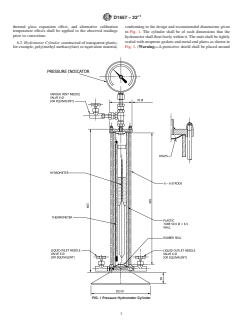
thermal glass expansion effect, and alternative calibration conforming to the design and recommended dimensions given
temperature effects shall be applied to the observed readings in Fig. 1. The cylinder shall be of such dimensions that the
prior to corrections.
hydrometer shall float freely within it. The ends shall be tightly
sealed with neoprene gaskets and metal end plates as shown in
6.2 Hydrometer Cylinder, constructed of transparent plastic;
Fig. 1. (Warning—A protective shield shall be placed around
for example, poly(methyl methacrylate) or equivalent material,
FIG. 1 Pressure Hydrometer Cylinder
´1
D1657 − 22
the cylinder. Replace any cylinders that show signs of fogging, 8.1.1 Connect the source of supply of the liquid to be tested
crazing, cracking, or etching.) to the inlet valve by suitable fittings so that a representative
sample can be introduced into the cylinder. Ascertain that these
NOTE 1—Certain compounds attack plastics and cloud the inner surface
connections are free of leaks. Open the outlet and vent valves
of the cylinder, making it difficult or impossible to read the hydrometer.
and purge the sampling connections by opening the inlet valve
Tests showed no attack by ethane, ethene (ethylene), propane, propylene,
butane, methylpropane (isobutane), butenes (normal butylenes), methyl- slightly, permitting the product to flow through the outlet valve
propene (isobutylene), pentane, and methylbutane (isopentane), and no
at the bottom of the cylinder and the vent valve at the top of the
attack is expected from butadiene and acetaldehyde. Users are cautioned,
cylinder.
however, to clean the cylinder thoroughly after each determination.
8.1.2 When the connections have been purged, close the
Ketones and alcohols should not be used for cleaning as they attack and
outlet and vent valves and open the inlet valve, permitting the
weaken plastics while aromatics also tend to attack the surface of plastics
and should similarly not be used. A light aliphatic hydrocarbon is
liquid to enter the cylinder until it is full. If necessary, the vent
recommended for cleaning. (Warning—Extremely flammable. Harmful if
valve may be opened slightly to permit complete filling of the
inhaled. Vapors may cause flash fire.)
cylinder after which it shall be closed. At no time shall the
6.2.1 The liquid inlet valve and the liquid outlet valve shall
pressure in the cylinder be allowed to rise above a gage
be tightly connected to a base plate that shall be bored to give
pressure of 1.4 MPa (200 psi).
both valves a common inlet to the cylinder. The vapor vent
8.1.3 When the cylinder has b
...