

ASTM E2550-21
(Test Method)Standard Test Method for Thermal Stability by Thermogravimetry
General Information
- Abstract
SIGNIFICANCE AND USE
5.1 Thermogravimetry provides a rapid method for determining the thermal decomposition and reaction mass change of a material.
5.2 This test method is useful in detecting potentially hazardous reactions and in estimating the temperatures at which these reactions occur. This test method is recommended as a screening test for detecting the thermal hazards of an uncharacterized material or mixture (see Section 8).
5.3 Energetic materials, pharmaceuticals and polymers are examples of materials for which this test might be useful. This test is especially useful for materials having melting points that overlap with the onset of reaction or decomposition.
Note 1: In differential scanning calorimetry (DSC), the melting endotherm may interfere with the determination of the onset temperature for reaction or decomposition.
5.4 This test is not suitable for materials that sublime or vaporize in the temperature range of interest. A sample with volatile impurities needs to be purified prior to testing by thermogravimetric analysis. Alternatively, the sample can be tested as is, however, special caution is required during the data analysis. The mass loss due to the loss of impurity should not interfere with the determination of reaction or decomposition temperature.
5.5 The four significant criteria of this test method are: the detection of a sample mass change; the extent of the mass change; the approximate temperature at which the event occurs; the observance of effects due to the atmosphere.
SCOPE
1.1 This test method describes the assessment of material thermal stability through the determination of the temperature at which the materials start to decompose or react and the extent of the mass change using thermogravimetry. The test method uses minimum quantities of material and is applicable over the temperature range from ambient to 800 °C.
1.2 The absence of reaction or decomposition is used as an indication of thermal stability in this test method under the experimental conditions used.
1.3 This test method may be performed on solids or liquids, which do not sublime or vaporize in the temperature range of interest.
1.4 This test method shall not be used by itself to establish a safe operating or storage temperature. It may be used in conjunction with other test methods (for example, Test Methods E487 and E537, and Guide E1981) as part of a hazard analysis of a material.
1.5 This test method is normally applicable to reaction or decomposition occurring in the range from room temperature to 800 °C. The temperature range may be extended depending on the instrumentation used.
1.6 This test method may be performed in an inert, a reactive or self-generated atmosphere.
1.7 The values stated in SI units are to be regarded as standard. No other units of measurement are included in this standard.
1.8 This standard does not purport to address all of the safety concerns, if any, associated with its use. It is the responsibility of the user of this standard to establish appropriate safety, health, and environmental practices and determine the applicability of regulatory limitations prior to use.
1.9 This international standard was developed in accordance with internationally recognized principles on standardization established in the Decision on Principles for the Development of International Standards, Guides and Recommendations issued by the World Trade Organization Technical Barriers to Trade (TBT) Committee.
- Status
- Published
- Publication Date
- 30-Sep-2021
- Technical Committee
- E37 - Thermal Measurements
- Drafting Committee
- E37.01 - Calorimetry and Mass Loss
Overview
ASTM E2550-21: Standard Test Method for Thermal Stability by Thermogravimetry establishes a procedure for assessing the thermal stability of materials by determining the temperature of decomposition or reaction and measuring mass changes using thermogravimetry (TG). This standard, developed by ASTM International, is widely applicable to solids and liquids that do not sublime or vaporize in the intended temperature range, typically from ambient up to 800 °C. Using minimal sample quantities, the method serves as a rapid screening tool to evaluate thermal hazards, especially for uncharacterized materials or mixtures.
Thermogravimetry (TGA) provides essential data for detecting hazardous reactions, estimating onset temperatures, and understanding the extent of mass loss due to decomposition or reaction. The test is applicable in various industries, including the analysis of energetic materials, pharmaceuticals, and polymers.
Key Topics
Thermal Decomposition and Reaction Mass Change: Thermogravimetry efficiently detects and quantifies mass loss or gain as materials undergo decomposition or chemical reaction upon controlled heating.
Screening for Thermal Hazards: The method is valuable for identifying hazardous reactions and estimating the temperatures at which they occur, supporting safety evaluations of unknown materials.
Applicability: Suitable for both solids and liquids that remain stable in the defined temperature range. Materials which easily vaporize or sublime, or contain volatile impurities, may require pretreatment or special analytical caution.
Critical Criteria Evaluated:
- Detection of a sample mass change
- Extent of the mass change
- Approximate temperature of thermal events
- Influence of the test atmosphere (inert, reactive, or self-generated)
Limitations: The method only detects reactions involving a mass change and is not suitable for establishing definitive safe storage or operating temperatures. It may not reliably characterize heterogeneous samples or those with complex volatilization behaviors.
Applications
ASTM E2550-21 is applied across multiple sectors where knowledge of a material’s thermal stability is critical:
- Material Safety Assessment: Offers a rapid initial test to detect exothermic reactions or decomposition that may present safety risks, particularly for uncharacterized materials, chemical intermediates, and new product formulations.
- Research and Development: Essential for characterizing thermal behavior in pharmaceuticals, polymers, and energetic materials, supporting process development, and product validation.
- Quality Control: Useful in ensuring material consistency by monitoring decomposition temperatures and mass changes during manufacturing and storage.
- Hazard Analysis: Supports broader hazard analysis when used together with other thermal analysis techniques (such as differential scanning calorimetry), as recommended by industry practice.
- Regulatory Compliance: Provides standardized testing methodology, contributing to product safety data required for regulatory submissions or international trade.
Related Standards
ASTM E2550-21 references and complements several other ASTM standards relevant to thermal analysis and material stability:
- ASTM E473 - Terminology relating to thermal analysis and rheology
- ASTM E487 - Test methods for constant-temperature stability of chemical materials
- ASTM E537 - Test method for thermal stability of chemicals by differential scanning calorimetry (DSC)
- ASTM E691 - Practice for conducting interlaboratory studies to determine the precision of a test method
- ASTM E1582 - Test method for temperature calibration of thermogravimetric analyzers
- ASTM E967, E1142, E1445, E1981, E2040 - Various methods and terminology supporting temperature calibration, hazard potential, and instrumentation
These related standards help ensure the reliability and reproducibility of thermal analysis data, supporting comprehensive assessments of material thermal behavior.
Keywords
thermal analysis, thermal decomposition, thermal stability, thermogravimetric analysis, thermogravimetry, ASTM E2550-21, mass loss, onset temperature, screening test, hazard analysis, polymers, pharmaceuticals, energetic materials
Relations
- Effective Date
- 15-Nov-2023
- Effective Date
- 01-Oct-2023
- Effective Date
- 01-Oct-2023
- Effective Date
- 01-Feb-2020
- Effective Date
- 01-Feb-2020
- Refers
ASTM E2040-19 - Standard Test Method for Mass Scale Calibration of Thermogravimetric Analyzers - Effective Date
- 01-Dec-2019
- Effective Date
- 01-May-2015
- Effective Date
- 01-Feb-2015
- Effective Date
- 15-Aug-2014
- Effective Date
- 15-Aug-2014
- Effective Date
- 01-Apr-2014
- Refers
ASTM E2040-08(2014) - Standard Test Method for Mass Scale Calibration of Thermogravimetric Analyzers - Effective Date
- 15-Mar-2014
- Effective Date
- 01-Mar-2014
- Effective Date
- 15-Feb-2014
- Effective Date
- 01-May-2013
Get Certified
Connect with accredited certification bodies for this standard

BSMI (Bureau of Standards, Metrology and Inspection)
Taiwan's standards and inspection authority.
Sponsored listings
Frequently Asked Questions
ASTM E2550-21 is a standard published by ASTM International. Its full title is "Standard Test Method for Thermal Stability by Thermogravimetry". This standard covers: SIGNIFICANCE AND USE 5.1 Thermogravimetry provides a rapid method for determining the thermal decomposition and reaction mass change of a material. 5.2 This test method is useful in detecting potentially hazardous reactions and in estimating the temperatures at which these reactions occur. This test method is recommended as a screening test for detecting the thermal hazards of an uncharacterized material or mixture (see Section 8). 5.3 Energetic materials, pharmaceuticals and polymers are examples of materials for which this test might be useful. This test is especially useful for materials having melting points that overlap with the onset of reaction or decomposition. Note 1: In differential scanning calorimetry (DSC), the melting endotherm may interfere with the determination of the onset temperature for reaction or decomposition. 5.4 This test is not suitable for materials that sublime or vaporize in the temperature range of interest. A sample with volatile impurities needs to be purified prior to testing by thermogravimetric analysis. Alternatively, the sample can be tested as is, however, special caution is required during the data analysis. The mass loss due to the loss of impurity should not interfere with the determination of reaction or decomposition temperature. 5.5 The four significant criteria of this test method are: the detection of a sample mass change; the extent of the mass change; the approximate temperature at which the event occurs; the observance of effects due to the atmosphere. SCOPE 1.1 This test method describes the assessment of material thermal stability through the determination of the temperature at which the materials start to decompose or react and the extent of the mass change using thermogravimetry. The test method uses minimum quantities of material and is applicable over the temperature range from ambient to 800 °C. 1.2 The absence of reaction or decomposition is used as an indication of thermal stability in this test method under the experimental conditions used. 1.3 This test method may be performed on solids or liquids, which do not sublime or vaporize in the temperature range of interest. 1.4 This test method shall not be used by itself to establish a safe operating or storage temperature. It may be used in conjunction with other test methods (for example, Test Methods E487 and E537, and Guide E1981) as part of a hazard analysis of a material. 1.5 This test method is normally applicable to reaction or decomposition occurring in the range from room temperature to 800 °C. The temperature range may be extended depending on the instrumentation used. 1.6 This test method may be performed in an inert, a reactive or self-generated atmosphere. 1.7 The values stated in SI units are to be regarded as standard. No other units of measurement are included in this standard. 1.8 This standard does not purport to address all of the safety concerns, if any, associated with its use. It is the responsibility of the user of this standard to establish appropriate safety, health, and environmental practices and determine the applicability of regulatory limitations prior to use. 1.9 This international standard was developed in accordance with internationally recognized principles on standardization established in the Decision on Principles for the Development of International Standards, Guides and Recommendations issued by the World Trade Organization Technical Barriers to Trade (TBT) Committee.
SIGNIFICANCE AND USE 5.1 Thermogravimetry provides a rapid method for determining the thermal decomposition and reaction mass change of a material. 5.2 This test method is useful in detecting potentially hazardous reactions and in estimating the temperatures at which these reactions occur. This test method is recommended as a screening test for detecting the thermal hazards of an uncharacterized material or mixture (see Section 8). 5.3 Energetic materials, pharmaceuticals and polymers are examples of materials for which this test might be useful. This test is especially useful for materials having melting points that overlap with the onset of reaction or decomposition. Note 1: In differential scanning calorimetry (DSC), the melting endotherm may interfere with the determination of the onset temperature for reaction or decomposition. 5.4 This test is not suitable for materials that sublime or vaporize in the temperature range of interest. A sample with volatile impurities needs to be purified prior to testing by thermogravimetric analysis. Alternatively, the sample can be tested as is, however, special caution is required during the data analysis. The mass loss due to the loss of impurity should not interfere with the determination of reaction or decomposition temperature. 5.5 The four significant criteria of this test method are: the detection of a sample mass change; the extent of the mass change; the approximate temperature at which the event occurs; the observance of effects due to the atmosphere. SCOPE 1.1 This test method describes the assessment of material thermal stability through the determination of the temperature at which the materials start to decompose or react and the extent of the mass change using thermogravimetry. The test method uses minimum quantities of material and is applicable over the temperature range from ambient to 800 °C. 1.2 The absence of reaction or decomposition is used as an indication of thermal stability in this test method under the experimental conditions used. 1.3 This test method may be performed on solids or liquids, which do not sublime or vaporize in the temperature range of interest. 1.4 This test method shall not be used by itself to establish a safe operating or storage temperature. It may be used in conjunction with other test methods (for example, Test Methods E487 and E537, and Guide E1981) as part of a hazard analysis of a material. 1.5 This test method is normally applicable to reaction or decomposition occurring in the range from room temperature to 800 °C. The temperature range may be extended depending on the instrumentation used. 1.6 This test method may be performed in an inert, a reactive or self-generated atmosphere. 1.7 The values stated in SI units are to be regarded as standard. No other units of measurement are included in this standard. 1.8 This standard does not purport to address all of the safety concerns, if any, associated with its use. It is the responsibility of the user of this standard to establish appropriate safety, health, and environmental practices and determine the applicability of regulatory limitations prior to use. 1.9 This international standard was developed in accordance with internationally recognized principles on standardization established in the Decision on Principles for the Development of International Standards, Guides and Recommendations issued by the World Trade Organization Technical Barriers to Trade (TBT) Committee.
ASTM E2550-21 is classified under the following ICS (International Classification for Standards) categories: 17.200.99 - Other standards related to thermodynamics. The ICS classification helps identify the subject area and facilitates finding related standards.
ASTM E2550-21 has the following relationships with other standards: It is inter standard links to ASTM E1445-08(2023), ASTM E473-23b, ASTM E1142-23b, ASTM E537-20, ASTM E487-20, ASTM E2040-19, ASTM E1142-15, ASTM E1445-08(2015), ASTM E1142-14b, ASTM E473-14, ASTM E1142-14a, ASTM E2040-08(2014), ASTM E487-14, ASTM E1142-14, ASTM E691-13. Understanding these relationships helps ensure you are using the most current and applicable version of the standard.
ASTM E2550-21 is available in PDF format for immediate download after purchase. The document can be added to your cart and obtained through the secure checkout process. Digital delivery ensures instant access to the complete standard document.
Standards Content (Sample)
This international standard was developed in accordance with internationally recognized principles on standardization established in the Decision on Principles for the
Development of International Standards, Guides and Recommendations issued by the World Trade Organization Technical Barriers to Trade (TBT) Committee.
Designation: E2550 − 21
Standard Test Method for
Thermal Stability by Thermogravimetry
This standard is issued under the fixed designation E2550; the number immediately following the designation indicates the year of
original adoption or, in the case of revision, the year of last revision. A number in parentheses indicates the year of last reapproval. A
superscript epsilon (´) indicates an editorial change since the last revision or reapproval.
1. Scope* Development of International Standards, Guides and Recom-
mendations issued by the World Trade Organization Technical
1.1 This test method describes the assessment of material
Barriers to Trade (TBT) Committee.
thermal stability through the determination of the temperature
at which the materials start to decompose or react and the
2. Referenced Documents
extent of the mass change using thermogravimetry. The test
method uses minimum quantities of material and is applicable 2.1 ASTM Standards:
over the temperature range from ambient to 800 °C. E473 Terminology Relating to Thermal Analysis and Rhe-
ology
1.2 The absence of reaction or decomposition is used as an
E487 Test Methods for Constant-Temperature Stability of
indication of thermal stability in this test method under the
Chemical Materials
experimental conditions used.
E537 Test Method for Thermal Stability of Chemicals by
1.3 This test method may be performed on solids or liquids,
Differential Scanning Calorimetry
which do not sublime or vaporize in the temperature range of
E691 Practice for Conducting an Interlaboratory Study to
interest.
Determine the Precision of a Test Method
1.4 This test method shall not be used by itself to establish E967 Test Method for Temperature Calibration of Differen-
tial Scanning Calorimeters and Differential ThermalAna-
a safe operating or storage temperature. It may be used in
conjunction with other test methods (for example, Test Meth- lyzers
E1142 Terminology Relating to Thermophysical Properties
ods E487 and E537, and Guide E1981) as part of a hazard
analysis of a material. E1445 Terminology Relating to Hazard Potential of Chemi-
cals
1.5 This test method is normally applicable to reaction or
E1582 Test Method for Temperature Calibration of Thermo-
decomposition occurring in the range from room temperature
gravimetric Analyzers
to 800 °C. The temperature range may be extended depending
E1981 Guide for Assessing Thermal Stability of Materials
on the instrumentation used.
by Methods of Accelerating Rate Calorimetry
1.6 This test method may be performed in an inert, a
E2040 Test Method for Mass Scale Calibration of Thermo-
reactive or self-generated atmosphere.
gravimetric Analyzers
1.7 The values stated in SI units are to be regarded as
3. Terminology
standard. No other units of measurement are included in this
standard.
3.1 Definitions:
1.8 This standard does not purport to address all of the 3.1.1 Specific technical terms used in this test method are
safety concerns, if any, associated with its use. It is the defined in Terminologies E473, E1142, and E1445. These
responsibility of the user of this standard to establish appro- terms include thermogravimetry (TG), thermogravimetric
priate safety, health, and environmental practices and deter- analysis (TGA), thermal stability, onset temperature (T ),
o
mine the applicability of regulatory limitations prior to use. derivative, and TG curve.
1.9 This international standard was developed in accor- 3.2 Definitions of Terms Specific to This Standard:
dance with internationally recognized principles on standard- 3.2.1 derivative thermogravimetry or DTG curve, n—a dis-
ization established in the Decision on Principles for the play of the first derivative of thermogravimetry data with
respect to temperature or time.
ThistestmethodisunderthejurisdictionofASTMCommitteeE37onThermal
Measurements and is the direct responsibility of Subcommittee E37.01 on Calo-
rimetry and Mass Loss. For referenced ASTM standards, visit the ASTM website, www.astm.org, or
Current edition approved Oct. 1, 2021. Published November 2021. Originally contact ASTM Customer Service at service@astm.org. For Annual Book of ASTM
approved in 2007. Last previous edition approved in 2017 as E2550 – 17. DOI: Standards volume information, refer to the standard’s Document Summary page on
10.1520/E2550-21. the ASTM website.
*A Summary of Changes section appears at the end of this standard
Copyright © ASTM International, 100 Barr Harbor Drive, PO Box C700, West Conshohocken, PA 19428-2959. United States
E2550 − 21
3.2.2 mass change plateau, n—a region of the thermogra- thermogravimetric analysis. Alternatively, the sample can be
vimetry curve with a relatively constant mass; it is accompa- testedasis,however,specialcautionisrequiredduringthedata
nied by a minimum in the DTG curve for a mass loss, or a analysis. The mass loss due to the loss of impurity should not
maximum for a mass gain. interfere with the determination of reaction or decomposition
temperature.
4. Summary of Test Method
5.5 The four significant criteria of this test method are: the
4.1 Asample of the material to be examined is placed in an
detection of a sample mass change; the extent of the mass
inert container and then heated at a controlled rate (β)of1°C
change; the approximate temperature at which the event
-1 -1
min to 20 °C min under a controlled atmosphere. The
occurs; the observance of effects due to the atmosphere.
samplemassisrecordedcontinuouslyasafunctionoftimeand
temperature.
6. Limitations
4.2 When the sample undergoes a reaction or thermal
6.1 Many environmental factors affect the existence, mag-
decomposition involving a mass change, that change is indi-
nitude and onset temperature of a particular reaction or
cated by a departure from the initially established baseline of
decomposition. Some of these, including heating rate, instru-
the mass record (see Fig. 1).
mental sensitivity, and atmosphere reactivity, will affect the
4.3 Theonsettemperatureandmasschangesaredetermined
detectability of a reaction or decomposition using this proce-
and reported.
dure. Therefore, it is imperative that the results obtained from
the application of this test method be viewed only as an
5. Significance and Use
indication of the thermal stability of a material.
5.1 Thermogravimetry provides a rapid method for deter-
6.2 This test method can only be used to detect reaction or
miningthethermaldecompositionandreactionmasschangeof
decomposition that involves a mass change, such as a produc-
a material.
tion of gaseous species or a mass gain in reactive atmosphere.
5.2 This test method is useful in detecting potentially
This test method is not suitable for materials that sublime or
hazardous reactions and in estimating the temperatures at
vaporize in the temperature of interest.
which these reactions occur. This test method is recommended
as a screening test for detecting the thermal hazards of an 6.3 This test method may not be reliable for heterogeneous
samples.
uncharacterized material or mixture (see Section 8).
5.3 Energetic materials, pharmaceuticals and polymers are
NOTE 2—For heterogeneous samples, it is recommended to perform
examples of materials for which this test might be useful. This replicate measurements to determine the variability of the results. If
inconsistent results are obtained, the study should be carried out using
testisespeciallyusefulformaterialshavingmeltingpointsthat
larger-scale apparatus, such as accelerating rate calorimetry.
overlap with the onset of reaction or decomposition.
NOTE 1—In differential scanning calorimetry (DSC), the melting
7. Apparatus
endotherm may interfere with the determination of the onset temperature
for reaction or decomposition.
7.1 Thermogravimetric Analyzer (TGA)—The essential in-
strumentation required to provide the minimum thermogravi-
5.4 This test is not suitable for materials that sublime or
metric analytical capability for this test method includes:
vaporize in the temperature range of interest. A sample with
volatile impurities needs to be purified prior to testing by 7.1.1 A thermobalance composed of:
FIG. 1 Typical Thermogravimetry and Derivative Thermogravimetry Curves
E2550 − 21
7.1.1.1 Afurnace to provide uniform controlled heating of a 8.3 When particle size reduction by grinding is necessary,
specimen to a constant temperature or at a constant rate within the user of the test method shall presume that the material is
the applicable temperature range of ambient to 600 °C. sensitive to stimuli such as friction and electrostatic discharge.
7.1.1.2 Atemperature sensor to provide an indication of the Accordingly, appropriate tests shall be conducted on those
specimen/furnace temperature to 60.5 °C. materials prior to grinding. Use of suitable protective equip-
7.1.1.3 A continuously recording balance to measure the ment is always recommended when preparing materials of
specimen mass with a minimum capacity of 10 mg and a unknown hazard. If a Safety Data Sheet is available, it shall be
sensitivity of 610 µg. acquired and studied prior to handling unknown materials.
8.4 Toxic or corrosive effluents, or both, may be released
NOTE 3—An apparatus with a larger capacity can also be used. The
sensitivity must be at least 60.1 mass %.
when heating the material and could be harmful to the
personnelortheapparatus.Useofanexhaustsystemtoremove
7.1.1.4 A means of maintaining the specimen/container
such effluents is highly recommended.
under atmospheric control of an inert or reactive gas of
-1
99.9+ % purity at a purge rate of 20 mL min to 100
-1 -1
9. Sampling
mL min 65mLmin .
9.1 Samples shall be representative of the material being
NOTE 4—Purge rate may vary depending on the instrument used.
studied including particle size and purity.
Excessive purge rates should be avoided as this may introduce interfer-
ences due to turbulence effects and temperature gradients.
9.2 In the absence of other information, the samples are
NOTE 5—Experiments can also be performed in a self generated
assumed to be analyzed as received. If a treatment, such as
atmosphere. Differential scanning calorimeter sealed containers with a
drying, is applied to the sample prior to analysis, this treatment
pinhole of 25-µm to 380-µm diameter have been shown to establish
saturation of a gaseous self generated atmosphere. and any resulting mass change must be noted in the report.
7.1.2 A temperature controller capable of executing a spe-
9.3 The selection of specimen mass depends upon the
cific temperature program by operating the furnace between
magnitude of hazard associated with the material, the sensitiv-
selected temperature limits at a rate of temperature change
ity of the instrument, the heating rate and the specimen
-1 -1 -1
between 1 °C min and 20 °C min to within 60.1 °C min .
homogeneity. This test method should be
...
This document is not an ASTM standard and is intended only to provide the user of an ASTM standard an indication of what changes have been made to the previous version. Because
it may not be technically possible to adequately depict all changes accurately, ASTM recommends that users consult prior editions as appropriate. In all cases only the current version
of the standard as published by ASTM is to be considered the official document.
Designation: E2550 − 17 E2550 − 21
Standard Test Method for
Thermal Stability by Thermogravimetry
This standard is issued under the fixed designation E2550; the number immediately following the designation indicates the year of
original adoption or, in the case of revision, the year of last revision. A number in parentheses indicates the year of last reapproval. A
superscript epsilon (´) indicates an editorial change since the last revision or reapproval.
1. Scope Scope*
1.1 This test method describes the assessment of material thermal stability through the determination of the temperature at which
the materials start to decompose or react and the extent of the mass change using thermogravimetry. The test method uses minimum
quantities of material and is applicable over the temperature range from ambient to 800°C.800 °C.
1.2 The absence of reaction or decomposition is used as an indication of thermal stability in this test method under the
experimental conditions used.
1.3 This test method may be performed on solids or liquids, which do not sublime or vaporize in the temperature range of interest.
1.4 This test method shall not be used by itself to establish a safe operating or storage temperature. It may be used in conjunction
with other test methods (for example, Test Methods E487 and E537, and Guide E1981) as part of a hazard analysis of a material.
1.5 This test method is normally applicable to reaction or decomposition occurring in the range from room temperature to 800°C.
800 °C. The temperature range may be extended depending on the instrumentation used.
1.6 This test method may be performed in an inert, a reactive or self-generated atmosphere.
1.7 The values stated in SI units are to be regarded as standard. No other units of measurement are included in this standard.
1.8 This standard does not purport to address all of the safety concerns, if any, associated with its use. It is the responsibility
of the user of this standard to establish appropriate safety, health, and environmental practices and determine the applicability of
regulatory limitations prior to use.
1.9 This international standard was developed in accordance with internationally recognized principles on standardization
established in the Decision on Principles for the Development of International Standards, Guides and Recommendations issued
by the World Trade Organization Technical Barriers to Trade (TBT) Committee.
2. Referenced Documents
2.1 ASTM Standards:
E473 Terminology Relating to Thermal Analysis and Rheology
This test method is under the jurisdiction of ASTM Committee E37 on Thermal Measurements and is the direct responsibility of Subcommittee E37.01 on Calorimetry
and Mass Loss.
Current edition approved Sept. 1, 2017Oct. 1, 2021. Published September 2017November 2021. Originally approved in 2007. Last previous edition approved in 20112017
as E2550 – 11.E2550 – 17. DOI: 10.1520/E2550-17.10.1520/E2550-21.
For referenced ASTM standards, visit the ASTM website, www.astm.org, or contact ASTM Customer Service at service@astm.org. For Annual Book of ASTM Standards
volume information, refer to the standard’s Document Summary page on the ASTM website.
*A Summary of Changes section appears at the end of this standard
Copyright © ASTM International, 100 Barr Harbor Drive, PO Box C700, West Conshohocken, PA 19428-2959. United States
E2550 − 21
E487 Test Methods for Constant-Temperature Stability of Chemical Materials
E537 Test Method for Thermal Stability of Chemicals by Differential Scanning Calorimetry
E691 Practice for Conducting an Interlaboratory Study to Determine the Precision of a Test Method
E967 Test Method for Temperature Calibration of Differential Scanning Calorimeters and Differential Thermal Analyzers
E1142 Terminology Relating to Thermophysical Properties
E1445 Terminology Relating to Hazard Potential of Chemicals
E1582 Test Method for Temperature Calibration of Thermogravimetric Analyzers
E1981 Guide for Assessing Thermal Stability of Materials by Methods of Accelerating Rate Calorimetry
E2040 Test Method for Mass Scale Calibration of Thermogravimetric Analyzers
3. Terminology
3.1 Definitions:
3.1.1 Specific technical terms used in this test method are defined in Terminologies E473, E1142, and E1445. These terms include
thermogravimetry (TG),thermogravimetric analysis (TGA),thermal stability,onset temperature (T ),derivative, and TG curve.
o
3.2 Definitions of Terms Specific to This Standard:
3.2.1 derivative thermogravimetry or DTG curve, n—a display of the first derivative of thermogravimetry data with respect to
temperature or time.
3.2.2 mass change plateau, n—a region of the thermogravimetry curve with a relatively constant mass; it is accompanied by a
minimum in the DTG curve for a mass loss, or a maximum for a mass gain.
4. Summary of Test Method
4.1 A sample of the material to be examined is placed in an inert container and then heated at a controlled rate (β) of 1°C 1 °C
-1 -1
min to 20°C 20 °C min under a controlled atmosphere. The sample mass is recorded continuously as a function of time and
temperature.
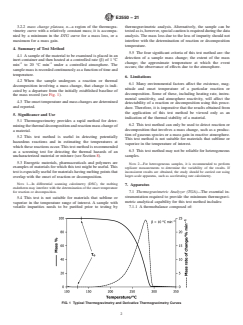
4.2 When the sample undergoes a reaction or thermal decomposition involving a mass change, that change is indicated by a
departure from the initially established baseline of the mass record (see Fig. 1).
4.3 The onset temperature and mass changes are determined and reported.
5. Significance and Use
5.1 Thermogravimetry provides a rapid method for determining the thermal decomposition and reaction mass change of a
material.
FIG. 1 Typical Thermogravimetry and Derivative Thermogravimetry Curves
E2550 − 21
5.2 This test method is useful in detecting potentially hazardous reactions and in estimating the temperatures at which these
reactions occur. This test method is recommended as a screening test for detecting the thermal hazards of an uncharacterized
material or mixture (see Section 8).
5.3 Energetic materials, pharmaceuticals and polymers are examples of materials for which this test might be useful. This test is
especially useful for materials having melting points that overlap with the onset of reaction or decomposition.
NOTE 1—In Differential Scanning Calorimetrydifferential scanning calorimetry (DSC), the melting endotherm may interfere with the determination of the
onset temperature for reaction or decomposition.
5.4 This test is not suitable for materials that sublime or vaporize in the temperature range of interest. A sample with volatile
impurities needs to be purified prior to testing by thermogravimetric analysis. Alternatively, the sample can be tested as is, however,
special caution is required during the data analysis. The mass loss due to the loss of impurity should not interfere with the
determination of reaction or decomposition temperature.
5.5 The four significant criteria of this test method are: the detection of a sample mass change; the extent of the mass change; the
approximate temperature at which the event occurs; the observance of effects due to the atmosphere.
6. Limitations
6.1 Many environmental factors affect the existence, magnitude and onset temperature of a particular reaction or decomposition.
Some of these, including heating rate, instrumental sensitivity, and atmosphere reactivity, will affect the detectability of a reaction
or decomposition using this procedure. Therefore, it is imperative that the results obtained from the application of this test method
be viewed only as an indication of the thermal stability of a material.
6.2 This test method can only be used to detect reaction or decomposition that involves a mass change, such as a production of
gaseous species or a mass gain in reactive atmosphere. This test method is not suitable for materials that sublime or vaporize in
the temperature of interest.
6.3 This test method may not be reliable for heterogeneous samples.
NOTE 2—For heterogeneous samples, it is recommended to perform replicate measurements to determine the variability of the results. If inconsistent
results are obtained, the study should be carried out using larger-scale apparatus, such as accelerating rate calorimetry.
7. Apparatus
7.1 Thermogravimetric Analyzer (TGA)—The essential instrumentation required to provide the minimum thermogravimetric
analytical capability for this test method includes:
7.1.1 A thermobalance composed of:
7.1.1.1 A furnace to provide uniform controlled heating of a specimen to a constant temperature or at a constant rate within the
applicable temperature range of ambient to 600°C.600 °C.
7.1.1.2 A temperature sensor to provide an indication of the specimen/furnace temperature to 60.1°C.60.5 °C.
7.1.1.3 A continuously recording balance to measure the specimen mass with a minimum capacity of 10 mg and a sensitivity of
610 μg.
NOTE 3—An apparatus with a larger capacity can also be used. The sensitivity must be at least 60.1 mass %.
7.1.1.4 A means of maintaining the specimen/container under atmospheric control of an inert or reactive gas of 99.9+ % purity
-1 -1 -1
at a purge rate of 20 mL min to 100 mL min 6 5 mL min .
E2550 − 21
NOTE 4—Purge rate may vary depending on the instrument used. Excessive purge rates should be avoided as this may introduce interferences due to
turbulence effects and temperature gradients.
NOTE 5—Experiments can also be performed in a self generated atmosphere. DSC Differential scanning calorimeter sealed containers with a pinhole of
25-μm to 380-μm diameter have been shown to establish saturation of a gaseous self generated atmosphere.
7.1.2 A temperature controller capable of executing a specific temperature program by operating the furnace between selected
-1 -1
temperature limits at a rate of temperature change between 1°C min1 °C min and 20°C min20 °C min to within
-1
60.1°C min60.1 °C min .
7.1.3 A recording device capable of recording and displaying on the Y-axis any fraction of the specimen mass signal (TGA(TGA
curve) including the signal noise as a function of any fraction of the temperature (or time) signal on the X-axis including the signal
noise.
7.1.4 Containers (pans, crucibles, etc.) that are inert to the specimen and that will remain gravimetrically stable within the
temperature limits of this test method.
NOTE 6—For experiments in a self generated atmosphere, DSC sealed containers with pinhole of 25-μm to 380-μm diameter can be used.
7.2 Auxiliary equipment necessary or useful in conducting this test method includes:
7.2.1 A balance with a capacity of 100 mg or more to weigh specimens or containers, or both, to 60.1 mg.
7.2.2 Device to encapsulate the specimen in DSC differential scanning calorimeter sealable containers for self-generated
atmosphere studies.
8. Safety Precautions
8.1 The use of this test method as an initial test for material whose potential hazards are unknown requires that precautions be
taken during the sample preparation and testing.
8.2 Larger specimens (>5 mg) should be used only after consideration is given to the potential for hazardous reaction(s). For
energetic material or materials whose characteri
...