

ASTM C1430-18
(Test Method)Standard Test Method for Determination of Uranium, Oxygen to Uranium (O/U), and Oxygen to Metal (O/M) in Sintered Uranium Dioxide and Gadolinia-Uranium Dioxide Pellets by Atmospheric Equilibration
General Information
- Abstract
SIGNIFICANCE AND USE
5.1 Uranium dioxide is used as a nuclear-reactor fuel. This test method is designed to determine whether the percent uranium and O/U or O/M content meet Specifications C776 and C922.
SCOPE
1.1 This test method applies to the determination of uranium, the oxygen to uranium (O/U) ratio in sintered uranium dioxide pellets, and the oxygen to metal (O/M) ratio in sintered gadolinium oxide-uranium dioxide pellets with a Gd2O3 concentration of up to 12 weight %. The O/M calculations assume that the gadolinium and uranium oxides are present in a metal dioxide solid solution.
1.2 The values stated in SI units are to be regarded as standard. No other units of measurement are included in this standard.
1.3 This standard does not purport to address all of the safety concerns, if any, associated with its use. It is the responsibility of the user of this standard to establish appropriate safety, health, and environmental practices and determine the applicability of regulatory limitations prior to use. For specific hazards statements, see Section 9.
1.4 This international standard was developed in accordance with internationally recognized principles on standardization established in the Decision on Principles for the Development of International Standards, Guides and Recommendations issued by the World Trade Organization Technical Barriers to Trade (TBT) Committee.
- Status
- Published
- Publication Date
- 31-Jan-2018
- Technical Committee
- C26 - Nuclear Fuel Cycle
- Drafting Committee
- C26.05 - Methods of Test
Buy Documents
ASTM C1430-18 - Standard Test Method for Determination of Uranium, Oxygen to Uranium (O/U), and Oxygen to Metal (O/M) in Sintered Uranium Dioxide and Gadolinia-Uranium Dioxide Pellets by Atmospheric Equilibration
REDLINE ASTM C1430-18 - Standard Test Method for Determination of Uranium, Oxygen to Uranium (O/U), and Oxygen to Metal (O/M) in Sintered Uranium Dioxide and Gadolinia-Uranium Dioxide Pellets by Atmospheric Equilibration
Overview
ASTM C1430-18 is an internationally recognized standard test method developed by ASTM International for the determination of uranium content, oxygen to uranium ratio (O/U), and oxygen to metal ratio (O/M) in sintered uranium dioxide (UO₂) and gadolinia-uranium dioxide (UO₂-Gd₂O₃) pellets. This analytic method, based on atmospheric equilibration, is crucial for confirming that nuclear fuel pellets meet rigorous specifications as outlined in ASTM C776 and ASTM C922. Uranium dioxide is a primary fuel in nuclear reactors, and maintaining precise stoichiometry and impurity levels is vital for reactor performance and safety.
Key Topics
Scope of Application
- Designed for sintered uranium dioxide pellets and sintered gadolinium oxide-uranium dioxide pellets with up to 12% Gd₂O₃ by weight.
- Suitable for analyses where gadolinium and uranium oxides are present as a metal dioxide solid solution.
- Observes SI units as the measurement standard.
Testing Procedure Highlights
- Involves weighing sintered nuclear fuel pellets before and after exposure to an equilibrating atmosphere at 800°C.
- Uses a humidified mixture of hydrogen and argon or nitrogen as a purge gas.
- Calculations of uranium content and O/U or O/M ratios are based on pellet weight changes.
Critical Parameters
- Precise temperature and gas flow control are mandatory.
- Analytical balances with high accuracy are required for valid results.
- Careful sample handling is essential to avoid pellet chipping and weight loss.
- Assumes compliance with impurity limits as specified in related standards.
Safety Considerations
- Emphasizes necessary precautions for handling uranium, operating high-temperature furnaces, and using pressurized gases.
- Users of the method must adhere to relevant safety, health, and environmental regulations.
Applications
Quality Assurance in Nuclear Fuel Fabrication
- Ensures that uranium dioxide and mixed gadolinia-uranium dioxide pellets meet fuel design requirements for nuclear reactors.
- Provides analytical verification for O/U and O/M ratios, essential for fuel performance, reactivity, and safety.
Specification Compliance
- Used to confirm material compliance with ASTM specifications (C776 for UO₂ and C922 for UO₂-Gd₂O₃ pellets).
- Supports process control and certification in commercial and research nuclear fuel manufacturing.
Reactor Safety and Reliability
- Accurate O/U and O/M measurements help prevent deviation from stoichiometry, which could impact reactivity and material integrity.
- Facilitates investigation of manufacturing quality issues and supports regulatory documentation.
Related Standards
- ASTM C776 - Specification for Sintered Uranium Dioxide Pellets for Light Water Reactors
- ASTM C922 - Specification for Sintered Gadolinium Oxide-Uranium Dioxide Pellets
- ASTM C859 - Terminology Relating to Nuclear Materials
- ASTM C696 - Test Methods for Chemical, Mass Spectrometric, and Spectrochemical Analysis of Nuclear-Grade Uranium Dioxide Powders and Pellets
- ASTM C968 - Test Methods for Analysis of Sintered Gadolinium Oxide-Uranium Dioxide Pellets
- ASTM C1287 - Test Method for Determination of Impurities in Nuclear Grade Uranium Compounds by Inductively Coupled Plasma Mass Spectrometry
Practical Value
The ASTM C1430-18 standard is a vital resource for nuclear fuel producers, laboratories, and regulatory bodies requiring strict control over nuclear fuel composition. It supports international trade in nuclear materials by providing a consistent, reliable method for measuring critical properties of fuel pellets, helping ensure reactor efficiency, safety, and regulatory compliance.
Keywords: ASTM C1430-18, uranium dioxide analysis, O/U ratio, O/M ratio, sintered nuclear fuel pellets, gadolinia-uranium dioxide, atmospheric equilibration, nuclear fuel specification, nuclear material testing, ASTM standards.
Relations
- Effective Date
- 01-Feb-2018
- Effective Date
- 01-Jan-2024
- Effective Date
- 01-Nov-2019
- Effective Date
- 01-Jan-2018
- Effective Date
- 15-Jun-2014
- Effective Date
- 15-Jan-2014
- Effective Date
- 01-Jun-2013
- Effective Date
- 01-May-2013
- Effective Date
- 01-Jan-2012
- Effective Date
- 01-Sep-2011
- Effective Date
- 01-Jun-2011
- Effective Date
- 01-Nov-2010
- Effective Date
- 01-Aug-2010
- Effective Date
- 01-Jun-2010
- Effective Date
- 01-Feb-2010
Buy Documents
ASTM C1430-18 - Standard Test Method for Determination of Uranium, Oxygen to Uranium (O/U), and Oxygen to Metal (O/M) in Sintered Uranium Dioxide and Gadolinia-Uranium Dioxide Pellets by Atmospheric Equilibration
REDLINE ASTM C1430-18 - Standard Test Method for Determination of Uranium, Oxygen to Uranium (O/U), and Oxygen to Metal (O/M) in Sintered Uranium Dioxide and Gadolinia-Uranium Dioxide Pellets by Atmospheric Equilibration
Get Certified
Connect with accredited certification bodies for this standard

DNV
DNV is an independent assurance and risk management provider.

Lloyd's Register
Lloyd's Register is a global professional services organisation specialising in engineering and technology.
DNV Energy Systems
Energy and renewable energy certification.
Sponsored listings
Frequently Asked Questions
ASTM C1430-18 is a standard published by ASTM International. Its full title is "Standard Test Method for Determination of Uranium, Oxygen to Uranium (O/U), and Oxygen to Metal (O/M) in Sintered Uranium Dioxide and Gadolinia-Uranium Dioxide Pellets by Atmospheric Equilibration". This standard covers: SIGNIFICANCE AND USE 5.1 Uranium dioxide is used as a nuclear-reactor fuel. This test method is designed to determine whether the percent uranium and O/U or O/M content meet Specifications C776 and C922. SCOPE 1.1 This test method applies to the determination of uranium, the oxygen to uranium (O/U) ratio in sintered uranium dioxide pellets, and the oxygen to metal (O/M) ratio in sintered gadolinium oxide-uranium dioxide pellets with a Gd2O3 concentration of up to 12 weight %. The O/M calculations assume that the gadolinium and uranium oxides are present in a metal dioxide solid solution. 1.2 The values stated in SI units are to be regarded as standard. No other units of measurement are included in this standard. 1.3 This standard does not purport to address all of the safety concerns, if any, associated with its use. It is the responsibility of the user of this standard to establish appropriate safety, health, and environmental practices and determine the applicability of regulatory limitations prior to use. For specific hazards statements, see Section 9. 1.4 This international standard was developed in accordance with internationally recognized principles on standardization established in the Decision on Principles for the Development of International Standards, Guides and Recommendations issued by the World Trade Organization Technical Barriers to Trade (TBT) Committee.
SIGNIFICANCE AND USE 5.1 Uranium dioxide is used as a nuclear-reactor fuel. This test method is designed to determine whether the percent uranium and O/U or O/M content meet Specifications C776 and C922. SCOPE 1.1 This test method applies to the determination of uranium, the oxygen to uranium (O/U) ratio in sintered uranium dioxide pellets, and the oxygen to metal (O/M) ratio in sintered gadolinium oxide-uranium dioxide pellets with a Gd2O3 concentration of up to 12 weight %. The O/M calculations assume that the gadolinium and uranium oxides are present in a metal dioxide solid solution. 1.2 The values stated in SI units are to be regarded as standard. No other units of measurement are included in this standard. 1.3 This standard does not purport to address all of the safety concerns, if any, associated with its use. It is the responsibility of the user of this standard to establish appropriate safety, health, and environmental practices and determine the applicability of regulatory limitations prior to use. For specific hazards statements, see Section 9. 1.4 This international standard was developed in accordance with internationally recognized principles on standardization established in the Decision on Principles for the Development of International Standards, Guides and Recommendations issued by the World Trade Organization Technical Barriers to Trade (TBT) Committee.
ASTM C1430-18 is classified under the following ICS (International Classification for Standards) categories: 27.120.30 - Fissile materials and nuclear fuel technology. The ICS classification helps identify the subject area and facilitates finding related standards.
ASTM C1430-18 has the following relationships with other standards: It is inter standard links to ASTM C1430-07(2011)e1, ASTM C859-24, ASTM C696-19, ASTM C1287-18, ASTM C859-14a, ASTM C859-14, ASTM C859-13a, ASTM C859-13, ASTM C968-12, ASTM C696-11, ASTM C776-06(2011), ASTM C859-10b, ASTM C859-10a, ASTM C1287-10, ASTM C859-10. Understanding these relationships helps ensure you are using the most current and applicable version of the standard.
ASTM C1430-18 is available in PDF format for immediate download after purchase. The document can be added to your cart and obtained through the secure checkout process. Digital delivery ensures instant access to the complete standard document.
Standards Content (Sample)
This international standard was developed in accordance with internationally recognized principles on standardization established in the Decision on Principles for the
Development of International Standards, Guides and Recommendations issued by the World Trade Organization Technical Barriers to Trade (TBT) Committee.
Designation: C1430 − 18
Standard Test Method for
Determination of Uranium, Oxygen to Uranium (O/U), and
Oxygen to Metal (O/M) in Sintered Uranium Dioxide and
Gadolinia-Uranium Dioxide Pellets by Atmospheric
Equilibration
This standard is issued under the fixed designation C1430; the number immediately following the designation indicates the year of
original adoption or, in the case of revision, the year of last revision.Anumber in parentheses indicates the year of last reapproval.A
superscript epsilon (´) indicates an editorial change since the last revision or reapproval.
1. Scope C776SpecificationforSinteredUraniumDioxidePelletsfor
Light Water Reactors
1.1 This test method applies to the determination of
C859Terminology Relating to Nuclear Materials
uranium, the oxygen to uranium (O/U) ratio in sintered
C922SpecificationforSinteredGadoliniumOxide-Uranium
uraniumdioxidepellets,andtheoxygentometal(O/M)ratioin
Dioxide Pellets
sintered gadolinium oxide-uranium dioxide pellets with a
C968Test Methods for Analysis of Sintered Gadolinium
Gd O concentration of up to 12 weight %. The O/M calcula-
2 3
Oxide-Uranium Dioxide Pellets
tions assume that the gadolinium and uranium oxides are
C1287Test Method for Determination of Impurities in
present in a metal dioxide solid solution.
Nuclear Grade Uranium Compounds by Inductively
1.2 The values stated in SI units are to be regarded as
Coupled Plasma Mass Spectrometry
standard. No other units of measurement are included in this
standard.
3. Terminology
1.3 This standard does not purport to address all of the
3.1 Definitions:
safety concerns, if any, associated with its use. It is the
3.1.1 For definitions of terms relating to the nuclear fuel
responsibility of the user of this standard to establish appro-
cycle, refer to Terminology C859.
priate safety, health, and environmental practices and deter-
mine the applicability of regulatory limitations prior to use.
4. Summary of Test Method
For specific hazards statements, see Section 9.
1.4 This international standard was developed in accor-
4.1 Theuranium,andeitherO/UorO/M,aredeterminedby
dance with internationally recognized principles on standard-
measuring the weight change of a sintered pellet after it has
ization established in the Decision on Principles for the
been exposed to an equilibrating atmosphere to bring it to the
Development of International Standards, Guides and Recom-
stoichiometric condition. Sintered pellets are weighed and
mendations issued by the World Trade Organization Technical
loaded into a sample boat.The boat is placed in a tube furnace
Barriers to Trade (TBT) Committee.
capable of holding a temperature of 800 6 10°C. The furnace
is purged with a moist gas flow of 4% hydrogen and 96%
2. Referenced Documents
argon or nitrogen to remove all air. The temperature of the
2.1 ASTM Standards: furnace is raised to 800°C and held at this temperature with
constant gas flow for 4 h. The furnace then is turned off and
C696Test Methods for Chemical, Mass Spectrometric, and
SpectrochemicalAnalysis of Nuclear-Grade Uranium Di- allowed to cool, with gas purge on, to room temperature. The
samples are removed from the furnace and reweighed.
oxide Powders and Pellets
4.2 The weight change, gadolinia content, and chemical
impurity content are used to calculate % uranium and the O/U
ThistestmethodisunderthejurisdictionofASTMCommitteeC26onNuclear
or O/M.
Fuel Cycle and is the direct responsibility of Subcommittee C26.05 on Methods of
Test.
Current edition approved Feb. 1, 2018. Published February 2018. Originally
5. Significance and Use
ε1
approved in 2000. Last previous edition approved in 2011 as C1430–07 (2011) .
DOI: 10.1520/C1430-18.
5.1 Uranium dioxide is used as a nuclear-reactor fuel. This
For referenced ASTM standards, visit the ASTM website, www.astm.org, or
test method is designed to determine whether the percent
contact ASTM Customer Service at service@astm.org. For Annual Book of ASTM
uranium and O/U or O/M content meet Specifications C776
Standards volume information, refer to the standard’s Document Summary page on
the ASTM website. and C922.
Copyright © ASTM International, 100 Barr Harbor Drive, PO Box C700, West Conshohocken, PA 19428-2959. United States
C1430 − 18
6. Interferences 7.4 Assorted Connectors, Tubing, Flasks, Stoppers, and
Delivery Tubes—The purge gas is passed through a humidifier,
6.1 Parameters for temperature, gas composition, gas flow,
intothetubefurnace.Abubblerflaskisattachedtothefurnace
and moist air purge must be monitored and maintained care-
outlet to monitor gas flow (see Fig. 1).
fully within the limits set in the procedure.
7.5 Gas Pressure Gage and Regulator.
6.2 This test method assumes that chemical impurities meet
Specifications C776 and C922 limits. Potential method inter- 7.6 Purge Gas(4%hydrogen,96%argonor4%hydrogen
ferences from higher impurity concentrations will require and 96% nitrogen. Gas purity of 99.995% has been found to
evaluation. perform satisfactorily.
6.3 Furnace tubes or boats made from metals that oxidize 7.7 Purge Gas Humidifier, with heater and controller ca-
under the test conditions may prevent proper equilibration by pable of maintaining water temperature at 35 6 10°C.
consuming available oxygen.
8. Standard Materials
6.4 Preciseweighingofsamplesiscriticaltotheaccuracyof
8.1 NBL , NBL-traceable, or equivalent, uranium dioxide
this test method.
pellets. Analyze at least one standard pellet per batch.
6.5 Loss of weight due to pellet chipping would invalidate
the analysis. Handle pellets with care.
9. Hazards and Precautions
6.6 This test method assumes that pellets are sintered. It
9.1 Take proper safety precautions for handling uranium.
does not correct for moisture or volatile additives.
9.2 Thefurnace,sampletubeandsampleboatsareheatedto
6.7 This test method assumes that UO -Gd O pellets have
2 2 3
800°C. Care must be taken to avoid burns.
formed a solid solution; however, the error from incomplete
9.3 Exercise appropriate caution when working with com-
dissolution of Gd O would be very small (see the calculation
2 3
pressed gasses.
in 11.2).
10. Procedure
7. Apparatus
10.1 Analyze samples as whole pellets. No preparation is
7.1 Analytical Balance, capable of weighing to 6 0.0001 g.
required. The nominal sample size is 5–10-g pellet. Smaller
7.2 Tube Furnace, capable of controlling temperatures at
800 6 10°C, that has been fitted with a fused quartz furnace
tube.
Available from the New Brunswick Laboratory, 9800 S. Cass Ave., Argonne,
7.3 Fused Quartz Sample Boats. IL.
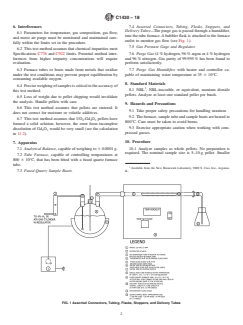
FIG. 1 Assorted Connectors, Tubing, Flasks, Stoppers, and Delivery Tubes
C1430 − 18
thepurgegasisflowing,thewaterinthepurgegaswillbegintocondense
pellets may need to be composited (two pellets/test) to main-
inside the tube and on the pellets.Atemperature of 50°C is high enough
tain minimum weight.Avoid using chipped or cracked pellets.
to prevent condensation but low enough to prevent oxidation by room air.
10.2 Place a small weighing tray or watch glass on the
10.14 Remove the sample boat and reweigh the pellets
balance pan. Tare the balance and check to ensure that the
immediately. Use multiple weighings as necessary to obtain a
balance is stable. If the balance will not stabilize, do not
consistent weight.
proceed.
11. Calculation
NOTE 1—The extremely small weight changes that are being measured
in this test method make it critical that the balance is working properly.
11.1 O/U (UO Pellets):
10.3 Weigh a check weight at least daily to confirm that the
~W 2 W !
2 1
52.000 2 (1)
analytical balance is operating correctly.
W AW / AW 12 AW
~ ! @~ ! ~ !#
2 o u o
10.4 Create a boat map to maintain sample identity.
W 2 W
~ !
2 1
52.000 2
10.5 Use a pair of tweezers and carefully weigh the pellet.
~W !~0.0593!
Rezero the balance and repeat the pellet weighing until a
where:
consistent weight is obtained. Carefully place the pellet in the
W = Weight of sample before equilibration, g,
quartz sample boat. Repeat for each pellet.
W = Weight of sample after equilibration, g,
10.6 Includeoneortwoequilibratedstandardcontrolpellets
AW = Atomic weight of oxygen,
o
with each sample batch.
AW = Atomic weight of uranium, and
u
AW
~ !
0.0593 =
10.7 Carefully place the loaded boat into the sample tube. o
.
AW 12 AW
~ !
u o
Position the boat as close to center of the furnace tube as
possible.
11.2 O/M (UO -Gd O Pellets):
2 2 3
10.8 Fit the purge gas connection to end of tube and clamp.
Make certain that the water in the humidifying flask is at 35 6
PelletO/M 52.000 2∆ O/M (2)
10°C(65°Cisoptimal)andcheckthegascylinderpressureto
W 2 W
~ !
verify there is sufficient gas to complete the cycle. 2 1
52.000 2
~W ! @0.05931~%Gd O 30.00026!#
2 2 3
10.9 Turn on the gas flow and allow the chamber to purge
where:
for approximately five minutes.
W = Weight of sample before
NOTE 2—The flow rate of the purge gas and the length of the purge
equilibration, g,
cycle will vary with the size of the furnace tube.Apurge of greater than
W = Weight of sample after
or equal to three furnace volumes/minute is the recommended minimum.
The flow rate must be adequate to maintain a positive pressure inside the
equilibration, g,
sample chamber.
%Gd O = Measured Gd, expressed as stoi-
2 3
chiometric weight % Gd O , and
10.10 Attach a Pyrex® delivery tube with ground glass
2 3
(% Gd O )(0.00026) = Correction factor for weight gain
fitting to the exit end of the furnace, and place the end in a
2 3
due to formation of oxygen-rich
container of water to verify and monitor the gas flow.
UO-Gd O solid solution during
2 3
10.11 Turn on the furnace and bring the temperature to
sintering. For processes that do not
800°C.
producea100%solidsolution,this
10.12 After temperature is reach
...
This document is not an ASTM standard and is intended only to provide the user of an ASTM standard an indication of what changes have been made to the previous version. Because
it may not be technically possible to adequately depict all changes accurately, ASTM recommends that users consult prior editions as appropriate. In all cases only the current version
of the standard as published by ASTM is to be considered the official document.
´1
Designation: C1430 − 07 (Reapproved 2011) C1430 − 18
Standard Test Method for
Determination of Uranium, Oxygen to Uranium (O/U), and
Oxygen to Metal (O/M) in Sintered Uranium Dioxide and
Gadolinia-Uranium Dioxide Pellets by Atmospheric
Equilibration
This standard is issued under the fixed designation C1430; the number immediately following the designation indicates the year of
original adoption or, in the case of revision, the year of last revision. A number in parentheses indicates the year of last reapproval. A
superscript epsilon (´) indicates an editorial change since the last revision or reapproval.
ε NOTE—A units statement was added editorially in June 2011.
1. Scope
1.1 This test method applies to the determination of uranium, the oxygen to uranium (O/U) ratio in sintered uranium dioxide
pellets, and the oxygen to metal (O/M) ratio in sintered gadolinium oxide-uranium dioxide pellets with a Gd O concentration of
2 3
up to 12 weight %. The O/M calculations assume that the gadolinium and uranium oxides are present in a metal dioxide solid
solution.
1.2 The values stated in SI units are to be regarded as standard. No other units of measurement are included in this standard.
1.3 This standard does not purport to address all of the safety concerns, if any, associated with its use. It is the responsibility
of the user of this standard to establish appropriate safety safety, health, and healthenvironmental practices and determine the
applicability of regulatory limitations prior to use. For specific hazards statements, see Section 89.
1.4 This international standard was developed in accordance with internationally recognized principles on standardization
established in the Decision on Principles for the Development of International Standards, Guides and Recommendations issued
by the World Trade Organization Technical Barriers to Trade (TBT) Committee.
2. Referenced Documents
2.1 ASTM Standards:
C696 Test Methods for Chemical, Mass Spectrometric, and Spectrochemical Analysis of Nuclear-Grade Uranium Dioxide
Powders and Pellets
C776 Specification for Sintered Uranium Dioxide Pellets for Light Water Reactors
C859 Terminology Relating to Nuclear Materials
C922 Specification for Sintered Gadolinium Oxide-Uranium Dioxide Pellets
C968 Test Methods for Analysis of Sintered Gadolinium Oxide-Uranium Dioxide Pellets
C1287 Test Method for Determination of Impurities in Nuclear Grade Uranium Compounds by Inductively Coupled Plasma
Mass Spectrometry
3. Terminology
3.1 Definitions:
3.1.1 For definitions of terms relating to the nuclear fuel cycle, refer to Terminology C859.
4. Summary of Test Method
4.1 The uranium, and either O/U or O/M, are determined by measuring the weight change of a sintered pellet after it has been
exposed to an equilibrating atmosphere to bring it to the stoichiometric condition. Sintered pellets are weighed and loaded into a
sample boat. The boat is placed in a tube furnace capable of holding a temperature of 800 6 10°C. The furnace is purged with
a moist gas flow of 4 % hydrogen and 96 % argon or nitrogen to remove all air. The temperature of the furnace is raised to 800°C
This test method is under the jurisdiction of ASTM Committee C26 on Nuclear Fuel Cycle and is the direct responsibility of Subcommittee C26.05 on Methods of Test.
Current edition approved June 1, 2011Feb. 1, 2018. Published June 2011February 2018. Originally approved in 2000. Last previous edition approved in 20072011 as
ε1
C1430C1430 – 07 (2011) –07. DOI: 10.1520/C1430-07R11E01.10.1520/C1430-18.
For referenced ASTM standards, visit the ASTM website, www.astm.org, or contact ASTM Customer Service at service@astm.org. For Annual Book of ASTM Standards
volume information, refer to the standard’s Document Summary page on the ASTM website.
Copyright © ASTM International, 100 Barr Harbor Drive, PO Box C700, West Conshohocken, PA 19428-2959. United States
C1430 − 18
and held at this temperature with constant gas flow for 4 h. The furnace then is turned off and allowed to cool, with gas purge on,
to room temperature. The samples are removed from the furnace and reweighed.
4.2 The weight change, gadolinia content, and chemical impurity content are used to calculate % uranium and the O/U or O/M.
5. Significance and Use
5.1 Uranium dioxide is used as a nuclear-reactor fuel. This test method is designed to determine whether the percent uranium
and O/U or O/M content meet Specifications C776 and C922.
6. Interferences
6.1 Parameters for temperature, gas composition, gas flow, and moist air purge must be monitored and maintained carefully
within the limits set in the procedure.
6.2 This test method assumes that chemical impurities meet Specifications C776 and C922 limits. Potential method
interferences from higher impurity concentrations will require evaluation.
6.3 Furnace tubes or boats made from metals that oxidize under the test conditions may prevent proper equilibration by
consuming available oxygen.
6.4 Precise weighing of samples is critical to the accuracy of this test method.
6.5 Loss of weight due to pellet chipping would invalidate the analysis. Handle pellets with care.
6.6 This test method assumes that pellets are sintered. It does not correct for moisture or volatile additives.
6.7 This test method assumes that UO -Gd O pellets have formed a solid solution; however, the error from incomplete
2 2 3
dissolution of Gd O would be very small (see the calculation in 10.211.2).
2 3
7. Apparatus
7.1 Analytical Balance, capable of weighing to 6 0.0001 g.
7.2 Tube Furnace, capable of controlling temperatures at 800 6 10°C, that has been fitted with a fused quartz furnace tube.
7.3 Fused Quartz Sample Boats.
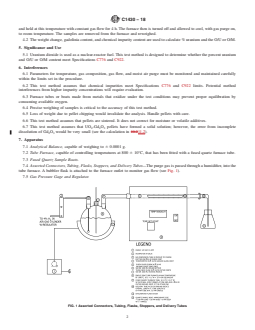
7.4 Assorted Connectors, Tubing, Flasks, Stoppers, and Delivery Tubes—The purge gas is passed through a humidifier, into the
tube furnace. A bubbler flask is attached to the furnace outlet to monitor gas flow (see Fig. 1).
7.5 Gas Pressure Gage and Regulator.
FIG. 1 Assorted Connectors, Tubing, Flasks, Stoppers, and Delivery Tubes
C1430 − 18
7.6 Purge Gas (4 % hydrogen, 96 % argon or 4 % hydrogen and 96 % nitrogen. Gas purity of 99.995 % has been found to
perform satisfactorily.
7.7 Purge Gas Humidifier, with heater and controller capable of maintaining water temperature at 35 6 10°C.
8. Standard Materials
8.1 NBL ,NBL-traceable, or equivalent, uranium dioxide pellets. Analyze at least one standard pellet per batch.
9. Hazards and Precautions
9.1 Take proper safety precautions for handling uranium.
9.2 The furnace, sample tube and sample boats are heated to 800°C. Care must be taken to avoid burns.
9.3 Exercise appropriate caution when working with compressed gasses.
10. Procedure
10.1 Analyze samples as whole pellets. No preparation is required. The nominal sample size is 5–10-g pellet. Smaller pellets
may need to be composited (two pellets/test) to maintain minimum weight. Avoid using chipped or cracked pellets.
10.2 Place a small weighing tray or watch glass on the balance pan. Tare the balance and check to ensure that the balance is
stable. If the balance will not stabilize, do not proceed.
NOTE 1—The extremely small weight changes that are being measured in this test method make it critical that the balance is working properly.
10.3 Weigh a check weight at least daily to confirm that the analytical balance is operating correctly.
10.4 Create a boat map to maintain sample identity.
10.5 Use a pair of tweezers and carefully weigh the pellet. Rezero the balance and repeat the pellet weighing until a consistent
weight is obtained. Carefully place the pellet in the quartz sample boat. Repeat for each pellet.
10.6 Include one or two equilibrated standard control pellets with each sample batch.
10.7 Carefully place the loaded boat into the sample tube. Position the boat as close to center of the furnace tube as possible.
10.8 Fit the purge gas connection to end of tube and clamp. Make certain that the water in the humidifying flask is at 35 6 10°C
(6 5°C is optimal) and check the gas cylinder pressure to verify there is sufficient gas to complete the cycle.
10.9 Turn on the gas flow and allow the chamber to purge for approximately five minutes.
NOTE 2—The flow rate of the purge gas and the length of the purge cycle will vary with the size of the furnace tube. A purge of greater than or equal
to three furnace volumes/minute is the recommended minimum. The flow rate must be adequate to maintain a positive pressure inside the sample chamber.
10.10 Attach a Pyrex® delivery tube with ground glass fitting to the exit end of the furnace, and place the end in a container
of water to verify and monitor the gas flow.
10.11 Turn on the furnace and bring the temperature to 800°C.
10.12 After temperature is reached, allow the pellets to equilibrate for a minimum of 4 h. Monitor the system occasionally
during the run to ensure constant temperature and gas flow.
10.13 At the end of the 4-h cycle, turn the furnace down to 50°C and allow the samples to cool. The purge gas flow must be
maintained until the samples reach 50°C. Then, turn off the carrier gas and allow the pellets to cool to room temperature.
NOTE 3—If the samples are allowed to cool to room temperature while the purge gas is flowing, the water in the purge gas will begin to condense inside
the tube and on the pellets. A temperature of 50°C is high enough to prevent condensation but low enough to prevent oxidation by room air.
10.14 Remove the sample boat and reweigh the pellets immediately. Use multiple weighings as necessary to obtain a consistent
weight.
11. Calculation
11.1 O/U (UO Pellets):
~W 2 W !
2 1
52.000 2 (1)
W AW / AW 12 AW
~ ! @~ ! ~ !#
2 o u o
~W 2 W !
2 1
52.000 2
W 0.0593
~ ! ~ !
Available from the New Brunswick Laboratory, 9800 S. Cass Ave., Argonne, IL.
C1430 − 18
where:
W = Weight of sample before equilibration, g,
W = Weight of sample after equilibration, g,
AW = Atomic weight of oxygen,
o
AW = Atomic weight of uranium, and
u
AW
~ !
...