

ASTM D291/D291M-20
(Test Method)Standard Test Method for Bulk Density of Crushed Bituminous Coal
General Information
- Abstract
SIGNIFICANCE AND USE
3.1 This test method concerns the compaction of crushed coal to determine either its compacted or uncompacted bulk density, for purposes such as charging coke ovens.
SCOPE
1.1 This test method covers two procedures for determining the bulk density of crushed coal less than 37.5 mm [1.5 in.] in size, such as is charged into coke ovens, as follows:
1.1.1 Procedure A—The cone procedure for determining an uncompacted bulk density.
1.1.1.1 Standard Method—Procedure employs the use of a 115 mm [4.5 in.] chute opening and a measuring box having dimensions of 305 mm x 305 mm x 305 mm [12.0 in. x 12.0 in. x 12.0 in.].
1.1.1.2 Alternate Method—Procedure employs the use of a 203 mm [8.0 in.] chute opening and a measuring box having dimensions of 203 mm x 203 mm x 305 mm [8.0 in. x 8.0 in. x 12.0 in.] for coals with a total moisture greater than 7 %.
1.1.2 Procedure B—The dropped-coal procedure for determining a compacted bulk density, comparable to actual bulk densities attained in coke ovens.
1.2 This test method is not applicable to the testing of powdered coal as used in boiler plants, nor to the determination of the bulk density of coal in storage piles.
1.3 Units—The values stated in either SI units or inch-pound units are to be regarded separately as standard. The values stated in each system are not necessarily exact equivalents; therefore, to ensure conformance with the standard, each system shall be used independently of the other, and values from the two systems shall not be combined.
1.4 This standard does not purport to address all of the safety concerns, if any, associated with its use. It is the responsibility of the user of this standard to establish appropriate safety, health, and environmental practices and determine the applicability of regulatory limitations prior to use.
1.5 This international standard was developed in accordance with internationally recognized principles on standardization established in the Decision on Principles for the Development of International Standards, Guides and Recommendations issued by the World Trade Organization Technical Barriers to Trade (TBT) Committee.
- Status
- Published
- Publication Date
- 31-Oct-2020
- Technical Committee
- D05 - Coal and Coke
- Drafting Committee
- D05.15 - Metallurgical Properties of Coal and Coke
Overview
ASTM D291/D291M-20 is the internationally recognized standard test method for determining the bulk density of crushed bituminous coal. Developed by ASTM International, this standard outlines precise procedures to measure both uncompacted and compacted bulk density. The bulk density values are critical for industries such as coke production, where they influence oven charging efficiency and the quality of the end product.
This standard covers coal samples less than 37.5 mm (1.5 in.) in size-typical of those used in coke oven charging. It provides distinct methods for measuring uncompacted and compacted bulk density, reflecting real-world conditions in industrial applications.
Key Topics
Bulk Density Measurement
The standard details two primary procedures for assessing the cubic foot or cubic metre weight of crushed bituminous coal:- Procedure A: Cone Procedure – Determines uncompacted bulk density using standardized apparatus and techniques.
- Procedure B: Dropped-Coal Procedure – Simulates compaction that occurs in industrial processes, yielding compacted bulk density values.
Sampling and Sample Handling
Proper collection and handling of representative gross and laboratory samples are emphasized to prevent moisture loss and ensure accuracy in bulk density determination.Influence of Moisture and Size Distribution
Alongside bulk density measurement, the standard recommends reporting coal moisture content and size distribution, as these factors significantly impact results.Testing Equipment and Calibration
The method specifies apparatus dimensions, calibration requirements, and weighing procedures needed to ensure reliable, reproducible measurements.Reporting and Repeatability
Guidelines are provided for documenting methods, bulk density results, and repeatability criteria to standardize communications between laboratories and users.
Applications
ASTM D291/D291M-20 is essential in several industrial and laboratory contexts where control and consistency of coal bulk density are vital:
Coke Oven Charging
Bulk density directly impacts the efficiency of charging coke ovens, influencing gas flow and the production rate. Accurate measurement ensures optimal oven operation and consistent coke quality.Coal Processing and Handling
Facilities managing blending, transport, or storage of crushed coal benefit from knowing the coal’s bulk density to optimize material handling systems and prevent operational issues.Laboratory Quality Control
Laboratories involved in coal analysis apply this standard to verify material properties, validate sources, or assess performance in pilot-scale studies.Contract Compliance and Specifications
Bulk density is often a contract specification. This standard provides an authoritative test method for verifying compliance in commercial agreements.
Related Standards
For comprehensive coal analysis and quality control, several other ASTM standards are frequently used in conjunction with ASTM D291/D291M-20:
- ASTM D2234/D2234M – Practice for Collection of a Gross Sample of Coal
- ASTM D3302/D3302M – Test Method for Total Moisture in Coal
- ASTM D440 – Test Method of Drop Shatter Test for Coal
- ASTM D4749 – Test Method for Performing the Sieve Analysis of Coal and Designating Coal Size
- ASTM D3038 – Test Method for Drop Shatter Test for Coke
By following the protocols and guidance outlined in ASTM D291/D291M-20, stakeholders ensure reliable measurement of the bulk density of crushed bituminous coal-supporting consistent process control, product quality, and regulatory compliance across the coal and coke industries.
Relations
- Effective Date
- 01-Dec-2019
- Effective Date
- 01-Nov-2019
- Effective Date
- 01-Jun-2018
- Effective Date
- 15-Oct-2017
- Effective Date
- 01-Mar-2016
- Effective Date
- 01-Sep-2012
- Effective Date
- 01-Apr-2012
- Effective Date
- 01-May-2010
- Effective Date
- 01-Jan-2010
- Effective Date
- 01-Oct-2009
- Effective Date
- 01-Oct-2007
- Effective Date
- 01-May-2007
- Effective Date
- 01-Apr-2004
- Effective Date
- 01-Jan-2004
- Effective Date
- 10-Jun-2003
Get Certified
Connect with accredited certification bodies for this standard

Bureau Veritas Chile
Bureau Veritas certification services in Chile.
Bureau Veritas Peru
Bureau Veritas certification services in Peru.
BVQI Peru
Bureau Veritas certification in Peru.
Sponsored listings
Frequently Asked Questions
ASTM D291/D291M-20 is a standard published by ASTM International. Its full title is "Standard Test Method for Bulk Density of Crushed Bituminous Coal". This standard covers: SIGNIFICANCE AND USE 3.1 This test method concerns the compaction of crushed coal to determine either its compacted or uncompacted bulk density, for purposes such as charging coke ovens. SCOPE 1.1 This test method covers two procedures for determining the bulk density of crushed coal less than 37.5 mm [1.5 in.] in size, such as is charged into coke ovens, as follows: 1.1.1 Procedure A—The cone procedure for determining an uncompacted bulk density. 1.1.1.1 Standard Method—Procedure employs the use of a 115 mm [4.5 in.] chute opening and a measuring box having dimensions of 305 mm x 305 mm x 305 mm [12.0 in. x 12.0 in. x 12.0 in.]. 1.1.1.2 Alternate Method—Procedure employs the use of a 203 mm [8.0 in.] chute opening and a measuring box having dimensions of 203 mm x 203 mm x 305 mm [8.0 in. x 8.0 in. x 12.0 in.] for coals with a total moisture greater than 7 %. 1.1.2 Procedure B—The dropped-coal procedure for determining a compacted bulk density, comparable to actual bulk densities attained in coke ovens. 1.2 This test method is not applicable to the testing of powdered coal as used in boiler plants, nor to the determination of the bulk density of coal in storage piles. 1.3 Units—The values stated in either SI units or inch-pound units are to be regarded separately as standard. The values stated in each system are not necessarily exact equivalents; therefore, to ensure conformance with the standard, each system shall be used independently of the other, and values from the two systems shall not be combined. 1.4 This standard does not purport to address all of the safety concerns, if any, associated with its use. It is the responsibility of the user of this standard to establish appropriate safety, health, and environmental practices and determine the applicability of regulatory limitations prior to use. 1.5 This international standard was developed in accordance with internationally recognized principles on standardization established in the Decision on Principles for the Development of International Standards, Guides and Recommendations issued by the World Trade Organization Technical Barriers to Trade (TBT) Committee.
SIGNIFICANCE AND USE 3.1 This test method concerns the compaction of crushed coal to determine either its compacted or uncompacted bulk density, for purposes such as charging coke ovens. SCOPE 1.1 This test method covers two procedures for determining the bulk density of crushed coal less than 37.5 mm [1.5 in.] in size, such as is charged into coke ovens, as follows: 1.1.1 Procedure A—The cone procedure for determining an uncompacted bulk density. 1.1.1.1 Standard Method—Procedure employs the use of a 115 mm [4.5 in.] chute opening and a measuring box having dimensions of 305 mm x 305 mm x 305 mm [12.0 in. x 12.0 in. x 12.0 in.]. 1.1.1.2 Alternate Method—Procedure employs the use of a 203 mm [8.0 in.] chute opening and a measuring box having dimensions of 203 mm x 203 mm x 305 mm [8.0 in. x 8.0 in. x 12.0 in.] for coals with a total moisture greater than 7 %. 1.1.2 Procedure B—The dropped-coal procedure for determining a compacted bulk density, comparable to actual bulk densities attained in coke ovens. 1.2 This test method is not applicable to the testing of powdered coal as used in boiler plants, nor to the determination of the bulk density of coal in storage piles. 1.3 Units—The values stated in either SI units or inch-pound units are to be regarded separately as standard. The values stated in each system are not necessarily exact equivalents; therefore, to ensure conformance with the standard, each system shall be used independently of the other, and values from the two systems shall not be combined. 1.4 This standard does not purport to address all of the safety concerns, if any, associated with its use. It is the responsibility of the user of this standard to establish appropriate safety, health, and environmental practices and determine the applicability of regulatory limitations prior to use. 1.5 This international standard was developed in accordance with internationally recognized principles on standardization established in the Decision on Principles for the Development of International Standards, Guides and Recommendations issued by the World Trade Organization Technical Barriers to Trade (TBT) Committee.
ASTM D291/D291M-20 is classified under the following ICS (International Classification for Standards) categories: 73.040 - Coals. The ICS classification helps identify the subject area and facilitates finding related standards.
ASTM D291/D291M-20 has the following relationships with other standards: It is inter standard links to ASTM D2234/D2234M-19, ASTM D440-07(2019)e1, ASTM D3038-93(2018), ASTM D2234/D2234M-17, ASTM D2234/D2234M-16, ASTM D440-07(2012), ASTM D3302/D3302M-12, ASTM D3038-93(2010), ASTM D2234/D2234M-10, ASTM D2234/D2234M-09a, ASTM D440-07, ASTM D2234/D2234M-07, ASTM D3038-93(2004), ASTM D2234/D2234M-03e1, ASTM D2234/D2234M-03. Understanding these relationships helps ensure you are using the most current and applicable version of the standard.
ASTM D291/D291M-20 is available in PDF format for immediate download after purchase. The document can be added to your cart and obtained through the secure checkout process. Digital delivery ensures instant access to the complete standard document.
Standards Content (Sample)
This international standard was developed in accordance with internationally recognized principles on standardization established in the Decision on Principles for the
Development of International Standards, Guides and Recommendations issued by the World Trade Organization Technical Barriers to Trade (TBT) Committee.
Designation: D291/D291M − 20
Standard Test Method for
Bulk Density of Crushed Bituminous Coal
This standard is issued under the fixed designation D291/D291M; the number immediately following the designation indicates the year
of original adoption or, in the case of revision, the year of last revision. A number in parentheses indicates the year of last reapproval.
A superscript epsilon (´) indicates an editorial change since the last revision or reapproval.
1. Scope 2. Referenced Documents
1.1 This test method covers two procedures for determining 2.1 ASTM Standards:
the bulk density of crushed coal less than 37.5 mm [1.5 in.] in D440 Test Method of Drop Shatter Test for Coal
size, such as is charged into coke ovens, as follows: D2234/D2234M Practice for Collection of a Gross Sample
1.1.1 Procedure A—The cone procedure for determining an of Coal
uncompacted bulk density. D3038 Test Method for Drop Shatter Test for Coke
1.1.1.1 Standard Method—Procedure employs the use of a D3302/D3302M Test Method for Total Moisture in Coal
115 mm [4.5 in.] chute opening and a measuring box having D4749 Test Method for Performing the Sieve Analysis of
dimensionsof305 mmx305 mmx305 mm[12.0 in.x12.0 in. Coal and Designating Coal Size
x 12.0 in.].
3. Significance and Use
1.1.1.2 Alternate Method—Procedure employs the use of a
203 mm [8.0 in.] chute opening and a measuring box having
3.1 This test method concerns the compaction of crushed
dimensions of 203 mm x 203 mm x 305 mm [8.0 in. x 8.0 in. x
coal to determine either its compacted or uncompacted bulk
12.0 in.] for coals with a total moisture greater than 7 %.
density, for purposes such as charging coke ovens.
1.1.2 Procedure B—The dropped-coal procedure for deter-
PROCEDURE A—CONE PROCEDURE FOR
mining a compacted bulk density, comparable to actual bulk
UNCOMPACTED BULK DENSITY
densities attained in coke ovens.
1.2 This test method is not applicable to the testing of
4. Apparatus
powderedcoalasusedinboilerplants,nortothedetermination
4.1 Measuring Box:
of the bulk density of coal in storage piles.
4.1.1 Standard Method, of rigid construction, having inside
1.3 Units—The values stated in either SI units or inch-
dimensionsof305 mmx305 mmx305 mm[12.0 in.x12.0 in.
3 3
pound units are to be regarded separately as standard. The
x 12.0 in.], and a volume of 0.02873 m 6 0.00008 m
3 3
values stated in each system are not necessarily exact equiva-
[1.000 ft 6 .003 ft ]. The exact volume of the box shall be
lents; therefore, to ensure conformance with the standard, each
determined by water calibration.
system shall be used independently of the other, and values
4.1.2 Alternate Method, of rigid construction, having the
from the two systems shall not be combined.
inside dimensions of 203 mm x 203 mm x 305 mm [8.0 in. x
3 3
8.0 in. x 12.0 in.], and a volume of 0.01257 m 6 .00003 m
1.4 This standard does not purport to address all of the
3 3
[0.4444 ft 60.0012 ft ].Theexactvolumeoftheboxshallbe
safety concerns, if any, associated with its use. It is the
determined by water calibration.
responsibility of the user of this standard to establish appro-
priate safety, health, and environmental practices and deter-
4.2 Cone:
mine the applicability of regulatory limitations prior to use.
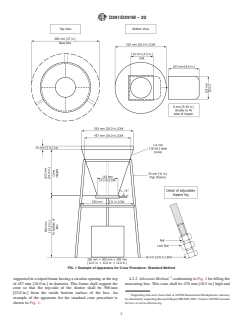
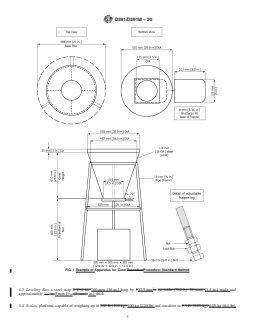
4.2.1 Standard Method, conforming to Fig. 1 for filling the
1.5 This international standard was developed in accor-
measuring box. This cone shall be 610 mm [24.0 in.] high and
dance with internationally recognized principles on standard-
510 mm [20.0 in.] in inside diameter at the top, with a circular
ization established in the Decision on Principles for the
opening 115 mm [4.5 in.] in diameter at the bottom. A slide
Development of International Standards, Guides and Recom-
valve consisting of a sliding-plate shutter and its supports shall
mendations issued by the World Trade Organization Technical
be welded to the bottom of the cone in such a manner that the
Barriers to Trade (TBT) Committee.
valve may be opened and closed with ease by removing or
inserting the shutter in its supporting slides. The cone shall be
This test method is under the jurisdiction of ASTM Committee D05 on Coal
and Coke and is the direct responsibility of Subcommittee D05.15 on Metallurgical
Properties of Coal and Coke. For referenced ASTM standards, visit the ASTM website, www.astm.org, or
Current edition approved Nov. 1, 2020. Published January 2021. Originally contact ASTM Customer Service at service@astm.org. For Annual Book of ASTM
approved in 1927. Last previous edition approved in 2012 as D291 – 07(2012). Standards volume information, refer to the standard’s Document Summary page on
DOI: 10.1520/D0291_D0291M-20. the ASTM website.
Copyright © ASTM International, 100 Barr Harbor Drive, PO Box C700, West Conshohocken, PA 19428-2959. United States
D291/D291M − 20
FIG. 1 Example of Apparatus for Cone Procedure: Standard Method
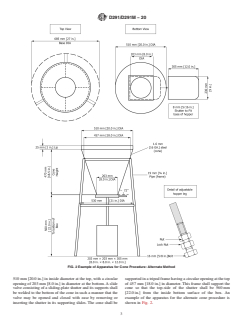
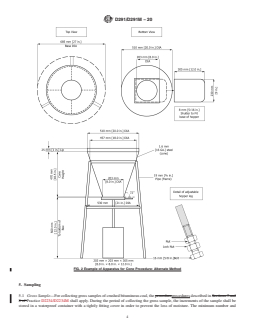
supported in a tripod frame having a circular opening at the top 4.2.2 AlternateMethod, conformingtoFig.2forfillingthe
of 457 mm [18.0 in.] in diameter. This frame shall support the measuring box. This cone shall be 470 mm [18.5 in.] high and
cone so that the top-side of the shutter shall be 560 mm
[22.0 in.] from the inside bottom surface of the box. An
Supporting data have been filed at ASTM International Headquarters and may
example of the apparatus for the standard cone procedure is
beobtainedbyrequestingResearchReportRR:D05-2001.ContactASTMCustomer
shown in Fig. 1. Service at service@astm.org.
D291/D291M − 20
FIG. 2 Example of Apparatus for Cone Procedure: Alternate Method
510 mm [20.0 in.] in inside diameter at the top, with a circular supported in a tripod frame having a circular opening at the top
opening of 203 mm [8.0 in.] in diameter at the bottom.Aslide of 457 mm [18.0 in.] in diameter. This frame shall support the
valve consisting of a sliding-plate shutter and its supports shall cone so that the top-side of the shutter shall be 560 mm
be welded to the bottom of the cone in such a manner that the [22.0 in.] from the inside bottom surface of the box. An
valve may be opened and closed with ease by removing or example of the apparatus for the alternate cone procedure is
inserting the shutter in its supporting slides. The cone shall be shown in Fig. 2.
D291/D291M − 20
4.3 Leveling Bar, a steel strip 760 mm [30 in.] long by the determination of the bulk density (see Section 5). The
37.5 mm[1.5 in.]wideandapproximately5 mm[ ⁄16 in.]thick. minimum gross sample masses required by Test Methods
D3302/D3302M and D4749 will not apply.
4.4 Scales, platform, capable of weighing up to 100 kg
[220 lb] and sensitive to 0.05 kg [0.1 lb]. 6.5 For the purpose of simplifying communication between
concerned parties in the reporting of the size distribution of the
5. Sampling
actual bulk density sample, it is recommended to employ the
standard series of sieves identified in 6.1.2 of Test Method
5.1 GrossSample—Forcollectinggrosssamplesofcrushed
bituminous coal, the procedures described in Practice D2234/ D4749 covering from within the actual topsize of the coal
down to 6.3 mm ( ⁄4 in.). Other sieve sizes may be used.
D2234M shall apply. During the period of collecting the gross
sample, the increments of the sample shall be stored in a
7. Calculation
waterproof container with a tightly fitting cover in order to
prevent the loss of moisture. The minimum number and mass
7.1 Calculate the uncompacted bulk density, BD ,to
uncomp
3 3
of increments collected shall be in accordance with Table 2 of
the nearest 0.05 kg/m [0.1 lb/ft ] as follows:
Practice D2234/D2234M. The minimum gross mass of the
3 3
BD ,kg⁄m lb ⁄ ft 5 W 2 W ⁄V (1)
@ # ~ !
uncomp 2 1 1
sample shall be 140 kg [300 lb].
where:
5.2 Laboratory Sample—The gross sample of coal shall be
W = the mass of the empty measuring box, kg [lb];
thoroughly mixed and subdivided, without crushing, into four
W = the mass of the filled measuring box after leveling as
34 kg [75 lb] portions. This operation shall be done as quickly
described in 6.3, kg [lb]; and
as possible to avoid loss of moisture, and the bulk density shall
V = the measured volume of the measuring box as deter-
be determined immediately. If this determination cannot be
mined by water calibration as described in 4.1,m
made immediately, the samples shall be kept in waterproof
[ft ].
containers with tightly fitting covers until the time for making
the determination.
8. Report
6. Procedure
8.1 Report the uncompacted bulk density, BD ,as
uncomp
3 3
calculated in Section 7 to the nearest 0.05 kg/m [0.1 lb/ft ].
6.1 Before filling the cone hopper, level it in its tripod on a
solidfloor.Pourthepreparedsampleintoapileonthefloorand
8.2 Report the method, either the Standard Method or
carefully flatten it to about 100 mm [4 in.] in thickness using a
Alternate Method, used to determine the BD .
uncomp
rake or shovel.Avoid pounding of the pile with the back of the
shovel. Take successive shovelfuls from uniformly distributed 9. Precision and Bias
pointsinthepileandallowthemtoslidegentlyfromtheshovel
9.1 Repeatability:
into the hopper at different peripheral points. This will prevent
9.1.1 Duplicate results by the same operator in a given
segregation and packing while the hopper is being filled. Place
laboratory on consecutive tests determined within a minimum
about 34 kg [75 lb] of coal in the hopper.
interval of time shall be considered suspect if they differ by
3 3
6.2 Weigh the empty measuring box to the nearest 0.05 kg more than 9.6 kg/m [0.6 lb/ft ].
[0.1 lb]. Center the previously weighed measuring box under 9.1.2 When two results are obtained that differ by more than
the valve of the cone. Remove the valve shutter completely, this value, two additional tests shall be made. If the second pair
allowing all of the coal to flow into the box and overflow the of results differs by less than the repeatability, the first pair
edges. Loosen wet coal, not flowing freely from the hopper, by shall be discarded and the mean of the second pair shall be
gently thrusting downward (or poke) through the coal to the reported as the result of the test.
valve with the leveling bar. 9.1.3 Whenbothpairsofresultsexceedtherepeatability,the
meanofthefourresultsshallbereported,providedthatthetwo
6.3 After filling the box, carefully level off the excess coal
3 3
most divergent results differ by less than 13 kg/m [0.8 lb/ft ].
above the box edge by means of the leveling bar, and place the
Otherwise, all results shall be discarded and the apparatus,
box on the platfor
...
This document is not an ASTM standard and is intended only to provide the user of an ASTM standard an indication of what changes have been made to the previous version. Because
it may not be technically possible to adequately depict all changes accurately, ASTM recommends that users consult prior editions as appropriate. In all cases only the current version
of the standard as published by ASTM is to be considered the official document.
Designation: D291 − 07 (Reapproved 2012) D291/D291M − 20
Standard Test Method for
Cubic Foot Weight Bulk Density of Crushed Bituminous
Coal
This standard is issued under the fixed designation D291;D291/D291M; the number immediately following the designation indicates the
year of original adoption or, in the case of revision, the year of last revision. A number in parentheses indicates the year of last
reapproval. A superscript epsilon (´) indicates an editorial change since the last revision or reapproval.
1. Scope
1.1 This test method covers two procedures for determining the cubic foot weight bulk density of crushed coal less than
137.5 mm ⁄2 in. (37 mm) [1.5 in.] in size, such as is charged into coke ovens, as follows:
1.1.1 Procedure A—The cone procedure for determining an uncompacted weight per cubic foot (cubic metre).bulk density.
1.1.1.1 Standard Method—Procedure employs the use of a 115 mm [4.5 in.] chute opening and a measuring box having
dimensions of 305 mm x 305 mm x 305 mm [12.0 in. x 12.0 in. x 12.0 in.].
1.1.1.2 Alternate Method—Procedure employs the use of a 203 mm [8.0 in.] chute opening and a measuring box having
dimensions of 203 mm x 203 mm x 305 mm [8.0 in. x 8.0 in. x 12.0 in.] for coals with a total moisture greater than 7 %.
1.1.2 Procedure B—The dropped-coal procedure for determining a compacted weight per cubic foot (cubic metre), bulk density,
comparable to actual bulk densities attained in coke ovens.
1.2 This test method is not applicable to the testing of powdered coal as used in boiler plants, nor to the determination of weights
per cubic foot the bulk density of coal in storage piles.
1.3 Units—The values stated in either SI units or inch-pound units are to be regarded separately as standard. The values
givenstated in parentheses are mathematical conversions to SI units that are provided for information only and are not considered
standard. Mass may be expressed in metric values.each system are not necessarily exact equivalents; therefore, to ensure
conformance with the standard, each system shall be used independently of the other, and values from the two systems shall not
be combined.
1.4 This standard does not purport to address all of the safety concerns, if any, associated with its use. It is the responsibility
of the user of this standard to establish appropriate safety safety, health, and healthenvironmental practices and determine the
applicability of regulatory limitations prior to use.
1.5 This international standard was developed in accordance with internationally recognized principles on standardization
established in the Decision on Principles for the Development of International Standards, Guides and Recommendations issued
by the World Trade Organization Technical Barriers to Trade (TBT) Committee.
This test method is under the jurisdiction of ASTM Committee D05 on Coal and Coke and is the direct responsibility of Subcommittee D05.15 on Metallurgical Properties
of Coal and Coke.
Current edition approved Sept. 1, 2012Nov. 1, 2020. Published October 2007January 2021. Originally approved in 1927. Last previous edition approved in 20072012 as
ε1
D291 – 07 .(2012). DOI: 10.1520/D0291-07R12. 10.1520/D0291_D0291M-20.
Copyright © ASTM International, 100 Barr Harbor Drive, PO Box C700, West Conshohocken, PA 19428-2959. United States
D291/D291M − 20
2. Referenced Documents
2.1 ASTM Standards:
D440 Test Method of Drop Shatter Test for Coal
D2234/D2234M Practice for Collection of a Gross Sample of Coal
D3038 Test Method for Drop Shatter Test for Coke
D3302D3302/D3302M Test Method for Total Moisture in Coal
D4749 Test Method for Performing the Sieve Analysis of Coal and Designating Coal Size
3. Significance and Use
3.1 This test method concerns the compaction of crushed coal to determine either its compacted or uncompacted weight, bulk
density, for purposes such as charging coke ovens.
PROCEDURE A—CONE PROCEDURE FOR UNCOMPACTED CUBIC FOOT (CUBIC METRE) WEIGHT BULK
DENSITY
4. Apparatus
4.1 Measuring Box,Box: of rigid construction, having inside dimensions of 12.0 by 12.0 by 12.0 in. (305 by 305 by 305 mm), and
3 3 3
a volume of 1728 6 5 in. (0.0283 m 6 82 cm ). The exact volume of the box shall be determined by water calibration.
4.1.1 Standard Method, of rigid construction, having inside dimensions of 305 mm x 305 mm x 305 mm [12.0 in. x 12.0 in. x
3 3 3 3
12.0 in.], and a volume of 0.02873 m 6 0.00008 m [1.000 ft 6 .003 ft ]. The exact volume of the box shall be determined by
water calibration.
4.1.2 Alternate Method, of rigid construction, having the inside dimensions of 203 mm x 203 mm x 305 mm [8.0 in. x 8.0 in. x
3 3 3 3
12.0 in.], and a volume of 0.01257 m 6 .00003 m [0.4444 ft 6 0.0012 ft ]. The exact volume of the box shall be determined
by water calibration.
4.2 Cone,Cone: conforming to Fig. 1 for filling the box. This cone shall be 2 ft 0 in. (610 mm) high and 1 ft 8 in. (508 mm) in
inside diameter at the top, with a circular opening 4 ⁄2 in. (114 mm) in diameter at the bottom. A slide valve consisting of a
sliding-plate shutter and its supports shall be welded to the bottom of the cone in such a manner that the valve may be opened and
closed with ease by removing or inserting the shutter in its supporting slides. The cone shall be supported in a tripod frame having
a circular opening at the top of about 1 ft 6 in. (457 mm) in diameter. This frame shall support the cone so that the top-side of
the shutter shall be 1 ft 10 in. (559 mm) from the inside bottom surface of the box. (See Fig. 1.)
4.2.1 Standard Method, conforming to Fig. 1 for filling the measuring box. This cone shall be 610 mm [24.0 in.] high and 510
mm [20.0 in.] in inside diameter at the top, with a circular opening 115 mm [4.5 in.] in diameter at the bottom. A slide valve
consisting of a sliding-plate shutter and its supports shall be welded to the bottom of the cone in such a manner that the valve may
be opened and closed with ease by removing or inserting the shutter in its supporting slides. The cone shall be supported in a tripod
frame having a circular opening at the top of 457 mm [18.0 in.] in diameter. This frame shall support the cone so that the top-side
of the shutter shall be 560 mm [22.0 in.] from the inside bottom surface of the box. An example of the apparatus for the standard
cone procedure is shown in Fig. 1.
4.2.2 Alternate Method, conforming to Fig. 2 for filling the measuring box. This cone shall be 470 mm [18.5 in.] high and 510
mm [20.0 in.] in inside diameter at the top, with a circular opening of 203 mm [8.0 in.] in diameter at the bottom. A slide valve
consisting of a sliding-plate shutter and its supports shall be welded to the bottom of the cone in such a manner that the valve may
be opened and closed with ease by removing or inserting the shutter in its supporting slides. The cone shall be supported in a tripod
frame having a circular opening at the top of 457 mm [18.0 in.] in diameter. This frame shall support the cone so that the top-side
of the shutter shall be 560 mm [22.0 in.] from the inside bottom surface of the box. An example of the apparatus for the alternate
cone procedure is shown in Fig. 2.
For referenced ASTM standards, visit the ASTM website, www.astm.org, or contact ASTM Customer Service at service@astm.org. For Annual Book of ASTM Standards
volume information, refer to the standard’s Document Summary page on the ASTM website.
Supporting data have been filed at ASTM International Headquarters and may be obtained by requesting Research Report RR:D05-2001. Contact ASTM Customer
Service at service@astm.org.
D291/D291M − 20
FIG. 1 Example of Apparatus for Cone ProcedureProcedure: Standard Method
4.3 Leveling Bar, a steel strip 2 ft 6 in. 760 mm [30 in.] long by 137.5 mm ⁄2 in. wide (762 by 38 mm) [1.5 in.] wide and
3 3
approximately ⁄16 in.5 mm [ ⁄16 (5 mm) in.] thick.
4.4 Scales, platform, capable of weighing up to 200 lb (100 kg) 100 kg [220 lb] and sensitive to 0.1 lb (0.05 kg).0.05 kg [0.1 lb].
D291/D291M − 20
FIG. 2 Example of Apparatus for Cone Procedure: Alternate Method
5. Sampling
5.1 Gross Sample—For collecting gross samples of crushed bituminous coal, the procedureprocedures described in Sections 7 and
8 of Practice D2234/D2234M shall apply. During the period of collecting the gross sample, the increments of the sample shall be
stored in a waterproof container with a tightly fitting cover in order to prevent the loss of moisture. The minimum number and
D291/D291M − 20
weightsmass of increments collected shall be in accordance with Table 2 of Practice D2234/D2234M. The minimum gross
weightmass of the sample shall be 300 lb (136 kg).140 kg [300 lb].
5.2 Laboratory Sample—The gross sample of coal shall be thoroughly mixed and subdivided, without crushing, into four 75-lb
(34-kg)34 kg [75 lb] portions. This operation shall be done as quickly as possible to avoid loss of moisture, and the cubic foot
(cubic metre) weight bulk density shall be determined immediately. If this determination cannot be made immediately, the samples
shall be kept in waterproof containers with tightly fitting covers until the time for making the determination.
6. Procedure
6.1 Before filling the cone hopper, level it in its tripod on a solid floor. Pour the prepared sample into a pile on the floor and
carefully flatten it to about 4 in. (100 mm) in thickness. 100 mm [4 in.] in thickness using a rake or shovel. Avoid pounding of the
pile with the back of the shovel. Take successive shovelfuls from uniformly distributed points in the pile,pile and allow them to
slide gently from the shovel into the hopper at different peripheral points. This will prevent segregation and packing while the
hopper is being filled. Place about 75 lb (34 kg)34 kg [75 lb] of coal in the hopper.
6.2 Weigh the empty measuring box to the nearest 0.05 kg [0.1 lb]. Center the previously weighed cubic foot (cubic metre)
measuring box under the valve of the cone. Then remove Remove the valve shutter completely, allowing all of the coal to flow
into the box and overflow the edges. Loosen wet coal, not flowing freely from the hopper, by gently thrusting downward (or poke)
through the coal to the valve with the leveling bar.
6.3 After filling the box, carefully level off the excess coal above the box edge by means of the leveling bar, and place the box
on the platform scale and weigh it to the nearest 0.1 lb (0.05 kg). 0.05 kg [0.1 lb]. Avoid jarring or shifting of the filled box until
all excess coal is leveled off. Record the difference in weight between mass of the filled and empty measuring box to the nearest
0.1 lb (0.05 kg) as the uncompacted cubic foot weight.0.05 kg [0.1 lb].
NOTE 1—Aside from the character of the coal itself, moisture content and size distribution of the coal are the two main factors which affect the cubic
foot weight. A moisture determination and sieve analysis of the coal should be reported along with the cubic foot weight for proper interpretation of the
cubic foot weight. For directions for making these determinations, see the following:
Moisture—Test Method D3302.
Sieve Analysis—Method D4749.
6.4 Moisture and size distribution of the coal are the two main factors which affect the bulk density. It is recommended for proper
interpretation that a moisture determination and sieve analysis of the coal be reported along with the bulk density result. For
directions for determination of the total moisture, see Test Method D3302/D3302M. For directions for the determination of size
distribution, see Test Method D4749. For the purposes of reporting both total moisture and size distribution associated with the
bulk density results, the representative sample is taken to be the actual sample employed for the determination of the bulk density
(see Section 5). The minimum gross sample masses required by Test Methods D3302/D3302M and D4749 will not apply.
6.5 For the purpose of simplifying communication between concerned parties in the reporting of the size distribution of the actual
bulk density sample, it is recommended to employ the standard series of sieves identified in 6.1.2 of Test Method D4749 covering
from within the actual topsize of the coal down to 6.3 mm ( ⁄4 in.). Other sieve sizes may be used.
7. Calculation
3 3
7.1 Calculate the uncompacted bulk densi
...