

ASTM B131-22
(Specification)Standard Specification for Copper Alloy Bullet Jacket Cups
General Information
- Abstract
ABSTRACT
This specification covers bullet jacket preform cups made from UNS C22000 wrought copper alloy used for processing Types I-IV and Classes I-II bullet jackets. This standard contains information on chemical composition, grain size and testing requirements for the preform cups.
SIGNIFICANCE AND USE
15.1 For the purpose of determining compliance with the specified limits for requirements of the properties listed in the following table and for dimensional tolerances, an observed value or a calculated value shall be rounded as indicated in accordance with the rounding method of Practice E29.
Property
Rounded Unit for Observed or Calculated Value
Chemical Composition
Nearest unit in the last right-hand significant digit used in expressing the limiting value
Grain size
Nearest multiple of 0.005 mm
SCOPE
1.1 This specification establishes the requirements for bullet jacket preform cups produced of Copper Alloy UNS No. C22000 for processing into bullet jackets of the following types and classes:
1.1.1 Type I—Caliber 0.30.
1.1.2 Type II—Caliber 0.45.
1.1.3 Type III—Caliber 0.50.
1.1.4 Type IV—As specified in the contract or order.
1.1.5 Class I—Not annealed.
1.1.6 Class II—Annealed.
1.2 Units—The values stated in inch-pound units are to be regarded as standard, except for grain size, which is given in SI units. The values given in parentheses are mathematical conversions to SI units that are provided for information only and are not considered standard.
1.3 This international standard was developed in accordance with internationally recognized principles on standardization established in the Decision on Principles for the Development of International Standards, Guides and Recommendations issued by the World Trade Organization Technical Barriers to Trade (TBT) Committee.
- Status
- Published
- Publication Date
- 30-Sep-2022
- Technical Committee
- B05 - Copper and Copper Alloys
- Drafting Committee
- B05.01 - Plate, Sheet, and Strip
Overview
ASTM B131-22 is the internationally recognized standard specification for copper alloy bullet jacket cups made from UNS C22000. Developed and published by ASTM International, this standard establishes comprehensive requirements for the material composition, grain size, temper condition, manufacturing, testing, and quality assurance of bullet jacket preform cups. These cups are primarily used as intermediate forms that are subsequently processed into finished bullet jackets for ammunition manufacturing.
ASTM B131-22 provides crucial guidance for manufacturers, purchasers, and quality control professionals across the ammunition and defense sectors, ensuring product uniformity, performance reliability, and compliance with international trade and procurement requirements.
Key Topics
Material Requirements
- Specifies use of wrought copper alloy UNS C22000, known for its formability and corrosion resistance.
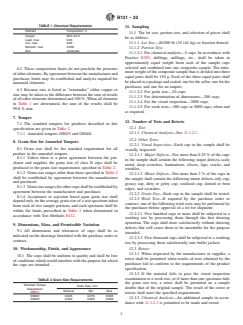
- Defines chemical composition limits, including copper content (89.0–91.0%), with the balance primarily zinc.
- Restricts impurities such as lead, iron, and bismuth.
Product Forms and Types
- Covers preform cups for bullet jackets in a range of calibers: Type I (0.30), Type II (0.45), Type III (0.50), and Type IV (as specified).
- Designates two classes by temper: Class I (not annealed) and Class II (annealed).
Dimensional and Quality Requirements
- Requires products to meet tight dimensional tolerances and specified grain size ranges for optimal drawability and performance.
- Details acceptable levels of major and minor surface defects and requires uniform appearance and structure.
Testing and Inspection
- Includes protocols for chemical analysis, grain size determination, visual inspection, and workability testing.
- Prescribes sampling methods and lot sizes to ensure representative quality checks.
Ordering and Traceability
- Outlines essential information for purchase orders, including specification reference, type and class, grain size, dimensions, and any special testing requirements.
- Stipulates packaging, marking, and certification protocols to facilitate traceability and quality control.
Applications
Ammunition Manufacturing
- The primary application is in the production of bullet jackets for various calibers, where copper alloy cups provide the necessary malleability and uniformity for subsequent drawing operations.
- Applicable to both commercial and military ammunition manufacturing, supporting calibers commonly used in small arms.
Defense Industry Procurement
- Used as a reference in military contracts and large-scale government procurement processes to ensure reliable ammunition component sourcing.
Quality Assurance and Compliance
- Essential for meeting international quality standards and for compliance with technical barrier-to-trade provisions established by the World Trade Organization.
Related Standards
Several other ASTM and federal standards are often associated with ASTM B131-22 in the production, testing, and procurement of copper alloys and bullet components:
- ASTM B601 - Classification for Temper Designations for Copper and Copper Alloys (Wrought and Cast)
- ASTM B846 - Terminology for Copper and Copper Alloys
- ASTM E3 - Guide for Preparation of Metallographic Specimens
- ASTM E29 - Practice for Using Significant Digits in Test Data to Determine Conformance with Specifications
- ASTM E112 - Test Methods for Determining Average Grain Size
- ASTM E255 - Practice for Sampling Copper and Copper Alloys for Chemical Composition
- ASTM E478 - Test Methods for Chemical Analysis of Copper Alloys
- ASTM B900 - Practice for Packaging Copper and Copper-Alloy Mill-Products for U.S. Government Agencies
These standards work alongside ASTM B131-22 to ensure the reliability, consistency, and traceability of copper alloy bullet jacket cups in global supply chains.
Keywords: ASTM B131-22, copper alloy bullet jacket cups, UNS C22000, ammunition manufacturing, grain size, chemical composition, quality assurance, copper alloy standards, bullet jackets, defense procurement, ASTM standards.
Relations
- Effective Date
- 01-Aug-2019
- Effective Date
- 01-Jan-2019
- Effective Date
- 01-Oct-2018
- Effective Date
- 01-Mar-2018
- Effective Date
- 01-Oct-2016
- Effective Date
- 15-Nov-2012
- Effective Date
- 01-Oct-2012
- Effective Date
- 01-Jun-2011
- Effective Date
- 01-Jan-2011
- Effective Date
- 01-Nov-2010
- Effective Date
- 15-Nov-2009
- Effective Date
- 01-Nov-2009
- Effective Date
- 01-Oct-2009
- Effective Date
- 15-Dec-2008
- Effective Date
- 01-Oct-2008
Get Certified
Connect with accredited certification bodies for this standard

Element Materials Technology
Materials testing and product certification.

Inštitut za kovinske materiale in tehnologije
Institute of Metals and Technology. Materials testing, metallurgical analysis, NDT.
Sponsored listings
Frequently Asked Questions
ASTM B131-22 is a technical specification published by ASTM International. Its full title is "Standard Specification for Copper Alloy Bullet Jacket Cups". This standard covers: ABSTRACT This specification covers bullet jacket preform cups made from UNS C22000 wrought copper alloy used for processing Types I-IV and Classes I-II bullet jackets. This standard contains information on chemical composition, grain size and testing requirements for the preform cups. SIGNIFICANCE AND USE 15.1 For the purpose of determining compliance with the specified limits for requirements of the properties listed in the following table and for dimensional tolerances, an observed value or a calculated value shall be rounded as indicated in accordance with the rounding method of Practice E29. Property Rounded Unit for Observed or Calculated Value Chemical Composition Nearest unit in the last right-hand significant digit used in expressing the limiting value Grain size Nearest multiple of 0.005 mm SCOPE 1.1 This specification establishes the requirements for bullet jacket preform cups produced of Copper Alloy UNS No. C22000 for processing into bullet jackets of the following types and classes: 1.1.1 Type I—Caliber 0.30. 1.1.2 Type II—Caliber 0.45. 1.1.3 Type III—Caliber 0.50. 1.1.4 Type IV—As specified in the contract or order. 1.1.5 Class I—Not annealed. 1.1.6 Class II—Annealed. 1.2 Units—The values stated in inch-pound units are to be regarded as standard, except for grain size, which is given in SI units. The values given in parentheses are mathematical conversions to SI units that are provided for information only and are not considered standard. 1.3 This international standard was developed in accordance with internationally recognized principles on standardization established in the Decision on Principles for the Development of International Standards, Guides and Recommendations issued by the World Trade Organization Technical Barriers to Trade (TBT) Committee.
ABSTRACT This specification covers bullet jacket preform cups made from UNS C22000 wrought copper alloy used for processing Types I-IV and Classes I-II bullet jackets. This standard contains information on chemical composition, grain size and testing requirements for the preform cups. SIGNIFICANCE AND USE 15.1 For the purpose of determining compliance with the specified limits for requirements of the properties listed in the following table and for dimensional tolerances, an observed value or a calculated value shall be rounded as indicated in accordance with the rounding method of Practice E29. Property Rounded Unit for Observed or Calculated Value Chemical Composition Nearest unit in the last right-hand significant digit used in expressing the limiting value Grain size Nearest multiple of 0.005 mm SCOPE 1.1 This specification establishes the requirements for bullet jacket preform cups produced of Copper Alloy UNS No. C22000 for processing into bullet jackets of the following types and classes: 1.1.1 Type I—Caliber 0.30. 1.1.2 Type II—Caliber 0.45. 1.1.3 Type III—Caliber 0.50. 1.1.4 Type IV—As specified in the contract or order. 1.1.5 Class I—Not annealed. 1.1.6 Class II—Annealed. 1.2 Units—The values stated in inch-pound units are to be regarded as standard, except for grain size, which is given in SI units. The values given in parentheses are mathematical conversions to SI units that are provided for information only and are not considered standard. 1.3 This international standard was developed in accordance with internationally recognized principles on standardization established in the Decision on Principles for the Development of International Standards, Guides and Recommendations issued by the World Trade Organization Technical Barriers to Trade (TBT) Committee.
ASTM B131-22 is classified under the following ICS (International Classification for Standards) categories: 77.150.30 - Copper products. The ICS classification helps identify the subject area and facilitates finding related standards.
ASTM B131-22 has the following relationships with other standards: It is inter standard links to ASTM B846-19a, ASTM B846-19, ASTM B601-18a, ASTM B601-18, ASTM B601-16, ASTM E112-12, ASTM B601-12, ASTM B846-11a, ASTM B846-11, ASTM E112-10, ASTM B846-09a, ASTM B846-09, ASTM B601-09, ASTM E478-08, ASTM E29-08. Understanding these relationships helps ensure you are using the most current and applicable version of the standard.
ASTM B131-22 is available in PDF format for immediate download after purchase. The document can be added to your cart and obtained through the secure checkout process. Digital delivery ensures instant access to the complete standard document.
Standards Content (Sample)
This international standard was developed in accordance with internationally recognized principles on standardization established in the Decision on Principles for the
Development of International Standards, Guides and Recommendations issued by the World Trade Organization Technical Barriers to Trade (TBT) Committee.
Designation:B131 −22
Standard Specification for
Copper Alloy Bullet Jacket Cups
This standard is issued under the fixed designation B131; the number immediately following the designation indicates the year of
original adoption or, in the case of revision, the year of last revision. A number in parentheses indicates the year of last reapproval. A
superscript epsilon (´) indicates an editorial change since the last revision or reapproval.
1. Scope* the Determination of Chemical Composition
E478 Test Methods for ChemicalAnalysis of CopperAlloys
1.1 This specification establishes the requirements for bullet
jacket preform cups produced of Copper Alloy UNS No.
3. Terminology
C22000 for processing into bullet jackets of the following
types and classes:
3.1 For definitions of terms related to copper and copper
1.1.1 Type I—Caliber 0.30.
alloys, refer to Terminology B846.
1.1.2 Type II—Caliber 0.45.
3.2 Definitions of Terms Specific to This Standard:
1.1.3 Type III—Caliber 0.50.
3.2.1 cup (cupping), n—a shallow cylindrical shell closed at
1.1.4 Type IV—As specified in the contract or order.
one end, normally intended for further fabrication, formed
1.1.5 Class I—Not annealed.
from a blank.
1.1.6 Class II—Annealed.
1.2 Units—The values stated in inch-pound units are to be
4. Ordering Information
regarded as standard, except for grain size, which is given in SI
4.1 Include the following specified choices when placing
units. The values given in parentheses are mathematical
orders for product under this specification, as applicable:
conversions to SI units that are provided for information only
and are not considered standard. 4.1.1 ASTM designation and year of issue,
4.1.2 Type and class (Section 1),
1.3 This international standard was developed in accor-
dance with internationally recognized principles on standard- 4.1.3 Grain size (Section 8),
ization established in the Decision on Principles for the
4.1.4 Dimensions and tolerances (Subsection 9.1),
Development of International Standards, Guides and Recom-
4.1.5 Drawing number to which order applies (Subsection
mendations issued by the World Trade Organization Technical
9.1),
Barriers to Trade (TBT) Committee.
4.1.6 Work test requirements, if required (Section 12), and
4.1.7 If product is purchased for agencies of the U.S.
2. Referenced Documents
Government (see the Supplementary Requirements section of
2.1 ASTM Standards:
this specification for additional requirements, if specified).
B601 Classification forTemper Designations for Copper and
Copper Alloys—Wrought and Cast
5. Materials and Manufacture
B846 Terminology for Copper and Copper Alloys
5.1 Materials:
E3 Guide for Preparation of Metallographic Specimens
5.1.1 The material of manufacture shall be annealed plate,
E29 Practice for Using Significant Digits in Test Data to
Determine Conformance with Specifications sheet, strip, or disks of wrought Copper Alloy UNS No.
C22000 processed to produce even-topped cups.
E112 Test Methods for Determining Average Grain Size
E255 Practice for Sampling Copper and Copper Alloys for
5.2 Manufacture:
5.2.1 The product shall be manufactured by such blanking
and cupping to meet the cup dimensions specified, and subse-
ThisspecificationisunderthejurisdictionofASTMCommitteeB05onCopper
quently annealed, if required. The annealed cups shall be
andCopperAlloysandisthedirectresponsibilityofSubcommitteeB05.01onPlate,
Sheet, and Strip. cleaned to provide a surface suitable for subsequent redrawing
Current edition approved Oct. 1, 2022. Published October 2022. Originally
into bullet jackets.
approved in 1940. Last previous edition approved in 2017 as B131-17. DOI:
10.1520/B0131-22.
6. Chemical Composition
For referenced ASTM standards, visit the ASTM website, www.astm.org, or
contact ASTM Customer Service at service@astm.org. For Annual Book of ASTM
6.1 The product shall conform to the chemical composition
Standards volume information, refer to the standard’s Document Summary page on
the ASTM website. requirements in Table 1.
*A Summary of Changes section appears at the end of this standard
Copyright © ASTM International, 100 Barr Harbor Drive, PO Box C700, West Conshohocken, PA 19428-2959. United States
B131−22
TABLE 1 Chemical Requirements
11. Sampling
Element Composition, %
11.1 The lot size, portion size, and selection of pieces shall
Copper 89.0–91.0
be as follows:
Lead, max 0.05
Iron, max 0.05 11.1.1 Lot Size—40 000 lb (18 144 kg) or fraction thereof.
Bismuth, max 0.006
11.1.2 Portion Size:
Zinc remainder
11.1.2.1 For chemical analysis—5 cups. In accordance with
Practice E255, drillings, millings, etc., shall be taken in
approximately equal weight from each of the sample cups
selected and combined into one composite sample. The mini-
6.2 These composition limits do not preclude the presence
mum weight of the composite sample that is divided into three
ofotherelements.Byagreementbetweenthemanufacturerand
equal parts shall be 150 g. Each of the three equal parts shall
purchaser, limits may be established and analysis required for
beplacedinapackageandsealed:onefortheseller,oneforthe
unnamed elements.
purchaser, and one for an umpire.
6.3 Because zinc is listed as “remainder,” either copper or
11.1.2.2 For grain size—20 cups.
zinc may be taken as the difference between the sum of results
11.1.2.3 For determination of dimensions—200 cups.
ofallotherelementsdeterminedand100 %.Whenallelements
11.1.2.4 For the visual inspection—2000 cups.
in Table 1 are determined, the sum of the results shall be
11.1.2.5 For work tests—500 cups or 5000 cups, when and
99.8 % min.
as required.
7. Temper
12. Number of Tests and Retests
7.1 The standard tempers for products described in this
12.1 Test:
specification are given in Table 2.
7.1.1 Annealed tempers OS025 and OS040. 12.1.1 Chemical Analysis—See 11.1.2.1.
12.2 Other Tests:
8. Grain Size for Annealed Tempers
12.2.1 Visual Inspection—Each cup in the sample shall be
8.1 Grain size shall be the standard requirement for all
visually inspected.
product in the annealed tempers.
12.2.1.1 Major Defects—Not more than 0.25 % of the cups
8.1.1 Unless there is a prior agreement between the pur-
in the sample shall contain the following major defects–scaly
chaser and supplier, the grain size of class II cups shall be
metal, deep scratches, laminations, slivers, laps, cracks, and
produced to the grain size requirements specified in Table 2.
wrinkles.
8.1.2 Grain size ranges other than those specified in Table 2
12.2.1.2 Minor Defects—Not more than 2 % of the cups in
shall be established by agreement between the manufacturer
the sample shall contain the following minor defects–oily cup,
and purchaser.
greasy cup, dirty or gritty cup, oxidized cup, dented or bent
8.1.3 Grainsizerangesforothercupsshallbeestablishedby
edges, and scratches.
agreement between the manufacturer and purchaser.
12.2.2 Grain Size—Each cup in the sample shall be tested.
8.1.4 Acceptance or rejection based upon grain size shall
12.2.3 Work Test—If required by the purchase order or
depend only on the average grain size of a test specimen taken
contract, one of the following work tests may be performed by
from each of two sample portions, and each specimen shall be
the purchaser before approval of a lot for shipment:
within the limits prescribed in Table 2 when determined in
12.2.3.1 Five hundred cups or more shall be subjected to a
accordance with Test Methods E112.
working test by processing them through the first drawing
operation. The cups shall draw satisfactorily without showing
9. Dimensions, Mass, and Permissible Variation
defects that will cause them to be unsuitable for the purpose
9.1 All dimensions and tolerances of cups shall be as
intended.
indicated on the drawings furnished with the purchase order or
12.2.3.2 Five thousand cups shall be subjected to a working
contract.
test by processing them satisfactorily into bullet jackets.
12.3 Retest:
10. Workmanship, Finish, and Appearance
12.3.1 When requested by the manufacturer or supplier, a
10.1 The cups shall be uniform in quality and shall be free
retest shall be permitted when results of tests obtained by the
ofconditionswhichwouldinterferewiththepurposeforwhich
purchaser fail to conform to the requirements of the product
the cups are intended.
specification.
12.3.2 If the material fails to pass the visual inspection
examination or a work test, or if more than one specimen fails
TABLE 2 Grain Size Requirements
the grain size test, a retest shall be permitted on a sample
Standard Temper
Grain Size, mm
double that of the original sample. The result of the retest or
Designation
Nominal Min Max
(B601)
retests shall meet the specified requirements.
OS025 0.025 0.015 0.035
12.3.3 Chemical Analysis—An additional sample in accor-
OS040 0.040 0.025 0.050
dance with 11.1.2.1 is permitted to be made and tested.
B131−22
13. Specimen Preparation 14.2.2 Grainsizemeasurementsshallbemadeinazonethat
is the approximate mid-point of the side-wall length and
13.1 For grain size measurements, either tangential grinding
thickness of the cups as shown in Fig. 1. At least three
and polishing, or cutting, mounting, and polishing methods
measurements shall be made, averaged, and recorded for each
may be used to reach the zone (Fig. 1).
grain size determination.
13.1.1 The test specimen shall be prepared in accordance
...
This document is not an ASTM standard and is intended only to provide the user of an ASTM standard an indication of what changes have been made to the previous version. Because
it may not be technically possible to adequately depict all changes accurately, ASTM recommends that users consult prior editions as appropriate. In all cases only the current version
of the standard as published by ASTM is to be considered the official document.
Designation: B131 − 17 B131 − 22
Standard Specification for
Copper Alloy Bullet Jacket Cups
This standard is issued under the fixed designation B131; the number immediately following the designation indicates the year of
original adoption or, in the case of revision, the year of last revision. A number in parentheses indicates the year of last reapproval. A
superscript epsilon (´) indicates an editorial change since the last revision or reapproval.
1. Scope*
1.1 This specification establishes the requirements for bullet jacket preform cups produced of Copper Alloy UNS No. C22000 for
processing into bullet jackets of the following types and classes:
1.1.1 Type I—Caliber 0.30.
1.1.2 Type II—Caliber 0.45.
1.1.3 Type III—Caliber 0.50.
1.1.4 Type IV—As specified in the contract or order.
1.1.5 Class I—Not annealed.
1.1.6 Class II—Annealed.
1.2 Units—The values stated in inch-pound units are to be regarded as standard, except for grain size, which is given in SI units.
The values given in parentheses are mathematical conversions to SI units, whichunits that are provided for information only and
are not considered standard.
1.3 This international standard was developed in accordance with internationally recognized principles on standardization
established in the Decision on Principles for the Development of International Standards, Guides and Recommendations issued
by the World Trade Organization Technical Barriers to Trade (TBT) Committee.
2. Referenced Documents
2.1 ASTM Standards:
B601 Classification for Temper Designations for Copper and Copper Alloys—Wrought and Cast
B846 Terminology for Copper and Copper Alloys
E3 Guide for Preparation of Metallographic Specimens
E29 Practice for Using Significant Digits in Test Data to Determine Conformance with Specifications
E112 Test Methods for Determining Average Grain Size
E255 Practice for Sampling Copper and Copper Alloys for the Determination of Chemical Composition
This specification is under the jurisdiction of ASTM Committee B05 on Copper and Copper Alloys and is the direct responsibility of Subcommittee B05.01 on Plate,
Sheet, and Strip.
Current edition approved April 1, 2017Oct. 1, 2022. Published April 2017October 2022. Originally approved in 1940. Last previous edition approved in 20122017 as
B131-12.-17. DOI: 10.1520/B0131-17.10.1520/B0131-22.
For referenced ASTM standards, visit the ASTM website, www.astm.org, or contact ASTM Customer Service at service@astm.org. For Annual Book of ASTM Standards
volume information, refer to the standard’s Document Summary page on the ASTM website.
*A Summary of Changes section appears at the end of this standard
Copyright © ASTM International, 100 Barr Harbor Drive, PO Box C700, West Conshohocken, PA 19428-2959. United States
B131 − 22
E478 Test Methods for Chemical Analysis of Copper Alloys
3. Terminology
3.1 For definitions of terms related to copper and copper alloys, see refer to Terminology B846.
3.2 Definitions of Terms Specific to This Standard:
3.2.1 cup (cupping), n—a shallow cylindrical shell closed at one end, normally intended for further fabrication, formed from a
blank.
4. Ordering Information
4.1 Include the following specified choices when placing orders for product under this specification, as applicable:
4.1.1 ASTM designation and year of issue.issue,
4.1.2 Type and class (Section 1),
4.1.3 Grain size (Section 8),
4.1.4 Dimensions and tolerances (see(Subsection 9.1),
4.1.5 Drawing number to which order applies (see(Subsection 9.1),
4.1.6 Work test requirements, if required (Section 12), and
4.1.7 If product is purchased for agencies of the U.S. Government (see the Supplementary Requirements section of this
specification for additional requirements, if specified).
5. Materials and Manufacture
5.1 Materials:
5.1.1 The material of manufacture shall be annealed plate, sheet, strip, or disks of wrought Copper Alloy UNS No. C22000
processed to produce even-topped cups.
5.2 Manufacture:
5.2.1 The product shall be manufactured by such blanking and cupping to meet the cup dimensions specified, and subsequently
annealed, if required. The annealed cups shall be cleaned to provide a surface suitable for subsequent redrawing into bullet jackets.
6. Chemical Composition
6.1 The product shall conform to the chemical composition requirements prescribed in Table 1.
6.2 These composition limits do not preclude the presence of other elements. By agreement between the manufacturer and
purchaser, limits may be established and analysis required for unnamed elements.
TABLE 1 Chemical Requirements
Element Composition, %
Copper 89.0–91.0
Lead, max 0.05
Iron, max 0.05
Bismuth, max 0.006
Zinc remainder
B131 − 22
6.3 Because zinc is listed as “remainder,” either copper or zinc may be taken as the difference between the sum of results of all
other elements determined and 100 %. When all elements in Table 1 are determined, the sum of the results shall be 99.8 % min.
7. Temper
7.1 The standard tempers for products described in this specification are given in Table 2.
7.1.1 Annealed tempers OS025 and OS040.
8. Grain Size for Annealed Tempers
8.1 Grain size shall be the standard requirement for all product in the annealed tempers.
8.1.1 Unless there is a prior agreement between the purchaser and supplier, the grain size of class II cups shall be produced to the
grain size requirements specified in Table 2.
8.1.2 Grain size ranges other than those specified in Table 2 shall be established by agreement between the manufacturer and
purchaser.
8.1.3 Grain size ranges for other cups shall be established by agreement between the manufacturer and purchaser.
8.1.4 Acceptance or rejection based upon grain size shall depend only on the average grain size of a test specimen taken from each
of two sample portions, and each specimen shall be within the limits prescribed in Table 2 when determined in accordance with
Test Methods E112.
9. Dimensions, Mass, and Permissible Variation
9.1 All dimensions and tolerances of cups shall be as indicated on the drawings furnished with the purchase order or contract.
10. Workmanship, Finish, and Appearance
10.1 The cups shall be uniform in quality and shall be free of conditions which would interfere with the purpose for which the
cups are intended.
11. Sampling
11.1 The lot size, portion size, and selection of pieces shall be as follows:
11.1.1 Lot Size—40 000 lb (18 144 kg) or fraction thereof.
11.1.2 Portion Size:
11.1.2.1 For chemical analysis—5 cups. In accordance with Practice E255, drillings, millings, etc., shall be taken in approximately
equal weight from each of the sample cups selected and combined into one composite sample. The minimum weight of the
composite sample that is divided into three equal parts shall be 150 g. Each of the three equal parts shall be placed in a package
and sealed: one for the seller, one for the purchaser, and one for an umpire.
11.1.2.2 For grain size—20 cups.
11.1.2.3 For determination of dimensions—200 cups.
TABLE 2 Grain Size Requirements
Standard Temper
Grain Size, mm
Designation
Nominal Min Max
(B601)
OS025 0.025 0.015 0.035
OS040 0.040 0.025 0.050
B131 − 22
11.1.2.4 For the visual inspection—2000 cups.
11.1.2.5 For work tests—500 cups or 5000 cups, when and as required.
12. Number of Tests and Retests
12.1 Test:
12.1.1 Chemical Analysis—See 11.1.2.1.
12.2 Other Tests:
12.2.1 Visual Inspection—Each cup in the sample shall be visually inspected.
12.2.1.1 Major Defects—Not more than 0.25 % of the cups in the sample shall contain the following major defects–scaly metal,
deep scratches, laminations, slivers, laps, cracks, and wrinkles.
12.2.1.2 Minor Defects—Not more than 2 % of the cups in the sample shall contain the following minor defects–oily cup, greasy
cup, dirty or gritty cup, oxidized cup, dented or bent edges, and scratches.
12.2.2 Grain Size—Each cup in the sample shall be tested.
12.2.3 Work Test—If required by the purchase order or contract, one of the following work tests may be performed by the
purchaser before approval of a lot for shipment:
12.2.3.1 Five hundred cups or more shall be subjected to a working test by processing them through the first drawing operation.
The cups shall draw satisfactorily without showing defects that will cause them to be unsuitable for the purpose intended.
12.2.3.2 Five thousand cups shall be subjected to a working test by processing them satisfactorily into bullet jackets.
12.3 Retest:
12.3.1 When requested by the manufacturer or supplier, a retest shall be permitted when results of tests obtained by the purchaser
fail to conform to the requirements of the product specification.
12.3.2 If the material fails to pass the visual inspection examination or a work test, or if more than one specimen fails the grain
size test, a retest shall be permitted on a sample double that of the original sample. The result of the retest or retests shall meet
the specified requirements.
12.3.3 Chemical Analysis—An additional sample in accordance with 11.1.2.1 is permitted to be made and tested.
13. Specimen Preparation
13.1 For grain size measurements, either tangential grinding and polishing, or cutting, mounting, and polishing methods may be
used to reach the zone (Fig. 1).
13.1.1 The test specimen shall be prepared in accordance with Guide E3.
13.2 Specimens for chemical analysis shall be prepared in accordance with Practice E255.
14. Test Methods
14.1 Chemical Analyses:
14.1.1 In cases of disagreement, test methods for chemical analysis shall be subject to agreement between the manufacturer or
B131 − 22
FIG. 1 Location of Areas to Be
...