

ASTM D5494-93(2023)
(Test Method)Standard Test Method for the Determination of Pyramid Puncture Resistance of Unprotected and Protected Geomembranes
General Information
- Abstract
SIGNIFICANCE AND USE
5.1 The pyramid method of puncture resistance is an index test for the determination of the puncture resistance of unprotected geomembranes or geomembranes protected with nonwoven geotextiles and other puncture-protective geosynthetics.
5.1.1 The purpose of this test method is to establish an index value of puncture resistance by providing standard criteria and a basis for uniform reporting.
5.2 This test method may be used for acceptance testing of commercial shipments of geomembranes and geomembranes protected with nonwoven geotextiles; however, caution is advised since information about between-laboratory precision is incomplete.
SCOPE
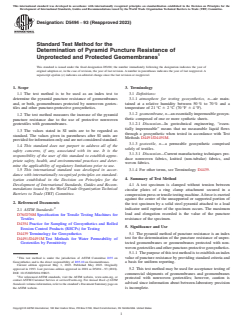
1.1 The test method is to be used as an index test to determine the pyramid puncture resistance of geomembranes and, or both, geomembranes protected by nonwoven geotextiles and other puncture-protective geosynthetics.
1.2 The test method measures the increase of the pyramid puncture resistance due to the use of protective nonwoven geotextiles with geomembranes.
1.3 The values stated in SI units are to be regarded as standard. The values given in parentheses after SI units are provided for information only and are not considered standard.
1.4 This standard does not purport to address all of the safety concerns, if any, associated with its use. It is the responsibility of the user of this standard to establish appropriate safety, health, and environmental practices and determine the applicability of regulatory limitations prior to use.
1.5 This international standard was developed in accordance with internationally recognized principles on standardization established in the Decision on Principles for the Development of International Standards, Guides and Recommendations issued by the World Trade Organization Technical Barriers to Trade (TBT) Committee.
- Status
- Published
- Publication Date
- 30-Apr-2023
- Technical Committee
- D35 - Geosynthetics
- Drafting Committee
- D35.10 - Geomembranes
Overview
ASTM D5494-93(2023), titled Standard Test Method for the Determination of Pyramid Puncture Resistance of Unprotected and Protected Geomembranes, is a widely recognized standard developed by ASTM International. This document specifies an index test methodology to determine the puncture resistance of geomembranes, both unprotected and protected with nonwoven geotextiles or other puncture-protective geosynthetic materials. The standard is developed in line with internationally accepted principles, facilitating uniformity and reliability in reporting puncture resistance values for geomembrane products.
Key Topics
- Pyramid Puncture Resistance: The test evaluates the resistance of geomembranes-both bare and protected-against a puncture force applied using a standard steel pyramid-shaped probe.
- Index Test Method: The procedure is mainly designed as an index test, providing a standard criterion and uniform basis for reporting puncture resistance values.
- Testing Configurations: The method uses either a water medium or an aluminum plate as the underlying support, simulating different installation environments.
- Applicability: The standard is suitable for acceptance testing of commercial shipments and quality control of geomembranes and protected geomembranes.
- Reporting Requirements: Results include the average puncture load, elongation at break (for water medium), the number of tests performed, and a detailed description of test conditions and samples.
Applications
ASTM D5494-93(2023) is essential in geotechnical, civil engineering, and environmental applications involving geomembranes. Its practical value includes:
- Quality Assurance in Manufacturing: Manufacturers of geomembranes and geotextiles depend on this test to validate product puncture resistance, ensuring compliance with project specifications.
- Acceptance Testing: Purchasers and suppliers utilize the standard for acceptance testing of geomembrane shipments, enabling reliable comparison between products or lots.
- Design and Specification: Engineers use the results of this standard to estimate the suitability of specific geomembranes and protective geotextiles under possible puncture loads found in field installations such as landfill liners, reservoirs, or containment barriers.
- Comparative Evaluation: The test enables the comparison of the effect of nonwoven geotextile protection on geomembrane puncture resistance, helping in selecting optimal material combinations for specific site conditions.
Related Standards
For comprehensive testing and specification of geosynthetics and geomembranes, consider the following ASTM standards closely related to ASTM D5494-93(2023):
- ASTM D4354 – Practice for Sampling of Geosynthetics and Rolled Erosion Control Products (RECPs) for Testing
- ASTM D4439 – Terminology for Geosynthetics
- ASTM D4491/D4491M – Test Methods for Water Permeability of Geotextiles by Permittivity
- ASTM D76/D76M – Specification for Tensile Testing Machines for Textiles
Practical Value
By standardizing the test method for measuring pyramid puncture resistance, ASTM D5494-93(2023) equips stakeholders with a reliable, repeatable tool for evaluating and comparing the mechanical integrity of geomembranes and their protective systems. This supports safer design, improved quality control, and minimizes risk of damage during transport, installation, or service life-critical for infrastructure longevity and environmental protection.
Keywords: ASTM D5494, pyramid puncture resistance, geomembranes, geotextiles, geosynthetics, index test, puncture test, quality control, civil engineering, environmental protection.
Relations
- Effective Date
- 01-Feb-2024
- Effective Date
- 01-May-2020
- Effective Date
- 15-Apr-2018
- Effective Date
- 01-Aug-2017
- Refers
ASTM D4491/D4491M-17 - Standard Test Methods for Water Permeability of Geotextiles by Permittivity - Effective Date
- 01-Jan-2017
- Refers
ASTM D4491/D4491M-16 - Standard Test Methods for Water Permeability of Geotextiles by Permittivity - Effective Date
- 01-Jul-2016
- Effective Date
- 01-Sep-2015
- Effective Date
- 01-Jul-2015
- Refers
ASTM D4491/D4491M-15 - Standard Test Methods for Water Permeability of Geotextiles by Permittivity - Effective Date
- 01-Jul-2015
- Effective Date
- 01-Mar-2014
- Effective Date
- 01-Jul-2012
- Effective Date
- 01-Dec-2011
- Effective Date
- 01-Oct-2011
- Effective Date
- 15-Jan-2009
- Effective Date
- 01-Nov-2004
Get Certified
Connect with accredited certification bodies for this standard

Control Union Certifications
Global certification for agriculture and sustainability.

Hohenstein Institut
Textile testing and certification.

Bureau Veritas Bangladesh
Bureau Veritas certification services in Bangladesh.
Sponsored listings
Frequently Asked Questions
ASTM D5494-93(2023) is a standard published by ASTM International. Its full title is "Standard Test Method for the Determination of Pyramid Puncture Resistance of Unprotected and Protected Geomembranes". This standard covers: SIGNIFICANCE AND USE 5.1 The pyramid method of puncture resistance is an index test for the determination of the puncture resistance of unprotected geomembranes or geomembranes protected with nonwoven geotextiles and other puncture-protective geosynthetics. 5.1.1 The purpose of this test method is to establish an index value of puncture resistance by providing standard criteria and a basis for uniform reporting. 5.2 This test method may be used for acceptance testing of commercial shipments of geomembranes and geomembranes protected with nonwoven geotextiles; however, caution is advised since information about between-laboratory precision is incomplete. SCOPE 1.1 The test method is to be used as an index test to determine the pyramid puncture resistance of geomembranes and, or both, geomembranes protected by nonwoven geotextiles and other puncture-protective geosynthetics. 1.2 The test method measures the increase of the pyramid puncture resistance due to the use of protective nonwoven geotextiles with geomembranes. 1.3 The values stated in SI units are to be regarded as standard. The values given in parentheses after SI units are provided for information only and are not considered standard. 1.4 This standard does not purport to address all of the safety concerns, if any, associated with its use. It is the responsibility of the user of this standard to establish appropriate safety, health, and environmental practices and determine the applicability of regulatory limitations prior to use. 1.5 This international standard was developed in accordance with internationally recognized principles on standardization established in the Decision on Principles for the Development of International Standards, Guides and Recommendations issued by the World Trade Organization Technical Barriers to Trade (TBT) Committee.
SIGNIFICANCE AND USE 5.1 The pyramid method of puncture resistance is an index test for the determination of the puncture resistance of unprotected geomembranes or geomembranes protected with nonwoven geotextiles and other puncture-protective geosynthetics. 5.1.1 The purpose of this test method is to establish an index value of puncture resistance by providing standard criteria and a basis for uniform reporting. 5.2 This test method may be used for acceptance testing of commercial shipments of geomembranes and geomembranes protected with nonwoven geotextiles; however, caution is advised since information about between-laboratory precision is incomplete. SCOPE 1.1 The test method is to be used as an index test to determine the pyramid puncture resistance of geomembranes and, or both, geomembranes protected by nonwoven geotextiles and other puncture-protective geosynthetics. 1.2 The test method measures the increase of the pyramid puncture resistance due to the use of protective nonwoven geotextiles with geomembranes. 1.3 The values stated in SI units are to be regarded as standard. The values given in parentheses after SI units are provided for information only and are not considered standard. 1.4 This standard does not purport to address all of the safety concerns, if any, associated with its use. It is the responsibility of the user of this standard to establish appropriate safety, health, and environmental practices and determine the applicability of regulatory limitations prior to use. 1.5 This international standard was developed in accordance with internationally recognized principles on standardization established in the Decision on Principles for the Development of International Standards, Guides and Recommendations issued by the World Trade Organization Technical Barriers to Trade (TBT) Committee.
ASTM D5494-93(2023) is classified under the following ICS (International Classification for Standards) categories: 59.080.70 - Geotextiles. The ICS classification helps identify the subject area and facilitates finding related standards.
ASTM D5494-93(2023) has the following relationships with other standards: It is inter standard links to ASTM D4439-24, ASTM D4354-12(2020), ASTM D4439-18, ASTM D4439-17, ASTM D4491/D4491M-17, ASTM D4491/D4491M-16, ASTM D4439-15a, ASTM D4439-15, ASTM D4491/D4491M-15, ASTM D4439-14, ASTM D4354-12, ASTM D76/D76M-11, ASTM D4439-11, ASTM D4354-99(2009), ASTM D4354-99(2004). Understanding these relationships helps ensure you are using the most current and applicable version of the standard.
ASTM D5494-93(2023) is available in PDF format for immediate download after purchase. The document can be added to your cart and obtained through the secure checkout process. Digital delivery ensures instant access to the complete standard document.
Standards Content (Sample)
This international standard was developed in accordance with internationally recognized principles on standardization established in the Decision on Principles for the
Development of International Standards, Guides and Recommendations issued by the World Trade Organization Technical Barriers to Trade (TBT) Committee.
Designation: D5494 − 93 (Reapproved 2023)
Standard Test Method for the
Determination of Pyramid Puncture Resistance of
Unprotected and Protected Geomembranes
This standard is issued under the fixed designation D5494; the number immediately following the designation indicates the year of
original adoption or, in the case of revision, the year of last revision. A number in parentheses indicates the year of last reapproval. A
superscript epsilon (´) indicates an editorial change since the last revision or reapproval.
1. Scope 3. Terminology
1.1 The test method is to be used as an index test to 3.1 Definitions:
determine the pyramid puncture resistance of geomembranes 3.1.1 atmosphere for testing geosynthetics, n—air main-
and, or both, geomembranes protected by nonwoven geotex- tained at a relative humidity between 50 % to 70 % and a
tiles and other puncture-protective geosynthetics. temperature of 21 °C 6 2 °C (70 °F 6 4 °F).
3.1.2 geomembrane, n—an essentially impermeable geosyn-
1.2 The test method measures the increase of the pyramid
thetic composed of one or more synthetic sheets.
puncture resistance due to the use of protective nonwoven
3.1.2.1 Discussion—In geotechnical engineering, “essen-
geotextiles with geomembranes.
tially impermeable” means that no measurable liquid flows
1.3 The values stated in SI units are to be regarded as
through a geosynthetic when tested in accordance with Test
standard. The values given in parentheses after SI units are
Methods D4491/D4491M.
provided for information only and are not considered standard.
3.1.3 geotextile, n—a permeable geosynthetic comprised
1.4 This standard does not purport to address all of the
solely of textiles.
safety concerns, if any, associated with its use. It is the
3.1.3.1 Discussion—Current manufacturing techniques pro-
responsibility of the user of this standard to establish appro-
duce nonwoven fabrics, knitted (non-tubular) fabrics, and
priate safety, health, and environmental practices and deter-
woven fabrics.
mine the applicability of regulatory limitations prior to use.
3.1.4 For other terms, see Terminology D4439.
1.5 This international standard was developed in accor-
dance with internationally recognized principles on standard-
4. Summary of Test Method
ization established in the Decision on Principles for the
Development of International Standards, Guides and Recom-
4.1 A test specimen is clamped without tension between
mendations issued by the World Trade Organization Technical
circular plates of a ring clamp attachment secured in a
Barriers to Trade (TBT) Committee.
compression press or tensile testing machine. A force is exerted
against the center of the unsupported or supported portion of
2. Referenced Documents
the test specimen by a solid steel pyramid attached to a load
indicator until rupture of the specimen occurs. The maximum
2.1 ASTM Standards:
load and elongation recorded is the value of the puncture
D76/D76M Specification for Tensile Testing Machines for
resistance of the specimen.
Textiles
D4354 Practice for Sampling of Geosynthetics and Rolled
5. Significance and Use
Erosion Control Products (RECPs) for Testing
D4439 Terminology for Geosynthetics 5.1 The pyramid method of puncture resistance is an index
D4491/D4491M Test Methods for Water Permeability of test for the determination of the puncture resistance of unpro-
Geotextiles by Permittivity tected geomembranes or geomembranes protected with non-
woven geotextiles and other puncture-protective geosynthetics.
5.1.1 The purpose of this test method is to establish an index
value of puncture resistance by providing standard criteria and
This test method is under the jurisdiction of ASTM Committee D35 on
Geosynthetics and is the direct responsibility of D35.10 on Geomembranes.
a basis for uniform reporting.
Current edition approved May 1, 2023. Published May 2023. Originally
5.2 This test method may be used for acceptance testing of
approved in 1993. Last previous edition approved in 2018 as D5494 – 93 (2018).
DOI: 10.1520/D5494-93R23.
commercial shipments of geomembranes and geomembranes
For referenced ASTM standards, visit the ASTM website, www.astm.org, or
protected with nonwoven geotextiles; however, caution is
contact ASTM Customer Service at service@astm.org. For Annual Book of ASTM
advised since information about between-laboratory precision
Standards volume information, refer to the standard’s Document Summary page on
the ASTM website. is incomplete.
Copyright © ASTM International, 100 Barr Harbor Drive, PO Box C700, West Conshohocken, PA 19428-2959. United States
D5494 − 93 (2023)
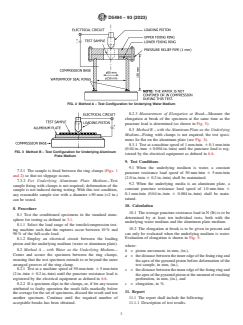
6. Apparatus must be placed on the compression base so that the sealing
system (geomembrane and geotextile) lies flat on it. The
6.1 Test Setup—A compression press with a reading force
aluminum plate shall be reinforced (possibly with a steel plate)
accuracy of at least 2 N (0.5 lb) is necessary. The press must
to prevent bending (Fig. 3).
maintain a constant test speed and should be provided with an
automatic chart recorder for the force-versus-deformation be-
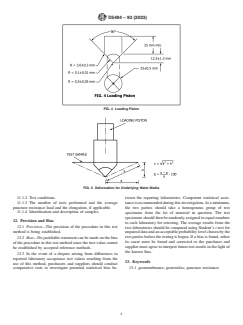
6.5 Loading Piston (Fig. 4)—The loading piston shall be a
havior. A clamping device for the test sample, a special piston,
cylinder with a diameter of 25 mm 6 0.1 mm (1 in. 6
and electrical signal equipment for determining the puncture
0.004 in.) with a polished and hardened pyramid formed apex
load are the additional pieces of test equipment needed. Also,
as shown in Fig. 4. The apex shall be a four-sided pyramid with
a tensile testing machine conforming to the requirements of
an apex angle of 90° rounded off with a radius (R) of 0.5 mm
Specification D76/D76M can be utilized in a compression
6 0.01 mm (0.02 in. 6 0.0004 in.). The edges of the pyramid
mode for this test method. The equipment setup shall provide
shall be rounded off with a radius of 0.1 mm 6 0.01 mm
a constant rate of speed, reading accuracy of at least 2 N
(0.004 in. 6 0.0004 in.). The transitional edge from the base of
(0.5 lb). and be provided with an automatic chart recorder for
the pyramid to the cylinder shall have a radius (R) of 3.0 mm
load versus deformation. Additional equipment required by this
6 0.1 mm (0.12 in. 6 0.004 in.).
test method is described below.
6.6 Electrical Equipment for the Determination of the Punc-
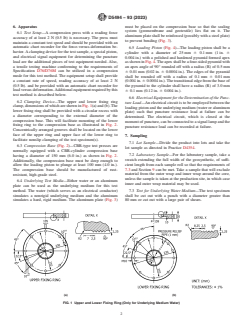
6.2 Clamping Device—The upper and lower fixing ring
ture Load—An electrical circuit is to be employed between the
clamp, dimensions of which are shown in Fig. 1(a) and (b). The
loading piston and the underlying medium (water or aluminum
lower fixing ring shall be provided with a circular recess with
plate) such that puncture resistance load at failure can be
a diameter corresponding to the external diameter of the
determined. The electrical circuit, which is closed at the
compression base. This will facilitate mounting of the lower
moment of puncture, can be connected to a signal lamp and the
fixing ring to the compression base as illustrated in Fig. 2.
puncture resistance load can be recorded at failure.
Concentrically arranged grooves shall be located on the lower
face of the upper ring and upper face of the lower ring to
7. Sampling
facilitate nonslip clamping of the test specimen(s).
7.1 Lot Sample—Divide the product into lots and take the
6.3 Compression Base (Fig. 2)—CBR-type test presses are
lot sample as directed in Practice D4354.
normally equipped with a CBR-cylin
...