

ASTM E1210-21
(Practice)Standard Practice for Fluorescent Liquid Penetrant Testing Using the Hydrophilic Post-Emulsification Process
General Information
- Abstract
SIGNIFICANCE AND USE
5.1 Liquid penetrant examination methods indicate the presence, location, and, to a limited extent, the nature and magnitude of the detected discontinuities. This practice is normally used for production examination of critical components, where reproducibility is essential. More procedural controls and processing steps are required than with other processes.
SCOPE
1.1 This practice covers procedures for fluorescent penetrant examination utilizing the hydrophilic post-emulsification process. It is a nondestructive testing method for detecting discontinuities that are open to the surface such as cracks, seams, laps, cold shuts, laminations, isolated porosity, through leaks, or lack of fusion and is applicable to in-process, final, and maintenance examination. It can be effectively used in the examination of nonporous, metallic materials, both ferrous and nonferrous, and of nonmetallic materials such as glazed or fully densified ceramics and certain nonporous plastics and glass.
1.2 This practice also provides a reference:
1.2.1 By which a fluorescent penetrant examination hydrophilic post-emulsification process recommended or required by individual organizations can be reviewed to ascertain their applicability and completeness.
1.2.2 For use in the preparation of process specifications dealing with the fluorescent penetrant examination of materials and parts using the hydrophilic post-emulsification process. Agreement by the purchaser and the manufacturer regarding specific techniques is strongly recommended.
1.2.3 For use in the organization of the facilities and personnel concerned with the liquid penetrant examination.
1.3 This practice does not indicate or suggest standards for evaluation of the indications obtained. It should be pointed out, however, that indications must be interpreted or classified and then evaluated. For this purpose there must be a separate code or specification or a specific agreement to define the type, size, location, and direction of indications considered acceptable, and those considered unacceptable.
1.3.1 The user is encouraged to use materials and processing parameters necessary to detect conditions of a type or severity which could affect the evaluation of the product.
1.4 Units—The values stated in inch-pound units are to be regarded as standard. The values given in parentheses are mathematical conversions to SI units that are provided for information only and are not considered standard.
1.5 All areas of this practice may be open to agreement between the cognizant engineering organization and the supplier, or specific direction from the cognizant engineering organization.
1.6 This standard does not purport to address all of the safety concerns, if any, associated with its use. It is the responsibility of the user of this standard to establish appropriate safety, health, and environmental practices and determine the applicability of regulatory limitations prior to use.
1.7 This international standard was developed in accordance with internationally recognized principles on standardization established in the Decision on Principles for the Development of International Standards, Guides and Recommendations issued by the World Trade Organization Technical Barriers to Trade (TBT) Committee.
- Status
- Published
- Publication Date
- 30-Jun-2021
- Technical Committee
- E07 - Nondestructive Testing
- Drafting Committee
- E07.03 - Liquid Penetrant and Magnetic Particle Methods
Buy Documents
ASTM E1210-21 - Standard Practice for Fluorescent Liquid Penetrant Testing Using the Hydrophilic Post-Emulsification Process
REDLINE ASTM E1210-21 - Standard Practice for Fluorescent Liquid Penetrant Testing Using the Hydrophilic Post-Emulsification Process
Overview
ASTM E1210-21 establishes procedures for fluorescent liquid penetrant testing using the hydrophilic post-emulsification process. This nondestructive testing (NDT) method is designed to detect open-to-surface discontinuities such as cracks, seams, laps, cold shuts, laminations, isolated porosity, through leaks, or lack of fusion. It is widely applicable in the in-process, final, and maintenance examination of nonporous, metallic materials (ferrous and nonferrous), as well as certain nonmetallic materials, including glazed or fully densified ceramics, particular plastics, and glass.
The practice is particularly useful for the inspection of critical components where consistent, reliable, and sensitive flaw detection is paramount. Its reproducibility and controlled processes make it ideal in industry sectors demanding high standards of quality assurance.
Key Topics
Method Description
- Application of a fluorescent, post-emulsifiable liquid penetrant to surfaces to reveal surface-breaking discontinuities.
- Use of a hydrophilic emulsifier to enable selective removal of excess penetrant, thus increasing inspection sensitivity.
- Post-application development and UV-A (ultraviolet) inspection in a darkened environment to interpret surface indications.
Scope of Use
- Detection of flaws that are open to the surface such as cracks, laps, porosity, and weld defects.
- Suitable for a variety of materials, including both metals and certain ceramics, plastics, and glasses.
Procedural Controls
- Requires careful process control, including cleaning, penetration time, rinsing, emulsification, development, and inspection.
- Parameters and materials must be selected and validated for specific applications.
- Interpretation of indications should be based on agreed acceptance criteria external to this practice.
Personnel and Agency Qualifications
- Operators and agencies must be qualified in accordance with recognized international and national standards to ensure competence in performing these nondestructive evaluations.
Safety and Environmental Considerations
- Users of this standard are responsible for establishing suitable safety, health, and environmental practices and complying with relevant regulations.
Applications
- Aerospace and Defense: Inspection of high-integrity components such as turbine blades, airframes, and structural welds.
- Power Generation: Evaluation of critical power plant components, including turbine and generator parts.
- Automotive Industry: Quality assurance testing of engine components, axles, and frames.
- Petrochemical and Process Industries: Maintenance inspections for pressure vessels, piping, and tankage.
- Manufacturing: In-process and final inspection of metallic and appropriate nonmetallic parts where surface integrity is essential.
The method’s high sensitivity makes it invaluable where detection of minute, surface-breaking flaws could prevent failures and ensure long-term reliability.
Related Standards
Practitioners using ASTM E1210-21 frequently reference related standards to ensure comprehensive testing and qualification processes:
- ASTM E165/E165M – Practice for Liquid Penetrant Testing for General Industry
- ASTM E433 – Reference Photographs for Liquid Penetrant Inspection
- ASTM E543 – Specification for Agencies Performing Nondestructive Testing
- ASTM E1316 – Terminology for Nondestructive Examinations
- ASTM E2297 & E3022 – Guides for UV-A/visible light sources and LED lamp requirements in penetrant and magnetic particle testing
- ASNT SNT-TC-1A / ANSI/ASNT CP-189 / NAS410 / ISO 9712 – Personnel qualification and certification for NDT
- AMS 2644 – Specification for inspection material penetrant
Maintaining compliance with these related documents enhances the reliability, traceability, and acceptance of testing results across industries.
Keywords: fluorescent liquid penetrant testing, hydrophilic post-emulsification, nondestructive testing standard, ASTM E1210-21, surface discontinuity detection, quality assurance, UV-A inspection.
For further details or implementation guidance, always refer to the official ASTM publication.
Relations
- Effective Date
- 01-Feb-2024
- Effective Date
- 01-Dec-2019
- Effective Date
- 01-Mar-2019
- Effective Date
- 01-Jan-2018
- Effective Date
- 15-Jun-2017
- Effective Date
- 01-Feb-2017
- Effective Date
- 01-Aug-2016
- Effective Date
- 01-Jul-2016
- Effective Date
- 01-Feb-2016
- Effective Date
- 01-Dec-2015
- Effective Date
- 01-Sep-2015
- Effective Date
- 01-Sep-2015
- Effective Date
- 15-Jun-2014
- Effective Date
- 01-Jun-2014
- Effective Date
- 01-Jun-2014
Buy Documents
ASTM E1210-21 - Standard Practice for Fluorescent Liquid Penetrant Testing Using the Hydrophilic Post-Emulsification Process
REDLINE ASTM E1210-21 - Standard Practice for Fluorescent Liquid Penetrant Testing Using the Hydrophilic Post-Emulsification Process
Get Certified
Connect with accredited certification bodies for this standard

IMP NDT d.o.o.
Non-destructive testing services. Radiography, ultrasonic, magnetic particle, penetrant, visual inspection.
Inštitut za kovinske materiale in tehnologije
Institute of Metals and Technology. Materials testing, metallurgical analysis, NDT.
Q Techna d.o.o.
NDT and quality assurance specialist. 30+ years experience. NDT personnel certification per ISO 9712, nuclear and thermal power plant inspections, QA/
Sponsored listings
Frequently Asked Questions
ASTM E1210-21 is a standard published by ASTM International. Its full title is "Standard Practice for Fluorescent Liquid Penetrant Testing Using the Hydrophilic Post-Emulsification Process". This standard covers: SIGNIFICANCE AND USE 5.1 Liquid penetrant examination methods indicate the presence, location, and, to a limited extent, the nature and magnitude of the detected discontinuities. This practice is normally used for production examination of critical components, where reproducibility is essential. More procedural controls and processing steps are required than with other processes. SCOPE 1.1 This practice covers procedures for fluorescent penetrant examination utilizing the hydrophilic post-emulsification process. It is a nondestructive testing method for detecting discontinuities that are open to the surface such as cracks, seams, laps, cold shuts, laminations, isolated porosity, through leaks, or lack of fusion and is applicable to in-process, final, and maintenance examination. It can be effectively used in the examination of nonporous, metallic materials, both ferrous and nonferrous, and of nonmetallic materials such as glazed or fully densified ceramics and certain nonporous plastics and glass. 1.2 This practice also provides a reference: 1.2.1 By which a fluorescent penetrant examination hydrophilic post-emulsification process recommended or required by individual organizations can be reviewed to ascertain their applicability and completeness. 1.2.2 For use in the preparation of process specifications dealing with the fluorescent penetrant examination of materials and parts using the hydrophilic post-emulsification process. Agreement by the purchaser and the manufacturer regarding specific techniques is strongly recommended. 1.2.3 For use in the organization of the facilities and personnel concerned with the liquid penetrant examination. 1.3 This practice does not indicate or suggest standards for evaluation of the indications obtained. It should be pointed out, however, that indications must be interpreted or classified and then evaluated. For this purpose there must be a separate code or specification or a specific agreement to define the type, size, location, and direction of indications considered acceptable, and those considered unacceptable. 1.3.1 The user is encouraged to use materials and processing parameters necessary to detect conditions of a type or severity which could affect the evaluation of the product. 1.4 Units—The values stated in inch-pound units are to be regarded as standard. The values given in parentheses are mathematical conversions to SI units that are provided for information only and are not considered standard. 1.5 All areas of this practice may be open to agreement between the cognizant engineering organization and the supplier, or specific direction from the cognizant engineering organization. 1.6 This standard does not purport to address all of the safety concerns, if any, associated with its use. It is the responsibility of the user of this standard to establish appropriate safety, health, and environmental practices and determine the applicability of regulatory limitations prior to use. 1.7 This international standard was developed in accordance with internationally recognized principles on standardization established in the Decision on Principles for the Development of International Standards, Guides and Recommendations issued by the World Trade Organization Technical Barriers to Trade (TBT) Committee.
SIGNIFICANCE AND USE 5.1 Liquid penetrant examination methods indicate the presence, location, and, to a limited extent, the nature and magnitude of the detected discontinuities. This practice is normally used for production examination of critical components, where reproducibility is essential. More procedural controls and processing steps are required than with other processes. SCOPE 1.1 This practice covers procedures for fluorescent penetrant examination utilizing the hydrophilic post-emulsification process. It is a nondestructive testing method for detecting discontinuities that are open to the surface such as cracks, seams, laps, cold shuts, laminations, isolated porosity, through leaks, or lack of fusion and is applicable to in-process, final, and maintenance examination. It can be effectively used in the examination of nonporous, metallic materials, both ferrous and nonferrous, and of nonmetallic materials such as glazed or fully densified ceramics and certain nonporous plastics and glass. 1.2 This practice also provides a reference: 1.2.1 By which a fluorescent penetrant examination hydrophilic post-emulsification process recommended or required by individual organizations can be reviewed to ascertain their applicability and completeness. 1.2.2 For use in the preparation of process specifications dealing with the fluorescent penetrant examination of materials and parts using the hydrophilic post-emulsification process. Agreement by the purchaser and the manufacturer regarding specific techniques is strongly recommended. 1.2.3 For use in the organization of the facilities and personnel concerned with the liquid penetrant examination. 1.3 This practice does not indicate or suggest standards for evaluation of the indications obtained. It should be pointed out, however, that indications must be interpreted or classified and then evaluated. For this purpose there must be a separate code or specification or a specific agreement to define the type, size, location, and direction of indications considered acceptable, and those considered unacceptable. 1.3.1 The user is encouraged to use materials and processing parameters necessary to detect conditions of a type or severity which could affect the evaluation of the product. 1.4 Units—The values stated in inch-pound units are to be regarded as standard. The values given in parentheses are mathematical conversions to SI units that are provided for information only and are not considered standard. 1.5 All areas of this practice may be open to agreement between the cognizant engineering organization and the supplier, or specific direction from the cognizant engineering organization. 1.6 This standard does not purport to address all of the safety concerns, if any, associated with its use. It is the responsibility of the user of this standard to establish appropriate safety, health, and environmental practices and determine the applicability of regulatory limitations prior to use. 1.7 This international standard was developed in accordance with internationally recognized principles on standardization established in the Decision on Principles for the Development of International Standards, Guides and Recommendations issued by the World Trade Organization Technical Barriers to Trade (TBT) Committee.
ASTM E1210-21 is classified under the following ICS (International Classification for Standards) categories: 19.100 - Non-destructive testing. The ICS classification helps identify the subject area and facilitates finding related standards.
ASTM E1210-21 has the following relationships with other standards: It is inter standard links to ASTM E1316-24, ASTM E1316-19b, ASTM E1316-19, ASTM E1316-18, ASTM E1316-17a, ASTM E1316-17, ASTM E1316-16a, ASTM D1552-16, ASTM E1316-16, ASTM E1316-15a, ASTM E3022-15, ASTM E1316-15, ASTM D1552-08(2014), ASTM E1316-14, ASTM E1316-14e1. Understanding these relationships helps ensure you are using the most current and applicable version of the standard.
ASTM E1210-21 is available in PDF format for immediate download after purchase. The document can be added to your cart and obtained through the secure checkout process. Digital delivery ensures instant access to the complete standard document.
Standards Content (Sample)
This international standard was developed in accordance with internationally recognized principles on standardization established in the Decision on Principles for the
Development of International Standards, Guides and Recommendations issued by the World Trade Organization Technical Barriers to Trade (TBT) Committee.
Designation:E1210 −21
Standard Practice for
Fluorescent Liquid Penetrant Testing Using the Hydrophilic
Post-Emulsification Process
This standard is issued under the fixed designation E1210; the number immediately following the designation indicates the year of
original adoption or, in the case of revision, the year of last revision. A number in parentheses indicates the year of last reapproval. A
superscript epsilon (´) indicates an editorial change since the last revision or reapproval.
1. Scope 1.4 Units—The values stated in inch-pound units are to be
regarded as standard. The values given in parentheses are
1.1 This practice covers procedures for fluorescent pen-
mathematical conversions to SI units that are provided for
etrantexaminationutilizingthehydrophilicpost-emulsification
information only and are not considered standard.
process. It is a nondestructive testing method for detecting
1.5 All areas of this practice may be open to agreement
discontinuities that are open to the surface such as cracks,
between the cognizant engineering organization and the
seams, laps, cold shuts, laminations, isolated porosity, through
supplier, or specific direction from the cognizant engineering
leaks, or lack of fusion and is applicable to in-process, final,
organization.
and maintenance examination. It can be effectively used in the
examination of nonporous, metallic materials, both ferrous and
1.6 This standard does not purport to address all of the
nonferrous, and of nonmetallic materials such as glazed or
safety concerns, if any, associated with its use. It is the
fully densified ceramics and certain nonporous plastics and
responsibility of the user of this standard to establish appro-
glass.
priate safety, health, and environmental practices and deter-
mine the applicability of regulatory limitations prior to use.
1.2 This practice also provides a reference:
1.7 This international standard was developed in accor-
1.2.1 By which a fluorescent penetrant examination hydro-
dance with internationally recognized principles on standard-
philicpost-emulsificationprocessrecommendedorrequiredby
ization established in the Decision on Principles for the
individual organizations can be reviewed to ascertain their
Development of International Standards, Guides and Recom-
applicability and completeness.
mendations issued by the World Trade Organization Technical
1.2.2 For use in the preparation of process specifications
Barriers to Trade (TBT) Committee.
dealing with the fluorescent penetrant examination of materials
and parts using the hydrophilic post-emulsification process.
2. Referenced Documents
Agreement by the purchaser and the manufacturer regarding
2.1 ASTM Standards:
specific techniques is strongly recommended.
D129 Test Method for Sulfur in Petroleum Products (Gen-
1.2.3 For use in the organization of the facilities and
eral High Pressure Decomposition Device Method)
personnel concerned with the liquid penetrant examination.
D516 Test Method for Sulfate Ion in Water
1.3 This practice does not indicate or suggest standards for
D808 Test Method for Chlorine in New and Used Petroleum
evaluationoftheindicationsobtained.Itshouldbepointedout,
Products (High Pressure Decomposition Device Method)
however, that indications must be interpreted or classified and
D1552 Test Method for Sulfur in Petroleum Products by
then evaluated. For this purpose there must be a separate code
High Temperature Combustion and Infrared (IR) Detec-
or specification or a specific agreement to define the type, size,
tion or Thermal Conductivity Detection (TCD)
location, and direction of indications considered acceptable,
E165/E165M Practice for Liquid Penetrant Testing for Gen-
and those considered unacceptable.
eral Industry
1.3.1 Theuserisencouragedtousematerialsandprocessing
E433 Reference Photographs for Liquid Penetrant Inspec-
parameters necessary to detect conditions of a type or severity
tion
which could affect the evaluation of the product.
E543 Specification forAgencies Performing Nondestructive
Testing
E1316 Terminology for Nondestructive Examinations
This practice is under the jurisdiction of ASTM Committee E07 on Nonde-
structive Testing and is the direct responsibility of Subcommittee E07.03 on Liquid
Penetrant and Magnetic Particle Methods. For referenced ASTM standards, visit the ASTM website, www.astm.org, or
Current edition approved July 1, 2021. Published August 2021. Originally contact ASTM Customer Service at service@astm.org. For Annual Book of ASTM
approved in 1987. Last previous edition approved in 2016 as E1210 – 16. DOI: Standards volume information, refer to the standard’s Document Summary page on
10.1520/E1210-21. the ASTM website.
Copyright © ASTM International, 100 Barr Harbor Drive, PO Box C700, West Conshohocken, PA 19428-2959. United States
E1210−21
E2297 GuideforUseofUV-AandVisibleLightSourcesand dancewith9.2,becausevisibledyesmaycausedeteriorationor
Meters used in the Liquid Penetrant and Magnetic Particle quenching of fluorescent dyes.)
Methods
4.2 Processing parameters such as precleaning, penetration
E3022 Practice for Measurement of Emission Characteris-
time, prerinsing, hydrophilic emulsifier concentration, etc., are
tics and Requirements for LED UV-A Lamps Used in
determinedbythespecificmaterialsused,thenatureofthepart
Fluorescent Penetrant and Magnetic Particle Testing
under examination (that is, size, shape, surface condition,
2.2 ASNT Documents:
alloy), type of discontinuities expected, etc.
Recommended Practice SNT-TC-1A Personnel Qualifica-
tion and Certification in Nondestructive Testing 5. Significance and Use
ANSI/ASNT-CP-189 Standard for Qualification and Certifi-
5.1 Liquid penetrant examination methods indicate the
cation of Nondestructive Testing Personnel
presence, location, and, to a limited extent, the nature and
2.3 Other Standards:
magnitude of the detected discontinuities. This practice is
ISO 9712 Nondestructive Testing–Qualification and vertifi-
normally used for production examination of critical
caiton of NDT Personnel
components, where reproducibility is essential. More proce-
AMS 2644 Inspection Material Penetrant
duralcontrolsandprocessingstepsarerequiredthanwithother
2.4 AIA Standard:
processes.
NAS410 Certification and Qualification of Nondestructive
6. Reagents and Materials
Testing Personnel
2.5 DoD Contracts—Unless otherwise specified, the issue
6.1 Liquid Fluorescent Penetrant Testing Materials, for use
of the documents that are DoD adopted are those listed in the
in the hydrophilic post-emulsification process, (see Note 1)
issue of the DoDISS (Department of Defense Index of
consist of a family of post-emulsifiable fluorescent penetrant,
Specifications and Standards) cited in the solicitation.
hydrophilic remover, and appropriate developer and are clas-
2.6 Order of Precedence—In the event of conflict between
sified as Type I Fluorescent, Method D—Post-Emulsifiable,
this practice and the references cited herein, this practice takes
Hydrophilic. Penetrant materials shall conform to AMS 2644
precedence.
unless approved by the contract or Level III. Each penetrant
and emulsifier are approved together as a pair. Intermixing of
materials from various manufacturers is not recommended.
3. Terminology
NOTE 1—Refer to 8.1 for special requirements for sulfur, halogen, and
3.1 Definitions—Definitions relating to liquid penetrant
alkali metal content. (Warning—While approved penetrant materials will
examination, which appear in Terminology E1316, shall apply
not adversely affect common metallic materials, some plastics or rubbers
to the terms used in this practice. Throughout this practice, the
may be swollen or stained by certain penetrants.)
term “black light” has been changed to “UV-A” to conform
6.2 Post-Emulsifiable Penetrants are designed to be in-
with the latest terminology in E1316. “Black light” can mean
soluble in water and cannot be removed with water rinsing
a broad range of ultraviolet radiation; fluorescent penetrant
alone. They are designed to be selectively removed from the
inspection only uses the UV-A range.
surface by the use of a separate hydrophilic emulsifier. The
hydrophilic emulsifier, at the proper concentration, properly
4. Summary of Practice
applied, and given a proper emulsification time, combines with
4.1 A post-emulsifiable, liquid, fluorescent penetrant is ap-
the excess surface penetrant to form a water-washable mixture,
plied evenly over the surface being tested and allowed to enter
which can then be rinsed from the surface leaving the surface
open discontinuities. After a suitable dwell time and prerinse,
free of fluorescent background. Proper concentration and
the excess surface penetrant is removed by applying a hydro-
hydrophilic emulsification time must be experimentally estab-
philic emulsifier and the surface is rinsed and dried. A
lished and maintained to assure that over-emulsification does
developer is then applied drawing the entrapped penetrant out
not occur, resulting in loss of indications.
of the discontinuity and staining the developer. If an aqueous
6.3 Hydrophilic Emulsifiers are liquids used to emulsify the
developer is to be employed, the developer is applied prior to
excess oily fluorescent penetrant on the surface of the part,
the drying step. The test surface is then examined visually
rendering it water-washable (see 7.1.6). They are water-base
under UV-A radiation in a darkened area to determine the
emulsifiers (detergent-type removers) that are supplied as
presence or absence of indications. (Warning—Fluorescent
concentratestobedilutedwithwaterandusedasadiporspray.
penetrant examination shall not follow a visible penetrant
Theconcentration,use,andmaintenanceshallbeinaccordance
examination unless the procedure has been qualified in accor-
with manufacturer’s recommendations.
6.3.1 Hydrophilic emulsifiers function by displacing the
Available fromTheAmerican Society for NondestructiveTesting (ASNT), P.O.
excess penetrant film from the surface of the part through
Box 28518, 1711 Arlingate Lane, Columbus, OH 43228-0518.
4 detergentaction.Theforceofthewatersprayorair/mechanical
Available from International Organization for Standardization (ISO), ISO
agitation in an open dip tank provides the scrubbing action
Central Secretariat, BIBC II, Chemin de Blandonnet 8, CP 401, 1214 Vernier,
Geneva, Switzerland, http://www.iso.org.
whilethedetergentdisplacesthefilmofpenetrantfromthepart
Available from SAE International (SAE), 400 Commonwealth Dr.,Warrendale,
surface. The emulsification time will vary, depending on its
PA 15096, http://www.sae.org.
concentration. Its concentration can be monitored by the use of
Available from the Aerospace Industries Association of America, Inc., 1250
Eye St., N.W., Washington, DC 20005. a suitable refractometer.
E1210−21
6.4 Developers—Development of penetrant indications is ping of indications if not properly applied and controlled. The
the process of bringing the penetrant out of discontinuities procedure should be qualified in accordance with 9.2.)
through blotting action of the applied developer, thus increas- 6.4.3 Nonaqueous, Wet Developers are supplied as suspen-
ing the visibility of the penetrant indications. Several types of sions of developer particles in a nonaqueous, solvent carrier
developers are suitable for use with the hydrophilic penetrant ready for use as supplied. Nonaqueous, wet developers form a
process. coating on the surface of the part when dried, which serves as
6.4.1 Dry Powder Developers are used as supplied (that is, the developing medium for fluorescent penetrants (see
free-flowing, noncaking powder) in accordance with 7.1.9.1(c). (Warning—This type of developer is intended for
7.1.9.1(a). Care should be taken not to contaminate the application by spray only.)
developer with fluorescent penetrant, as the penetrant specks
7. Procedure
can appear as indications.
6.4.2 Aqueous Developers are normally supplied as dry 7.1 The following general procedure applies to the fluores-
powder particles to be either suspended or dissolved (soluble) cent penetrant examination hydrophilic post-emulsification
in water. The concentration, use, and maintenance shall be in method (see Fig. 1).
accordance with manufacturer’s recommendations (see 7.1.1 Temperature Limits—The temperature of the penetrant
7.1.9.1(b). (Warning—Aqueous developers may cause strip-
materials and the surface of the part to be processed should be
Incoming Parts
PRECLEAN Alkaline Steam Vapor Degrease Solvent Wash Acid
(See 7.1.3.1) Etch
Mechanical Paint Stripper Ultrasonic Detergent
DRY
Dry
(See 7.1.3.2)
PENETRANT Apply Post-
APPLICATION Emulsifiable
(See 7.1.4) Penetrant
PRERINSE
Prerinse
(See 7.1.5)
HYDROPHILIC Apply
EMULSIFIER Hydrophilic
(See 7.1.6) Emulsifier
Spray Immersion
FINAL RINSE Water
(See 7.1.7) Wash
DRY
(See 7.1.8) Developer
Dry
DEVELOP (Aqueous)
(See 7.1.9)
DEVELOP
(See 7.1.9) Developer Dry,
Dry
DRY Nonaqueous
(See 7.1.8)
EXAMINE
Examine
(See 7.1.10)
Water Rinse Detergent Mechanical Wash
POST CLEAN
(See 7.1.12 and Prac-
tice E165/E165M, Annex Dry
on
Post Cleaning)
Vapor Degrease Solvent Soak Ultrasonic Clean
Outgoing Parts
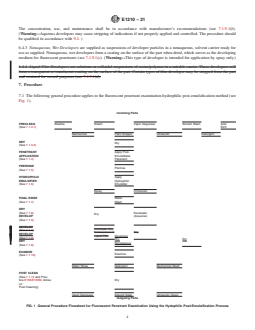
FIG. 1 General Procedure Flowsheet for Fluorescent Penetrant Examination Using the Hydophilic Post-Emulsification Process
E1210−21
between 40 and 125 °F (4 and 52 °C). Where it is not practical 7.1.4 Penetrant Application—After the part has been
to comply with these temperature limitations, qualify the cleaned, dried, and is within the specified temperature range,
procedure at the temperature of intended use as described in apply the penetrant to the surface to be inspected so that the
9.2. entire part or area under examination is completely covered
with penetrant.
7.1.2 Surface Conditioning Prior to Penetrant Inspection—
Satisfactory results may be obtained on surfaces in the as- 7.1.4.1 Modes of Application—There are various modes of
welded, as-rolled, as-cast, or as-forged conditions or for effective application of penetrant such as dipping, brushing,
ceramics in the densified condition. These sensitive penetrants flooding, or spraying. Small parts are quite often placed in
are generally less easily rinsed away and are therefore less suitable baskets and dipped into a tank of penetrant. On larger
suitable for rougher surfaces. When only loose surface residu- parts, and those with complex geometries, penetrant can be
als are present, these may be removed by wiping the surface applied effectively by brushing or spraying. Both conventional
with clean lint-free cloths. However, precleaning of metals to and electrostatic spray guns are effective means of applying
remove processing residuals such as oil, graphite, scale, liquid penetrants to the part surfaces. Electrostatic spray
insulating materials, coatings, and so forth, should be done application can eliminate excess liquid buildup of penetrant on
using cleaning solvents, vapor degreasing or chemical remov- the part, minimize overspray, and minimize the amount of
penetrantenteringhollow-coredpassageswhichmightserveas
ing processes. Surface conditioning by grinding, machining,
polishing or etching shall follow shot, sand, grit and vapor penetrant reservoirs, causing severe bleedout problems during
examination. Aerosol sprays are conveniently portable and
blasting to remove the peened skin and when penetrant
entrapment in surface irregularities might mask the indications suitable for local application. (Warning—Not all penetrant
materials are suitable for electrostatic spray applications.)
of unacceptable discontinuities or otherwise interfere with the
effectiveness of the examination. For metals, unless otherwise (Warning—With spray applications, it is important that there
be proper ventilation. This is generally accomplished through
specified, etching shall be performed when evidence exists that
previous cleaning, surface treatments or service usage have the use of a properly designed spray booth and exhaust
system.)
produced a surface condition that degrades the effectiveness of
the examination. (See Annex on Cleaning Parts and Materials 7.1.4.2 Penetrant Dwell Time—After application, allow ex-
cess penetrant to drain from the part (care should be taken to
in Practice E165/E165M for general precautions relative to
surface preparation.) prevent pools of penetrant on the part), while allowing for
proper penetrant dwell time (see Table 1). The length of time
NOTE 2—When agreed between purchaser and supplier, grit blasting
the penetrant must remain on the part to allow proper penetra-
without subsequent etching may be an acceptable cleaning method.
tion should be as recommended by the penetrant manufacturer.
(Warning—Sand or shot blasting may possibly close indications and
extreme care should be used with grinding and machining operations.)
Table 1, however, provides a guide for selection of penetrant
NOTE 3—For structural or electronic ceramics, surface preparation by
dwell times for a variety of materials, forms, and types of
grinding, sand blasting and etching for penetrant examination is not
discontinuity. Unless otherwise specified the dwell time shall
recommended because of the potential for damage.
not exceed the maximum recommended by the manufacturer.
7.1.3 Removal of Surface Contaminants:
NOTE 4—For some specific applications in structural ceramics (for
7.1.3.1 Precleaning—The success of any penetrant exami-
example, detecting parting lines in slip-cast material), the required
nation procedure is greatly dependent upon the surface and
penetrant dwell time should be determined experimentally and may be
discontinuity being free of any contaminant (solid or liquid)
that might interfere with the penetrant process. All parts or
TABLE 1 Recommended Minimum Dwell Times
areas of parts to be inspected must be clean and dry before the
A
Dwell Times
penetrant is applied. If only a section of a part, such as a weld,
(minutes)
Type of
Material Form
including the heat-affected zone is to be examined, all con- Discontinuity
Pene- Devel-
B C
trant oper
taminants shall be removed from the area being examined as
Aluminum, castings and cold shuts, 510
defined by the contracting parties. “Clean” is intended to mean
magnesium, steel, welds porosity,
that the surface must be free of any rust, scale, welding flux,
brass and bronze, lack of fusion,
spatter, grease, paint, oily films, dirt, etc., that might interfere
titanium and cracks (all forms)
high-temperature
with penetration. All of these contaminants can prevent the
alloys
penetrant from entering discontinuities. (See Annex on Clean-
wrought laps, cracks (all 10 10
ing of Parts and Materials in Practice E165/E165M for more materials— forms)
extrusions,
detailed cleaning methods.) (Warning—Residues from clean-
fo
...
This document is not an ASTM standard and is intended only to provide the user of an ASTM standard an indication of what changes have been made to the previous version. Because
it may not be technically possible to adequately depict all changes accurately, ASTM recommends that users consult prior editions as appropriate. In all cases only the current version
of the standard as published by ASTM is to be considered the official document.
Designation: E1210 − 16 E1210 − 21
Standard Practice for
Fluorescent Liquid Penetrant Testing Using the Hydrophilic
Post-Emulsification Process
This standard is issued under the fixed designation E1210; the number immediately following the designation indicates the year of
original adoption or, in the case of revision, the year of last revision. A number in parentheses indicates the year of last reapproval. A
superscript epsilon (´) indicates an editorial change since the last revision or reapproval.
1. Scope
1.1 This practice covers procedures for fluorescent penetrant examination utilizing the hydrophilic post-emulsification process. It
is a nondestructive testing method for detecting discontinuities that are open to the surface such as cracks, seams, laps, cold shuts,
laminations, isolated porosity, through leaks, or lack of fusion and is applicable to in-process, final, and maintenance examination.
It can be effectively used in the examination of nonporous, metallic materials, both ferrous and nonferrous, and of nonmetallic
materials such as glazed or fully densified ceramics and certain nonporous plastics and glass.
1.2 This practice also provides a reference:
1.2.1 By which a fluorescent penetrant examination hydrophilic post-emulsification process recommended or required by
individual organizations can be reviewed to ascertain their applicability and completeness.
1.2.2 For use in the preparation of process specifications dealing with the fluorescent penetrant examination of materials and parts
using the hydrophilic post-emulsification process. Agreement by the purchaser and the manufacturer regarding specific techniques
is strongly recommended.
1.2.3 For use in the organization of the facilities and personnel concerned with the liquid penetrant examination.
1.3 This practice does not indicate or suggest standards for evaluation of the indications obtained. It should be pointed out,
however, that indications must be interpreted or classified and then evaluated. For this purpose there must be a separate code or
specification or a specific agreement to define the type, size, location, and direction of indications considered acceptable, and those
considered unacceptable.
1.3.1 The user is encouraged to use materials and processing parameters necessary to detect conditions of a type or severity which
could affect the evaluation of the product.
1.4 Units—The values stated in inch-pound units are to be regarded as standard. SI unitsThe values given in parentheses are for
information only.mathematical conversions to SI units that are provided for information only and are not considered standard.
1.5 All areas of this practice may be open to agreement between the cognizant engineering organization and the supplier, or
specific direction from the cognizant engineering organization.
This practice is under the jurisdiction of ASTM Committee E07 on Nondestructive Testing and is the direct responsibility of Subcommittee E07.03 on Liquid Penetrant
and Magnetic Particle Methods.
Current edition approved June 1, 2016July 1, 2021. Published June 2016August 2021. Originally approved in 1987. Last previous edition approved in 20102016 as E1210 -
10. – 16. DOI: 10.1520/E1210-16.10.1520/E1210-21.
Copyright © ASTM International, 100 Barr Harbor Drive, PO Box C700, West Conshohocken, PA 19428-2959. United States
E1210 − 21
1.6 This standard does not purport to address all of the safety concerns, if any, associated with its use. It is the responsibility
of the user of this standard to establish appropriate safety safety, health, and healthenvironmental practices and determine the
applicability of regulatory limitations prior to use.
1.6 All areas of this practice may be open to agreement between the cognizant engineering organization and the supplier, or
specific direction from the cognizant engineering organization.
1.7 This international standard was developed in accordance with internationally recognized principles on standardization
established in the Decision on Principles for the Development of International Standards, Guides and Recommendations issued
by the World Trade Organization Technical Barriers to Trade (TBT) Committee.
2. Referenced Documents
2.1 ASTM Standards:
D129 Test Method for Sulfur in Petroleum Products (General High Pressure Decomposition Device Method)
D516 Test Method for Sulfate Ion in Water
D808 Test Method for Chlorine in New and Used Petroleum Products (High Pressure Decomposition Device Method)
D1552 Test Method for Sulfur in Petroleum Products by High Temperature Combustion and Infrared (IR) Detection or Thermal
Conductivity Detection (TCD)
E165/E165M Practice for Liquid Penetrant Testing for General Industry
E433 Reference Photographs for Liquid Penetrant Inspection
E543 Specification for Agencies Performing Nondestructive Testing
E1316 Terminology for Nondestructive Examinations
E2297 Guide for Use of UV-A and Visible Light Sources and Meters used in the Liquid Penetrant and Magnetic Particle Methods
E3022 Practice for Measurement of Emission Characteristics and Requirements for LED UV-A Lamps Used in Fluorescent
Penetrant and Magnetic Particle Testing
2.2 ASNT Documents:
Recommended Practice SNT-TC-1A Personnel Qualification and Certification in Nondestructive Testing
ANSI/ASNT-CP-189 Standard for Qualification and Certification of Nondestructive Testing Personnel
2.3 Other Standards:
ISO 9712 Nondestructive Testing–Qualification and vertificaiton of NDT Personnel
AMS 2644 Inspection Material Penetrant
2.4 AIA Standard:
NAS410 Certification and Qualification of Nondestructive Testing Personnel
2.5 AIA Standard:DoD Contracts—
NAS 410 Certification and Qualification of Nondestructive Testing Personnel
2.5 DoD Contracts—Unless otherwise specified, the issue of the documents that are DoD adopted are those listed in the issue
of the DoDISS (Department of Defense Index of Specifications and Standards) cited in the solicitation.Unless
2.6 Order of Precedence—In the event of conflict between this practice and the references cited herein, this practice takes
precedence. otherwise specified, the issue of the documents that are DoD adopted are those listed in the issue of the DoDISS
(Department of Defense Index of Specifications and Standards) cited in the solicitation.
2.6 Order of Precedence—In the event of conflict between this practice and the references cited herein, this practice takes
precedence.
3. Terminology
3.1 Definitions—definitions—Definitions relating to liquid penetrant examination, which appear in Terminology E1316, shall
apply to the terms used in this practice.
ThroughoutThroughout this practice, the term “black light” has been changed to “UV-A” to conform with the latest terminology
in E1316. “Black light” can mean a broad range of ultraviolet radiation; fluorescent penetrant inspection only uses the UV-A range.
For referenced ASTM standards, visit the ASTM website, www.astm.org, or contact ASTM Customer Service at service@astm.org. For Annual Book of ASTM Standards
volume information, refer to the standard’s Document Summary page on the ASTM website.
Available from The American Society for Nondestructive Testing (ASNT), P.O. Box 28518, 1711 Arlingate Lane, Columbus, OH 43228-0518.
Available from International Organization for Standardization (ISO), ISO Central Secretariat, BIBC II, Chemin de Blandonnet 8, CP 401, 1214 Vernier, Geneva,
Switzerland, http://www.iso.org.
Available from SAE International (SAE), 400 Commonwealth Dr., Warrendale, PA 15096, http://www.sae.org.
Available from the Aerospace Industries Association of America, Inc., 1250 Eye St., N.W., Washington, DC 20005.
E1210 − 21
4. Summary of Practice
4.1 A post-emulsifiable, liquid, fluorescent penetrant is applied evenly over the surface being tested and allowed to enter open
discontinuities. After a suitable dwell time and prerinse, the excess surface penetrant is removed by applying a hydrophilic
emulsifier and the surface is rinsed and dried. A developer is then applied drawing the entrapped penetrant out of the discontinuity
and staining the developer. If an aqueous developer is to be employed, the developer is applied prior to the drying step. The test
surface is then examined visually under UV-A radiation in a darkened area to determine the presence or absence of indications.
(Warning—Fluorescent penetrant examination shall not follow a visible penetrant examination unless the procedure has been
qualified in accordance with 9.2, because visible dyes may cause deterioration or quenching of fluorescent dyes.)
4.2 Processing parameters such as precleaning, penetration time, prerinsing, hydrophilic emulsifier concentration, etc., are
determined by the specific materials used, the nature of the part under examination (that is, size, shape, surface condition, alloy),
type of discontinuities expected, etc.
5. Significance and Use
5.1 Liquid penetrant examination methods indicate the presence, location, and, to a limited extent, the nature and magnitude of
the detected discontinuities. This practice is normally used for production examination of critical components, where
reproducibility is essential. More procedural controls and processing steps are required than with other processes.
6. Reagents and Materials
6.1 Liquid Fluorescent Penetrant Testing Materials, for use in the hydrophilic post-emulsification process, (see Note 1) consist
of a family of post-emulsifiable fluorescent penetrant, hydrophilic remover, and appropriate developer and are classified as Type
I Fluorescent, Method D—Post-Emulsifiable, Hydrophilic. Penetrant materials shall conform to AMS 2644 unless approved by the
contract or Level III. Each penetrant and emulsifier are approved together as a pair. Intermixing of materials from various
manufacturers is not recommended.
NOTE 1—Refer to 8.1 for special requirements for sulfur, halogen, and alkali metal content. (Warning—While approved penetrant materials will not
adversely affect common metallic materials, some plastics or rubbers may be swollen or stained by certain penetrants.)
6.2 Post-Emulsifiable Penetrants are designed to be insoluble in water and cannot be removed with water rinsing alone. They are
designed to be selectively removed from the surface by the use of a separate hydrophilic emulsifier. The hydrophilic emulsifier,
at the proper concentration, properly applied, and given a proper emulsification time, combines with the excess surface penetrant
to form a water-washable mixture, which can then be rinsed from the surface leaving the surface free of fluorescent background.
Proper concentration and hydrophilic emulsification time must be experimentally established and maintained to assure that
over-emulsification does not occur, resulting in loss of indications.
6.3 Hydrophilic Emulsifiers are liquids used to emulsify the excess oily fluorescent penetrant on the surface of the part, rendering
it water-washable (see 7.1.6). They are water-base emulsifiers (detergent-type removers) that are supplied as concentrates to be
diluted with water and used as a dip or spray. The concentration, use, and maintenance shall be in accordance with manufacturer’s
recommendations.
6.3.1 Hydrophilic emulsifiers function by displacing the excess penetrant film from the surface of the part through detergent
action. The force of the water spray or air/mechanical agitation in an open dip tank provides the scrubbing action while the
detergent displaces the film of penetrant from the part surface. The emulsification time will vary, depending on its concentration.
Its concentration can be monitored by the use of a suitable refractometer.
6.4 Developers—Development of penetrant indications is the process of bringing the penetrant out of discontinuities through
blotting action of the applied developer, thus increasing the visibility of the penetrant indications. Several types of developers are
suitable for use with the hydrophilic penetrant process.
6.4.1 Dry Powder Developers are used as supplied (that is, free-flowing, noncaking powder) in accordance with 7.1.9.1(a). Care
should be taken not to contaminate the developer with fluorescent penetrant, as the penetrant specks can appear as indications.
6.4.2 Aqueous Developers are normally supplied as dry powder particles to be either suspended or dissolved (soluble) in water.
E1210 − 21
The concentration, use, and maintenance shall be in accordance with manufacturer’s recommendations (see 7.1.9.1(b).
(Warning—Aqueous developers may cause stripping of indications if not properly applied and controlled. The procedure should
be qualified in accordance with 9.2. )
6.4.3 Nonaqueous, Wet Developers are supplied as suspensions of developer particles in a nonaqueous, solvent carrier ready for
use as supplied. Nonaqueous, wet developers form a coating on the surface of the part when dried, which serves as the developing
medium for fluorescent penetrants (see 7.1.9.1(c). (Warning—This type of developer is intended for application by spray only.)
6.4.4 Liquid Film Developers are solutions or colloidal suspensions of resins/polymer in a suitable carrier. These developers will
form a transparent or translucent coating on the surface of the part. Certain types of film developer may be stripped from the part
and retained for record purposes (see 7.1.9.1(d).
7. Procedure
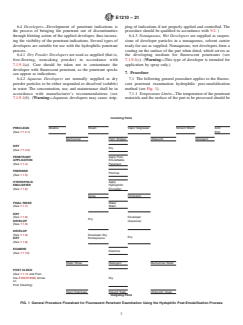
7.1 The following general procedure applies to the fluorescent penetrant examination hydrophilic post-emulsification method (see
Fig. 1).
Incoming Parts
PRECLEAN Alkaline Steam Vapor Degrease Solvent Wash Acid
(See 7.1.3.1) Etch
Mechanical Paint Stripper Ultrasonic Detergent
DRY
Dry
(See 7.1.3.2)
PENETRANT Apply Post-
APPLICATION Emulsifiable
(See 7.1.4) Penetrant
PRERINSE
Prerinse
(See 7.1.5)
HYDROPHILIC Apply
EMULSIFIER Hydrophilic
(See 7.1.6) Emulsifier
Spray Immersion
FINAL RINSE Water
(See 7.1.7) Wash
DRY
(See 7.1.8) Developer
Dry
DEVELOP (Aqueous)
(See 7.1.9)
DEVELOP
Developer Dry,
(See 7.1.9)
Nonaqueous or Dry
DEVELOP
Liquid Film Developer
(See 7.1.9)
Dry, Dry
DRY
Nonaqueous
(See 7.1.8)
EXAMINE
Examine
(See 7.1.10)
Water Rinse Detergent Mechanical Wash
POST CLEAN
(See 7.1.12 and Prac-
tice E165/E165M, Annex Dry
on
Post Cleaning)
Vapor Degrease Solvent Soak Ultrasonic Clean
Outgoing Parts
FIG. 1 General Procedure Flowsheet for Fluorescent Penetrant Examination Using the Hydophilic Post-Emulsification Process
E1210 − 21
7.1.1 Temperature Limits—The temperature of the penetrant materials and the surface of the part to be processed should be
between 40 and 125°F125 °F (4 and 52°C).52 °C). Where it is not practical to comply with these temperature limitations, qualify
the procedure at the temperature of intended use as described in 9.2.
7.1.2 Surface Conditioning Prior to Penetrant Inspection—Satisfactory results may be obtained on surfaces in the as-welded,
as-rolled, as-cast, or as-forged conditions or for ceramics in the densified condition. These sensitive penetrants are generally less
easily rinsed away and are therefore less suitable for rougher surfaces. When only loose surface residuals are present, these may
be removed by wiping the surface with clean lint-free cloths. However, precleaning of metals to remove processing residuals such
as oil, graphite, scale, insulating materials, coatings, and so forth, should be done using cleaning solvents, vapor degreasing or
chemical removing processes. Surface conditioning by grinding, machining, polishing or etching shall follow shot, sand, grit and
vapor blasting to remove the peened skin and when penetrant entrapment in surface irregularities might mask the indications of
unacceptable discontinuities or otherwise interfere with the effectiveness of the examination. For metals, unless otherwise
specified, etching shall be performed when evidence exists that previous cleaning, surface treatments or service usage have
produced a surface condition that degrades the effectiveness of the examination. (See Annex on Cleaning Parts and Materials in
Practice E165/E165M for general precautions relative to surface preparation.)
NOTE 2—When agreed between purchaser and supplier, grit blasting without subsequent etching may be an acceptable cleaning method. (Warning—Sand
or shot blasting may possibly close indications and extreme care should be used with grinding and machining operations.)
NOTE 3—For structural or electronic ceramics, surface preparation by grinding, sand blasting and etching for penetrant examination is not recommended
because of the potential for damage.
7.1.3 Removal of Surface Contaminants:
7.1.3.1 Precleaning—The success of any penetrant examination procedure is greatly dependent upon the surface and discontinuity
being free of any contaminant (solid or liquid) that might interfere with the penetrant process. All parts or areas of parts to be
inspected must be clean and dry before the penetrant is applied. If only a section of a part, such as a weld, including the
heat-affected zone is to be examined, all contaminants shall be removed from the area being examined as defined by the contracting
parties. “Clean” is intended to mean that the surface must be free of any rust, scale, welding flux, spatter, grease, paint, oily films,
dirt, etc., that might interfere with penetration. All of these contaminants can prevent the penetrant from entering discontinuities.
(See Annex on Cleaning of Parts and Materials in Practice E165/E165M for more detailed cleaning methods.) (Warning—
Residues from cleaning processes, such as strong alkalies, pickling solutions and chromates in particular, may adversely react with
the penetrant and reduce its sensitivity and performance.)
7.1.3.2 Drying After Cleaning—It is essential that the surface be thoroughly dry after cleaning, since any liquid residue will hinder
the entrance of the penetrant. Drying may be accomplished by warming the parts in drying ovens, with infrared lamps, forced hot
or cold air, or exposure to ambient temperature.
7.1.4 Penetrant Application—After the part has been cleaned, dried, and is within the specified temperature range, apply the
penetrant to the surface to be inspected so that the entire part or area under examination is completely covered with penetrant.
7.1.4.1 Modes of Application—There are various modes of effective application of penetrant such as dipping, brushing, flooding,
or spraying. Small parts are quite often placed in suitable baskets and dipped into a tank of penetrant. On larger parts, and those
with complex geometries, penetrant can be applied effectively by brushing or spraying. Both conventional and electrostatic spray
guns are effective means of applying liquid penetrants to the part surfaces. Electrostatic spray application can eliminate excess
liquid buildup of penetrant on the part, minimize overspray, and minimize the amount of penetrant entering hollow-cored passages
which might serve as penetrant reservoirs, causing severe bleedout problems during examination. Aerosol sprays are conveniently
portable and suitable for local application. (Warning—Not all penetrant materials are suitable for electrostatic spray applications.)
(Warning—With spray applications, it is important that there be proper ventilation. This is generally accomplished through the
use of a properly designed spray booth and exhaust system.)
7.1.4.2 Penetrant Dwell Time—After application, allow excess penetrant to drain from the part (care should be taken to prevent
pools of penetrant on the part), while allowing for proper penetrant dwell time (see Table 1). The length of time the penetrant must
remain on the part to allow proper penetr
...