

ASTM D6415/D6415M-22
(Test Method)Standard Test Method for Measuring the Curved Beam Strength of a Fiber-Reinforced Polymer-Matrix Composite
General Information
- Abstract
SIGNIFICANCE AND USE
5.1 Susceptibility to delamination is one of the major design concerns for many advanced laminated composite structures. Complex structural geometries can result in out-of-plane stresses, which may be difficult to analyze. When curved structural details are loaded such that the deformation results in an increase in the radius of curvature, interlaminar tensile stress and delaminations can result. Knowledge of a laminated composite material’s resistance to interlaminar fracture is useful for product development and material selection. Failure criteria and design allowables involving out-of-plane stresses may not be readily available or may be poorly validated, requiring additional experimental data.
5.2 This test method can serve the following purposes:
5.2.1 To measure a curved-beam strength;
5.2.2 To measure an interlaminar strength when using a unidirectional specimen where all fibers are oriented 0° relative to the long straight edges of the specimen;
5.2.3 To establish quantitatively the effect of fiber surface treatment, local variations in fiber volume fraction, and processing and environmental variables on the curved beam strength or the interlaminar (through-the-thickness) tensile strength of a particular composite material;
5.2.4 To compare quantitatively the relative curved-beam strength or interlaminar tensile strengths of composite materials with different constituents;
5.2.5 To compare quantitatively the values of the curved-beam strength or interlaminar tensile strengths obtained from different batches of a specific composite material, for example, to use as a material screening criterion, to use for quality assurance, or to develop a design allowable;
5.2.6 To produce out-of-plane structural failure data for structural design and analysis; and
5.2.7 To develop failure criteria for predicting failures caused by out-of-plane stresses.
SCOPE
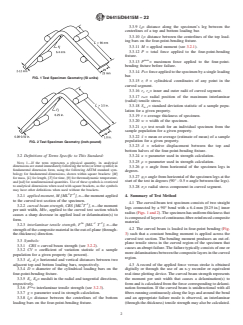
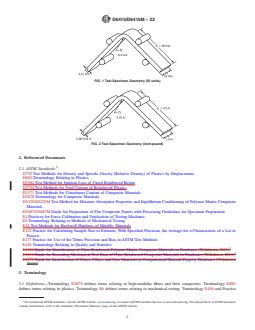
1.1 This test method determines the curved beam strength of a continuous fiber-reinforced composite material using a 90° curved beam specimen (Figs. 1 and 2). The curved beam consists of two straight legs connected by a 90° bend with a 6.4 mm [0.25 in.] inner radius. An out-of-plane (through-the-thickness) tensile stress is produced in the curved region of the specimen when force is applied. This test method is limited to use with composites consisting of layers of fabric or layers of unidirectional fibers.
FIG. 1 Test Specimen Geometry (SI units)
FIG. 2 Test Specimen Geometry (inch-pound)
1.2 This test method may also be used to measure the interlaminar tensile strength if a unidirectional specimen is used where the fibers run continuously along the legs and around the bend.
1.3 This test method is limited to use with composites consisting of layers of fabric or layers of unidirectional fibers.
1.4 Units—The values stated in either SI units or inch-pound units are to be regarded separately as standard. The values stated in each system are not necessarily exact equivalents; therefore, to ensure conformance with the standard, each system shall be used independently of the other, and values from the two systems shall not be combined.
1.4.1 Within the text, the inch-pound units are shown in brackets.
1.5 This standard does not purport to address all of the safety concerns, if any, associated with its use. It is the responsibility of the user of this standard to establish appropriate safety, health, and environmental practices and determine the applicability of regulatory limitations prior to use.
1.6 This international standard was developed in accordance with internationally recognized principles on standardization established in the Decision on Principles for the Development of International Standards, Guides and Recommendations issued by the World Trade Organization Technical Barriers to Trade (TBT) Committee.
- Status
- Published
- Publication Date
- 31-Jan-2022
- Technical Committee
- D30 - Composite Materials
- Drafting Committee
- D30.06 - Interlaminar Properties
Buy Documents
ASTM D6415/D6415M-22 - Standard Test Method for Measuring the Curved Beam Strength of a Fiber-Reinforced Polymer-Matrix Composite
REDLINE ASTM D6415/D6415M-22 - Standard Test Method for Measuring the Curved Beam Strength of a Fiber-Reinforced Polymer-Matrix Composite
Overview
ASTM D6415/D6415M-22 is the internationally recognized standard test method developed by ASTM for measuring the curved beam strength of fiber-reinforced polymer-matrix composites. This method is instrumental in evaluating the capability of composite materials, specifically those with continuous fiber reinforcement arranged in layered fabrics or unidirectional orientations, to resist interlaminar tensile stress when subjected to out-of-plane loading.
Curved structural details in advanced composite applications are susceptible to delamination due to complex stress states. ASTM D6415/D6415M-22 provides engineers and designers the data needed for accurate material selection, quality assurance, product development, and validation of analytical models-particularly for structural sections where failure from delamination is a critical concern.
Key Topics
- Curved Beam Strength Measurement: The test uses a 90° curved beam specimen, loaded in four-point bending, to quantify the resistance of a composite to out-of-plane tensile forces.
- Interlaminar (Through-Thickness) Tensile Strength: When tested with unidirectional fiber layups, this method can also determine the interlaminar tensile properties, offering valuable insight for structural design involving layered composites.
- Material Behavior under Out-of-Plane Stress: The method highlights the influence of variables like fiber surface treatment, fiber volume fraction, manufacturing process variables, and environmental factors on curved beam strength and delamination resistance.
- Comparison and Quality Assurance: ASTM D6415/D6415M-22 allows for comparative assessments across different material batches, material systems with various constituents, and for screening and developing material allowables.
- Data for Structural Design: The generated data supports the development of failure criteria for predicting and preventing structural failures caused by out-of-plane stress states.
Applications
The practical applications of ASTM D6415/D6415M-22 in industry and research include:
- Aerospace and Automotive Engineering: Used to assess the structural reliability of composite components such as frames, brackets, and stiffeners which often feature curved geometries and are prone to interlaminar failures.
- Materials Development and Screening: Valuable in new product development by enabling comparative studies of different fiber, matrix, and process combinations for robust design.
- Quality Control: Manufacturers leverage this standard for routine quality assurance, batch acceptance, and conformance verification in composite fabrication.
- Design Allowables and Failure Analysis: Test results can be used to establish design values, input data for finite element analysis, and to validate or improve analytical models for out-of-plane loading scenarios.
- Research and Academic Studies: Provides a reproducible method for academic studies focusing on composite mechanics and the effects of stress concentrations in laminated structures.
Related Standards
For a comprehensive approach, ASTM D6415/D6415M-22 is often used in conjunction with other key standards:
- ASTM D792: Test Methods for Density and Specific Gravity of Plastics.
- ASTM D2584, D2734, D3171: Methods for analyzing void and fiber content in reinforced plastics.
- ASTM D883, D3878, E6: Terminology standards for plastics and composite materials.
- ASTM D5229/D5229M: Guide for conditioning and moisture absorption studies in polymer composites.
- ASTM D5687/D5687M: Guidelines for specimen preparation.
- ASTM E4, E177, E456: Standards relating to testing equipment calibration and statistical methods.
Summary
ASTM D6415/D6415M-22 is essential for any organization involved in the design, manufacture, or research of fiber-reinforced polymer-matrix composites. Its procedures enable precise measurement of curved beam strength and interlaminar tensile strength, providing crucial data for structural integrity evaluation, material selection, process optimization, and quality control. By referencing ASTM D6415/D6415M-22, engineers and quality professionals can ensure composites are fit for service in demanding applications that exhibit complex geometry and are prone to delamination.
Relations
- Effective Date
- 01-Feb-2024
- Effective Date
- 01-Nov-2023
- Effective Date
- 01-Oct-2023
- Effective Date
- 01-Apr-2022
- Effective Date
- 01-Mar-2020
- Effective Date
- 01-Jan-2020
- Effective Date
- 15-Oct-2019
- Effective Date
- 01-Aug-2019
- Effective Date
- 15-Apr-2019
- Effective Date
- 15-Apr-2019
- Effective Date
- 01-Feb-2019
- Effective Date
- 01-Dec-2018
- Effective Date
- 01-Nov-2018
- Effective Date
- 15-Sep-2018
- Effective Date
- 01-Jul-2018
Buy Documents
ASTM D6415/D6415M-22 - Standard Test Method for Measuring the Curved Beam Strength of a Fiber-Reinforced Polymer-Matrix Composite
REDLINE ASTM D6415/D6415M-22 - Standard Test Method for Measuring the Curved Beam Strength of a Fiber-Reinforced Polymer-Matrix Composite
Get Certified
Connect with accredited certification bodies for this standard

DIN CERTCO
DIN Group product certification.

Smithers Quality Assessments
US management systems and product certification.
Sponsored listings
Frequently Asked Questions
ASTM D6415/D6415M-22 is a standard published by ASTM International. Its full title is "Standard Test Method for Measuring the Curved Beam Strength of a Fiber-Reinforced Polymer-Matrix Composite". This standard covers: SIGNIFICANCE AND USE 5.1 Susceptibility to delamination is one of the major design concerns for many advanced laminated composite structures. Complex structural geometries can result in out-of-plane stresses, which may be difficult to analyze. When curved structural details are loaded such that the deformation results in an increase in the radius of curvature, interlaminar tensile stress and delaminations can result. Knowledge of a laminated composite material’s resistance to interlaminar fracture is useful for product development and material selection. Failure criteria and design allowables involving out-of-plane stresses may not be readily available or may be poorly validated, requiring additional experimental data. 5.2 This test method can serve the following purposes: 5.2.1 To measure a curved-beam strength; 5.2.2 To measure an interlaminar strength when using a unidirectional specimen where all fibers are oriented 0° relative to the long straight edges of the specimen; 5.2.3 To establish quantitatively the effect of fiber surface treatment, local variations in fiber volume fraction, and processing and environmental variables on the curved beam strength or the interlaminar (through-the-thickness) tensile strength of a particular composite material; 5.2.4 To compare quantitatively the relative curved-beam strength or interlaminar tensile strengths of composite materials with different constituents; 5.2.5 To compare quantitatively the values of the curved-beam strength or interlaminar tensile strengths obtained from different batches of a specific composite material, for example, to use as a material screening criterion, to use for quality assurance, or to develop a design allowable; 5.2.6 To produce out-of-plane structural failure data for structural design and analysis; and 5.2.7 To develop failure criteria for predicting failures caused by out-of-plane stresses. SCOPE 1.1 This test method determines the curved beam strength of a continuous fiber-reinforced composite material using a 90° curved beam specimen (Figs. 1 and 2). The curved beam consists of two straight legs connected by a 90° bend with a 6.4 mm [0.25 in.] inner radius. An out-of-plane (through-the-thickness) tensile stress is produced in the curved region of the specimen when force is applied. This test method is limited to use with composites consisting of layers of fabric or layers of unidirectional fibers. FIG. 1 Test Specimen Geometry (SI units) FIG. 2 Test Specimen Geometry (inch-pound) 1.2 This test method may also be used to measure the interlaminar tensile strength if a unidirectional specimen is used where the fibers run continuously along the legs and around the bend. 1.3 This test method is limited to use with composites consisting of layers of fabric or layers of unidirectional fibers. 1.4 Units—The values stated in either SI units or inch-pound units are to be regarded separately as standard. The values stated in each system are not necessarily exact equivalents; therefore, to ensure conformance with the standard, each system shall be used independently of the other, and values from the two systems shall not be combined. 1.4.1 Within the text, the inch-pound units are shown in brackets. 1.5 This standard does not purport to address all of the safety concerns, if any, associated with its use. It is the responsibility of the user of this standard to establish appropriate safety, health, and environmental practices and determine the applicability of regulatory limitations prior to use. 1.6 This international standard was developed in accordance with internationally recognized principles on standardization established in the Decision on Principles for the Development of International Standards, Guides and Recommendations issued by the World Trade Organization Technical Barriers to Trade (TBT) Committee.
SIGNIFICANCE AND USE 5.1 Susceptibility to delamination is one of the major design concerns for many advanced laminated composite structures. Complex structural geometries can result in out-of-plane stresses, which may be difficult to analyze. When curved structural details are loaded such that the deformation results in an increase in the radius of curvature, interlaminar tensile stress and delaminations can result. Knowledge of a laminated composite material’s resistance to interlaminar fracture is useful for product development and material selection. Failure criteria and design allowables involving out-of-plane stresses may not be readily available or may be poorly validated, requiring additional experimental data. 5.2 This test method can serve the following purposes: 5.2.1 To measure a curved-beam strength; 5.2.2 To measure an interlaminar strength when using a unidirectional specimen where all fibers are oriented 0° relative to the long straight edges of the specimen; 5.2.3 To establish quantitatively the effect of fiber surface treatment, local variations in fiber volume fraction, and processing and environmental variables on the curved beam strength or the interlaminar (through-the-thickness) tensile strength of a particular composite material; 5.2.4 To compare quantitatively the relative curved-beam strength or interlaminar tensile strengths of composite materials with different constituents; 5.2.5 To compare quantitatively the values of the curved-beam strength or interlaminar tensile strengths obtained from different batches of a specific composite material, for example, to use as a material screening criterion, to use for quality assurance, or to develop a design allowable; 5.2.6 To produce out-of-plane structural failure data for structural design and analysis; and 5.2.7 To develop failure criteria for predicting failures caused by out-of-plane stresses. SCOPE 1.1 This test method determines the curved beam strength of a continuous fiber-reinforced composite material using a 90° curved beam specimen (Figs. 1 and 2). The curved beam consists of two straight legs connected by a 90° bend with a 6.4 mm [0.25 in.] inner radius. An out-of-plane (through-the-thickness) tensile stress is produced in the curved region of the specimen when force is applied. This test method is limited to use with composites consisting of layers of fabric or layers of unidirectional fibers. FIG. 1 Test Specimen Geometry (SI units) FIG. 2 Test Specimen Geometry (inch-pound) 1.2 This test method may also be used to measure the interlaminar tensile strength if a unidirectional specimen is used where the fibers run continuously along the legs and around the bend. 1.3 This test method is limited to use with composites consisting of layers of fabric or layers of unidirectional fibers. 1.4 Units—The values stated in either SI units or inch-pound units are to be regarded separately as standard. The values stated in each system are not necessarily exact equivalents; therefore, to ensure conformance with the standard, each system shall be used independently of the other, and values from the two systems shall not be combined. 1.4.1 Within the text, the inch-pound units are shown in brackets. 1.5 This standard does not purport to address all of the safety concerns, if any, associated with its use. It is the responsibility of the user of this standard to establish appropriate safety, health, and environmental practices and determine the applicability of regulatory limitations prior to use. 1.6 This international standard was developed in accordance with internationally recognized principles on standardization established in the Decision on Principles for the Development of International Standards, Guides and Recommendations issued by the World Trade Organization Technical Barriers to Trade (TBT) Committee.
ASTM D6415/D6415M-22 is classified under the following ICS (International Classification for Standards) categories: 83.120 - Reinforced plastics. The ICS classification helps identify the subject area and facilitates finding related standards.
ASTM D6415/D6415M-22 has the following relationships with other standards: It is inter standard links to ASTM D883-24, ASTM D883-23, ASTM D2734-23, ASTM E456-13a(2022)e1, ASTM D5229/D5229M-20, ASTM D883-20, ASTM D3878-19a, ASTM D883-19c, ASTM D883-19a, ASTM D3878-19, ASTM D883-19, ASTM D883-18a, ASTM D883-18, ASTM D2584-18, ASTM E18-18. Understanding these relationships helps ensure you are using the most current and applicable version of the standard.
ASTM D6415/D6415M-22 is available in PDF format for immediate download after purchase. The document can be added to your cart and obtained through the secure checkout process. Digital delivery ensures instant access to the complete standard document.
Standards Content (Sample)
This international standard was developed in accordance with internationally recognized principles on standardization established in the Decision on Principles for the
Development of International Standards, Guides and Recommendations issued by the World Trade Organization Technical Barriers to Trade (TBT) Committee.
Designation: D6415/D6415M − 22
Standard Test Method for
Measuring the Curved Beam Strength of a Fiber-Reinforced
Polymer-Matrix Composite
This standard is issued under the fixed designation D6415/D6415M; the number immediately following the designation indicates the
year of original adoption or, in the case of revision, the year of last revision. A number in parentheses indicates the year of last
reapproval. A superscript epsilon (´) indicates an editorial change since the last revision or reapproval.
1. Scope 2. Referenced Documents
1.1 Thistestmethoddeterminesthecurvedbeamstrengthof 2.1 ASTM Standards:
a continuous fiber-reinforced composite material using a 90° D792Test Methods for Density and Specific Gravity (Rela-
curved beam specimen (Figs. 1 and 2). The curved beam tive Density) of Plastics by Displacement
consists of two straight legs connected by a 90° bend with a D883Terminology Relating to Plastics
6.4mm [0.25 in.] inner radius. An out-of-plane (through-the- D2584Test Method for Ignition Loss of Cured Reinforced
thickness) tensile stress is produced in the curved region of the Resins
specimen when force is applied. This test method is limited to D2734TestMethodsforVoidContentofReinforcedPlastics
use with composites consisting of layers of fabric or layers of D3171Test Methods for Constituent Content of Composite
unidirectional fibers. Materials
D3878Terminology for Composite Materials
1.2 This test method may also be used to measure the
D5229/D5229MTestMethodforMoistureAbsorptionProp-
interlaminar tensile strength if a unidirectional specimen is
erties and Equilibrium Conditioning of Polymer Matrix
used where the fibers run continuously along the legs and
Composite Materials
around the bend.
D5687/D5687MGuide for Preparation of Flat Composite
1.3 This test method is limited to use with composites
Panels with Processing Guidelines for Specimen Prepara-
consisting of layers of fabric or layers of unidirectional fibers.
tion
E4Practices for Force Calibration and Verification of Test-
1.4 Units—The values stated in either SI units or inch-
pound units are to be regarded separately as standard. The ing Machines
E6Terminology Relating to Methods of MechanicalTesting
values stated in each system are not necessarily exact equiva-
E18Test Methods for Rockwell Hardness of Metallic Ma-
lents; therefore, to ensure conformance with the standard, each
system shall be used independently of the other, and values terials
E122PracticeforCalculatingSampleSizetoEstimate,With
from the two systems shall not be combined.
1.4.1 Within the text, the inch-pound units are shown in Specified Precision, the Average for a Characteristic of a
Lot or Process
brackets.
E177Practice for Use of the Terms Precision and Bias in
1.5 This standard does not purport to address all of the
ASTM Test Methods
safety concerns, if any, associated with its use. It is the
E456Terminology Relating to Quality and Statistics
responsibility of the user of this standard to establish appro-
priate safety, health, and environmental practices and deter-
3. Terminology
mine the applicability of regulatory limitations prior to use.
3.1 Definitions—Terminology D3878 defines terms relating
1.6 This international standard was developed in accor-
dance with internationally recognized principles on standard- to high-modulus fibers and their composites. Terminology
D883definestermsrelatingtoplastics.TerminologyE6defines
ization established in the Decision on Principles for the
Development of International Standards, Guides and Recom- terms relating to mechanical testing. Terminology E456 and
Practice E177 define terms relating to statistics. In the event of
mendations issued by the World Trade Organization Technical
a conflict between terms, Terminology D3878 shall have
Barriers to Trade (TBT) Committee.
precedence over the other terminology standards.
This test method is under the jurisdiction of ASTM Committee D30 on
Composite Materials and is the direct responsibility of D30.06 on Interlaminar
Properties. For referenced ASTM standards, visit the ASTM website, www.astm.org, or
Current edition approved Feb. 1, 2022. Published April 2022. Originally contact ASTM Customer Service at service@astm.org. For Annual Book of ASTM
approved in 1999. Last previous edition approved in 2013 as D6415/ Standards volume information, refer to the standard’s Document Summary page on
D6415M–06a(2013). DOI: 10.1520/D6415_D6415M-22. the ASTM website.
Copyright © ASTM International, 100 Barr Harbor Drive, PO Box C700, West Conshohocken, PA 19428-2959. United States
D6415/D6415M − 22
3.3.9 l = distance along the specimen’s leg between the
centerlines of a top and bottom loading bar.
3.3.10 l= distance between the centerlines of the top load-
t
ing bars on the four-point-bending fixture.
3.3.11 M = applied moment (see 3.2.1).
3.3.12 P = total force applied to the four-point-bending
fixture.
max
3.3.13 P = maximum force applied to the four-point-
bending fixture before failure.
3.3.14 P =forceappliedtothespecimenbyasingleloading
b
bar.
FIG. 1 Test Specimen Geometry (SI units)
3.3.15 r, θ = cylindrical coordinates of any point in the
curved segment.
3.3.16 r,r = inner and outer radii of curved segment.
i o
3.3.17 r = radial position of the maximum interlaminar
m
(radial) tensile stress.
3.3.18 S = standard deviation statistic of a sample popu-
n–1
lation for a given property.
3.3.19 t = average thickness of specimen.
3.3.20 w = width of the specimen.
3.3.21 x= test result for an individual specimen from the
i
sample population for a given property.
3.3.22 x¯ = mean or average (estimate of mean) of a sample
population for a given property.
FIG. 2 Test Specimen Geometry (inch-pound)
3.3.23 ∆ = relative displacement between the top and
bottom halves of the four-point-bending fixture.
3.2 Definitions of Terms Specific to This Standard:
3.3.24 κ = parameter used in strength calculation.
3.3.25 ρ = parameter used in strength calculation.
NOTE 1—If the term represents a physical quantity, its analytical
dimensionsarestatedimmediatelyfollowingtheterm(orlettersymbol)in
3.3.26 φ = angle from horizontal of the specimen legs in
fundamental dimension form, using the following ASTM standard sym-
degrees.
bology for fundamental dimensions, shown within square brackets: [M]
3.3.27 φ= angle from horizontal of the specimen legs at the
i
for mass, [L] for length, [T] for time, [θ] for thermodynamic temperature,
start of the test in degrees (90° - 0.5 × angle between the legs).
and [nd] for nondimensional quantities. Use of these symbols is restricted
to analytical dimensions when used with square brackets, as the symbols
3.3.28 σ = radial stress component in curved segment.
r
may have other definitions when used without the brackets.
2 –2
3.2.1 applied moment, M [ML T ], n—the moment applied 4. Summary of Test Method
to the curved test section of the specimen.
4.1 The curved-beam test specimen consists of two straight
1 –2
3.2.2 curved beam strength, CBS [ML T ], n—the moment
legs connected by a 90° bend with a 6.4mm [0.25in.] inner
per unit width, M/w, applied to the curved test section which
radius(Figs.1and2).Thespecimenhasuniformthicknessthat
causes a sharp decrease in applied load or delamination(s) to
iscomposedoflayersofcontinuous-fiber-reinforcedcomposite
form.
material.
3u –1 –2
3.2.3 interlaminar tensile strength, F [ML T ], n—the
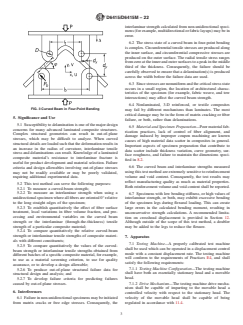
4.2 The curved beam is loaded in four-point bending (Fig.
strengthofthecompositematerialintheout-of-plane(through-
3) such that a constant bending moment is applied across the
the-thickness) direction.
curved test section. The bending moment produces an out-of-
3.3 Symbols:
plane tensile stress in the curved region of the specimen that
3.3.1 CBS = curved beam strength (see 3.2.2).
causesanabruptfailure.Thefailuretypicallyconsistsofoneor
3.3.2 CV = coefficient of variation statistic of a sample
moredelaminationsbetweenthecompositelayersinthecurved
population for a given property (in percent).
region.
3.3.3 d ,d = horizontal and vertical distances between two
x y
adjacent top and bottom loading bars, respectively. 4.3 A record of the applied force versus stroke is obtained
3.3.4 D = diameter of the cylindrical loading bars on the digitally or through the use of an x-y recorder or equivalent
four-point-bending fixture. real-time plotting device.The curved beam strength represents
3.3.5 E ,E = moduli in the radial and tangential directions, the moment per unit width that causes a delamination(s) to
r θ
respectively. formandiscalculatedfromtheforcecorrespondingtodelami-
3u
3.3.6 F = interlaminar tensile strength (see 3.2.3). nation formation. If the curved beam is unidirectional with all
3.3.7 g = parameter used in strength calculation. fibersrunningcontinuouslyalongthelegsandaroundthebend
3.3.8 l = distance between the centerlines of the bottom and an appropriate failure mode is observed, an interlaminar
b
loading bars on the four-point-bending fixture. (through-the-thickness)tensilestrengthmayalsobecalculated.
D6415/D6415M − 22
interlaminar strength calculated from non-unidirectional speci-
mens(forexample,multidirectionalorfabriclayups)maybein
error.
6.2 The stress state of a curved beam in four-point bending
iscomplex.Circumferentialtensilestressesareproducedalong
the inner surface, and circumferential compressive stresses are
produced on the outer surface. The radial tensile stress ranges
fromzeroattheinnerandoutersurfacestoapeakinthemiddle
third of the thickness. Consequently, the failure should be
carefullyobservedtoensurethatadelamination(s)isproduced
across the width before the failure data are used.
6.3 Sincestressesarenonuniformandthecriticalstressstate
occurs in a small region, the location of architectural charac-
teristics of the specimen (for example, fabric weave, and tow
intersections) may affect the curved beam strength.
6.4 Nonlaminated, 3-D reinforced, or textile composites
FIG. 3 Curved Beam in Four-Point Bending
may fail by different mechanisms than laminates. The most
critical damage may be in the form of matrix cracking or fiber
5. Significance and Use
failure, or both, rather than delaminations.
5.1 Susceptibilitytodelaminationisoneofthemajordesign
6.5 Material and Specimen Preparation—Poormaterialfab-
concerns for many advanced laminated composite structures.
rication practices, lack of control of fiber alignment, and
Complex structural geometries can result in out-of-plane
damage induced by improper coupon machining are known
stresses, which may be difficult to analyze. When curved
causes of high material data scatter in composites in general.
structuraldetailsareloadedsuchthatthedeformationresultsin
Important aspects of specimen preparation that contribute to
an increase in the radius of curvature, interlaminar tensile
data scatter include thickness variation, curve geometry, sur-
stress and delaminations can result. Knowledge of a laminated
face roughness, and failure to maintain the dimensions speci-
composite material’s resistance to interlaminar fracture is
fied in 8.2.
useful for product development and material selection. Failure
criteria and design allowables involving out-of-plane stresses 6.6 The curved beam and interlaminar strengths measured
using this test method are extremely sensitive to reinforcement
may not be readily available or may be poorly validated,
requiring additional experimental data. volume and void content. Consequently, the test results may
reflect manufacturing quality as much as material properties.
5.2 This test method can serve the following purposes:
Bothreinforcementvolumeandvoidcontentshallbereported.
5.2.1 To measure a curved-beam strength;
5.2.2 To measure an interlaminar strength when using a
6.7 Specimens with low bending stiffness, or high values of
unidirectionalspecimenwhereallfibersareoriented0°relative
interlaminar strength, or both, may exhibit excessive bending
to the long straight edges of the specimen;
of the specimen legs during flexural loading. This can create
5.2.3 To establish quantitatively the effect of fiber surface
large errors in the calculated bending moment, resulting in
treatment, local variations in fiber volume fraction, and pro-
unconservative strength calculations. A recommended limita-
cessing and environmental variables on the curved beam
tion on crosshead displacement is provided in Section 12.
strength or the interlaminar (through-the-thickness) tensile
Although outside of the scope of this test method, a doubler
strength of a particular composite material;
may be added to the legs to reduce the flexure.
5.2.4 To compare quantitatively the relative curved-beam
strength or interlaminar tensile strengths of composite materi-
7. Apparatus
als with different constituents;
7.1 Testing Machine—A properly calibrated test machine
5.2.5 To compare quantitatively the values of the curved-
shall be used which can be operated in a displacement control
beam strength or interlaminar tensile strengths obtained from
mode with a constant displacement rate. The testing machine
differentbatchesofaspecificcompositematerial,forexample,
will conform to the requirements of Practices E4, and shall
to use as a material screening criterion, to use for quality
satisfy the following requirements:
assurance, or to develop a design allowable;
7.1.1 Testing Machine Configuration—The testing machine
5.2.6 To produce out-of-plane structural failure data for
shall have both an essentially stationary head and a movable
structural design and analysis; and
head.
5.2.7 To develop failure criteria for predicting failures
7.1.2 Drive Mechanism—The testing machine drive mecha-
caused by out-of-plane stresses.
nism shall be capable of imparting to the movable head a
6. Interferences
controlled velocity with respect to the stationary head. The
6.1 Failureinnon-unidirectionalspecimensmaybeinitiated velocity of the movable head shall be capable of being
from matrix cracks or free edge stresses. Consequently, the regulated in accordance with 11.4.
D6415/D6415M − 22
7.1.3 Force Indicator—The testing machine force-sensing an instrument with an accuracy of 60.025mm [60.001in.] is
device shall be capable of indicating the total force being adequate for measurement of length, width, other machined
surface dimensions.
carried by the test specimen. This device shall be essentially
free from inertia lag at the specified rate of testing and shall
7.6 Environmental Test Chamber—An environmental test
indicate the force with an accuracy over the force range(s) of
chamber is required for test environments other than ambient
interest of within 61% of the indicated value.
testing laboratory conditions.This chamber shall be capable of
7.1.4 Grips—Each head of the testing machine shall have a
maintaining the test specimen and fixture at the required test
means to hold half of the four-point-bending fixture firmly in
environment during the mechanical test. The test temperature
place.Aconvenientmeansofprovidinganattachmentpointfor
shall be maintained within 63°C [65°F] of the required
each fixture half is through the use of a metal “T” in each grip.
temperature, and the relative humidity level shall be main-
The lower part of the “T” is clamped in the grips, and the top tained to within 63%RH of the required humidity level.
part of the “T” provides a flat attachment surface for each
fixture half.
8. Sampling and Test Specimens
8.1 Sampling—Test at least five specimens per condition
7.2 Four-Point-Bending Fixture—Afour-point-bending test
unless valid results can be gained through the use of fewer
apparatusasshowninFig.3shallbeusedtoloadthespecimen.
specimens, such as the case of a designed experiment. For
Machine drawings, for example, fixtures are shown in the
statisticallysignificantdata,theproceduresoutlinedinPractice
appendix. Other designs that perform the necessary functions
E122 should be consulted. Report the method of sampling.
are acceptable. The cylindrical loading bars shall have
diameters, D, of 6.0 to 12.8mm [0.23 to 0.50in.] and be
8.2 Geometry
mounted on roller bearings. All loading bars shall have
8.2.1 Dimensions—Specimen geometry is shown in Figs. 1
diameters within 60.1mm [60.004in.] and shall have finely
and 2. The laminate shall have a cross section of constant
ground surfaces free of indentations and burrs with a hardness
thickness. The thickness shall be 2 to 12 mm [0.08 to 0.50 in.]
greater than or equal to 55 HRC as specified in Test Methods
The width shall be 25 6 1 mm [1.00 6 0.04 in.] wide with an
E18. The distance between the bar centers shall be 100 6
innerradiusof6.4 60.2mm[0.25 60.01in.]atthebend.The
2mm [4.00 6 0.05in.] (l ) for the bottom fixture and 75 6
b loading leg length shall be a minimum of 90 mm [3.5 in.] and
2mm [3.00 6 0.05in.] (l) for the top fixture.
t short enough to prevent contact with the fixture base. The
variation in thickness for any given specimen shall not exceed
7.3 Displacement Indicator—The relative axial displace-
5% of the nominal thickness. The angle between the two
mentbetweentheupperandlowerfixturesmaybeestimatedas
loadinglegsshallbe90 63°.Thisangleisoftendifferentfrom
the crosshead travel, provided the deformation of the testing
90°becauseofspecimen“springback”uponremovalfromthe
machine and support fixture is less than 2% of the crosshead
tool after curing.
travel. If not, this displacement shall be obtained from a
8.2.2 Stacking Sequence
properlycalibratedexternalgageortransducerlocatedbetween
8.2.2.1 Curved Beam Strength Measurement—Any stacking
the two fixtures. The displacement indicator shall indicate the
sequence that can be manufactured to the specified dimensions
displacementwithanaccuracyof 61%ofthethicknessofthe
may be used.
specimen.
8.2.2.2 Interlaminar Strength Measurement—Specimens
7.4 Force Versus Displacement (P Versus ∆) Record—A
shall have a unidirectional stacking sequence with the fibers
digital record of force versus load point displacement shall be
running circumferentially around the curved region. For com-
stored for subsequent post-processing. Alternatively, an X-Y
parison screening of interlaminar strength, a specimen with an
plotter, or similar device, may be used to make a permanent
appropriate number of plies to produce a thickness of 4.2 6
record during the test of force versus displacement.
0.2mm [0.17 6 0.008in.] is suggested.
7.5 Micrometers and Calipers—A micrometer witha4to
8.3 Specimen Preparation—Guide D5687/D5687M pro-
8mm[0.16to0.32in.]nominaldiameterball-interfaceoraflat videsrecommendedspecimenpreparationpracticesandshould
anvil interface shall be used to measure the specimen thick- be followed where practical. Special care should be taken to
ness. A ball interface is recommended for thickness measure- ensure that specimen edges are sufficiently free of obvious
ments when at least one surface is irregular (for example, a flaws as determined by visual inspection.
coarse peel ply surface which is neither smooth nor flat). A
8.3.1 A male tool is recommended for lay-up and cure to
micrometer or caliper with a flat anvil interface shall be used obtain a more precise inner radius.Amale/female tool combi-
for measuring length, width, and other machined surface
nationoracompletelyenclosedmoldcanalsobeused.Control
dimensions.Aknife-edge caliper shall be used to measure the of fiber alignment is critical. Improper fiber alignment will
specimenthicknessintheradiussection.Theuseofalternative affectthemeasuredproperties.Erraticfiberalignmentwillalso
measurementdevicesispermittedifspecified(oragreedto)by increase the coefficient of variation. Report the panel fabrica-
the test requestor and reported by the testing laboratory. The tion method.
accuracy of the instrument(s) shall be suitable for reading to
8.3.2 Machining—Specimen preparation is extremely im-
within1%ofthe specimen dimensions. For typical specimen portant for this specimen. Take precautions when cutting
geometries, an instrument with an accuracy of 60.0025mm
specimensfromlargepanelstoavoidnotches,undercuts,rough
[60.0001in.] is adequate for thickness measurements, while or uneven surfaces, or delaminations due to inappropriate
D6415/D6415M − 22
machining methods. Obtain final dimensions by water- 11.1.1 The specimen sampling met
...
This document is not an ASTM standard and is intended only to provide the user of an ASTM standard an indication of what changes have been made to the previous version. Because
it may not be technically possible to adequately depict all changes accurately, ASTM recommends that users consult prior editions as appropriate. In all cases only the current version
of the standard as published by ASTM is to be considered the official document.
Designation: D6415/D6415M − 06a (Reapproved 2013) D6415/D6415M − 22
Standard Test Method for
Measuring the Curved Beam Strength of a Fiber-Reinforced
Polymer-Matrix Composite
This standard is issued under the fixed designation D6415/D6415M; the number immediately following the designation indicates the
year of original adoption or, in the case of revision, the year of last revision. A number in parentheses indicates the year of last
reapproval. A superscript epsilon (´) indicates an editorial change since the last revision or reapproval.
1. Scope
1.1 This test method determines the curved beam strength of a continuous fiber-reinforced composite material using a 90° curved
beam specimen (Fig. 1Figs. 1 and 2 and Fig. 2). The curved beam consists of two straight legs connected by a 90° bend with a
6.4-mm6.4 mm [0.25 in.] inner radius. An out-of-plane (through-the-thickness) tensile stress is produced in the curved region of
the specimen when force is applied. This test method is limited to use with composites consisting of layers of fabric or layers of
unidirectional fibers.
1.2 This test method may also be used to measure the interlaminar tensile strength if a unidirectional specimen is used where the
fibers run continuously along the legs and around the bend.
1.3 This test method is limited to use with composites consisting of layers of fabric or layers of unidirectional fibers.
1.4 Units—The values stated in either SI units or inch-pound units are to be regarded separately as standard. The values stated in
each system are not necessarily exact equivalents; therefore, to ensure conformance with the standard, each system shall be used
independently of the other, and values from the two systems shall not be combined.
1.4.1 Within the text, the inch-pound units are shown in brackets.
1.5 This standard does not purport to address all of the safety concerns, if any, associated with its use. It is the responsibility
of the user of this standard to establish appropriate safety safety, health, and healthenvironmental practices and determine the
applicability of regulatory limitations prior to use.
1.4 The values stated in either SI units or inch-pound units are to be regarded separately as standard. Within the text the
inch-pound units are shown in brackets. The values stated in each system are not exact equivalents; therefore, each system must
be used independently of the other. Combining values from the two systems may result in nonconformance with the standard.
1.6 This international standard was developed in accordance with internationally recognized principles on standardization
established in the Decision on Principles for the Development of International Standards, Guides and Recommendations issued
by the World Trade Organization Technical Barriers to Trade (TBT) Committee.
This test method is under the jurisdiction of ASTM Committee D30 on Composite Materials and is the direct responsibility of D30.06 on Interlaminar Properties.
Current edition approved Oct. 1, 2013Feb. 1, 2022. Published October 2013April 2022. Originally approved in 1999. Last previous edition approved in 20062013 as
ε1
D6415 – 06D6415/D6415M – 06aA(2013). . DOI: 10.1520/D6415_D6415M-06AR13.10.1520/D6415_D6415M-22.
Copyright © ASTM International, 100 Barr Harbor Drive, PO Box C700, West Conshohocken, PA 19428-2959. United States
D6415/D6415M − 22
FIG. 1 Test Specimen Geometry (SI units)
FIG. 2 Test Specimen Geometry (inch-pound)
2. Referenced Documents
2.1 ASTM Standards:
D792 Test Methods for Density and Specific Gravity (Relative Density) of Plastics by Displacement
D883 Terminology Relating to Plastics
D2584 Test Method for Ignition Loss of Cured Reinforced Resins
D2734 Test Methods for Void Content of Reinforced Plastics
D3171 Test Methods for Constituent Content of Composite Materials
D3878 Terminology for Composite Materials
D5229/D5229M Test Method for Moisture Absorption Properties and Equilibrium Conditioning of Polymer Matrix Composite
Materials
D5687/D5687M Guide for Preparation of Flat Composite Panels with Processing Guidelines for Specimen Preparation
E4 Practices for Force Calibration and Verification of Testing Machines
E6 Terminology Relating to Methods of Mechanical Testing
E18 Test Methods for Rockwell Hardness of Metallic Materials
E122 Practice for Calculating Sample Size to Estimate, With Specified Precision, the Average for a Characteristic of a Lot or
Process
E177 Practice for Use of the Terms Precision and Bias in ASTM Test Methods
E456 Terminology Relating to Quality and Statistics
E1309 Guide for Identification of Fiber-Reinforced Polymer-Matrix Composite Materials in Databases (Withdrawn 2015)
E1434 Guide for Recording Mechanical Test Data of Fiber-Reinforced Composite Materials in Databases (Withdrawn 2015)
E1471 Guide for Identification of Fibers, Fillers, and Core Materials in Computerized Material Property Databases (Withdrawn
2015)
3. Terminology
3.1 Definitions—Terminology D3878 defines terms relating to high-modulus fibers and their composites. Terminology D883
defines terms relating to plastics. Terminology E6 defines terms relating to mechanical testing. Terminology E456 and Practice
For referenced ASTM standards, visit the ASTM website, www.astm.org, or contact ASTM Customer Service at service@astm.org. For Annual Book of ASTM Standards
volume information, refer to the standard’s Document Summary page on the ASTM website.
D6415/D6415M − 22
E177 define terms relating to statistics. In the event of a conflict between terms, Terminology D3878 shall have precedence over
the other terminologies. terminology standards.
3.2 Definitions of Terms Specific to This Standard:
NOTE 1—If the term represents a physical quantity, its analytical dimensions are stated immediately following the term (or letter symbol) in fundamental
dimension form, using the following ASTM standard symbology for fundamental dimensions, shown within square brackets: [M] for mass, [L] for length,
[T] for time, [θ] for thermodynamic temperature, and [nd] for nondimensional quantities. Use of these symbols is restricted to analytical dimensions when
used with square brackets, as the symbols may have other definitions when used without the brackets.
2 –2
3.2.1 applied moment, M [ML T ], n—the moment applied to the curved test section of the specimen.
1 –2
3.2.2 curved beam strength, CBS [ML T ], n—the moment per unit width, M/w, applied to the curved test section which causes
a sharp decrease in applied load or delamination(s) to form.
3u –1 –2
3.2.3 interlaminar tensile strength, F [ML T ], n—the strength of the composite material in the out-of-plane (through-the-
thickness) direction.
3.3 Symbols:
3.3.1 CBS = curved beam strength (see 3.2.2).
3.3.2 CV = coefficient of variation statistic of a sample population for a given property (in percent).
3.3.3 d , d = horizontal and vertical distances between two adjacent top and bottom loading bars, respectively.
x y
3.3.4 D = diameter of the cylindrical loading bars on the four-point-bending fixture.
3.3.5 E , E = moduli in the radial and tangential directions, respectively.
r θ
3u
3.3.6 F = interlaminar tensile strength (see 3.2.3).
3.3.7 g = parameter used in strength calculation.
3.3.8 l = distance between the centerlines of the bottom loading bars on the four-point-bending fixture.
b
3.3.9 l = distance along the specimen’s leg between the centerlines of a top and bottom loading bar.
3.3.10 l = distance between the centerlines of the top loading bars on the four-point-bending fixture.
t
3.3.11 M = applied moment (see 3.2.1).
3.3.12 P = total force applied to the four-point-bending fixture.
max
3.3.13 P = maximum force applied to the four-point-bending fixture before failure.
3.3.14 P = force applied to the specimen by a single loading bar.
b
3.3.15 r, θ = cylindrical coordinates of any point in the curved segment.
3.3.16 r , r = inner and outer radii of curved segment.
i o
3.3.17 r = radial position of the maximum interlaminar (radial) tensile stress.
m
3.3.18 S = standard deviation statistic of a sample population for a given property.
n–1
3.3.19 t = average thickness of specimen.
3.3.20 w = width of the specimen.
D6415/D6415M − 22
3.3.21 x = test result for an individual specimen from the sample population for a given property.
1i
3.3.22 x¯x¯ = mean or average (estimate of mean) of a sample population for a given property.
3.3.23 Δ = relative displacement between the top and bottom halves of the four-point-bending fixture.
3.3.24 κ = parameter used in strength calculation.
3.3.25 ρ = parameter used in strength calculation.
3.3.26 φ = angle from horizontal of the specimen legs in degrees.
3.3.27 φ = angle from horizontal of the specimen legs at the start of the test in degrees (0.5 (90° - 0.5 × angle between the legs).
i
3.3.28 σ = radial stress component in curved segment.
r
4. Summary of Test Method
4.1 The curved-beam test specimen consists of two straight legs connected by a 90° bend with a 6.4 mm [0.25 in.] inner radius
(Figs. 1 and 2). The specimen has uniform thickness that is composed of layers of continuous-fiber-reinforced composite material.
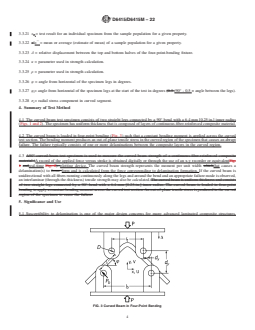
4.2 The curved beam is loaded in four-point bending (Fig. 3) such that a constant bending moment is applied across the curved
test section. The bending moment produces an out-of-plane tensile stress in the curved region of the specimen that causes an abrupt
failure. The failure typically consists of one or more delaminations between the composite layers in the curved region.
4.3 A90° curved-beam test specimen is used to measure the curved beam strength of a continuous-fiber-reinforced composite
material (A record of the applied force versus stroke is obtained digitally or through the use of an x-y recorder or equivalentFig.
1 andreal-time Fig. 2). plotting device. The curved beam strength represents the moment per unit width whichthat causes a
delamination(s) to form. form and is calculated from the force corresponding to delamination formation. If the curved beam is
unidirectional with all fibers running continuously along the legs and around the bend and an appropriate failure mode is observed,
an interlaminar (through-the-thickness) tensile strength may also be calculated. The curved beam is uniform thickness and consists
of two straight legs connected by a 90° bend with a 6.4-mm [0.25-in.] inner radius. The curved beam is loaded in four-point
bending to apply a constant bending moment across the curved test section. An out-of-plane tensile stress is produced in the curved
region of the specimen to cause the failure.
5. Significance and Use
5.1 Susceptibility to delamination is one of the major design concerns for many advanced laminated composite structures.
FIG. 3 Curved Beam in Four-Point Bending
D6415/D6415M − 22
Complex structural geometries can result in out-of-plane stresses, which may be difficult to analyze. When curved structural details
are loaded such that the deformation results in an increase in the radius of curvature, interlaminar tensile stress and delaminations
can result. Knowledge of a laminated composite material’s resistance to interlaminar fracture is useful for product development
and material selection. Failure criteria and design allowables involving out-of-plane stresses may not be readily available or may
be poorly validated, requiring additional experimental data.
5.2 Out-of-plane stress analyses are not easily performed. Failure criteria are varied and poorly validated. Interlaminar allowables
are not readily available. However, stress analysts routinely encounter structural details in which they cannot ignore the
out-of-plane loads. This test method is designed to produce out-of-plane structural failure data for structural design and analysis,
quality assurance, and research and development. For unidirectional specimens, this test method is designed to produce
interlaminar tensile strength data. Factors that influence the curved beam strength and should therefore be reported include the
following: material, methods of material preparation, methods of processing and specimen fabrication, specimen preparation,
specimen conditioning, environment of testing, speed of testing, time at temperature, void content, and volume percent
reinforcement.can serve the following purposes:
5.2.1 To measure a curved-beam strength;
5.2.2 To measure an interlaminar strength when using a unidirectional specimen where all fibers are oriented 0° relative to the long
straight edges of the specimen;
5.2.3 To establish quantitatively the effect of fiber surface treatment, local variations in fiber volume fraction, and processing and
environmental variables on the curved beam strength or the interlaminar (through-the-thickness) tensile strength of a particular
composite material;
5.2.4 To compare quantitatively the relative curved-beam strength or interlaminar tensile strengths of composite materials with
different constituents;
5.2.5 To compare quantitatively the values of the curved-beam strength or interlaminar tensile strengths obtained from different
batches of a specific composite material, for example, to use as a material screening criterion, to use for quality assurance, or to
develop a design allowable;
5.2.6 To produce out-of-plane structural failure data for structural design and analysis; and
5.2.7 To develop failure criteria for predicting failures caused by out-of-plane stresses.
6. Interferences
6.1 Failure in non-unidirectional specimens may be initiated from matrix cracks or free edge stresses. Consequently, the
interlaminar strength calculated from non-unidirectional specimens (for example, multidirectional or fabric layups) may be in error.
6.2 The stress state of a curved beam in four-point bending is complex. Circumferential tensile stresses are produced along the
inner surface, and circumferential compressive stresses are produced on the outer surface. The radial tensile stress ranges from zero
at the inner and outer surfaces to a peak in the middle third of the thickness. Consequently, the failure should be carefully observed
to ensure that a delamination(s) is produced across the width before the failure data are used.
6.3 Since stresses are nonuniform and the critical stress state occurs in a small region, the location of architectural characteristics
of the specimen (for example, fabric weave, and tow intersections) may affect the curved beam strength.
6.4 Nonlaminated, 3-D reinforced, or textile composites may fail by different mechanisms than laminates. The most critical
damage may be in the form of matrix cracking or fiber failure, or both, rather than delaminations.
6.5 Material and Specimen Preparation—Poor material fabrication practices, lack of control of fiber alignment, and damage
induced by improper coupon machining are known causes of high material data scatter in composites in general. Important aspects
of specimen preparation that contribute to data scatter include thickness variation, curve geometry, surface roughness, and failure
to maintain the dimensions specified in section 8.2.
D6415/D6415M − 22
6.6 The curved beam and interlaminar strengths measured using this test method are extremely sensitive to reinforcement volume
and void content. Consequently, the test results may reflect manufacturing quality as much as material properties. Both
reinforcement volume and void content shall be reported.
6.7 Specimens with low bending stiffness, or high values of interlaminar strength, or both, may exhibit excessive bending of the
specimen legs during flexural loading. This can create large errors in the calculated bending moment, resulting in unconservative
strength calculations. A recommended limitation on crosshead displacement is provided in Section 12. Although outside of the
scope of this test method, a doubler may be added to the legs to reduce the flexure.
7. Apparatus
7.1 Testing Machine—A properly calibrated test machine shall be used which can be operated in a displacement control mode with
a constant displacement rate. The testing machine shall be in conformance with will conform to the requirements of Practices E4,
and shall satisfy the following requirements:
7.1.1 Testing Machine Configuration—The testing machine shall have both an essentially stationary head and a movable head.
7.1.2 Drive Mechanism—The testing machine drive mechanism shall be capable of imparting to the movable head a controlled
velocity with respect to the stationary head. The velocity of the movable head shall be capable of being regulated in accordance
with 11.311.4.
7.1.3 Force Indicator—The testing machine force-sensing device shall be capable of indicating the total force being carried by the
test specimen. This device shall be essentially free from inertia lag at the specified rate of testing and shall indicate the force with
an accuracy over the force range(s) of interest of within 61 % of the indicated value.
7.1.4 Grips—Each head of the testing machine shall have a means to hold half of the four-point-bending fixture firmly in place.
A convenient means of providing an attachment point for each fixture half is through the use of a metal “T” in each grip. The lower
part of the “T” is clamped in the grips, and the top part of the “T” provides a flat attachment surface for each fixture half.
7.2 Four-Point-Bending Fixture—A four-point-bending test apparatus as shown in Fig. 3 shall be used to load the specimen.
Machine drawings, for example, fixtures are shown in the appendix. Other designs that perform the necessary functions are
acceptable. The cylindrical loading bars shall have diameters.diameters, D, of 6 to 10 mm [0.25 to 0.40 in.] 6.0 to 12.8 mm [0.23
to 0.50 in.] and be mounted on roller bearings. All loading bars shall have diameters within 60.1 mm [60.004 in.] and shall have
finely ground surfaces free of indentations and burrs with a hardness greater than or equal to 55 HRC as specified in Test Methods
E18. The distance between the bar centers shall be 100 6 2 mm 2 mm [4.00 6 0.05 in.] 0.05 in.] (l ) for the bottom fixture and
b
75 6 2 mm 2 mm [3.00 6 0.05 in.] 0.05 in.] (l ) for the top fixture.
t
7.3 Displacement Indicator—The relative axial displacement between the upper and lower fixtures may be estimated as the
crosshead travel, provided the deformation of the testing machine and support fixture is less than 2 % of the crosshead travel. If
not, this displacement shall be obtained from a properly calibrated external gage or transducer located between the two fixtures.
The displacement indicator shall indicate the displacement with an accuracy of 61 % of the thickness of the specimen.
7.4 Force Versus Displacement (P Versus Δ) Record—An A digital record of force versus load point displacement shall be stored
for subsequent post-processing. Alternatively, an X-Y plotter, or similar device, shallmay be used to make a permanent record
during the test of force versus displacement. Alternatively, the data may be stored digitally and postprocessed.
7.5 Micrometers—The micrometer(s) shall use a 4 to 6 mm [0.16 to 0.25 in.] ball-interface on irregular surfaces such as the
bag-side of a laminate, and a flat anvil interface on machined or very-smooth tooled surfaces. The accuracy of the instruments shall
be suitable for reading to within 1 % of the sample width and thickness. For typical specimen geometries, an instrument with an
accuracy of 625 μm [60.001 in.] is desirable for both thickness and width measurements.
7.5 Micrometers and Calipers—The caliper(s) shall use a knife-edge interface on the curved surfaces of the specimen andA
micrometer with a 4 to 8 mm [0.16 to 0.32 in.] nominal diameter ball-interface or a flat anvil interface on machined or very-smooth
tooled surfaces. The shall be used to measure the specimen thickness. A ball interface is recommended for thickness measurements
when at least one surface is irregular (for example, a coarse peel ply surface which is neither smooth nor flat). A micrometer or
D6415/D6415M − 22
caliper with a flat anvil interface shall be used for measuring length, width, and other machined surface dimensions. A knife-edge
caliper shall be used to measure the specimen thickness in the radius section. The use of alternative measurement devices is
permitted if specified (or agreed to) by the test requestor and reported by the testing laboratory. The accuracy of the
instrumentsinstrument(s) shall be suitable for reading to within 1 % 1 % of the sample width and thickness. specimen dimensions.
For typical specimen geometries, an instrument with an accuracy of 625 μm [60.001 in.] is desirable for both thickness and width
measurements.60.0025 mm [60.0001 in.] is adequate for thickness measurements, while an instrument with an accuracy of
60.025 mm [60.001 in.] is adequate for measurement of length, width, other machined surface dimensions.
7.7 Conditioning Chamber—When conditioning materials at non-laboratory environments, a temperature/vapor-level controlled
environmental conditioning chamber is required that shall be capable of maintaining the required temperature to within 6 3°C [6
5°CF] and the required relative humidity level to be within 6 3 %. Chamber conditions shall be monitored either on an automated
continuous basis or on a manual basis at regular intervals.
7.6 Environmental Test Chamber—An environmental test chamber is required for test environments other than ambient testing
laboratory conditions. This chamber shall be capable of maintaining the gage section of the test specimen and fixture at the required
test environment during the mechanical test. The test temperature shall be maintained within 63 °C [65 °F] of the required
temperature, and the relative humidity level shall be maintained to within 63 % RH of the required humidity level.
8. Sampling and Test Specimens
8.1 Sampling—Test at least five specimens per condition unless valid results can be gained through the use of fewer specimens,
such as the case of a designed experiment. For statistically significant data, the procedures outlined in Practice E122 should be
consulted. Report the method of sampling.
8.2 Geometry
8.2.1 Dimensions—Specimen geometry is shown in Fig. 1Figs. 1 and 2 and Fig. 2. The laminate shall have a cross section of
constant thickness. The thickness shall be 2 to 12 mm [0.08 to 0.50 in.] The width shall be 25 6 1 mm [1.00 6 0.04 in.] wide
with an inner radius of 6.4 6 0.2 mm [0.25 6 0.01 in.] at the bend. The loading leg length shall be a minimum of 90 mm [3.5
in.] and short enough to prevent contact with the fixture base. The variation in thickness for any given specimen shall not exceed
5 % of the nominal thickness. The angle between the two loading legs shall be 90 6 3°. This angle is often different from 90°
because of specimen “spring back” upon removal from the tool after curing.
8.2.2 Stacking Sequence
8.2.2.1 Curved Beam Strength Measurement—Any stacking sequence that can be manufactured to the specified dimensions may
be used.
8.2.2.2 Interlaminar Strength Measurement—Specimens shall have a unidirectional stacking sequence with the fibers running
circumferentially around the curved region. For comparison screening of interlaminar strength, a specimen with an appropriate
number of plies to produce a thickness of 4.2 6 0.2 mm 0.2 mm [0.17 6 0.008 in.] 0.008 in.] is suggested.
8.3 Specimen Preparation—Guide D5687/D5687M provides recommended specimen preparation practices and should be
followed where practical. Special care should be taken to ensure that specimen edges are sufficiently free of obvious flaws as
determined by visual inspection.
8.3.1 A male tool is recommended for lay-up and cure to obtain a more precise inner radius. A male/female tool combination or
a completely enclosed mold can also be used. Control of fiber alignment is critical. Improper fiber alignment will affect the
measured properties. Erratic fiber alignment will also increase the coefficient of variation. Report the panel fabrication method.
8.3.2 Machining—Specimen preparation is extremely important for this specimen. Take precautions when cutting specimens from
large panels to avoid notches, undercuts, rough or uneven surfac
...