

ASTM D7425/D7425M-13(2019)
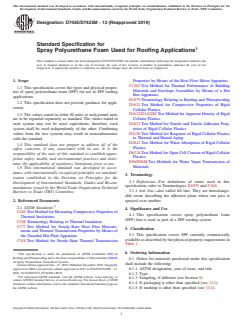
(Specification)Standard Specification for Spray Polyurethane Foam Used for Roofing Applications
General Information
- Abstract
SCOPE
1.1 This specification covers the types and physical properties of spray polyurethane foam (SPF) for use in SPF roofing applications.
1.2 This specification does not provide guidance for application.
1.3 The values stated in either SI units or inch-pound units are to be regarded separately as standard. The values stated in each system may not be exact equivalents; therefore, each system shall be used independently of the other. Combining values from the two systems may result in nonconformance with the standard.
1.4 This standard does not purport to address all of the safety concerns, if any, associated with its use. It is the responsibility of the user of this standard to establish appropriate safety, health, and environmental practices and determine the applicability of regulatory limitations prior to use.
1.5 This international standard was developed in accordance with internationally recognized principles on standardization established in the Decision on Principles for the Development of International Standards, Guides and Recommendations issued by the World Trade Organization Technical Barriers to Trade (TBT) Committee.
- Status
- Published
- Publication Date
- 14-Dec-2019
- Technical Committee
- D08 - Roofing and Waterproofing
- Drafting Committee
- D08.06 - Spray Polyurethane Foam Roof Systems


Overview
ASTM D7425/D7425M-13(2019), Standard Specification for Spray Polyurethane Foam Used for Roofing Applications, establishes the minimum physical property requirements and types of spray polyurethane foam (SPF) intended for use in roofing systems. Developed by ASTM International, this specification ensures that SPF roofing materials meet consistent standards, improving performance, safety, and reliability in commercial and residential building applications. The standard does not address specific application methods or provide installation guidance, but focuses on the characterization and quality of SPF products used in roofing.
Key Topics
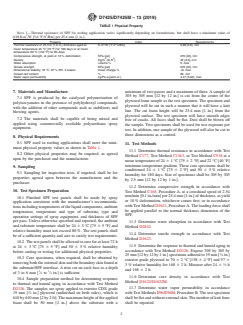
Physical Property Requirements: ASTM D7425/D7425M-13(2019) specifies key physical properties that SPF materials must meet, including:
- Minimum thermal resistance (R-value) per unit thickness
- Compressive strength and tensile strength
- Apparent density
- Water absorption and vapor permeability
- Closed cell content
- Dimensional stability under temperature and humidity extremes
Material Composition: The specification covers SPF produced by polymerizing polyisocyanates and polyhydroxyl compounds, with added stabilizers and blowing agents. The foam must be suitable for mixing and application with commercially available spray equipment.
Sampling and Testing: The document outlines procedures for sampling, specimen preparation, and testing to verify compliance with physical requirements. Standardized methods ensure consistent product quality.
Packaging and Marking: Requirements for the packaging and labeling of SPF components help maintain product integrity and traceability through shipping, handling, and storage.
International Standardization: As an international standard, ASTM D7425/D7425M-13(2019) aligns with globally recognized principles for developing technical standards, supporting international trade and regulatory acceptance.
Applications
The principal application of ASTM D7425/D7425M-13(2019) is to define quality benchmarks and performance characteristics for spray polyurethane foam used in roofing systems. Key uses include:
- Flat and Low-Slope Roof Insulation: SPF is commonly sprayed directly onto existing substrates to create continuous insulation, improving building energy efficiency and thermal performance.
- Roof Recoating and Rehabilitation: The standard supports selection of SPF materials for restoring or upgrading older roofs, enhancing durability and weather resistance.
- Commercial and Residential Buildings: SPF meeting this specification is used in a wide range of structures, from warehouses and factories to schools, offices, and homes.
- Sustainable Construction: SPF’s high thermal resistance and moisture control support sustainable building practices by helping reduce energy consumption and improve envelope performance.
Related Standards
For comprehensive compliance and optimized results, ASTM D7425/D7425M-13(2019) references several related ASTM standards, including:
- ASTM D1079 - Terminology Relating to Roofing and Waterproofing
- ASTM C168 - Terminology Relating to Thermal Insulation
- ASTM C518, C177, and C1363 - Test methods for determining thermal transmission properties
- ASTM D1621, D1622, D1623 - Test methods for compressive properties, density, and tensile properties.
- ASTM D2126 - Test method for response to thermal and humid aging
- ASTM D2842 - Test method for water absorption
- ASTM D6226 - Test method for open cell content
- ASTM E96/E96M - Test methods for water vapor transmission
These standards are critical for manufacturers, specifiers, and contractors seeking compliance when selecting and installing spray polyurethane foam roofing systems.
Keywords: ASTM D7425, spray polyurethane foam, SPF roofing, roof insulation standards, thermal resistance, compressive strength, building codes, ASTM roofing standards.
Relations
- Effective Date
- 15-Dec-2019
- Effective Date
- 15-Apr-2024
- Effective Date
- 01-Mar-2024
- Effective Date
- 01-Mar-2024
- Effective Date
- 15-Nov-2023
- Effective Date
- 01-May-2020
- Effective Date
- 01-Sep-2019
- Effective Date
- 01-May-2019
- Effective Date
- 15-Dec-2018
- Effective Date
- 15-Dec-2018
- Effective Date
- 15-Apr-2018
- Effective Date
- 01-Jun-2017
- Effective Date
- 01-Feb-2016
- Effective Date
- 15-Oct-2015
- Effective Date
- 01-Sep-2015
Get Certified
Connect with accredited certification bodies for this standard

DIBt (Deutsches Institut für Bautechnik)
German Institute for Building Technology.
DIN CERTCO
DIN Group product certification.

Aboma Certification B.V.
Specialized in construction, metal, and transport sectors.
Sponsored listings
Frequently Asked Questions
ASTM D7425/D7425M-13(2019) is a technical specification published by ASTM International. Its full title is "Standard Specification for Spray Polyurethane Foam Used for Roofing Applications". This standard covers: SCOPE 1.1 This specification covers the types and physical properties of spray polyurethane foam (SPF) for use in SPF roofing applications. 1.2 This specification does not provide guidance for application. 1.3 The values stated in either SI units or inch-pound units are to be regarded separately as standard. The values stated in each system may not be exact equivalents; therefore, each system shall be used independently of the other. Combining values from the two systems may result in nonconformance with the standard. 1.4 This standard does not purport to address all of the safety concerns, if any, associated with its use. It is the responsibility of the user of this standard to establish appropriate safety, health, and environmental practices and determine the applicability of regulatory limitations prior to use. 1.5 This international standard was developed in accordance with internationally recognized principles on standardization established in the Decision on Principles for the Development of International Standards, Guides and Recommendations issued by the World Trade Organization Technical Barriers to Trade (TBT) Committee.
SCOPE 1.1 This specification covers the types and physical properties of spray polyurethane foam (SPF) for use in SPF roofing applications. 1.2 This specification does not provide guidance for application. 1.3 The values stated in either SI units or inch-pound units are to be regarded separately as standard. The values stated in each system may not be exact equivalents; therefore, each system shall be used independently of the other. Combining values from the two systems may result in nonconformance with the standard. 1.4 This standard does not purport to address all of the safety concerns, if any, associated with its use. It is the responsibility of the user of this standard to establish appropriate safety, health, and environmental practices and determine the applicability of regulatory limitations prior to use. 1.5 This international standard was developed in accordance with internationally recognized principles on standardization established in the Decision on Principles for the Development of International Standards, Guides and Recommendations issued by the World Trade Organization Technical Barriers to Trade (TBT) Committee.
ASTM D7425/D7425M-13(2019) is classified under the following ICS (International Classification for Standards) categories: 91.100.50 - Binders. Sealing materials. The ICS classification helps identify the subject area and facilitates finding related standards.
ASTM D7425/D7425M-13(2019) has the following relationships with other standards: It is inter standard links to ASTM D7425/D7425M-13, ASTM C168-24, ASTM E96/E96M-24, ASTM C1363-24, ASTM E96/E96M-23, ASTM D1079-20, ASTM C1363-19, ASTM D2842-19, ASTM D1079-18e1, ASTM D1079-18, ASTM C168-18, ASTM C168-17, ASTM D1079-16, ASTM C168-15a, ASTM C518-15. Understanding these relationships helps ensure you are using the most current and applicable version of the standard.
ASTM D7425/D7425M-13(2019) is available in PDF format for immediate download after purchase. The document can be added to your cart and obtained through the secure checkout process. Digital delivery ensures instant access to the complete standard document.
Standards Content (Sample)
This international standard was developed in accordance with internationally recognized principles on standardization established in the Decision on Principles for the
Development of International Standards, Guides and Recommendations issued by the World Trade Organization Technical Barriers to Trade (TBT) Committee.
Designation:D7425/D7425M −13 (Reapproved 2019)
Standard Specification for
Spray Polyurethane Foam Used for Roofing Applications
This standard is issued under the fixed designation D7425/D7425M; the number immediately following the designation indicates the
year of original adoption or, in the case of revision, the year of last revision. A number in parentheses indicates the year of last
reapproval. A superscript epsilon (´) indicates an editorial change since the last revision or reapproval.
1. Scope Properties by Means of the Heat Flow Meter Apparatus
C1363 Test Method for Thermal Performance of Building
1.1 This specification covers the types and physical proper-
Materials and Envelope Assemblies by Means of a Hot
ties of spray polyurethane foam (SPF) for use in SPF roofing
Box Apparatus
applications.
D1079 Terminology Relating to Roofing and Waterproofing
1.2 This specification does not provide guidance for appli-
D1621 Test Method for Compressive Properties of Rigid
cation.
Cellular Plastics
D1622/D1622M Test Method forApparent Density of Rigid
1.3 The values stated in either SI units or inch-pound units
are to be regarded separately as standard. The values stated in Cellular Plastics
D1623 Test Method for Tensile and Tensile Adhesion Prop-
each system may not be exact equivalents; therefore, each
system shall be used independently of the other. Combining erties of Rigid Cellular Plastics
D2126 Test Method for Response of Rigid Cellular Plastics
values from the two systems may result in nonconformance
with the standard. to Thermal and Humid Aging
D2842 Test Method for Water Absorption of Rigid Cellular
1.4 This standard does not purport to address all of the
Plastics
safety concerns, if any, associated with its use. It is the
D6226 Test Method for Open Cell Content of Rigid Cellular
responsibility of the user of this standard to establish appro-
Plastics
priate safety, health, and environmental practices and deter-
E96/E96M Test Methods for Water Vapor Transmission of
mine the applicability of regulatory limitations prior to use.
Materials
1.5 This international standard was developed in accor-
dance with internationally recognized principles on standard-
3. Terminology
ization established in the Decision on Principles for the
3.1 Definitions—For definitions of terms used in this
Development of International Standards, Guides and Recom-
specification, refer to Terminologies D1079 and C168.
mendations issued by the World Trade Organization Technical
3.1.1 knit line—also called lift line. They are interchange-
Barriers to Trade (TBT) Committee.
able terms describing the adhesion plane where one pass is
sprayed over another.
2. Referenced Documents
2.1 ASTM Standards:
4. Significance and Use
C165 Test Method for Measuring Compressive Properties of
4.1 This specification covers spray polyurethane foam
Thermal Insulations
(SPF) that is used as part of a SPF roofing system.
C168 Terminology Relating to Thermal Insulation
C177 Test Method for Steady-State Heat Flux Measure-
5. Classification
ments and Thermal Transmission Properties by Means of
5.1 This specification covers SPF currently commercially
the Guarded-Hot-Plate Apparatus
available as described by the physical property requirements in
C518 Test Method for Steady-State Thermal Transmission
Table 1.
6. Ordering Information
This specification is under the jurisdiction of ASTM Committee D08 on
Roofing and Waterproofing and is the direct responsibility of Subcommittee D08.06
6.1 Orders for materials purchased under this specification
on Spray Polyurethane Foam Roof Systems.
shall include the following:
Current edition approved Dec. 15, 2019. Published December 2019. Originally
6.1.1 ASTM designation, year of issue, and title.
approved in 2008. Last previous edition approved in 2013 as D7425/D7425M – 13.
DOI: 10.1520/D7425_D7425M-13R19.
6.1.2 Type.
For referenced ASTM standards, visit the ASTM website, www.astm.org, or
6.1.3 Sampling, if different (see Section 9).
contact ASTM Customer Service at service@astm.org. For Annual Book of ASTM
6.1.4 If packaging is other than specified (see 13.1).
Standards volume information, refer to the standard’s Document Summary page on
the ASTM website. 6.1.5 If marking is other than specified (see 13.4).
Copyright © ASTM International, 100 Barr Harbor Drive, PO Box C700, West Conshohocken, PA 19428-2959. United States
D7425/D7425M−13 (2019)
TABLE 1 Physical Property
NOTE 1—Thermal resistance of SPF for roofing application varies significantly depending on formulations, but shall have a minimum value of
2 2
0.98 K·m /W [5.6 °F·ft /Btu] per 25.4 mm [1 in.].
Property Units Requirements
2 2
Thermal resistance of 25 mm [1.0 in.] thickness aged at K·m /W [°F·ft ·h/Btu] 0.98 [5.6], min
mean temperature 24 °C [75 °F] for 180 days or at mean
temperature 60 °C [140 °F] for 90 days.
Compressive strength, at yield or 10 % deformation KPa [psi] 276 [40], min
3 3
Density Kg/m [lb ⁄ft ] 40 [2.5], min
Water absorption volume % 5, max
Tensile strength KPa [psi] 276 [40], min
Dimensional stability, 70 °C, 97 % RH, 2 weeks linear change % +6, max
Closed cell content % 90, min
Water vapor permeability ng/Pa·s·[perm-in.] 4.47 [3.02], max
7. Materials and Manufacture minimum of two passes and a maximum of three.Asample of
305 by 305 mm [12 by 12 in.] is cut from the center of the
7.1 SPF is produced by the catalyzed polymerization of
plywood foam sample as the test specimen. The specimen and
polyisocyanates in the presence of polyhydroxyl compounds,
plywood will be cut in such a manner that it will have a knit
with the addition of other compounds such as stabilizers and
line. The cut foam height will be 25.4 mm [1 in.] from the
blowing agents.
plywood surface. The test specimen will have smooth edges
7.2 The materials shall be capable of being mixed and
free of cracks. All faces shall be flat. Dust shall be blown off
applied using commercially available polyurethane spray
the sample. Two specimens shall be used for test exposure per
equipment.
test. In addition, one sample of the plywood will also be cut to
these dimensions as a control.
8. Physical Requirements
8.1 SPF used in roofing applications shall meet the mini-
11. Test Methods
mum physical property values as shown in Table 1.
11.1 Determine thermal resistance in accordance with Test
8.2 Other physical properties may be required, as agreed
Method C177, Test Method C1363, or Test Method C518 at a
upon by the purchaser and the manufacturer.
mean temperature of 24 6 1 °C [75 6 2 °F] and 22 °C [40 °F]
minimum temperature gradient. These core specimens shall be
9. Sampling
conditioned 24 6 1 °C [75 6 2 °F]
...