

ASTM D2276-22
(Test Method)Standard Test Method for Particulate Contaminant in Aviation Fuel by Line Sampling
General Information
- Abstract
SIGNIFICANCE AND USE
5.1 This test method provides a gravimetric measurement of the particulate matter present in a sample of aviation turbine fuel by line sampling. The objective is to minimize these contaminants to avoid filter plugging and other operational problems. Although tolerable levels of particulate contaminants have not yet been established for all points in fuel distribution systems, the total contaminant measurement is normally of most interest. The Appendix X1 color rating method is useful for fuel system monitoring purposes. No quantitative relationship exists between gravimetric and color rating test results.
SCOPE
1.1 This test method covers the determination of particulate contaminant in aviation turbine fuel using a field monitor.
1.2 There are two test methods described. The basic test method is used to evaluate the level of contamination gravimetrically. The second test method, presented in Appendix X1, describes a color rating technique that is used for rapid qualitative assessment of changes in contamination level without the time delay required for the gravimetric determinations by stringent laboratory procedures.
1.3 There are two Annexes and two Appendixes in this test method.
1.3.1 Annex A1 provides some precautionary information regarding the use of the required reagents.
1.3.2 Annex A2 describes a standard practice for obtaining a sample of the particulates present in a flowing stream of aviation turbine fuel.
1.3.3 Appendix X1 describes a test method for rating the particulate level in an aviation turbine fuel on the basis of the color of a filter membrane after sampling the fuel in the field.
1.3.4 Appendix X2 provides some safety precautions to avoid static discharge resulting from the accumulation of electrical charges in the fuel and on the equipment while following the procedures.
1.4 The values stated in SI units are to be regarded as the standard. The values given in parentheses are for information only.
1.5 This standard does not purport to address all of the safety concerns, if any, associated with its use. It is the responsibility of the user of this standard to establish appropriate safety, health, and environmental practices and determine the applicability of regulatory limitations prior to use.
1.6 This international standard was developed in accordance with internationally recognized principles on standardization established in the Decision on Principles for the Development of International Standards, Guides and Recommendations issued by the World Trade Organization Technical Barriers to Trade (TBT) Committee.
- Status
- Published
- Publication Date
- 30-Jun-2022
- Technical Committee
- D02 - Petroleum Products, Liquid Fuels, and Lubricants
- Drafting Committee
- D02.J0.05 - Fuel Cleanliness
Buy Documents
ASTM D2276-22 - Standard Test Method for Particulate Contaminant in Aviation Fuel by Line Sampling
REDLINE ASTM D2276-22 - Standard Test Method for Particulate Contaminant in Aviation Fuel by Line Sampling
Overview
ASTM D2276-22: Standard Test Method for Particulate Contaminant in Aviation Fuel by Line Sampling specifies procedures for measuring particulate contaminants in aviation turbine fuel using line sampling. Developed by ASTM International, this standard provides both gravimetric and color rating methods to help ensure fuel cleanliness, reducing the risk of operational problems such as filter plugging. Accurate detection and control of particulates in aviation turbine fuels are critical to safeguarding aircraft systems, maintaining fuel quality, and complying with international best practices throughout distribution and handling.
Key Topics
Gravimetric Determination: Provides a precise measurement of particulate matter in aviation turbine fuels by passing a known volume of fuel through preweighed membrane filters using a field monitor. The increase in filter mass, corrected for potential fuel-induced changes, reflects the particulate contaminant level.
Color Rating Method (Appendix X1): Offers a rapid, qualitative assessment of particulate contamination by visually comparing filter membrane color to ASTM color standards. This method is useful for field monitoring and detecting changes in contamination levels without the delay of gravimetric testing.
Sampling Practices: Outlines best practices for collecting representative fuel samples from pressurized fuel systems using approved sampling apparatus and preparation of membrane filters, ensuring accurate results and minimizing contamination risks.
Safety and Precautions: Includes guidelines for safe handling of flammable reagents and aviation turbine fuel, prevention of static electricity buildup, and environmental considerations during testing procedures.
Applications
ASTM D2276-22 is widely applied across the aviation fuel supply chain to:
Monitor Fuel Cleanliness: Regular testing at airports, refineries, pipelines, storage terminals, and aircraft refueling points ensures particulate levels remain within acceptable limits to prevent operational disruptions and safeguard fuel system components.
Fuel System Maintenance: Allows operators and maintenance staff to detect rising contaminant levels early, supporting timely interventions to protect filters, pumps, and sensitive engine parts.
Compliance with International Standards: Assists fuel suppliers and aviation operators in adhering to industry requirements for fuel quality, contributing to safe and reliable operation in accordance with regulations and technical guidelines.
Incident Investigation: Provides reliable data for analysis when troubleshooting filter plugging or other fuel-related operational issues.
Related Standards
Adherence to ASTM D2276-22 is often coordinated with other fuel quality and handling standards, such as:
- ASTM D1655: Specification for Aviation Turbine Fuels
- ASTM D5452: Test Method for Particulate Contamination in Aviation Fuels by Laboratory Filtration
- ASTM D4865: Guide for Generation and Dissipation of Static Electricity in Petroleum Fuel Systems
- ASTM D1193: Specification for Reagent Water
- ASTM D6615: Specification for Jet B Wide-Cut Aviation Turbine Fuel
Compliance with these related documents strengthens overall fuel management programs by providing comprehensive coverage of sampling, testing, and safety best practices.
In summary, ASTM D2276-22 is an essential standard for aviation fuel quality control, supporting robust particulate contamination monitoring. Its methods help ensure aviation turbine fuels remain clean and safe, underpinning reliable aircraft operations, reducing maintenance costs, and upholding regulatory and industry standards globally.
Keywords: aviation fuel, particulate contaminant, ASTM D2276, line sampling, gravimetric analysis, color rating, field monitor, fuel quality, jet fuel cleanliness, fuel system monitoring, aviation standards.
Relations
- Effective Date
- 15-Mar-2024
- Refers
ASTM D4175-23a - Standard Terminology Relating to Petroleum Products, Liquid Fuels, and Lubricants - Effective Date
- 15-Dec-2023
- Effective Date
- 01-Nov-2023
- Effective Date
- 01-Oct-2023
- Refers
ASTM D4175-23e1 - Standard Terminology Relating to Petroleum Products, Liquid Fuels, and Lubricants - Effective Date
- 01-Jul-2023
- Effective Date
- 01-Jan-2018
- Effective Date
- 01-Dec-2017
- Effective Date
- 01-Dec-2016
- Effective Date
- 01-Sep-2016
- Effective Date
- 01-Jun-2016
- Effective Date
- 01-Oct-2015
- Effective Date
- 01-Sep-2015
- Effective Date
- 01-Aug-2015
- Effective Date
- 15-Jul-2015
- Effective Date
- 01-Jul-2015
Buy Documents
ASTM D2276-22 - Standard Test Method for Particulate Contaminant in Aviation Fuel by Line Sampling
REDLINE ASTM D2276-22 - Standard Test Method for Particulate Contaminant in Aviation Fuel by Line Sampling
Get Certified
Connect with accredited certification bodies for this standard

Element Materials Technology
Materials testing and product certification.

ABS Group Brazil
ABS Group certification services in Brazil.

ABS Quality Evaluations Inc.
American Bureau of Shipping quality certification.
Sponsored listings
Frequently Asked Questions
ASTM D2276-22 is a standard published by ASTM International. Its full title is "Standard Test Method for Particulate Contaminant in Aviation Fuel by Line Sampling". This standard covers: SIGNIFICANCE AND USE 5.1 This test method provides a gravimetric measurement of the particulate matter present in a sample of aviation turbine fuel by line sampling. The objective is to minimize these contaminants to avoid filter plugging and other operational problems. Although tolerable levels of particulate contaminants have not yet been established for all points in fuel distribution systems, the total contaminant measurement is normally of most interest. The Appendix X1 color rating method is useful for fuel system monitoring purposes. No quantitative relationship exists between gravimetric and color rating test results. SCOPE 1.1 This test method covers the determination of particulate contaminant in aviation turbine fuel using a field monitor. 1.2 There are two test methods described. The basic test method is used to evaluate the level of contamination gravimetrically. The second test method, presented in Appendix X1, describes a color rating technique that is used for rapid qualitative assessment of changes in contamination level without the time delay required for the gravimetric determinations by stringent laboratory procedures. 1.3 There are two Annexes and two Appendixes in this test method. 1.3.1 Annex A1 provides some precautionary information regarding the use of the required reagents. 1.3.2 Annex A2 describes a standard practice for obtaining a sample of the particulates present in a flowing stream of aviation turbine fuel. 1.3.3 Appendix X1 describes a test method for rating the particulate level in an aviation turbine fuel on the basis of the color of a filter membrane after sampling the fuel in the field. 1.3.4 Appendix X2 provides some safety precautions to avoid static discharge resulting from the accumulation of electrical charges in the fuel and on the equipment while following the procedures. 1.4 The values stated in SI units are to be regarded as the standard. The values given in parentheses are for information only. 1.5 This standard does not purport to address all of the safety concerns, if any, associated with its use. It is the responsibility of the user of this standard to establish appropriate safety, health, and environmental practices and determine the applicability of regulatory limitations prior to use. 1.6 This international standard was developed in accordance with internationally recognized principles on standardization established in the Decision on Principles for the Development of International Standards, Guides and Recommendations issued by the World Trade Organization Technical Barriers to Trade (TBT) Committee.
SIGNIFICANCE AND USE 5.1 This test method provides a gravimetric measurement of the particulate matter present in a sample of aviation turbine fuel by line sampling. The objective is to minimize these contaminants to avoid filter plugging and other operational problems. Although tolerable levels of particulate contaminants have not yet been established for all points in fuel distribution systems, the total contaminant measurement is normally of most interest. The Appendix X1 color rating method is useful for fuel system monitoring purposes. No quantitative relationship exists between gravimetric and color rating test results. SCOPE 1.1 This test method covers the determination of particulate contaminant in aviation turbine fuel using a field monitor. 1.2 There are two test methods described. The basic test method is used to evaluate the level of contamination gravimetrically. The second test method, presented in Appendix X1, describes a color rating technique that is used for rapid qualitative assessment of changes in contamination level without the time delay required for the gravimetric determinations by stringent laboratory procedures. 1.3 There are two Annexes and two Appendixes in this test method. 1.3.1 Annex A1 provides some precautionary information regarding the use of the required reagents. 1.3.2 Annex A2 describes a standard practice for obtaining a sample of the particulates present in a flowing stream of aviation turbine fuel. 1.3.3 Appendix X1 describes a test method for rating the particulate level in an aviation turbine fuel on the basis of the color of a filter membrane after sampling the fuel in the field. 1.3.4 Appendix X2 provides some safety precautions to avoid static discharge resulting from the accumulation of electrical charges in the fuel and on the equipment while following the procedures. 1.4 The values stated in SI units are to be regarded as the standard. The values given in parentheses are for information only. 1.5 This standard does not purport to address all of the safety concerns, if any, associated with its use. It is the responsibility of the user of this standard to establish appropriate safety, health, and environmental practices and determine the applicability of regulatory limitations prior to use. 1.6 This international standard was developed in accordance with internationally recognized principles on standardization established in the Decision on Principles for the Development of International Standards, Guides and Recommendations issued by the World Trade Organization Technical Barriers to Trade (TBT) Committee.
ASTM D2276-22 is classified under the following ICS (International Classification for Standards) categories: 75.160.20 - Liquid fuels. The ICS classification helps identify the subject area and facilitates finding related standards.
ASTM D2276-22 has the following relationships with other standards: It is inter standard links to ASTM D1655-24, ASTM D4175-23a, ASTM D4865-23, ASTM D1655-23a, ASTM D4175-23e1, ASTM D1655-18, ASTM D1655-17a, ASTM D1655-16c, ASTM D1655-16b, ASTM D1655-16, ASTM D1655-15d, ASTM D6615-15a, ASTM D2244-15a, ASTM D1655-15b, ASTM D6615-15. Understanding these relationships helps ensure you are using the most current and applicable version of the standard.
ASTM D2276-22 is available in PDF format for immediate download after purchase. The document can be added to your cart and obtained through the secure checkout process. Digital delivery ensures instant access to the complete standard document.
Standards Content (Sample)
This international standard was developed in accordance with internationally recognized principles on standardization established in the Decision on Principles for the
Development of International Standards, Guides and Recommendations issued by the World Trade Organization Technical Barriers to Trade (TBT) Committee.
Designation: D2276 − 22
Designation: 216/05 (2005)
Standard Test Method for
1,2
Particulate Contaminant in Aviation Fuel by Line Sampling
This standard is issued under the fixed designation D2276; the number immediately following the designation indicates the year of
original adoption or, in the case of revision, the year of last revision.Anumber in parentheses indicates the year of last reapproval.A
superscript epsilon (´) indicates an editorial change since the last revision or reapproval.
This standard has been approved for use by agencies of the U.S. Department of Defense.
1. Scope* 1.5 This standard does not purport to address all of the
safety concerns, if any, associated with its use. It is the
1.1 This test method covers the determination of particulate
responsibility of the user of this standard to establish appro-
contaminant in aviation turbine fuel using a field monitor.
priate safety, health, and environmental practices and deter-
1.2 There are two test methods described. The basic test
mine the applicability of regulatory limitations prior to use.
method is used to evaluate the level of contamination gravi-
1.6 This international standard was developed in accor-
metrically.Thesecondtestmethod,presentedinAppendixX1,
dance with internationally recognized principles on standard-
describes a color rating technique that is used for rapid
ization established in the Decision on Principles for the
qualitative assessment of changes in contamination level with-
Development of International Standards, Guides and Recom-
out the time delay required for the gravimetric determinations
mendations issued by the World Trade Organization Technical
by stringent laboratory procedures.
Barriers to Trade (TBT) Committee.
1.3 There are twoAnnexes and twoAppendixes in this test
2. Referenced Documents
method.
1.3.1 Annex A1 provides some precautionary information
2.1 ASTM Standards:
regarding the use of the required reagents.
D1193Specification for Reagent Water
1.3.2 Annex A2 describes a standard practice for obtaining
D1535Practice for Specifying Color by the Munsell System
a sample of the particulates present in a flowing stream of
D1655Specification for Aviation Turbine Fuels
aviation turbine fuel.
D2244Practice for Calculation of Color Tolerances and
1.3.3 Appendix X1 describes a test method for rating the
Color Differences from Instrumentally Measured Color
particulate level in an aviation turbine fuel on the basis of the
Coordinates
color of a filter membrane after sampling the fuel in the field.
D4175Terminology Relating to Petroleum Products, Liquid
1.3.4 Appendix X2 provides some safety precautions to
Fuels, and Lubricants
avoid static discharge resulting from the accumulation of
D4865Guide for Generation and Dissipation of Static Elec-
electrical charges in the fuel and on the equipment while
tricity in Petroleum Fuel Systems
following the procedures.
D5452Test Method for Particulate Contamination in Avia-
tion Fuels by Laboratory Filtration
1.4 The values stated in SI units are to be regarded as the
D6615Specification for Jet B Wide-Cut Aviation Turbine
standard. The values given in parentheses are for information
Fuel
only.
3. Terminology
This test method is under the jurisdiction of ASTM International Committee
3.1 Definitions:
D02 on Petroleum Products, Liquid Fuels, and Lubricants and is the direct
3.1.1 For definitions of terms used in this test method, refer
responsibility ofASTM Subcommittee D02.J0.05 on Fuel Cleanliness. The techni-
to Terminology D4175.
cally equivalent standard as referenced is under the jurisdiction of the Energy
Institute Subcommittee SC-B-11.
3.2 Definitions of Terms Specific to This Standard:
This test method has been approved by the sponsoring committees and accepted
3.2.1 membrane color, n—a visual rating of particulate on a
by the Cooperating Societies in accordance with established procedures.
filter membrane against ASTM Color Standards.
Current edition approved July 1, 2022. Published September 2022. Originally
approved in 1964. Last previous edition approved in 2014 as D2276–06 (2014).
DOI: 10.1520/D2276-22.
2 3
This test method has been developed through the cooperative effort between For referenced ASTM standards, visit the ASTM website, www.astm.org, or
ASTMandtheEnergyInstitute,London.ASTMandIPstandardswereapprovedby contact ASTM Customer Service at service@astm.org. For Annual Book of ASTM
ASTMandEItechnicalcommitteesasbeingtechnicallyequivalentbutthatdoesnot Standards volume information, refer to the standard’s Document Summary page on
imply both standards are identical. the ASTM website.
*A Summary of Changes section appears at the end of this standard
Copyright © ASTM International, 100 Barr Harbor Drive, PO Box C700, West Conshohocken, PA 19428-2959. United States
D2276 − 22
3.2.2 membrane filter, n—a porous article of closely con-
trolled pore size through which a liquid is passed to separate
matter in suspension.
3.2.2.1 Discussion—RR:D02-1012 contains information
on membrane filters that meet the requirements therein.
3.2.3 monitor, n—something that reminds or warns.
3.2.3.1 Discussion—A plastic holder for a membrane filter
held in a field sampling apparatus.
3.2.4 particulate, adj—of or relating to minute separate
particles.
3.2.4.1 Discussion—Solids generally composed of oxides,
silicates, and fuel insoluble salts.
3.2.5 volatile fuels, n—relativelywideboilingrangevolatile
distillate.
3.2.5.1 Discussion—These are identified as Jet B in Speci-
fication D6615 or the military grade known as JP-4.
4. Summary of Test Method
4.1 Aknownvolumeoffuelisfilteredthroughapreweighed
test membrane filter in a field monitor and the increase in
membrane filter mass determined after washing and drying.
FIG. 1 Apparatus for Filtering and Dispensing Flushing Fluid
The change in mass of a control membrane filter located
immediatelybelowthetestmembranefilterisalsodetermined.
6. Apparatus
Theobjectiveofusingacontrolmembraneistoassesswhether
6.1 Analytical Balance, single- or double-pan, the precision
the fuel itself influences the weight of a membrane. The
standard deviation of which must be 0.07 mg or better.
particulate contaminant is determined from the increase in
mass of the test membrane filter relative to the control
6.2 Oven, of the static type (without fan-assisted air
membrane filter.
circulation), controllable to 90°C 6 5°C.
4.2 This test method employs a field monitor to filter a
6.3 Petri Dishes, approximately 125 mm in diameter with
sample of fuel that is taken in the field by the sampling
removable glass supports for membrane filters.
procedure detailed in Annex A2.
6.4 Forceps, flat-bladed with unserrated, non-pointed tips.
4.3 For situations where it is not possible to take a field
6.5 Vacuum System.
monitor sample, procedures are given in Test Method D5452
4,5
6.6 Test Membrane Filters, plain, 37mm diameter,
for the determination of particulate contaminant in a fuel
nominal pore size 0.8 µm (see Note 1).
sample by laboratory filtration.
4,5
6.7 Control Membrane Filters, 37mmdiameter,nominal
4.4 Appendix X1 describes a method for color-rating used
pore size 0.8 µm. (Gridded control membrane filters may be
filter membranes.
used for purpose of identification.)
5. Significance and Use
NOTE 1—Matched weight membrane filters, 37mm diameter, nominal
pore size 0.8 µm, may be used as test and control membrane filters if so
5.1 Thistestmethodprovidesagravimetricmeasurementof
desired. Use of matched-weight membrane filters precludes the necessity
the particulate matter present in a sample of aviation turbine
for carrying out subsequently the procedures detailed in Section 8.
fuel by line sampling. The objective is to minimize these
6.8 Dispenser for Flushing Fluid,0.45µmmembranefilters
contaminants to avoid filter plugging and other operational
to be provided in the delivery line (see Fig. 1). Alternatively,
problems. Although tolerable levels of particulate contami-
flushing fluid that has been pre-filtered through a 0.45 µm
nants have not yet been established for all points in fuel
membrane before delivery to the dispenser flask is acceptable.
distribution systems, the total contaminant measurement is
6.9 Field Monitors, complete with protective plugs and
normally of most interest. The Appendix X1 color rating
34mm support pads.
method is useful for fuel system monitoring purposes. No
quantitative relationship exists between gravimetric and color
6.10 Air Ionizer, for the balance case (see Note 2 and Note
rating test results.
3).
NOTE 2—When using a solid-pan balance, the air ionizer may be
Supportingdata(andalistofsupplierswhohaveprovideddataindicatingtheir
membranes, field monitors, and field monitor castings) have been filed at ASTM All available membrane filters are not suitable for this application. Apparatus
International Headquarters and may be obtained by requesting Research Report considered for this application shall be checked by the user for suitability in
RR:D02-1012. Contact ASTM Customer Service at service@astm.org. accordance with the requirements of RR:D02-1012, 1994 revision.
D2276 − 22
7.5 Flushing Fluids:
7.5.1 Petroleum Spirit (also known as petroleum ether or IP
Petroleum Spirit 40/60) (Warning—Extremely flammable.
Harmful if inhaled. Vapors are easily ignited by electrostatic
discharges, causing flash fire. See A1.2.), having boiling range
from 35°C to 60°C.
8. Preparation of Test and Control Membrane Filters
and Field Monitors Prior to Sampling
8.1 Two 37mm membrane filters of nominal pore size
0.8µm are required: a test and a control membrane filter.
Matched-weight membrane filters may be used if so desired
(seeNote1).Ifmatched-weightmembranefiltersareused,itis
unnecessary to carry out the procedures detailed in this section
because they have been carried out previously by the mem-
FIG. 2 Field Monitor Flushing Apparatus brane filter supplier. The two membrane filters used for each
individual test should be identified by marking the petri dishes
usedascontainers.Glasswareusedinpreparationofmembrane
omitted provided that, when weighing a membrane filter, it is placed on
filters shall be cleaned as described in Section 10.
the pan so that no part protrudes over the edge of the pan.
NOTE 3—Air ionizers should be replaced within 1 year of manufacture. 8.1.1 Using forceps, place the test and control membrane
filters side by side in a clean petri dish. To facilitate handling
6.11 Multimeter/VOM, used for determining whether elec-
the membrane filters should rest on clean glass support rods in
trical continuity is 10Ω or less between 2 points.
the petri dish.
6.12 Field Monitor Flushing Apparatus, of the type shown
8.1.2 Placethepetridishwithitslidslightlyajar,inanoven
inFig.2.Itconsistsofareceivingflasklargeenoughtocontain
at 90°C 6 5°C and leave it for 30 min.
the flushing fluid and shall be equipped with a side arm to
8.1.3 Remove the petri dish from the oven and place it near
connect to the vacuum system. Reagent resistant tubing shall
the balance. The petri dish cover should be ajar but still
bearrangedtoallowpassageofagroundingwire.Anassembly
protecting the membrane filters from contamination from the
of reagent grade resistant tubing and bung fitted with a glass
atmosphere.Allow 30 min for the membrane filters to come to
tube shall be assembled as shown in Fig. 2 to attach to a field
equilibrium with the ambient air temperature and humidity.
monitor.
8.1.4 Remove the control membrane filter from the petri
6.13 Ground/Bond Wire, Nos. 10 through 19, (0.912mm to
dish with forceps, handling by the edge only, and place it
2.59mm) bare stranded flexible stainless steel or copper
centrallyontheweighingpan.Weighitandreturnittothepetri
installed in the flask and grounded as shown in Fig. 2.
dish.
7. Reagents
8.1.5 Repeat 8.1.4 for the test membrane filter. Record the
membrane filter masses.
7.1 Purity of Reagents—Reagent grade chemicals shall be
8.1.6 Take a clean field monitor, mark for identification,
used in all tests. Unless otherwise indicated, it is intended that
all reagents shall conform to the specifications of the Commit- rinsewithfilteredflushingfluid,andinsertacleansupportpad.
tee onAnalytical Reagents of theAmerican Chemical Society,
8.1.7 Using clean forceps, place the weighed control mem-
where such specifications are available. Other grades may be
branefiltercentrallyonthesupportpadinthefieldmonitorand
used, provided it is first ascertained that the reagent is of
place the weighed test membrane filter on top of the control
sufficiently high purity to permit its use without lessening the
membrane filter. Assemble the two parts of the field monitor,
accuracy of the determination.
ensuring that the membrane filters are firmly clamped inside
and the protective plugs are in position.
7.2 Purity of Water—Unless otherwise indicated references
to water shall be understood to mean reagent water as defined
8.1.8 Record the monitor identification.
by Type III of Specification D1193.
9. Sampling and Testing Procedure
7.3 Isopropyl Alcohol, reagent grade. (Warning—
Flammable. See A1.1.)
9.1 Whenpossible,3.785L(1gal)to5L(1.321gal)offuel
7.4 Liquid Detergent, water-soluble. should be passed through the monitor during field sampling.
The sample volume actually employed shall be reported.
(Warning—Jet A, combustible. Vapor harmful. See A1.3.)
ACS Reagent Chemicals, Specifications and Procedures for Reagents and
(Warning—Jet B, extremely flammable. Harmful if inhaled.
Standard-Grade Reference Materials, American Chemical Society, Washington,
Vapors may cause flash fire. See A1.4.)
DC. For suggestions on the testing of reagents not listed by theAmerican Chemical
Society, see Analar Standards for Laboratory Chemicals, BDH Ltd., Poole, Dorset,
9.2 See AnnexA2 for specific details of sampling practices
U.K., and the United States Pharmacopeia and National Formulary, U.S. Pharma-
copeial Convention, Inc. (USPC), Rockville, MD. that shall be followed.
D2276 − 22
TABLE 1 Statistical Information for Particulate Contaminant
10. Preparation of Flushing Apparatus
Average Result,
10.1 Fig. 2 shows the recommended configuration of the 0.0 0.1 0.2 0.3 0.5 0.7 1.0 1.5 2.0
mg/L
flushing apparatus. Alternative apparatus may be used, pro-
Repeatability 0.07 0.09 0.11 0.12 0.16 0.19 0.25 0.33 0.42
Reproducibility 0.18 0.22 0.27 0.31 0.40 0.49 0.62 0.84 1.07
vided that it achieves the same end.
10.1.1 Wash the petri dishes and supports with warm water
containing detergent. Then rinse with warm water and finally
test (see Note 1), then W = W and the corrected mass of contaminant in
with distilled water.
1 3
12.3 becomes W − W .
2 4
10.1.2 Rinse thoroughly with filtered isopropyl alcohol.
10.1.3 Rinse thoroughly with filtered flushing fluid. 12.4 Reporttheresulttothenearest0.01mg/L,andalsothe
10.1.4 Drain for a few seconds, and then air or oven dry. sample volume used in the test.
10.2 Ensure that all glass and plastic tubing attached to the 7
13. Precision and Bias
solvent filtering dispenser is clean by flushing thoroughly with
13.1 The precision of this test method is not known to have
filtered flushing fluid.
beenobtainedinaccordancewithcurrentlyacceptedguidelines
11. Flushing and Weighing Procedure
in Committee D02 RR:D02-1007.
11.1 Upon receipt of the field monitor in the laboratory,
13.2 These precision data have been obtained by statistical
assemble the apparatus shown in Fig. 2 with the field monitor
examination of test results using 5L samples and were first
in place on the stopper of the vacuum flask. published in 1966.
NOTE 4—Take care to ensure that monitors are tightly closed and 13.3 Repeatability—The difference between successive re-
preferably clamped. Spring paper clips have been found suitable for this
sults obtained by the same operator with the same apparatus
purpose.
under constant operating conditions on identical test material
11.2 Place the tip of the delivery spout of the solvent would, in the long run, in the normal and correct operation of
filtering dispenser in direct contact with the monitor inlet hole.
the test method, exceed the following values in only one case
Introduce filtered flushing fluid. in twenty:
Range Repeatability
11.3 Apply vacuum to the flask and allow approximately
0.0 mg ⁄L to 2.0 mg/L 0.175x + 0.070
250 mLof filtered flushing fluid to pass from the flushing fluid
where x is the average value of two results.
dispenser through the monitor and into the vacuum flask.
13.4 Reproducibility—The difference between two single
11.4 Removetheflushingfluiddispenserandslowlyrelease
and independent results obtained by different operators work-
the vacuum.
ing in different laboratories on identical test material would, in
11.5 Remove the monitor from the stopper of the vacuum
the long run, exceed the following values in only one case in
flask and carefully dismantle it in an upright position.
twenty:
11.6 Carefullyremovethetestandcontrolmembranefilters,
Range Reproducibility
0.0 mg ⁄L to 2.0 mg/L 0.444x + 0.178
and place side by side on clean glass supports in a clean,
covered petri dish.
where x is the average value of two results.
NOTE 5—The test and control membrane filters can be removed from 13.5 Typical values are given in Table 1.
themonitorbypushingupwardsagainstthesupportpadthroughtheoutlet
NOTE 7—Reproducibility values were determined through cooperative
orifice with a thin dowel.
testingbydifferentoperatorsusingseparateapparatusworkingatthesame
11.7 Dry and reweigh the membrane filters as described in
location using identical test material. This procedure was adopted as it is
8.1.2 – 8.1.5, taking care not to disturb the contaminant on the highly improbable, if not impossible, to ensure the obtaining of “identical
test material” when testing at different locations.
surface of the test membrane filter.
13.6 Bias—The procedure given for the determination of
12. Calculation and Report
particulate contaminant in aviation turbine fuels has no bias
12.1 Subtract the initial mass of the test membrane filter, since this property can only be defined in terms of this test
W , from the final mass, W . method.
1 2
12.2 Subtracttheinitialmassofthecontrolmembranefilter,
14. Keywords
W , from the final mass, W .
3 4
14.1 aviation fuel; color rating; field monitor; gravimetric
12.3 Divide the correct mass of contaminant
contaminant; membrane color; membrane filter; particulate
(W − W)−(W − W ) by the volume of sample filtered and
2 1 4 3
report the result as total contaminant, expressed in milligrams
Supporting data have been filed atASTM International Headquarters and may
per litre.
beobtainedbyrequestingResearchReportRR:D02-1197.ContactASTMCustomer
NOTE 6—If matched-weight membrane filters have been used for the Service at service@astm.org.
D2276 − 22
ANNEXES
(Mandatory Information)
A1. PRECAUTIONARY STATEMENTS
A1.1 Isopropyl Alcohol A1.2.6 Avoid prolonged or repeated skin contact.
A1.1.1 Keep away from heat, sparks, and open flame.
A1.3 Aviation Turbine Fuel (Jet A or A-1, see Specification
D1655)
A1.1.2 Keep container closed.
A1.3.1 Keep away from heat, sparks, and open flames.
A1.1.3 Use with adequate ventilation.
A1.3.2 Keep container closed.
A1.1.4 Avoid prolonged breathing of vapor or spray mist.
A1.3.3 Use with adequate ventilation.
A1.1.5 Avoid contact with eyes and skin.
A1.3.4 Avoid breathing vapor or spray mist.
A1.1.6 Do not take internally.
A1.3.5 Avoid prolonged or repeated contact with skin.
A1.2 Petroleum Ether
A1.4 Aviation Turbine Fuel (Jet B, see Specification D6615)
A1.2.1 Keep away from heat, sparks, and open flame.
A1.4.1 Keep container closed.
A1.2.2 Keep container closed.
A1.4.2 Use with adequate ventilation.
A1.2.3 Use with adequate ventilation.
A1.4.3 Avoid build-up of vapors and eliminate all sources
of ignition, especially nonexplosion-proof electrical apparatus
A1.2.4 Avoid build-up of vapors and eliminate all sources
and heaters.
of ignition, especially nonexplosion-proof electrical apparatus
and heaters.
A1.4.4 Avoid breathing vapor or spray mist.
A1.2.5 Avoid prolonged breathing of vapor or spray mist. A1.4.5 Avoid prolonged or repeated contact with skin.
A2. SAMPLING AVIATION TURBINE FUEL FOR PARTICULATE CONTAMINATION
A2.1 Scope If a shut-off valve is desired, a stainless steel ball or plug-type
valve should be used.
A2.1.1 This test method covers taking samples of aviation
turbine fuels from fuel handling systems under pressure, A2.3.2 Field SamplingApparatus,asillustratedinFig.A2.1
through field monitors, for the determination of particulate
and consisting of the following components:
contaminant.
A2.3.2.1 Sampling Valve Connection, designed to meet the
followingrequirements:(1)Itshallbemountedinthesampling
A2.2 Summary of Test Method
point and must incorporate a self-sealing quick disconnect
A2.2.1 A3.785to5Lsampleistakenfromaflowinglineor valvetomatewithasuitableconnectionleadingtotheselector
pipe and passed under line pressure through a field monitor valve of the assembly. (2) It must be completely resistant to
containing a preweighed 0.8µm test membrane filter and a fuel and be leak proof up to the maximum working pressures
preweighed 0.8µm control
...
This document is not an ASTM standard and is intended only to provide the user of an ASTM standard an indication of what changes have been made to the previous version. Because
it may not be technically possible to adequately depict all changes accurately, ASTM recommends that users consult prior editions as appropriate. In all cases only the current version
of the standard as published by ASTM is to be considered the official document.
Designation: D2276 − 06 (Reapproved 2014) D2276 − 22
Designation: 216/97216/05 (2005)
Standard Test Method for
1,2
Particulate Contaminant in Aviation Fuel by Line Sampling
This standard is issued under the fixed designation D2276; the number immediately following the designation indicates the year of
original adoption or, in the case of revision, the year of last revision. A number in parentheses indicates the year of last reapproval. A
superscript epsilon (´) indicates an editorial change since the last revision or reapproval.
This standard has been approved for use by agencies of the U.S. Department of Defense.
1. Scope Scope*
1.1 This test method covers the determination of particulate contaminant in aviation turbine fuel using a field monitor.
1.2 There are two test methods described. The basic test method is used to evaluate the level of contamination gravimetrically.
The second test method, presented in Appendix X1, describes a color rating technique that is used for rapid qualitative assessment
of changes in contamination level without the time delay required for the gravimetric determinations by stringent laboratory
procedures.
1.3 There are two Annexes and two Appendixes in this test method.
1.3.1 Annex A1 provides some precautionary information regarding the use of the required reagents.
1.3.2 Annex A2 describes a standard practice for obtaining a sample of the particulates present in a flowing stream of aviation
turbine fuel.
1.3.3 Appendix X1 describes a test method for rating the particulate level in an aviation turbine fuel on the basis of the color of
a filter membrane after sampling the fuel in the field.
1.3.4 Appendix X2 provides some safety precautions to avoid static discharge resulting from the accumulation of electrical
charges in the fuel and on the equipment while following the procedures.
1.4 The values stated in SI units are to be regarded as the standard. The values given in parentheses are for information only.
1.5 This standard does not purport to address all of the safety concerns, if any, associated with its use. It is the responsibility
of the user of this standard to establish appropriate safety safety, health, and healthenvironmental practices and determine the
applicability of regulatory limitations prior to use.
This test method is under the jurisdiction of ASTM International Committee D02 on Petroleum Products, Liquid Fuels, and Lubricants and is the direct responsibility
of ASTM Subcommittee D02.J0.05 on Fuel Cleanliness. The technically equivalent standard as referenced is under the jurisdiction of the Energy Institute Subcommittee
SC-B-11.
This test method has been approved by the sponsoring committees and accepted by the Cooperating Societies in accordance with established procedures.
Current edition approved June 1, 2014July 1, 2022. Published July 2014September 2022. Originally approved in 1964. Last previous edition approved in 20062014 as
D2276D2276 – 06 (2014).–06. DOI: 10.1520/D2276-06R14.10.1520/D2276-22.
This test method has been developed through the cooperative effort between ASTM and the Energy Institute, London. ASTM and IP standards were approved by ASTM
and EI technical committees as being technically equivalent but that does not imply both standards are identical.
*A Summary of Changes section appears at the end of this standard
Copyright © ASTM International, 100 Barr Harbor Drive, PO Box C700, West Conshohocken, PA 19428-2959. United States
D2276 − 22
1.6 This international standard was developed in accordance with internationally recognized principles on standardization
established in the Decision on Principles for the Development of International Standards, Guides and Recommendations issued
by the World Trade Organization Technical Barriers to Trade (TBT) Committee.
2. Referenced Documents
2.1 ASTM Standards:
D1193 Specification for Reagent Water
D1535 Practice for Specifying Color by the Munsell System
D1655 Specification for Aviation Turbine Fuels
D2244 Practice for Calculation of Color Tolerances and Color Differences from Instrumentally Measured Color Coordinates
D4175 Terminology Relating to Petroleum Products, Liquid Fuels, and Lubricants
D4865 Guide for Generation and Dissipation of Static Electricity in Petroleum Fuel Systems
D5452 Test Method for Particulate Contamination in Aviation Fuels by Laboratory Filtration
D6615 Specification for Jet B Wide-Cut Aviation Turbine Fuel
3. Terminology
3.1 Definitions:
3.1.1 For definitions of terms used in this test method, refer to Terminology D4175.
3.2 Definitions:Definitions of Terms Specific to This Standard:
3.2.1 membrane color, n—a visual rating of particulate on a filter membrane against ASTM Color Standards.
3.2.2 membrane filter, n—a porous article of closely controlled pore size through which a liquid is passed to separate matter in
suspension.
3.2.2.1 Discussion—
RR:D02-1012 contains information on membrane filters that meet the requirements therein.
3.2.3 monitor, n—something that reminds or warns.
3.2.3.1 Discussion—
A plastic holder for a membrane filter held in a field sampling apparatus.
3.2.4 particulate, adj—of or relating to minute separate particles.
3.2.4.1 Discussion—
Solids generally composed of oxides, silicates, and fuel insoluble salts.
3.2.5 volatile fuels, n—relatively wide boiling range volatile distillate.
3.2.5.1 Discussion—
These are identified as Jet B in Specification D6615 or the military grade known as JP-4.
3.2 Definitions of Terms Specific to This Standard:
3.2.1 volatile fuels, n—relatively wide boiling range volatile distillate.
3.2.1.1 Discussion—
These are identified as Jet B in Specification D6615 or the military grade known as JP-4.
4. Summary of Test Method
4.1 A known volume of fuel is filtered through a preweighed test membrane filter in a field monitor and the increase in membrane
filter mass determined after washing and drying. The change in mass of a control membrane filter located immediately below the
test membrane filter is also determined. The objective of using a control membrane is to assess whether the fuel itself influences
the weight of a membrane. The particulate contaminant is determined from the increase in mass of the test membrane filter relative
to the control membrane filter.
For referenced ASTM standards, visit the ASTM website, www.astm.org, or contact ASTM Customer Service at service@astm.org. For Annual Book of ASTM Standards
volume information, refer to the standard’s Document Summary page on the ASTM website.
Supporting data (and a list of suppliers who have provided data indicating their membranes, field monitors, and field monitor castings) have been filed at ASTM
International Headquarters and may be obtained by requesting Research Report RR:D02-1012. Contact ASTM Customer Service at service@astm.org.
D2276 − 22
4.2 This test method employs a field monitor to filter a sample of fuel that is taken in the field by the sampling procedure detailed
in Annex A2.
4.3 For situations where it is not possible to take a field monitor sample, procedures are given in Test Method D5452 for the
determination of particulate contaminant in a fuel sample by laboratory filtration.
4.4 Appendix X1 describes a method for color-rating used filter membranes.
5. Significance and Use
5.1 This test method provides a gravimetric measurement of the particulate matter present in a sample of aviation turbine fuel by
line sampling. The objective is to minimize these contaminants to avoid filter plugging and other operational problems. Although
tolerable levels of particulate contaminants have not yet been established for all points in fuel distribution systems, the total
contaminant measurement is normally of most interest. The Appendix X1 color rating method is useful for fuel system monitoring
purposes. No quantitative relationship exists between gravimetric and color rating test results.
6. Apparatus
6.1 Analytical Balance, single- or double-pan, the precision standard deviation of which must be 0.07 mg or better.
6.2 Oven, of the static type (without fan-assisted air circulation), controllable to 9090 °C 6 5°C.5 °C.
6.3 Petri Dishes, approximately 125 mm in diameter with removable glass supports for membrane filters.
6.4 Forceps, flat-bladed with unserrated, non-pointed tips.
6.5 Vacuum System.
4,5
6.6 Test Membrane Filters, plain, 37-mm37 mm diameter, nominal pore size 0.8 μm (see Note 1).
4,5
6.7 Control Membrane Filters, 37-mm37 mm diameter, nominal pore size 0.8 μm. (Gridded control membrane filters may be
used for purpose of identification.)
NOTE 1—Matched weight membrane filters, 37-mm37 mm diameter, nominal pore size 0.8 μm, may be used as test and control membrane filters if so
desired. Use of matched-weight membrane filters precludes the necessity for carrying out subsequently the procedures detailed in Section 8.
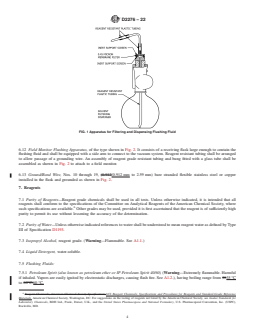
6.8 Dispenser for Flushing Fluid, 0.45-μm0.45 μm membrane filters to be provided in the delivery line (see Fig. 1). Alternatively,
flushing fluid that has been pre-filtered through a 0.45 μm membrane before delivery to the dispenser flask is acceptable.
6.9 Field Monitors, complete with protective plugs and 34-mm34 mm support pads.
6.10 Air Ionizer, for the balance case (see Note 2 and Note 3).
NOTE 2—When using a solid-pan balance, the air ionizer may be omitted provided that, when weighing a membrane filter, it is placed on the pan so that
no part protrudes over the edge of the pan.
NOTE 3—Air ionizers should be replaced within 1 year of manufacture.
6.11 Multimeter/VOM, used for determining whether electrical continuity is 10 Ω or less between 2 points.
All available membrane filters are not suitable for this application. Apparatus considered for this application shall be checked by the user for suitability in accordance
with the requirements of RR:D02-1012, 1994 revision.
D2276 − 22
FIG. 1 Apparatus for Filtering and Dispensing Flushing Fluid
6.12 Field Monitor Flushing Apparatus, of the type shown in Fig. 2. It consists of a receiving flask large enough to contain the
flushing fluid and shall be equipped with a side arm to connect to the vacuum system. Reagent resistant tubing shall be arranged
to allow passage of a grounding wire. An assembly of reagent grade resistant tubing and bung fitted with a glass tube shall be
assembled as shown in Fig. 2 to attach to a field monitor.
6.13 Ground/Bond Wire, Nos. 10 through 19, (0.912(0.912 mm to 2.59 mm) bare stranded flexible stainless steel or copper
installed in the flask and grounded as shown in Fig. 2.
7. Reagents
7.1 Purity of Reagents—Reagent grade chemicals shall be used in all tests. Unless otherwise indicated, it is intended that all
reagents shall conform to the specifications of the Committee on Analytical Reagents of the American Chemical Society, where
such specifications are available. Other grades may be used, provided it is first ascertained that the reagent is of sufficiently high
purity to permit its use without lessening the accuracy of the determination.
7.2 Purity of Water—Unless otherwise indicated references to water shall be understood to mean reagent water as defined by Type
III of Specification D1193.
7.3 Isopropyl Alcohol, reagent grade. (Warning—Flammable. See A1.1.)
7.4 Liquid Detergent, water-soluble.
7.5 Flushing Fluids:
7.5.1 Petroleum Spirit (also known as petroleum ether or IP Petroleum Spirit 40/60) (Warning—Extremely flammable. Harmful
if inhaled. Vapors are easily ignited by electrostatic discharges, causing flash fire. See A1.2.), having boiling range from 3535 °C
to 60°C.60 °C.
Reagent Chemicals, American Chemical Society Specifications,ACS Reagent Chemicals, Specifications and Procedures for Reagents and Standard-Grade Reference
Materials, American Chemical Society, Washington, DC. For suggestions on the testing of reagents not listed by the American Chemical Society, see Analar Standards for
Laboratory Chemicals, BDH Ltd., Poole, Dorset, U.K., and the United States Pharmacopeia and National Formulary, U.S. Pharmacopeial Convention, Inc. (USPC),
Rockville, MD.
D2276 − 22
FIG. 2 Field Monitor Flushing Apparatus
8. Preparation of Test and Control Membrane Filters and Field Monitors Prior to Sampling
8.1 Two 37-mm37 mm membrane filters of nominal pore size 0.8 μm 0.8 μm are required: a test and a control membrane filter.
Matched-weight membrane filters may be used if so desired (see Note 1). If matched-weight membrane filters are used, it is
unnecessary to carry out the procedures detailed in this section because they have been carried out previously by the membrane
filter supplier. The two membrane filters used for each individual test should be identified by marking the petri dishes used as
containers. Glassware used in preparation of membrane filters shall be cleaned as described in Section 10.
8.1.1 Using forceps, place the test and control membrane filters side by side in a clean petri dish. To facilitate handling the
membrane filters should rest on clean glass support rods in the petri dish.
8.1.2 Place the petri dish with its lid slightly ajar, in an oven at 9090 °C 6 5°C5 °C and leave it for 30 min.
8.1.3 Remove the petri dish from the oven and place it near the balance. The petri dish cover should be ajar but still protecting
the membrane filters from contamination from the atmosphere. Allow 30 min for the membrane filters to come to equilibrium with
the ambient air temperature and humidity.
8.1.4 Remove the control membrane filter from the petri dish with forceps, handling by the edge only, and place it centrally on
the weighing pan. Weigh it and return it to the petri dish.
8.1.5 Repeat 8.1.4 for the test membrane filter. Record the membrane filter masses.
8.1.6 Take a clean field monitor, mark for identification, rinse with filtered flushing fluid, and insert a clean support pad.
8.1.7 Using clean forceps, place the weighed control membrane filter centrally on the support pad in the field monitor and place
the weighed test membrane filter on top of the control membrane filter. Assemble the two parts of the field monitor, ensuring that
the membrane filters are firmly clamped inside and the protective plugs are in position.
8.1.8 Record the monitor identification.
9. Sampling and Testing Procedure
9.1 When possible, 3.785 L (1 gal) to 5 L (1.321 gal) of fuel should be passed through the monitor during field sampling. The
sample volume actually employed shall be reported. (Warning—Jet A, combustible. Vapor harmful. See A1.3.) (Warning—Jet
B, extremely flammable. Harmful if inhaled. Vapors may cause flash fire. See A1.4.)
9.2 See Annex A2 for specific details of sampling practices that shall be followed.
D2276 − 22
10. Preparation of Flushing Apparatus
10.1 Fig. 2 shows the recommended configuration of the flushing apparatus. Alternative apparatus may be used, provided that it
achieves the same end.
10.1.1 Wash the petri dishes and supports with warm water containing detergent. Then rinse with warm water and finally with
distilled water.
10.1.2 Rinse thoroughly with filtered isopropyl alcohol.
10.1.3 Rinse thoroughly with filtered flushing fluid.
10.1.4 Drain for a few seconds, and then air or oven dry.
10.2 Ensure that all glass and plastic tubing attached to the solvent filtering dispenser is clean by flushing thoroughly with filtered
flushing fluid.
11. Flushing and Weighing Procedure
11.1 Upon receipt of the field monitor in the laboratory, assemble the apparatus shown in Fig. 2 with the field monitor in place
on the stopper of the vacuum flask.
NOTE 4—Take care to ensure that monitors are tightly closed and preferably clamped. Spring paper clips have been found suitable for this purpose.
11.2 Place the tip of the delivery spout of the solvent filtering dispenser in direct contact with the monitor inlet hole. Introduce
filtered flushing fluid.
11.3 Apply vacuum to the flask and allow approximately 250 mL of filtered flushing fluid to pass from the flushing fluid dispenser
through the monitor and into the vacuum flask.
11.4 Remove the flushing fluid dispenser and slowly release the vacuum.
11.5 Remove the monitor from the stopper of the vacuum flask and carefully dismantle it in an upright position.
11.6 Carefully remove the test and control membrane filters, and place side by side on clean glass supports in a clean, covered
petri dish.
NOTE 5—The test and control membrane filters can be removed from the monitor by pushing upwards against the support pad through the outlet orifice
with a thin dowel.
11.7 Dry and reweigh the membrane filters as described in 8.1.2 – 8.1.5, taking care not to disturb the contaminant on the surface
of the test membrane filter.
12. Calculation and Report
12.1 Subtract the initial mass of the test membrane filter, W , from the final mass, W .
1 2
12.2 Subtract the initial mass of the control membrane filter, W , from the final mass, W .
3 4
12.3 Divide the correct mass of contaminant (W − W ) − (W − W ) by the volume of sample filtered and report the result as total
2 1 4 3
contaminant, expressed in milligrams per litre.
NOTE 6—If matched-weight membrane filters have been used for the test (see Note 1), then W = W and the corrected mass of contaminant in 12.3
1 3
becomes W − W .
2 4
D2276 − 22
TABLE 1 Statistical Information for Particulate Contaminant
Average Result,
0.0 0.1 0.2 0.3 0.5 0.7 1.0 1.5 2.0
mg/L
Repeatability 0.07 0.09 0.11 0.12 0.16 0.19 0.25 0.33 0.42
Reproducibility 0.18 0.22 0.27 0.31 0.40 0.49 0.62 0.84 1.07
12.4 Report the result to the nearest 0.01 mg/L, and also the sample volume used in the test.
13. Precision and Bias
13.1 The precision of this test method is not known to have been obtained in accordance with currently accepted guidelines in
Committee D02 RR:D02-1007.
13.2 These precision data have been obtained by statistical examination of test results using 5-L5 L samples and were first
published in 1966.
13.3 Repeatability—The difference between successive results obtained by the same operator with the same apparatus under
constant operating conditions on identical test material would, in the long run, in the normal and correct operation of the test
method, exceed the following values in only one case in twenty:
Range Repeatability
0.0 to 2.0 mg/L 0.175x + 0.070
0.0 mg ⁄L to 2.0 mg/L 0.175x + 0.070
where x is the average value of two results.
13.4 Reproducibility—The difference between two single and independent results obtained by different operators working in
different laboratories on identical test material would, in the long run, exceed the following values in only one case in twenty:
Range Reproducibility
0.0 to 2.0 mg/L 0.444x + 0.178
0.0 mg ⁄L to 2.0 mg/L 0.444x + 0.178
where x is the average value of two results.
13.5 Typical values are given in Table 1.
NOTE 7—Reproducibility values were determined through cooperative testing by different operators using separate apparatus working at the same location
using identical test material. This procedure was adopted as it is highly improbable, if not impossible, to ensure the obtaining of “identical test material”
when testing at different locations.
13.6 Bias—The procedure given for the determination of particulate contaminant in aviation turbine fuels has no bias since this
property can only be defined in terms of this test method.
14. Keywords
14.1 aviation fuel; color rating; field monitor; gravimetric contaminant; membrane color; membrane filter; particulate
Supporting data have been filed at ASTM International Headquarters and may be obtained by requesting Research Report RR:D02-1197. Contact ASTM Customer
Service at service@astm.org.
D2276 − 22
ANNEXES
(Mandatory Information)
A1. PRECAUTIONARY STATEMENTS
A1.1 Isopropyl Alcohol
A1.1.1 Keep away from heat, sparks, and open flame.
A1.1.2 Keep container closed.
A1.1.3 Use with adequate ventilation.
A1.1.4 Avoid prolonged breathing of vapor or spray mist.
A1.1.5 Avoid contact with eyes and skin.
A1.1.6 Do not take internally.
A1.2 Petroleum Ether
A1.2.1 Keep away from heat, sparks, and open flame.
A1.2.2 Keep container closed.
A1.2.3 Use with adequate ventilation.
A1.2.4 Avoid build-up of vapors and eliminate all sources of ignition, especially nonexplosion-proof electrical apparatus and
heaters.
A1.2.5 Avoid prolonged breathing of vapor or spray mist.
A1.2.6 Avoid prolonged or repeated skin contact.
D2276 − 22
A1.3 Aviation Turbine Fuel (Jet A or A-1, see Specification D1655)
A1.3.1 Keep away from heat, sparks, and open flames.
A1.3.2 Keep container closed.
A1.3.3 Use with adequate ventilation.
A1.3.4 Avoid breathing vapor or spray mist.
A1.3.5 Avoid prolonged or repeated contact with skin.
A1.4 Aviation Turbine Fuel (Jet B, see Specification D6615)
A1.4.1 Keep container closed.
A1.4.2 Use with adequate ventilation.
A1.4.3 Avoid build-up of vapors and eliminate all sources of ignition, especially nonexplosion-proof electrical apparatus and
heaters.
A1.4.4 Avoid breathing vapor or spray mist.
A1.4.5 Avoid prolonged or repeated contact with skin.
A2. SAMPLING AVIATION TURBINE FUEL FOR PARTICULATE CONTAMINATION
A2.1 Scope
A2.1.1 This test method covers taking samples of aviation turbine fuels from fuel handling systems under pressure, through field
monitors, for the determination of particulate contaminant.
A2.2 Summary of Test Method
A2.2.1 A 3.785 to 5-L5 L sample is taken from a flowing line or pipe and passed under line pressure through a field monitor
D2276 − 22
containing a preweighed 0.8-μm0.8 μm test membrane filter and a preweighed 0.8-μm0.8 μm control membrane filter. After
filtration the field monitor is returned to a laboratory for analysis.
NOTE A2.1—Examine the monitor carefully to ensure that it is located correctly in its holder (that is, not reversed). The
...