

ASTM C1481-12(2017)
(Guide)Standard Guide for Use of Joint Sealants with Exterior Insulation and Finish Systems (EIFS)
General Information
- Abstract
SIGNIFICANCE AND USE
4.1 The intent of this guide is to provide information and guidelines for consideration by the designer or applicator of joint seals in, or adjacent to, EIFS. Refer to Specification E2568 for additional information pertaining to specifying Class PB EIFS. Refer to Guide E2511 for additional information pertaining to detailing of EIFS-Clad Wall Assemblies.
4.2 Proper selection and use of a sealant is fundamental to its ultimate performance, service life, and durability. A sealant joint subjected to movement and other similar performance factors should be designed for the particular application to avoid compromising its performance capability and causing failures. Refer to C1193 for guidance.
4.3 In addition to the design and installation data in this guide, consult the sealant manufacturer about applications for its products and their proper use and installation.
SCOPE
1.1 This guide describes the use of single and multi-component, cold-applied joint sealants, or precured sealant systems for joint sealing applications, or both, in buildings using Exterior Insulation and Finish Systems (EIFS) on one or both sides of the joint. Refer to 10.1 for joint seal geometries.
1.2 The elastomeric sealants described by this guide meet the requirements of Specifications C834, C920, or C1311.
1.3 The values stated in SI units are to be regarded as standard. No other units of measurement are included in this standard.
1.4 This standard does not purport to address all of the safety concerns, if any, associated with its use. It is the responsibility of the user of this standard to establish appropriate safety and health practices and determine the applicability of regulatory limitations prior to use.
1.5 There are no ISO standards similar or equivalent to this ASTM standard.
- Status
- Published
- Publication Date
- 31-Dec-2016
- Technical Committee
- C24 - Building Seals and Sealants
- Drafting Committee
- C24.10 - Specifications, Guides and Practices
Overview
ASTM C1481-12(2017): Standard Guide for Use of Joint Sealants with Exterior Insulation and Finish Systems (EIFS) provides comprehensive guidance for designers and installers working with joint sealants in buildings clad with EIFS. The standard addresses the selection, application, and evaluation of cold-applied joint sealants-both single and multi-component-as well as precured sealant systems, specifically tailored for successful integration with EIFS wall assemblies. This ASTM guide serves as a critical technical reference for ensuring long-term durability, weather resistance, and compatibility of sealant joints in EIFS applications.
Key Topics
Sealant Selection and Evaluation
- The standard outlines the importance of choosing sealants that meet ASTM Specifications C834, C920, or C1311.
- Proper selection directly impacts performance, service life, and the durability of joint seals in EIFS constructions.
Joint Design and Geometry
- Guidance is provided for various joint types: butt joint, bridge joint, fillet joint, and lap joint.
- The standard recommends minimum and maximum joint dimensions, considering movement capability and EIFS manufacturer guidelines.
Surface Preparation and Installation
- Emphasizes the need for a clean, dry substrate and details procedures for joint preparation.
- Advises on protecting insulation board edges with base coat and reinforcing mesh or approved accessories.
Sealant Backing and Primers
- Recommendations for compatible backing materials to prevent three-sided adhesion and enhance performance.
- Advises on primer selection to improve sealant adhesion without damaging EIFS components.
Testing and Performance Evaluation
- References ASTM test methods (C1382, C794, C719) to assess sealant adhesion, weathering, movement capability, and overall performance in EIFS joints.
Applications
ASTM C1481-12(2017) is widely applicable in residential, commercial, and institutional construction projects where Exterior Insulation and Finish Systems (EIFS) are used. Key applications include:
New Construction and Renovation:
- Installation of joint sealants at expansion joints, floor lines, transitions between dissimilar materials, and perimeters of EIFS panels.
- Restoration or repair of failed EIFS joint seals using recommended bridge or fillet joint techniques.
Design Specification:
- Architects and engineers use this guide to ensure joint seals accommodate building movement while maintaining weather resistance and energy efficiency.
Quality Assurance and Inspection:
- Contractors and building inspectors refer to this standard for best practices in EIFS joint sealant installation and to verify compliance with project requirements.
Related Standards
For a complete approach to EIFS joint sealant specification and installation, ASTM C1481-12(2017) references and is complemented by several related documents:
- ASTM C834, C920, C1311: Specifications for various elastomeric and latex sealants used in building joints.
- ASTM C1193: Guide for Use of Joint Sealants.
- ASTM C1382: Test method for determining tensile adhesion properties of sealants with EIFS joints.
- ASTM C1472: Guide for calculating movement and selecting joint widths.
- ASTM C717, E2110: Terminology standards for building seals, sealants, and EIFS.
- ASTM E2511: Guide for detailing EIFS-clad wall assemblies.
- ASTM E2568: Specification for PB Exterior Insulation and Finish Systems.
Summary
By following ASTM C1481-12(2017), professionals ensure best practices for the use of joint sealants with EIFS, leading to enhanced system performance, weather resistance, and service life. Proper joint design, sealant selection, and installation-validated by referenced ASTM test methods-are critical for the long-term success of EIFS-clad buildings. For technical accuracy and code compliance, referencing this guide and its related standards is essential for all EIFS construction and maintenance projects.
Keywords: joint sealant, EIFS, exterior insulation and finish systems, ASTM C1481, weatherproofing, building envelope, sealant installation, construction standards.
Relations
- Effective Date
- 01-Jan-2017
- Effective Date
- 01-Mar-2019
- Effective Date
- 01-Mar-2018
- Effective Date
- 01-Jan-2018
- Effective Date
- 01-Nov-2017
- Effective Date
- 15-Jan-2017
- Effective Date
- 01-Jan-2017
- Effective Date
- 01-Jan-2017
- Effective Date
- 15-Nov-2016
- Effective Date
- 01-Sep-2016
- Effective Date
- 01-Jul-2016
- Effective Date
- 01-Jul-2015
- Effective Date
- 01-Mar-2015
- Effective Date
- 15-Jul-2014
- Effective Date
- 01-Jun-2014
Get Certified
Connect with accredited certification bodies for this standard

DIBt (Deutsches Institut für Bautechnik)
German Institute for Building Technology.
DIN CERTCO
DIN Group product certification.

Aboma Certification B.V.
Specialized in construction, metal, and transport sectors.
Sponsored listings
Frequently Asked Questions
ASTM C1481-12(2017) is a guide published by ASTM International. Its full title is "Standard Guide for Use of Joint Sealants with Exterior Insulation and Finish Systems (EIFS)". This standard covers: SIGNIFICANCE AND USE 4.1 The intent of this guide is to provide information and guidelines for consideration by the designer or applicator of joint seals in, or adjacent to, EIFS. Refer to Specification E2568 for additional information pertaining to specifying Class PB EIFS. Refer to Guide E2511 for additional information pertaining to detailing of EIFS-Clad Wall Assemblies. 4.2 Proper selection and use of a sealant is fundamental to its ultimate performance, service life, and durability. A sealant joint subjected to movement and other similar performance factors should be designed for the particular application to avoid compromising its performance capability and causing failures. Refer to C1193 for guidance. 4.3 In addition to the design and installation data in this guide, consult the sealant manufacturer about applications for its products and their proper use and installation. SCOPE 1.1 This guide describes the use of single and multi-component, cold-applied joint sealants, or precured sealant systems for joint sealing applications, or both, in buildings using Exterior Insulation and Finish Systems (EIFS) on one or both sides of the joint. Refer to 10.1 for joint seal geometries. 1.2 The elastomeric sealants described by this guide meet the requirements of Specifications C834, C920, or C1311. 1.3 The values stated in SI units are to be regarded as standard. No other units of measurement are included in this standard. 1.4 This standard does not purport to address all of the safety concerns, if any, associated with its use. It is the responsibility of the user of this standard to establish appropriate safety and health practices and determine the applicability of regulatory limitations prior to use. 1.5 There are no ISO standards similar or equivalent to this ASTM standard.
SIGNIFICANCE AND USE 4.1 The intent of this guide is to provide information and guidelines for consideration by the designer or applicator of joint seals in, or adjacent to, EIFS. Refer to Specification E2568 for additional information pertaining to specifying Class PB EIFS. Refer to Guide E2511 for additional information pertaining to detailing of EIFS-Clad Wall Assemblies. 4.2 Proper selection and use of a sealant is fundamental to its ultimate performance, service life, and durability. A sealant joint subjected to movement and other similar performance factors should be designed for the particular application to avoid compromising its performance capability and causing failures. Refer to C1193 for guidance. 4.3 In addition to the design and installation data in this guide, consult the sealant manufacturer about applications for its products and their proper use and installation. SCOPE 1.1 This guide describes the use of single and multi-component, cold-applied joint sealants, or precured sealant systems for joint sealing applications, or both, in buildings using Exterior Insulation and Finish Systems (EIFS) on one or both sides of the joint. Refer to 10.1 for joint seal geometries. 1.2 The elastomeric sealants described by this guide meet the requirements of Specifications C834, C920, or C1311. 1.3 The values stated in SI units are to be regarded as standard. No other units of measurement are included in this standard. 1.4 This standard does not purport to address all of the safety concerns, if any, associated with its use. It is the responsibility of the user of this standard to establish appropriate safety and health practices and determine the applicability of regulatory limitations prior to use. 1.5 There are no ISO standards similar or equivalent to this ASTM standard.
ASTM C1481-12(2017) is classified under the following ICS (International Classification for Standards) categories: 91.100.50 - Binders. Sealing materials. The ICS classification helps identify the subject area and facilitates finding related standards.
ASTM C1481-12(2017) has the following relationships with other standards: It is inter standard links to ASTM C1481-12, ASTM C717-19, ASTM C717-18, ASTM C920-18, ASTM C717-17a, ASTM E2110-17, ASTM C717-17, ASTM E2568-17, ASTM C717-16a, ASTM C717-16, ASTM C1472-16, ASTM C794-15a, ASTM C794-15, ASTM C719-14, ASTM C920-14a. Understanding these relationships helps ensure you are using the most current and applicable version of the standard.
ASTM C1481-12(2017) is available in PDF format for immediate download after purchase. The document can be added to your cart and obtained through the secure checkout process. Digital delivery ensures instant access to the complete standard document.
Standards Content (Sample)
This international standard was developed in accordance with internationally recognized principles on standardization established in the Decision on Principles for the
Development of International Standards, Guides and Recommendations issued by the World Trade Organization Technical Barriers to Trade (TBT) Committee.
Designation: C1481 − 12 (Reapproved 2017)
Standard Guide for
Use of Joint Sealants with Exterior Insulation and Finish
Systems (EIFS)
This standard is issued under the fixed designation C1481; the number immediately following the designation indicates the year of
original adoption or, in the case of revision, the year of last revision. A number in parentheses indicates the year of last reapproval. A
superscript epsilon (´) indicates an editorial change since the last revision or reapproval.
1. Scope C794 TestMethodforAdhesion-in-PeelofElastomericJoint
Sealants
1.1 This guide describes the use of single and multi-
C834 Specification for Latex Sealants
component, cold-applied joint sealants, or precured sealant
C920 Specification for Elastomeric Joint Sealants
systems for joint sealing applications, or both, in buildings
C1193 Guide for Use of Joint Sealants
using Exterior Insulation and Finish Systems (EIFS) on one or
C1311 Specification for Solvent Release Sealants
both sides of the joint. Refer to 10.1 for joint seal geometries.
C1382 Test Method for DeterminingTensileAdhesion Prop-
1.2 The elastomeric sealants described by this guide meet
erties of Sealants When Used in Exterior Insulation and
the requirements of Specifications C834, C920,or C1311.
Finish Systems (EIFS) Joints
C1397 Practice forApplication of Class PB Exterior Insula-
1.3 The values stated in SI units are to be regarded as
standard. No other units of measurement are included in this tion and Finish Systems (EIFS) and EIFS with Drainage
C1472 Guide for Calculating Movement and Other Effects
standard.
When Establishing Sealant Joint Width
1.4 This standard does not purport to address all of the
E2110 Terminology for Exterior Insulation and Finish Sys-
safety concerns, if any, associated with its use. It is the
tems (EIFS)
responsibility of the user of this standard to establish appro-
E2511 Guide for Detailing of EIFS-Clad Barrier and Drain-
priate safety and health practices and determine the applica-
age Wall Assemblies
bility of regulatory limitations prior to use.
E2568 Specification for PB Exterior Insulation and Finish
1.5 There are no ISO standards similar or equivalent to this
Systems
ASTM standard.
2.2 ANSI Standard:
1.6 This international standard was developed in accor-
American National Standard for Exterior Insulation and
dance with internationally recognized principles on standard-
Finish Systems (EIFS)
ization established in the Decision on Principles for the
Development of International Standards, Guides and Recom-
3. Terminology
mendations issued by the World Trade Organization Technical
3.1 Definitions:
Barriers to Trade (TBT) Committee.
3.1.1 Refer to Terminology C717 for definitions of the
following terms used in this guide: bicellular sealant backing,
2. Referenced Documents
bond breaker, bridge sealant joint, butt sealant joint, chemi-
2.1 ASTM Standards:
cally curing sealant, closed cell sealant backing, compatibility,
C717 Terminology of Building Seals and Sealants
compatible materials, cure, elastomeric, elongation, fillet seal-
C719 Test Method for Adhesion and Cohesion of Elasto-
ant joint, joint, lap sealant joint, latex sealant, modulus,
meric Joint Sealants Under Cyclic Movement (Hockman
non-sag sealant, open cell sealant backing, precured sealant,
Cycle)
primer, seal, sealant, sealant backing, shelf-life, solvent-
release sealant, shrinkage, substrate, tooling, tooling time,
working life (pot life).
ThisguideisunderthejurisdictionofASTMCommitteeC24onBuildingSeals
E2110 for definitions of the
3.1.2 Refer to Terminology
and Sealants and is the direct responsibility of Subcommittee C24.10 on
following terms used in this guide: accessories, base coat,
Specifications, Guides and Practices.
Current edition approved Jan. 1, 2017. Published February 2017. Originally
cure, dry, durability, edge wrap, embed, expansion joint,
approved in 2000. Last previous edition approved in 2012 as C1481-12. DOI:
exterior insulation and finish system (EIFS), finish coat,
10.1520/C1481-12R17.
For referenced ASTM standards, visit the ASTM website, www.astm.org, or
contact ASTM Customer Service at service@astm.org. For Annual Book of ASTM
Standards volume information, refer to the standard’s Document Summary page on Available from American National Standards Institute (ANSI), 25 W. 43rd St.,
the ASTM website. 4th Floor, New York, NY 10036.
Copyright © ASTM International, 100 Barr Harbor Drive, PO Box C700, West Conshohocken, PA 19428-2959. United States
C1481 − 12 (2017)
lamina, nonmetallic reinforcing mesh, primers, reinforced base
coat, substrate, texture, thermal insulation board, wrap.
4. Significance and Use
4.1 The intent of this guide is to provide information and
guidelines for consideration by the designer or applicator of
joint seals in, or adjacent to, EIFS. Refer to Specification
E2568foradditionalinformationpertainingtospecifyingClass
PB EIFS. Refer to Guide E2511 for additional information
pertaining to detailing of EIFS-Clad Wall Assemblies.
4.2 Proper selection and use of a sealant is fundamental to
its ultimate performance, service life, and durability. A sealant
FIG. 2 Sealant Butt Joint Seal (EIFS to Dissimilar Substrates)
joint subjected to movement and other similar performance
factors should be designed for the particular application to
avoid compromising its performance capability and causing
failures. Refer to C1193 for guidance.
4.3 In addition to the design and installation data in this
guide, consult the sealant manufacturer about applications for
its products and their proper use and installation.
5. General
5.1 The major components of a joint seal in, or adjacent to,
EIFS that should be considered when selecting or using
sealants are as follows: EIFS, primer, sealant backing or bond
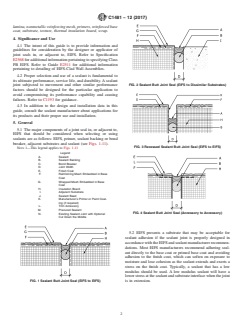
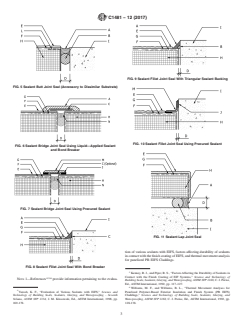
breaker, adjacent substrates and sealant (see Figs. 1-11).
FIG. 3 Recessed Sealant Butt Joint Seal (EIFS to EIFS)
NOTE 1—This legend applies to Figs. 1-11
Legend
A. Sealant
B. Sealant Backing
C. Bond Breaker
D. Joint Width
E. Finish Coat
F. Reinforcing Mesh Embedded in Base
Coat
G. Wrapped Mesh Embedded in Base
Coat
H. Insulation Board
I. Adjacent Substrate
J. Sealant Bead
K. Manufacturer’s Primer or Paint Coat-
ing (if required)
L. Trim Accessory
M. Precured Sealant
N. Existing Sealant Joint with Optional FIG. 4 Sealant Butt Joint Seal (Accessory to Accessory)
Cut Down the Middle
5.2 EIFS presents a substrate that may be acceptable for
sealant adhesion if the sealant joint is properly designed in
accordancewiththeEIFSandsealantmanufacturerrecommen-
dations. Most EIFS manufacturers recommend adhering seal-
ant directly to the base coat or primed base coat and avoiding
adhesion to the finish coat, which can soften on exposure to
moisture and lose cohesion as the sealant extends and exerts a
stress on the finish coat. Typically, a sealant that has a low
modulus should be used. A low modulus sealant will have a
lowerstressatthesealantandsubstrateinterfacewhenthejoint
FIG. 1 Sealant Butt Joint Seal (EIFS to EIFS) is in extension.
C1481 − 12 (2017)
FIG. 9 Sealant Fillet Joint Seal With Triangular Sealant Backing
FIG. 5 Sealant Butt Joint Seal (Accessory to Dissimilar Substrate)
FIG. 10 Sealant Fillet Joint Seal Using Precured Sealant
FIG. 6 Sealant Bridge Joint Seal Using Liquid—Applied Sealant
and Bond Breaker
FIG. 7 Sealant Bridge Joint Seal Using Precured Sealant
FIG. 11 Sealant Lap Joint Seal
tion of various sealants with EIFS, factors affecting durability of sealants
in contact with the finish coating of EIFS, and thermal movement analysis
for panelized PB EIFS Claddings.
FIG. 8 Sealant Fillet Joint Seal With Bond Breaker
Kenney, R. J., and Piper, R. S., “FactorsAffecting the Durability of Sealants in
Contact with the Finish Coating of EIF Systems,” Science and Technology of
4,5,6
NOTE 1—References provide information pertaining to the evalua-
Building Seals, Sealants, Glazing, and Waterproofing, ASTM STP 1168, C. J. Parise,
Ed., ASTM International, 1992, pp. 117–127.
Williams, M. F., and Williams, B. L., “Thermal Movement Analyses for
Yarosh, K. F., “Evaluation of Various Sealants with EIFS,” Science and Panelized Polymer-Based Exterior Insulation and Finish System (PB EIFS)
Technology of Building Seals, Sealants, Glazing, and Waterproofing - Seventh Claddings,” Science and Technology of Building Seals, Sealants, Glazing, and
Volume, ASTM STP 1334, J. M. Klosowski, Ed., ASTM International, 1998, pp. Waterproofing, ASTM STP 1168, C. J. Parise, Ed., ASTM International, 1992, pp.
169-178. 128-138.
C1481 − 12 (2017)
5.3 Due to the difficulty that can be encountered in perform- of sealants. A minimum drying time of 24 h is required.
ing remedial work for an EIFS sealant joint, the selected Curing/drying time may be affected by environmental condi-
sealant should have very good environmental weathering tions as well as whether the EIFS base coat is cementitious or
characteristics so that it will last for the maximum useful noncementitious. Consult EIFS manufacturer for recommen-
lifetime of the sealant. Since an EIFS system is water-based, if dations for appropriate curing/drying time.
it becomes saturated with rainwater or snow melt, the adhesion 6.2.4 Some EIFS manufacturers require a primer or paint
of a sealant to an EIFS base coat can be lessened. Information coating over the base coat within the joint. The primer,
onsealanttensileadhesionpropertieswhenusedwithEIFScan provided by the EIFS manufacturer, may be used to promote
be found in Test Method C1382. EIFS can be damaged by sealant adhesion, protect cementitious base coat from efflores-
grinding or cutting during sealant removal, so it is a good cence and/or provide color uniformity.
candidate for use of a bridge type sealant joint or precured 6.2.5 Theapplicationoffinishcoatintothejointisgenerally
sealant, in a remedial application. This may be helpful since it not recommended by EIFS manufacturers. The test method
does not require the removal of all the old or failed sealant but describedinTestMethodC1382allowsevaluationofaspecific
does change the appearance of the joint seal. sealant to a specific EIFS substrate.
6.2.6 Careful consideration should be given to the construc-
tion sequencing of the EIFS finish coat, EIFS primer or paint
6. EIFS
coating, and sealant application as well as the termination of
6.1 Joint Location and Configuration—In an EIFS-clad
the EIFS finish coat relative to the joint.
building, sealant joints typically are required at the following
locations: 6.3 EIFS Joint Preparation:
6.3.1 Joints must be clean, dry, and free of frost or other
6.1.1 At the floor line of multi-level wood frame construc-
tion; surface contaminants.
6.3.2 Generally, joints shall be cleaned with a nonmetallic
6.1.2 At an existing building expansion joint;
6.1.3 Where dissimilar substrates form the joint; stiff bristle brush or oil-free compressed air. Solvents may be
incompatible with the EIFS or underlying thermal insulation
6.1.4 When an EIFS ab
...