

ASTM E3149-18
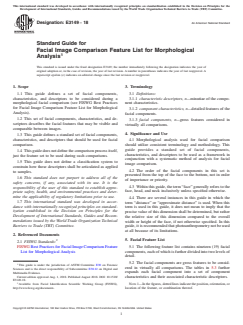
(Guide)Standard Guide for Facial Image Comparison Feature List for Morphological Analysis
General Information
- Abstract
SIGNIFICANCE AND USE
4.1 Morphological analysis used for facial comparison should utilize consistent terminology and methodology. This guide provides a standard set of facial components, characteristics, and descriptors to be used as a framework in conjunction with a systematic method of analysis for facial image comparison.
4.2 The order of the facial components in this set is presented from the top of the face to the bottom, not in order of importance or priority.
4.3 Within this guide, the term “face” generally refers to the face, head, and neck inclusively unless specified otherwise.
4.4 There are several instances in this guide in which the term “distance” or “approximate distance” is used. When this term is used in this guide, it does not mean to imply that the precise value of this dimension shall be determined, but rather the relative size of this dimension compared to the overall width or height of the face, if not otherwise specified. In this guide, it is recommended that photoanthropometry not be used at all because of its limitations.
SCOPE
1.1 This guide defines a set of facial components, characteristics, and descriptors to be considered during a morphological facial comparison (see FISWG Best Practices for Facial Image Comparison Feature List for Morphological Analysis).
1.2 This set of facial components, characteristics, and descriptors describes the facial features that may be visible and comparable between images.
1.3 This guide defines a standard set of facial components, characteristics, and descriptors that should be used for facial comparison.
1.4 This guide does not define the comparison process itself, just the feature set to be used during such comparisons.
1.5 This guide does not define a classification system to constrain how those descriptors shall be articulated as applied to samples.
1.6 This standard does not purport to address all of the safety concerns, if any, associated with its use. It is the responsibility of the user of this standard to establish appropriate safety, health, and environmental practices and determine the applicability of regulatory limitations prior to use.
1.7 This international standard was developed in accordance with internationally recognized principles on standardization established in the Decision on Principles for the Development of International Standards, Guides and Recommendations issued by the World Trade Organization Technical Barriers to Trade (TBT) Committee.
- Status
- Published
- Publication Date
- 31-Jul-2018
- Technical Committee
- E30 - Forensic Sciences
- Drafting Committee
- E30.12 - Digital and Multimedia Evidence
Overview
ASTM E3149-18: Standard Guide for Facial Image Comparison Feature List for Morphological Analysis establishes a consistent and comprehensive feature list for morphological facial image comparison. Developed by ASTM International, this standard describes a structured set of facial components, characteristics, and descriptors. It serves as a practical framework for professionals engaged in facial comparison, enabling uniform terminology and systematic analysis of facial images in forensic and identity verification applications.
This guide is not a detailed procedural manual for conducting facial image comparison but provides the essential foundation for referencing facial features consistently in comparative analysis. The standard emphasizes relative proportions and descriptors over precise measurements, and explicitly recommends against using photoanthropometry due to its limitations.
Key Topics
- Standardized Facial Components: The guide details nineteen primary facial components, including skin, face/head outline, head composition, hair, forehead, eyebrows, eyes, cheeks, nose, ears, mouth, chin/jawline, neck, facial hair, facial lines, scars, facial marks, alterations, and others.
- Component Characteristics and Descriptors: For each facial component, the standard outlines characteristic features (such as shape, size, symmetry, texture, position, and color) and further describes how to consistently reference these details in analysis.
- Terminology and Consistency: The standard promotes the use of uniform language and descriptors, ensuring consistent documentation and communication among practitioners.
- Descriptor Order: Features are listed sequentially from the top of the face (hairline, forehead) to the bottom (chin, neck), not by relative importance.
- Relative Measurements: Where distances or sizes are described, the focus is on proportions relative to the facial structure, not precise numerical measurement, to improve reliability under varying image conditions.
Applications
ASTM E3149-18 is widely used in contexts that require reliable, repeatable comparison of facial images, such as:
- Forensic Science: Assists forensic analysts in documenting and comparing facial features in criminal investigations, missing persons cases, and historical remains identification.
- Law Enforcement: Supports law enforcement agencies with standardized feature lists for database entries, suspect identification, and evidence presentation in court.
- Identity Verification: Enables more consistent analysis in security, border control, and biometric systems that employ facial recognition as a primary identification method.
- Research and Training: Serves as a reference for the development of training materials or research projects focusing on facial morphology, anthropometry, and biometric standards.
Related Standards
- FISWG Best Practices for Facial Image Comparison Feature List for Morphological Analysis: This key referenced document provides further technical context for best practice in the field.
- ASTM E2916: Terminology for Digital and Multimedia Evidence, supporting clarity across various forensic digital analyses.
- ISO/IEC 19794-5: International framework for face image data used in biometric applications.
- ASTM E2329: Standard Practice for Identification of Seized Drugs, related in purpose to standardized identification protocols.
Keywords: facial image comparison, forensic facial analysis, morphological analysis, facial features, biometric standards, identity verification, ASTM E3149-18.
By establishing a structured feature list for facial morphological analysis, ASTM E3149-18 enhances the reliability and consistency of facial comparison practices across forensic and biometric disciplines.
Get Certified
Connect with accredited certification bodies for this standard

BSI Group
BSI (British Standards Institution) is the business standards company that helps organizations make excellence a habit.

NYCE
Mexican standards and certification body.
Sponsored listings
Frequently Asked Questions
ASTM E3149-18 is a guide published by ASTM International. Its full title is "Standard Guide for Facial Image Comparison Feature List for Morphological Analysis". This standard covers: SIGNIFICANCE AND USE 4.1 Morphological analysis used for facial comparison should utilize consistent terminology and methodology. This guide provides a standard set of facial components, characteristics, and descriptors to be used as a framework in conjunction with a systematic method of analysis for facial image comparison. 4.2 The order of the facial components in this set is presented from the top of the face to the bottom, not in order of importance or priority. 4.3 Within this guide, the term “face” generally refers to the face, head, and neck inclusively unless specified otherwise. 4.4 There are several instances in this guide in which the term “distance” or “approximate distance” is used. When this term is used in this guide, it does not mean to imply that the precise value of this dimension shall be determined, but rather the relative size of this dimension compared to the overall width or height of the face, if not otherwise specified. In this guide, it is recommended that photoanthropometry not be used at all because of its limitations. SCOPE 1.1 This guide defines a set of facial components, characteristics, and descriptors to be considered during a morphological facial comparison (see FISWG Best Practices for Facial Image Comparison Feature List for Morphological Analysis). 1.2 This set of facial components, characteristics, and descriptors describes the facial features that may be visible and comparable between images. 1.3 This guide defines a standard set of facial components, characteristics, and descriptors that should be used for facial comparison. 1.4 This guide does not define the comparison process itself, just the feature set to be used during such comparisons. 1.5 This guide does not define a classification system to constrain how those descriptors shall be articulated as applied to samples. 1.6 This standard does not purport to address all of the safety concerns, if any, associated with its use. It is the responsibility of the user of this standard to establish appropriate safety, health, and environmental practices and determine the applicability of regulatory limitations prior to use. 1.7 This international standard was developed in accordance with internationally recognized principles on standardization established in the Decision on Principles for the Development of International Standards, Guides and Recommendations issued by the World Trade Organization Technical Barriers to Trade (TBT) Committee.
SIGNIFICANCE AND USE 4.1 Morphological analysis used for facial comparison should utilize consistent terminology and methodology. This guide provides a standard set of facial components, characteristics, and descriptors to be used as a framework in conjunction with a systematic method of analysis for facial image comparison. 4.2 The order of the facial components in this set is presented from the top of the face to the bottom, not in order of importance or priority. 4.3 Within this guide, the term “face” generally refers to the face, head, and neck inclusively unless specified otherwise. 4.4 There are several instances in this guide in which the term “distance” or “approximate distance” is used. When this term is used in this guide, it does not mean to imply that the precise value of this dimension shall be determined, but rather the relative size of this dimension compared to the overall width or height of the face, if not otherwise specified. In this guide, it is recommended that photoanthropometry not be used at all because of its limitations. SCOPE 1.1 This guide defines a set of facial components, characteristics, and descriptors to be considered during a morphological facial comparison (see FISWG Best Practices for Facial Image Comparison Feature List for Morphological Analysis). 1.2 This set of facial components, characteristics, and descriptors describes the facial features that may be visible and comparable between images. 1.3 This guide defines a standard set of facial components, characteristics, and descriptors that should be used for facial comparison. 1.4 This guide does not define the comparison process itself, just the feature set to be used during such comparisons. 1.5 This guide does not define a classification system to constrain how those descriptors shall be articulated as applied to samples. 1.6 This standard does not purport to address all of the safety concerns, if any, associated with its use. It is the responsibility of the user of this standard to establish appropriate safety, health, and environmental practices and determine the applicability of regulatory limitations prior to use. 1.7 This international standard was developed in accordance with internationally recognized principles on standardization established in the Decision on Principles for the Development of International Standards, Guides and Recommendations issued by the World Trade Organization Technical Barriers to Trade (TBT) Committee.
ASTM E3149-18 is classified under the following ICS (International Classification for Standards) categories: 35.240.15 - Identification cards. Chip cards. Biometrics. The ICS classification helps identify the subject area and facilitates finding related standards.
ASTM E3149-18 is available in PDF format for immediate download after purchase. The document can be added to your cart and obtained through the secure checkout process. Digital delivery ensures instant access to the complete standard document.
Standards Content (Sample)
This international standard was developed in accordance with internationally recognized principles on standardization established in the Decision on Principles for the
Development of International Standards, Guides and Recommendations issued by the World Trade Organization Technical Barriers to Trade (TBT) Committee.
Designation: E3149 − 18 An American National Standard
Standard Guide for
Facial Image Comparison Feature List for Morphological
Analysis
This standard is issued under the fixed designation E3149; the number immediately following the designation indicates the year of
original adoption or, in the case of revision, the year of last revision. A number in parentheses indicates the year of last reapproval. A
superscript epsilon (´) indicates an editorial change since the last revision or reapproval.
1. Scope 3. Terminology
1.1 This guide defines a set of facial components, 3.1 Definitions:
characteristics, and descriptors to be considered during a 3.1.1 characteristic descriptors, n—minutiae of the compo-
morphological facial comparison (see FISWG Best Practices nent characteristics.
for Facial Image Comparison Feature List for Morphological
3.1.2 component characteristics, n—detailed features of the
Analysis).
facial components.
1.2 This set of facial components, characteristics, and de-
3.1.3 facial components, n—gross features considered in
scriptors describes the facial features that may be visible and
virtually all comparisons.
comparable between images.
4. Significance and Use
1.3 This guide defines a standard set of facial components,
characteristics, and descriptors that should be used for facial
4.1 Morphological analysis used for facial comparison
comparison.
should utilize consistent terminology and methodology. This
guide provides a standard set of facial components,
1.4 Thisguidedoesnotdefinethecomparisonprocessitself,
characteristics, and descriptors to be used as a framework in
just the feature set to be used during such comparisons.
conjunction with a systematic method of analysis for facial
1.5 This guide does not define a classification system to
image comparison.
constrain how those descriptors shall be articulated as applied
4.2 The order of the facial components in this set is
to samples.
presented from the top of the face to the bottom, not in order
1.6 This standard does not purport to address all of the
of importance or priority.
safety concerns, if any, associated with its use. It is the
4.3 Within this guide, the term “face” generally refers to the
responsibility of the user of this standard to establish appro-
face, head, and neck inclusively unless specified otherwise.
priate safety, health, and environmental practices and deter-
mine the applicability of regulatory limitations prior to use.
4.4 There are several instances in this guide in which the
1.7 This international standard was developed in accor-
term “distance” or “approximate distance” is used. When this
dance with internationally recognized principles on standard-
term is used in this guide, it does not mean to imply that the
ization established in the Decision on Principles for the
precise value of this dimension shall be determined, but rather
Development of International Standards, Guides and Recom-
the relative size of this dimension compared to the overall
mendations issued by the World Trade Organization Technical
width or height of the face, if not otherwise specified. In this
Barriers to Trade (TBT) Committee.
guide, it is recommended that photoanthropometry not be used
at all because of its limitations.
2. Referenced Documents
2 5. Facial Feature List
2.1 FISWG Standards:
FISWG Best Practices for Facial Image Comparison Feature 5.1 The following feature list contains nineteen (19) facial
List for Morphological Analysis components, each of which is further divided into two levels of
detail.
5.2 The facial components are gross features to be consid-
This guide is under the jurisdiction of ASTM Committee E30 on Forensic
ered in virtually all comparisons. The tables in 5.3 further
Sciences and is the direct responsibility of Subcommittee E30.12 on Digital and
expands each facial component into a set of component
Multimedia Evidence.
Current edition approved Aug. 1, 2018. Published August 2018. DOI: 10.1520/
characteristics and their associated characteristic descriptors.
E3149-18.
Available from Facial Identification Scientific Working Group (FISWG), NOTE1—Inthefigures,dottedlinesindicatetheposition,orientation,or
http://www.fiswg.org/documents. location of the feature, or combination thereof.
Copyright © ASTM International, 100 Barr Harbor Drive, PO Box C700, West Conshohocken, PA 19428-2959. United States
E3149 − 18
TABLE 4 Hair
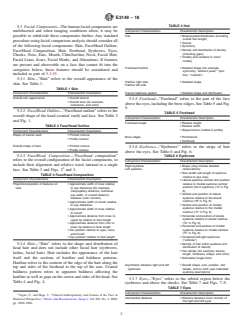
5.3 Facial Components—The human facial components are
Component Characteristics Characteristic Descriptors
multifaceted and when imaging conditions allow, it may be
Hair Shape/spatial distribution (including
possible to subdivide these components further. Any standard
overall hair length)
procedure using facial comparison analysis should consider all
Texture
of the following facial components: Skin, Face/Head Outline,
Symmetry
Density and distribution of density
Face/Head Composition, Hair, Forehead, Eyebrows, Eyes,
(including gaps)
Cheeks, Nose, Ears, Mouth, Chin/Jawline, Neck, Facial Hair,
Tonality and variation in color/
Facial Lines, Scars, Facial Marks, and Alterations. If features
tonality
are present and observable on a face that cannot fit into the
Forehead hairline Detailed shape (for example,
categories below, those features should be considered and
symmetry, “widow’s peak,” “part
included as part of 5.3.19.
line,” “cowlick”)
5.3.1 Skin—“Skin” refers to the overall appearance of the
Hairline right side Detailed shape
skin. See Table 1.
Hairline left side
TABLE 1 Skin
Cranial baldness pattern Detailed shape and distribution
Component Characteristics Characteristic Descriptors
Overall skin appearance Overall texture
5.3.5 Forehead—“Forehead” refers to the part of the face
Overall tone (for example,
above the eyes, including the brow ridges. SeeTable 5 and Fig.
luminance, and color)
5.
5.3.2 Face/Head Outline—“Face/head outline” refers to the
TABLE 5 Forehead
overall shape of the head (cranial vault) and face. See Table 2
Component Characteristics Characteristic Descriptors
and Fig. 1.
Forehead shape Relative height
TABLE 2 Face/Head Outline
Relative width
Slope/contour (visible in profile)
Component Characteristics Characteristic Descriptors
Shape of cranial vault Portrait contour
Brow ridges Prominence
Profile contour
Continuity
Overall shape of face Portrait contour
5.3.6 Eyebrows—“Eyebrows” refers to the strips of hair
Profile contour
above the eyes. See Table 6 and Fig. 6.
5.3.3 Face/Head Composition—“Face/head composition”
TABLE 6 Eyebrows
refers to the overall configuration of the facial components, to
Component Characteristics Characteristic Descriptors
include their alignment and relative sized, internal to a single
Right eyebrow Shape (may include detailed
Left eyebrow observations)
face. See Table 3 and Figs. 2 and 3.
Size (width and length of eyebrow
TABLE 3 Face/Head Composition
relative to eye size)
Component Characteristics Characteristic Descriptors
Lateral eyebrow vertical end position
relative to medial eyebrow vertical
Proportions/position of features on Approximate width of nose relative
position (tilt of eyebrow) (“A” in Fig.
face to eye distances (for example,
6)
interpupillary distance, individual
Vertical end position of lateral
eye width, or overall distance
eyebrow relative to the lateral
between outer corners)
canthus (“B” in Fig. 6)
Approximate width of mouth relative
Vertical end position of medial
to eye distances
eyebrow relative to the medial
Approximate width of nose relative
canthus (“C” in Fig. 6)
to mouth
Horizontal end position of lateral
Approximate distance from nose to
eyebrow relative to lateral canthus
upper lip relative to face length
(“D” in Fig. 6)
Approximate distance from chin to
Horizontal end position of medial
lower lip relative to face length
eyebrow relative to medial canthus
Ear position relative to eyes, nose,
(“E” in Fig. 6)
and mouth
Conjoined left-right eyebrows
Eye position relative to face length
(“unibrow”)
5.3.4 Hair—“Hair” refers to the shape and distribution of Density of hair within eyebrow and
distribution of density
head hair and does not include other facial hair (eyebrows,
Hair details (for example, texture,
lashes, facial hair). Hair includes the appearance of the hair
length, thickness, shape, and color)
itself and the sections of hairline and baldness patterns. Noticeably longer hairs
Hairline refers to the contour of the edge of the hair along the
Asymmetry between right and left Overall shape, size, position, hair
top and sides of the forehead to the top of the ears. Cranial
eyebrows details, and so forth (see individual
baldness pattern refers to apparent baldness affecting the eyebrow descriptors)
hairline as well as gaps on the crown and sides of the head. See
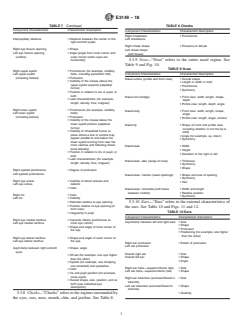
5.3.7 Eyes—“Eyes” refers to the orbital region below the
Table 4 and Fig. 4.
eyebrows and above the cheeks. See Table 7 and Figs. 7–9.
TABLE 7 Eyes
Component Characteristics Characteristic Descriptors
Vegter, F., and Hage, J., “Clinical Anthropometry and Canons of the Face in
Intercanthal distance Distance between inner corners of
Historical Perspective,” Plastic and Reconstructive Surgery, Vol 106, No. 5, 2000,
the right and left eyes
pp. 1090–1096.
E3149 − 18
TABLE 7 Continued
TABLE 8 Cheeks
Component Characteristics Characteristic Descriptors
Component Characteristics Characteristic Descriptors
Right cheekbone Prominence
Interpupillary distance Distance between the center of the
Left cheekbone
right and left pupils
Right cheek shape Presence of dimple
Right eye fissure opening Shape
Left cheek shape
Left eye fissure opening Angle [angle from inner corner and
(soft tissue)
(outline) outer corner (when eyes are
5.3.9 Nose—“Nose” refers to the entire nasal region. See
horizontal)]
Table 9 and Fig. 10.
TABLE 9 Nose
Right upper eyelid Prominence (for example, visibility,
Component Characteristics Characteristic Descriptors
Left upper eyelid folds, including epicanthic fold)
(including lashes) Protrusion
Nasal outline (profile and front view) Overall shape
Visibility of the crease above the
Length or width or both
upper eyelid (superior palpebral
Prominence
furrow)
Symmetry
Position in relation to iris or pupil, or
both
Nasal root (bridge) Front view: width, length, shape,
Lash characteristics (for example,
depth
length, density, flow, irregular)
Profile view: length, depth, angle
Right lower eyelid Prominence (for example, visibility,
Nasal body Front view: width, length, shape,
Left lower eyelid folds)
angle
(including lashes) Protrusion
Profile view: length, angle, contour
Visibility of the crease below the
lower eyelid (inferior palpebral
Nasal tip Shape (in front and profile view,
furrow)
including whether or not the tip is
Visibility of infraorbital furrow (a
bifid)
place where a line or wrinkle may
Angle (for example, up, down)
appear parallel to and below the
Symmetry
lower eyelid running from near the
inner canthus and following cheek
Nasal base Width
bone laterally)
Height
Position in relation to iris or pupil, or
Deviation to the right or left
both
Lash characteristics (for example,
Nasal base: alae (wings of nose) Thickness
length, density, flow, irregular)
Symmetry
Shape
Right eyeball prominence Degree of protrusion
Left eyeball prominence
Nasal base: nostrils (nasal openings) Shape and size of opening
Symmetry
Right eye sclera Visibility of blood vessels and
Hair
Left eye sclera defects
Color
Nasal base: columella (soft tissue Width and length
between nostrils) Relative position
Right iris Color
Symmetry
Left iris Visibility
Diameter relative to eye opening
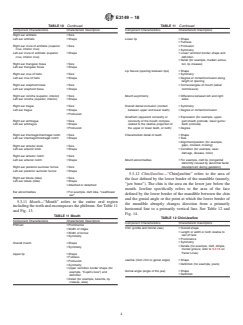
5.3.10 Ears—“Ears” refers to the external characteristics of
Position relative to eye opening (in
the ears. See Table 10 and Figs. 11 and 12.
front view)
TABLE 10 Ears
Irregularity in pupil
Component Characteristics Characteristic Descriptors
Right eye medial canthus Caruncle (fleshy prominence at
Asymmetry between left and right ears Size
Left eye medial canthus inner eye corner)
Shape
Shape and angle of inner corner of
Protrusion
the eye
Positioning (for example, one higher
than the other)
Right eye lateral canthus Shape and angle of outer corner of
Left eye lateral canthus the eye
Right ear protrusion Extent of protrusion
Left ear protrusion
Asymmetry between right and left Shape, angle
eyes
Overall right ear Size
Off-set (for example, one eye higher
Overall left ear Shape
than the other)
Angle
Eyelids (for example, one drooping,
one retracted) and eyelashes
Right ear helix—superior/inferior (tail) Size
Color
Left ear helix—superior/inferior (tail) Shape
Iris and pupil position (for example,
cross-eyed)
Right ear tubercles (auricular/Darwin’s Size
Overall shape, size, position, and so
tubercle)
forth (see individual eye
Left ear tubercles (auricular/Darwin’s Shape
descriptors)
tubercle)
Quantity
5.3.8 Cheeks—“Cheeks” refers to the regions surrounded by
the eyes, ears, nose, mouth, chin, and jawline. See Table 8.
E3149 − 18
TABLE 10 Continued TABLE 11 Continued
Component Characteristics Characteristic Descriptors Component Characteristics Characteristic Descriptors
Right ear antihelix Size
Left ear antihelix Shape Lower lip Shape
Fullness
Right ear crura of antihelix (superior Size Protrusion
crux, inferior crux) Symmetry
Left ear crura of antihelix (superior Shape Lower vermilion border shape and
crux, inferior crux) definition
Detail (for example, median sulcus,
Right ear triangular fossa Size tori, lip creases)
Left ear triangular fossa Shape
Lip fissure (opening between lips) Shape
Right ear crus of helix Size Symmetry
Left ear crus of helix Shape Degree of contact/occlusion along
length of opening
Right ear scaphoid fossa Size Corners/angles of mouth (labial
Left ear scaphoid fossa Shape commissure)
Right ear concha (superior, inferior) Size Mouth asymmetry Difference between left and right
Left ear concha (superior, inferior) Shape sides
Right ear tragus Size Overall dental occlusion (contact Symmetry
between upper and lower teeth) Degree of contact/occlusion
Left ear tragus
...