

ASTM D7187-20
(Test Method)Standard Test Method for Measuring Mechanistic Aspects of Scratch/Mar Behavior of Paint Coatings by Nanoscratching
General Information
- Abstract
SIGNIFICANCE AND USE
4.1 This test addresses two limitations in existing mar tests such as Test Methods D1044, D3363, D5178, D6037, and D6279, namely:
4.1.1 Measured damage is caused by hundreds of contacts with differing contact geometries making it difficult or impossible for mechanical quantities (force, displacement) at the contact points to be reliably determined.
4.1.2 The damage is evaluated using subjective visual assessments, which provide only a qualitative sense of wear with little information about mar mechanisms.
4.2 This test provides a quantitative assessment of a paint coating’s mechanistic aspects of scratch/mar behavior in various conditions. The ability to control testing variables such as loading rate, speed, and temperature allow the study of the scratch/mar behavior in a variety of environments.
4.3 This test method is particularly suitable for measurement of paint coatings on laboratory test panels.
4.4 The accuracy and precision of scratch/mar performance may be significantly influenced by coating surface non-uniformity and irregularities.
4.5 A correlation has been observed between good mar resistance in field studies and a combination of high plastic resistance and high fracture resistance. When coatings have had either high plastic resistance and low fracture resistance, or low plastic resistance and high fracture resistance, there have been contradictory results in field studies.
4.6 Mar resistance characterizes the ability of the coating to resist light damage. The difference between mar and scratch resistance is that mar is related to only the relatively fine surface scratches which spoil the appearance of the coating. The mechanistic aspects of mar resistance depend on a complex interplay between visco-elastic and thermal recovery, yield or plastic flow, and micro-fracture. Polymers are challenging because they exhibit a range of mechanical properties from near liquid through rubber materials to brittle solids. The mechanical propertie...
SCOPE
1.1 This test method covers a nanoscratch method for determining the resistance of paint coatings on smooth flat surfaces to scratch/mar.
1.2 Other methods used in scratch/mar evaluation physically scratch or mar a sample’s surface with single or multiple contact cutting, and then use visual inspection to assign a ranking. It has been recognized that loss of appearance is mainly due to surface damage created. This method quantitatively and objectively measures scratch/mar behavior by making the evaluation process two steps with emphasis on surface damage. Step one is to find the relationship between damage shape and size and external input (such as forces, contact geometry, and deformation). Step two is to relate damage shape and size to visual loss of luster. The first step is covered by this method; in addition, a survey in the appendix provides an example of an experiment to relate the damage to the change in luster.
1.3 There are three elementary deformation mechanisms: elastic deformation, plastic deformation and fracture; only the latter two contribute significantly to mar. This method evaluates scratch/mar based on the latter two damage mechanisms.
1.4 Although this standard was developed for paint coatings, it can also be applied to other types of similar polymer-based coatings, for example, lacquers, varnishes, glazes and other decorative and protective layers deposited on hard substrates.
1.5 The values stated in SI units are to be regarded as the standard. The values given in parentheses are for information only.
1.6 This standard does not purport to address all of the safety concerns, if any, associated with its use. It is the responsibility of the user of this standard to establish appropriate safety, health, and environmental practices and determine the applicability of regulatory limitations prior to use.
1.7 This international standard was developed in accordance with internationally rec...
- Status
- Published
- Publication Date
- 31-May-2020
- Technical Committee
- D01 - Paint and Related Coatings, Materials, and Applications
- Drafting Committee
- D01.23 - Physical Properties of Applied Paint Films
Buy Documents
ASTM D7187-20 - Standard Test Method for Measuring Mechanistic Aspects of Scratch/Mar Behavior of Paint Coatings by Nanoscratching
REDLINE ASTM D7187-20 - Standard Test Method for Measuring Mechanistic Aspects of Scratch/Mar Behavior of Paint Coatings by Nanoscratching
Overview
ASTM D7187-20 is the Standard Test Method for Measuring Mechanistic Aspects of Scratch/Mar Behavior of Paint Coatings by Nanoscratching, published by ASTM International. This standard outlines a nanoscratch technique for quantitatively evaluating the scratch and mar resistance of paint coatings and similar polymer-based coatings on smooth, flat surfaces. Unlike traditional methods that rely on subjective visual assessments, ASTM D7187-20 enables objective, controlled measurement of mechanistic properties, providing valuable insights for coating development, quality control, and performance comparison.
Key Topics
- Objective Evaluation: The method addresses limitations in traditional mar resistance tests (such as ASTM D1044, D3363, D5178, D6037, D6279), which use subjective visual assessments and involve multiple contacts with variable geometries. Instead, ASTM D7187-20 uses precision instrumentation to measure force and displacement during nanoscratching.
- Quantitative Assessment: By controlling key variables such as load, speed, and temperature, the standard allows for a quantitative determination of scratch and mar resistance-including plastic resistance and fracture resistance.
- Mechanistic Insights: The test isolates two primary deformation mechanisms-plastic deformation and fracture-that contribute significantly to visible mar and loss of gloss in coatings.
- Suitability: While originally developed for paint coatings, ASTM D7187-20 is also applicable to lacquers, varnishes, glazes, and other decorative or protective polymer-based layers on hard substrates.
- Data Analysis: The method generates detailed data, such as penetration depth, residual deformation, plastic resistance, and fracture resistance, which can be compared across coatings and correlated with field performance.
Applications
- Research and Development: Provides coating manufacturers and R&D labs with a reliable tool to compare mechanical scratch/mar behavior of experimental formulations with industry benchmarks.
- Quality Control: Enables laboratories to monitor coating batch consistency and ensure products meet durability standards before release.
- Performance Improvement: Helps optimize formulation and application methods to achieve higher mar resistance and lasting appearance, especially in automotive, electronics, and architectural coatings.
- Comparative Analysis: Facilitates objective comparison between different coating systems or competitive products using reproducible, instrumented tests.
Related Standards
ASTM D7187-20 references and complements several other important test methods for coatings, including:
- ASTM D1044 - Resistance of Transparent Plastics to Surface Abrasion
- ASTM D3363 - Film Hardness by Pencil Test (Withdrawn)
- ASTM D5178 - Mar Resistance of Organic Coatings
- ASTM D6037 - Dry Abrasion Mar Resistance of High Gloss Coatings
- ASTM D6279 - Rub Abrasion Mar Resistance of High Gloss Coatings
- ASTM D7027 - Evaluation of Scratch Resistance of Polymeric Coatings and Plastics
- ASTM D1005, D7091 - Measurement of Dry-Film Thickness
- ASTM D609, D823 - Panel Preparation and Film Uniformity
- ASTM G171 - Scratch Hardness of Materials Using a Diamond Stylus
When adopting ASTM D7187-20, users should consider the referenced methods to ensure correct specimen preparation, environmental conditioning, and data interpretation for comprehensive coating performance evaluation.
Keywords: ASTM D7187-20, nanoscratch test, mar resistance, scratch resistance, paint coatings, polymer coatings, coating durability, coating performance, mechanical properties, plastic resistance, fracture resistance, quality control, standardized testing, ASTM standards.
Relations
- Effective Date
- 01-Jun-2020
- Effective Date
- 01-Jun-2020
- Effective Date
- 01-Sep-2019
- Effective Date
- 01-Dec-2017
- Refers
ASTM G171-03(2017) - Standard Test Method for Scratch Hardness of Materials Using a Diamond Stylus - Effective Date
- 01-Nov-2017
- Effective Date
- 01-Apr-2016
- Refers
ASTM D1044-13 - Standard Test Method for Resistance of Transparent Plastics to Surface Abrasion - Effective Date
- 01-Sep-2013
- Effective Date
- 01-Jun-2013
- Refers
ASTM D6037-13e1 - Standard Test Methods for Dry Abrasion Mar Resistance of High Gloss Coatings - Effective Date
- 01-Jun-2013
- Refers
ASTM D6279-03(2013) - Standard Test Method for Rub Abrasion Mar Resistance of High Gloss Coatings - Effective Date
- 01-Jun-2013
- Effective Date
- 15-May-2013
- Effective Date
- 01-Nov-2012
- Effective Date
- 01-Jun-2012
- Effective Date
- 01-Apr-2012
- Effective Date
- 01-Jun-2011
Buy Documents
ASTM D7187-20 - Standard Test Method for Measuring Mechanistic Aspects of Scratch/Mar Behavior of Paint Coatings by Nanoscratching
REDLINE ASTM D7187-20 - Standard Test Method for Measuring Mechanistic Aspects of Scratch/Mar Behavior of Paint Coatings by Nanoscratching
Frequently Asked Questions
ASTM D7187-20 is a standard published by ASTM International. Its full title is "Standard Test Method for Measuring Mechanistic Aspects of Scratch/Mar Behavior of Paint Coatings by Nanoscratching". This standard covers: SIGNIFICANCE AND USE 4.1 This test addresses two limitations in existing mar tests such as Test Methods D1044, D3363, D5178, D6037, and D6279, namely: 4.1.1 Measured damage is caused by hundreds of contacts with differing contact geometries making it difficult or impossible for mechanical quantities (force, displacement) at the contact points to be reliably determined. 4.1.2 The damage is evaluated using subjective visual assessments, which provide only a qualitative sense of wear with little information about mar mechanisms. 4.2 This test provides a quantitative assessment of a paint coating’s mechanistic aspects of scratch/mar behavior in various conditions. The ability to control testing variables such as loading rate, speed, and temperature allow the study of the scratch/mar behavior in a variety of environments. 4.3 This test method is particularly suitable for measurement of paint coatings on laboratory test panels. 4.4 The accuracy and precision of scratch/mar performance may be significantly influenced by coating surface non-uniformity and irregularities. 4.5 A correlation has been observed between good mar resistance in field studies and a combination of high plastic resistance and high fracture resistance. When coatings have had either high plastic resistance and low fracture resistance, or low plastic resistance and high fracture resistance, there have been contradictory results in field studies. 4.6 Mar resistance characterizes the ability of the coating to resist light damage. The difference between mar and scratch resistance is that mar is related to only the relatively fine surface scratches which spoil the appearance of the coating. The mechanistic aspects of mar resistance depend on a complex interplay between visco-elastic and thermal recovery, yield or plastic flow, and micro-fracture. Polymers are challenging because they exhibit a range of mechanical properties from near liquid through rubber materials to brittle solids. The mechanical propertie... SCOPE 1.1 This test method covers a nanoscratch method for determining the resistance of paint coatings on smooth flat surfaces to scratch/mar. 1.2 Other methods used in scratch/mar evaluation physically scratch or mar a sample’s surface with single or multiple contact cutting, and then use visual inspection to assign a ranking. It has been recognized that loss of appearance is mainly due to surface damage created. This method quantitatively and objectively measures scratch/mar behavior by making the evaluation process two steps with emphasis on surface damage. Step one is to find the relationship between damage shape and size and external input (such as forces, contact geometry, and deformation). Step two is to relate damage shape and size to visual loss of luster. The first step is covered by this method; in addition, a survey in the appendix provides an example of an experiment to relate the damage to the change in luster. 1.3 There are three elementary deformation mechanisms: elastic deformation, plastic deformation and fracture; only the latter two contribute significantly to mar. This method evaluates scratch/mar based on the latter two damage mechanisms. 1.4 Although this standard was developed for paint coatings, it can also be applied to other types of similar polymer-based coatings, for example, lacquers, varnishes, glazes and other decorative and protective layers deposited on hard substrates. 1.5 The values stated in SI units are to be regarded as the standard. The values given in parentheses are for information only. 1.6 This standard does not purport to address all of the safety concerns, if any, associated with its use. It is the responsibility of the user of this standard to establish appropriate safety, health, and environmental practices and determine the applicability of regulatory limitations prior to use. 1.7 This international standard was developed in accordance with internationally rec...
SIGNIFICANCE AND USE 4.1 This test addresses two limitations in existing mar tests such as Test Methods D1044, D3363, D5178, D6037, and D6279, namely: 4.1.1 Measured damage is caused by hundreds of contacts with differing contact geometries making it difficult or impossible for mechanical quantities (force, displacement) at the contact points to be reliably determined. 4.1.2 The damage is evaluated using subjective visual assessments, which provide only a qualitative sense of wear with little information about mar mechanisms. 4.2 This test provides a quantitative assessment of a paint coating’s mechanistic aspects of scratch/mar behavior in various conditions. The ability to control testing variables such as loading rate, speed, and temperature allow the study of the scratch/mar behavior in a variety of environments. 4.3 This test method is particularly suitable for measurement of paint coatings on laboratory test panels. 4.4 The accuracy and precision of scratch/mar performance may be significantly influenced by coating surface non-uniformity and irregularities. 4.5 A correlation has been observed between good mar resistance in field studies and a combination of high plastic resistance and high fracture resistance. When coatings have had either high plastic resistance and low fracture resistance, or low plastic resistance and high fracture resistance, there have been contradictory results in field studies. 4.6 Mar resistance characterizes the ability of the coating to resist light damage. The difference between mar and scratch resistance is that mar is related to only the relatively fine surface scratches which spoil the appearance of the coating. The mechanistic aspects of mar resistance depend on a complex interplay between visco-elastic and thermal recovery, yield or plastic flow, and micro-fracture. Polymers are challenging because they exhibit a range of mechanical properties from near liquid through rubber materials to brittle solids. The mechanical propertie... SCOPE 1.1 This test method covers a nanoscratch method for determining the resistance of paint coatings on smooth flat surfaces to scratch/mar. 1.2 Other methods used in scratch/mar evaluation physically scratch or mar a sample’s surface with single or multiple contact cutting, and then use visual inspection to assign a ranking. It has been recognized that loss of appearance is mainly due to surface damage created. This method quantitatively and objectively measures scratch/mar behavior by making the evaluation process two steps with emphasis on surface damage. Step one is to find the relationship between damage shape and size and external input (such as forces, contact geometry, and deformation). Step two is to relate damage shape and size to visual loss of luster. The first step is covered by this method; in addition, a survey in the appendix provides an example of an experiment to relate the damage to the change in luster. 1.3 There are three elementary deformation mechanisms: elastic deformation, plastic deformation and fracture; only the latter two contribute significantly to mar. This method evaluates scratch/mar based on the latter two damage mechanisms. 1.4 Although this standard was developed for paint coatings, it can also be applied to other types of similar polymer-based coatings, for example, lacquers, varnishes, glazes and other decorative and protective layers deposited on hard substrates. 1.5 The values stated in SI units are to be regarded as the standard. The values given in parentheses are for information only. 1.6 This standard does not purport to address all of the safety concerns, if any, associated with its use. It is the responsibility of the user of this standard to establish appropriate safety, health, and environmental practices and determine the applicability of regulatory limitations prior to use. 1.7 This international standard was developed in accordance with internationally rec...
ASTM D7187-20 is classified under the following ICS (International Classification for Standards) categories: 87.040 - Paints and varnishes. The ICS classification helps identify the subject area and facilitates finding related standards.
ASTM D7187-20 has the following relationships with other standards: It is inter standard links to ASTM D7187-15, ASTM D1005-95(2020), ASTM D1044-19, ASTM D823-17, ASTM G171-03(2017), ASTM D3924-16, ASTM D1044-13, ASTM D6037-13, ASTM D6037-13e1, ASTM D6279-03(2013), ASTM D5178-13, ASTM D823-95(2012), ASTM D609-00(2012), ASTM D7091-12, ASTM D3924-80(2011). Understanding these relationships helps ensure you are using the most current and applicable version of the standard.
ASTM D7187-20 is available in PDF format for immediate download after purchase. The document can be added to your cart and obtained through the secure checkout process. Digital delivery ensures instant access to the complete standard document.
Standards Content (Sample)
This international standard was developed in accordance with internationally recognized principles on standardization established in the Decision on Principles for the
Development of International Standards, Guides and Recommendations issued by the World Trade Organization Technical Barriers to Trade (TBT) Committee.
Designation: D7187 − 20
Standard Test Method for
Measuring Mechanistic Aspects of Scratch/Mar Behavior of
Paint Coatings by Nanoscratching
This standard is issued under the fixed designation D7187; the number immediately following the designation indicates the year of
original adoption or, in the case of revision, the year of last revision.Anumber in parentheses indicates the year of last reapproval.A
superscript epsilon (´) indicates an editorial change since the last revision or reapproval.
1. Scope 1.7 This international standard was developed in accor-
dance with internationally recognized principles on standard-
1.1 This test method covers a nanoscratch method for
ization established in the Decision on Principles for the
determining the resistance of paint coatings on smooth flat
Development of International Standards, Guides and Recom-
surfaces to scratch/mar.
mendations issued by the World Trade Organization Technical
1.2 Other methods used in scratch/mar evaluation physi-
Barriers to Trade (TBT) Committee.
cally scratch or mar a sample’s surface with single or multiple
2. Referenced Documents
contact cutting, and then use visual inspection to assign a
ranking. It has been recognized that loss of appearance is
2.1 ASTM Standards:
mainly due to surface damage created. This method quantita-
D609Practice for Preparation of Cold-Rolled Steel Panels
tively and objectively measures scratch/mar behavior by mak-
for Testing Paint, Varnish, Conversion Coatings, and
ing the evaluation process two steps with emphasis on surface
Related Coating Products
damage. Step one is to find the relationship between damage
D823Practices for Producing Films of Uniform Thickness
shape and size and external input (such as forces, contact
of Paint, Coatings and Related Products on Test Panels
geometry,anddeformation).Steptwoistorelatedamageshape
D1005Test Method for Measurement of Dry-Film Thick-
andsizetovisuallossofluster.Thefirststepiscoveredbythis
ness of Organic Coatings Using Micrometers
method; in addition, a survey in the appendix provides an
D1044TestMethodforResistanceofTransparentPlasticsto
exampleofanexperimenttorelatethedamagetothechangein
Surface Abrasion by the Taber Abraser
luster.
D3363Test Method for Film Hardness by Pencil Test
(Withdrawn 2020)
1.3 There are three elementary deformation mechanisms:
D3924Specification for Standard Environment for Condi-
elastic deformation, plastic deformation and fracture; only the
tioning and Testing Paint, Varnish, Lacquer, and Related
latter two contribute significantly to mar. This method evalu-
Materials
ates scratch/mar based on the latter two damage mechanisms.
D5178TestMethodforMarResistanceofOrganicCoatings
1.4 Although this standard was developed for paint
D6037Test Methods for Dry Abrasion Mar Resistance of
coatings, it can also be applied to other types of similar
High Gloss Coatings
polymer-based coatings, for example, lacquers, varnishes,
D6279Test Method for Rub Abrasion Mar Resistance of
glazes and other decorative and protective layers deposited on
High Gloss Coatings
hard substrates.
D7027Test Method for Evaluation of Scratch Resistance of
1.5 The values stated in SI units are to be regarded as the
Polymeric Coatings and Plastics Using an Instrumented
standard. The values given in parentheses are for information
Scratch Machine
only.
D7091Practice for Nondestructive Measurement of Dry
Film Thickness of Nonmagnetic Coatings Applied to
1.6 This standard does not purport to address all of the
Ferrous Metals and Nonmagnetic, Nonconductive Coat-
safety concerns, if any, associated with its use. It is the
ings Applied to Non-Ferrous Metals
responsibility of the user of this standard to establish appro-
G171Test Method for Scratch Hardness of Materials Using
priate safety, health, and environmental practices and deter-
a Diamond Stylus
mine the applicability of regulatory limitations prior to use.
1 2
This test method is under the jurisdiction of ASTM Committee D01 on Paint For referenced ASTM standards, visit the ASTM website, www.astm.org, or
andRelatedCoatings,Materials,andApplicationsandisthedirectresponsibilityof contact ASTM Customer Service at service@astm.org. For ASTM Book of ASTM
Subcommittee D01.23 on Physical Properties of Applied Paint Films. Standards volume information, refer to the standard’s Document Summary page on
Current edition approved June 1, 2020. Published June 2020. Originally the ASTM website.
approved in 2005. Last previous edition approved in 2015 as D7187 –15. DOI: The last approved version of this historical standard is referenced on
10.1520/D7187-20. www.astm.org.
Copyright © ASTM International, 100 Barr Harbor Drive, PO Box C700, West Conshohocken, PA 19428-2959. United States
D7187 − 20
3. Summary of Test Method 5. Apparatus
5.1 Paint Application Equipment, as described in Practices
3.1 This test method is based on representative samples of
D609 and D823.
the paint film being scratched using a nanoscratch instrument.
From information generated during a scratch test, values for
5.2 Nanoscratch Instrument, consisting of an instrument
plastic resistance (PR) and fracture resistance (FR) can be
with a well-defined indenter, which translates perpendicular to
determined. From these values, the mechanistic aspects of
the coating surface and has the capacity to produce an
scratch/mar behavior of the coating can be compared.
instrumented scratch of controlled and variable normal force
and continuously measured displacement during testing. The
4. Significance and Use
normal force shall be feedback controlled, in order to quickly
respond to variations in surface morphology. The force of the
4.1 This test addresses two limitations in existing mar tests
instrument should have a maximum normal force of at least
such as Test Methods D1044, D3363, D5178, D6037, and
50mN 60.1mN.Themaximumtangentialforce,ifmeasured,
D6279, namely:
should be at least 50 mN 6 0.5 mN. The range of the
4.1.1 Measured damage is caused by hundreds of contacts
displacement sensors should be at least 200 µm with a
with differing contact geometries making it difficult or impos-
resolutionofatleast20nm.Displacementandtangentialforce
sible for mechanical quantities (force, displacement) at the
response of the coating should be measured with a high data
contact points to be reliably determined.
acquisition rate, such as a maximum of 5 µm between data
4.1.2 The damage is evaluated using subjective visual
points.
assessments, which provide only a qualitative sense of wear
5.3 Suggested Range for Testing Parameters:
with little information about mar mechanisms.
5.3.1 Indenter size should range from 1µm to 100µm and
4.2 This test provides a quantitative assessment of a paint
should be spherical in geometry. Indenter material should be
coating’s mechanistic aspects of scratch/mar behavior in vari-
diamond.
ous conditions. The ability to control testing variables such as
5.3.2 The scratch should be applied at a rate of 0.5mm to
loading rate, speed, and temperature allow the study of the
10mm per minute.
scratch/mar behavior in a variety of environments.
5.3.3 Theloadingrateofthenormalforceshouldbeapplied
at 5mN to 200mN per minute.
4.3 This test method is particularly suitable for measure-
5.3.4 The scanning preload should be conducted with an
ment of paint coatings on laboratory test panels.
applied force of 0.1mN to 1mN.
4.4 The accuracy and precision of scratch/mar performance
5.4 The following is an example of one particular applica-
may be significantly influenced by coating surface non-
tion of the test ranges. This example is based on automotive
uniformity and irregularities.
clear coats on a metal substrate.
4.5 A correlation has been observed between good mar
5.4.1 Indenter size of 2µm.
resistance in field studies and a combination of high plastic
5.4.2 Scratch speed of 3mm per minute.
resistance and high fracture resistance. When coatings have
5.4.3 Loading rate of 40 mN per minute.
hadeitherhighplasticresistanceandlowfractureresistance,or
5.4.4 Scanning preload of 0.2 mN.
low plastic resistance and high fracture resistance, there have
5.4.5 Data acquisition rate of 3 µm between data points.
been contradictory results in field studies.
NOTE 1—To optimize test parameters for a particular coating, experi-
4.6 Mar resistance characterizes the ability of the coating to
mentsmayneedtobeconductedasdifferentcombinationsofappliedload
resist light damage. The difference between mar and scratch
and indenter radius will cause differing damage in coatings. A smaller
resistance is that mar is related to only the relatively fine
indenterradius(sharpertip)willtendtocutthecoatingandapplyahigher
surface scratches which spoil the appearance of the coating. contactpressure,whereasalargerindenterradius(bluntertip)willtendto
tear the coating and apply a lower contact pressure.
The mechanistic aspects of mar resistance depend on a
complex interplay between visco-elastic and thermal recovery,
6. Test Specimen
yield or plastic flow, and micro-fracture. Polymers are chal-
lenging because they exhibit a range of mechanical properties
6.1 The substrate for the paint coating should be a smooth,
from near liquid through rubber materials to brittle solids. The
plane, rigid surface, such as those specified in Practices D609
mechanical properties are rate and temperature dependent and
and D823.
visco-elasticrecoverycancausescratchestochangewithtime.
6.2 The thickness of the coating being tested, determined in
One such test for evaluating polymeric coatings and plastics is
accordance with either Test Methods D1005 or D7091, should
Test Method D7027.
be uniform within 5% of coating thickness.
4.7 Since this method measures mechanical qualities, such
6.3 At least three scratches shall be performed on each test
as forces and displacements (deformations) during the damage
specimen.
making process, rate dependence, temperature dependence,
and visco-elastic-plastic recovery can be further investigated 6.4 The surface of the specimens shall be free of any dirt
and visual impacts of damage can be related to deformation andoils.Careshouldbetakenwhencleaningsamples:solvents
mechanisms. should not be used as they may modify the surface properties
D7187 − 20
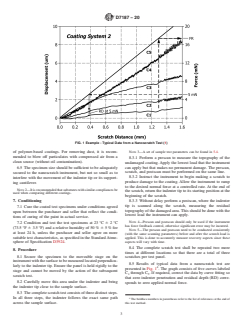
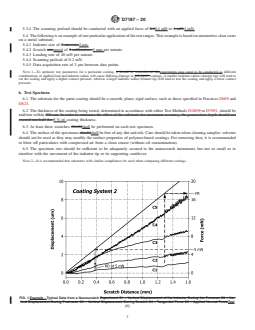
FIG. 1 Example - Typical Data from a Nanoscratch Test (1)
NOTE 3—A set of sample test parameters can be found in 5.4.
of polymer-based coatings. For removing dust, it is recom-
mended to blow off particulates with compressed air from a
8.3.1 Perform a prescan to measure the topography of the
clean source (without oil contamination).
undamaged coating.Apply the lowest load that the instrument
can apply but that makes no permanent damage. The prescan,
6.5 The specimen size should be sufficient to be adequately
scratch, and postscan must be performed on the same line.
secured to the nanoscratch instrument, but not so small as to
8.3.2 Instruct the instrument to begin making a scratch to
interfere with the movement of the indenter tip or its support-
produce damage to the coating. Allow the instrument to ramp
ing cantilever.
to the desired normal force at a controlled rate. At the end of
NOTE2—Itisrecommendedthatsubstrateswithsimilarcompliancesbe
the scratch, return the indenter tip to its starting position at the
used when comparing different coatings.
beginning of the scratch.
7. Conditioning 8.3.3 Without delay perform a postscan, where the indenter
tip is scanned along the scratch, measuring the residual
7.1 Cure the coated test specimens under conditions agreed
topography of the damaged area.This should be done with the
upon between the purchaser and seller that reflect the condi-
lowest load the instrument can apply.
tions of curing of the paint in actual service.
NOTE 4—Prescan and postscan should only be used if the instrument
7.2 Condition and test the test specimens at 23°C 62°C
has force feedback control, otherwise significant error may be incurred.
(73.5°F 6 3.5°F) and a relative humidity of 50% 6 5% for
NOTE 5—The prescan and postscan need to be conducted consistently
at least 24 h, unless the purchaser and seller agree on more
(with the same scanning parameters) before and after the scratch load is
suitable test characteristics, as specified in the StandardAtmo-
applied. This is done to accurately measure recovery aspects since these
aspects will vary with time.
sphere of Specification D3924.
8.4 The complete scratch test shall be repeated two more
8. Procedure
times at different locations so that there are a total of three
8.1 Secure the specimen to the moveable stage on the
scratches per test panel.
instrumentwiththesurfacetobemeasuredlocatedperpendicu-
8.5 Results of typical data from a nanoscratch test are
larly to the indenter tip. Ensure the panel is held rigidly to the
presented in Fig. 1 . The graph consists of five curves labeled
stage and cannot be moved by the action of the subsequent
C through C . If required, correct the data by curve fitting so
1 5
scratch test.
that zero indenter penetration and residual depth (RD) corre-
8.2 Carefully move this area under the indenter and bring
sponds to zero applied normal force.
the indenter tip close to the sample surface.
8.3 Thecompletescratchtestconsistsofthreedistinctsteps.
In all three steps, the indenter follows the exact same path
Theboldfacenumbersinparenthesesrefertothelistofreferencesattheendof
across the sample surface. this test method.
...
This document is not an ASTM standard and is intended only to provide the user of an ASTM standard an indication of what changes have been made to the previous version. Because
it may not be technically possible to adequately depict all changes accurately, ASTM recommends that users consult prior editions as appropriate. In all cases only the current version
of the standard as published by ASTM is to be considered the official document.
Designation: D7187 − 15 D7187 − 20
Standard Test Method for
Measuring Mechanistic Aspects of Scratch/Mar Behavior of
Paint Coatings by Nanoscratching
This standard is issued under the fixed designation D7187; the number immediately following the designation indicates the year of
original adoption or, in the case of revision, the year of last revision. A number in parentheses indicates the year of last reapproval. A
superscript epsilon (´) indicates an editorial change since the last revision or reapproval.
1. Scope
1.1 This test method covers thea nanoscratch method for determining the resistance of paint coatings on smooth flat surfaces
to scratch/mar.
1.2 PreviousOther methods used in scratch/mar evaluation first physically scratch or mar a sample’s surface with single or
multiple contact cutting, and then use visual inspection to assign a ranking. It has been recognized that loss of appearance is mainly
due to surface damages created. The philosophy of this method is to damage created. This method quantitatively and objectively
measuremeasures scratch/mar behavior by making the evaluation process two steps with emphasis on surface damages.damage.
Step one is to find the relationship between damage shape and size and external input (such as forces, contact geometry, and
deformation). Step two is to relate damage shape and size to visual loss of luster. The first step is covered by this method; in
addition, a survey in the appendix provides an example of an experiment to relate the damage to the change in luster.
1.3 There are three elementary deformation mechanisms: elastic deformation, plastic deformation and fracture; only the latter
two both contribute significantly to mar. This method evaluates scratch/mar based on the latter two damage mechanisms.
1.4 Although this standard was developed for paint coatings, it can also be applied to other types of similar polymer-based
coatings, for example, lacquers, varnishes, glazes and other decorative and protective layers deposited on hard substrates.
1.5 The values stated in SI units are to be regarded as the standard. The values given in parentheses are for information only.
1.6 This standard does not purport to address all of the safety problems,concerns, if any, associated with its use. It is the
responsibility of the user of this standard to establish appropriate safety safety, health, and healthenvironmental practices and
determine the applicability of regulatory limitations prior to use.
1.7 This international standard was developed in accordance with internationally recognized principles on standardization
established in the Decision on Principles for the Development of International Standards, Guides and Recommendations issued
by the World Trade Organization Technical Barriers to Trade (TBT) Committee.
2. Referenced Documents
2.1 ASTM Standards:
D609 Practice for Preparation of Cold-Rolled Steel Panels for Testing Paint, Varnish, Conversion Coatings, and Related Coating
Products
D823 Practices for Producing Films of Uniform Thickness of Paint, Coatings and Related Products on Test Panels
D1005 Test Method for Measurement of Dry-Film Thickness of Organic Coatings Using Micrometers
D1044 Test Method for Resistance of Transparent Plastics to Surface Abrasion by the Taber Abraser
D3363 Test Method for Film Hardness by Pencil Test (Withdrawn 2020)
D3924 Specification for Standard Environment for Conditioning and Testing Paint, Varnish, Lacquer, and Related Materials
D5178 Test Method for Mar Resistance of Organic Coatings
D6037 Test Methods for Dry Abrasion Mar Resistance of High Gloss Coatings
D6279 Test Method for Rub Abrasion Mar Resistance of High Gloss Coatings
This test method is under the jurisdiction of ASTM Committee D01 on Paint and Related Coatings, Materials, and Applications and is the direct responsibility of
Subcommittee D01.23 on Physical Properties of Applied Paint Films.
Current edition approved Feb. 1, 2015June 1, 2020. Published April 2015June 2020. Originally approved in 2005. Last previous edition approved in 20102015 as D7187
– 10.– 15. DOI: 10.1520/D7187-15.10.1520/D7187-20.
For referenced ASTM standards, visit the ASTM website, www.astm.org, or contact ASTM Customer Service at service@astm.org. For ASTM Book of ASTM Standards
volume information, refer to the standard’s Document Summary page on the ASTM website.
The last approved version of this historical standard is referenced on www.astm.org.
Copyright © ASTM International, 100 Barr Harbor Drive, PO Box C700, West Conshohocken, PA 19428-2959. United States
D7187 − 20
D7027 Test Method for Evaluation of Scratch Resistance of Polymeric Coatings and Plastics Using an Instrumented Scratch
Machine
D7091 Practice for Nondestructive Measurement of Dry Film Thickness of Nonmagnetic Coatings Applied to Ferrous Metals
and Nonmagnetic, Nonconductive Coatings Applied to Non-Ferrous Metals
G171 Test Method for Scratch Hardness of Materials Using a Diamond Stylus
3. Summary of Test Method
3.1 This test method is based on representative samples of the paint film being scratched using a nanoscratch instrument. From
information receivedgenerated during a scratch test, values for plastic resistance (PR) and fracture resistance (FR) can be
determined. From these values, the mechanistic aspects of scratch/mar behavior of the coating can be compared.
3.2 From these values of plastic resistance and fracture resistance, the mechanistic aspects of scratch/mar behavior of the
coating can be subsequently compared.
4. Significance and Use
4.1 This test attempts to address two major drawbacks addresses two limitations in existing mar tests such as Test Methods
D1044, D3363, D5178, D6037, and D6279, namely:
4.1.1 Measured damage is caused by hundreds of contacts with differing contact geometries making it difficult or impossible
for mechanical quantities (force, displacement) at the contact points to be reliably determined.
4.1.2 The damage is evaluated using subjective visual assessments, which provide only a qualitative sense of wear with little
information about mar mechanisms.
4.2 This test provides a quantitative assessment of a paint coating’s mechanistic aspects of scratch/mar behavior in various
conditions. The ability to control testing variables such as rate loading rate, speed, and temperature allow the study of the
scratch/mar behavior in a variety of environments.
4.3 This test method is particularly suitable for measurement of paint coatings on laboratory test panels.
4.4 The accuracy and precision of scratch/mar performance may be significantly influenced by coating surface
nonuniformitynon-uniformity and irregularities.
4.5 A correlation has been observed between good mar resistance in field studies and a combination of high Plastic Resistance
and high Fracture Resistance (terms are defined below). plastic resistance and high fracture resistance. When coatings have had
either high Plastic Resistanceplastic resistance and low Fracture Resistance,fracture resistance, or low Plastic Resistanceplastic
resistance and high Fracture Resistance,fracture resistance, there have been contradictory results in field studies.
4.6 Mar resistance characterizes the ability of the coating to resist light damage. The difference between mar and scratch
resistance is that mar is related to only the relatively fine surface scratches which spoil the appearance of the coating. The
mechanistic aspects of mar resistance depend on a complex interplay between visco-elastic and thermal recovery, yield or plastic
flow, and micro-fracture. Polymers are challenging because they exhibit a range of mechanical properties from near liquid through
rubber materials to brittle solids. The mechanical properties are rate and temperature dependent and visco-elastic recovery can
cause scratches to change with time. One such test for evaluating polymeric coatings and plastics is Test Method D7027.
4.7 Since this method measures mechanical qualities, such as forces and displacements (deformations) during the damage
making process, rate dependence, temperature dependence, and visco-elastic-plastic recovery can be further investigated and visual
impacts of damage can be related to deformation mechanisms.
5. Apparatus
5.1 Paint Application Equipment, as described in Practices D609 and D823.
5.2 Nanoscratch Instrument, consisting of an instrument with a well-defined indenter, which translates perpendicular to the
coating surface and has the capacity to produce an instrumented scratch of controlled and variable normal force and continuously
measured displacement during testing. The normal force mustshall be feedback controlled, in order to quickly respond to variations
in surface morphology. The force of the instrument should have a maximum normal force of at least 50 mN (mN should be read
as milli-Newtons) with a resolution of at least 0.1 mN. 50 mN 6 0.1 mN. The maximum tangential force, if measured, should be
at least 50 mN with a resolution of at least 6 0.5 mN. The range of the displacement sensors should be at least 50200 μm with
a resolution of at least 20 nm. Displacement and tangential force response of the coating should be measured with a high data
acquisition rate, such as a maximum of five5 μm between data points.
5.3 Suggested Range for Testing Parameters:
5.3.1 Indenter size should range from 11 μm to 100 microns 100 μm and should be spherical in geometry. Indenter material
should be diamond.
5.3.2 The scratch should be applied at a rate of 0.50.5 mm to 10 millimetres 10 mm per minute.
5.3.3 The loading rate of the normal force should be applied at 55 mN to 200 mN 200 mN per minute.
D7187 − 20
5.3.4 The scanning preload should be conducted with an applied force of 0.10.1 mN to 1 mN.1 mN.
5.4 The following is an example of one particular application of the test ranges. This example is based on automotive clear coats
on a metal substrate.
5.4.1 Indenter size of 2 microns.2 μm.
5.4.2 Scratch ratespeed of 3 millimetres 3 mm per minute.
5.4.3 Loading rate of 40 mN per minute.
5.4.4 Scanning preload of 0.2 mN.
5.4.5 Data acquisition rate of 3 μm between data points.
NOTE 1—To optimize test parameters for a particular coating, it should be remembered thatexperiments may need to be conducted as different
combinations of applied load and indenter radius will cause differing damage in polymeric coatings. A smaller indenter radius (sharper tip) will tend to
cut the coating and apply a higher contact pressure, whereas a larger indenter radius (blunter tip) will tend to tear the coating and apply a lower contact
pressure.
6. Test Specimen
6.1 The substrate for the paint coating should be a smooth, plane, rigid surface, such as those specified in Practices D609 and
D823.
6.2 The thickness of the coating being tested, determined in accordance with either Test Methods D1005, or D7091, should be
uniform within 500 nm. In order to minimize the effect of the substrate for maximum accuracy, the penetration depth should not
exceed one-half the 5 % of coating thickness.
6.3 At least three scratches shouldshall be performed on each test specimen.
6.4 The surface of the specimens shouldshall be free of any dirt and oils. Care should be taken when cleaning samples: solvents
should not be used as they may modify the surface properties of polymer-based coatings. For removing dust, it is recommended
to blow off particulates with compressed air from a clean source (without oil contamination).
6.5 The specimen size should be sufficient to be adequately secured to the nanoscratch instrument, but not so small as to
interfere with the movement of the indenter tip or its supporting cantilever.
NOTE 2—It is recommended that substrates with similar compliances be used when comparing different coatings.
FIG. 1 Example - Typical Data from a Nanoscratch Experiment C1 – Vertical Displacement of the Indenter During the Pre-scan C2 – Ver-
tical Displacement During Post-scan C3 – Vertical Displacement During Scratch C4 – Tangential Force C5 – Applied Normal ForceTest
(1)
D7187 − 20
7. Conditioning
7.1 Cure the coated test specimens under conditions agreed upon between the purchaser and seller that reflect the conditions
of curing of the paint in actual service.
7.2 Condition and test the test specimens at 2323 °C 6 2ºC (73.52 °C (73.5 °F 6 3.5ºF)3.5 °F) and a relative humidity of
5050 % 6 5 % for at least 24 h, unless the purchaser and seller agree on more suitable test characteristics, as specified in the
Standard Atmosphere of Specification D3924.
8. Procedure
8.1 Secure the specimen to the moveable stage on the instrument with the surface to be measured located perpendicularly to
the indenter tip. Ensure the panel is held rigidly to the stage and cannot be moved by the action of the subsequent scratch test.
8.2 Carefully move this area under the indenter and bring the indenter tip close to the sample surface.
8.3 The complete scratch test consists of three distinct steps. In all three steps, the indenter follows the exact same path across
the sample surface.
NOTE 3—A set of sample test parameters can be found in 5.4.
8.3.1 Perform a prescan to measure the topography of the undamaged coating. Apply the lowest load that the instrument can
apply but that makes no permanent damage. The prescan, scratch, and postscan should all must be performed on the same line.
8.3.2 Instruct the instrument to begin making a scratch to produce damage to the coating. Allow the instrument to ramp to the
desired normal force at a controlled rate. At the end of the scratch, return the indenter tip to its starting position at the beginning
of the scratch.
8.3.3 Perform Without delay perform a postscan, where the indenter tip is scanned along the scratch, measuring the residual
topography of the damaged area. This should be done with the lowest load the instrument can apply.
NOTE 4—Prescan and postscan should only be used if the instrument has force feedback control, otherwise significant error may be incurred.
NOTE 5—The prescan and postscan need to be conducted consistently (with the same scanning parameters) before and after the scratch load is applied.
This is done to accurately measure recovery aspects since these aspects will vary with time.
8.4 The complete scratch test shouldshall be repeated 2two more times at different locations so that there are a total of 3three
scratches per test panel.
8.5 Typical results of Results of typical data from a nanoscratch test are presented in
Fig. 1. . The graph consists of five curves labeled 1C through 5.C . If needed,required, correct the data by curve fitting so that
1 5
zero indenter penetration and residual depth (RD) corresponds to zero applied normal force.
8.5.1 Curve 1
...