

ASTM D87-09(2018)
(Test Method)Standard Test Method for Melting Point of Petroleum Wax (Cooling Curve)
General Information
- Abstract
SIGNIFICANCE AND USE
5.1 Melting point (cooling curve) is a test that is widely used by wax suppliers and consumers. it is particularly applied to petroleum waxes that are rather highly paraffinic or crystalline in nature. A plateau occurs with specimens containing appreciable amounts of hydrocarbons that crystallize at the same temperature, giving up heat of fusion, thus temporarily retarding the cooling rate. In general, petroleum waxes with large amounts of non-normal hydrocarbons or with amorphous solid forms will not exhibit a plateau.
SCOPE
1.1 This test method covers the determination of the melting point (cooling curve) of petroleum wax. It is unsuitable for waxes of the petrolatum group, microcrystalline waxes, or blends of such waxes with paraffin wax or scale wax.
Note 1: For additional methods used for testing petroleum waxes, see Test Method D127 and Test Method D938. Results may differ, depending on the method used. For pharmaceutical petrolatum, Test Method D127 usually is used.
1.2 The values stated in SI units are to be regarded as standard. The values given in parentheses after SI units are provided for information only and are not considered standard.
1.3 This standard does not purport to address all of the safety concerns, if any, associated with its use. It is the responsibility of the user of this standard to establish appropriate safety, health, and environmental practices and determine the applicability of regulatory limitations prior to use.
1.4 This international standard was developed in accordance with internationally recognized principles on standardization established in the Decision on Principles for the Development of International Standards, Guides and Recommendations issued by the World Trade Organization Technical Barriers to Trade (TBT) Committee.
- Status
- Published
- Publication Date
- 30-Sep-2018
- Technical Committee
- D02 - Petroleum Products, Liquid Fuels, and Lubricants
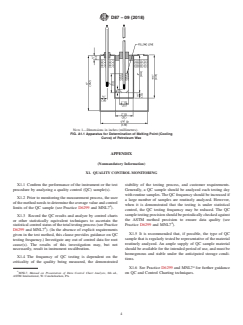
Overview
ASTM D87-09(2018), Standard Test Method for Melting Point of Petroleum Wax (Cooling Curve), provides a widely recognized method for determining the melting point of petroleum waxes using the cooling curve approach. Developed by ASTM International, this standard is essential for both suppliers and consumers working with highly paraffinic or crystalline petroleum waxes. The method identifies the precise temperature at which melted wax first shows a plateau in temperature change during cooling, indicating the melting point.
This test method is applicable exclusively to petroleum waxes that exhibit a distinct crystalline structure. It is not suitable for waxes in the petrolatum group, microcrystalline waxes, or blends of these with paraffin or scale wax.
Key Topics
- Melting Point by Cooling Curve: The standard defines the melting point as the temperature where a wax specimen, upon cooling, demonstrates a temporary plateau due to the crystallization of specific hydrocarbon components.
- Applicable Waxes: Focuses on petroleum waxes that are highly paraffinic or crystalline, which clearly exhibit a plateau during the cooling process.
- Procedures: Includes both a manual method (using glassware and thermometers) and an automated method (using electronic probes and digital displays). Both approaches rely on detecting the stabilization of temperature readings during cooling.
- Precision and Reproducibility: Results show strong agreement between manual and automatic methods, with defined repeatability and reproducibility thresholds essential for quality assurance.
- Quality Control: Recommends the implementation of routine QC checks using control samples, with guidance on recording, analyzing, and verifying test reliability using statistical methods (referencing ASTM D6299).
Applications
The ASTM D87 melting point test is widely utilized in industries that manufacture, supply, or use petroleum waxes. Practical applications include:
- Product Specification: Ensures compliance with quality standards by accurately determining the melting characteristics of petroleum waxes.
- Consumer Assurance: Enables wax suppliers and buyers to verify product properties and suitability for end use, ensuring that wax compositions meet specified melting point requirements.
- Process Control: Assists manufacturers in monitoring batch consistency, improving product performance, and meeting regulatory or contractual specifications.
- Research and Development: Used in quality control laboratories and R&D settings to test new wax formulations or raw material changes.
Industries benefitting from this standard include the production of candles, packaging materials, coatings, polishes, adhesives, cosmetics, and various specialty applications that require precise wax melting point information.
Related Standards
For comprehensive evaluation of petroleum waxes, several other ASTM standards are referenced and often used alongside ASTM D87:
- ASTM D127 – Test Method for Drop Melting Point of Petroleum Wax, Including Petrolatum
- ASTM D938 – Test Method for Congealing Point of Petroleum Waxes, Including Petrolatum
- ASTM D6299 – Practice for Applying Statistical Quality Assurance and Control Charting Techniques to Evaluate Analytical Measurement System Performance
- ASTM E1 – Specification for ASTM Liquid-in-Glass Thermometers
These related standards help ensure a complete and consistent approach to petroleum wax analysis, supporting quality assurance and regulatory compliance in global markets.
Keywords: ASTM D87, petroleum wax melting point, cooling curve method, wax testing standards, paraffin wax, crystalline wax, petroleum wax quality control, ASTM standards for waxes, industrial wax testing.
Relations
- Effective Date
- 01-Dec-2023
- Effective Date
- 15-Dec-2017
- Effective Date
- 15-Nov-2017
- Effective Date
- 01-Jan-2017
- Effective Date
- 01-Jan-2015
- Effective Date
- 01-Oct-2013
- Effective Date
- 01-May-2013
- Effective Date
- 01-Mar-2010
- Effective Date
- 01-Mar-2010
- Effective Date
- 01-Nov-2009
- Effective Date
- 15-Oct-2008
- Refers
ASTM D127-08 - Standard Test Method for Drop Melting Point of Petroleum Wax, Including Petrolatum - Effective Date
- 01-May-2008
- Effective Date
- 01-Nov-2007
- Effective Date
- 01-Nov-2007
- Effective Date
- 01-Nov-2007
Get Certified
Connect with accredited certification bodies for this standard

Element Materials Technology
Materials testing and product certification.

ABS Group Brazil
ABS Group certification services in Brazil.

ABS Quality Evaluations Inc.
American Bureau of Shipping quality certification.
Sponsored listings
Frequently Asked Questions
ASTM D87-09(2018) is a standard published by ASTM International. Its full title is "Standard Test Method for Melting Point of Petroleum Wax (Cooling Curve)". This standard covers: SIGNIFICANCE AND USE 5.1 Melting point (cooling curve) is a test that is widely used by wax suppliers and consumers. it is particularly applied to petroleum waxes that are rather highly paraffinic or crystalline in nature. A plateau occurs with specimens containing appreciable amounts of hydrocarbons that crystallize at the same temperature, giving up heat of fusion, thus temporarily retarding the cooling rate. In general, petroleum waxes with large amounts of non-normal hydrocarbons or with amorphous solid forms will not exhibit a plateau. SCOPE 1.1 This test method covers the determination of the melting point (cooling curve) of petroleum wax. It is unsuitable for waxes of the petrolatum group, microcrystalline waxes, or blends of such waxes with paraffin wax or scale wax. Note 1: For additional methods used for testing petroleum waxes, see Test Method D127 and Test Method D938. Results may differ, depending on the method used. For pharmaceutical petrolatum, Test Method D127 usually is used. 1.2 The values stated in SI units are to be regarded as standard. The values given in parentheses after SI units are provided for information only and are not considered standard. 1.3 This standard does not purport to address all of the safety concerns, if any, associated with its use. It is the responsibility of the user of this standard to establish appropriate safety, health, and environmental practices and determine the applicability of regulatory limitations prior to use. 1.4 This international standard was developed in accordance with internationally recognized principles on standardization established in the Decision on Principles for the Development of International Standards, Guides and Recommendations issued by the World Trade Organization Technical Barriers to Trade (TBT) Committee.
SIGNIFICANCE AND USE 5.1 Melting point (cooling curve) is a test that is widely used by wax suppliers and consumers. it is particularly applied to petroleum waxes that are rather highly paraffinic or crystalline in nature. A plateau occurs with specimens containing appreciable amounts of hydrocarbons that crystallize at the same temperature, giving up heat of fusion, thus temporarily retarding the cooling rate. In general, petroleum waxes with large amounts of non-normal hydrocarbons or with amorphous solid forms will not exhibit a plateau. SCOPE 1.1 This test method covers the determination of the melting point (cooling curve) of petroleum wax. It is unsuitable for waxes of the petrolatum group, microcrystalline waxes, or blends of such waxes with paraffin wax or scale wax. Note 1: For additional methods used for testing petroleum waxes, see Test Method D127 and Test Method D938. Results may differ, depending on the method used. For pharmaceutical petrolatum, Test Method D127 usually is used. 1.2 The values stated in SI units are to be regarded as standard. The values given in parentheses after SI units are provided for information only and are not considered standard. 1.3 This standard does not purport to address all of the safety concerns, if any, associated with its use. It is the responsibility of the user of this standard to establish appropriate safety, health, and environmental practices and determine the applicability of regulatory limitations prior to use. 1.4 This international standard was developed in accordance with internationally recognized principles on standardization established in the Decision on Principles for the Development of International Standards, Guides and Recommendations issued by the World Trade Organization Technical Barriers to Trade (TBT) Committee.
ASTM D87-09(2018) is classified under the following ICS (International Classification for Standards) categories: 75.140 - Waxes, bituminous materials and other petroleum products. The ICS classification helps identify the subject area and facilitates finding related standards.
ASTM D87-09(2018) has the following relationships with other standards: It is inter standard links to ASTM D6299-23a, ASTM D6299-17b, ASTM D6299-17a, ASTM D6299-17, ASTM D127-08(2015), ASTM D6299-13e1, ASTM E1-13, ASTM D6299-10, ASTM D6299-10e2, ASTM D6299-09, ASTM D6299-08, ASTM D127-08, ASTM D6299-07, ASTM D6299-07e1, ASTM E1-07. Understanding these relationships helps ensure you are using the most current and applicable version of the standard.
ASTM D87-09(2018) is available in PDF format for immediate download after purchase. The document can be added to your cart and obtained through the secure checkout process. Digital delivery ensures instant access to the complete standard document.
Standards Content (Sample)
This international standard was developed in accordance with internationally recognized principles on standardization established in the Decision on Principles for the
Development of International Standards, Guides and Recommendations issued by the World Trade Organization Technical Barriers to Trade (TBT) Committee.
Designation: D87 − 09 (Reapproved 2018) Technical Association of Pulp
and Paper Industry
Standard Method T 630m-61
Method 1402-Federal Test
Method Standard No. 791b
British Standard 4695
Designation: 55/77(83)
Standard Test Method for
Melting Point of Petroleum Wax (Cooling Curve)
This standard is issued under the fixed designation D87; the number immediately following the designation indicates the year of original
adoption or, in the case of revision, the year of last revision. A number in parentheses indicates the year of last reapproval. A superscript
epsilon (´) indicates an editorial change since the last revision or reapproval.
1. Scope D127 Test Method for Drop Melting Point of Petroleum
Wax, Including Petrolatum
1.1 This test method covers the determination of the melting
D938 Test Method for Congealing Point of Petroleum
point (cooling curve) of petroleum wax. It is unsuitable for
Waxes, Including Petrolatum
waxes of the petrolatum group, microcrystalline waxes, or
D6299 Practice for Applying Statistical Quality Assurance
blends of such waxes with paraffin wax or scale wax.
and Control Charting Techniques to Evaluate Analytical
NOTE 1—For additional methods used for testing petroleum waxes, see
Measurement System Performance
Test Method D127 and Test Method D938. Results may differ, depending
E1 Specification for ASTM Liquid-in-Glass Thermometers
on the method used. For pharmaceutical petrolatum, Test Method D127
usually is used.
3. Terminology
1.2 The values stated in SI units are to be regarded as
3.1 Definitions:
standard. The values given in parentheses after SI units are
3.1.1 melting point (cooling curve) of petroleum wax—
provided for information only and are not considered standard.
temperature at which melted petroleum wax first shows a
1.3 This standard does not purport to address all of the
minimum rate of temperature change when allowed to cool
safety concerns, if any, associated with its use. It is the
under prescribed conditions.
responsibility of the user of this standard to establish appro-
3.1.1.1 Discussion—The so-called “American Melting
priate safety, health, and environmental practices and deter-
Point” is arbitrarily 1.65 °C (3 °F) above the Melting Point
mine the applicability of regulatory limitations prior to use.
(Cooling Curve) of Petroleum Wax.
1.4 This international standard was developed in accor-
4. Summary of Test Method
dance with internationally recognized principles on standard-
ization established in the Decision on Principles for the
4.1 In Procedure A (Manual Method), a specimen of molten
Development of International Standards, Guides and Recom-
wax in a test tube fitted with a thermometer or equivalent
mendations issued by the World Trade Organization Technical
temperature measuring device is placed in an air bath, which in
Barriers to Trade (TBT) Committee.
turn is surrounded by a water bath held at 16 °C to 28 °C (60 °F
to 80 °F). As the molten wax cools, periodic readings of its
2. Referenced Documents
temperature are taken. When solidification of the wax occurs,
the rate of temperature change decreases, yielding a plateau in
2.1 ASTM Standards:
the cooling curve. The temperature at that point is recorded as
the melting point (cooling curve) of the sample.
This test method is under the jurisdiction of ASTM Committee D02 on
4.2 In Procedure B, an automatic analyzer is used. As the
Petroleum Products, Liquid Fuels, and Lubricants and is the direct responsibility of
molten wax cools, the sample temperature decrease is mea-
Subcommittee D02.10 on Properties of Petroleum Waxes and Alternative Wax-like
Materials.
sured every 15 s in 0.01 °C (0.1 °F) readings. The melting
In the IP, this test method is under the jurisdiction of the Standardization
point is considered to be reached when five consecutive
Committee. This test method was adopted as a joint ASTM-IP standard in 1966.
measurements are constant within a given temperature interval,
Current edition approved Oct. 1, 2018. Published November 2018. Originally
approved in 1921. Last previous edition approved in 2014 as D87 – 09 (2014). DOI: usually 0.1 °C (0.2 °F).
10.1520/D0087-09R18.
For referenced ASTM standards, visit the ASTM website, www.astm.org, or 5. Significance and Use
contact ASTM Customer Service at service@astm.org. For Annual Book of ASTM
5.1 Melting point (cooling curve) is a test that is widely
Standards volume information, refer to the standard’s Document Summary page on
the ASTM website. used by wax suppliers and consumers. it is particularly applied
Copyright © ASTM International, 100 Barr Harbor Drive, PO Box C700, West Conshohocken, PA 19428-2959. United States
D87 − 09 (2018)
to petroleum waxes that are rather highly paraffinic or crystal- 8.4 Take a temperature reading every 15 s. Record each
line in nature. A plateau occurs with specimens containing reading to at least the nearest 0.05 °C (0.1 °F). Monitor the
appreciable amounts of hydrocarbons that crystallize at the progress of these sequential readings to determine the appear-
same temperature, giving up heat of fusion, thus temporarily ance of the plateau. Identify the plateau as the first five
retarding the cooling rate. In general, petroleum waxes with consecutive readings all of which agree within 0.1 °C (0.2 °F).
large amounts of non-normal hydrocarbons or with amorphous You may discontinue the test after obtaining these five plateau
solid forms will not exhibit a plateau. readings.
NOTE 3—If no plateau appears as defined above, the reading procedure
6. Apparatus
is continued until either (1) the temperature reached 38 °C (100 °F) or (2)
6.1 The necessary apparatus for Procedure A is described in
the temperature reaches a point 8 °C (15 °F) below a temperature where
Annex A1. the wax has solidified (as may be observed through a transparent bath). In
either of these cases the test is discontinued and the method is judged Not
6.2 The automatic instrument consists of a bath (for
Applicable for the sample (see Note 1 for other methods).
example, an aluminum block with two measuring locations,
9. Procedure B (Automatic Method)
two apertures to place the test tubes, and two apertures for the
temperature probes). The apparatus may have an accessory
9.1 Place a clean test tube held in a PTFE holder ring in the
digital display and a printer.
aperture provided in the apparatus.
6.2.1 The temperature of the bath is maintained between
9.2 Insert the temperature probe into a centrally bored,
22 °C and 26 °C (72 °F and 79 °F). A heating device is used to
one-holed stopper, and insert it in the test tube. Check the
increase the temperature, and a cooling device with cold water
probe height to reach manufacturer’s suggested height. Place
circulation is used to decrease the temperature.
the stopper with the probe back in the resting holder provided.
6.2.2 The temperature may be monitored with a calibrated
9.3 Bring the sample to a temperature at least 8 °C (15 °F)
thermometer or an electronic temperature measuring device of
equivalent precision and accuracy. above the expected melting point. Heat the sample in a 93 °C
(200 °F) maximum temperature water bath.
6.3 Other types of equivalent automatic apparatus are ac-
ceptable. 9.4 Add the molten sample to the test tube to the filling
mark. Place the stopper with the probe on the test tube
7. Test Specimen
assembly.
7.1 Obtain a sample of wax representative of the shipment
9.5 Insert the assembly into the aluminum block aperture,
to be tested. From each test unit obtain a portion of wax
and initiate the analysis in accordance with the manufacturer’s
weighing at least 25 g for each melting point determination.
instructions.
8. Procedure A (Manual Method)
9.6 When the melting point is detected, the analysis will
automatically stop. Per available options on the instrument, the
8.1 Support the air bath in its proper position in the water
resulting melting point will be displayed on the digital monitor,
bath. Fill the water bath to within 13 mm ( ⁄2 in.) of the top
or printed on a printer, or both.
with water at a temperature of 16 °C to 28 °C (60 °F to 80 °F).
The bath temperature is kept within these limits throughout the
10. Calculation and Report
test.
10.1 When using a manual apparatus, average the first five
8.2 Heat the wax sample to at least 8 °C (15 °F) above its
consecutive temperature readings of the identified plateau,
expected melting point (see Note 2). To heat the wax sample
which agree within 0.1 °C (0.2 °F). Correct this average for
use a suitable container in an oven or water bath which is held
error in the thermometer scale where necessary.
at a temperature not exceeding 93 °C (200 °F). Avoid the use of
10.2 The automatic apparatus will average the first five
direct heat such as flame or hot plate. Do not keep the sample
consecutive temperature probe readings within 60.1 °C
in the molten state longer than 1 h.
(60.2 °F).
NOTE 2—If no estimate of the melting point is available, heat the wax
10.3 Report the result to at least the nearest 0.05 °C (0.1 °F)
sample to 10 °C (15 °F) above the temperature at which the wax is
completely molten, or to from 90 °C to 93 °C (195 °F to 200 °F) before
as the Petroleum Wax Melting Point (Cooling Curve),
...