

ASTM F2826-14(2018)
(Test Method)Standard Test Method for Evaluating the Sustained Air Performance and Exhaust Emission Efficiencies of Central Vacuum Cleaning Units
General Information
- Abstract
SIGNIFICANCE AND USE
4.1 The test results allow comparison of sustained air performance of central vacuum cleaners that employ various methods of separating the dirt from the air used to convey the dirt to the central power unit. The results will be expressed as a percentage of the original vacuum performance after loading a prescribed weight of media.
4.2 The test results will allow a comparison of emissions by measuring the media emitted during the test and expressing this as an Exhaust Emissions.
SCOPE
1.1 This test method is a laboratory test for determining the sustained air performance and Exhaust Emissions of a central vacuum cleaner when tested under laboratory conditions.
1.2 This test method is applicable to all central vacuum cleaners with or without any type of internal filter. This test method is intended to help indicate how performance may be affected after multiple times of vacuuming over an extended period of time.
1.3 The inch-pound system of units is used in this standard except for weight measurements, which are measured in grams. The values stated in parentheses are given for information only.
1.4 This standard does not purport to address all of the safety concerns, if any, associated with its use. It is the responsibility of the user of this standard to establish appropriate safety, health, and environmental practices and determine the applicability of regulatory limitations prior to use.
1.5 This international standard was developed in accordance with internationally recognized principles on standardization established in the Decision on Principles for the Development of International Standards, Guides and Recommendations issued by the World Trade Organization Technical Barriers to Trade (TBT) Committee.
- Status
- Published
- Publication Date
- 30-Apr-2018
- Technical Committee
- F11 - Vacuum Cleaners
- Drafting Committee
- F11.22 - Air Performance
Overview
ASTM F2826-14(2018) is the internationally recognized standard developed by ASTM International for assessing the sustained air performance and exhaust emission efficiencies of central vacuum cleaning units. It establishes a laboratory test method applicable to all central vacuum cleaners, whether or not they are equipped with internal filters. This method provides a reliable basis for comparing how a vacuum’s performance and exhaust emissions change over extended use, enabling meaningful product evaluation and benchmarking.
Key Topics
- Sustained Air Performance: This standard defines sustained air performance as the ability of a central vacuum unit to maintain effective air movement (vacuum suction) after multiple cycles of dirt load over time.
- Exhaust Emissions Efficiency: The standard measures the efficiency with which a central vacuum captures and contains debris, reporting the material released to exhaust as a percentage and identifying potential air quality concerns.
- Comparative Testing: The procedures allow direct performance comparisons between different makes and models, regardless of the filtration or separation technology used.
- Controlled Laboratory Testing: Tests are conducted under specified conditions, including prescribed environmental parameters, sample sizes, and test media to ensure repeatable and reproducible results.
- Reporting Requirements: Results are documented with key data points, including manufacturer details, vacuum configuration, test media used, and measured performance values.
Applications
The ASTM F2826-14(2018) standard delivers value to several sectors:
- Manufacturers: Assists in the research and development of central vacuum systems by providing a standardized test for product performance and exhaust emissions. Enables benchmarking against competitor products.
- Quality Assurance: Supports quality control by measuring how well a vacuum maintains its suction and filter efficiency after simulated extended usage.
- Consumer Protection: Provides third-party validation of manufacturer claims regarding air performance and exhaust cleanliness, contributing to safer and more efficient products.
- Regulatory Compliance: Offers a reliable, internationally recognized test method for compliance with indoor air quality and appliance performance regulations.
- Product Certification: Forms a basis for certification bodies to validate claims on sustained performance and filtration efficiency, especially important for sensitive environments such as healthcare, hospitality, and residential settings.
Related Standards
When implementing ASTM F2826-14(2018), consider its relationship to relevant standards, including:
- ASTM F820 - Standard Test Method for Measuring Air Performance Characteristics of Central Vacuum Cleaning Systems, referenced for foundational measurement techniques.
- ISO 5011 - Inlet Air Cleaning Equipment for Internal Combustion Engines and Compressors-Performance Testing, significant for its application in exhaust emissions filter evaluation.
- ASTM E1 - Specification for ASTM Liquid-in-Glass Thermometers, and ASTM E177/E691 - Practices covering precision and bias in laboratory test methods, supporting accurate test execution and reporting.
- World Trade Organization Technical Barriers to Trade (TBT) Committee - Recognized international principles guiding the development of this and other harmonized standards.
Central vacuum cleaner manufacturers, quality control labs, and certifying agencies can use ASTM F2826-14(2018) to ensure reliable, comparable, and traceable measurements for performance and emissions, supporting both industry advancement and consumer confidence. For full implementation, always refer to the official ASTM standard document.
Keywords: central vacuum cleaner, sustained air performance, exhaust emissions efficiency, ASTM F2826, air performance testing, filtration efficiency, vacuum cleaner standards.
Relations
- Effective Date
- 01-Sep-2017
- Effective Date
- 01-Oct-2016
- Effective Date
- 01-May-2014
- Effective Date
- 01-May-2013
- Effective Date
- 01-May-2013
- Effective Date
- 01-May-2013
- Effective Date
- 01-Nov-2011
- Effective Date
- 01-Nov-2011
- Effective Date
- 01-Oct-2010
- Effective Date
- 01-Oct-2008
- Effective Date
- 01-Oct-2008
- Effective Date
- 01-Nov-2007
- Refers
ASTM E177-06b - Standard Practice for Use of the Terms Precision and Bias in ASTM Test Methods - Effective Date
- 15-Nov-2006
- Refers
ASTM E177-06a - Standard Practice for Use of the Terms Precision and Bias in ASTM Test Methods - Effective Date
- 01-Nov-2006
- Effective Date
- 01-Apr-2006
Frequently Asked Questions
ASTM F2826-14(2018) is a standard published by ASTM International. Its full title is "Standard Test Method for Evaluating the Sustained Air Performance and Exhaust Emission Efficiencies of Central Vacuum Cleaning Units". This standard covers: SIGNIFICANCE AND USE 4.1 The test results allow comparison of sustained air performance of central vacuum cleaners that employ various methods of separating the dirt from the air used to convey the dirt to the central power unit. The results will be expressed as a percentage of the original vacuum performance after loading a prescribed weight of media. 4.2 The test results will allow a comparison of emissions by measuring the media emitted during the test and expressing this as an Exhaust Emissions. SCOPE 1.1 This test method is a laboratory test for determining the sustained air performance and Exhaust Emissions of a central vacuum cleaner when tested under laboratory conditions. 1.2 This test method is applicable to all central vacuum cleaners with or without any type of internal filter. This test method is intended to help indicate how performance may be affected after multiple times of vacuuming over an extended period of time. 1.3 The inch-pound system of units is used in this standard except for weight measurements, which are measured in grams. The values stated in parentheses are given for information only. 1.4 This standard does not purport to address all of the safety concerns, if any, associated with its use. It is the responsibility of the user of this standard to establish appropriate safety, health, and environmental practices and determine the applicability of regulatory limitations prior to use. 1.5 This international standard was developed in accordance with internationally recognized principles on standardization established in the Decision on Principles for the Development of International Standards, Guides and Recommendations issued by the World Trade Organization Technical Barriers to Trade (TBT) Committee.
SIGNIFICANCE AND USE 4.1 The test results allow comparison of sustained air performance of central vacuum cleaners that employ various methods of separating the dirt from the air used to convey the dirt to the central power unit. The results will be expressed as a percentage of the original vacuum performance after loading a prescribed weight of media. 4.2 The test results will allow a comparison of emissions by measuring the media emitted during the test and expressing this as an Exhaust Emissions. SCOPE 1.1 This test method is a laboratory test for determining the sustained air performance and Exhaust Emissions of a central vacuum cleaner when tested under laboratory conditions. 1.2 This test method is applicable to all central vacuum cleaners with or without any type of internal filter. This test method is intended to help indicate how performance may be affected after multiple times of vacuuming over an extended period of time. 1.3 The inch-pound system of units is used in this standard except for weight measurements, which are measured in grams. The values stated in parentheses are given for information only. 1.4 This standard does not purport to address all of the safety concerns, if any, associated with its use. It is the responsibility of the user of this standard to establish appropriate safety, health, and environmental practices and determine the applicability of regulatory limitations prior to use. 1.5 This international standard was developed in accordance with internationally recognized principles on standardization established in the Decision on Principles for the Development of International Standards, Guides and Recommendations issued by the World Trade Organization Technical Barriers to Trade (TBT) Committee.
ASTM F2826-14(2018) is classified under the following ICS (International Classification for Standards) categories: 97.080 - Cleaning appliances. The ICS classification helps identify the subject area and facilitates finding related standards.
ASTM F2826-14(2018) has the following relationships with other standards: It is inter standard links to ASTM F820-17, ASTM F820-16, ASTM E177-14, ASTM E691-13, ASTM E1-13, ASTM E177-13, ASTM F820-11, ASTM E691-11, ASTM E177-10, ASTM E177-08, ASTM E691-08, ASTM E1-07, ASTM E177-06b, ASTM E177-06a, ASTM F820-06. Understanding these relationships helps ensure you are using the most current and applicable version of the standard.
ASTM F2826-14(2018) is available in PDF format for immediate download after purchase. The document can be added to your cart and obtained through the secure checkout process. Digital delivery ensures instant access to the complete standard document.
Standards Content (Sample)
This international standard was developed in accordance with internationally recognized principles on standardization established in the Decision on Principles for the
Development of International Standards, Guides and Recommendations issued by the World Trade Organization Technical Barriers to Trade (TBT) Committee.
Designation: F2826 − 14 (Reapproved 2018)
Standard Test Method for
Evaluating the Sustained Air Performance and Exhaust
Emission Efficiencies of Central Vacuum Cleaning Units
This standard is issued under the fixed designation F2826; the number immediately following the designation indicates the year of
original adoption or, in the case of revision, the year of last revision.Anumber in parentheses indicates the year of last reapproval.A
superscript epsilon (´) indicates an editorial change since the last revision or reapproval.
1. Scope F820Test Method for Measuring Air Performance Charac-
teristics of Central Vacuum Cleaning Systems
1.1 This test method is a laboratory test for determining the
2.2 ISO Standard:
sustained air performance and Exhaust Emissions of a central
ISO 5011Inlet Air Cleaning Equipment for Internal Com-
vacuum cleaner when tested under laboratory conditions.
bustion Engines and Compressors—Performance Testing
1.2 This test method is applicable to all central vacuum
3. Terminology
cleaners with or without any type of internal filter. This test
method is intended to help indicate how performance may be
3.1 Definitions:
affected after multiple times of vacuuming over an extended
3.1.1 exhaust emissions—measure of the efficiency of a unit
period of time.
to capture the loading media. Exhaust Emissions is (1 – (the
weight of the media exhausted into the exhaust emissions bag,
1.3 The inch-pound system of units is used in this standard
divided by the weight of the media introduced) × 100).
exceptforweightmeasurements,whicharemeasuredingrams.
Thevaluesstatedinparenthesesaregivenforinformationonly.
3.1.2 input power, W, n—the rate at which electrical energy
is absorbed by a vacuum cleaner motor/fan system.
1.4 This standard does not purport to address all of the
safety concerns, if any, associated with its use. It is the
3.1.3 model, n—the designation of a group of vacuum
responsibility of the user of this standard to establish appro-
cleaner systems having the same mechanical and electrical
priate safety, health, and environmental practices and deter-
construction.
mine the applicability of regulatory limitations prior to use.
3.1.4 population, n—the total of all units of a particular
1.5 This international standard was developed in accor-
model vacuum cleaner system being tested.
dance with internationally recognized principles on standard-
3.1.5 sample, n—a group of vacuum cleaner systems taken
ization established in the Decision on Principles for the
from a large collection of vacuum cleaner systems of one
Development of International Standards, Guides and Recom-
particularmodel,whichservestoprovideinformationthatmay
mendations issued by the World Trade Organization Technical
be used as a basis for making a decision concerning the larger
Barriers to Trade (TBT) Committee.
collection.
2. Referenced Documents 3.1.6 seal vacuum—a water lift reading for a power unit
2 when the inlet is entirely closed or sealed.
2.1 ASTM Standards:
3.1.7 standard air density, ρ , lb/ft,n—atmospheric air
E1Specification for ASTM Liquid-in-Glass Thermometers
std
3 3
density of 0.075 lb/ft (1.2014 Kg/m ).
E177Practice for Use of the Terms Precision and Bias in
3.1.7.1 Discussion—Thisvalueofairdensitycorrespondsto
ASTM Test Methods
atmospheric air at a temperature of 68°F (20°C), 14.696 psi
E691Practice for Conducting an Interlaboratory Study to
(101.325 kPa), and approximately 30% relative humidity.
Determine the Precision of a Test Method
3.1.8 suction, inches of water, n—in a vacuum cleaner
system, the absolute difference between ambient and sub-
atmospheric pressure.
ThistestmethodisunderthejurisdictionofASTMCommitteeF11onVacuum
Cleaners and is the direct responsibility of Subcommittee F11.22 on Air Perfor-
3.1.9 sustained air performance, n—the ability of a vacuum
mance.
cleaner to maintain air performance with a known quantity of
Current edition approved May 1, 2018. Published June 2018. Originally
approved in 2014. Last previous edition approved in 2014 as F2826–14. DOI: media aspirated into unit throughout a number of feeding
10.1520/F2826-14R18.
cycles.
For referenced ASTM standards, visit the ASTM website, www.astm.org, or
contact ASTM Customer Service at service@astm.org. For Annual Book of ASTM
Standards volume information, refer to the standard’s Document Summary page on Available from International Organization for Standardization (ISO), 1, ch. de
the ASTM website. la Voie-Creuse, CP 56, CH-1211 Geneva 20, Switzerland, http://www.iso.org.
Copyright © ASTM International, 100 Barr Harbor Drive, PO Box C700, West Conshohocken, PA 19428-2959. United States
F2826 − 14 (2018)
3.1.10 test run, n—the definitive procedure that produces 5.3 Voltmeter, to provide measurements accurate to within
the singular result. 61%.
3.1.11 test station pressure, B, inches of mercury, n—for a
5.4 Barometer, with an accuracy of 60.05 in. (1.27 mm)
t
vacuumcleanersystem,theabsolutebarometricpressureatthe
Hg, with scale divisions 0.02 in. (0.51 mm) or finer.
test location (elevation), and test time.
5.5 Thermometer, solid stem thermometer having a range
3.1.11.1 Discussion—It is not the equivalent mean sea level
from 18 to 89°F (8 to 32°C) with gradation of 0.2°F (0.1°C)
value of barometric pressure typically reported by the airport
increments and conforming to the requirements for thermom-
and weather bureaus. It is sometimes referred to as the
eter 63°F or 63°C as prescribed in Specification E1.
uncorrected barometric pressure (that is, not corrected to the
5.6 Voltage Regulator System,tocontroltheinputvoltageto
mean sea level equivalent value).
the vacuum cleaner motor/fan system. The regulator system
3.1.12 unit, n—asinglevacuumcleanersystemofthemodel
shall be capable of maintaining the vacuum cleaner’s rated
being tested.
voltage 61% and rated frequency 61 Hz having a wave form
3.1.13 working vacuum—a water lift reading value at an
that is essentially sinusoidal with 3% maximum harmonic
orificecausingavacuumequivalenttoastandardcleaningtool
distortion for the duration of the test.
applied to the floor or rug.
5.7 WeighingScale(forweighingmedia),accurateto0.0035
oz. (0.1 g) and having a weighing capacity of at least 1000 g.
4. Significance and Use
4.1 The test results allow comparison of sustained air
NOTE 1—All available scales may not be suitable for this test method.
Any scale considered for use in this test method shall be checked for
performance of central vacuum cleaners that employ various
suitability in accordance with the requirements listed above.
methods of separating the dirt from the air used to convey the
dirt to the central power unit. The results will be expressed as
5.8 Stop Watch/Clock, with a second hand or other type of
a percentage of the original vacuum performance after loading equipment capable of establishing the specified rate of move-
a prescribed weight of media. ment and total cycle time.
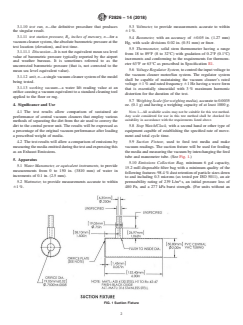
4.2 Thetestresultswillallowacomparisonofemissionsby 5.9 Suction Fixture, used to feed test media and make
measuringthemediaemittedduringthetestandexpressingthis
vacuum readings. The suction fixture will be used for feeding
as an Exhaust Emissions. themediaandmeasuringthevacuumbyinterchangingthefeed
tube and manometer tube. (See Fig. 1.)
5. Apparatus
5.10 Emissions Collection Bag, minimum 6 gal capacity,
5.1 Water Manometer, or equivalent instruments, to provide
15.2 mill disposable filter bag with a minimum quality of the
measurements from 0 to 150 in. (3810 mm) of water in
followingfeatures:98.4%dustretentionofparticlesizesdown
increments of 0.1 in. (2.5 mm).
to and including 0.3 microns (as tested per ISO 5011), an air
5.2 Wattmeter, to provide measurements accurate to within permeability rating of 239 L/m ·s, an initial pressure loss of
61%. 480 Pa, and a 277 kPa burst strength. (For units without an
FIG. 1 Suction Fixture
F2826 − 14 (2018)
integral discharge tube, a non-permeable shroud shall be fitted 9. Preparation for Test
over the discharge area such that all emissions are routed into
9.1 New Test Central Vacuum Systems:
the emissions bag.)
9.1.1 Preconditioning a New Central Vacuum System—Run
thesysteminaratedvoltage 61%andratedfrequency 61Hz
6. Sampling
with filters in place for 1 h. Unit is to run in at full open orifice
6.1 A minimum of three units of the same model central
during preconditioning period.
vacuum cleaner system, selected at random in accordance with
9.1.2 For systems with non-disposable filters, weigh and
goodstatisticalpractice,shallconstitutethepopulationsample.
record the filter’s original weight to the nearest 0.0035 oz (0.1
6.1.1 To determine the best estimate of the sustained air
g). This may not be possible with some systems in which the
performance and Exhaust Emissions for the population of the
non-disposable filter cannot be removed.
central vacuum cleaner system model being tested, the arith-
9.2 Used Test Central Vacuum Systems:
metic mean of the Sustained Air Performance and Exhaust
9.2.1 Reconditionausedtestcentralvacuumsystempriorto
Emissions of the sample from the population shall be estab-
each test run as follows:
lished by testing it to a 90% confidence level within 65%of
the calculated mean. 9.2.1.1 Thoroughly remove excess dirt from the test central
vacuum system.Without using tools for disassembly, clean the
6.2 AnnexA1 provides a procedural example for determin-
entire outer surface, ductwork, and inside of the chamber
ing the 90% confidence level and when the sample size shall
surrounding any and all filters (disposable or not).
be increased.
9.2.1.2 Forsystemsusingdisposablefilters,usenewdispos-
able filter(s) for each test. Thoroughly clean the inside of the
7. Materials
chamber surrounding the primary filter each time the filter is
7.1 Medial—Commercial grade talcum.
replaced.
9.2.1.3 For systems using cloth filter bags or other types of
8. Conditioning
non-disposable dirt receptacles, empty according to manufac-
8.1 Test Room—The test room shall be maintained at 70 6
turer’s instructions after each test run, and clean the cloth filter
5°F (21 6 3°C) and 45 to 55% relative humidity.
bag or non-disposable dirt receptacle until its weight is within
0.07 oz (2 g) of its original weight (see 9.1.2).
8.2 All components involved in the test shall remain and be
exposed in the controlled environment for at least 16 h prior to
9.3 Set-Up for Sustained Air Performance and Exhaust
the start of the test.
Emissions Test:
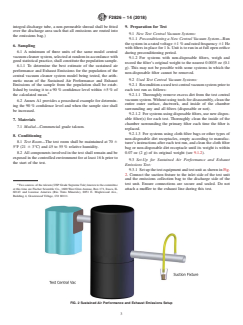
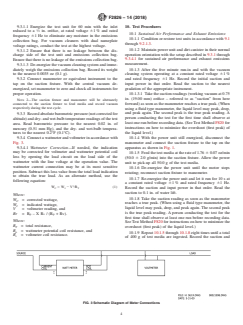
9.3.1 SetupthetestequipmentandtestunitasshowninFig.
2. Connect the suction fixture to the inlet side of the test unit
and the emissions collection bag to the discharge side of the
test unit. Ensure connections are secure and sealed. Do not
Two sources of the talcum (USPGrade SupremeTalc) known to the committee
at this time are Fischer Scientific Co., 1600 West GlenAvenue, Box 171, Itasca, IL
attach a muffler to the exhaust line during this test.
60143 and Luzenac America (Rio Tinto Minerals), 8051 E. Maplewood Ave.,
Building 4, Greenwood Village, CO 80111.
FIG. 2 Sustained Air Performance and Exhaust Emissions Setup
F2826 − 14 (2018)
9.3.1.1 Energize the test unit for 60 min with the inlet 10. Test Procedures
reduced to a ⁄2 in. orifice, at rated voltage 61% and rated
10.1 Sustained Air Performance and Exhaust Emissions:
frequency 61 Hz to eliminate any moisture in the emissions
10.1.1 Conditionorrestoretestunitsinaccordancewith9.1
collection bag. For vacuum cleaners with dual nameplate
through 9.2.1.3.
voltage ratings, conduct the test at the highest voltage.
10.1.2 Maintain power unit and dirt canister in their normal
9.3.1.2 Ensure that there is no leakage between the dis-
operation orientation with the setup described in 9.3.1 through
charge side of the test unit and emissions collection bag.
9.3.4.1 for sustained air performance and exhaust emissions
Ensurethatthereisnoleakageoftheemissionscollectionbag.
measurement.
9.3.1.3 De-energizethevacuumcleaningsystemandimme-
diately weigh the emissions collection bag. Record its weight 10.1.3 After the five minute run-in and with the vacuum
to the nearest 0.0035 oz (0.1 g). cleaning system operating at a constant rated voltage 61%
9.3.2 Connect manometer or equivalent instrument to the and rated frequency 61 Hz. Record the initial suction and
tap on the suction fixture. With the central vacuum de- input power in that order. Read the suction to the nearest
energized, set manometer to zero and check all instruments for gradation of the appropriate instrument.
prop
...