

ASTM E3040-22
(Practice)Standard Practice for Evaluation of Instrumental Color Difference with a Gray Scale
General Information
- Abstract
SIGNIFICANCE AND USE
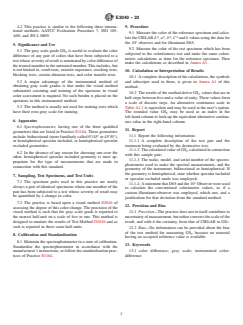
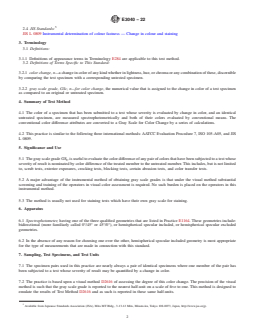
5.1 The gray scale grade GSC is useful to evaluate the color difference of any pair of colors that have been subjected to a test whose severity of result is nominated by color difference of the treated member to the untreated member. This includes, but is not limited to, scrub tests, exterior exposures, crocking tests, blocking tests, certain abrasion tests, and color transfer tests.
5.2 A major advantage of the instrumental method of obtaining gray scale grades is that under the visual method substantial screening and training of the operators in visual color assessment is required. No such burden is placed on the operators in this instrumental method.
5.3 The method is usually not used for staining tests which have their own gray scale for staining.
SCOPE
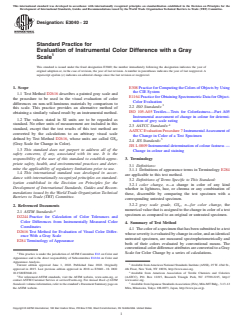
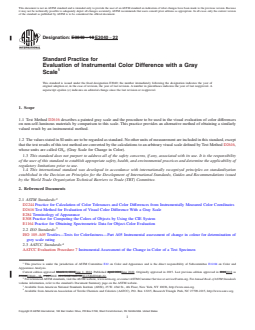
1.1 Test Method D2616 describes a painted gray scale and the procedure to be used in the visual evaluation of color differences on non-self-luminous materials by comparison to this scale. This practice provides an alternative method of obtaining a similarly valued result by an instrumental method.
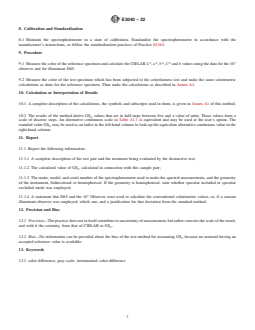
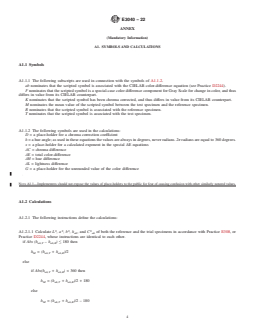
1.2 The values stated in SI units are to be regarded as standard. No other units of measurement are included in this standard, except that the test results of this test method are converted by the calculations to an arbitrary visual scale defined by Test Method D2616, whose units are called GSC (Gray Scale for Change in Color).
1.3 This standard does not purport to address all of the safety concerns, if any, associated with its use. It is the responsibility of the user of this standard to establish appropriate safety, health, and environmental practices and determine the applicability of regulatory limitations prior to use.
1.4 This international standard was developed in accordance with internationally recognized principles on standardization established in the Decision on Principles for the Development of International Standards, Guides and Recommendations issued by the World Trade Organization Technical Barriers to Trade (TBT) Committee.
- Status
- Published
- Publication Date
- 31-May-2022
- Technical Committee
- E12 - Color and Appearance
- Drafting Committee
- E12.04 - Color and Appearance Analysis
Buy Documents
ASTM E3040-22 - Standard Practice for Evaluation of Instrumental Color Difference with a Gray Scale
REDLINE ASTM E3040-22 - Standard Practice for Evaluation of Instrumental Color Difference with a Gray Scale
Overview
ASTM E3040-22: Standard Practice for Evaluation of Instrumental Color Difference with a Gray Scale provides a standardized, instrumental approach for assessing color differences between pairs of materials subjected to tests such as abrasion, exposure, or cleaning. By converting conventional colorimetric data into a gray scale grade (GSC), this practice ensures objective and repeatable evaluation without relying on subjective visual comparison methods. Developed by ASTM Committee E12 on Color and Appearance, the standard aligns with international guidelines and supports precise quality control in color assessment.
Key Topics
Instrumental Evaluation of Color Change
ASTM E3040-22 outlines procedures to measure and interpret color differences using spectrophotometric data, eliminating the need for extensive operator training required for visual evaluations.Conversion to Gray Scale Grade (GSC)
The standard describes how instrumental color difference data, such as CIELAB measurements, are mathematically converted to a gray scale grade, directly relating results to established visual comparison standards.Applications to Diverse Testing Methods
This practice applies to color change evaluation in various testing scenarios, including:- Scrub tests
- Exterior exposure tests
- Crocking and blocking tests
- Abrasion and color transfer tests
Calibration and Standardization
Guidance is provided to ensure spectrophotometer calibration and standardization practices align with recognized standards, maintaining measurement accuracy.
Applications
ASTM E3040-22 is especially valuable in industries where accurate and objective color difference evaluation is critical to product quality and conformity. Key application areas include:
Textiles and Fabrics
Assess changes in fabric color following laundering, rubbing, or sunlight exposure, aiding in colorfastness and durability evaluation.Paints and Coatings
Monitor color shifts after weathering or abrasion tests to ensure paint and coatings meet performance specifications.Plastics and Polymers
Evaluate materials' resistance to discoloration during processing or service life.Quality Control and Production
Replace subjective visual inspections with repeatable, instrument-based assessments, streamlining processes and reducing human error.International Trade
Facilitate global compliance and specification alignment by referencing internationally recognized color assessment methods.
Related Standards
ASTM E3040-22 builds on and complements several key standards for color measurement and appearance assessment, including:
- ASTM D2616 – Visual evaluation of color difference using a painted gray scale
- ASTM D2244 – Calculation of color tolerances and differences from instrumentally measured color coordinates
- ASTM E308 – Computing object colors using the CIE system
- ASTM E1164 – Obtaining spectrometric data for object-color evaluation
- ISO 105-A05 – Instrumental assessment for color change in textiles
- AATCC Evaluation Procedure 7 – Instrumental assessment of textile color change
- JIS L 0809 – Instrumental determination of color fastness for change and staining
By adhering to ASTM E3040-22, organizations benefit from a consistent, accurate, and internationally harmonized method for evaluating and reporting color differences across a wide range of materials and industries. This fosters greater confidence in product quality, enhances communication with partners and customers, and streamlines global trade and compliance efforts.
Relations
- Refers
ASTM E1164-23 - Standard Practice for Obtaining Spectrometric Data for Object-Color Evaluation - Effective Date
- 01-Nov-2023
- Refers
ASTM D2616-19 - Standard Test Method for Evaluation of Visual Color Difference With a Gray Scale - Effective Date
- 01-Nov-2019
- Effective Date
- 01-May-2017
- Effective Date
- 01-Aug-2015
- Effective Date
- 01-Apr-2015
- Effective Date
- 01-Jan-2015
- Effective Date
- 01-Jan-2015
- Effective Date
- 01-May-2014
- Effective Date
- 01-Nov-2013
- Effective Date
- 01-Jun-2013
- Effective Date
- 01-Jan-2013
- Effective Date
- 01-Jul-2012
- Refers
ASTM E1164-12e1 - Standard Practice for Obtaining Spectrometric Data for Object-Color Evaluation - Effective Date
- 01-Jul-2012
- Refers
ASTM D2616-12 - Standard Test Method for Evaluation of Visual Color Difference With a Gray Scale - Effective Date
- 01-Jul-2012
- Refers
ASTM E1164-12 - Standard Practice for Obtaining Spectrometric Data for Object-Color Evaluation - Effective Date
- 01-Jul-2012
Buy Documents
ASTM E3040-22 - Standard Practice for Evaluation of Instrumental Color Difference with a Gray Scale
REDLINE ASTM E3040-22 - Standard Practice for Evaluation of Instrumental Color Difference with a Gray Scale
Get Certified
Connect with accredited certification bodies for this standard

BSMI (Bureau of Standards, Metrology and Inspection)
Taiwan's standards and inspection authority.
Sponsored listings
Frequently Asked Questions
ASTM E3040-22 is a standard published by ASTM International. Its full title is "Standard Practice for Evaluation of Instrumental Color Difference with a Gray Scale". This standard covers: SIGNIFICANCE AND USE 5.1 The gray scale grade GSC is useful to evaluate the color difference of any pair of colors that have been subjected to a test whose severity of result is nominated by color difference of the treated member to the untreated member. This includes, but is not limited to, scrub tests, exterior exposures, crocking tests, blocking tests, certain abrasion tests, and color transfer tests. 5.2 A major advantage of the instrumental method of obtaining gray scale grades is that under the visual method substantial screening and training of the operators in visual color assessment is required. No such burden is placed on the operators in this instrumental method. 5.3 The method is usually not used for staining tests which have their own gray scale for staining. SCOPE 1.1 Test Method D2616 describes a painted gray scale and the procedure to be used in the visual evaluation of color differences on non-self-luminous materials by comparison to this scale. This practice provides an alternative method of obtaining a similarly valued result by an instrumental method. 1.2 The values stated in SI units are to be regarded as standard. No other units of measurement are included in this standard, except that the test results of this test method are converted by the calculations to an arbitrary visual scale defined by Test Method D2616, whose units are called GSC (Gray Scale for Change in Color). 1.3 This standard does not purport to address all of the safety concerns, if any, associated with its use. It is the responsibility of the user of this standard to establish appropriate safety, health, and environmental practices and determine the applicability of regulatory limitations prior to use. 1.4 This international standard was developed in accordance with internationally recognized principles on standardization established in the Decision on Principles for the Development of International Standards, Guides and Recommendations issued by the World Trade Organization Technical Barriers to Trade (TBT) Committee.
SIGNIFICANCE AND USE 5.1 The gray scale grade GSC is useful to evaluate the color difference of any pair of colors that have been subjected to a test whose severity of result is nominated by color difference of the treated member to the untreated member. This includes, but is not limited to, scrub tests, exterior exposures, crocking tests, blocking tests, certain abrasion tests, and color transfer tests. 5.2 A major advantage of the instrumental method of obtaining gray scale grades is that under the visual method substantial screening and training of the operators in visual color assessment is required. No such burden is placed on the operators in this instrumental method. 5.3 The method is usually not used for staining tests which have their own gray scale for staining. SCOPE 1.1 Test Method D2616 describes a painted gray scale and the procedure to be used in the visual evaluation of color differences on non-self-luminous materials by comparison to this scale. This practice provides an alternative method of obtaining a similarly valued result by an instrumental method. 1.2 The values stated in SI units are to be regarded as standard. No other units of measurement are included in this standard, except that the test results of this test method are converted by the calculations to an arbitrary visual scale defined by Test Method D2616, whose units are called GSC (Gray Scale for Change in Color). 1.3 This standard does not purport to address all of the safety concerns, if any, associated with its use. It is the responsibility of the user of this standard to establish appropriate safety, health, and environmental practices and determine the applicability of regulatory limitations prior to use. 1.4 This international standard was developed in accordance with internationally recognized principles on standardization established in the Decision on Principles for the Development of International Standards, Guides and Recommendations issued by the World Trade Organization Technical Barriers to Trade (TBT) Committee.
ASTM E3040-22 is classified under the following ICS (International Classification for Standards) categories: 17.180.20 - Colours and measurement of light. The ICS classification helps identify the subject area and facilitates finding related standards.
ASTM E3040-22 has the following relationships with other standards: It is inter standard links to ASTM E1164-23, ASTM D2616-19, ASTM E308-17, ASTM D2244-15a, ASTM E308-15, ASTM D2244-15, ASTM D2244-15e1, ASTM D2244-14, ASTM E284-13b, ASTM E284-13a, ASTM E284-13, ASTM E308-12, ASTM E1164-12e1, ASTM D2616-12, ASTM E1164-12. Understanding these relationships helps ensure you are using the most current and applicable version of the standard.
ASTM E3040-22 is available in PDF format for immediate download after purchase. The document can be added to your cart and obtained through the secure checkout process. Digital delivery ensures instant access to the complete standard document.
Standards Content (Sample)
This international standard was developed in accordance with internationally recognized principles on standardization established in the Decision on Principles for the
Development of International Standards, Guides and Recommendations issued by the World Trade Organization Technical Barriers to Trade (TBT) Committee.
Designation: E3040 − 22
Standard Practice for
Evaluation of Instrumental Color Difference with a Gray
Scale
This standard is issued under the fixed designation E3040; the number immediately following the designation indicates the year of
original adoption or, in the case of revision, the year of last revision. A number in parentheses indicates the year of last reapproval. A
superscript epsilon (´) indicates an editorial change since the last revision or reapproval.
1. Scope E308 PracticeforComputingtheColorsofObjectsbyUsing
the CIE System
1.1 Test Method D2616 describes a painted gray scale and
E1164 PracticeforObtainingSpectrometricDataforObject-
the procedure to be used in the visual evaluation of color
Color Evaluation
differences on non-self-luminous materials by comparison to
2.2 ISO Standards:
this scale. This practice provides an alternative method of
ISO 105-A05 Textiles—Tests for Colorfastness—Part A05
obtaining a similarly valued result by an instrumental method.
Instrumental assessment of change in colour for determi-
1.2 The values stated in SI units are to be regarded as
nation of grey scale rating
standard. No other units of measurement are included in this
2.3 AATCC Standards:
standard, except that the test results of this test method are
AATCC Evaluation Procedure 7 InstrumentalAssessment of
converted by the calculations to an arbitrary visual scale
the Change in Color of a Test Specimen
defined by Test Method D2616, whose units are called GS
C
2.4 JIS Standards:
(Gray Scale for Change in Color).
JIS L 0809 Instrumental determination of colour fastness —
1.3 This standard does not purport to address all of the
Change in colour and staining
safety concerns, if any, associated with its use. It is the
responsibility of the user of this standard to establish appro- 3. Terminology
priate safety, health, and environmental practices and deter-
3.1 Definitions:
mine the applicability of regulatory limitations prior to use.
3.1.1 Definitions of appearance terms in Terminology E284
1.4 This international standard was developed in accor-
are applicable to this test method.
dance with internationally recognized principles on standard-
3.2 Definitions of Terms Specific to This Standard:
ization established in the Decision on Principles for the
3.2.1 color change, n—a change in color of any kind
Development of International Standards, Guides and Recom-
whether in lightness, hue, or chroma or any combination of
mendations issued by the World Trade Organization Technical
these, discernible by comparing the test specimen with a
Barriers to Trade (TBT) Committee.
corresponding untested specimen.
3.2.2 gray scale grade, GS , n—for color change, the
2. Referenced Documents C
numerical value that is assigned to the change in color of a test
2.1 ASTM Standards:
specimen as compared to an original or untreated specimen.
D2244 Practice for Calculation of Color Tolerances and
Color Differences from Instrumentally Measured Color
4. Summary of Test Method
Coordinates
4.1 Thecolorofaspecimenthathasbeensubmittedtoatest
D2616 Test Method for Evaluation of Visual Color Differ-
whoseseverityisevaluatedbychangeincolor,andanidentical
ence With a Gray Scale
untreated specimen, are measured spectrophotometrically and
E284 Terminology of Appearance
both of their colors evaluated by conventional means. The
conventional color difference attributes are converted to a Gray
1 Scale for Color Change by a series of calculations.
This practice is under the jurisdiction of ASTM Committee E12 on Color and
Appearance and is the direct responsibility of Subcommittee E12.04 on Color and
Appearance Analysis.
Current edition approved June 1, 2022. Published June 2022. Originally Available from American National Standards Institute (ANSI), 25 W. 43rd St.,
approved in 2015. Last previous edition approved in 2018 as E3040 – 18. DOI: 4th Floor, New York, NY 10036, http://www.ansi.org.
10.1520/E3040-22. Available from American Association of Textile Chemists and Colorists
For referenced ASTM standards, visit the ASTM website, www.astm.org, or (AATCC), P.O. Box 12215, Research Triangle Park, NC 27709-2215, http://
contact ASTM Customer Service at service@astm.org. For Annual Book of ASTM www.aatcc.org.
Standards volume information, refer to the standard’s Document Summary page on Available from Japanese StandardsAssociation (JSA), Mita MTBldg., 3-13-12
the ASTM website. Mita, Minato-ku, Tokyo 108-0073, Japan, http://www.jsa.or.jp.
Copyright ©ASTM International, 100 Barr Harbor Drive, PO Box C700, West Conshohocken, PA19428-2959. United States
E3040 − 22
4.2 This practice is similar to the following three interna- 9. Procedure
tional methods: AATCC Evaluation Procedure 7, ISO 105-
9.1 Measure the color of the reference specimen and calcu-
A05, and JIS L 0809.
late the CIELAB L*, a*, b*, C* and h values using the data for
the 10° observer and for illuminant D65.
5. Significance and Use
9.2 Measure the color of the test specimen which has been
5.1 The gray scale grade GS is useful to evaluate the color
C
subjected to the colorfastness test and make the same colori-
difference of any pair of colors that have been subjected to a
metric calculations as done for the reference specimen. Then
testwhoseseverityofresultisnominatedbycolordifferenceof
make the calculations as described in Annex A1.
the treated member to the untreated member.This includes, but
is not limited to, scrub tests, exterior exposures, crocking tests,
10. Calculation or Interpretation of Results
blocking tests, certain abrasion tests, and color transfer tests.
10.1 Acompletedescriptionofthecalculations,thesymbols
5.2 A major advantage of the instrumental method of
and subscripts used in them, is given in Annex A1 of this
obtaining gray scale grades is that under the visual method
method.
substantial screening and training of the operators in visual
10.2 The results of the method derive GS values that are in
C
color assessment is required. No such burden is placed on the
half-steps between five and a value of unity.These values form
operators in this instrumental method.
a scale of discrete steps. An alternative continuous scale in
5.3 The method is usually not used for staining tests which
TableA1.1 is equivalent and may be used at the user’s option.
have their own gray scale for staining.
The rounded value GS may be used as an index in the
C
left-hand column to look-up the equivalent alternative continu-
6. Apparatus
ous value in the right-hand column.
6.1 Spectrophotometer, having one of the three qualified
11. Report
geometries that are listed in Practice E1164. These geometries
11.1 Report the following information:
include:bidirectional(morefamiliarlycalled0°/45°or45°/0°),
11.1.1 A complete description of the test pair and the
or hemispherical specular included, or hemispherical specular
treatment being evaluated by the destructive test;
excluded geometries.
11.1.2 The calculated value of GS calculated in connection
C
6.2 In the absence of any reason for choosing one over the
with this sample pair;
other, hemispherical specular included geometry is most ap-
11.1.3 The make, model, and serial number of the spectro-
propriate for the type of measurements that are made in
photometer used to make the spectral measurements, and the
connection with this standard.
geometry
...
This document is not an ASTM standard and is intended only to provide the user of an ASTM standard an indication of what changes have been made to the previous version. Because
it may not be technically possible to adequately depict all changes accurately, ASTM recommends that users consult prior editions as appropriate. In all cases only the current version
of the standard as published by ASTM is to be considered the official document.
Designation: E3040 − 18 E3040 − 22
Standard Practice for
Evaluation of Instrumental Color Difference with a Gray
Scale
This standard is issued under the fixed designation E3040; the number immediately following the designation indicates the year of
original adoption or, in the case of revision, the year of last revision. A number in parentheses indicates the year of last reapproval. A
superscript epsilon (´) indicates an editorial change since the last revision or reapproval.
1. Scope
1.1 Test Method D2616 describes a painted gray scale and the procedure to be used in the visual evaluation of color differences
on non-self-luminous materials by comparison to this scale. This practice provides an alternative method of obtaining a similarly
valued result by an instrumental method.
1.2 The values stated in SI units are to be regarded as standard. No other units of measurement are included in this standard, except
that the test results of this test method are converted by the calculations to an arbitrary visual scale defined by Test Method D2616,
whose units are called GS (Gray Scale for Change in Color).
C
1.3 This standard does not purport to address all of the safety concerns, if any, associated with its use. It is the responsibility
of the user of this standard to establish appropriate safety, health, and environmental practices and determine the applicability of
regulatory limitations prior to use.
1.4 This international standard was developed in accordance with internationally recognized principles on standardization
established in the Decision on Principles for the Development of International Standards, Guides and Recommendations issued
by the World Trade Organization Technical Barriers to Trade (TBT) Committee.
2. Referenced Documents
2.1 ASTM Standards:
D2244 Practice for Calculation of Color Tolerances and Color Differences from Instrumentally Measured Color Coordinates
D2616 Test Method for Evaluation of Visual Color Difference With a Gray Scale
E284 Terminology of Appearance
E308 Practice for Computing the Colors of Objects by Using the CIE System
E1164 Practice for Obtaining Spectrometric Data for Object-Color Evaluation
2.2 ISO Standards:
ISO 105-A05 Textiles—Tests for Colorfastness—Part A05 Instrumental assessment of change in colour for determination of
grey scale rating
2.3 AATCC Standards:
AATCC Evaluation Procedure 7 Instrumental Assessment of the Change in Color of a Test Specimen
This practice is under the jurisdiction of ASTM Committee E12 on Color and Appearance and is the direct responsibility of Subcommittee E12.04 on Color and
Appearance Analysis.
Current edition approved March 1, 2018June 1, 2022. Published April 2018June 2022. Originally approved in 2015. Last previous edition approved in 20162018 as
E3040E3040 – 18. – 16. DOI: 10.1520/E3040-18.10.1520/E3040-22.
For referenced ASTM standards, visit the ASTM website, www.astm.org, or contact ASTM Customer Service at service@astm.org. For Annual Book of ASTM Standards
volume information, refer to the standard’s Document Summary page on the ASTM website.
Available from American National Standards Institute (ANSI), 25 W. 43rd St., 4th Floor, New York, NY 10036, http://www.ansi.org.
Available from American Association of Textile Chemists and Colorists (AATCC), P.O. Box 12215, Research Triangle Park, NC 27709-2215, http://www.aatcc.org.
Copyright © ASTM International, 100 Barr Harbor Drive, PO Box C700, West Conshohocken, PA 19428-2959. United States
E3040 − 22
2.4 JIS Standards:
JIS L 0809 Instrumental determination of colour fastness — Change in colour and staining
3. Terminology
3.1 Definitions:
3.1.1 Definitions of appearance terms in Terminology E284 are applicable to this test method.
3.2 Definitions of Terms Specific to This Standard:
3.2.1 color change, n—a change in color of any kind whether in lightness, hue, or chroma or any combination of these, discernible
by comparing the test specimen with a corresponding untested specimen.
3.2.2 gray scale grade, GS , n—for color change, the numerical value that is assigned to the change in color of a test specimen
C
as compared to an original or untreated specimen.
4. Summary of Test Method
4.1 The color of a specimen that has been submitted to a test whose severity is evaluated by change in color, and an identical
untreated specimen, are measured spectrophotometrically and both of their colors evaluated by conventional means. The
conventional color difference attributes are converted to a Gray Scale for Color Change by a series of calculations.
4.2 This practice is similar to the following three international methods: AATCC Evaluation Procedure 7, ISO 105-A05, and JIS
L 0809.
5. Significance and Use
5.1 The gray scale grade GS is useful to evaluate the color difference of any pair of colors that have been subjected to a test whose
C
severity of result is nominated by color difference of the treated member to the untreated member. This includes, but is not limited
to, scrub tests, exterior exposures, crocking tests, blocking tests, certain abrasion tests, and color transfer tests.
5.2 A major advantage of the instrumental method of obtaining gray scale grades is that under the visual method substantial
screening and training of the operators in visual color assessment is required. No such burden is placed on the operators in this
instrumental method.
5.3 The method is usually not used for staining tests which have their own gray scale for staining.
6. Apparatus
6.1 Spectrophotometer, having one of the three qualified geometries that are listed in Practice E1164. These geometries include:
bidirectional (more familiarly called 0°/45° or 45°/0°), or hemispherical specular included, or hemispherical specular excluded
geometries.
6.2 In the absence of any reason for choosing one over the other, hemispherical specular included geometry is most appropriate
for the type of measurements that are made in connection with this standard.
7. Sampling, Test Specimens, and Test Units
7.1 The specimen pairs used in this practice are nearly always a pair of identical specimens where one member of the pair has
been subjected to a test whose severity of result may be quantified by a change in color.
7.2 The practice is based upon a visual method D2616 of assessing the degree of this color change. The precision of the visual
method is such that the gray scale grade is reported to the nearest half-unit on a scale of five to one. This method is designed to
emulate the results of Test Method D2616 and as such is reported in these same half-units.
Available from Japanese Standards Association (JSA), Mita MT Bldg., 3-13-12 Mita, Minato-ku, Tokyo 108-0073, Japan, http://www.jsa.or.jp.
E3040 − 22
8. Calibration and Standardization
8.1 Maintain the spectrophotometer in a state of calibration. Standardize the spectrophotometer in accordance with the
manufacturer’s instructions, or follow the standardization practices of Practice E1164.
9. Procedure
9.1 Measure the color of the reference specimen and calculate the CIELAB L*, a*, b*, C* and h values using the data for the 10°
observer and for illuminant D65.
9.2 Measure the color of the test specimen which has been subjected to the colorfastness test and make the same colorimetric
calculations as done for the reference specimen. Then make the calculations as described in Annex A1.
10. Calculation or Interpretation of Results
10.1 A complete description of the calculations, the symbols and subscripts used in them, is given in Annex A1 of this method.
10.2 The resul
...