

ASTM F2158-08(2016)
(Specification)Standard Specification for Residential Central-Vacuum Tube and Fittings
General Information
- Abstract
ABSTRACT
This specification establishes requirements and test methods for materials, dimensions and tolerances, flattening resistance and impact resistance of plastic tubing and fittings for use in central-vacuum systems for residential buildings. The tube and fittings shall be homogeneous throughout and free of visible cracks, holes, foreign inclusions, or other defects. The tube flattening, tube impact strength, tube dimensions, tube length, and fitting dimensions shall be tested to meet the requirements prescribed.
SCOPE
1.1 This specification covers the establishment of requirements and test methods for materials, dimensions and tolerances, flattening resistance and impact resistance of plastic tubing for use in central-vacuum systems for residential buildings.
1.2 All notes and footnotes shall be considered as nonmandatory requirements of the specification.
1.3 This specification does not apply to: inlet valve mounting plates of fittings directly connected to these plates, reducer fittings, mufflers exhaust vents, or flex tubing attached at the power unit location.
1.4 The values stated in inch-pound units are to be regarded as standard. The values given in parentheses are mathematical conversions to SI units that are provided for information only and are not considered standard.
1.5 This standard does not purport to address all of the safety concerns, if any, associated with its use. It is the responsibility of the user of this standard to establish appropriate safety and health practices and determine the applicability of regulatory requirements prior to use.
- Status
- Published
- Publication Date
- 30-Sep-2016
- Technical Committee
- F11 - Vacuum Cleaners
- Drafting Committee
- F11.50 - Special Vacuum Cleaner Types
Overview
ASTM F2158-08(2016), Standard Specification for Residential Central-Vacuum Tube and Fittings, defines the essential requirements, materials, dimensions, tolerances, and testing methods for plastic tubing and fittings intended for use in residential central-vacuum systems. Developed by ASTM International, this standard ensures that tubing and fittings used to convey debris from vacuum inlets to central vacuum power units are safe, reliable, and compatible with industry expectations. The specification focuses on performance characteristics critical to installations in homes, addressing resistance to flattening, impact, uniformity, and defect-free construction.
Key Topics
Material Requirements
- Tubing and fittings must be constructed from virgin or recycled plastics equivalent in quality to specified rigid Poly(Vinyl Chloride) (PVC) compounds.
- Materials must be homogeneous, free from cracks, holes, inclusions, or visible defects.
Dimensional Standards and Tolerances
- Precise tube and fitting dimensions are specified for proper function and interchangeability.
- Tolerances on tube length, wall thickness, and fitting hub dimensions are outlined to ensure system performance.
Mechanical Performance
- Tubes and fittings must exhibit adequate resistance to flattening and impacts, proven through standardized test methods.
- Split, crack, or breakage during testing constitutes a failure.
Marking and Identification
- Products must be permanently marked with manufacturer, standard designation (ASTM F2158), nominal size, and material identification for traceability.
Testing and Quality Assurance
- Sampling, conditioning, and testing procedures are defined for manufacturers and independent testers to validate compliance.
- Clear guidance on retesting and rejection criteria if initial tests fail.
Applications
Residential Central Vacuum Systems rely on the tubing and fittings covered by ASTM F2158 for efficient and long-lasting installation. Compliant components are used to:
- Connect vacuum inlets throughout a house to a central power unit
- Ensure airtight and robust joints using solvent cement methods
- Allow for reliable debris transport and minimal maintenance
- Support building code adherence for new home construction and retrofitting projects
The standard supports installers, designers, and manufacturers by providing a framework that ensures consistent product quality and performance. By following ASTM F2158, professionals can avoid costly failures such as leaks, poorly fitting connections, or damaged components.
Related Standards
ASTM F2158 references and aligns with several related ASTM standards and practices to support broad compatibility and safety in plastic piping systems:
- ASTM D1784: Specification for Rigid PVC Compounds
- ASTM D2122: Test Method for Dimensions of Thermoplastic Pipe and Fittings
- ASTM D2444: Determination of Impact Resistance of Thermoplastic Pipe and Fittings
- ASTM D2564: Specification for Solvent Cements for PVC Plastic Piping Systems
- ASTM F402: Safe Handling of Solvent Cements, Primers, and Cleaners
Recognizing these related documents ensures a comprehensive approach to central-vacuum system installation and product manufacturing, fostering increased reliability, safety, and code compliance in the residential building sector.
Keywords: ASTM F2158, central vacuum tubing, central vacuum fittings, PVC vacuum tube, residential vacuum system, vacuum pipe standards, plastic tubing specifications, home vacuum installation, impact resistance, pipe fitting dimensions
Relations
- Effective Date
- 01-Aug-2020
- Effective Date
- 01-Apr-2020
- Effective Date
- 15-Jan-2020
- Effective Date
- 01-Jan-2019
- Effective Date
- 01-Aug-2018
- Refers
ASTM D1600-18 - Standard Terminology for Abbreviated Terms Relating to Plastics (Withdrawn 2024) - Effective Date
- 01-Jan-2018
- Effective Date
- 15-Nov-2017
- Effective Date
- 01-Aug-2017
- Effective Date
- 01-Feb-2017
- Effective Date
- 15-Nov-2016
- Effective Date
- 01-Aug-2016
- Effective Date
- 01-Jun-2015
- Refers
ASTM D2122-15 - Standard Test Method for Determining Dimensions of Thermoplastic Pipe and Fittings - Effective Date
- 15-Mar-2015
- Effective Date
- 01-Feb-2014
- Effective Date
- 15-Apr-2013
Frequently Asked Questions
ASTM F2158-08(2016) is a technical specification published by ASTM International. Its full title is "Standard Specification for Residential Central-Vacuum Tube and Fittings". This standard covers: ABSTRACT This specification establishes requirements and test methods for materials, dimensions and tolerances, flattening resistance and impact resistance of plastic tubing and fittings for use in central-vacuum systems for residential buildings. The tube and fittings shall be homogeneous throughout and free of visible cracks, holes, foreign inclusions, or other defects. The tube flattening, tube impact strength, tube dimensions, tube length, and fitting dimensions shall be tested to meet the requirements prescribed. SCOPE 1.1 This specification covers the establishment of requirements and test methods for materials, dimensions and tolerances, flattening resistance and impact resistance of plastic tubing for use in central-vacuum systems for residential buildings. 1.2 All notes and footnotes shall be considered as nonmandatory requirements of the specification. 1.3 This specification does not apply to: inlet valve mounting plates of fittings directly connected to these plates, reducer fittings, mufflers exhaust vents, or flex tubing attached at the power unit location. 1.4 The values stated in inch-pound units are to be regarded as standard. The values given in parentheses are mathematical conversions to SI units that are provided for information only and are not considered standard. 1.5 This standard does not purport to address all of the safety concerns, if any, associated with its use. It is the responsibility of the user of this standard to establish appropriate safety and health practices and determine the applicability of regulatory requirements prior to use.
ABSTRACT This specification establishes requirements and test methods for materials, dimensions and tolerances, flattening resistance and impact resistance of plastic tubing and fittings for use in central-vacuum systems for residential buildings. The tube and fittings shall be homogeneous throughout and free of visible cracks, holes, foreign inclusions, or other defects. The tube flattening, tube impact strength, tube dimensions, tube length, and fitting dimensions shall be tested to meet the requirements prescribed. SCOPE 1.1 This specification covers the establishment of requirements and test methods for materials, dimensions and tolerances, flattening resistance and impact resistance of plastic tubing for use in central-vacuum systems for residential buildings. 1.2 All notes and footnotes shall be considered as nonmandatory requirements of the specification. 1.3 This specification does not apply to: inlet valve mounting plates of fittings directly connected to these plates, reducer fittings, mufflers exhaust vents, or flex tubing attached at the power unit location. 1.4 The values stated in inch-pound units are to be regarded as standard. The values given in parentheses are mathematical conversions to SI units that are provided for information only and are not considered standard. 1.5 This standard does not purport to address all of the safety concerns, if any, associated with its use. It is the responsibility of the user of this standard to establish appropriate safety and health practices and determine the applicability of regulatory requirements prior to use.
ASTM F2158-08(2016) is classified under the following ICS (International Classification for Standards) categories: 97.080 - Cleaning appliances. The ICS classification helps identify the subject area and facilitates finding related standards.
ASTM F2158-08(2016) has the following relationships with other standards: It is inter standard links to ASTM D2564-20, ASTM F412-20, ASTM D1784-20, ASTM F412-19, ASTM D2564-12(2018), ASTM D1600-18, ASTM D2444-17, ASTM F412-17a, ASTM F412-17, ASTM F412-16a, ASTM F412-16, ASTM F412-15, ASTM D2122-15, ASTM D1600-14, ASTM D1600-13. Understanding these relationships helps ensure you are using the most current and applicable version of the standard.
ASTM F2158-08(2016) is available in PDF format for immediate download after purchase. The document can be added to your cart and obtained through the secure checkout process. Digital delivery ensures instant access to the complete standard document.
Standards Content (Sample)
This international standard was developed in accordance with internationally recognized principles on standardization established in the Decision on Principles for the
Development of International Standards, Guides and Recommendations issued by the World Trade Organization Technical Barriers to Trade (TBT) Committee.
Designation: F2158 −08 (Reapproved 2016)
Standard Specification for
Residential Central-Vacuum Tube and Fittings
This standard is issued under the fixed designation F2158; the number immediately following the designation indicates the year of
original adoption or, in the case of revision, the year of last revision. A number in parentheses indicates the year of last reapproval. A
superscript epsilon (´) indicates an editorial change since the last revision or reapproval.
1. Scope D2444 Practice for Determination of the Impact Resistance
of Thermoplastic Pipe and Fittings by Means of a Tup
1.1 This specification covers the establishment of require-
(Falling Weight)
ments and test methods for materials, dimensions and
D2564 Specification for Solvent Cements for Poly(Vinyl
tolerances,flatteningresistanceandimpactresistanceofplastic
Chloride) (PVC) Plastic Piping Systems
tubing for use in central-vacuum systems for residential
D2749 Symbols for Dimensions of Plastic Pipe Fittings
buildings.
D5033 GuideforDevelopmentofASTMStandardsRelating
1.2 All notes and footnotes shall be considered as nonman-
to Recycling and Use of Recycled Plastics (Withdrawn
datory requirements of the specification. 3
2007)
F402 Practice for Safe Handling of Solvent Cements,
1.3 This specification does not apply to: inlet valve mount-
ing plates of fittings directly connected to these plates, reducer Primers, and Cleaners Used for Joining Thermoplastic
Pipe and Fittings
fittings, mufflers exhaust vents, or flex tubing attached at the
power unit location. F412 Terminology Relating to Plastic Piping Systems
1.4 The values stated in inch-pound units are to be regarded
3. Terminology
as standard. The values given in parentheses are mathematical
3.1 Definitions are in accordance with Terminology F412,
conversions to SI units that are provided for information only
abbreviations are in accordance with Terminology D1600, and
and are not considered standard.
dimension symbols are in accordance with Specification
1.5 This standard does not purport to address all of the
D2749.
safety concerns, if any, associated with its use. It is the
3.2 Definitions of Terms Specific to This Standard:
responsibility of the user of this standard to establish appro-
priate safety and health practices and determine the applica- 3.2.1 central-vacuum tubing, n—piping used for central-
vacuum systems, that is O.D. controlled.
bility of regulatory requirements prior to use.
3.2.2 unaided eye, n—observable without enhancement be-
2. Referenced Documents
yond correction for normal vision.
2.1 ASTM Standards:
4. Significance and Use
D618 Practice for Conditioning Plastics for Testing
D1600 Terminology forAbbreviatedTerms Relating to Plas-
4.1 The requirements of this specification are intended to
tics
provide tube and fittings for central-vacuum cleaning systems,
D1784 Classification System and Basis for Specification for
used to convey debris from the vacuum inlets to the central-
Rigid Poly(Vinyl Chloride) (PVC) Compounds and Chlo-
vacuum power units.
rinated Poly(Vinyl Chloride) (CPVC) Compounds
D2122 Test Method for Determining Dimensions of Ther-
5. Materials
moplastic Pipe and Fittings
5.1 Basic Materials—The tube and fittings shall be made of
virgin plastic having a cell classification of equivalent to or
greater than that for poly (vinyl chloride) (PVC) 12454, 13354,
This specification is under the jurisdiction of ASTM Committee F11 on
and 12223, as defined in Specification D1784. Compounds that
VacuumCleanersandisthedirectresponsibilityofSubcommitteeF11.50onSpecial
have different cell classifications, because one or more prop-
Vacuum Cleaner Types.
ertiesaresuperiortothoseofthespecifiedcompounds,arealso
Current edition approved Oct. 1, 2016. Published October 2016. Originally
approved in 2001. Last previous edition approved in 2013 as F2158 – 08 (2013).
acceptable.
DOI: 10.1520/F2158-08R16.
For referenced ASTM standards, visit the ASTM website, www.astm.org, or
contact ASTM Customer Service at service@astm.org. For Annual Book of ASTM
Standardsvolume information, refer to the standard’s Document Summary page on The last approved version of this historical standard is referenced on
the ASTM website. www.astm.org.
Copyright © ASTM International, 100 Barr Harbor Drive, PO Box C700, West Conshohocken, PA 19428-2959. United States
F2158 − 08 (2016)
TABLE 2 Fitting and Tube Hub Dimensions, in. (mm)
5.2 Recycled Material—The use of recycled materials as
defined in Guide D5033 is acceptable as long as the material Socket Socket
Socket Wall
Nominal
Entrance-Diameter Bottom-Diameter
Depth, Thickness,
meets the cell classification requirements in 5.1.
Size
A
A A A A
min min
min max OOR min max OOR
5.3 Solvent Cement—Where solvent cement is used to join
2 2.005 2.015 +0.015 1.990 2.000 +0.015 0.730 0.085
(50.93) (51.18) (0.38) (50.54) (50.8) (0.38) (18.54) (2.16)
PVC tube and fittings, it shall meet the requirements of
A
Specification D2564. The wall thickness is a minimum value except that a ±10 % variation resulting
from core shift is allowed. In such case, the average of the two opposite wall
thicknesses shall equal or exceed the value shown in the table.
6. Requirements
6.1 General—The tube and fittings shall be homogeneous
throughout and free of visible cracks, holes, foreign inclusions,
7.4 Tube and Fitting Flattening—Flatten three test speci-
or other defects. They shall be as uniform as commercially
practicable in color, opacity, density, and other physical prop- mens between parallel plates in a press until the distance
between the plates is 40 % of the outside diameter of the tube
erties.
6.1.1 Tube and Fitting Flattening—There shall be no evi- orfitting.Therateofloadingshallbeuniformandsuchthatthe
flatteningiscompletedwithin2to5min.Ontheremovalofthe
dence of splitting, cracking, or breaking when the tube and
fittings are tested in accordance with 7.4. load, the specimen shall pass if no splitting, cracking, or
breaking is observed under normal light with the unaided eye.
6.1.2 Tube and Fitting Impact Strength—The impact
strengthofthetubeandfittingsatthetimeofmanufactureshall
7.5 Impact Resistance—Determine the impact resistance of
not be less than 20 ft·lbf (27 J), when tested in accordance with
the tube or fitting in accordance with Appendix X3.5, “Proce-
7.5.
dure–Specification Requirement,” of D2444. Use either a 6-lb
(2.7-kg) or a 20-lb (9.1-kg) B tup and the flat plate (holder B).
6.2 Dimensions and Tolerances:
6.2.1 Tube Dimensions—The tube dimensions shall meet Test six specimens at an impact of 20 ft·lbf (27 J). If all six
the requirements given in Table 1, when measured in accor- specimens pass, accept the lot. If one specimen fails, test
dance with Test Method D2122. another six specimens. If eleven of twelve specimens pass,
6.2.1.1 Tube Length—The tolerance on the tube length shall accept the lot. If two or more specimens fail, reject the lot.
be 6 ⁄2 in. (612.5 mm).
8. Retest and Rejection
6.2.2 Fitting and Tube Hub Dimensions—The dimensions
of fittings and tube hubs shall meet the requirements of Table
8.1 If the results of any test(s) do not meet the requirements
2 and Fig. 1, when measured in accordance with Test Method
of this specification, the tests shall be conducted again in
D2122.
accordance with an agreement between the purchaser and the
6.2.3 Belled Tube—For belled tube fabricated from tube
seller. There shall be no agreement to lower the minimum
sections, the thickness of the belled section shall be considered
requirements of this specification by such means as omitting
satisfactory if the bell was formed from tube meeting the
tests that are a part of this specification, substituting or
requirements of Table 1.
modifying a test method, or by changing the specification
limits. In retesting, the product requirements of this specifica-
7. Test Methods
tion shall be met, and the test methods designated in the
7.1 Sampling—The selection of tube samples shall be as specification shall be followed. If, upon retest, failure occurs,
agreed upon between the purchaser and seller. In case of no the quantity of product represented by the test(s) does not meet
prior agreement, samples selected by a testing laboratory shall the requirements of this specification.
be deemed adequate.
9. Product Marking
7.2 Tube Test Specimens—For testing in accordance with
9.1 Tube Marking—The markings shall be applied to the
7.4 and 7.5, cut each test specimen from the selected tube to a
1 tube in such a manner that they remain legible after installa-
minimumof6 6 ⁄8in.(152 63.175mm)inlength.Deburrthe
tion.
edges of each specimen on the inner and outer diameter.
9.2 Content of Marking—The tube shall be marked at least
7.3 Conditioning—For time-of-manufacture testing, condi-
every 5 ft (1.5 m) in letters not less than ⁄16 in. (5 mm) high,
tioning shall be permitted at the ambient temperature and
in a contrasting color, with the following information.
humidity of the manufacturer’s facility. For referee purposes,
9.2.1 The manufacturer’s name (or trademark).
conditioning shall be in accordance with Procedure A of
9.2.2 The designation “ASTM F2158.”
Practice D618.
9.2.3 Nominal Pipe Size (for example, 2 in. (50 mm)).
9.2.4 The material identification for example “PVCVacuum
TABLE 1 Outside Diameters and Tolerances for Vacuum Tubing,
Tubing.”
in. (mm)
9.3 Fitting Markings:
Wall Thickness
Nominal
9.3.1 Manufacturer’s name (or trademark).
Tube Size
max min min max
9.3.2 The designation ASTM F2158.
2 2.005 1.995 0.060 0.070
9.3.3 Nominal tube size.
(50.93) (50.67) (1.52) (1.78)
9.3.4 The material identification symbol, for example, PVC.
F2158 − 08 (2016)
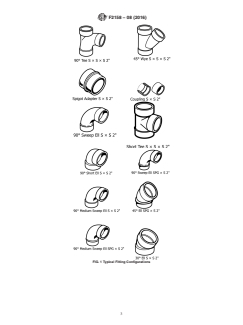
FIG. 1 Typical Fitting Configurations
F2158 − 08 (2016)
10. Quality Assurance 11. Keywords
10.1 When the product is marked with this designation, 11.1 central vacuum; fittings; PVC; tube
ASTM F2158, the manufacturer affirms that the product was
manufactured, inspected, sampled, and tested in accordance
with and has been found to meet the requirements of this
specification.
APPENDIXES
(Nonmandatory Information)
X1. STORAGE
X1.1 Outside Storage—Plastic tube should be stored on a the temperature exceeds 100°F (38°C).
flat surface or supported in a manner that will prevent sagging
X1.2 Inventories of plastic tube should be used on a first-in,
or bending. Do not store tube in direct sunlight for long
periods.Topreventdamage,fittingsshouldnotbestoredwhere first-out basis.
X2. JOINTS AND CONNECTIONS
X2.1 PVC tubing and fittings shall be joined by the solvent-
cement method.
X2.2 When connecting to metal tubing systems, metal
tubing and fitting shall be joined in accordance with Appendix
X4.
X3. SOLVENT CEMENT JOINTS
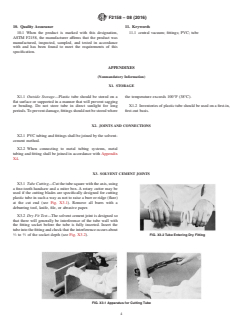
X3.1 Tube Cutting—Cutthetubesquarewiththeaxis,using
a fine-tooth handsaw and a miter box. A rotary cutter may be
used if the cutting blades are specifically designed for cutting
plastic tube in such a way as not to raise a burr or ridge (flare)
at the cut end (see Fig. X3.1). Remove all burrs with a
deburring tool, knife, file, or abrasive paper.
X3.2 Dry Fit Test—The solvent cement joint is designed so
that there will generally be interference of the tube wall with
the fitting socket before the tube is fully inserted. Insert the
tubeintothefittingandcheckthattheinterferenceoccursabout
1 2
⁄3 to ⁄3 of the socket depth (see Fig. X3.2). FIG. X3.2 Tube Entering Dry Fitting
FIG. X3.1 Apparatus for Cutting Tube
F2158 − 08 (2016)
X3.3 Cleaning—Surfaces to be joined must be cleaned and The surface temperature of the mating surfaces should not
be free of dirt, moisture, oil, and other foreign material. If this exceed 110°F (43°C) at the time of assembly.
cannot be accomplished by wiping with a clean, dry cloth, a
X3.4.3 Apply cement lightly but uniformly to the outside of
chemical or mechanical cleaner must be used. If a chemical
thetubing,takingcaretokeeptheuseofcementtoaminimum.
cleaner is used, apply with an applicator. (Warning—Skin
(Warning—Application of cement to fitting socket is not
contact with chemical cleaners should be avoided.)
recommended and can cause drip
...