


ASTM D4102-82(2015)
(Test Method)Standard Test Method for Thermal Oxidative Resistance of Carbon Fibers
Standard Test Method for Thermal Oxidative Resistance of Carbon Fibers
SIGNIFICANCE AND USE
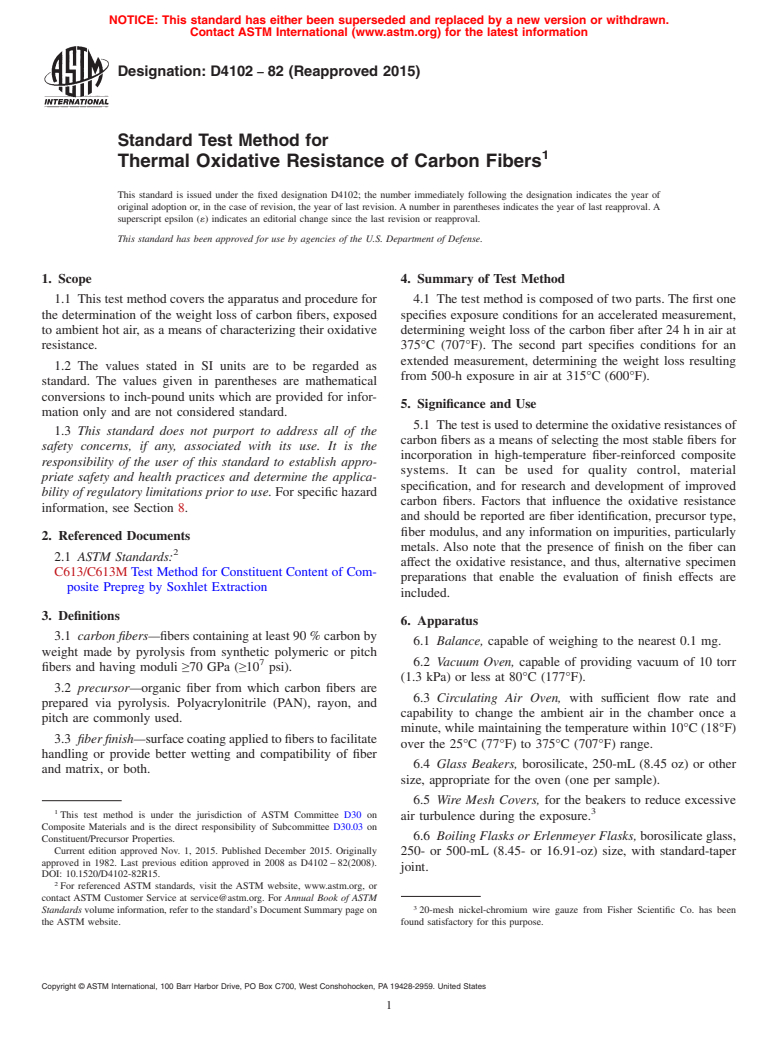
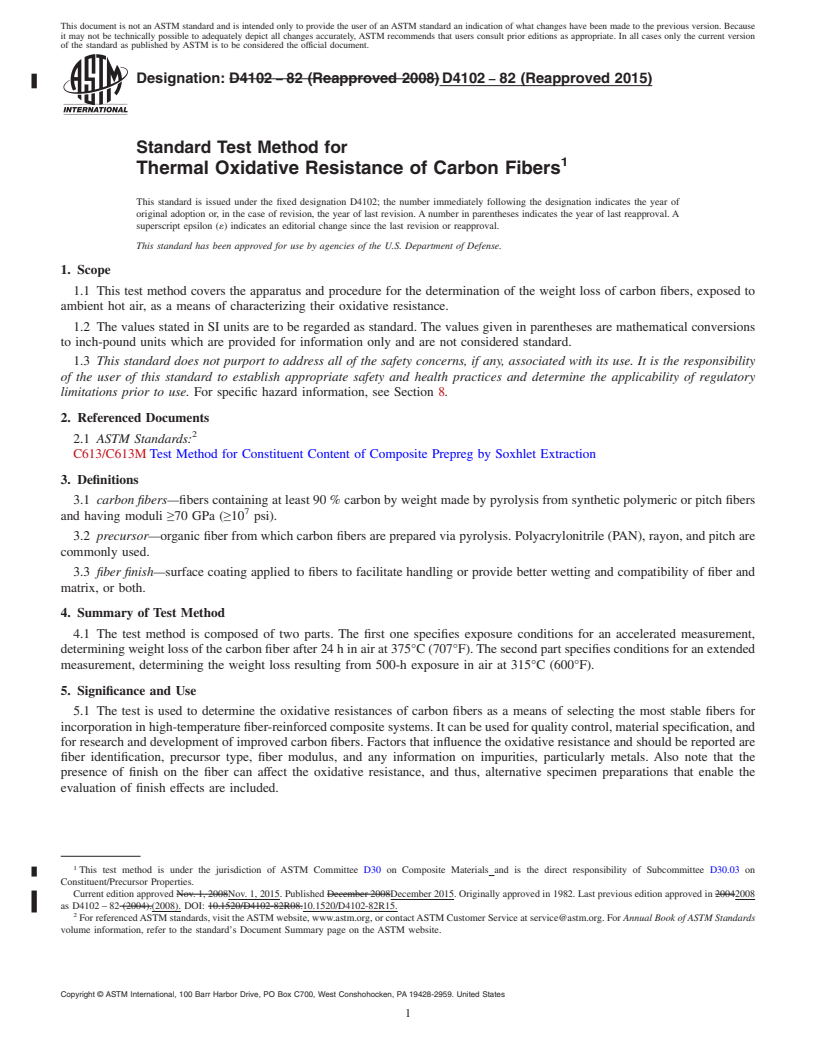
5.1 The test is used to determine the oxidative resistances of carbon fibers as a means of selecting the most stable fibers for incorporation in high-temperature fiber-reinforced composite systems. It can be used for quality control, material specification, and for research and development of improved carbon fibers. Factors that influence the oxidative resistance and should be reported are fiber identification, precursor type, fiber modulus, and any information on impurities, particularly metals. Also note that the presence of finish on the fiber can affect the oxidative resistance, and thus, alternative specimen preparations that enable the evaluation of finish effects are included.
SCOPE
1.1 This test method covers the apparatus and procedure for the determination of the weight loss of carbon fibers, exposed to ambient hot air, as a means of characterizing their oxidative resistance.
1.2 The values stated in SI units are to be regarded as standard. The values given in parentheses are mathematical conversions to inch-pound units which are provided for information only and are not considered standard.
1.3 This standard does not purport to address all of the safety concerns, if any, associated with its use. It is the responsibility of the user of this standard to establish appropriate safety and health practices and determine the applicability of regulatory limitations prior to use. For specific hazard information, see Section 8.
General Information
Buy Standard
Standards Content (Sample)
NOTICE: This standard has either been superseded and replaced by a new version or withdrawn.
Contact ASTM International (www.astm.org) for the latest information
Designation: D4102 − 82 (Reapproved 2015)
Standard Test Method for
Thermal Oxidative Resistance of Carbon Fibers
This standard is issued under the fixed designation D4102; the number immediately following the designation indicates the year of
original adoption or, in the case of revision, the year of last revision. A number in parentheses indicates the year of last reapproval. A
superscript epsilon (´) indicates an editorial change since the last revision or reapproval.
This standard has been approved for use by agencies of the U.S. Department of Defense.
1. Scope 4. Summary of Test Method
1.1 This test method covers the apparatus and procedure for 4.1 The test method is composed of two parts. The first one
the determination of the weight loss of carbon fibers, exposed specifies exposure conditions for an accelerated measurement,
to ambient hot air, as a means of characterizing their oxidative determining weight loss of the carbon fiber after 24 h in air at
resistance. 375°C (707°F). The second part specifies conditions for an
extended measurement, determining the weight loss resulting
1.2 The values stated in SI units are to be regarded as
from 500-h exposure in air at 315°C (600°F).
standard. The values given in parentheses are mathematical
conversions to inch-pound units which are provided for infor-
5. Significance and Use
mation only and are not considered standard.
5.1 The test is used to determine the oxidative resistances of
1.3 This standard does not purport to address all of the
carbon fibers as a means of selecting the most stable fibers for
safety concerns, if any, associated with its use. It is the
incorporation in high-temperature fiber-reinforced composite
responsibility of the user of this standard to establish appro-
systems. It can be used for quality control, material
priate safety and health practices and determine the applica-
specification, and for research and development of improved
bility of regulatory limitations prior to use. For specific hazard
carbon fibers. Factors that influence the oxidative resistance
information, see Section 8.
and should be reported are fiber identification, precursor type,
fiber modulus, and any information on impurities, particularly
2. Referenced Documents
metals. Also note that the presence of finish on the fiber can
2.1 ASTM Standards:
affect the oxidative resistance, and thus, alternative specimen
C613/C613M Test Method for Constituent Content of Com-
preparations that enable the evaluation of finish effects are
posite Prepreg by Soxhlet Extraction
included.
3. Definitions
6. Apparatus
3.1 carbon fibers—fibers containing at least 90 % carbon by
6.1 Balance, capable of weighing to the nearest 0.1 mg.
weight made by pyrolysis from synthetic polymeric or pitch
6.2 Vacuum Oven, capable of providing vacuum of 10 torr
fibers and having moduli ≥70 GPa (≥10 psi).
(1.3 kPa) or less at 80°C (177°F).
3.2 precursor—organic fiber from which carbon fibers are
6.3 Circulating Air Oven, with sufficient flow rate and
prepared via pyrolysis. Polyacrylonitrile (PAN), rayon, and
capability to change the ambient air in the chamber once a
pitch are commonly used.
minute, while maintaining the temperature within 10°C (18°F)
3.3 fiberfinish—surfacecoatingappliedtofiberstofacilitate
over the 25°C (77°F) to 375°C (707°F) range.
handling or provide better wetting and compatibility of fiber
6.4 Glass Beakers, borosilicate, 250-mL (8.45 oz) or other
and matrix, or both.
size, appropriate for the oven (one per sample).
6.5 Wire Mesh Covers, for the beakers to reduce excessive
1 3
This test method is under the jurisdiction of ASTM Committee D30 on
air turbulence during the exposure.
Composite Materials and is the direct responsibility of Subcommittee D30.03 on
6.6 Boiling Flasks or Erlenmeyer Flasks, borosilicate glass,
Constituent/Precursor Properties.
Current edition approved Nov. 1, 2015. Published December 2015. Originally
250- or 500-mL (8.45- or 16.91-oz) size, with standard-taper
approved in 1982. Last previous edition approved in 2008 as D4102 – 82(2008).
joint.
DOI: 10.1520/D4102-82R15.
For referenced ASTM standards, visit the ASTM website, www.astm.org, or
contact ASTM Customer Service at service@astm.org. For Annual Book of ASTM
Standards volume information, refer to the standard’s Document Summary page on 20-mesh nickel-chromium wire gauze from Fisher Scientific Co. has been
the ASTM website. found satisfactory for this purpose.
Copyright © ASTM International, 100 Barr Harbor Drive, PO Box C700, West Conshohocken, PA 19428-2959. United States
D4102 − 82 (2015)
6.7 Glass Condensers, borosilicate for the above flasks. 11.2 If finish is to be removed (see 9.3), then either use a
Soxhlet extraction as recommended in Test Method C613/
6.8 Hot Plate.
C613M or follow Steps 11.3.1 – 11.3.4. If finish is not to be
6.9 Tweezers, stainless steel.
removed, skip Steps 11.3.1 – 11.3.4 and proceed with Step
11.4.
7. Reagents and Materials
11.3 Removal of the Finish:
7.1 Methyl Ethyl Ketone (2-butanone) 99.5 % pure, boiling
11.3.1 Put the specimen in a dry flask and cover with 100 to
range 70.0 to 81.0°C (158 to 177.8°F), or other suitable
200 mL(3.38 to 6.76 oz) of methyl ethyl ketone solvent. Place
solvents recommended in Test Method C613/C613M.
the condenser onto the flask and start the cooling water. Heat
8. Hazards the flask on the hot plate or heating bath to bring the solvent to
boil. Soak the specimen in the boiling solvent for 15 min. Take
8.1 The methyl ethyl ketone, classified as an irritant and a
off the condenser, decant the solvent, and remove the speci-
fire hazard, should be handled in a well-ventilated area and
men.
should not be exposed to direct heat or open flame.
11.3.2 Dry the specimen in the vacuum oven at 77°C
(170°F) at a reduced pressure of 10 torr (1.3 kPa) or less for 30
9. Test Specimen and Sampling
min.
9.1 Using clean gloves to prevent any contamination, par-
11.3.3 Weigh the dried specimen to the nearest 0.1 mg.
ticularly with salt, unwrap the outer layers, which may have
Record the weight.
been contaminated by previous handling or environmental
11.3.4 Repeat Steps 11.3.1 – 11.3.3 until the weight remains
exposure, from the test package of carbon-fiber yarn and
constant, within 60.1 mg. Record the final weight, W .
e
discard. Form a small coil of fresh fiber weighing approxi-
11.4 Drying:
mately 2 g around two gloved fingers and tuck the ends in to
11.4.1 Dry each specimen for 16 h in a vacuum oven at
obtain a specimen in the form of an easily handleable loop.
77°C (170°F) at a reduced pressure of 10 torr (1.3 kPa)
...
This document is not an ASTM standard and is intended only to provide the user of an ASTM standard an indication of what changes have been made to the previous version. Because
it may not be technically possible to adequately depict all changes accurately, ASTM recommends that users consult prior editions as appropriate. In all cases only the current version
of the standard as published by ASTM is to be considered the official document.
Designation: D4102 − 82 (Reapproved 2008) D4102 − 82 (Reapproved 2015)
Standard Test Method for
Thermal Oxidative Resistance of Carbon Fibers
This standard is issued under the fixed designation D4102; the number immediately following the designation indicates the year of
original adoption or, in the case of revision, the year of last revision. A number in parentheses indicates the year of last reapproval. A
superscript epsilon (´) indicates an editorial change since the last revision or reapproval.
This standard has been approved for use by agencies of the U.S. Department of Defense.
1. Scope
1.1 This test method covers the apparatus and procedure for the determination of the weight loss of carbon fibers, exposed to
ambient hot air, as a means of characterizing their oxidative resistance.
1.2 The values stated in SI units are to be regarded as standard. The values given in parentheses are mathematical conversions
to inch-pound units which are provided for information only and are not considered standard.
1.3 This standard does not purport to address all of the safety concerns, if any, associated with its use. It is the responsibility
of the user of this standard to establish appropriate safety and health practices and determine the applicability of regulatory
limitations prior to use. For specific hazard information, see Section 8.
2. Referenced Documents
2.1 ASTM Standards:
C613/C613M Test Method for Constituent Content of Composite Prepreg by Soxhlet Extraction
3. Definitions
3.1 carbon fibers—fibers containing at least 90 % carbon by weight made by pyrolysis from synthetic polymeric or pitch fibers
and having moduli ≥70 GPa (≥10 psi).
3.2 precursor—organic fiber from which carbon fibers are prepared via pyrolysis. Polyacrylonitrile (PAN), rayon, and pitch are
commonly used.
3.3 fiber finish—surface coating applied to fibers to facilitate handling or provide better wetting and compatibility of fiber and
matrix, or both.
4. Summary of Test Method
4.1 The test method is composed of two parts. The first one specifies exposure conditions for an accelerated measurement,
determining weight loss of the carbon fiber after 24 h in air at 375°C (707°F). The second part specifies conditions for an extended
measurement, determining the weight loss resulting from 500-h exposure in air at 315°C (600°F).
5. Significance and Use
5.1 The test is used to determine the oxidative resistances of carbon fibers as a means of selecting the most stable fibers for
incorporation in high-temperature fiber-reinforced composite systems. It can be used for quality control, material specification, and
for research and development of improved carbon fibers. Factors that influence the oxidative resistance and should be reported are
fiber identification, precursor type, fiber modulus, and any information on impurities, particularly metals. Also note that the
presence of finish on the fiber can affect the oxidative resistance, and thus, alternative specimen preparations that enable the
evaluation of finish effects are included.
This test method is under the jurisdiction of ASTM Committee D30 on Composite Materials and is the direct responsibility of Subcommittee D30.03 on
Constituent/Precursor Properties.
Current edition approved Nov. 1, 2008Nov. 1, 2015. Published December 2008December 2015. Originally approved in 1982. Last previous edition approved in 20042008
as D4102 – 82 (2004).(2008). DOI: 10.1520/D4102-82R08.10.1520/D4102-82R15.
For referenced ASTM standards, visit the ASTM website, www.astm.org, or contact ASTM Customer Service at service@astm.org. For Annual Book of ASTM Standards
volume information, refer to the standard’s Document Summary page on the ASTM website.
Copyright © ASTM International, 100 Barr Harbor Drive, PO Box C700, West Conshohocken, PA 19428-2959. United States
D4102 − 82 (2015)
6. Apparatus
6.1 Balance, capable of weighing to the nearest 0.1 mg.
6.2 Vacuum Oven, capable of providing vacuum of 10 torr (1.3 kPa) or less at 80°C (177°F).
6.3 Circulating Air Oven, with sufficient flow rate and capability to change the ambient air in the chamber once a minute, while
maintaining the temperature within 10°C (18°F) over the 25°C (77°F) to 375°C (707°F) range.
6.4 Glass Beakers, borosilicate, 250-mL (8.45 oz) or other size, appropriate for the oven (one per sample).
6.5 Wire Mesh Covers, for the beakers to reduce excessive air turbulence during the exposure.
6.6 Boiling Flasks or Erlenmeyer Flasks, borosilicate glass, 250- or 500-mL (8.45- or 16.91-oz) size, with standard-taper joint.
6.7 Glass Condensers, borosilicate for the above flasks.
6.8 Hot Plate.
6.9 Tweezers, stainless steel.
7. Reagents and Materials
7.1 Methyl Ethyl Ketone (2-butanone) 99.5 % pure, boiling range 70.0 to 81.0°C (158 to 177.8°F), or other suitable solvents
recommended in Test Method C613/C613M.
8. Hazards
8.1 The methyl ethyl ketone, classified as an irritant and a fire hazard, should be handled in a well-ventilated area and should
not be exposed to direct heat or open flame.
9. Test Specimen and Sampling
9.1 Using clean gloves to prevent any contamination, particularly with salt, unwrap the outer layers, which may have been
contaminated by previous handling or environmental exposure, from the test package of carbon-fiber yarn and discard. Form a
small coil of fresh fiber weighing approximately 2 g around two gloved fingers and tuck the ends in to obtain a specimen in the
form of an easily handleable loop.
9.2 Number of Specimens—For quality control purposes, test a minimum of two specimens from each sample. For a quantitative
assessment of the fiber performance, however, test a minimum of ten specimens and evaluate the results statistically as described
in 12.4.
9.3 Finish Removal from the Fiber—Many carbon fibers are coated with an organic finish to improve handleability, wettability,
and adhesion to the matrix. These materials are generally present at about 1 % levels and are usually not stable at the exposure
temperatures prescribed herein. The finish, if present, may be removed by extraction with hot solvent, such as methyl ethyl ketone
or dimethyl formamide (DMF). Soxhlet extraction as described in Test Method C613/C613M is recommended for difficult-to-
remove finishes and as a reference control. However, other finishes may be extracted by the procedure given in 11.3.1 – 11.3.4.
9.4 Finish Left on the Fiber—Since the fiber will normally be used with the finish intact, it is most useful to know the oxidative
resistance of the fiber containing finish. To characterize and select fibers with optimum finishes, it
...
Questions, Comments and Discussion
Ask us and Technical Secretary will try to provide an answer. You can facilitate discussion about the standard in here.