

ASTM C1849/C1849M-23
(Test Method)Standard Test Method for Density and Air Content (Pressure Method) of Freshly Mixed Roller-Compacted Concrete
General Information
- Abstract
SIGNIFICANCE AND USE
4.1 The test determines the air content of freshly mixed RCC exclusive of any air that may exist inside voids within aggregate particles. For this reason, it is applicable to concrete made with normal-density or high-density aggregate particles and requires determination of the aggregate correction factor described in Test Method C231/C231M.
4.2 If the concrete being tested contains aggregate that would be retained on a 50 mm (2 in.) sieve, the air content of the total mixture is only approximated by the test.
4.3 The test determines the density of freshly mixed RCC containing aggregate with a maximum size not greater than 50 mm (2 in.).
4.4 The density and air content of hardened RCC may be either higher or lower than that determined by this test method. This depends upon the methods and amount of consolidation effort applied to the RCC from which the hardened concrete specimen is taken; uniformity and stability of the air bubbles in the fresh RCC; accuracy of the microscopic examination, if used; stage in the delivery at which the density and air content of the unhardened RCC are determined; and other factors.
SCOPE
1.1 This test method covers the determination of density and air content of freshly mixed roller-compacted concrete (RCC) using the apparatus described in Test Method C231/C231M and the vibrating hammer described in Test Method C1435/C1435M.
1.2 The values stated in either SI units or inch-pound units are to be regarded separately as standard. The values stated in each system are not necessarily exact equivalents; therefore, to ensure conformance with the standard, each system shall be used independently of the other, and values from the two systems shall not be combined.
Note 1: Sieve size is identified by its standard designation in Specification E11. The alternative designation given in parentheses is for information only and does not represent a different standard sieve size.
1.3 The text of this test method references notes and footnotes that provide explanatory information. These notes and footnotes (excluding those in tables and figures) shall not be considered as requirements of this standard.
1.4 This standard does not purport to address all of the safety concerns, if any, associated with its use. It is the responsibility of the user of this standard to establish appropriate safety, health, and environmental practices and determine the applicability of regulatory limitations prior to use. (Warning—Fresh hydraulic cementitious mixtures are caustic and may cause chemical burns to skin and tissue upon prolonged exposure.)2
1.5 This international standard was developed in accordance with internationally recognized principles on standardization established in the Decision on Principles for the Development of International Standards, Guides and Recommendations issued by the World Trade Organization Technical Barriers to Trade (TBT) Committee.
- Status
- Published
- Publication Date
- 30-Nov-2023
- Technical Committee
- C09 - Concrete and Concrete Aggregates
- Drafting Committee
- C09.45 - Roller-Compacted Concrete
Buy Documents
ASTM C1849/C1849M-23 - Standard Test Method for Density and Air Content (Pressure Method) of Freshly Mixed Roller-Compacted Concrete
REDLINE ASTM C1849/C1849M-23 - Standard Test Method for Density and Air Content (Pressure Method) of Freshly Mixed Roller-Compacted Concrete
Overview
ASTM C1849/C1849M-23 defines the standard test method for the determination of density and air content in freshly mixed roller-compacted concrete (RCC) using the pressure method. Specifically tailored for RCC, this standard plays a critical role in quality assurance and control for concrete paving and dam construction. The test method utilizes the equipment described in ASTM C231/C231M (Pressure Method) and the vibrating hammer method detailed in ASTM C1435/C1435M to measure both the density and the amount of entrained air, exclusive of air that may be present in the voids within aggregate particles.
Key Topics
- Density Determination: The test method establishes procedures for measuring the density of freshly mixed RCC, provided aggregate maximum size does not exceed 50 mm (2 in.).
- Air Content Measurement: The pressure method provides the air content of the RCC mix, essential for assessing workability and durability of the concrete, exclusive of air within aggregate particles.
- Aggregate Correction Factor: Determination and application of the correction factor are required, as described in ASTM C231/C231M, to ensure accurate air content results.
- Use with Varied Aggregates: Applicable to mixes containing normal-density and high-density aggregates; however, the method only approximates air content if aggregates larger than a 50 mm sieve are present.
- Precision and Limitations: Results for density and air content in hardened RCC may differ based on consolidation, air stability, and other factors impacting the uniformity of the mix.
Applications
- Quality Control in RCC Construction: Ensures that freshly mixed roller-compacted concrete used in pavement, dam, and large infrastructural projects meets specified performance criteria for compaction and durability.
- Material Optimization: Provides guidance for adjusting mix proportions and compaction strategies based on measured air content and density.
- Comparative Testing: Allows practitioners to assess RCC properties at various points in the delivery and placement process, supporting process optimization for construction teams.
- Regulatory Compliance: Offers a standardized method for contractors and quality assurance personnel to document compliance with project and agency specifications related to RCC density and air content.
Related Standards
For effective implementation of ASTM C1849/C1849M-23, the following related ASTM standards are referenced and should be consulted:
- ASTM C231/C231M – Test Method for Air Content of Freshly Mixed Concrete by the Pressure Method
- ASTM C1435/C1435M – Practice for Molding Roller-Compacted Concrete in Cylinder Molds Using a Vibrating Hammer
- ASTM C1170/C1170M – Test Method for Determining Consistency and Density of Roller-Compacted Concrete Using a Vibrating Table
- ASTM C125 – Terminology Relating to Concrete and Concrete Aggregates
- ASTM C172/C172M – Practice for Sampling Freshly Mixed Concrete
- ASTM C31/C31M – Practice for Making and Curing Concrete Test Specimens in the Field
Practical Value
By following ASTM C1849/C1849M-23, users benefit from:
- Enhanced Consistency: Achieve uniform, reproducible results for density and air content in RCC mixes.
- Improved Durability Assessment: Understanding air content supports durability predictions for long-term concrete performance.
- Comprehensive Reporting: Provides structured guidance for documenting test results, supporting traceability and regulatory requirements.
- International Recognition: Developed in alignment with World Trade Organization principles, enabling global acceptance and application.
Keywords: roller-compacted concrete, RCC, air content, density, pressure method, ASTM C1849/C1849M, quality control, aggregate correction factor, concrete testing, standard test method
Relations
- Effective Date
- 01-Dec-2023
- Refers
ASTM C31/C31M-24a - Standard Practice for Making and Curing Concrete Test Specimens in the Field - Effective Date
- 01-Apr-2024
- Effective Date
- 01-Feb-2024
- Effective Date
- 01-Jan-2024
- Refers
ASTM C31/C31M-24 - Standard Practice for Making and Curing Concrete Test Specimens in the Field - Effective Date
- 01-Jan-2024
- Effective Date
- 01-Jan-2024
- Refers
ASTM C31/C31M-23 - Standard Practice for Making and Curing Concrete Test Specimens in the Field - Effective Date
- 01-Jun-2023
- Effective Date
- 01-Jun-2022
- Effective Date
- 15-Jun-2015
Buy Documents
ASTM C1849/C1849M-23 - Standard Test Method for Density and Air Content (Pressure Method) of Freshly Mixed Roller-Compacted Concrete
REDLINE ASTM C1849/C1849M-23 - Standard Test Method for Density and Air Content (Pressure Method) of Freshly Mixed Roller-Compacted Concrete
Get Certified
Connect with accredited certification bodies for this standard

DIBt (Deutsches Institut für Bautechnik)
German Institute for Building Technology.
DIN CERTCO
DIN Group product certification.

Aboma Certification B.V.
Specialized in construction, metal, and transport sectors.
Sponsored listings
Frequently Asked Questions
ASTM C1849/C1849M-23 is a standard published by ASTM International. Its full title is "Standard Test Method for Density and Air Content (Pressure Method) of Freshly Mixed Roller-Compacted Concrete". This standard covers: SIGNIFICANCE AND USE 4.1 The test determines the air content of freshly mixed RCC exclusive of any air that may exist inside voids within aggregate particles. For this reason, it is applicable to concrete made with normal-density or high-density aggregate particles and requires determination of the aggregate correction factor described in Test Method C231/C231M. 4.2 If the concrete being tested contains aggregate that would be retained on a 50 mm (2 in.) sieve, the air content of the total mixture is only approximated by the test. 4.3 The test determines the density of freshly mixed RCC containing aggregate with a maximum size not greater than 50 mm (2 in.). 4.4 The density and air content of hardened RCC may be either higher or lower than that determined by this test method. This depends upon the methods and amount of consolidation effort applied to the RCC from which the hardened concrete specimen is taken; uniformity and stability of the air bubbles in the fresh RCC; accuracy of the microscopic examination, if used; stage in the delivery at which the density and air content of the unhardened RCC are determined; and other factors. SCOPE 1.1 This test method covers the determination of density and air content of freshly mixed roller-compacted concrete (RCC) using the apparatus described in Test Method C231/C231M and the vibrating hammer described in Test Method C1435/C1435M. 1.2 The values stated in either SI units or inch-pound units are to be regarded separately as standard. The values stated in each system are not necessarily exact equivalents; therefore, to ensure conformance with the standard, each system shall be used independently of the other, and values from the two systems shall not be combined. Note 1: Sieve size is identified by its standard designation in Specification E11. The alternative designation given in parentheses is for information only and does not represent a different standard sieve size. 1.3 The text of this test method references notes and footnotes that provide explanatory information. These notes and footnotes (excluding those in tables and figures) shall not be considered as requirements of this standard. 1.4 This standard does not purport to address all of the safety concerns, if any, associated with its use. It is the responsibility of the user of this standard to establish appropriate safety, health, and environmental practices and determine the applicability of regulatory limitations prior to use. (Warning—Fresh hydraulic cementitious mixtures are caustic and may cause chemical burns to skin and tissue upon prolonged exposure.)2 1.5 This international standard was developed in accordance with internationally recognized principles on standardization established in the Decision on Principles for the Development of International Standards, Guides and Recommendations issued by the World Trade Organization Technical Barriers to Trade (TBT) Committee.
SIGNIFICANCE AND USE 4.1 The test determines the air content of freshly mixed RCC exclusive of any air that may exist inside voids within aggregate particles. For this reason, it is applicable to concrete made with normal-density or high-density aggregate particles and requires determination of the aggregate correction factor described in Test Method C231/C231M. 4.2 If the concrete being tested contains aggregate that would be retained on a 50 mm (2 in.) sieve, the air content of the total mixture is only approximated by the test. 4.3 The test determines the density of freshly mixed RCC containing aggregate with a maximum size not greater than 50 mm (2 in.). 4.4 The density and air content of hardened RCC may be either higher or lower than that determined by this test method. This depends upon the methods and amount of consolidation effort applied to the RCC from which the hardened concrete specimen is taken; uniformity and stability of the air bubbles in the fresh RCC; accuracy of the microscopic examination, if used; stage in the delivery at which the density and air content of the unhardened RCC are determined; and other factors. SCOPE 1.1 This test method covers the determination of density and air content of freshly mixed roller-compacted concrete (RCC) using the apparatus described in Test Method C231/C231M and the vibrating hammer described in Test Method C1435/C1435M. 1.2 The values stated in either SI units or inch-pound units are to be regarded separately as standard. The values stated in each system are not necessarily exact equivalents; therefore, to ensure conformance with the standard, each system shall be used independently of the other, and values from the two systems shall not be combined. Note 1: Sieve size is identified by its standard designation in Specification E11. The alternative designation given in parentheses is for information only and does not represent a different standard sieve size. 1.3 The text of this test method references notes and footnotes that provide explanatory information. These notes and footnotes (excluding those in tables and figures) shall not be considered as requirements of this standard. 1.4 This standard does not purport to address all of the safety concerns, if any, associated with its use. It is the responsibility of the user of this standard to establish appropriate safety, health, and environmental practices and determine the applicability of regulatory limitations prior to use. (Warning—Fresh hydraulic cementitious mixtures are caustic and may cause chemical burns to skin and tissue upon prolonged exposure.)2 1.5 This international standard was developed in accordance with internationally recognized principles on standardization established in the Decision on Principles for the Development of International Standards, Guides and Recommendations issued by the World Trade Organization Technical Barriers to Trade (TBT) Committee.
ASTM C1849/C1849M-23 is classified under the following ICS (International Classification for Standards) categories: 91.100.30 - Concrete and concrete products. The ICS classification helps identify the subject area and facilitates finding related standards.
ASTM C1849/C1849M-23 has the following relationships with other standards: It is inter standard links to ASTM C1849/C1849M-17, ASTM C31/C31M-24a, ASTM C670-24a, ASTM C670-24, ASTM C31/C31M-24, ASTM C231/C231M-24, ASTM C31/C31M-23, ASTM C231/C231M-22, ASTM C670-15. Understanding these relationships helps ensure you are using the most current and applicable version of the standard.
ASTM C1849/C1849M-23 is available in PDF format for immediate download after purchase. The document can be added to your cart and obtained through the secure checkout process. Digital delivery ensures instant access to the complete standard document.
Standards Content (Sample)
This international standard was developed in accordance with internationally recognized principles on standardization established in the Decision on Principles for the
Development of International Standards, Guides and Recommendations issued by the World Trade Organization Technical Barriers to Trade (TBT) Committee.
Designation: C1849/C1849M − 23
Standard Test Method for
Density and Air Content (Pressure Method) of Freshly Mixed
Roller-Compacted Concrete
This standard is issued under the fixed designation C1849/C1849M; the number immediately following the designation indicates the
year of original adoption or, in the case of revision, the year of last revision. A number in parentheses indicates the year of last
reapproval. A superscript epsilon (´) indicates an editorial change since the last revision or reapproval.
1. Scope* 2. Referenced Documents
2.1 ASTM Standards:
1.1 This test method covers the determination of density and
air content of freshly mixed roller-compacted concrete (RCC) C31/C31M Practice for Making and Curing Concrete Test
Specimens in the Field
using the apparatus described in Test Method C231/C231M
and the vibrating hammer described in Test Method C1435/ C125 Terminology Relating to Concrete and Concrete Ag-
gregates
C1435M.
C138/C138M Test Method for Density (Unit Weight), Yield,
1.2 The values stated in either SI units or inch-pound units
and Air Content (Gravimetric) of Concrete
are to be regarded separately as standard. The values stated in
C172/C172M Practice for Sampling Freshly Mixed Con-
each system are not necessarily exact equivalents; therefore, to
crete
ensure conformance with the standard, each system shall be
C192/C192M Practice for Making and Curing Concrete Test
used independently of the other, and values from the two
Specimens in the Laboratory
systems shall not be combined.
C231/C231M Test Method for Air Content of Freshly Mixed
NOTE 1—Sieve size is identified by its standard designation in Speci-
Concrete by the Pressure Method
fication E11. The alternative designation given in parentheses is for
information only and does not represent a different standard sieve size. C670 Practice for Preparing Precision and Bias Statements
for Test Methods for Construction Materials
1.3 The text of this test method references notes and
C1067 Practice for Conducting a Ruggedness Evaluation or
footnotes that provide explanatory information. These notes
Screening Program for Test Methods for Construction
and footnotes (excluding those in tables and figures) shall not
Materials
be considered as requirements of this standard.
C1170/C1170M Test Method for Determining Consistency
1.4 This standard does not purport to address all of the
and Density of Roller-Compacted Concrete Using a Vi-
safety concerns, if any, associated with its use. It is the
brating Table
responsibility of the user of this standard to establish appro-
C1435/C1435M Practice for Molding Roller-Compacted
priate safety, health, and environmental practices and deter-
Concrete in Cylinder Molds Using a Vibrating Hammer
mine the applicability of regulatory limitations prior to use.
E11 Specification for Woven Wire Test Sieve Cloth and Test
(Warning—Fresh hydraulic cementitious mixtures are caustic
Sieves
and may cause chemical burns to skin and tissue upon
prolonged exposure.)
3. Terminology
1.5 This international standard was developed in accor-
3.1 Definitions:
dance with internationally recognized principles on standard-
3.1.1 For definitions of terms used in this test method, refer
ization established in the Decision on Principles for the
to Terminology C125.
Development of International Standards, Guides and Recom-
mendations issued by the World Trade Organization Technical
4. Significance and Use
Barriers to Trade (TBT) Committee.
4.1 The test determines the air content of freshly mixed
RCC exclusive of any air that may exist inside voids within
aggregate particles. For this reason, it is applicable to concrete
This test method is under the jurisdiction of ASTM Committee C09 on
made with normal-density or high-density aggregate particles
Concrete and Concrete Aggregates and is the direct responsibility of Subcommittee
C09.45 on Roller-Compacted Concrete.
Current edition approved Dec. 1, 2023. Published December 2023. Originally
approved in 2017. Last previous edition approved in 2017 as C1849/C1849M–17. For referenced ASTM standards, visit the ASTM website, www.astm.org, or
DOI: 10.1520/C1849_C1849M-23. contact ASTM Customer Service at service@astm.org. For Annual Book of ASTM
Section on Safety Precautions, Manual of Aggregate and Concrete Testing, Standards volume information, refer to the standard’s Document Summary page on
Annual Book of ASTM Standards, Vol 04.02. the ASTM website.
*A Summary of Changes section appears at the end of this standard
Copyright © ASTM International, 100 Barr Harbor Drive, PO Box C700, West Conshohocken, PA 19428-2959. United States
C1849/C1849M − 23
and requires determination of the aggregate correction factor 7. Determination of Aggregate Correction Factor
described in Test Method C231/C231M.
7.1 Determine the aggregate correction factor on a com-
bined sample of fine and coarse aggregate as directed in Test
4.2 If the concrete being tested contains aggregate that
would be retained on a 50 mm (2 in.) sieve, the air content of Method C231/C231M.
NOTE 2—The aggregate correction factor will vary with different
the total mixture is only approximated by the test.
aggregates. It can be determined only by test. The test can be made easily.
4.3 The test determines the density of freshly mixed RCC
Ordinarily the factor will remain reasonably constant for given aggregates,
but an occasional check test is recommended.
containing aggregate with a maximum size not greater than
50 mm (2 in.).
8. Preparation of Concrete Test Sample
4.4 The density and air content of hardened RCC may be
8.1 Obtain the sample of freshly mixed concrete in accor-
either higher or lower than that determined by this test method.
dance with applicable procedures of Practice C172/C172M.
This depends upon the methods and amount of consolidation
8.2 Use concrete that does not appear to have undergone
effort applied to the RCC from which the hardened concrete
segregation.
specimen is taken; uniformity and stability of the air bubbles in
NOTE 3—Concrete with stiff to very dry consistency is highly suscep-
the fresh RCC; accuracy of the microscopic examination, if
tible to segregation during handling, transporting, and preparing samples
used; stage in the delivery at which the density and air content
for testing.
of the unhardened RCC are determined; and other factors.
8.3 If the concrete contains coarse aggregate particles that
would be retained on a 50 mm (2 in.) sieve, wet-sieve a
5. Apparatus
sufficient amount of the representative sample over a 37.5 mm
5.1 Air Meter—Type B air meter and auxiliary equipment
(1 ⁄2 in.) sieve, as described in Practice C172/C172M, to yield
conforming to Test Method C231/C231M.
sufficient material to completely fill the measuring bowl.
Weigh and record the mass of the sample before and after
5.2 Vibrating Hammer—A vibrating compaction hammer
wet-sieving. Make no attempt to wipe adhering mortar from
conforming to Practice C1435/C1435M.
coarse aggregate particles retained on the sieve.
5.3 Tamping Plate—A circular steel plate attached to a steel
8.4 Remix the concrete passing through the sieve with a
shaft, which is inserted into the vibrating hammer chuck. The
1 1 shovel until it appears uniform and proceed with testing.
plate diameter shall be 6 to 13 mm [ ⁄4 in. to ⁄2 in.] less than
the inside diameter of the measuring bowl. The mass of the
9. Procedure
plate and shaft assembly shall be 8 kg to 12 kg [18 lb to 26 lb]
(see Fig. 1). 9.1 Placement—Dampen the interior of the measuring bowl.
Weigh the dampened bowl. Record the mass of the bowl and
5.4 Mallet—A mallet conforming to Test Method C231/
place it on a supporting surface that will not deform during the
C231M.
test procedure. The entire surface of the bottom of the bowl
5.5 Strike-Off Plate—A strike-off plate conforming to Test
shall remain in contact with the supporting surface during the
Method C231/C231M.
test procedure with the sides of the bowl plumb to within 5
2 2
1 degrees of vertical. Using the scoop described in 5.7, place the
5.6 Sieve—37.5 mm (1 ⁄2 in.) with at least 0.2 m [2 ft ] of
concrete in the measuring bowl in two layers of approximately
sieving area.
equal volume. While placing the concrete in the bowl, move
5.7 Scoop—A size large enough so each amount of concrete
the scoop around the perimeter of the bowl opening to ensure
obtained from the sampling receptacle is representative and
an even distribution of the concrete with minimal segregation.
small enough so it is not spilled during placement in the
9.2 Consolidation—Place the vibrating hammer with tamp-
measuring bowl.
ing plate onto the first layer of concrete. Start the vibrating
5.8 Stopwatch—A stopwatch capable of measuring elapsed
hammer and allow the concrete to consolidate under the
time to the nearest second.
tamping plate. Observe the concrete in the annular space
between the outer edge of the tamping plate and the inside wall
5.9 Balance—A balance or scale accurate to 50 g [0.1 lb] or
of the measuring bowl. As the concrete consolidates, mortar
to within 0.3 % of the test load, whichever is greater, at any
should move into the annular space between the outer edge of
point within the range of use. The range of use shall be
the tamping plate and the inside wall of the measuring bowl.
considered to extend from the mass of the measure empty to
Observe the mortar until it forms a ring around the total
the mass of the measure plus its contents at 2600 kg/m [160
perimeter of the tamping plate. Stop the vibrating hammer
lb/ft ].
when the mortar ring forms completely around the tamping
5.10 Syringe—A syringe capable of injecting water into one
plate. Return mortar that remains on the tamping plate to the
petcock on the cover assembly.
measuring bowl before placing the second layer. Place the
second layer and repeat the process to consolidate the second
6. Standardization of Apparatus
layer. Return mortar that remains on the tamping plate to the
6.1 Standardize the apparatus and maintain standardization measuring bowl. If the top of the concrete is below the top of
records in accordance with the procedure prescribed in Annex the measuring bowl after returning the mortar that remains on
A1 of Test Method C231/C231M for a Type B meter. the tamping plate, add concrete and repeat the process to
C1849/C1849M − 23
FIG. 1 Example of Tamping Plate and Shaft Assembly
consolidate the added concrete. Before strike off, return mortar that the measure is level full. A small quantity of concrete may
that remains on the tamping plate to the measuring bowl. If a be added or removed to correct a deficiency. Strike off the
rock or rock pocket prevents the mortar ring from forming at
measure by pressing the strike-off plate on the top surface of
one location, even though it has formed in all other locations,
the measure to cover about two thirds of the surface and
stop the vibrating hammer and add the next layer of concrete or
withdraw the plate with a sawing motion to finish only the area
finish the top surface as described in 9.3. If a significant portion
originally covered. Then return the plate to the top of the
of the mortar ring does not form after 20 s, stop the vibrating
measure to cover the same two thirds of the surface and strike
hammer and add the next layer of concrete or finish the top
off the other one third of the surface by advancing it with a
surface as described in 9.3.
vertical pressure
...
This document is not an ASTM standard and is intended only to provide the user of an ASTM standard an indication of what changes have been made to the previous version. Because
it may not be technically possible to adequately depict all changes accurately, ASTM recommends that users consult prior editions as appropriate. In all cases only the current version
of the standard as published by ASTM is to be considered the official document.
Designation: C1849/C1849M − 17 C1849/C1849M − 23
Standard Test Method for
Density and Air Content (Pressure Method) of Freshly Mixed
Roller-Compacted Concrete
This standard is issued under the fixed designation C1849/C1849M; the number immediately following the designation indicates the
year of original adoption or, in the case of revision, the year of last revision. A number in parentheses indicates the year of last
reapproval. A superscript epsilon (´) indicates an editorial change since the last revision or reapproval.
1. Scope Scope*
1.1 This test method covers the determination of density and air content of freshly mixed roller-compacted concrete (RCC) using
the apparatus described in Test Method C231/C231M and the vibrating hammer described in Test Method C1435/C1435M.
1.2 The values stated in either SI units or inch-pound units are to be regarded separately as standard. The values stated in each
system may not beare not necessarily exact equivalents; therefore, to ensure conformance with the standard, each system shall be
used independently of the other. Combiningother, and values from the two systems may result in non-conformance with the
standard.shall not be combined.
NOTE 1—Sieve size is identified by its standard designation in Specification E11. The alternative designation given in parentheses is for information only
and does not represent a different standard sieve size.
1.3 The text of this test method references notes and footnotes that provide explanatory information. These notes and footnotes
(excluding those in tables and figures) shall not be considered as requirements of this standard.
1.4 This standard does not purport to address all of the safety concerns, if any, associated with its use. It is the responsibility
of the user of this standard to establish appropriate safety and healthsafety, health, and environmental practices and determine
the applicability of regulatory limitations prior to use. (Warning—Fresh hydraulic cementitious mixtures are caustic and may cause
chemical burns to skin and tissue upon prolonged exposure.)
1.5 This international standard was developed in accordance with internationally recognized principles on standardization
established in the Decision on Principles for the Development of International Standards, Guides and Recommendations issued
by the World Trade Organization Technical Barriers to Trade (TBT) Committee.
2. Referenced Documents
2.1 ASTM Standards:
C31/C31M Practice for Making and Curing Concrete Test Specimens in the Field
C125 Terminology Relating to Concrete and Concrete Aggregates
C138/C138M Test Method for Density (Unit Weight), Yield, and Air Content (Gravimetric) of Concrete
C172/C172M Practice for Sampling Freshly Mixed Concrete
C192/C192M Practice for Making and Curing Concrete Test Specimens in the Laboratory
This test method is under the jurisdiction of ASTM Committee C09 on Concrete and Concrete Aggregates and is the direct responsibility of Subcommittee C09.45 on
Roller-Compacted Concrete.
Current edition approved June 15, 2017Dec. 1, 2023. Published July 2017December 2023. Originally approved in 2017. Last previous edition approved in 2017 as
C1849/C1849M–17. DOI: 10.1520/C1849_C1849M-17.10.1520/C1849_C1849M-23.
Section on Safety Precautions, Manual of Aggregate and Concrete Testing, Annual Book of ASTM Standards, Vol 04.02.
For referenced ASTM standards, visit the ASTM website, www.astm.org, or contact ASTM Customer Service at service@astm.org. For Annual Book of ASTM Standards
volume information, refer to the standard’s Document Summary page on the ASTM website.
*A Summary of Changes section appears at the end of this standard
Copyright © ASTM International, 100 Barr Harbor Drive, PO Box C700, West Conshohocken, PA 19428-2959. United States
C1849/C1849M − 23
C231/C231M Test Method for Air Content of Freshly Mixed Concrete by the Pressure Method
C670 Practice for Preparing Precision and Bias Statements for Test Methods for Construction Materials
C1067 Practice for Conducting a Ruggedness Evaluation or Screening Program for Test Methods for Construction Materials
C1170/C1170M Test Method for Determining Consistency and Density of Roller-Compacted Concrete Using a Vibrating Table
C1435/C1435M Practice for Molding Roller-Compacted Concrete in Cylinder Molds Using a Vibrating Hammer
E11 Specification for Woven Wire Test Sieve Cloth and Test Sieves
3. Terminology
3.1 Definitions:
3.1.1 For definitions of terms used in this test method, refer to Terminology C125.
4. Significance and Use
4.1 The test determines the air content of freshly mixed RCC exclusive of any air that may exist inside voids within aggregate
particles. For this reason, it is applicable to concrete made with normal-density or high-density aggregate particles and requires
determination of the aggregate correction factor described in Test Method C231/C231M.
4.2 If the concrete being tested contains aggregate that would be retained on a 50-mm (2-in.)50 mm (2 in.) sieve, the air content
of the total mixture is only approximated by the test.
4.3 The test determines the density of freshly mixed RCC containing aggregate with a maximum size not greater than 50-mm
(2-in.).50 mm (2 in.).
4.4 The density and air content of hardened RCC may be either higher or lower than that determined by this test method. This
depends upon the methods and amount of consolidation effort applied to the RCC from which the hardened concrete specimen is
taken; uniformity and stability of the air bubbles in the fresh RCC; accuracy of the microscopic examination, if used; stage in the
delivery at which the density and air content of the unhardened RCC isare determined; and other factors.
5. Apparatus
5.1 Air Meter—Type B air meter and auxiliary equipment conforming to Test Method C231/C231M.
5.2 Vibrating Hammer—A vibrating compaction hammer conforming to Practice C1435/C1435M.
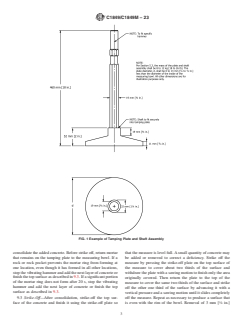
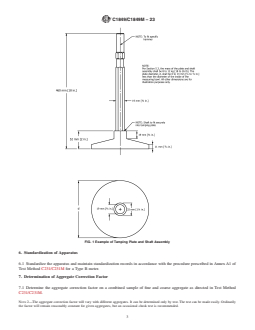
5.3 Tamping Plate—A circular steel plate attached to a steel shaft, which is inserted into the vibrating hammer chuck. The plate
1 1
diameter shall be 6 to 13 mm [ ⁄4 in. to ⁄2 in.] less than the inside diameter of the measuring bowl. The mass of the plate and shaft
assembly shall be 88 kg to 12 kg [18[18 lb to 26 lb] (see Fig. 1).
5.4 Mallet—A mallet conforming to Test Method C231/C231M.
5.5 Strike-Off Plate—A strike-off plate conforming to Test Method C231/C231M.
2 2
5.6 Sieve—37.5-mm37.5 mm (1 ⁄2-in.) in.) with at least 0.2 m [2 ft ] of sieving area.
5.7 Scoop—A size large enough so each amount of concrete obtained from the sampling receptacle is representative and small
enough so it is not spilled during placement in the measuring bowl.
5.8 Stopwatch—A stopwatch capable of measuring elapsed time to the nearest second.
5.9 Balance—A balance or scale accurate to 50 g [0.1 lb] or to within 0.3 % of the test load, whichever is greater, at any point
within the range of use. The range of use shall be considered to extend from the mass of the measure empty to the mass of the
3 3
measure plus its contents at 2600 kg/m [160 lb/ft ].
5.10 Syringe—A syringe capable of injecting water into one petcock on the cover assembly.
C1849/C1849M − 23
FIG. 1 Example of Tamping Plate and Shaft Assembly
6. Standardization of Apparatus
6.1 Standardize the apparatus and maintain standardization records in accordance with the procedure prescribed in Annex A1 of
Test Method C231/C231M for a Type B meter.
7. Determination of Aggregate Correction Factor
7.1 Determine the aggregate correction factor on a combined sample of fine and coarse aggregate as directed in Test Method
C231/C231M.
NOTE 2—The aggregate correction factor will vary with different aggregates. It can be determined only by test. The test can be made easily. Ordinarily
the factor will remain reasonably constant for given aggregates, but an occasional check test is recommended.
C1849/C1849M − 23
8. Preparation of Concrete Test Sample
8.1 Obtain the sample of freshly mixed concrete in accordance with applicable procedures of Practice C172/C172M.
8.2 Use concrete that does not appear to have undergone segregation.
NOTE 3—Concrete with stiff to very dry consistency is highly susceptible to segregation during handling, transporting, and preparing samples for testing.
8.3 If the concrete contains coarse aggregate particles that would be retained on a 50-mm (2-in.)50 mm (2 in.) sieve, wet-sieve
a sufficient amount of the representative sample over a 37.5-mm37.5 mm (1 ⁄2-in.) in.) sieve, as described in Practice
C172/C172M, to yield sufficient material to completely fill the measuring bowl. Weigh and record the mass of the sample before
and after wet-sieving. Make no attempt to wipe adhering mortar from coarse aggregate particles retained on the sieve.
8.4 Remix the concrete passing through the sieve with a shovel until it appears uniform and proceed with testing.
9. Procedure
9.1 Placement—Dampen the interior of the measuring bowl. Weigh the dampened bowl. Record the mass of the bowl and place
it on a supporting surface that will not deform during the test procedure. The entire surface of the bottom of the bowl shall remain
in contact with the supporting surface during the test procedure with the sides of the bowl plumb to within 5 degrees of vertical.
Using the scoop described in 5.7, place the concrete in the measuring bowl in two layers of approximately equal volume. While
placing the concrete in the bowl, move the scoop around the perimeter of the bowl opening to ensure an even distribution of the
concrete with minimal segregation.
9.2 Consolidation—Place the vibrating hammer with tamping plate onto the first layer of concrete. Start the vibrating hammer and
allow the concrete to consolidate under the tamping plate. Observe the concrete in the annular space between the outer edge of
the tamping plate and the inside wall of the measuring bowl. As the concrete consolidates, mortar should move into the annular
space between the outer edge of the tamping plate and the inside wall of the measuring bowl. Observe the mortar until it forms
a ring around the total perimeter of the tamping plate. Stop the vibrating hammer when the mortar ring forms completely around
the tamping plate. Return mortar that remains on the tamping plate to the measuring bowl before placing the second layer. Place
the second layer and repeat the process to consolidate the second layer. Return mortar that remains on the tamping plate to the
measuring bowl. If the top of the concrete is below the top of the measuring bowl after returning the mortar that remains on the
tamping plate, add concrete and repeat the process to consolidate the added concrete. Before strike off, return mortar that remains
on the tamping plate to the measuring bowl. If a rock or rock pocket prevents the mortar ring from forming at one location, even
though it has formed in all other locations, stop the vibrating hammer and add the next layer of concrete or finish the top surface
as described in 9.3. If a significant portion of the mortar ring does not form after 20 s, stop the vibrating hammer and add the next
layer of concrete or finish the top surface as described in 9.3.
9.3 Strike-Off—After consolidation, strike-off the top surface of the concrete and finish it using the strike-off plate so that the
measure is level full. A small quantity of concrete may be added or removed to correct a deficiency. Strike off the measure by
pressing the strike-off plate on the top surface of the measure to cover about two thirds of the surface and withdraw the plate with
a sawing motion to fin
...