

ASTM F3129-16
(Guide)Standard Guide for Characterization of Material Loss from Conical Taper Junctions in Total Joint Prostheses
General Information
- Abstract
SCOPE
1.1 This guide specifies a method to measure the surface and estimate the in-vivo material loss from the conical taper junctions, such as the femoral head/stem junction or adapter sleeve from explanted modular hip prosthesis, modular knee or shoulder joints. This guide is applicable to any articulating bearing material, stem material and conical taper size. The principles in this guide may be applied to other designs of taper junction, such as the modular stem/neck junction found in some hip joints.
1.2 This guide covers the measurement of the surface and estimation of depth of material loss and volume of material loss and taper geometry using a Roundness Machine (1-4), Coordinate Measuring Machine (CMM) (5) and Optical Coordinate Measuring Machine (6, 7).2 Other measurement equipment may be used to measure the surface if the resolution and accuracy of the measurements are comparable with the instruments detailed in this standard. The measurement and analysis protocols should be based on those described in this standard.
Note 1: The maximum depth of material loss is sensitive to the number and spacing of data points.
1.3 The measurement techniques in this standard guide use measurements taken on the surface of the taper using stylus instruments. The material loss/corrosion mechanisms in the taper junction may lead to oxide layers or corrosion products deposited on the surface of the taper. These layers may lead to an underestimation of the volume of material loss.
1.4 The explants may have debris or biological deposits on the surfaces of the taper junctions. These deposits will prevent the measurement of the actual surface of the taper junction and their effect on the measurement must be considered when deciding the cleaning protocol. Normally, the taper surfaces will be cleaned before measurements are taken.
1.5 This standard may involve hazardous materials, operations and equipment. As a precautionary measure, explanted devices should be sterilized or minimally disinfected by an appropriate means that does not adversely affect the implant or the associated tissue that may be the subject of subsequent analysis. A detailed discussion of precautions to be used in handling human tissues can be found in ISO 12891-1. This standard does not purport to address all of the safety concerns, if any, associated with its use. It is the responsibility of the user of this standard to establish appropriate safety and health practices and determine the applicability of regulatory limitations prior to use.
- Status
- Published
- Publication Date
- 14-Apr-2016
- Technical Committee
- F04 - Medical and Surgical Materials and Devices
- Drafting Committee
- F04.22 - Arthroplasty
Overview
ASTM F3129-16 is the international standard guide for the characterization of material loss from conical taper junctions in total joint prostheses. Established by ASTM International, this document defines standardized methods to measure surface characteristics and estimate in-vivo material loss at conical taper junctions, such as found in hip, knee, and shoulder joint prostheses. The guide is broadly applicable across various bearing materials, stem materials, and taper sizes. Its protocols support consistent, accurate evaluation of explanted modular joint prosthetic components, enhancing the understanding of implant performance, material degradation, and product safety in the healthcare industry.
Key Topics
- Measurement Techniques: The standard details the use of roundness machines, coordinate measuring machines (CMM), and optical coordinate measuring machines to assess surface features, depth of material loss, and taper geometry.
- Surface Analysis: Procedures for identifying and removing debris or biological deposits to ensure accurate measurements.
- Material Loss Patterns: Classification and analysis of material loss types, such as Type 1, Type 2, and asymmetric patterns, are crucial for correct data interpretation.
- Data Interpretation: Guidelines for visual and statistical analysis of 2D and 3D data, including identification of as-manufactured regions versus regions of material loss.
- Precautions: Important health and safety considerations when handling explanted devices, including sterilization protocols and conformance to ISO 12891-1 recommendations.
- Calibration and Validation: Emphasis on instrument calibration, alignment, and verification processes to ensure measurement accuracy and repeatability.
Applications
- Orthopedic Implant Retrieval Analysis: Used extensively by laboratories and manufacturers to evaluate explanted modular hip, knee, and shoulder joint prostheses for in-vivo material loss at critical taper junctions.
- Product Development and Quality Assurance: Helps device companies verify the performance and durability of conical taper designs during research, development, and post-market surveillance.
- Failure Analysis: Assists in determining root causes of prosthesis failures linked to material loss, corrosion, or wear at taper interfaces, supporting improved implant designs.
- Regulatory Submissions: Provides a recognized standard for reporting material degradation, supporting regulatory filings and compliance.
- Clinical Research: Offers a scientific approach for researchers studying long-term behavior, tribology, and corrosion patterns of modular joint implants under real-world conditions.
- Cross-compatibility Assessment: Useful for evaluating various taper geometries and materials in both unmodified and custom designs.
Related Standards
- ASTM F561 - Practice for Retrieval and Analysis of Medical Devices, and Associated Tissues and Fluids
- ISO 12181-1, ISO 12181-2 - Geometrical Product Specifications (GPS) for roundness vocabulary, parameters, and specification operators
- ISO 4287, ISO 4287/Cor 1 & Cor 2 - Geometrical Product Specifications (GPS) for surface texture profile methods and definitions
- ISO 25178-2 - GPS for areal surface texture terms and parameters
- ISO 12891-1 - Guidelines for handling and analysis of human tissues associated with medical devices
These related standards provide essential background and complementary measurement protocols for laboratories engaged in the retrieval and analysis of orthopedic implants.
By adhering to ASTM F3129-16, organizations can achieve standardized, high-precision assessment of conical taper junction material loss, leading to improved implant safety, device performance, and regulatory compliance in orthopedic surgery. This standard plays a pivotal role in medical device research, development, and post-market analysis.
Relations
- Effective Date
- 01-Sep-2013
- Effective Date
- 01-Sep-2010
- Effective Date
- 01-Oct-2005
- Effective Date
- 01-Jun-2005
- Effective Date
- 01-Dec-2004
- Effective Date
- 10-Apr-2003
- Effective Date
- 01-Jan-1997
- Effective Date
- 15-Apr-2016
Get Certified
Connect with accredited certification bodies for this standard

BSI Group
BSI (British Standards Institution) is the business standards company that helps organizations make excellence a habit.

TÜV Rheinland
TÜV Rheinland is a leading international provider of technical services.

TÜV SÜD
TÜV SÜD is a trusted partner of choice for safety, security and sustainability solutions.
Sponsored listings
Frequently Asked Questions
ASTM F3129-16 is a guide published by ASTM International. Its full title is "Standard Guide for Characterization of Material Loss from Conical Taper Junctions in Total Joint Prostheses". This standard covers: SCOPE 1.1 This guide specifies a method to measure the surface and estimate the in-vivo material loss from the conical taper junctions, such as the femoral head/stem junction or adapter sleeve from explanted modular hip prosthesis, modular knee or shoulder joints. This guide is applicable to any articulating bearing material, stem material and conical taper size. The principles in this guide may be applied to other designs of taper junction, such as the modular stem/neck junction found in some hip joints. 1.2 This guide covers the measurement of the surface and estimation of depth of material loss and volume of material loss and taper geometry using a Roundness Machine (1-4), Coordinate Measuring Machine (CMM) (5) and Optical Coordinate Measuring Machine (6, 7).2 Other measurement equipment may be used to measure the surface if the resolution and accuracy of the measurements are comparable with the instruments detailed in this standard. The measurement and analysis protocols should be based on those described in this standard. Note 1: The maximum depth of material loss is sensitive to the number and spacing of data points. 1.3 The measurement techniques in this standard guide use measurements taken on the surface of the taper using stylus instruments. The material loss/corrosion mechanisms in the taper junction may lead to oxide layers or corrosion products deposited on the surface of the taper. These layers may lead to an underestimation of the volume of material loss. 1.4 The explants may have debris or biological deposits on the surfaces of the taper junctions. These deposits will prevent the measurement of the actual surface of the taper junction and their effect on the measurement must be considered when deciding the cleaning protocol. Normally, the taper surfaces will be cleaned before measurements are taken. 1.5 This standard may involve hazardous materials, operations and equipment. As a precautionary measure, explanted devices should be sterilized or minimally disinfected by an appropriate means that does not adversely affect the implant or the associated tissue that may be the subject of subsequent analysis. A detailed discussion of precautions to be used in handling human tissues can be found in ISO 12891-1. This standard does not purport to address all of the safety concerns, if any, associated with its use. It is the responsibility of the user of this standard to establish appropriate safety and health practices and determine the applicability of regulatory limitations prior to use.
SCOPE 1.1 This guide specifies a method to measure the surface and estimate the in-vivo material loss from the conical taper junctions, such as the femoral head/stem junction or adapter sleeve from explanted modular hip prosthesis, modular knee or shoulder joints. This guide is applicable to any articulating bearing material, stem material and conical taper size. The principles in this guide may be applied to other designs of taper junction, such as the modular stem/neck junction found in some hip joints. 1.2 This guide covers the measurement of the surface and estimation of depth of material loss and volume of material loss and taper geometry using a Roundness Machine (1-4), Coordinate Measuring Machine (CMM) (5) and Optical Coordinate Measuring Machine (6, 7).2 Other measurement equipment may be used to measure the surface if the resolution and accuracy of the measurements are comparable with the instruments detailed in this standard. The measurement and analysis protocols should be based on those described in this standard. Note 1: The maximum depth of material loss is sensitive to the number and spacing of data points. 1.3 The measurement techniques in this standard guide use measurements taken on the surface of the taper using stylus instruments. The material loss/corrosion mechanisms in the taper junction may lead to oxide layers or corrosion products deposited on the surface of the taper. These layers may lead to an underestimation of the volume of material loss. 1.4 The explants may have debris or biological deposits on the surfaces of the taper junctions. These deposits will prevent the measurement of the actual surface of the taper junction and their effect on the measurement must be considered when deciding the cleaning protocol. Normally, the taper surfaces will be cleaned before measurements are taken. 1.5 This standard may involve hazardous materials, operations and equipment. As a precautionary measure, explanted devices should be sterilized or minimally disinfected by an appropriate means that does not adversely affect the implant or the associated tissue that may be the subject of subsequent analysis. A detailed discussion of precautions to be used in handling human tissues can be found in ISO 12891-1. This standard does not purport to address all of the safety concerns, if any, associated with its use. It is the responsibility of the user of this standard to establish appropriate safety and health practices and determine the applicability of regulatory limitations prior to use.
ASTM F3129-16 is classified under the following ICS (International Classification for Standards) categories: 11.040.40 - Implants for surgery, prosthetics and orthotics. The ICS classification helps identify the subject area and facilitates finding related standards.
ASTM F3129-16 has the following relationships with other standards: It is inter standard links to ASTM F561-13, ASTM F561-05a(2010), ASTM F561-05a, ASTM F561-05, ASTM F561-04, ASTM F561-97(2003), ASTM F561-97, ASTM F561-19. Understanding these relationships helps ensure you are using the most current and applicable version of the standard.
ASTM F3129-16 is available in PDF format for immediate download after purchase. The document can be added to your cart and obtained through the secure checkout process. Digital delivery ensures instant access to the complete standard document.
Standards Content (Sample)
This international standard was developed in accordance with internationally recognized principles on standardization established in the Decision on Principles for the
Development of International Standards, Guides and Recommendations issued by the World Trade Organization Technical Barriers to Trade (TBT) Committee.
Designation: F3129 − 16
Standard Guide for
Characterization of Material Loss from Conical Taper
Junctions in Total Joint Prostheses
This standard is issued under the fixed designation F3129; the number immediately following the designation indicates the year of
original adoption or, in the case of revision, the year of last revision. A number in parentheses indicates the year of last reapproval. A
superscript epsilon (´) indicates an editorial change since the last revision or reapproval.
1. Scope 1.5 This standard may involve hazardous materials, opera-
tions and equipment. As a precautionary measure, explanted
1.1 This guide specifies a method to measure the surface
devices should be sterilized or minimally disinfected by an
and estimate the in-vivo material loss from the conical taper
appropriate means that does not adversely affect the implant or
junctions, such as the femoral head/stem junction or adapter
the associated tissue that may be the subject of subsequent
sleeve from explanted modular hip prosthesis, modular knee or
analysis. A detailed discussion of precautions to be used in
shoulder joints. This guide is applicable to any articulating
handling human tissues can be found in ISO 12891-1. This
bearing material, stem material and conical taper size. The
standard does not purport to address all of the safety concerns,
principlesinthisguidemaybeappliedtootherdesignsoftaper
if any, associated with its use. It is the responsibility of the user
junction, such as the modular stem/neck junction found in
of this standard to establish appropriate safety and health
some hip joints.
practices and determine the applicability of regulatory limita-
1.2 This guide covers the measurement of the surface and tions prior to use.
estimationofdepthofmateriallossandvolumeofmaterialloss
and taper geometry using a Roundness Machine (1-4), Coor- 2. Referenced Documents
dinate Measuring Machine (CMM) (5) and Optical Coordinate 3
2.1 ASTM Standards:
Measuring Machine (6, 7). Other measurement equipment
F561 Practice for Retrieval and Analysis of Medical
may be used to measure the surface if the resolution and
Devices, and Associated Tissues and Fluids
accuracy of the measurements are comparable with the instru-
2.2 ISO Standards:
ments detailed in this standard. The measurement and analysis
ISO 12181-1-2003 Geometrical Product Specifications
protocols should be based on those described in this standard.
(GPS)—Roundness Part 1: Vocabulary and Parameters of
NOTE 1—The maximum depth of material loss is sensitive to the
Roundness
number and spacing of data points.
ISO 12181-2-2003 Geometrical Product Specifications
1.3 The measurement techniques in this standard guide use
(GPS)—Roundness Part 2: Specification Operators
measurements taken on the surface of the taper using stylus
ISO 4287:1997 Geometrical Product Specifications (GPS)—
instruments. The material loss/corrosion mechanisms in the
Surface Texture: Profile Method—Terms, Definitions and
taper junction may lead to oxide layers or corrosion products
Surface Texture Parameters
deposited on the surface of the taper. These layers may lead to
ISO 4287:1997/Cor 1:1998 Geometrical Product Specifica-
an underestimation of the volume of material loss.
tions (GPS)—Surface Texture: Profile Method—Surface
and its Parameters
1.4 The explants may have debris or biological deposits on
ISO 4287:1997/Cor 2:2005 Geometrical Product Specifica-
the surfaces of the taper junctions. These deposits will prevent
tions (GPS)—Surface Texture: Profile Method—
the measurement of the actual surface of the taper junction and
Measurement of Surface Roughness Parameters
their effect on the measurement must be considered when
ISO 25178-2 Geometric Product Specifications (GPS)—
deciding the cleaning protocol. Normally, the taper surfaces
Surface Texture: Areal—Part 2: Terms, Definitions and
will be cleaned before measurements are taken.
Surface Texture Parameters
This guide is under the jurisdiction of ASTM Committee F04 on Medical and
Surgical Materials and Devices and is the direct responsibility of Subcommittee For referenced ASTM standards, visit the ASTM website, www.astm.org, or
F04.22 on Arthroplasty. contact ASTM Customer Service at service@astm.org. For Annual Book of ASTM
Current edition approved April 15, 2016. Published May 2016. DOI: 10.1520/ Standards volume information, refer to the standard’s Document Summary page on
F3129–16. the ASTM website.
2 4
The boldface numbers in parentheses refer to the list of references at the end of Available from American National Standards Institute (ANSI), 25 W. 43rd St.,
this standard. 4th Floor, New York, NY 10036, http://www.ansi.org.
Copyright © ASTM International, 100 Barr Harbor Drive, PO Box C700, West Conshohocken, PA 19428-2959. United States
F3129 − 16
3. Terminology 4.3 Apparatus—3D Coordinate measuring machine or a
CNC controlled Roundness Machine with automated centering
3.1 Definitions:
and leveling procedure.
3.1.1 For the purposes of this standard the following defi-
nitions shall apply.
4.4 In order to measure axial profiles in the taper, the
3.1.2 form deviations, n—deviations from the nominal de-
roundness machine must have the capability to measure
signedshapeoftheconicaltaperimplantsthatarenottheresult
“vertical straightness” profiles and “arcuate correction” to
of material loss. Form deviations may result from manufactur-
compensate for the arcuate motion of the stylus.
ing tolerances, or due to deformation during implantation or
4.5 Stylus—The stylus acts as a morphological filter, me-
revision procedures.
chanically filtering short wavelength roughness features from
3.1.3 iatrogenic damage, n—damage induced inadvertently
the measured surface profile. The use of a diamond stylus
by surgeon during explantion of components.
allows surface roughness to be simultaneously measured with
3.1.4 material loss, n—deviations from the as-manufactured form (with sufficient spacing of data points) (8).
shape due to loss of material from the conical taper surfaces.
4.6 The stylus choice may introduce errors into the esti-
3.1.5 maximum depth of material loss, n—the maximum
mated material loss. The “imprinting’ of microgrooves from
penetration normal to the taper surface due to in-vivo material
the stem cone taper onto the head bore taper has been reported
loss mechanisms. The maximum depth of material loss would
in the literature. This may lead to a “saw tooth” topography in
normally occur in a highly localized area, which may be
the regions of material loss with an amplitude of tens of
significantly deeper than the surrounding area. The estimation
microns. If a ball stylus (rather than a diamond stylus used for
of maximum depth of material loss is highly sensitive to the
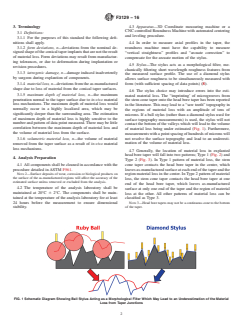
surface topography measurements) is used, the stylus will not
number and pattern of data point measured.There may be little
contact the bottom of the valleys which will lead to the volume
correlation between the maximum depth of material loss and
of material loss being under estimated (Fig. 1). Furthermore,
the volume of material loss from the surface.
measurementswithapointspacingofhundredsofmicronswill
not resolve the surface topography and lead to an underesti-
3.1.6 volumetric material loss, n—the volume of material
mation of the volume of material loss.
removed from the taper surface as a result of in-vivo material
loss mechanisms.
4.7 Generally, the location of material loss in explanted
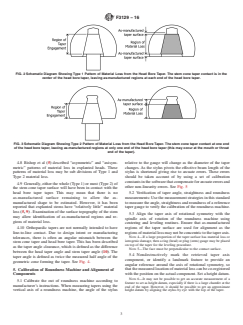
head bore taper will fall into two patterns; Type 1 (Fig. 2) and
4. Analysis Preparation
Type 2 (Fig. 3). In Type 1 pattern of material loss, the stem
4.1 All components shall be cleaned in accordance with the cone taper contacts the head bore taper in the center, which
procedure detailed in ASTM F561. leaves as-manufactured surface at each end of the taper and the
NOTE 2—Surface deposits of wear, corrosion or biological products on
region material loss in the center. In Type 2 pattern of material
the surface of the as-manufactured regions will affect the accuracy of the
loss, the stem cone taper contacts the head bore taper at one
estimated surface unless removed or excluded from the analysis.
end of the head bore taper, which leaves as-manufactured
4.2 The temperature of the analysis laboratory shall be
surface at only one end of the taper and the region of material
maintained at 20°C 6 2°C. The components shall be main-
loss at the other. All other patterns of material loss can be
tained at the temperature of the analysis laboratory for at least
classified as Type 3.
24 hours before the measurement to ensure dimensional
NOTE 3—Head bore tapers may not be a continuous cone to the bottom
stability. of the taper.
FIG. 1 Schematic Diagram Showing Ball Stylus Acting as a Morphological Filter Which May Lead to an Underestimation of the Material
Loss from Taper Junctions
F3129 − 16
FIG. 2 Schematic Diagram Showing Type 1 Pattern of Material Loss from the Head Bore Taper. The stem cone taper contact is in the
center of the head bore taper, leaving as-manufactured regions at each end of the head bore taper.
FIG. 3 Schematic Diagram Showing Type 2 Pattern of Material Loss from the Head Bore Taper. The stem cone taper contact at one end
of the head bore taper, leaving as-manufactured regions at only one end of the head bore taper (this may occur at the mouth or throat
end of the taper).
4.8 Bishop et al (5) described “asymmetric” and “axisym- relative to the gauge will change as the diameter of the taper
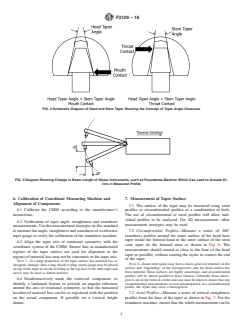
metric” patterns of material loss in explanted heads. These changes. As the stylus pivots the effective beam length of the
patterns of material loss may be sub divisions of Type 1 and stylus is shortened giving rise to arcuate errors. These errors
Type 2 material loss. should be taken account of by using a set of calibration
constantsinthesoftwarethatcompensateforarcuateerrorsand
4.9 Generally, either the whole (Type 1) or most (Type 2) of
other non-linearity errors. See Fig. 5
the stem cone taper surface will have been in contact with the
head bore taper taper. This may mean that there is no 5.2 Verification of taper angle, straightness and roundness
as-manufactured surface remaining to allow the as- measurements: Use the measurement strategies in this standard
manufactured shape to be estimated. However, it has been to measure the angle, straightness and roundness of a reference
reported that explanted stems have “relatively little” material taper gauge to verify the calibration of the roundness machine.
loss (5, 9) . Examination of the surface topography of the stem
5.3 Align the taper axis of rotational symmetry with the
may allow identification of as-manufactured regions and re-
spindle axis of rotation of the roundness machine using
gions of material loss.
centering and leveling routines. Ensure that as-manufactured
4.10 Orthopaedic tapers are not normally intended to have regions of the taper surface are used for alignment as the
line-to-line contact. Due to design intent or manufacturing regions of material loss may not be concentric to the taper axis.
NOTE 4—If a large proportion of the taper surface has material loss or
tolerances, there is often an angular mismatch between the
iatrogenic damage, then a ring (head) or plug (stem) gauge may be placed
stem cone taper and head bore taper. This has been described
on top of the taper for the leveling procedure.
as the taper angle clearance, which is defined as the difference
NOTE 5—The face must be perpendicular to the contact surface.
between the head taper angle and stem taper angle (10). The
5.4 Nondestructively mark the retrieved taper axis
taper angle is defined as twice the measured half angle of the
component, or identify a landmark feature to provide an
geometric cone forming the taper. See Fig. 4.
angular reference around the axis of rotational symmetry, so
5. Calibration of Roundness Machine and Alignment of that the measured location of material loss can be co-registered
with the position on the actual component. Set a height datum.
Components
NOTE 6—It may not be possible to get an accurate measurement of a
5.1 Calibrate the out of roundness machine according to
feature to set as height datum, especially if there is a large chamfer at the
manufacturer’s instructions. When measuring tapers using the
end of the taper. However, it should be possible to get an approximate
vertical axis of a roundness machine, the angle of the stylus height datum by aligning the stylus by eye with the top of the taper.
F3129 − 16
FIG. 4 Schematic Diagram of Head and Stem Taper Showing the Concept of Taper Angle Clearance
FIG. 5 Diagram Showing Change in Beam Length of Stylus Instruments, such as Roundness Machine Which Can Lead to Arcuate Er-
rors in Measured Profile
6. Calibration of Coordinate Measuring Machine and 7. Measurement of Taper Surface
Alignment of Components
7.1 The surface of the taper may be measured using axial
6.1 Calibrate the CMM according to the manufacturer’s profiles or circumferential profiles or a combination of both.
The use of circumferential or axial profiles will allow indi-
instructions.
vidual profiles to be analyzed. For 3D measurements, other
6.2 Verification of taper angle, straightness and roundness
measurement strategies may be used.
measurements: Use the measurement strategies in this standard
7.2 Circumferential Profiles—Measure a series of 360°
to measure the angle, straightness and roundness of a reference
taper gauge to verify the calibration of the roundness machine. roundness profiles around the inner surface of the head bore
taper inside the femoral head or the outer surface of the stem
6.3 Align the taper axis of rotational symmetry with the
cone taper on the femoral stem as shown in Fig. 6. The
coordinate system of the CMM. Ensure that as-manufactured
measurements should extend as close to the base of the head
regions of the taper surface are used for alignment as the
taper as possible, without causing the stylus to contact the end
regions of material loss may not be concentric to the taper axis.
of the taper.
NOTE 7—If a large proportion of the taper surface has material loss or
NOTE 8—Some stem tapers may have a micro-grooved structure on the
iatrogenic damage, then a ring (head) or plug (stem) gauge may be placed
surface and “imprinting” of the microgrooves onto the head surface has
on top of the taper to for the leveling or the top face of the stem taper and
been reported. These surfaces are highly anisotropic, and circumferential
sleeve may be used as datum surfaces.
profiles will be almost parallel to these features. Generally these micro-
6.4 Nondestructively mark the retrieved component, or
groves are in the form of a helix and care must be taken to ensure that any
identify a landmark feature to provide an angular reference circumferential measurements are not misinterpreted; in a circumferential
profile, the stylus may cross a microgroove.
around the axis of rotational symmetry, so that the measured
location of material loss can be co-registered with the position 7.3 Axial Profiles—Measure a series of vertical straightness
on the actual component. If possible set a vertical height profiles from the base of the taper as shown in Fig. 7. For the
datum.
...