

ASTM C708-16
(Specification)Standard Specification for Nuclear-Grade Beryllium Oxide Powder
General Information
- Abstract
SCOPE
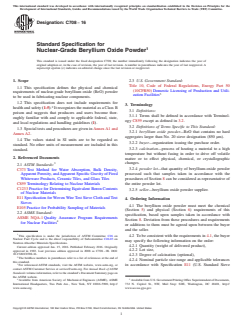
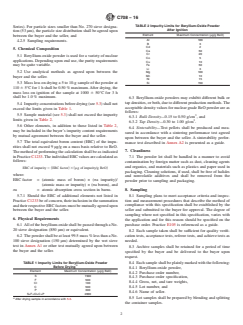
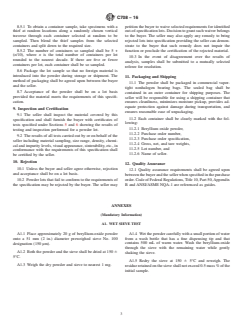
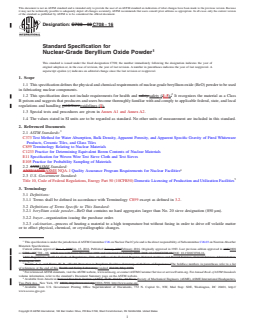
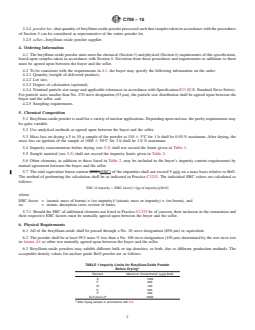
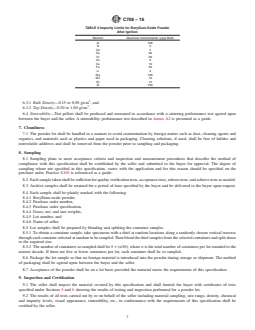
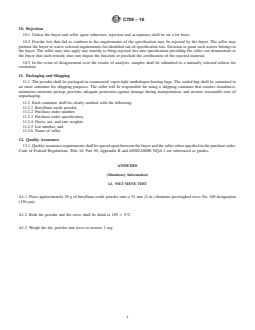
1.1 This specification defines the physical and chemical requirements of nuclear-grade beryllium oxide (BeO) powder to be used in fabricating nuclear components.
1.2 This specification does not include requirements for health and safety (1-5).2 It recognizes the material as a Class B poison and suggests that producers and users become thoroughly familiar with and comply to applicable federal, state, and local regulations and handling guidelines (1).
1.3 Special tests and procedures are given in Annex A1 and Annex A2.
1.4 The values stated in SI units are to be regarded as standard. No other units of measurement are included in this standard.
- Status
- Published
- Publication Date
- 14-Jan-2016
- Technical Committee
- C26 - Nuclear Fuel Cycle
- Drafting Committee
- C26.03 - Neutron Absorber Materials Specifications

Overview
ASTM C708-16: Standard Specification for Nuclear-Grade Beryllium Oxide Powder sets the requirements for the physical and chemical properties of nuclear-grade beryllium oxide (BeO) powder used in nuclear applications. Developed by ASTM International, this standard ensures that BeO powder meets stringent criteria for use in fabricating nuclear components, supporting quality and safety in nuclear fuel cycle operations. The specification covers methods for sampling, impurity limits, particle size requirements, and packaging, but it does not address health and safety provisions for this material, which is classified as a Class B poison.
Key Topics
Physical and Chemical Properties:
The standard defines the required purity levels for BeO powder, with detailed impurity limits for elements such as aluminum, boron, cadmium, and others critical for nuclear use. Impurity concentrations must not exceed specified thresholds, and total equivalent boron content (EBC) is capped to maintain suitability for neutron-sensitive nuclear applications.Particle Size and Density:
BeO powder must pass through a No. 20 sieve (850 µm) and primarily be less than 150 µm, validated by specific wet sieve tests. Target ranges for bulk and tap densities ensure the material can be processed and sintered effectively, producing components with reliable performance characteristics.Sampling and Inspection:
The standard provides detailed protocols for sampling BeO powder lots to ensure representative analysis and quality control, including archival requirements and labeling for traceability. Acceptance is determined on a lot basis, and material must conform to all specified criteria to be certified.Sinterability Testing:
The sinterability of the BeO powder is verified using performance tests, requiring that test pellets reach a minimum of 90% of the theoretical BeO density. Consistent testing conditions and procedures must be agreed upon between buyers and sellers.Packaging and Marking:
Strict guidelines ensure BeO powder is packaged in vapor-tight, non-halogen-bearing bags within protective outer containers, minimizing contamination and moisture. Marking requirements facilitate clear identification through all stages of supply.
Applications
Nuclear Fuel Components:
Nuclear-grade beryllium oxide powder is vital in manufacturing components for nuclear reactors, such as neutron reflectors, moderators, and thermal management parts due to BeO's high thermal conductivity and low neutron absorption.Quality Assurance in the Nuclear Industry:
Adhering to ASTM C708-16 supports robust quality assurance practices, ensuring traceability, consistency, and compliance with international standards for critical nuclear operations.Research and Development:
Laboratories and R&D facilities employ ASTM C708-16 to guarantee that materials used in the development of new nuclear technologies meet rigorous industry requirements.
Related Standards
- ASTM C373: Test Method for Water Absorption, Bulk Density, Apparent Porosity, and Apparent Specific Gravity of Fired Whiteware Products, Ceramic Tiles, and Glass Tiles.
- ASTM C859: Terminology Relating to Nuclear Materials.
- ASTM C1233: Practice for Determining Equivalent Boron Contents of Nuclear Materials.
- ASTM E11: Specification for Woven Wire Test Sieve Cloth and Test Sieves.
- ASTM E105: Practice for Probability Sampling of Materials.
- ASME NQA-1: Quality Assurance Program Requirements for Nuclear Facilities.
- 10 CFR 50: U.S. NRC regulations for domestic licensing of production and utilization nuclear facilities.
By adhering to ASTM C708-16, producers and users can ensure that beryllium oxide powder for nuclear applications meets high standards for purity, safety, and performance-supporting reliability in the global nuclear supply chain. For more information, refer to the ASTM International website or consult with industry professionals regarding compliance and best practices.
Relations
- Effective Date
- 15-Jan-2016
- Effective Date
- 01-Jan-2024
- Effective Date
- 01-Sep-2017
- Effective Date
- 01-Aug-2016
- Effective Date
- 01-Aug-2016
- Effective Date
- 01-Dec-2014
- Effective Date
- 15-Jun-2014
- Effective Date
- 01-Mar-2014
- Effective Date
- 15-Jan-2014
- Effective Date
- 01-Oct-2013
- Effective Date
- 01-Jun-2013
- Effective Date
- 01-May-2013
- Effective Date
- 01-Nov-2010
- Effective Date
- 01-Oct-2010
- Effective Date
- 01-Aug-2010
Get Certified
Connect with accredited certification bodies for this standard

DNV
DNV is an independent assurance and risk management provider.

Lloyd's Register
Lloyd's Register is a global professional services organisation specialising in engineering and technology.
DNV Energy Systems
Energy and renewable energy certification.
Sponsored listings
Frequently Asked Questions
ASTM C708-16 is a technical specification published by ASTM International. Its full title is "Standard Specification for Nuclear-Grade Beryllium Oxide Powder". This standard covers: SCOPE 1.1 This specification defines the physical and chemical requirements of nuclear-grade beryllium oxide (BeO) powder to be used in fabricating nuclear components. 1.2 This specification does not include requirements for health and safety (1-5).2 It recognizes the material as a Class B poison and suggests that producers and users become thoroughly familiar with and comply to applicable federal, state, and local regulations and handling guidelines (1). 1.3 Special tests and procedures are given in Annex A1 and Annex A2. 1.4 The values stated in SI units are to be regarded as standard. No other units of measurement are included in this standard.
SCOPE 1.1 This specification defines the physical and chemical requirements of nuclear-grade beryllium oxide (BeO) powder to be used in fabricating nuclear components. 1.2 This specification does not include requirements for health and safety (1-5).2 It recognizes the material as a Class B poison and suggests that producers and users become thoroughly familiar with and comply to applicable federal, state, and local regulations and handling guidelines (1). 1.3 Special tests and procedures are given in Annex A1 and Annex A2. 1.4 The values stated in SI units are to be regarded as standard. No other units of measurement are included in this standard.
ASTM C708-16 is classified under the following ICS (International Classification for Standards) categories: 27.120.30 - Fissile materials and nuclear fuel technology. The ICS classification helps identify the subject area and facilitates finding related standards.
ASTM C708-16 has the following relationships with other standards: It is inter standard links to ASTM C708-08, ASTM C859-24, ASTM C373-17, ASTM C373-16e1, ASTM C373-16, ASTM C373-14a, ASTM C859-14a, ASTM C373-14, ASTM C859-14, ASTM E11-13, ASTM C859-13a, ASTM C859-13, ASTM C859-10b, ASTM E105-10, ASTM C859-10a. Understanding these relationships helps ensure you are using the most current and applicable version of the standard.
ASTM C708-16 is available in PDF format for immediate download after purchase. The document can be added to your cart and obtained through the secure checkout process. Digital delivery ensures instant access to the complete standard document.
Standards Content (Sample)
This international standard was developed in accordance with internationally recognized principles on standardization established in the Decision on Principles for the
Development of International Standards, Guides and Recommendations issued by the World Trade Organization Technical Barriers to Trade (TBT) Committee.
Designation:C708 −16
Standard Specification for
Nuclear-Grade Beryllium Oxide Powder
This standard is issued under the fixed designation C708; the number immediately following the designation indicates the year of
original adoption or, in the case of revision, the year of last revision.Anumber in parentheses indicates the year of last reapproval.A
superscript epsilon (´) indicates an editorial change since the last revision or reapproval.
1. Scope 2.3 U.S. Government Standard:
Title 10, Code of Federal Regulations, Energy Part 50
1.1 This specification defines the physical and chemical
(10CFR50)Domestic Licensing of Production and Utili-
requirements of nuclear-grade beryllium oxide (BeO) powder
zation Facilities
to be used in fabricating nuclear components.
1.2 This specification does not include requirements for
3. Terminology
healthandsafety (1-5). ItrecognizesthematerialasaClassB
3.1 Definitions:
poison and suggests that producers and users become thor-
3.1.1 Terms shall be defined in accordance with Terminol-
oughly familiar with and comply to applicable federal, state,
ogy C859 except as defined in 3.2.
and local regulations and handling guidelines (1).
3.2 Definitions of Terms Specific to This Standard:
1.3 Special tests and procedures are given in AnnexA1 and
3.2.1 beryllium oxide powder—BeO that contains no hard
Annex A2.
aggregates larger than No. 20 sieve designation (850 µm).
1.4 The values stated in SI units are to be regarded as
3.2.2 buyer—organization issuing the purchase order.
standard. No other units of measurement are included in this
3.2.3 calcination—process of heating a material to a high
standard.
temperature but without fusing in order to drive off volatile
2. Referenced Documents matter or to effect physical, chemical, or crystallographic
changes.
2.1 ASTM Standards:
3.2.4 powder lot—that quantity of beryllium-oxide powder
C373Test Method for Water Absorption, Bulk Density,
ApparentPorosity,andApparentSpecificGravityofFired processed such that samples taken in accordance with the
procedures of Section 8 can be considered as representative of
Whiteware Products, Ceramic Tiles, and Glass Tiles
C859Terminology Relating to Nuclear Materials the entire powder lot.
C1233Practice for Determining Equivalent Boron Contents
3.2.5 seller—beryllium oxide powder supplier.
of Nuclear Materials
E11Specification forWovenWireTest Sieve Cloth andTest
4. Ordering Information
Sieves
4.1 The beryllium oxide powder must meet the chemical
E105Practice for Probability Sampling of Materials
(Section 5) and physical (Section 6) requirements of this
2.2 ASME Standard:
specification, based upon samples taken in accordance with
ASME NQA-1Quality Assurance Program Requirements
Section 8. Deviation from these procedures and requirements
for Nuclear Facilities
or additions to them must be agreed upon between the buyer
and the seller.
This specification is under the jurisdiction of ASTM Committee C26 on
4.2 To be consistent with the requirements in 4.1, the buyer
Nuclear Fuel Cycle and is the direct responsibility of Subcommittee C26.03 on
may specify the following information on the order:
Neutron Absorber Materials Specifications.
4.2.1 Quantity (weight of delivered product),
Current edition approved Jan. 15, 2016. Published February 2016. Originally
approved in 1983. Last previous edition approved in 2008 as C708–08. DOI: 4.2.2 Lot size,
10.1520/C0708-16.
4.2.3 Degree of calcination (optional),
The boldface numbers in parentheses refer to a list of references at the end of
4.2.4 Nominal particle size range and applicable tolerances
this standard.
3 in accordance with Specification E11 (U.S. Standard Sieve
For referenced ASTM standards, visit the ASTM website, www.astm.org, or
contact ASTM Customer Service at service@astm.org. For Annual Book of ASTM
Standards volume information, refer to the standard’s Document Summary page on
the ASTM website.
4 5
Available from American Society of Mechanical Engineers (ASME), ASME AvailablefromU.S.GovernmentPrintingOfficeSuperintendentofDocuments,
International Headquarters, Two Park Ave., New York, NY 10016-5990, http:// 732 N. Capitol St., NW, Mail Stop: SDE, Washington, DC 20401, http://
www.asme.org. www.access.gpo.gov.
Copyright © ASTM International, 100 Barr Harbor Drive, PO Box C700, West Conshohocken, PA 19428-2959. United States
C708−16
TABLE 2 Impurity Limits for Beryllium-Oxide Powder
Series). For particle sizes smaller than No. 270 sieve designa-
After Ignition
tion(53µm),theparticlesizedistributionshallbeagreedupon
Element Maximum Concentration (µg/g BeO)
between the buyer and the seller, and
Al 100
4.2.5 Sampling requirements.
B3
Cd 2
5. Chemical Composition
Ca 50
Cr 20
5.1 Beryllium-oxide powder is used for a variety of nuclear
Co 5
applications. Depending upon end use, the purity requirements
Cu 10
may be quite variable. Fe 50
Li 3
5.2 Use analytical methods as agreed upon between the
Mg 100
Mn 10
buyer and the seller.
Ni 15
5.3 Masslossondryinga5to10-gsampleofthepowderat Si 150
110 65°Cfor1hshallbe0.50%maximum.Afterdrying,the
mass loss on ignition of the sample at 1000 6 50°C for 3 h
shall be 1.0% maximum.
6.3 Beryllium-oxide powders may exhibit different bulk or
tapdensities,orboth,duetodifferentproductionmethods.The
5.4 Impurityconcentrationsbeforedrying(see5.3)shallnot
acceptabledensityvaluesfornucleargradeBeOpowderareas
exceed the limits given in Table 1.
follows:
5.5 Sample material (see 5.3) shall not exceed the impurity
6.3.1 Bulk Density—0.15 to 0.50 g/cm , and
limits given in Table 2.
6.3.2 Tap Density—0.30 to 1.00 g/cm .
5.6 Other elements, in addition to those listed in Table 2,
6.4 Sinterability—Test pellets shall be produced and mea-
may be included in the buyer’s impurity content requirements
sured in accordance with a sintering performance test agreed
by mutual agreement between the buyer and the seller.
upon between the buyer and the seller. A sinterability perfor-
5.7 The total equivalent boron content (EBC) of the impu-
mance test described in Annex A2 is presented as a guide.
rities shall not exceed 9 µg/g on a mass basis relative to BeO.
7. Cleanliness
The method of performing the calculation shall be as indicated
inPracticeC1233.TheindividualEBCvaluesarecalculatedas
7.1 The powder lot shall be handled in a manner to avoid
follows:
contamination by foreign matter such as dust, cleaning agents
and organics, and materials such as plastics and paper used in
EBCofimpurity 5 EBCfactor 3 µg ofimpurity/g BeO
~ ! ~ !
packaging. Cleaning solutions, if used, shall be free of halides
where:
and nonvolatile additives and shall be removed from the
EBC factor = (atomic mass of boron) × (σa impurity)/
powder prior to sampling and packaging.
(atomic mass or impurity) × (σa boron), and
σa = atomic absorption cross section in barns. 8. Sampling
8.1 Sampling plans to meet acceptance criteria and inspec-
5.7.1 Should the EBC of additional elements not listed in
PracticeC1233beofconcern,theirinclusioninthesummation tion and measurement procedures that describe the method of
andtheirrespectiveEBCfactorsmustbemutuallyagreedupon compliance with this specification shall be established by the
between the buyer and the seller. seller and submitted to the buyer for approval. The degree of
sampling where not specified in this specification, varies with
6. Physical Requirements
the application and for this reason should be specified on the
purchase order. Practice E105 is referenced as a guide.
6.1 Alloftheberyllium-oxideshallbepassedthroughaNo.
20 sieve designation (850 µm) or equivalent.
8.2 Each sample taken shall be sufficient for quality verifi-
cation tests, acceptance tests, referee tests, and achieve tests as
6.2 Thepowdershallbeatleast99.5mass%lessthanaNo.
needed.
100 sieve designation (150 µm) determined by the wet sieve
test in Annex A1 or other test mutually agreed upon between
8.3 Archive samples shall be retained for a period of time
the buyer and the seller.
specified by the buyer and be delivered to the buyer upon
request.
TABLE 1 Impurity Limits for Beryllium-Oxide Powder 8.4 Eachsampleshallbeplainlym
...
This document is not an ASTM standard and is intended only to provide the user of an ASTM standard an indication of what changes have been made to the previous version. Because
it may not be technically possible to adequately depict all changes accurately, ASTM recommends that users consult prior editions as appropriate. In all cases only the current version
of the standard as published by ASTM is to be considered the official document.
Designation: C708 − 08 C708 − 16
Standard Specification for
Nuclear-Grade Beryllium Oxide Powder
This standard is issued under the fixed designation C708; the number immediately following the designation indicates the year of
original adoption or, in the case of revision, the year of last revision. A number in parentheses indicates the year of last reapproval. A
superscript epsilon (´) indicates an editorial change since the last revision or reapproval.
1. Scope
1.1 This specification defines the physical and chemical requirements of nuclear-grade beryllium oxide (BeO) powder to be used
in fabricating nuclear components.
, ,2
1.2 This specification does not include requirements for health and safety.safety ( 1-5). It recognizes the material as a Class
B poison and suggests that producers and users become thoroughly familiar with and comply to applicable federal, state, and local
regulations and handling guidelines.guidelines (1).
1.3 Special tests and procedures are given in Annex A1 and Annex A2.
1.4 The values stated in SI units are to be regarded as standard. No other units of measurement are included in this standard.
2. Referenced Documents
2.1 ASTM Standards:
C373 Test Method for Water Absorption, Bulk Density, Apparent Porosity, and Apparent Specific Gravity of Fired Whiteware
Products, Ceramic Tiles, and Glass Tiles
C859 Terminology Relating to Nuclear Materials
C1233 Practice for Determining Equivalent Boron Contents of Nuclear Materials
E11 Specification for Woven Wire Test Sieve Cloth and Test Sieves
E105 Practice for Probability Sampling of Materials
2.2 ANSIASME Standard:
ANSI/ASMEASME NQA-1 Quality Assurance Program Requirements for Nuclear Facilities
2.3 U.S. Government Standard:
Title 10, Code of Federal Regulations, Energy Part 50 (10CFR50) Domestic Licensing of Production and Utilization Facilities
3. Terminology
3.1 Definitions:
3.1.1 Terms shall be defined in accordance with Terminology C859 except as defined in 3.2.
3.2 Definitions of Terms Specific to This Standard:
3.2.1 beryllium oxide powder—BeO that contains no hard aggregates larger than No. 20 sieve designation (850 μm).
3.2.2 buyer—organization issuing the purchase order.
3.2.3 calcination—process of heating a material to a high temperature but without fusing in order to drive off volatile matter
or to effect physical, chemical, or crystallographic changes.
This specification is under the jurisdiction of ASTM Committee C26 on Nuclear Fuel Cycle and is the direct responsibility of Subcommittee C26.03 on Neutron Absorber
Materials Specifications.
Current edition approved Dec. 1, 2008Jan. 15, 2016. Published January 2009February 2016. Originally approved in 1983. Last previous edition approved in 19872008
as C708 – 87C708 – 08. which was withdrawn November 1991 and reinstated in January 2009. DOI: 10.1520/C0708-08.DOI: 10.1520/C0708-16.
ICC Regulations, Tariff 12, Code of Regulations, Title 49, Office of the Federal Register, National Archives and Record Services, General Services Administration,
Washington, DC.
Breslin, A. J., arid Harris, W. B., “Health Protection in Beryllium Facilities: Summary of 10 Years of Experience,”The boldface numbers in parentheses refer to a list
of references at the end of this Health and Safety Laboratory,standard. Vol 26, May 1959.
For referenced ASTM standards, visit the ASTM website, www.astm.org, or contact ASTM Customer Service at service@astm.org. For Annual Book of ASTM Standards
volume information, refer to the standard’s Document Summary page on the ASTM website.
Available from American National Standards Institute (ANSI), 25 W. 43rd St., 4th Floor, Society of Mechanical Engineers (ASME), ASME International Headquarters,
Two Park Ave., New York, NY 10036, http://www.ansi.org.10016-5990, http://www.asme.org.
Available from U.S. Government Printing Office Superintendent of Documents, 732 N. Capitol St., NW, Mail Stop: SDE, Washington, DC 20401, http://
www.access.gpo.gov.
Copyright © ASTM International, 100 Barr Harbor Drive, PO Box C700, West Conshohocken, PA 19428-2959. United States
C708 − 16
3.2.4 powder lot—that quantity of beryllium-oxide powder processed such that samples taken in accordance with the procedures
of Section 8 can be considered as representative of the entire powder lot.
3.2.5 seller—beryllium oxide powder supplier.
4. Ordering Information
4.1 The beryllium oxide powder must meet the chemical (Section 5) and physical (Section 6) requirements of this specification,
based upon samples taken in accordance with Section 8. Deviation from these procedures and requirements or additions to them
must be agreed upon between the buyer and the seller.
4.2 To be consistent with the requirements in 4.1, the buyer may specify the following information on the order:
4.2.1 Quantity (weight of delivered product),
4.2.2 Lot size,
4.2.3 Degree of calcination (optional),
4.2.4 Nominal particle size range and applicable tolerances in accordance with Specification E11 (U.S. Standard Sieve Series).
For particle sizes smaller than No. 270 sieve designation (53 μm), the particle size distribution shall be agreed upon between the
buyer and the seller, and
4.2.5 Sampling requirements.
5. Chemical Composition
5.1 Beryllium-oxide powder is used for a variety of nuclear applications. Depending upon end use, the purity requirements may
be quite variable.
5.2 Use analytical methods as agreed upon between the buyer and the seller.
5.3 Mass loss on drying a 5 to 10-g sample of the powder at 110 6 5°C for 1 h shall be 0.50 % maximum. After drying, the
mass loss on ignition of the sample at 1000 6 50°C for 3 h shall be 1.0 % maximum.
5.4 Impurity concentrations before drying (see 5.3) shall not exceed the limits given in Table 1.
5.5 Sample material (see 5.3) shall not exceed the impurity limits given in Table 2.
5.6 Other elements, in addition to those listed in Table 2, may be included in the buyer’s impurity content requirements by
mutual agreement between the buyer and the seller.
5.7 The total equivalent boron content (EEC)(EBC) of the impurities shall not exceed 9 μg/g on a mass basis relative to BeO.
The method of performing the calculation shall be as indicated in Practice C1233. The individual EBC values are calculated as
follows:
EBC of impurity 5 ~EBC factor!3~µg of impurity/g BeO!
where:
EBC factor = (atomic mass of boron) × (σa impurity)/ (atomic mass or impurity) × (σa boron), and
σa = atomic absorption cross section in barns.
5.7.1 Should the EBC of additional elements not listed in Practice C1233 be of concern, their inclusion in the summation and
their respective EBC factors must be mutually agreed upon between the buyer and the seller.
6. Physical Requirements
6.1 All of the beryllium-oxide shall be passed through a No. 20 sieve designation (850 μm) or equivalent.
6.2 The powder shall be at least 99.5 mass % less than a No. 100 sieve designation (150 μm) determined by the wet sieve test
in Annex A1 or other test mutually agreed upon between the buyer and the seller.
6.3 Beryllium-oxide powders may exhibit different bulk or tap densities, or both, due to different production methods. The
acceptable density values for nuclear grade BeO powder are as follows:
TABLE 1 Impurity Limits for Beryllium-Oxide Powder
A
Before Drying
Element Maximum Concentration (μg/g BeO)
S 1500
F 500
Cl 100
C 500
P 300
S+F+Cl+C+P 2000
A
After drying sample in accordance with 5.3.
C708 − 16
TABLE 2 Impurity Limits for Beryllium-Oxide Powder
After Ignition
Element Maximum Concentration (μg/g BeO)
Al 100
B 3
Cd 2
Ca 50
Cr 20
Co 5
Cu 10
Fe 50
Li 3
Mg 100
Mn 10
Ni 15
Si 150
6.3.1 Bulk Density—0.15 to 0.50 g/cm , and
6.3.2 Tap Density—0.30 to 1.00 g/cm .
6.4 Sinterability—Test pellets shall be produced and measured in accordance with a sintering performance test agreed upon
between the buyer and the seller. A sinterability performance test described in Annex A2 is presented as a guide.
7. Cleanliness
7.1 The powder lot shall be handled in a manner to avoid contamination by foreign matter such as dust, cleaning agents and
organics, and materials such as plastics and paper used in packaging. Cleaning solutions, if used, shall be free of halides and
nonvolatile additives and shall be removed from the powder prior to sampling and packaging.
8. Sampling
8.1 Sampling plans to meet acceptance criteria and inspection and measurement procedures that describe the method of
compliance with this specification shall be established by the seller and submitted to the buyer for approval. The degree of
sampling where not specified i
...