


ASTM B380-97(2007)
(Test Method)Standard Test Method of Corrosion Testing of Decorative Electrodeposited Coatings by the Corrodkote Procedure
Standard Test Method of Corrosion Testing of Decorative Electrodeposited Coatings by the Corrodkote Procedure
SIGNIFICANCE AND USE
Nickel/chromium and copper/nickel/chromium electrodeposited coatings are widely used for decorative and protective applications. The Corrodkote test provides a method of controlling the quality of electroplated articles and is suitable for manufacturing control, as well as research and development.
SCOPE
1.1 This test method describes the Corrodkote method of evaluating the corrosion performance of copper/nickel/chromium and nickel/chromium coatings electrodeposited on steel, zinc alloys, aluminum alloys, plastics and other substrates. Note 1 - The following ASTM standards are not requirements. They are reference for information only: Practice B 537, Specification B 456, Test Method B 602, and Specification B 604.
This standard does not purport to address all of the safety concerns, if any, associated with its use. It is the responsibility of the user of this standard to establish appropriate safety and health practices and determine the applicability of regulatory limitations prior to use.
General Information
Relations
Buy Standard

Standards Content (Sample)
NOTICE: This standard has either been superseded and replaced by a new version or withdrawn.
Contact ASTM International (www.astm.org) for the latest information
Designation:B380 –97 (Reapproved 2007)
Standard Test Method of
Corrosion Testing of Decorative Electrodeposited Coatings
by the Corrodkote Procedure
This standard is issued under the fixed designation B 380; the number immediately following the designation indicates the year of
original adoption or, in the case of revision, the year of last revision. A number in parentheses indicates the year of last reapproval. A
superscript epsilon (e) indicates an editorial change since the last revision or reapproval.
1. Scope B 604 Specification for Decorative Electroplated Coatings
2 of Copper Plus Nickel Plus Chromium on Plastics
1.1 This test method describes the Corrodkote method of
D 1193 Specification for Reagent Water
evaluating the corrosion performance of copper/nickel/
chromium and nickel/chromium coatings electrodeposited on
3. Summary of Test Method
steel, zinc alloys, aluminum alloys, plastics and other sub-
3.1 The test is conducted by applying a slurry containing
strates.
corrosivesaltstotestspecimens,allowingtheslurrytodry,and
NOTE 1—The following ASTM standards are not requirements. They
exposingthespecimenscoatedwiththeslurrytoahighrelative
are reference for information only: Practice B 537, Specification B 456,
humidity for a specified period of time.
Test Method B 602, and Specification B 604.
4. Significance and Use
1.2 This standard does not purport to address all of the
safety concerns, if any, associated with its use. It is the
4.1 Nickel/chromium and copper/nickel/chromium elec-
responsibility of the user of this standard to establish appro-
trodeposited coatings are widely used for decorative and
priate safety and health practices and determine the applica-
protective applications.The Corrodkote test provides a method
bility of regulatory limitations prior to use.
of controlling the quality of electroplated articles and is
suitable for manufacturing control, as well as research and
2. Referenced Documents
development.
2.1 ASTM Standards:
5. Apparatus
B117 Practice for Operating Salt Spray (Fog) Apparatus
B 456 Specification for Electrodeposited Coatings of Cop-
5.1 The apparatus shall consist of a humidity chamber,
per Plus Nickel Plus Chromium and Nickel Plus Chro-
specimen supports, provision for heating the chamber, and
mium
provisions for air circulation in the chamber.
B 537 Practice for Rating of Electroplated Panels Subjected
5.2 Drops of moisture that might accumulate on the ceiling
to Atmospheric Exposure
or cover of the chamber of specimen supports shall not be
B 602 Test Method for Attribute Sampling of Metallic and
permitted to fall on the specimens being tested.
Inorganic Coatings
NOTE 2—Suitable apparatus may be constructed from salt-spray equip-
ment by eliminating fog-spray nozzles, substituting water for the salt
solution in the reservoir, adding a manifold for bubbling air through the
This test method is under the jurisdiction ofASTM Committee B08 on Metallic
water in the reservoir, and adding a fan for circulating the air in the
and Inorganic Coatings and is the direct responsibility of Subcommittee B08.10 on
chamber with the fan discharge directed across the surface of the water in
Test Methods.
the reservoir.
The original work in developing the Corrodkote procedure was initiated by the
American Electroplaters’ Society Research Committee, Project No. 15.
5.3 Materials of construction shall not affect the corrosive-
Current edition approved Oct. 1, 2007. Published October 2007. Originally
ness of the test.
approved in 1961. Last previous edition approved in 2002 as B 380 – 85 (2002).
Bigge, D. M., “Experience with the Use of the Corrodkote Test,” Proceedings,
6. Procedure
Am. Electroplaters’ Soc., Vol. 46, 1959, p. 149.
For referenced ASTM standards, visit the ASTM website, www.astm.org, or
6.1 Corrodkote Slurry—Prepare the Corrodkote slurry in a
contact ASTM Customer Service at service@astm.org. For Annual Book of ASTM
glass beaker by dissolving 0.035 g of reagent grade cupric
Standards volume information, refer to the standard’s Document Summary page on
the ASTM website. nitrate (Cu(NO ) ·3H O), 0.165 g of ACS reagent grade ferric
3 2 2
Copyright © ASTM International, 100 Barr Harbor Drive, PO Box C700, West Conshohocken, PA 19428-2959, United States.
B380 –97 (2007)
chamber necessary to maintain these conditions must be determined for
chloride (FeCl ·6H O), and 1.0 g of ACS reagent grade
3 2
each chamber. An Abbeon certified hygrometer Model No. 167, or its
ammonium chloride (NH Cl) in 50 mLof water conforming to
equivalent is a suitable instrument for measuring the relative humidity of
Specification D 1193, Type IV. Stir 30 g of water-washed,
the exposure zone of the humidity chamber.
ceramic-grade kaolin into the solution. Mix the slurry thor-
6.7 Test Cycle—Exposure in the humidity chamber shall be
oughly and allow it to stand for about 2 min so that the kaolin
continuous for periods up to 20 h.Asingle test period up to 20
will become saturated. Mix the slurry thoroughly just before
h shall be considered as one cycle. Continuous operation
using.
implies that the humidity chamber be closed and operated
6.1.1 An alternative method of preparing the Corrodkote
continuously except for the short interruptions necessary to
slurry is as follows. Weigh out 2.5 g of cupric nitrate
place or remove test specimens. Operations shall be so sched-
(Cu(NO ) ·3H O), and dissolve and dilute with distilled water
3 2 2
uled that these interruptions are held to a minimum. When
in a volumetric flask to exactly 500 mL. Weigh out 2.50 g of
more than one test cycle of 20 h or less is specified, the test
ferric chloride (FeCl ·6H O), and dissolve and dilute with
3 2
specimen shall be treated as outlined in 6.9 after each test
distilled water in a second volumetric flask to exactly 500 mL.
cycle. Fresh slurry shall be applied for each succeeding cycle.
(The ferric chloride solution shall be kept in a dark place and
After the last test cycle, the test specimen shall be treated as
stoppered with a rubber or glass stopper when not in use.) (The
outlined in 6.9.
ferric chloride solution shall not be more than 2 weeks old,
6.8 Period of Test—The period of each test cycle as well as
since older solutions become unstable.) Weigh out 50.0 g of
the number of test cycle
...
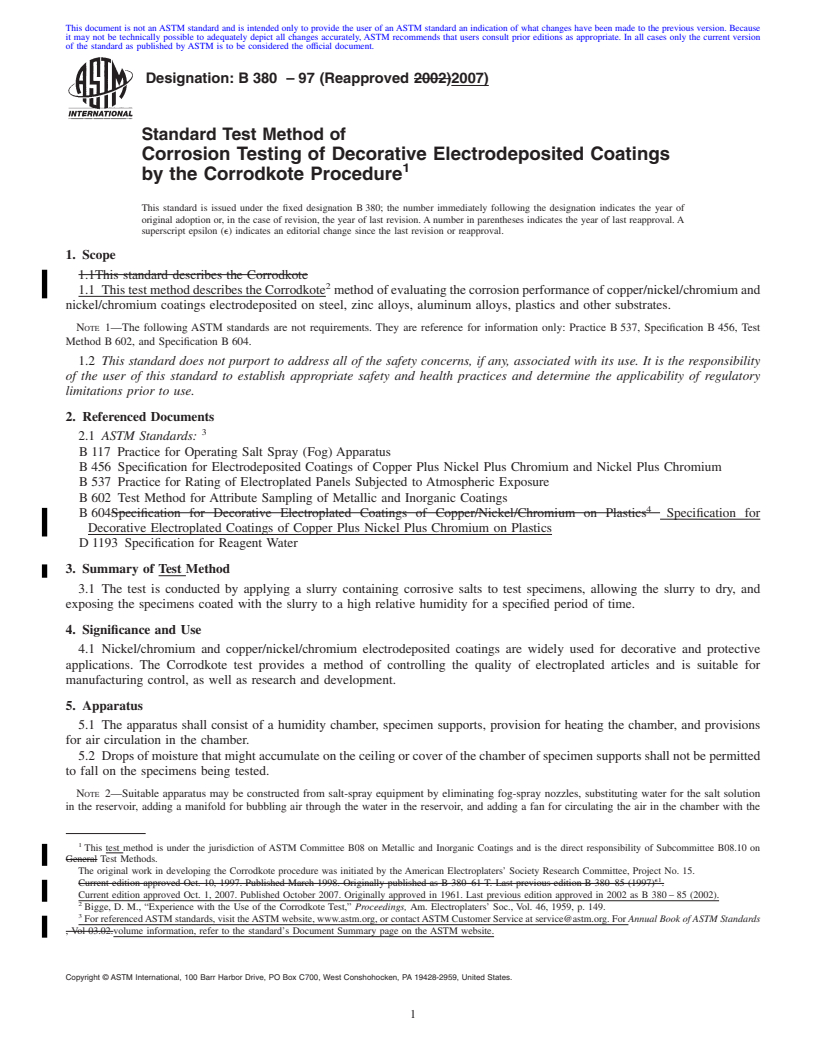
This document is not an ASTM standard and is intended only to provide the user of an ASTM standard an indication of what changes have been made to the previous version. Because
it may not be technically possible to adequately depict all changes accurately, ASTM recommends that users consult prior editions as appropriate. In all cases only the current version
of the standard as published by ASTM is to be considered the official document.
Designation: B 380 – 97 (Reapproved 2002)2007)
Standard Test Method of
Corrosion Testing of Decorative Electrodeposited Coatings
by the Corrodkote Procedure
This standard is issued under the fixed designation B 380; the number immediately following the designation indicates the year of
original adoption or, in the case of revision, the year of last revision. A number in parentheses indicates the year of last reapproval. A
superscript epsilon (e) indicates an editorial change since the last revision or reapproval.
1. Scope
1.1This standard describes the Corrodkote
1.1 This test method describes the Corrodkote method of evaluatingthe corrosion performance of copper/nickel/chromiumand
nickel/chromium coatings electrodeposited on steel, zinc alloys, aluminum alloys, plastics and other substrates.
NOTE 1—The following ASTM standards are not requirements. They are reference for information only: Practice B 537, Specification B 456, Test
Method B 602, and Specification B 604.
1.2 This standard does not purport to address all of the safety concerns, if any, associated with its use. It is the responsibility
of the user of this standard to establish appropriate safety and health practices and determine the applicability of regulatory
limitations prior to use.
2. Referenced Documents
2.1 ASTM Standards:
B 117 Practice for Operating Salt Spray (Fog) Apparatus
B 456 Specification for Electrodeposited Coatings of Copper Plus Nickel Plus Chromium and Nickel Plus Chromium
B 537 Practice for Rating of Electroplated Panels Subjected to Atmospheric Exposure
B 602 Test Method for Attribute Sampling of Metallic and Inorganic Coatings
B 604Specification for Decorative Electroplated Coatings of Copper/Nickel/Chromium on Plastics Specification for
Decorative Electroplated Coatings of Copper Plus Nickel Plus Chromium on Plastics
D 1193 Specification for Reagent Water
3. Summary of Test Method
3.1 The test is conducted by applying a slurry containing corrosive salts to test specimens, allowing the slurry to dry, and
exposing the specimens coated with the slurry to a high relative humidity for a specified period of time.
4. Significance and Use
4.1 Nickel/chromium and copper/nickel/chromium electrodeposited coatings are widely used for decorative and protective
applications. The Corrodkote test provides a method of controlling the quality of electroplated articles and is suitable for
manufacturing control, as well as research and development.
5. Apparatus
5.1 The apparatus shall consist of a humidity chamber, specimen supports, provision for heating the chamber, and provisions
for air circulation in the chamber.
5.2 Drops of moisture that might accumulate on the ceiling or cover of the chamber of specimen supports shall not be permitted
to fall on the specimens being tested.
NOTE 2—Suitable apparatus may be constructed from salt-spray equipment by eliminating fog-spray nozzles, substituting water for the salt solution
in the reservoir, adding a manifold for bubbling air through the water in the reservoir, and adding a fan for circulating the air in the chamber with the
This test method is under the jurisdiction of ASTM Committee B08 on Metallic and Inorganic Coatings and is the direct responsibility of Subcommittee B08.10 on
General Test Methods.
The original work in developing the Corrodkote procedure was initiated by the American Electroplaters’ Society Research Committee, Project No. 15.
e1
Current edition approved Oct. 10, 1997. Published March 1998. Originally published as B 380–61 T. Last previous edition B 380–85 (1997) .
Current edition approved Oct. 1, 2007. Published October 2007. Originally approved in 1961. Last previous edition approved in 2002 as B 380 – 85 (2002).
Bigge, D. M., “Experience with the Use of the Corrodkote Test,” Proceedings, Am. Electroplaters’ Soc., Vol. 46, 1959, p. 149.
For referencedASTM standards, visit theASTM website, www.astm.org, or contactASTM Customer Service at service@astm.org. For Annual Book ofASTM Standards
, Vol 03.02.volume information, refer to the standard’s Document Summary page on the ASTM website.
Copyright © ASTM International, 100 Barr Harbor Drive, PO Box C700, West Conshohocken, PA 19428-2959, United States.
B 380 – 97 (2002)(2007)
fan discharge directed across the surface of the water in the reservoir.
5.3 Materials of construction shall not affect the corrosiveness of the test.
6. Procedure
6.1 Corrodkote Slurry—Prepare the Corrodkote slurry in a glass beaker by dissolving 0.035 g of reagent grade cupric nitrate
(Cu(NO ) ·3H O), 0.165 g of ACS reagent grade ferric chloride (FeCl ·6H O), and 1.0 g of ACS reagent grade ammonium
3 2 2 3 2
chloride (NH Cl) in 50 mLof water conforming to Specification D 1193,Type IV. Stir 30 g of water-washed, ceramic-grade kaolin
into the solution. Mix the slurry thoroughly and allow it to stand for about 2 min so that the kaolin will become saturated. Mix
the slurry thoroughly just before using.
6.1.1 An alternative method of preparing the Corrodkote slurry is as follows. Weigh out 2.5 g of cupric nitrate (Cu(NO )
2·3H O), and dissolve and dilute with distilled water in a volumetric flask to exactly 500 mL. Weigh out 2.50 g of ferric chloride
(FeCl ·6H O), and dissolve and dilute with distilled water in a second volumetric flask to exactly 500 mL. (The ferric chloride
3 2
solution shall be kept in a dark place and stoppered with a rubber or glass stopper when not in use.) (The ferric chloride solution
shall not be more than 2 weeks old, since older solutions become unstable.) Weigh out 50.0 g of ammonium chloride (NH Cl) and
dissolve and dilute with distilled water in a volumetric flask to exactly 500 mL. Then measure out exactly 7.0 mL of the cupric
nitrate solution, 33.0 mL of ferric chloride solution, and 10.0 mL of the ammonium chloride solution; place these in a beaker to
which 30.0 g of kaolin is now added. Stir with a glass stirring rod.
6.2 Test Specimens—The type and number of test specimens to be used, as well as the criteria for evaluation of the test results,
shall be defined in the specifications covering the material or product being tested, or shall be mutually agreed upon by the
manufacturer and the purchaser.
6.3 Preparation of Test Specimens— Metallic and metallic-coated specimens may be solvent cleaned before testing, using a
suitable solvent
...
Questions, Comments and Discussion
Ask us and Technical Secretary will try to provide an answer. You can facilitate discussion about the standard in here.