


ASTM D7326-06
(Practice)Standard Practice for Handling, Transportation, and Storage of HFC Blend B (CH2FCF 3, CHF2 CF3, and CO2)
Standard Practice for Handling, Transportation, and Storage of HFC Blend B (CH<sub>2</sub>FCF<sub> 3</sub>, CHF<sub>2</sub> CF<sub>3</sub>, and CO<sub>2</sub>)
SCOPE
1.1 This practice covers guidance and direction to suppliers, reclaimers, purchasers, and users in the handling, transportation, and storage of HFC Blend B.
1.2 The values stated in inch-pound and SI units are to be regarded as standard. SI units are preferred.
This standard does not purport to address all of the safety concerns, if any, associated with its use. It is the responsibility of the user of this standard to establish appropriate safety and health practices and determine the applicability of regulatory limitations prior to use.
General Information
Relations

Standards Content (Sample)
NOTICE: This standard has either been superseded and replaced by a new version or withdrawn.
Contact ASTM International (www.astm.org) for the latest information
Designation:D 7326–06
Standard Practice for
Handling, Transportation, and Storage of HFC Blend B
(CH FCF , CHF CF , and CO )
2 3 2 3 2
This standard is issued under the fixed designation D 7326; the number immediately following the designation indicates the year of
original adoption or, in the case of revision, the year of last revision. A number in parentheses indicates the year of last reapproval. A
superscript epsilon (e) indicates an editorial change since the last revision or reapproval.
1. Scope CFR Title 49, Part 178, U.S. DOT, Specifications for
Packagings
1.1 This practice covers guidance and direction to suppliers,
CFRTitle 49, Part 180, U.S. DOT, Continuing Qualification
reclaimers, purchasers, and users in the handling, transporta-
and Maintenance of Packagings
tion, and storage of HFC Blend B.
1.2 The values stated in inch-pound and SI units are to be
3. Terminology
regarded as standard. SI units are preferred.
3.1 Definitions of Terms Specific to This Standard:
1.3 This standard does not purport to address all of the
3.1.1 containers—storage vessels for HFC Blend B.
safety concerns, if any, associated with its use. It is the
3.1.2 cylinders—containers of HFC Blend B.
responsibility of the user of this standard to establish appro-
3.1.3 HFC Blend B—tertiary blend comprised of HFC-134a
priate safety and health practices and determine the applica-
(1,1,1,2-tetrafluoroethane), HFC-125 (pentafluoroethane), and
bility of regulatory limitations prior to use.
carbon dioxide (CO ); a compound used to inert, extinguish, or
2. Referenced Documents suppress a fire or explosion hazard.
3.1.4 insulated—placed in an isolated situation to protect
2.1 CGA Standards:
and prevent the transfer of damage.
C-6 Standards for Visual Inspection of Steel Compressed
Gas Cylinders
4. Significance and Use
C-7 Guide to Preparation of Precautionary Labeling and
4.1 This practice provides requirements for the handling,
Marking of Compressed Gas Containers
transportation, and storage of HFC Blend B encountered in
P-1 Safe Handling of Compressed Gases in Containers
distribution through both commercial and military channels. It
SB-1 Safety Bulletin: Hazards of Refilling Compressed
is intended to ensure that HFC Blend B is handled, transported,
Refrigerant (Halogenated Hydrocarbon) Gas Cylinders
and stored in such a way that its physical property virtues are
SB-5 Safety Bulletin: Hazards of Reusing Disposable Re-
not degraded. Transport may be by various means, such as, but
frigerant (Halogenated Hydrocarbon) Gas Cylinders
not limited to, highway, rail, water, and air.
SB-18 Safety Bulletin: Use of Refrigerant (Halogenated
Hydrocarbons) Recovery Cylinders
5. Practice
2.2 U.S. Government Standards:
5.1 To ensure safe handling, loading, unloading, storing,
CFR Title 49, Part 172, Subpart D, U.S. Department of
and transporting of material, personnel shall be trained in the
Transportation(DOT), MarkingRequirementsofPackag-
CGA publications and Title 49 CFR regulations as listed in
ing for Transportation
Sections 2.1 and 2.2, respectively.
CFRTitle 49, Part 172.101, U.S. DOT, Tables of Hazardous
5.2 Handling:
Materials and Special Provisions
5.2.1 Handling shall be in accordance with CGA P-1, Safe
CFR Title 49, Part 173, U.S. DOT, Shippers-General Re-
Handling of Compressed Gases in Containers.
quirements for Shipping and Packagings
5.2.1.1 Personnel who handle or store, or both, cylinders of
HFC Blend B shall be trained properly to recognize and
identify the characteristics of the product and the proper
This practice is under the jurisdiction of ASTM Committee D26 on Haloge-
methods of safely handling full, partially full, and empty
nated Organic Solvents and Fire Extinguishing Agents and is the direct responsi-
bility of Subcommittee D26.09 on Fire Extinguishing Agents.
cylinders.
Current edition approved Dec. 1, 2006. Published February 2007.
5.2.2 All HFC Blend B transfers between storage containers
Available from Compressed Gas Association. Online, www.cganet.com.
3 and recycling processes shall be performed by personnel
Available from Superintendent of Documents, U.S. Government Printing
Office, Washington, DC 20036. trained in handling procedures.
Copyright © ASTM International, 100 Barr Harbor Drive, PO Box C700, West Conshohocken, PA 19428-2959, United States.
D 7326–06
5.2.2.1 HFC Blend B recycling and transfer processes shall 5.3.1.2 The minimum design pressure requirements shall be
be in conjunction with the equipment specified by the manu- as indicated in Title 49 CFR, Part 173.304. The pressure inside
facturer. the container at 70°F (21°C) shall not exceed the service
5.2.3 HFC Blend B handling shall be in nonsmoking, pressure for which the container is marked.The pressure inside
heater-free, ventilated areas to preclude product accumulation. the container at 130°F (54°C) shall not exceed ⁄4 times the
Provisions shall be made to ensure that service areas limit HFC service pressure for which the container is marked. Fig. 1 and
Blend B concentrations do not exceed 75,000 ppm (7.5 %) by Fig. 2 illustrate the effect of temperature on a typical storage
volume for 1 min and 100 ppm by volume for a time weighted cylinder filled with HFC Blend B. Extinguisher filters filled
exposure of 8 h. with HFC Blend B may be under additional nitrogen pressur-
5.2.4 Cylinders shall not be overfilled. The liquid portion of ization and isometric diagrams for these conditions are pro-
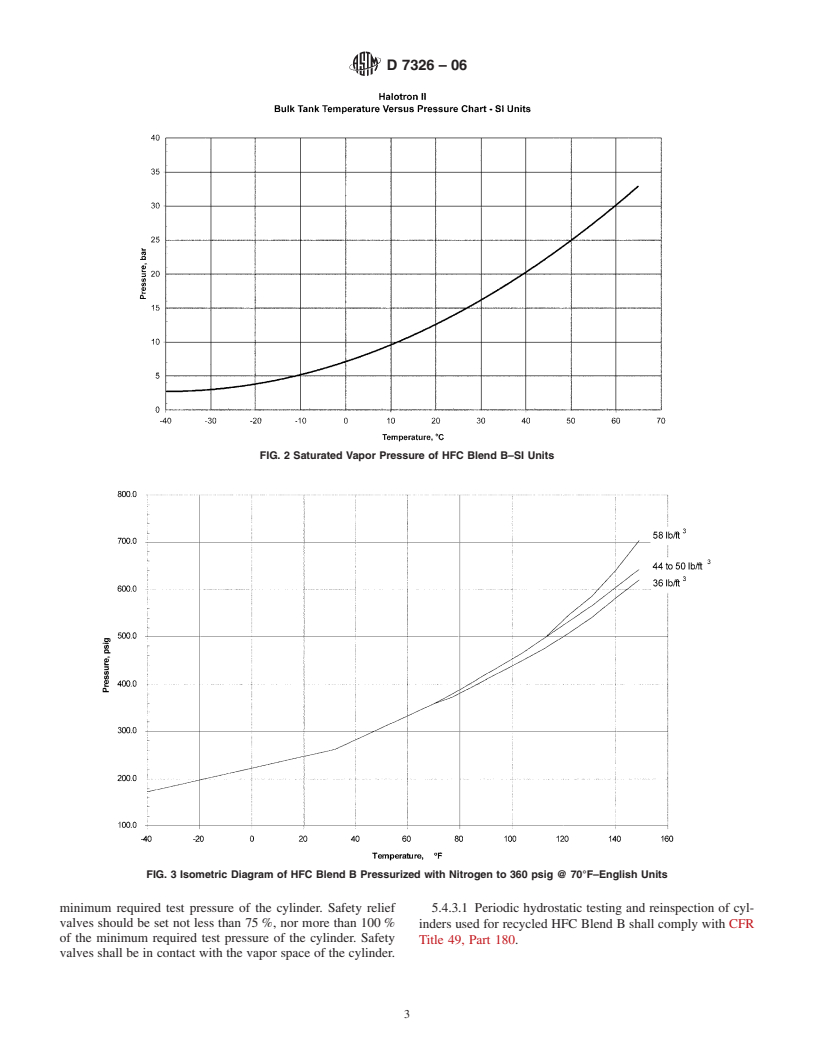
the HFC Blend B must not completely fill the container’s vided in Figs. 3-6.
internal volume at any temperature up to and including 130°F 5.3.2 Transportation shall be by suitable vehicles to pre-
(54°C). The maximum pe
...
Questions, Comments and Discussion
Ask us and Technical Secretary will try to provide an answer. You can facilitate discussion about the standard in here.