

ASTM F2052-21
(Test Method)Standard Test Method for Measurement of Magnetically Induced Displacement Force on Medical Devices in the Magnetic Resonance Environment
General Information
- Abstract
SIGNIFICANCE AND USE
5.1 This test method is one of those required to determine if the presence of a medical device may cause injury to individuals during an MR examination or in the MR environment. Other safety issues which should be addressed include, but may not be limited to: magnetically induced torque (see Test Method F2213) and radiofrequency (RF) heating (see Test Method F2182). The terms and icons in Practice F2503 should be used to mark the device for safety in the magnetic resonance environment.
5.2 If the maximum magnetically induced displacement force for the specified magnetic field conditions (see Appendix X3) is less than the force on the device due to gravity (its weight), it is assumed that any risk imposed by the application of the magnetically induced force is no greater than any risk imposed by normal daily activity in the Earth’s gravitational field. This statement does not constitute an acceptance criterion; it is provided as a conservative reference point. It is possible that a greater magnetically induced displacement force can be acceptable and would not harm a patient or other individual in a specific case.
Note 2: For instance, in the case of an implanted device that is or could be subjected to a magnetic displacement force greater than the force due to gravity, the location of the implant, surrounding tissue properties, and means of fixation within the body may be considered. For a non-implanted device with a magnetically induced force greater than the gravitational force, consideration should be given to mitigate the projectile risk which may include fixing or tethering the device or excluding it from the MR environment so that it does not become a projectile.
5.3 The maximum static magnetic field strength and spatial field gradient vary for different MR systems. Appendix X3 provides guidance for calculating the allowable static magnetic field strength and spatial field gradient.
5.4 This test method alone is not sufficient for determining if a d...
SCOPE
1.1 This test method covers the measurement of the magnetically induced displacement force produced by static magnetic field gradients (spatial field gradient) on medical devices and the comparison of that force to the weight of the medical device.
1.2 This test method does not address other possible safety issues which include, but are not limited to: issues of magnetically induced torque, radiofrequency (RF) heating, induced heating, acoustic noise, interaction among devices, and the functionality of the device and the magnetic resonance (MR) system.
1.3 This test method is intended for devices that can be suspended from a string. Devices which cannot be suspended from a string are not covered by this test method. The weight of the string from which the device is suspended during the test must be less than 1 % of the weight of the tested device.
1.4 This test method shall be carried out in a horizontal bore MR system with a static magnetic field oriented horizontally and parallel to the MR system bore.
1.5 The values stated in SI units are to be regarded as standard. No other units of measurement are included in this standard.
1.6 This standard does not purport to address all of the safety concerns, if any, associated with its use. It is the responsibility of the user of this standard to establish appropriate safety, health, and environmental practices and determine the applicability of regulatory limitations prior to use.
1.7 This international standard was developed in accordance with internationally recognized principles on standardization established in the Decision on Principles for the Development of International Standards, Guides and Recommendations issued by the World Trade Organization Technical Barriers to Trade (TBT) Committee.
- Status
- Published
- Publication Date
- 30-Sep-2021
- Technical Committee
- F04 - Medical and Surgical Materials and Devices
- Drafting Committee
- F04.15 - Material Test Methods
Buy Documents
ASTM F2052-21 - Standard Test Method for Measurement of Magnetically Induced Displacement Force on Medical Devices in the Magnetic Resonance Environment
REDLINE ASTM F2052-21 - Standard Test Method for Measurement of Magnetically Induced Displacement Force on Medical Devices in the Magnetic Resonance Environment
Overview
ASTM F2052-21: Standard Test Method for Measurement of Magnetically Induced Displacement Force on Medical Devices in the Magnetic Resonance Environment provides a procedure to assess whether medical devices present a safety risk due to magnetically induced displacement forces when exposed to the static magnetic fields of MRI systems. Medical devices used in or near magnetic resonance environments must be evaluated for their potential to move or become projectile hazards when exposed to spatial magnetic field gradients. This test method is an important part of a comprehensive magnetic resonance (MR) safety assessment and supports regulatory and manufacturer requirements for device qualification.
Key Topics
- Purpose of the Standard: The method measures the force exerted on a medical device due to static magnetic field gradients and compares it to the device’s weight, which helps evaluate whether the device could move dangerously or become a projectile during MRI.
- Applicability: The standard specifically applies to devices that can be suspended from a string (where the string’s weight is less than 1% of the device).
- MR System Criteria: Testing should be performed in a horizontal bore MRI system, with the static magnetic field aligned horizontally and parallel to the bore.
- Test Approach:
- Suspend the medical device from a string in the region of highest spatial field gradient.
- Measure the angular deflection from vertical.
- If the deflection angle is less than 45°, the magnetically induced force is less than the device’s gravitational weight.
- Limitations: This standard does not cover other safety issues such as magnetically induced torque (see ASTM F2213), RF heating (see ASTM F2182), device functionality, or interactions between devices.
Applications
ASTM F2052-21 is most relevant for:
- Medical Device Manufacturers: Integrating MR safety testing during development, especially for implants, surgical instruments, and accessories that may enter the MRI environment.
- Regulatory Compliance: Providing objective test data for regulatory submissions and adherence to international quality management (e.g., ISO 13485) and risk management (ISO 14971) requirements.
- Clinical Facilities: Hospitals and imaging centers use these test results to evaluate whether a device is MR Safe, MR Conditional, or MR Unsafe, supporting proper labeling as required by ASTM F2503.
- Device Selection and Procurement: Ensuring devices are appropriately tested helps facilities minimize risk to patients and staff from unintentional device movement in the MRI suite.
- Risk Management: If the magnetically induced displacement force exceeds device weight, additional risk mitigation (e.g., tethers, exclusion from MRI) are recommended, particularly for non-implanted devices.
Related Standards
For a comprehensive MR safety evaluation, the following standards are commonly referenced alongside ASTM F2052-21:
- ASTM F2213 - Measurement of Magnetically Induced Torque
- ASTM F2182 - Measurement of RF Induced Heating on or Near Implants
- ASTM F2119 - Evaluation of MR Image Artifacts from Implants
- ASTM F2503 - Marking Medical Devices for MRI Safety
- IEC 60601-2-33 - Safety of Magnetic Resonance Equipment for Medical Diagnosis
- ISO 14971 - Application of Risk Management to Medical Devices
- ISO 13485 - Quality Management for Medical Devices
Practical Value
ASTM F2052-21 supports the safety assessment of medical devices in the magnetic resonance environment by quantifying the magnetically induced displacement force. By following this procedure, manufacturers and researchers can:
- Demonstrate compliance with global MRI safety requirements.
- Reduce the risk of injury or incidents during MR imaging.
- Support clinicians in safe device selection and use within MR environments.
- Contribute critical data for labeling devices as MR Safe, MR Conditional, or MR Unsafe.
This standard is a cornerstone for medical device MR safety, ensuring both patient and staff protection in the potentially hazardous environment of MRI systems.
Relations
- Effective Date
- 01-Apr-2023
- Effective Date
- 01-Mar-2020
- Effective Date
- 01-Dec-2019
- Effective Date
- 15-Sep-2019
- Effective Date
- 15-Sep-2019
- Effective Date
- 15-Sep-2019
- Effective Date
- 01-Sep-2017
- Effective Date
- 01-May-2014
- Effective Date
- 01-Oct-2013
- Effective Date
- 01-Jun-2013
- Effective Date
- 01-May-2013
- Effective Date
- 01-May-2013
- Effective Date
- 01-Apr-2013
- Effective Date
- 01-Dec-2012
- Effective Date
- 01-Nov-2012
Buy Documents
ASTM F2052-21 - Standard Test Method for Measurement of Magnetically Induced Displacement Force on Medical Devices in the Magnetic Resonance Environment
REDLINE ASTM F2052-21 - Standard Test Method for Measurement of Magnetically Induced Displacement Force on Medical Devices in the Magnetic Resonance Environment
Get Certified
Connect with accredited certification bodies for this standard

BSI Group
BSI (British Standards Institution) is the business standards company that helps organizations make excellence a habit.

TÜV Rheinland
TÜV Rheinland is a leading international provider of technical services.

TÜV SÜD
TÜV SÜD is a trusted partner of choice for safety, security and sustainability solutions.
Sponsored listings
Frequently Asked Questions
ASTM F2052-21 is a standard published by ASTM International. Its full title is "Standard Test Method for Measurement of Magnetically Induced Displacement Force on Medical Devices in the Magnetic Resonance Environment". This standard covers: SIGNIFICANCE AND USE 5.1 This test method is one of those required to determine if the presence of a medical device may cause injury to individuals during an MR examination or in the MR environment. Other safety issues which should be addressed include, but may not be limited to: magnetically induced torque (see Test Method F2213) and radiofrequency (RF) heating (see Test Method F2182). The terms and icons in Practice F2503 should be used to mark the device for safety in the magnetic resonance environment. 5.2 If the maximum magnetically induced displacement force for the specified magnetic field conditions (see Appendix X3) is less than the force on the device due to gravity (its weight), it is assumed that any risk imposed by the application of the magnetically induced force is no greater than any risk imposed by normal daily activity in the Earth’s gravitational field. This statement does not constitute an acceptance criterion; it is provided as a conservative reference point. It is possible that a greater magnetically induced displacement force can be acceptable and would not harm a patient or other individual in a specific case. Note 2: For instance, in the case of an implanted device that is or could be subjected to a magnetic displacement force greater than the force due to gravity, the location of the implant, surrounding tissue properties, and means of fixation within the body may be considered. For a non-implanted device with a magnetically induced force greater than the gravitational force, consideration should be given to mitigate the projectile risk which may include fixing or tethering the device or excluding it from the MR environment so that it does not become a projectile. 5.3 The maximum static magnetic field strength and spatial field gradient vary for different MR systems. Appendix X3 provides guidance for calculating the allowable static magnetic field strength and spatial field gradient. 5.4 This test method alone is not sufficient for determining if a d... SCOPE 1.1 This test method covers the measurement of the magnetically induced displacement force produced by static magnetic field gradients (spatial field gradient) on medical devices and the comparison of that force to the weight of the medical device. 1.2 This test method does not address other possible safety issues which include, but are not limited to: issues of magnetically induced torque, radiofrequency (RF) heating, induced heating, acoustic noise, interaction among devices, and the functionality of the device and the magnetic resonance (MR) system. 1.3 This test method is intended for devices that can be suspended from a string. Devices which cannot be suspended from a string are not covered by this test method. The weight of the string from which the device is suspended during the test must be less than 1 % of the weight of the tested device. 1.4 This test method shall be carried out in a horizontal bore MR system with a static magnetic field oriented horizontally and parallel to the MR system bore. 1.5 The values stated in SI units are to be regarded as standard. No other units of measurement are included in this standard. 1.6 This standard does not purport to address all of the safety concerns, if any, associated with its use. It is the responsibility of the user of this standard to establish appropriate safety, health, and environmental practices and determine the applicability of regulatory limitations prior to use. 1.7 This international standard was developed in accordance with internationally recognized principles on standardization established in the Decision on Principles for the Development of International Standards, Guides and Recommendations issued by the World Trade Organization Technical Barriers to Trade (TBT) Committee.
SIGNIFICANCE AND USE 5.1 This test method is one of those required to determine if the presence of a medical device may cause injury to individuals during an MR examination or in the MR environment. Other safety issues which should be addressed include, but may not be limited to: magnetically induced torque (see Test Method F2213) and radiofrequency (RF) heating (see Test Method F2182). The terms and icons in Practice F2503 should be used to mark the device for safety in the magnetic resonance environment. 5.2 If the maximum magnetically induced displacement force for the specified magnetic field conditions (see Appendix X3) is less than the force on the device due to gravity (its weight), it is assumed that any risk imposed by the application of the magnetically induced force is no greater than any risk imposed by normal daily activity in the Earth’s gravitational field. This statement does not constitute an acceptance criterion; it is provided as a conservative reference point. It is possible that a greater magnetically induced displacement force can be acceptable and would not harm a patient or other individual in a specific case. Note 2: For instance, in the case of an implanted device that is or could be subjected to a magnetic displacement force greater than the force due to gravity, the location of the implant, surrounding tissue properties, and means of fixation within the body may be considered. For a non-implanted device with a magnetically induced force greater than the gravitational force, consideration should be given to mitigate the projectile risk which may include fixing or tethering the device or excluding it from the MR environment so that it does not become a projectile. 5.3 The maximum static magnetic field strength and spatial field gradient vary for different MR systems. Appendix X3 provides guidance for calculating the allowable static magnetic field strength and spatial field gradient. 5.4 This test method alone is not sufficient for determining if a d... SCOPE 1.1 This test method covers the measurement of the magnetically induced displacement force produced by static magnetic field gradients (spatial field gradient) on medical devices and the comparison of that force to the weight of the medical device. 1.2 This test method does not address other possible safety issues which include, but are not limited to: issues of magnetically induced torque, radiofrequency (RF) heating, induced heating, acoustic noise, interaction among devices, and the functionality of the device and the magnetic resonance (MR) system. 1.3 This test method is intended for devices that can be suspended from a string. Devices which cannot be suspended from a string are not covered by this test method. The weight of the string from which the device is suspended during the test must be less than 1 % of the weight of the tested device. 1.4 This test method shall be carried out in a horizontal bore MR system with a static magnetic field oriented horizontally and parallel to the MR system bore. 1.5 The values stated in SI units are to be regarded as standard. No other units of measurement are included in this standard. 1.6 This standard does not purport to address all of the safety concerns, if any, associated with its use. It is the responsibility of the user of this standard to establish appropriate safety, health, and environmental practices and determine the applicability of regulatory limitations prior to use. 1.7 This international standard was developed in accordance with internationally recognized principles on standardization established in the Decision on Principles for the Development of International Standards, Guides and Recommendations issued by the World Trade Organization Technical Barriers to Trade (TBT) Committee.
ASTM F2052-21 is classified under the following ICS (International Classification for Standards) categories: 11.040.40 - Implants for surgery, prosthetics and orthotics. The ICS classification helps identify the subject area and facilitates finding related standards.
ASTM F2052-21 has the following relationships with other standards: It is inter standard links to ASTM F2503-23e1, ASTM F1537-20, ASTM F138-19, ASTM F2182-19, ASTM F2182-19e2, ASTM F2182-19e1, ASTM F2213-17, ASTM E177-14, ASTM F138-13a, ASTM F2503-13, ASTM E691-13, ASTM E177-13, ASTM F138-13, ASTM F136-12a, ASTM F136-12. Understanding these relationships helps ensure you are using the most current and applicable version of the standard.
ASTM F2052-21 is available in PDF format for immediate download after purchase. The document can be added to your cart and obtained through the secure checkout process. Digital delivery ensures instant access to the complete standard document.
Standards Content (Sample)
This international standard was developed in accordance with internationally recognized principles on standardization established in the Decision on Principles for the
Development of International Standards, Guides and Recommendations issued by the World Trade Organization Technical Barriers to Trade (TBT) Committee.
Designation: F2052 − 21
Standard Test Method for
Measurement of Magnetically Induced Displacement Force
on Medical Devices in the Magnetic Resonance
Environment
This standard is issued under the fixed designation F2052; the number immediately following the designation indicates the year of
original adoption or, in the case of revision, the year of last revision.Anumber in parentheses indicates the year of last reapproval.A
superscript epsilon (´) indicates an editorial change since the last revision or reapproval.
1. Scope mendations issued by the World Trade Organization Technical
Barriers to Trade (TBT) Committee.
1.1 This test method covers the measurement of the mag-
netically induced displacement force produced by static mag-
2. Referenced Documents
netic field gradients (spatial field gradient) on medical devices
2.1 ASTM Standards:
and the comparison of that force to the weight of the medical
E177Practice for Use of the Terms Precision and Bias in
device.
ASTM Test Methods
1.2 This test method does not address other possible safety
E691Practice for Conducting an Interlaboratory Study to
issues which include, but are not limited to: issues of magneti-
Determine the Precision of a Test Method
cally induced torque, radiofrequency (RF) heating, induced
F136 Specification for Wrought Titanium-6Aluminum-
heating, acoustic noise, interaction among devices, and the
4VanadiumELI(ExtraLowInterstitial)AlloyforSurgical
functionality of the device and the magnetic resonance (MR)
Implant Applications (UNS R56401)
system.
F138 Specification for Wrought 18Chromium-14Nickel-
2.5MolybdenumStainlessSteelBarandWireforSurgical
1.3 This test method is intended for devices that can be
suspended from a string. Devices which cannot be suspended Implants (UNS S31673)
F1537 Specification for Wrought Cobalt-28Chromium-
from a string are not covered by this test method. The weight
ofthestringfromwhichthedeviceissuspendedduringthetest 6Molybdenum Alloys for Surgical Implants (UNS
R31537, UNS R31538, and UNS R31539)
must be less than 1% of the weight of the tested device.
F2119Test Method for Evaluation of MR Image Artifacts
1.4 Thistestmethodshallbecarriedoutinahorizontalbore
from Passive Implants
MR system with a static magnetic field oriented horizontally
F2182Test Method for Measurement of Radio Frequency
and parallel to the MR system bore.
Induced Heating On or Near Passive Implants During
1.5 The values stated in SI units are to be regarded as
Magnetic Resonance Imaging
standard. No other units of measurement are included in this
F2213Test Method for Measurement of Magnetically In-
standard.
duced Torque on Medical Devices in the Magnetic Reso-
nance Environment
1.6 This standard does not purport to address all of the
F2503Practice for Marking Medical Devices and Other
safety concerns, if any, associated with its use. It is the
Items for Safety in the Magnetic Resonance Environment
responsibility of the user of this standard to establish appro-
2.2 Other Standards:
priate safety, health, and environmental practices and deter-
IEC60601-2-33Ed. 3.2 Medical Electronic Equipment—
mine the applicability of regulatory limitations prior to use.
Part2:ParticularRequirementsfortheSafetyofMagnetic
1.7 This international standard was developed in accor-
Resonance Equipment for Medical Diagnosis
dance with internationally recognized principles on standard-
GHTF/SG1/N071:2012 definition 5.1, Definition of the
ization established in the Decision on Principles for the
Terms ‘Medical Device’ and ‘In Vitro Diagnostic (IVD)
Development of International Standards, Guides and Recom-
Medical Device’
1 2
ThistestmethodisunderthejurisdictionofASTMCommitteeF04onMedical For referenced ASTM standards, visit the ASTM website, www.astm.org, or
andSurgicalMaterialsandDevicesandisthedirectresponsibilityofSubcommittee contact ASTM Customer Service at service@astm.org. For Annual Book of ASTM
F04.15 on Material Test Methods. Standards volume information, refer to the standard’s Document Summary page on
Current edition approved Oct. 1, 2021. Published January 2022. Originally the ASTM website.
approved in 2000. Last previous edition approved in 2015 as F2052–15. DOI: Available fromAmerican National Standards Institute (ANSI), 25 W. 43rd St.,
10.1520/F2052-21. 4th Floor, New York, NY 10036, http://www.ansi.org.
Copyright © ASTM International, 100 Barr Harbor Drive, PO Box C700, West Conshohocken, PA 19428-2959. United States
F2052 − 21
3. Terminology (1)Diagnosis, prevention, monitoring, treatment, or alle-
viation of disease;
3.1 Definitions:
(2)Diagnosis, monitoring, treatment, alleviation of, or
3.1.1 diamagnetic material, n—a material whose relative
compensation for an injury;
permeability is less than unity.
(3)Investigation, replacement, modification, or support of
3.1.2 ferromagnetic material, n—amaterialwhosemagnetic
the anatomy or of a physiological process;
moments are ordered and parallel producing magnetization in
(4)Supporting or sustaining life;
one direction.
(5)Control of conception;
(6)Disinfection of medical devices;
3.1.3 magnetic field strength (H), n—strength of the applied
(7)Providing information by means of in-vitro examina-
magnetic field, H, expressed in amperes per meter (A/m).
tion of specimens derived from the human body; and does not
3.1.4 magnetic induction or magnetic flux density (B),
achieve its primary intended action by pharmacological,
n—that magnetic vector quantity which at any point in a
immunological, or metabolic means, in or on the human body,
magnetic field is measured either by the mechanical force
but which may be assisted in its intended function by such
experiencedbyanelementofelectriccurrentatthepoint,orby
means.
the electromotive force induced in an elementary loop during
3.1.11.1 Discussion—Products which may be considered to
any change in flux linkages with the loop at the point and
be medical devices in some jurisdictions but not in others
expressed in tesla (T). The magnetic induction is frequently
include:
referred to as the magnetic field. B is the static field in an MR
o
(1)Disinfection substances;
system. Plain type (for example, B) indicates a scalar and bold
(2)Aids for persons with disabilities;
type (for example,B) indicates a vector.
(3)Devices incorporating animal and/or human tissues;
3.1.5 magnetic resonance (MR), n—resonant absorption of
(4)Devices for in-vitro fertilization or assisted reproduc-
electromagnetic energy by an ensemble of atomic particles
tion technologies. [from GHTF/SG1/N071:2012, 5.1]
situated in a magnetic field.
3.1.12 magnetically induced displacement force, n—force
3.1.6 magnetic resonance diagnostic device, n—a device
produced when a magnetic object is exposed to the spatial
intended for general diagnostic use to present images which
gradient of a magnetic field. This force will tend to cause the
reflectthespatialdistributionormagneticresonancespectra,or
object to translate in the gradient field.
both, which reflect frequency and distribution of nuclei exhib-
3.1.13 paramagnetic material, n—a material having a rela-
iting nuclear magnetic resonance. Other physical parameters
tive permeability which is slightly greater than unity, and
derived from the images or spectra, or both, may also be
which is practically independent of the magnetizing force.
produced.
3.1.14 spatial field gradient (SFG), n—the spatial rate of
3.1.7 magnetic resonance (MR) environment, n—volume
W
change of the main magnetic field, |π|B ||, expressed in tesla
within the 0.50 mT(5 gauss (G)) line of an MR system, which
per meter (T/m). [from IEC 60601-2-33]
includes the entire three-dimensional volume of space sur-
3.1.15 tesla, (T), n—the SI unit of magnetic induction equal
rounding the MR scanner. For cases where the 0.50 mT line is
to 10 gauss (G).
contained within the Faraday shielded volume, the entire room
shall be considered the MR environment.
4. Summary of Test Method
3.1.8 magnetic resonance equipment (MR equipment),
4.1 A medical device is suspended by a string in an MR
n—medical electrical equipment which is intended for in-vivo
system at a location near the entrance of the bore and on the
magnetic resonance examination of a patient. The MR equip-
z-axisofthebore.Thetestlocationischosensothatthespatial
ment comprises all parts in hardware and software from the
field gradient (that is, spatial gradient of the static magnetic
supply mains to the display monitor. The MR equipment is a
field) is within 20 % of the maximum spatial field gradient on
Programmable Electrical Medical System (PEMS).
theaxisofthebore.Theangulardeflectionfromtheverticalof
3.1.9 magnetic resonance examination (MR examination),
the string holding the test sample is measured. An analysis
n—process of acquiring data from a patient by magnetic
using the measured deflection angle, static magnetic field
resonance.
strength, and spatial field gradient at the test location is then
performed to determine the allowable static magnetic field
3.1.10 magnetic resonance system (MR system),
strength and spatial field gradient under specified conditions,
n—ensemble of MR equipment, accessories, including means
for example, clinical 1.5 T, 3.0 T, and/or 7.0 T MR systems.
for display, control, energy supplies, and the controlled access
NOTE1—Thespatialfieldgradientwithin20%ofthemaximumspatial
area, where provided.
field gradient value is specified to provide adequate measurement sensi-
[from IEC 60601-2-33]
tivity.
3.1.11 medical device, n—any instrument, apparatus,
5. Significance and Use
implement, machine, appliance, implant, reagent for in-vitro
use, software, material, or other similar or related article, 5.1 Thistestmethodisoneofthoserequiredtodetermineif
intended by the manufacturer to be used, alone or in the presence of a medical device may cause injury to individu-
combination, for human beings, for one or more of the specific als during an MR examination or in the MR environment.
medical purpose(s) of: Other safety issues which should be addressed include, but
F2052 − 21
may not be limited to: magnetically induced torque (see Test 7.2 For purposes of device qualification, the devices should
Method F2213) and radiofrequency (RF) heating (see Test not be altered in any manner prior to testing.
Method F2182).The terms and icons in Practice F2503 should
8. Procedure
beusedtomarkthedeviceforsafetyinthemagneticresonance
environment.
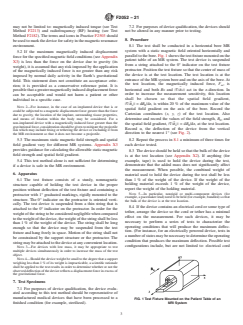
8.1 The test shall be conducted in a horizontal bore MR
system with a static magnetic field oriented horizontally and
5.2 If the maximum magnetically induced displacement
paralleltothebore.Fig.1showsthetestfixturemountedonthe
forceforthespecifiedmagneticfieldconditions(seeAppendix
patient table of an MR system. The test device is suspended
X3) is less than the force on the device due to gravity (its
from a string attached to the 0° indicator on the test fixture
weight), it is assumed that any risk imposed by the application
protractor. Position the test fixture so that the center of mass of
of the magnetically induced force is no greater than any risk
the device is at the test location. The test location is at the
imposed by normal daily activity in the Earth’s gravitational
entrance of the MR system bore and on the axis of the bore.At
field. This statement does not constitute an acceptance crite-
the test location, the magnetically induced force, F,is
m
rion; it is provided as a conservative reference point. It is
W
horizontal and both B and |π|B || act in the z-direction. In
possiblethatagreatermagneticallyinduceddisplacementforce 0 0
order to increase the measurement sensitivity, this location
can be acceptable and would not harm a patient or other
shall be chosen so that the spatial field gradient,
individual in a specific case.
W
|π|B ||=dB /dz, is within 20 % of the maximum value of the
0 0
NOTE 2—For instance, in the case of an implanted device that is or
spatial field gradient on the axis of the bore. Record the
couldbesubjectedtoamagneticdisplacementforcegreaterthantheforce
Cartesian coordinates (x, y, z) of the test location. Also
due to gravity, the location of the implant, surrounding tissue properties,
and means of fixation within the body may be considered. For a determine and record the values of the field strength, B , and
non-implanted device with a magnetically induced force greater than the W
the spatial field gradient, |π|B ||=dB /dz, at the test location.
0 0
gravitationalforce,considerationshouldbegiventomitigatetheprojectile
Record α, the deflection of the device from the vertical
risk which may include fixing or tethering the device or excluding it from
direction to the nearest 1° (see Fig. 2).
the MR environment so that it does not become a projectile.
8.2 Repeat the process in 8.1 a minimum of three times for
5.3 The maximum static magnetic field strength and spatial
each device tested.
field gradient vary for different MR systems. Appendix X3
providesguidanceforcalculatingtheallowablestaticmagnetic
8.3 The device should be held so that the bulk of the device
field strength and spatial field gradient.
is at the test location (see Appendix X2). If anything (for
example, tape) is used to hold the device during the test,
5.4 This test method alone is not sufficient for determining
demonstrate that the added mass does not significantly affect
if a device is safe in the MR environment.
the measurement. When possible, the combined weight of
6. Apparatus
material used to hold the device during the test shall be less
than 1% of the weight of the device. If the weight of the
6.1 The test fixture consists of a sturdy, nonmagnetic
holding material exceeds 1 % of the weight of the device,
structure capable of holding the test device in the proper
report the weight of the holding material.
position without deflection of the test fixture and containing a
NOTE 5—In particular, nonrigid or multi-component devices (for
protractor with 1° graduated markings, rigidly mounted to the
example,apacemakerlead)needtobeheld(forexample,bundled)sothat
structure. The 0° indicator on the protractor is oriented verti-
the bulk of the device is at the test location.
cally. The test device is suspended from a thin string that is
8.4 If the device contains an electrical cord or some type of
attached to the 0° indicator on the protractor. In order for the
tether, arrange the device so the cord or tether has a minimal
weightofthestringtobeconsiderednegligiblewhencompared
effect on the measurement. For such devices, it may be
totheweightofthedevice,theweightofthestringshallbeless
necessary to perform a series of tests to characterize the
than 1% of the weight of the device. The string shall be long
operating conditions that will produce the maximum deflec-
enough so that the device may be suspended from the test
tion. (For instance, for an electrically powered device, tests in
fixture and hang freely in space. Motion of the string shall not
anumberofstatesmaybenecessarytodeterminetheoperating
be constrained by the support structure or the protractor. The
condition that produces the maximum deflection. Possible test
stringmaybeattachedtothedeviceatanyconvenientlocation.
configurations include, but are not limited to: electrical cord
NOTE 3—For devices with low mass, it may be appropriate to test
multiple devices simultaneously in order to increase the mass of the test
object.
NOTE4—Shouldthedeviceweightbesmalltothedegreethatasupport
weighinglessthan1%ofitsweightisimpracticable,ascientificrationale
shall be applied to the test results in order to determine whether or not the
observeddeflectionofthedevicereflectsadisplacementforceinexcessof
the gravitational force.
7. Test Specimens
7.1 For purposes of device qualification, the device evalu-
ated according to this test method should be representative of
manufactured medical devices that have been processed to a
FIG. 1 Test Fixture Mounted on the Patient Table of an
finished condition (for example, sterilized). MRI System
F2052 − 21
location to determine an allowable spatial field gradient for a
specified magnetic field strength.
9.5 Ifforaspecifiedmagneticfieldstrengthandspatialfield
gradient (that is, for condition “C” in the equations in Appen-
dixX3),themagneticallyinduceddisplacementforceisgreater
than the force induced by gravity and the device is intended to
be used in those field conditions, a rationale supporting safe
use under those conditions shall be developed. For an implant
or other device in contact with a patient, the rationale might
include consideration of the tissue adjacent to the implant and
the means of fixation of the device.
NOTE9—Thisstandarddoesnotaddresswhatthemaximumacceptable
magnetically induced force should be for any device. See Appendix X1
for elaboration.
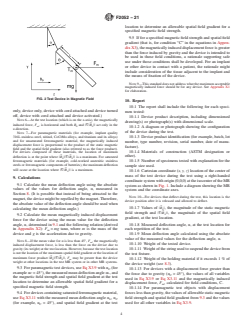
FIG. 2 Test Device in Magnetic Field
10. Report
10.1 The report shall include the following for each speci-
only, device only, device with cord attached and device turned
men tested:
off, device with cord attached and device activated.)
10.1.1 Device product description, including dimensioned
NOTE 6—At the test location (which is on the z-axis), the magnetically
drawing(s) or photograph(s) with dimensional scale.
W
induced force, F , is horizontal and both B and |π|B || act only in the
m 0
10.1.2 A diagram or photograph showing the configuration
z-direction.
of the device during the test.
NOTE 7—For paramagnetic materials (for example, implant quality
316L stainless steel, nitinol, CoCrMo alloys, and titanium and its alloys) 10.1.3 Deviceproductidentification(forexample,batch,lot
and for unsaturated ferromagnetic material, the magnetically induced
number, type number, revision, serial number, date of manu-
displacement force is proportional to the product of the static magnetic
facture).
field and the spatial field gradient (also referred to as the force product).
10.1.4 Materials of construction (ASTM designation or
For devices composed of these materials, the location of maximum
W W other).
deflection is at the point where |B ||π|B || is a maximum. For saturated
0 0
ferromagnetic materials (for example, cold-worked austenitic stainless 10.1.5 Number of specimens tested with explanation for the
steels or ferromagnetic components of batteries), the maximum deflection
sample size used.
W
will occur at the location where |π|B || is a maximum.
0 10.1.6 Cartesiancoordinate(x, y, z)locationofthecenterof
mass of the test device during the test using a right-handed
9. Calculations
coordinatesystemwithorigin(0,0,0)attheisocenteroftheMR
9.1 Calculate the mean deflection angle using the absolute
system as shown in Fig. 1. Include a diagram showing the MR
values of the values for deflection angle, α, measured in
system and the coordinate axes.
Section 8. (It is possible that instead of being attracted to the
NOTE 10—For devices that deflect during the test, this location is the
magnet,thedevicemightberepelledbythemagnet.Therefore,
device position after it is released and allowed to deflect.
the absolute value of the deflection angle should be used when
W
10.1.7 Values of |B |, the magnitude of the static magnetic
calculating the mean deflection angle.) 0
W
field strength and |π|B ||, the magnitude of the spatial field
9.2 Calculate the mean magnetically induced displacement
gradient, at the test location.
force for the device using the mean value for the deflection
angle, α, determined in 9.1 and the following relation (derived 10.1.8 Measured deflection angle, α, at the test location for
in Appendix X2): F = mg tanα, where m is the mass of the each repetition of the test.
m
device and g is the acceleration due to gravity.
10.1.9 Mean deflection angle calculated using the absolute
value of the measured values for the deflection angle, α.
NOTE 8—If the mean value for α is less than 45°, F , the magnetically
m
10.1.10 Weight of the tested device.
induced displacement force, is less than the force on the device due to
gravity(itsweight)atthetestlocation.However,becausethetestlocation
10.1.11 Weightofthestringusedtosuspendthedevicefrom
is not the location of the maximum spatial field gradient or the location of
the test fixture.
W W
maximum force product |B ||π|B ||, F may be greater than the device
0 0 m
10.1.12 Weight of the holding material if it exceeds1%of
weight at other locations in the test MR system or in other MR systems.
the device weight (see 8.3).
9.3 For paramagnetic test devices, use Eq X3.9 with α (for
C
10.1.13 For devices with a displacement force greater than
exampleα =45°),themeasuredmeandeflectionangleα ,and
C L the force due to gravity (α > 45°), the values of all variables
C
the magnetic field strength and spatial field gradient at the test
used in Eq X3.9 or Eq X3.11 and the magnetically induced
location to determine an allowable spatial field gradient for a
displacement force, F , calculated for field conditions, C.
m
specified magnetic field strength.
10.1.14 For paramagnetic test objects with displacement
9.4 Fordevicescontainingsaturatedferromagneticmaterial, forceslessthangravity,thevaluesofallowablestaticmagnetic
use Eq X3.11 with the measured mean deflection angle α , α field strength and spatial field gradient from 9.3 and the values
L C
(for example, α = 45°), and spatial field gradient at the test used for all other variables in Eq X3.9.
C
F2052 − 21
10.1.15 For ferromagnetic test objects with displacement 11.1.4 Any judgment in accordance with 11.1.1 and 11.1.2
forceslessthangravity,thevaluesofallowablestaticmagnetic would have an approximate 95 % probability of being correct;
field strength and spatial field gradient from 9.4 and the values however,theprecisionstatisticsobtainedinthisinterlaboratory
used for all other variables in Eq X3.11. study (ILS) must not be treated as exact mathematical quanti-
10.1.16 For test objects with both paramagnetic and ferro- ties which are applicable to all circumstances and uses. The
magnetic materials with displacement forces less than gravity, limited number of materials tested and laboratories reporting
the values of allowable static magnetic field strength and results guarantee that there will be times when differences
spatial field gradient from 9.3 and the values used for all other greater than predicted by the ILS results will arise, sometimes
variables in Eq X3.9 or Eq X3.11. with considerably greater or smaller frequency than the 95 %
probability
...
This document is not an ASTM standard and is intended only to provide the user of an ASTM standard an indication of what changes have been made to the previous version. Because
it may not be technically possible to adequately depict all changes accurately, ASTM recommends that users consult prior editions as appropriate. In all cases only the current version
of the standard as published by ASTM is to be considered the official document.
Designation: F2052 − 15 F2052 − 21
Standard Test Method for
Measurement of Magnetically Induced Displacement Force
on Medical Devices in the Magnetic Resonance
Environment
This standard is issued under the fixed designation F2052; the number immediately following the designation indicates the year of
original adoption or, in the case of revision, the year of last revision. A number in parentheses indicates the year of last reapproval. A
superscript epsilon (´) indicates an editorial change since the last revision or reapproval.
1. Scope
1.1 This test method covers the measurement of the magnetically induced displacement force produced by static magnetic field
gradients (spatial field gradient) on medical devices and the comparison of that force to the weight of the medical device.
1.2 This test method does not address other possible safety issues which include, but are not limited toto: issues of magnetically
induced torque, RF radiofrequency (RF) heating, induced heating, acoustic noise, interaction among devices, and the functionality
of the device and the MR magnetic resonance (MR) system.
1.3 This test method is intended for devices that can be suspended from a string. Devices which cannot be suspended from a string
are not covered by this test method. The weight of the string from which the device is suspended during the test must be less than
1 % of the weight of the tested device.
1.4 This test method shall be carried out in a horizontal bore MR system with a static magnetic filedfield oriented horizontally and
parallel to the MR system bore.
1.5 The values stated in SI units are to be regarded as standard. No other units of measurement are included in this standard.
1.6 This standard does not purport to address all of the safety concerns, if any, associated with its use. It is the responsibility
of the user of this standard to establish appropriate safety safety, health, and healthenvironmental practices and determine the
applicability of regulatory requirementslimitations prior to use.
1.7 This international standard was developed in accordance with internationally recognized principles on standardization
established in the Decision on Principles for the Development of International Standards, Guides and Recommendations issued
by the World Trade Organization Technical Barriers to Trade (TBT) Committee.
2. Referenced Documents
2.1 ASTM Standards:
E177 Practice for Use of the Terms Precision and Bias in ASTM Test Methods
E691 Practice for Conducting an Interlaboratory Study to Determine the Precision of a Test Method
This test method is under the jurisdiction of ASTM Committee F04 on Medical and Surgical Materials and Devices and is the direct responsibility of Subcommittee
F04.15 on Material Test Methods.
Current edition approved Sept. 15, 2015Oct. 1, 2021. Published September 2015January 2022. Originally approved in 2000. Last previous edition approved in 20142015
as F2052 – 14.F2052 – 15. DOI: 10.1520/F2052-15.10.1520/F2052-21.
For referenced ASTM standards, visit the ASTM website, www.astm.org, or contact ASTM Customer Service at service@astm.org. For Annual Book of ASTM Standards
volume information, refer to the standard’s Document Summary page on the ASTM website.
Copyright © ASTM International, 100 Barr Harbor Drive, PO Box C700, West Conshohocken, PA 19428-2959. United States
F2052 − 21
F136 Specification for Wrought Titanium-6Aluminum-4Vanadium ELI (Extra Low Interstitial) Alloy for Surgical Implant
Applications (UNS R56401)
F138 Specification for Wrought 18Chromium-14Nickel-2.5Molybdenum Stainless Steel Bar and Wire for Surgical Implants
(UNS S31673)
F1537 Specification for Wrought Cobalt-28Chromium-6Molybdenum Alloys for Surgical Implants (UNS R31537, UNS
R31538, and UNS R31539)
F2119 Test Method for Evaluation of MR Image Artifacts from Passive Implants
F2182 Test Method for Measurement of Radio Frequency Induced Heating On or Near Passive Implants During Magnetic
Resonance Imaging
F2213 Test Method for Measurement of Magnetically Induced Torque on Medical Devices in the Magnetic Resonance
Environment
F2503 Practice for Marking Medical Devices and Other Items for Safety in the Magnetic Resonance Environment
2.2 Other Standards:
IEC 60601–2–33IEC 60601-2-33 Ed. 2.03.2 Medical Electronic Equipment—Part 2: Particular Requirements for the Safety of
Magnetic Resonance Equipment for Medical Diagnosis
ISO 13485:2003(E)GHTF/SG1/N071:2012 Medical Devices—Quality Management Systems—Requirements for Regulatory
Purposes, definition 3.7definition 5.1, Definition of the Terms ‘Medical Device’ and ‘In Vitro Diagnostic (IVD) Medical
Device’
ISO 14971 Medical devices - Application of risk management to medical devices
3. Terminology
3.1 Definitions:
3.1.1 diamagnetic material, n—a material whose relative permeability is less than unity.
3.1.2 ferromagnetic material, n—a material whose magnetic moments are ordered and parallel producing magnetization in one
direction.
3.1.3 magnetic field strength ((H),H in A/m), n—strength of the applied magnetic field.field, H, expressed in amperes per meter
(A/m).
3.1.4 magnetic induction or magnetic flux density (B in T), (B), n—that magnetic vector quantity which at any point in a magnetic
field is measured either by the mechanical force experienced by an element of electric current at the point, or by the electromotive
force induced in an elementary loop during any change in flux linkages with the loop at the point. point and expressed in tesla (T).
The magnetic induction is frequently referred to as the magnetic field. B is the static field in aan MR system. Plain type indicates
o
a scalar (for example, B) indicates a scalar and bold type indicates a vector (for example, B).) indicates a vector.
3.1.5 magnetic resonance (MR), n—resonant absorption of electromagnetic energy by an ensemble of atomic particles situated in
a magnetic field.
3.1.6 magnetic resonance diagnostic device, n—a device intended for general diagnostic use to present images which reflect the
spatial distribution or magnetic resonance spectra, or both, which reflect frequency and distribution of nuclei exhibiting nuclear
magnetic resonance. Other physical parameters derived from the images or spectra, or both, may also be produced.
3.1.7 magnetic resonance (MR) environment, n—volume within the 0.50 mT (5 gauss (G)) line of an MR system, which includes
the entire three dimensional three-dimensional volume of space surrounding the MR scanner. For cases where the 0.50 mT line
is contained within the Faraday shielded volume, the entire room shall be considered the MR environment.
3.1.8 magnetic resonance equipment (MR equipment), n—medical electrical equipment which is intended for in-vivo magnetic
resonance examination of a patient. The MR equipment comprises all parts in hardware and software from the supply mains to
the display monitor. The MR equipment is a Programmable Electrical Medical System (PEMS).
3.1.9 magnetic resonance examination (MR examination), n—process of acquiring data from a patient by magnetic resonance.
Available from American National Standards Institute (ANSI), 25 W. 43rd St., 4th Floor, New York, NY 10036, http://www.ansi.org.
F2052 − 21
3.1.10 magnetic resonance system (MR system), n—ensemble of MR equipment, accessories, including means for display, control,
energy supplies, and the MR environment.controlled access area, where provided.
[from IEC 60601–2–3360601-2-33]
3.1.9 magnetic resonance examination (MR examination), n—process of acquiring data by magnetic resonance from a patient.
3.1.10 magnetic resonance (MR), n—resonant absorption of electromagnetic energy by an ensemble of atomic particles situated
in a magnetic field.
3.1.11 medical device, n—any instrument, apparatus, implement, machine, appliance, implant, in vitroreagent for in-vitro reagent
or calibrator, use, software, material, or other similar or related article, intended by the manufacturer to be used, alone or in
combination, for human beings, for one or more of the specific medical purpose(s) of:
(1) diagnosis, prevention, monitoring, treatment, or allevia-
tion of disease,
(2) diagnosis, monitoring, treatment, alleviation of, or com-
pensation for an injury,
(3) investigation, replacement, modification, or support of
the anatomy or of a physiological process,
(4) supporting or sustaining life,
(5) control of conception,
(6) disinfection of medical devices, and
(7) providing information for medical purposes by means of
in vitro examination of specimens derived from the hu-
man body, and which does not achieve its primary in-
tended action in or on the human body by
pharmacological, immunological, or metabolic means,
but which may be assisted in its function by such
means.
(1) Diagnosis, prevention, monitoring, treatment, or alleviation of disease;
(2) Diagnosis, monitoring, treatment, alleviation of, or compensation for an injury;
(3) Investigation, replacement, modification, or support of the anatomy or of a physiological process;
(4) Supporting or sustaining life;
(5) Control of conception;
(6) Disinfection of medical devices;
(7) Providing information by means of in-vitro examination of specimens derived from the human body; and does not achieve
its primary intended action by pharmacological, immunological, or metabolic means, in or on the human body, but which may be
assisted in its intended function by such means.
3.1.11.1 Discussion—
Products which may be considered to be medical devices in some jurisdictions but not in others include:
(1) Disinfection substances;
(2) Aids for persons with disabilities;
(3) Devices incorporating animal and/or human tissues;
(4) Devices for in-vitro fertilization or assisted reproduction technologies. ISO 13485[from GHTF/SG1/N071:2012, 5.1]
3.1.12 magnetically induced displacement force, n—force produced when a magnetic object is exposed to the spatial gradient of
a magnetic field. This force will tend to cause the object to translate in the gradient field.
3.1.13 paramagnetic material, n—a material having a relative permeability which is slightly greater than unity, and which is
practically independent of the magnetizing force.
W
3.1.14 spatial field gradient (SFG), n—the spatial rate of change of the main magnetic field, |π|B ||, expressed in tesla per meter
(T/m). [from IEC 60601-2-33]
3.1.15 tesla, (T), n—the SI unit of magnetic induction equal to 10 gauss (G).
4. Summary of Test Method
4.1 A medical device is suspended by a string in an MR system at a location near the entrance toof the bore and on the axisz-axis
of the bore. In order to increase the measurement sensitivity, this location shall be The test location is chosen so that the spatial
F2052 − 21
gradient of the field strength, πfield gradient (that is, spatial gradient of the static magnetic field)B = dB/dz, is within 20 percent%
of the maximum value of the spatial spatial field gradient on the axis of the bore. The angular deflection from the vertical of the
string fromholding the vertical test sample is measured. If the device deflects less than 45°, then the deflection force induced by
the MR system’s magnetic field is less than the force on the device due to gravity (its weight).An analysis using the measured
deflection angle, static magnetic field strength, and spatial field gradient at the test location is then performed to determine the
allowable static magnetic field strength and spatial field gradient under specified conditions, for example, clinical 1.5 T, 3.0 T,
and/or 7.0 T MR systems.
NOTE 1—It is important to choose a test location on the bore axis with as large a value of πThe spatial field gradient within 20 % of B as practical in
order to increase the measurement sensitivity. This is particularly important if the test result is used in an analysis like that in the Appendix X3 to
determine a maximum allowable spatial gradient to which the device may safely be exposed.maximum spatial field gradient value is specified to provide
adequate measurement sensitivity.
5. Significance and Use
5.1 This test method is one of those required to determine if the presence of a medical device may cause injury to individuals
during an MR examination andor in the MR environment. Other safety issues which should be addressed include, but may not be
limited toto: magnetically induced torque (see Test Method F2213) and RF radiofrequency (RF) heating (see Test Method F2182).
The terms and icons in Practice F2503 should be used to mark the device for safety in the magnetic resonance environment.
5.2 If the device deflects less than 45°, then the magnetically induced deflection force maximum magnetically induced
displacement force for the specified magnetic field conditions (see Appendix X3) is less than the force on the device due to gravity
(its weight). For this condition, weight), it is assumed that any risk imposed by the application of the magnetically induced force
is no greater than any risk imposed by normal daily activity in the Earth’sEarth’s gravitational field. This statement does not
constitute an acceptance criterion, however criterion; it is provided foras a conservative reference point. It is possible that a greater
magnetically induced deflectiondisplacement force can be acceptable and would not harm a patient. For forces greater than gravity
the location of the implant and means of fixation must be considered. Magnetically induced deflection forces greater than the force
of gravity may be acceptable when they can be justified for the patient or other individual in a specific case.
NOTE 2—For instance, in the case of an implanted device that is or could be subjected to a magnetic displacement force greater than the force due to
gravity, the location of the implant, surrounding tissue properties, and means of fixation within the body may be considered. For a non-implanted device
with a magnetically induced force greater than the gravitational force, consideration should be given to mitigate the projectile risk which may include
fixing or tethering the device or excluding it from the MR environment so that it does not become a projectile.
5.3 A deflection of less than 45° at the location of the maximum spatial gradient of the The maximum static magnetic field in one
MR system doesstrength and spatial field gradient vary for different MR systems. Appendix X3 not preclude a deflection exceeding
45° in a system with a higher field strength or larger static field spatial gradients.provides guidance for calculating the allowable
static magnetic field strength and spatial field gradient.
5.4 This test method alone is not sufficient for determining if a device is safe in the MR environment.
6. Apparatus
6.1 The test fixture consists of a sturdy, nonmagnetic structure capable of holding the test device in the proper position without
deflection of the test fixture and containing a protractor with 1° graduated markings, rigidly mounted to the structure. The 0°
indicator on the protractor is oriented vertically. The test device is suspended from a thin string that is attached to the 0° indicator
on the protractor. In order for the weight of the string to be considered negligible when compared to the weight of the device, the
weight of the string shall be less than 1 % of the weight of the device. The string shall be long enough so that the device may be
suspended from the test fixture and hang freely in space. Motion of the string shall not be constrained by the support structure or
the protractor. The string may be attached to the device at any convenient location.
NOTE 3—For devices with low mass, it may be appropriate to test multiple devices simultaneously in order to increase the mass of the test object.
NOTE 4—Should the device weight be small to the degree that a support weighing less than 1 % of its weight is impracticable, a scientific rationale shall
be applied to the test results in order to determine whether or not the observed deflection of the device reflects a deflectiondisplacement force in excess
of the gravitational force.
F2052 − 21
7. Test Specimens
7.1 For purposes of device qualification, the device evaluated according to this test method should be representative of
manufactured medical devices that have been processed to a finished condition (for example, sterilized).
7.2 For purposes of device qualification, the devices should not be altered in any manner prior to testing.
8. Procedure
8.1 The test shall be conducted in a horizontal bore MR system with a static magnetic field oriented horizontally and parallel to
the bore. Fig. 1 shows the test fixture mounted on the patient table of an MR system. The test device is suspended from a string
attached to the 0° indicator on the test fixture protractor. Position the test fixture so that the center of mass of the device is at the
test location. The test location is at the entrance of the MR system bore and on the axis of the bore. At the test location, the
W
magnetically induced force, F , is horizontal and both B and πB and |π|B || act in the z direction. z-direction. In order to increase
m 0 0
the measurement sensitivity, this location shall be chosen so that the spatial gradient of the field strength,field gradient,
W
|π|B ||π = dB = dB/dz, /dz, is within 20 percent% of the maximum value of the spatial field gradient on the axis of the bore. Record
0 0
the Cartesian coordinates (x, y, z) of the test location. Also determine and record the values of the field strength, B,B , and the
W
spatial gradient of the field strength,field gradient, |π|B ||π = dB = dB/dz /dz, at the test location. Record α, the deflection of the
0 0
device from the vertical direction to the nearest 1° (see Fig. 2).
8.2 Repeat the process in 8.1 a minimum of three times for each device tested.
8.3 The device should be held so that the bulk of the device is at the test location (see Appendix X2). If anything (for example,
tape) is used to hold the device during the test, demonstrate that the added mass does not significantly affect the measurement.
When possible, the combined weight of material used to hold the device during the test shall be less than 1 % of the weight of
the device. If the weight of the holding material exceeds 1 % of the weight of the device, report the weight of the holding material.
NOTE 5—In particular, nonrigid,nonrigid or multi-component devices (for example, a pacemaker lead) need to be held (for example, bundled) so that the
bulk of the device is at the test location.
8.4 If the device contains an electrical cord or some type of tether, arrange the device so the cord or tether has a minimal effect
on the measurement. For such devices, it may be necessary to perform a series of tests to characterize the operating conditions that
will produce the maximum deflection. (For instance, for an electrically powered device, tests in a number of states may be
necessary to determine the operating condition that produces the maximum deflection. Possible test configurations include, but are
not limited to: electrical cord only, device only, device with cord attached and device turned off, device with cord attached and
device activated).activated.)
W
NOTE 6—At the test location, the location (which is on the z-axis), the magnetically induced force, F , is horizontal and both B and |π|B ||πB act only
m 0 0
in the z direction.z-direction.
NOTE 7—For paramagnetic materials (for example, implant quality 316L stainless steel, nitinol, CoCrMo alloys, and titanium and its alloys, 316L stainless
steel) alloys) and for unsaturated ferromagnetic material, the magnetically induced deflectiondisplacement force is proportional to the product of the static
magnetic field and the spatial gradient of the static magnetic field. field gradient (also referred to as the force product). For devices composed of these
W W
materials, the location of maximum deflection is at the point where ||B ||π|B ||B| | πB| is a maximum. For saturated ferromagnetic materials, materials (for
0 0
example, cold-worked austenitic stainless steels or ferromagnetic components of batteries), the maximum deflection will occur at the location where
W
|π|B ||πB is a maximum.
FIG. 1 Test Fixture Mounted on the Patient Table of aan
MRI System
F2052 − 21
FIG. 2 Test Device in Magnetic Field
9. Calculations
9.1 Calculate the mean deflection angle using the absolute values of the values for deflection angle, α, measured in Section 8. (It
is possible that instead of being attracted to the magnet, the device might be repelled by the magnet. Therefore, the absolute value
of the deflection angle should be used when calculating the mean deflection angle.)
9.2 Calculate the mean magnetically induced deflectiondisplacement force for the device using the mean value for the deflection
angle αangle, α, determined in 9.1 and the following relation (derived in Appendix X2): F = mg tanα, where m is the mass of
m
the device and g is the acceleration due to gravity. If the mean value for α is less than 45°, F , the magnetically induced deflection
m
force, is less than the force on the device due to gravity (its weight).
NOTE 8—If the mean value for α is less than 45°, F , the magnetically induced displacement force, is less than the force on the device due to gravity
m
(its weight) at the test location. However, because the test location is not the location of the maximum spatial field gradient or the location of maximum
W W
force product |B ||π|B ||, F may be greater than the device weight at other locations in the test MR system or in other MR systems.
0 0 m
NOTE 7—This standard does not address what the maximum acceptable magnetic induced force should be for any device. See Appendix X1 for
elaboration.
9.3 For paramagnetic test devices, use Eq X3.9 with α (for example α = 45°), the measured mean deflection angle α , and the
C C L
magnetic field strength and spatial field gradient at the test location to determine an allowable spatial field gradient for a specified
magnetic field strength.
9.4 For devices containing saturated ferromagnetic material, use Eq X3.11 with the measured mean deflection angle α , α (for
L C
example, α = 45°), and spatial field gradient at the test location to determine an allowable spatial field gradient for a specified
C
magnetic field strength.
9.5 If for a specified magnetic field strength and spatial field gradient (that is, for condition “C” in the equations in Appendix X3),
the magnetically induced displacement force is greater than the force induced by gravity and the device is intended to be used in
those field conditions, a rationale supporting safe use under those conditions shall be developed. For an implant or other device
in contact with a patient, the rationale might include consideration of the tissue adjacent to the implant and the means of fixation
of the device.
NOTE 9—This standard does not address what the maximum acceptable magnetically induced force should be for any device. See Appendix X1 for
elaboration.
10. Report
10.1 The report shall include the following for each specimen tested:
10.1.1 Device product description, including dimensioned drawing(s) or photograph(s) with dimensional scale.
F2052 − 21
10.1.2 A diagram or photograph showing the configuration of the device during the test.
10.1.3 Device product identification (for example, batch, lot number, type number, revision, serial number, date of manufacture).
10.1.4 Materials of construction (ASTM designation or other).
10.1.5 Number of specimens tested with explanation for the sample size used.
10.1.6 Cartesian coordinate (x, y, z) location of the center of mass of the test device during the test using a right handed
right-handed coordinate system with origin (0,0,0) at the isocenter of the MR system as shown in Fig. 1. Include a diagram showing
the MR system and the coordinate axes.
NOTE 10—For devices that deflect during the test, this location is the device position after it is released and allowed to deflect.
W W
10.1.7 Values of |B ||,B|, the magnitude of the static magnetic field strength and |π|B |||π,B|, the magnitude of the spatial gradient
0 0
of the magnetic field, field gradient, at the test location.
10.1.8 Measured deflection angle, α, at the test location for each repetition of the test.
10.1.9 Mean deflection angle calculated using the absolute value of the measured values for the deflection angle, α.
10.1.10 Weight of the tested device.
10.1.11 Weight of the string used to suspend the device from the test fixture.
10.1.12 Weight of the holding material if it exceeds 1 % of the device weight (see 8.3).
10.1.13 For devices with a deflection angle, α greater than 45°, mean displacement force greater than the force due to gravity (α
C
> 45°), the values of all variables used in Eq X3.9 or Eq X3.11 and the magnetically induced displacement force, F , calculated
m
from measured test data for each device tested.for field conditions, C.
10.1.14 For paramagnetic test objects with displacement forces less than gravity, the values of allowable static magnetic field
strength and spatial field gradient from 9.3 and the values used for all other variables in Eq X3.9.
10.1.15 For ferromagnetic test objects with displacement forces less than gravity, the values of allowable static magnetic field
strength and spatial field gradient from 9.4 and the values used for all other variables in Eq X3.11.
10.1.16 If determined, value of the maximum allowable spatial gradient of the magnetic field and all details of the analysis used
to determine the maximum allowable spatial gradient of the magnetic field (see For test objects with both paramagnetic and
ferromagnetic materials with displacement forces less than gravity, the values of allowable static magnetic field strength and spatial
field gradient from Appendix X39.3). and the values used for all other variables in Eq X3.9 or Eq X3.11.
11. Precision and Bias
11.1 The precision and bias of this test method has not been established.is based on an interlaboratory study of ASTM F2052,
Standard Test Method for Measurement of Magnetically Induced Displacement Force on Medical Devices in the Magnetic
Resonance Environment, conducted in 2017. Seven laboratories tested six test samples. Every “test result” represents an individual
determination. Each laboratory was asked to submit three replicate test results, from a single test run, for each material. The details
of this study are provided in ASTM Research Report No. RR:F04-2001. The results are summarized in Tables 1 and 2, which
provide the repeatability and reproducibility statistics for the maximum allowable spatial field gradient at 1.5 T and 3.0 T. Practice
E691 was followed for the design and analysis of the data.
11.1.1 Repeatability Limit (r)—Two test results obtained within one laboratory shall be judged not equivalent if they differ by more
Supporting data have been filed at ASTM International Headquarters and may be obtained by requesting Research Report RR:F04-2001. Contact ASTM Customer
Service at service@astm.org.
F2052 − 21
TABLE 1 Maximum Allowable Spatial Field Gradient at 1.5 T [T/m]
Repeatability Standard Reproducibility Standard
A
Repeatability Limit Reproducibility Limit
Average
Material Deviation Deviation
x¯
r R
S S
r R
A 28.3 0.2 0.2 0.3 0.6
B 5.1
...