

ASTM B5-22
(Specification)Standard Specification for High Conductivity Tough-Pitch Copper Refinery Shapes
General Information
- Abstract
ABSTRACT
This specification establishes the requirements for high conductivity, tough-pitch, copper wire bars, cakes, slabs, billets, ingots, and ingot bars. Copper wires under this specification include UNS C113000, C11400, C11500 and C11600, C12000, C12200, C12300, and C14500. The maximum values of mass resistivity for wire bars, cakes, slabs, and billets, for electrical use and for other uses, shall conform to the specified requirements. Samples for the electrical resistivity test of electrolytic copper, electrorefined copper, electrowon copper, and fire-refined copper shall be fabricated into a rod. The external oxide shall be removed, the rod cold drawn into a wire of a specific diameter, and cut into sampling lengths. The resulting specimen shall be annealed and quickly cooled in an inert atmosphere. The mean resistivity shall be determined as the mean of the observations from the test on the wires.
SIGNIFICANCE AND USE
14.1 Calculated values shall be rounded to the specified number of places in accordance with Practice E29.
SCOPE
1.1 This specification establishes the requirements for high conductivity, tough-pitch, copper wire bars, cakes, slabs, billets, ingots, and ingot bars.
1.2 Copper under this specification corresponds to the designations “ETP” (UNS C11000) and “FRHC” (UNS C11020) as shown in Classification B224. These coppers may also be used to produce coppers corresponding to the following:
Copper UNS No.
Classification B224 Designation
C11300, C11400, C11500, and C11600
STP
C12000
DLP
C12200
DHP
C12300
DHPS
C14520
DPTE
1.3 Although this specification includes certain UNS designations as described in Practice E527, these designations are for cross reference only and are not specification requirements. Therefore, in case of conflict, this ASTM specification shall govern.
1.4 Units—The values stated in inch-pound units are to be regarded as standard. The values given in parentheses are mathematical conversions to SI units that are provided for information only and are not considered standard.
1.4.1 Exception—Electrical resistivity is expressed in SI units.
1.5 This international standard was developed in accordance with internationally recognized principles on standardization established in the Decision on Principles for the Development of International Standards, Guides and Recommendations issued by the World Trade Organization Technical Barriers to Trade (TBT) Committee.
- Status
- Published
- Publication Date
- 30-Sep-2022
- Technical Committee
- B05 - Copper and Copper Alloys
- Drafting Committee
- B05.07 - Refined Copper
Buy Documents
ASTM B5-22 - Standard Specification for High Conductivity Tough-Pitch Copper Refinery Shapes
REDLINE ASTM B5-22 - Standard Specification for High Conductivity Tough-Pitch Copper Refinery Shapes
Overview
ASTM B5-22: Standard Specification for High Conductivity Tough-Pitch Copper Refinery Shapes establishes internationally recognized requirements for the composition, production, physical properties, and marking of high conductivity tough-pitch copper refinery shapes. This standard, developed by ASTM International, covers wire bars, cakes, slabs, billets, ingots, and ingot bars made from electrolytic tough-pitch (ETP) and fire-refined high conductivity (FRHC) copper. These products are essential for electrical and industrial applications where high electrical conductivity and reliable material quality are required.
Key Topics
ASTM B5-22 specifies the following core areas:
- Copper Types and Designations: Includes ETP (UNS C11000), FRHC (UNS C11020), and related designations (such as STP, DLP, DHP, DHPS, DPTE) relevant for various industrial requirements.
- Chemical Composition: Sets a minimum copper (including silver) content of 99.90%, with allowances for specific silver-bearing coppers.
- Physical Properties: Establishes standards for mass resistivity, ensuring a minimum of 100% IACS conductivity (0.15328 Ω·g/m) for electrical uses, and 97.66% IACS for other uses and ingot bars.
- Product Dimensions and Permissible Variations: Details standard sizes and weights for wire bars, cakes, and other shapes. Permissible variations in size and weight are clearly outlined to ensure consistency and quality in production.
- Workmanship and Appearance: Requires products to be substantially free of physical defects that could affect performance.
- Sampling, Testing, and Retesting: Specifies methodologies for chemical analysis and electrical resistivity testing, including sample preparation, testing procedures, and guidelines for dispute resolution through umpire testing.
- Product Marking and Packaging: Defines permanent marking requirements for traceability and mandates protective packaging for transit.
Applications
Tough-pitch copper refinery shapes produced according to ASTM B5-22 are widely used in applications demanding high electrical and thermal conductivity, accuracy in chemical composition, and stringent manufacturing tolerances. Common uses include:
- Electrical Industry: For manufacturing conductor rods, wires, and other components in power transmission, distribution, and electronics.
- Industrial Fabrication: As feedstock for downstream processes such as hot or cold rolling, extrusion, and drawing into final products.
- Machinery and Equipment: In sectors requiring high-purity copper, such as transformers, electrical motors, switchgear, and various engineered copper components.
By ensuring uniformity in copper composition, physical properties, and rigorous quality checks, ASTM B5-22 supports reliability and global compatibility in copper supply chains.
Related Standards
ASTM B5-22 is harmonized with several related standards to provide comprehensive coverage for copper and copper alloy products:
- ASTM B193: Test Method for Resistivity of Electrical Conductor Materials
- ASTM B224: Classification of Coppers (designations and types of copper)
- ASTM B846: Terminology for Copper and Copper Alloys
- ASTM E29: Practice for Using Significant Digits in Test Data
- ASTM E255: Practice for Sampling Copper and Copper Alloys for Chemical Analysis
- ASTM E478: Test Methods for Chemical Analysis of Copper Alloys
- ASTM E527: Practice for Numbering Metals and Alloys in the Unified Numbering System (UNS)
These documents ensure consistency in terminology, testing, and classification, facilitating global trade and manufacturing in high-conductivity copper materials.
Keywords: ASTM B5-22, high conductivity copper, tough-pitch copper, copper refinery shapes, ETP copper, FRHC copper, copper wire bars, copper billets, copper cakes, mass resistivity, copper standards, electrical conductivity
Relations
- Effective Date
- 01-Aug-2019
- Effective Date
- 01-Jan-2019
- Effective Date
- 01-Apr-2016
- Effective Date
- 01-May-2015
- Effective Date
- 01-Jul-2014
- Effective Date
- 01-Apr-2014
- Effective Date
- 01-Jun-2011
- Effective Date
- 01-Jan-2011
- Effective Date
- 01-Oct-2010
- Effective Date
- 15-Nov-2009
- Effective Date
- 01-Nov-2009
- Effective Date
- 15-Dec-2008
- Effective Date
- 01-Oct-2008
- Effective Date
- 01-Sep-2008
- Effective Date
- 15-Nov-2007
Buy Documents
ASTM B5-22 - Standard Specification for High Conductivity Tough-Pitch Copper Refinery Shapes
REDLINE ASTM B5-22 - Standard Specification for High Conductivity Tough-Pitch Copper Refinery Shapes
Get Certified
Connect with accredited certification bodies for this standard

Element Materials Technology
Materials testing and product certification.

Inštitut za kovinske materiale in tehnologije
Institute of Metals and Technology. Materials testing, metallurgical analysis, NDT.
Sponsored listings
Frequently Asked Questions
ASTM B5-22 is a technical specification published by ASTM International. Its full title is "Standard Specification for High Conductivity Tough-Pitch Copper Refinery Shapes". This standard covers: ABSTRACT This specification establishes the requirements for high conductivity, tough-pitch, copper wire bars, cakes, slabs, billets, ingots, and ingot bars. Copper wires under this specification include UNS C113000, C11400, C11500 and C11600, C12000, C12200, C12300, and C14500. The maximum values of mass resistivity for wire bars, cakes, slabs, and billets, for electrical use and for other uses, shall conform to the specified requirements. Samples for the electrical resistivity test of electrolytic copper, electrorefined copper, electrowon copper, and fire-refined copper shall be fabricated into a rod. The external oxide shall be removed, the rod cold drawn into a wire of a specific diameter, and cut into sampling lengths. The resulting specimen shall be annealed and quickly cooled in an inert atmosphere. The mean resistivity shall be determined as the mean of the observations from the test on the wires. SIGNIFICANCE AND USE 14.1 Calculated values shall be rounded to the specified number of places in accordance with Practice E29. SCOPE 1.1 This specification establishes the requirements for high conductivity, tough-pitch, copper wire bars, cakes, slabs, billets, ingots, and ingot bars. 1.2 Copper under this specification corresponds to the designations “ETP” (UNS C11000) and “FRHC” (UNS C11020) as shown in Classification B224. These coppers may also be used to produce coppers corresponding to the following: Copper UNS No. Classification B224 Designation C11300, C11400, C11500, and C11600 STP C12000 DLP C12200 DHP C12300 DHPS C14520 DPTE 1.3 Although this specification includes certain UNS designations as described in Practice E527, these designations are for cross reference only and are not specification requirements. Therefore, in case of conflict, this ASTM specification shall govern. 1.4 Units—The values stated in inch-pound units are to be regarded as standard. The values given in parentheses are mathematical conversions to SI units that are provided for information only and are not considered standard. 1.4.1 Exception—Electrical resistivity is expressed in SI units. 1.5 This international standard was developed in accordance with internationally recognized principles on standardization established in the Decision on Principles for the Development of International Standards, Guides and Recommendations issued by the World Trade Organization Technical Barriers to Trade (TBT) Committee.
ABSTRACT This specification establishes the requirements for high conductivity, tough-pitch, copper wire bars, cakes, slabs, billets, ingots, and ingot bars. Copper wires under this specification include UNS C113000, C11400, C11500 and C11600, C12000, C12200, C12300, and C14500. The maximum values of mass resistivity for wire bars, cakes, slabs, and billets, for electrical use and for other uses, shall conform to the specified requirements. Samples for the electrical resistivity test of electrolytic copper, electrorefined copper, electrowon copper, and fire-refined copper shall be fabricated into a rod. The external oxide shall be removed, the rod cold drawn into a wire of a specific diameter, and cut into sampling lengths. The resulting specimen shall be annealed and quickly cooled in an inert atmosphere. The mean resistivity shall be determined as the mean of the observations from the test on the wires. SIGNIFICANCE AND USE 14.1 Calculated values shall be rounded to the specified number of places in accordance with Practice E29. SCOPE 1.1 This specification establishes the requirements for high conductivity, tough-pitch, copper wire bars, cakes, slabs, billets, ingots, and ingot bars. 1.2 Copper under this specification corresponds to the designations “ETP” (UNS C11000) and “FRHC” (UNS C11020) as shown in Classification B224. These coppers may also be used to produce coppers corresponding to the following: Copper UNS No. Classification B224 Designation C11300, C11400, C11500, and C11600 STP C12000 DLP C12200 DHP C12300 DHPS C14520 DPTE 1.3 Although this specification includes certain UNS designations as described in Practice E527, these designations are for cross reference only and are not specification requirements. Therefore, in case of conflict, this ASTM specification shall govern. 1.4 Units—The values stated in inch-pound units are to be regarded as standard. The values given in parentheses are mathematical conversions to SI units that are provided for information only and are not considered standard. 1.4.1 Exception—Electrical resistivity is expressed in SI units. 1.5 This international standard was developed in accordance with internationally recognized principles on standardization established in the Decision on Principles for the Development of International Standards, Guides and Recommendations issued by the World Trade Organization Technical Barriers to Trade (TBT) Committee.
ASTM B5-22 is classified under the following ICS (International Classification for Standards) categories: 77.150.30 - Copper products. The ICS classification helps identify the subject area and facilitates finding related standards.
ASTM B5-22 has the following relationships with other standards: It is inter standard links to ASTM B846-19a, ASTM B846-19, ASTM B193-16, ASTM B224-15, ASTM B224-14, ASTM B193-02(2014), ASTM B846-11a, ASTM B846-11, ASTM B224-10, ASTM B846-09a, ASTM B846-09, ASTM E478-08, ASTM E29-08, ASTM B193-02(2008), ASTM E255-07. Understanding these relationships helps ensure you are using the most current and applicable version of the standard.
ASTM B5-22 is available in PDF format for immediate download after purchase. The document can be added to your cart and obtained through the secure checkout process. Digital delivery ensures instant access to the complete standard document.
Standards Content (Sample)
This international standard was developed in accordance with internationally recognized principles on standardization established in the Decision on Principles for the
Development of International Standards, Guides and Recommendations issued by the World Trade Organization Technical Barriers to Trade (TBT) Committee.
Designation: B5 −22
Standard Specification for
High Conductivity Tough-Pitch Copper Refinery Shapes
This standard is issued under the fixed designation B5; the number immediately following the designation indicates the year of original
adoption or, in the case of revision, the year of last revision.Anumber in parentheses indicates the year of last reapproval.Asuperscript
epsilon (´) indicates an editorial change since the last revision or reapproval.
This standard has been approved for use by agencies of the U.S. Department of Defense.
1. Scope* 2. Referenced Documents
1.1 This specification establishes the requirements for high 2.1 ASTM Standards:
conductivity, tough-pitch, copper wire bars, cakes, slabs, B193 Test Method for Resistivity of Electrical Conductor
billets, ingots, and ingot bars. Materials
B224 Classification of Coppers
1.2 Copper under this specification corresponds to the
B846 Terminology for Copper and Copper Alloys
designations “ETP” (UNS C11000) and “FRHC” (UNS
E29 Practice for Using Significant Digits in Test Data to
C11020) as shown in Classification B224. These coppers may
Determine Conformance with Specifications
also be used to produce coppers corresponding to the follow-
E53 Test Method for Determination of Copper in Unalloyed
ing:
Copper by Gravimetry (Withdrawn 2022)
Copper UNS No. Classification B224 Designation
E255 Practice for Sampling Copper and Copper Alloys for
C11300, C11400, C11500, and C11600 STP the Determination of Chemical Composition
C12000 DLP
E478 Test Methods for ChemicalAnalysis of CopperAlloys
C12200 DHP
E527 Practice for Numbering Metals and Alloys in the
C12300 DHPS
C14520 DPTE Unified Numbering System (UNS)
1.3 Although this specification includes certain UNS desig-
3. Terminology
nations as described in Practice E527, these designations are
for cross reference only and are not specification requirements. 3.1 For definitions of terms related to copper and copper
Therefore, in case of conflict, this ASTM specification shall alloys, refer to Terminology B846. For definitions of terms
govern. related to standard classification of coppers, refer to Classifi-
cation B224.
1.4 Units—The values stated in inch-pound units are to be
regarded as standard. The values given in parentheses are
4. Ordering Information
mathematical conversions to SI units that are provided for
4.1 Include the following information, as applicable:
information only and are not considered standard.
4.1.1 ASTM Specification Designation and year of issue;
1.4.1 Exception—Electrical resistivity is expressed in SI
4.1.2 Copper UNS No. Designation;
units.
4.1.3 Quantity, shape, and dimension of each piece, and
1.5 This international standard was developed in accor-
weight;
dance with internationally recognized principles on standard-
4.1.4 Should cakes, slabs, or billets be ordered for electrical
ization established in the Decision on Principles for the
use, it must be stated in the contract or purchase order.
Development of International Standards, Guides and Recom-
4.1.5 Silver content in silver-bearing shapes, when required,
mendations issued by the World Trade Organization Technical
in troy oz per short ton.
Barriers to Trade (TBT) Committee.
1 2
ThisspecificationisunderthejurisdictionofASTMCommitteeB05onCopper For referenced ASTM standards, visit the ASTM website, www.astm.org, or
and Copper Alloys and is the direct responsibility of Subcommittee B05.07 on contact ASTM Customer Service at service@astm.org. For Annual Book of ASTM
Refined Copper. Standards volume information, refer to the standard’s Document Summary page on
Current edition approved Oct. 1, 2022. Published October 2022. Originally the ASTM website.
approved in 1911. Last previous edition approved in 2016 as B5 – 16. DOI: The last approved version of this historical standard is referenced on
10.1520/B0005-22. www.astm.org.
*A Summary of Changes section appears at the end of this standard
Copyright © ASTM International, 100 Barr Harbor Drive, PO Box C700, West Conshohocken, PA 19428-2959. United States
B5−22
5. Materials and Manufacture beconsideredwithinthespecification,withnoindividualsilver
analysis to exceed 35 troy oz per short ton (0.12 %).
5.1 Materials:
5.1.1 The material of manufacture shall be a form (copper
7. Physical Property Requirements
wire bar, cake, slabs, billets, ingots, and ingot bars) of Copper
7.1 Electrical Resistivity:
Alloy “ETP” (UNS C11000) or “FRHC” (UNS C11020) of
7.1.1 The maximum mass resistivity for wire bars, cakes,
such purity and soundness as to be suitable for processing into
slabs, and billets for electrical use shall be 0.153 28
the prescribed herein.
Ω·g⁄m (conductivity 100.00 % minimum, International An-
5.1.2 When specified in the contract or purchase order that
nealed Copper Standard, (IACS)), at 68 °F (20 °C), annealed.
heat identification or traceability is required, the purchaser
7.1.2 The maximum mass resistivity for other uses shall be
shall specify the details desired.
0.156 94 Ω·g/m (conductivity 97.66 % minimum IACS), at
NOTE 1—Due to the discontinuous nature of the processing of castings
68 °F (20 °C), annealed.
into wrought products, it is not always practical to identify a specific
7.1.3 The maximum mass resistivity for ingots and ingot
casting analysis with a specific quantity of finished material.
bars shall be 0.156 94Ω·g/m (conductivity 97.66 % minimum
5.2 Manufacture:
IACS), at 68 °F (20 °C), annealed.
5.2.1 Theproductshallbehot-orcold-workedastoproduce
a uniform wrought structure in the finished product.
8. Dimensions, Mass, and Permissible Variations
8.1 Standard Sizes and Shapes of Wire Bars:
6. Chemical Composition
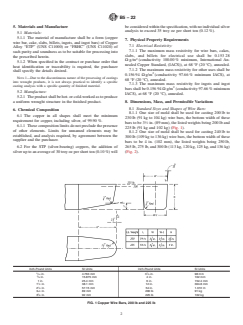
8.1.1 One size of mold shall be used for casting 200 lb to
6.1 The copper in all shapes shall meet the minimum
230 lb (91 kg to 104 kg) wire bars, the bottom width of these
requirement for copper, including silver, of 99.90 %.
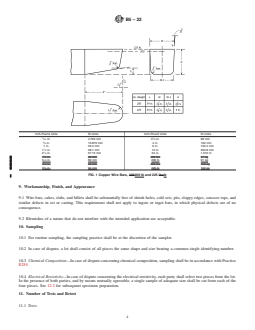
bars to be 3 ⁄2 in. (89 mm), the listed weights being 200 lb and
6.1.1 These composition limits do not preclude the presence
225 lb (91 kg and 102 kg) (Fig. 1).
of other elements. Limits for unnamed elements may be
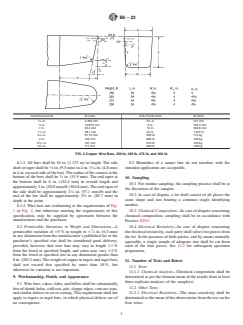
8.1.2 One size of mold shall be used for casting 240 lb to
established, and analysis required, by agreement between the
300 lb (109 kg to 136 kg) wire bars, the bottom width of these
supplier and the purchaser.
bars to be 4 in. (102 mm), the listed weights being 250 lb,
6.2 For the STP (silver-bearing) coppers, the addition of 265 lb,275 lb,and300lb(113 kg,120 kg,125 kg,and136kg)
silver up to an average of 30 troy oz per short ton (0.10 %) will (Fig. 2).
Inch-Pound Units SI Units Inch-Pound Units SI Units
3 7
⁄16 in. 4.763 mm 3 ⁄8 in. 98 mm
⁄8 in. 15.875 mm 4 in. 102 mm
1 in. 25.4 mm 6 in. 152.4 mm
1 ⁄2 in. 38.1 mm 12 in. 304.8 mm
2 ⁄4 in. 57.15 mm 54 in. 1.372 m
3 ⁄2 in. 89 mm 200 lb 91 kg
3 ⁄8 in. 92 mm 225 lb 102 kg
FIG. 1 Copper Wire Bars, 200 lb and 225 lb
B5−22
Inch-Pound Units SI Units Inch-Pound Units SI Units
3 3
⁄16 in. 4.763 mm 4 ⁄4 in. 121 mm
⁄8 in. 15.875 mm 6 in. 152.4 mm
1 in. 25.4 mm 12 in. 304.8 mm
1 ⁄2 in. 38.1 mm 54 in. 1.372 m
2 ⁄4 in. 57.15 mm 250 lb 113 kg
4 in. 102 mm 265 lb 120 kg
4 ⁄16 in. 107 mm 275 lb 125 kg
4 ⁄8 in. 111 mm 300 lb 136 kg
FIG. 2 Copper Wire Bars, 250 lb, 265 lb, 275 lb, and 300 lb
8.1.3 All bars shall be 54 in. (1.372 m) in length. The side 9.2 Blemishes of a nature that do not interfere with the
3 3
draft or taper shall be ⁄8 in. (9.5 mm) in 4 in. ( ⁄16 in. (4.8 mm) intended application are acceptable.
in 4 in. on each side of the bar).The radius of the corners at the
bottom of the bars shall be ⁄8 in. (15.9 mm). The end taper at 10. Sampling
the bottom shall be 6 in. (152.4 mm) in overall length and
10.1 For routine sampling, the sampling practice shall be at
approximately 2 in. (50.8 mm)/ft (304.8 mm).The end taper of
the discretion of the sampler.
the side shall be approximately 2 ⁄4 in. (57.1 mm)/ft and the
3 10.2 In case of dispute, a lot shall consist of all pieces the
end of the bar shall be approximately 3 ⁄8 in. (85.7 mm) in
same shape and size bearing a common single identifying
depth at the point.
number.
8.1.4 Wire bars not conforming to the requirements of Fig.
1 or Fig. 2, but otherwise meeting the requirements of this
10.3 Chemical Composition—In case of dispute concerning
specification, may be supplied by agreement between the
chemical composition, sampling shall be in accordance with
manufacturer and the purchaser.
Practice E255.
8.2 Permissible Variations in Weight and Dimensions—A
10.4 Electrical Resistivity—In case of dispute concerning
permissible variation of 65 % in weight or 6 ⁄4 in. (6.3 mm)
t
...
This document is not an ASTM standard and is intended only to provide the user of an ASTM standard an indication of what changes have been made to the previous version. Because
it may not be technically possible to adequately depict all changes accurately, ASTM recommends that users consult prior editions as appropriate. In all cases only the current version
of the standard as published by ASTM is to be considered the official document.
Designation: B5 − 16 B5 − 22
Standard Specification for
High Conductivity Tough-Pitch Copper Refinery Shapes
This standard is issued under the fixed designation B5; the number immediately following the designation indicates the year of original
adoption or, in the case of revision, the year of last revision. A number in parentheses indicates the year of last reapproval. A superscript
epsilon (´) indicates an editorial change since the last revision or reapproval.
This standard has been approved for use by agencies of the U.S. Department of Defense.
1. Scope*
1.1 This specification establishes the requirements for high conductivity, tough-pitch, copper wire bars, cakes, slabs, billets, ingots,
and ingot bars.
1.2 Copper under this specification corresponds to the designations “ETP” (UNS C11000) and “FRHC” (UNS C11020) as shown
in Classification B224. These coppers may also be used to produce coppers corresponding to the following:
Copper UNS No. Classification B224 Designation
C11300, C11400, C11500, and C11600 STP
C12000 DLP
C12200 DHP
C12300 DHPS
C14520 DPTE
1.3 Although this specification includes certain UNS designations as described in Practice E527, these designations are for cross
reference only and are not specification requirements. Therefore, in case of conflict, this ASTM specification shall govern.
1.4 Units—The values stated in inch-pound units are to be regarded as standard. The values given in parentheses are mathematical
conversions to SI units that are provided for information only and are not considered standard.
1.4.1 Exception—Electrical resistivity is expressed in SI units.
1.5 This international standard was developed in accordance with internationally recognized principles on standardization
established in the Decision on Principles for the Development of International Standards, Guides and Recommendations issued
by the World Trade Organization Technical Barriers to Trade (TBT) Committee.
2. Referenced Documents
2.1 ASTM Standards:
B193 Test Method for Resistivity of Electrical Conductor Materials
B224 Classification of Coppers
This specification is under the jurisdiction of ASTM Committee B05 on Copper and Copper Alloys and is the direct responsibility of Subcommittee B05.07 on Refined
Copper.
Current edition approved Oct. 1, 2016Oct. 1, 2022. Published November 2016October 2022. Originally approved in 1911. Last previous edition approved in 20112016
as B5 – 11.B5 – 16. DOI: 10.1520/B0005-16.10.1520/B0005-22.
For referenced ASTM standards, visit the ASTM website, www.astm.org, or contact ASTM Customer Service at service@astm.org. For Annual Book of ASTM Standards
volume information, refer to the standard’sstandard’s Document Summary page on the ASTM website.
*A Summary of Changes section appears at the end of this standard
Copyright © ASTM International, 100 Barr Harbor Drive, PO Box C700, West Conshohocken, PA 19428-2959. United States
B5 − 22
B846 Terminology for Copper and Copper Alloys
B950 Guide for Editorial Procedures and Form of Product Specifications for Copper and Copper Alloys
E29 Practice for Using Significant Digits in Test Data to Determine Conformance with Specifications
E53 Test Method for Determination of Copper in Unalloyed Copper by Gravimetry (Withdrawn 2022)
E255 Practice for Sampling Copper and Copper Alloys for the Determination of Chemical Composition
E478 Test Methods for Chemical Analysis of Copper Alloys
E527 Practice for Numbering Metals and Alloys in the Unified Numbering System (UNS)
3. Terminology
3.1 For definitions of terms related to copper and copper alloys, refer to Terminology B846. For definitions of terms related to
standard classification of coppers, refer to Classification B224.
4. Ordering Information
4.1 Include the following information, as applicable:
4.1.1 ASTM Specification Designation and year of issue;
4.1.2 Copper UNS No. Designation;
4.1.3 Quantity, shape, and dimension of each piece, and weight;
4.1.4 Should cakes, slabs, or billets be ordered for electrical use, it must be stated in the contract or purchase order.
4.1.5 Silver content in silver-bearing shapes, when required, in troy oz per short ton.
5. Materials and Manufacture
5.1 Materials:
5.1.1 The material of manufacture shall be a form (copper wire bar, cake, slabs, billets, ingots, and ingot bars) of Copper Alloy
“ETP” (UNS C11000) or “FRHC” (UNS C11020) of such purity and soundness as to be suitable for processing into the prescribed
herein.
5.1.2 When specified in the contract or purchase order that heat identification or traceability is required, the purchaser shall specify
the details desired.
The last approved version of this historical standard is referenced on www.astm.org.
B5 − 22
NOTE 1—Due to the discontinuous nature of the processing of castings into wrought products, it is not always practical to identify a specific casting
analysis with a specific quantity of finished material.
5.2 Manufacture:
5.2.1 The product shall be hot- or cold-worked as to produce a uniform wrought structure in the finished product.
6. Chemical Composition
6.1 The copper in all shapes shall meet the minimum requirement for copper, including silver, of 99.90 %.
6.1.1 These composition limits do not preclude the presence of other elements. Limits for unnamed elements may be established,
and analysis required, by agreement between the supplier and the purchaser.
6.2 For the STP (silver-bearing) coppers, the addition of silver up to an average of 30 troy oz per short ton (0.10 %) will be
considered within the specification, with no individual silver analysis to exceed 35 troy oz per short ton (0.12 %).
7. Physical Property Requirements
7.1 Electrical Resistivity:
7.1.1 The maximum mass resistivity for wire bars, cakes, slabs, and billets for electrical use shall be 0.153 28 Ω·g ⁄m (conduc-
tivity 100.00 % minimum, International Annealed Copper Standard, (IACS)), at 68°F (20°C),68 °F (20 °C), annealed.
7.1.2 The maximum mass resistivity for other uses shall be 0.156 94 Ω·g/m (conductivity 97.66 % minimum IACS), at 68°F
(20°C),68 °F (20 °C), annealed.
7.1.3 The maximum mass resistivity for ingots and ingot bars shall be 0.156 94 Ω·g/m (conductivity 97.66 % minimum IACS),
at 68°F (20°C),68 °F (20 °C), annealed.
8. Dimensions, Mass, and Permissible Variations
8.1 Standard Sizes and Shapes of Wire Bars:
8.1.1 One size of mold shall be used for casting 200-200 lb to 230-lb (91-230 lb (91 kg to 104-kg)104 kg) wire bars, the bottom
width of these bars to be 3 ⁄2 in. (89 mm), the listed weights being 200 and 225 lbs (91 200 lb and 225 lb (91 kg and 102 kg) (Fig.
1).
8.1.2 One size of mold shall be used for casting 240-240 lb to 300-lb (109-300 lb (109 kg to 136-kg)136 kg) wire bars, the bottom
width of these bars to be 4 in. (102 mm), the listed weights being 250, 265, 275,250 lb, 265 lb, 275 lb, and 300 lbs (113, 120, 125,lb
(113 kg, 120 kg, 125 kg, and 136 kg) (Fig. 2).
3 3
8.1.3 All bars shall be 54 in. (1.372 m) in length. The side draft or taper shall be ⁄8 in. (9.5 mm) in 4 in. ( ⁄16 in. (4.8 mm) in 4
in. on each side of the bar). The radius of the corners at the bottom of the bars shall be ⁄8 in. (15.9 mm). The end taper at the bottom
shall be 6 in. (152.4 mm) in overall length and approximately 2 in. (50.8 mm)/ft (304.8 mm). The end taper of the side shall be
1 3
approximately 2 ⁄4 in. (57.1 mm)/ft and the end of the bar shall be approximately 3 ⁄8 in. (85.7 mm) in depth at the point.
8.1.4 Wire bars not conforming to the requirements of Fig. 1 or Fig. 2, but otherwise meeting the requirements of this specification,
may be supplied by agreement between the manufacturer and the purchaser.
8.2 Permissible Variations in Weight and Dimensions—A permissible variation of 65 % in weight or 6 ⁄4 in. (6.3 mm) in any
dimension from the manufacturer’s published list or the purchaser’s specified size shall be considered good delivery; provided,
however, that wire bars may vary in length 61 % from the listed or specified length, and cakes may vary 63 % from the listed
or specified size in any dimension greater than 8 in. (203.2 mm). The weight of copper in ingots and ingot bars shall not exceed
that specified by more than 10 %, but otherwise its variation is not important.
B5 − 22
Inch-Pound Units SI Units Inch-Pound Units SI Units
3 7
⁄16 in. 4.763 mm 3 ⁄8 in. 98 mm
⁄8 in. 15.875 mm 4 in. 102 mm
1 in. 25.4 mm 6 in. 152.4 mm
1 ⁄2 in. 38.1 mm 12 in. 304.8 mm
2 ⁄4 in. 57.15 mm 54 in. 1.372 m
3 ⁄2 in. 89 mm 200 lbs 91 kg
3 ⁄2 in. 89 mm 200 lb 91 kg
3 ⁄8 in. 92 mm 225 lbs 102 kg
3 ⁄8 in. 92 mm 225 lb 102 kg
FIG. 1 Copper Wire Bars, 200200 lb and 225 lbslb
9. Workmanship, Finish, and Appearance
9.1 Wire bars, cakes, slabs, and billets shall be substantially free of shrink holes, cold sets, pits, sloppy edges, concave tops, and
similar defects in set or casting. This requirement shall not apply to ingots or ingot bars, in which physical defects are of no
consequence.
9.2 Blemishes of a nature that do not interfere with the intended application are acceptable.
10. Sampling
10.1 For routine sampling, the sampling practice shall be at the discretion of the sampler.
10.2 In case o
...