

ASTM D562-10(2023)
(Test Method)Standard Test Method for Consistency of Paints Measuring Krebs Unit (KU) Viscosity Using a Stormer-Type Viscometer
General Information
- Abstract
SIGNIFICANCE AND USE
5.1 This test method provides values that are useful in specifying and controlling the consistency of paints, such as consumer or trade sales products.
SCOPE
1.1 This test method covers the measurement of Krebs Unit (KU) viscosity to evaluate the consistency of paints and related coatings using the Stormer-type viscometer.
1.2 The values stated in SI units are to be regarded as the standard. The values given in parentheses are for information only.
1.3 This standard does not purport to address all of the safety concerns, if any, associated with its use. It is the responsibility of the user of this standard to establish appropriate safety, health, and environmental practices and determine the applicability of regulatory limitations prior to use.
1.4 This international standard was developed in accordance with internationally recognized principles on standardization established in the Decision on Principles for the Development of International Standards, Guides and Recommendations issued by the World Trade Organization Technical Barriers to Trade (TBT) Committee.
- Status
- Published
- Publication Date
- 31-Jan-2023
- Technical Committee
- D01 - Paint and Related Coatings, Materials, and Applications
- Drafting Committee
- D01.24 - Physical Properties of Liquid Paints & Paint Materials
Overview
ASTM D562-10(2023) - Standard Test Method for Consistency of Paints Measuring Krebs Unit (KU) Viscosity Using a Stormer-Type Viscometer provides a standardized procedure for determining the viscosity, or consistency, of paints and related coatings. The method uses a Stormer-type viscometer to measure Krebs Units (KU), a common scale for expressing paint viscosity, offering reliable values for product specification and quality control in the paint industry. This standard is essential for manufacturers, testing laboratories, and regulatory agencies involved in analyzing or verifying the consistency of consumer and trade sale paint products.
Key Topics
- Measurement Principle: Determines the load required to rotate a paddle-type rotor at 200 revolutions per minute (r/min) when immersed in a paint specimen.
- Krebs Units (KU): The unit of measure commonly used to express the viscosity or consistency of paints, especially those applied by brush or roller.
- Test Apparatus: Specifies use of the Stormer-type viscometer with options for analog and digital display types, as well as suitable thermometers and standard oils for calibration.
- Test Conditions: Stresses the importance of conducting viscosity measurements at controlled temperatures (standard: 25 ± 0.2 °C) to ensure accurate and repeatable results.
- Precision and Repeatability: Addresses within-laboratory repeatability and between-laboratory reproducibility, supporting consistent quality benchmarks in industrial testing.
- Calibration Protocols: Includes the use of reference oils and correction for temperature deviations, ensuring the viscometer's accuracy.
Applications
ASTM D562-10(2023) is widely applied throughout the paint and coatings industry for:
- Product Quality Control: Ensures that finished paints and coatings meet specified viscosity requirements, supporting optimal performance and application characteristics.
- Formulation Development: Guides R&D teams in adjusting and verifying the consistency of new or modified paint formulations.
- Regulatory Compliance: Assists manufacturers in aligning with industry standards for consistency, often required by contracts or regulations.
- Trade and Consumer Product Evaluation: Provides an objective method for comparing viscosities across product batches or brands.
- Process Optimization: Enables production teams to monitor and control paint consistency in real time, reducing variability and waste.
By using this standard, organizations can confidently guarantee the uniformity, application ease, and final appearance of their paint products, supporting both consumer satisfaction and regulatory adherence.
Related Standards
Several related ASTM standards complement the procedures and scope of ASTM D562-10(2023):
- ASTM E1 – Specification for ASTM Liquid-in-Glass Thermometers: Details thermometer requirements compatible with viscosity measurements.
- ASTM D4212 – Standard Test Method for Viscosity by Dip-Type Viscosity Cups: Provides an alternative approach for viscosity determination.
- ASTM D2196 – Standard Test Methods for Rheological Properties of Non-Newtonian Materials by Rotational (Brookfield) Viscometer: Covers broader rheological assessments of paints and coatings.
- ISO 2431 – Paints and varnishes - Determination of flow time by use of flow cups: An international standard relevant for cross-border consistency.
Summary
Adopting ASTM D562-10(2023) enables consistent, reliable measurement of paint viscosity in Krebs Units using Stormer-type viscometers. By ensuring that paint consistency is accurately specified and controlled, this standard underpins both product quality and regulatory compliance throughout the paint and coatings sector. For laboratories and manufacturers seeking robust, internationally recognized methods, ASTM D562 offers a practical and essential solution for viscosity testing.
Relations
- Effective Date
- 01-May-2013
- Effective Date
- 01-Nov-2007
- Effective Date
- 01-Nov-2005
- Effective Date
- 01-Nov-2003
- Effective Date
- 10-May-2003
- Effective Date
- 10-Oct-2001
- Effective Date
- 10-Oct-2001
- Effective Date
- 10-Oct-2001
Frequently Asked Questions
ASTM D562-10(2023) is a standard published by ASTM International. Its full title is "Standard Test Method for Consistency of Paints Measuring Krebs Unit (KU) Viscosity Using a Stormer-Type Viscometer". This standard covers: SIGNIFICANCE AND USE 5.1 This test method provides values that are useful in specifying and controlling the consistency of paints, such as consumer or trade sales products. SCOPE 1.1 This test method covers the measurement of Krebs Unit (KU) viscosity to evaluate the consistency of paints and related coatings using the Stormer-type viscometer. 1.2 The values stated in SI units are to be regarded as the standard. The values given in parentheses are for information only. 1.3 This standard does not purport to address all of the safety concerns, if any, associated with its use. It is the responsibility of the user of this standard to establish appropriate safety, health, and environmental practices and determine the applicability of regulatory limitations prior to use. 1.4 This international standard was developed in accordance with internationally recognized principles on standardization established in the Decision on Principles for the Development of International Standards, Guides and Recommendations issued by the World Trade Organization Technical Barriers to Trade (TBT) Committee.
SIGNIFICANCE AND USE 5.1 This test method provides values that are useful in specifying and controlling the consistency of paints, such as consumer or trade sales products. SCOPE 1.1 This test method covers the measurement of Krebs Unit (KU) viscosity to evaluate the consistency of paints and related coatings using the Stormer-type viscometer. 1.2 The values stated in SI units are to be regarded as the standard. The values given in parentheses are for information only. 1.3 This standard does not purport to address all of the safety concerns, if any, associated with its use. It is the responsibility of the user of this standard to establish appropriate safety, health, and environmental practices and determine the applicability of regulatory limitations prior to use. 1.4 This international standard was developed in accordance with internationally recognized principles on standardization established in the Decision on Principles for the Development of International Standards, Guides and Recommendations issued by the World Trade Organization Technical Barriers to Trade (TBT) Committee.
ASTM D562-10(2023) is classified under the following ICS (International Classification for Standards) categories: 87.040 - Paints and varnishes. The ICS classification helps identify the subject area and facilitates finding related standards.
ASTM D562-10(2023) has the following relationships with other standards: It is inter standard links to ASTM E1-13, ASTM E1-07, ASTM E1-05, ASTM E1-03a, ASTM E1-03, ASTM E1-01, ASTM E1-98e1, ASTM E1-98. Understanding these relationships helps ensure you are using the most current and applicable version of the standard.
ASTM D562-10(2023) is available in PDF format for immediate download after purchase. The document can be added to your cart and obtained through the secure checkout process. Digital delivery ensures instant access to the complete standard document.
Standards Content (Sample)
This international standard was developed in accordance with internationally recognized principles on standardization established in the Decision on Principles for the
Development of International Standards, Guides and Recommendations issued by the World Trade Organization Technical Barriers to Trade (TBT) Committee.
Designation: D562 − 10 (Reapproved 2023)
Standard Test Method for
Consistency of Paints Measuring Krebs Unit (KU) Viscosity
Using a Stormer-Type Viscometer
This standard is issued under the fixed designation D562; the number immediately following the designation indicates the year of
original adoption or, in the case of revision, the year of last revision. A number in parentheses indicates the year of last reapproval. A
superscript epsilon (´) indicates an editorial change since the last revision or reapproval.
This standard has been approved for use by agencies of the U.S. Department of Defense.
1. Scope 3.1.2.1 Discussion—This scale is a function of the “load to
produce 200 r ⁄min” scale.
1.1 This test method covers the measurement of Krebs Unit
(KU) viscosity to evaluate the consistency of paints and related
4. Summary of Test Method
coatings using the Stormer-type viscometer.
4.1 The load required to produce a rotational frequency of
1.2 The values stated in SI units are to be regarded as the
200 r/min for an offset paddle rotor immersed in a paint is
standard. The values given in parentheses are for information
determined.
only.
1.3 This standard does not purport to address all of the
5. Significance and Use
safety concerns, if any, associated with its use. It is the
5.1 This test method provides values that are useful in
responsibility of the user of this standard to establish appro-
specifying and controlling the consistency of paints, such as
priate safety, health, and environmental practices and deter-
consumer or trade sales products.
mine the applicability of regulatory limitations prior to use.
1.4 This international standard was developed in accor-
METHOD A
dance with internationally recognized principles on standard-
ization established in the Decision on Principles for the
6. Apparatus
Development of International Standards, Guides and Recom-
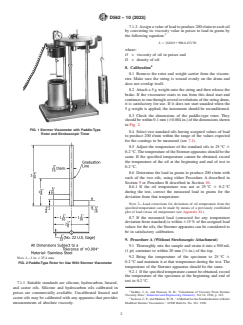
6.1 Viscometer, Stormer, with the paddle-type rotor as illus-
mendations issued by the World Trade Organization Technical
trated in Fig. 1 and Fig. 2. The stroboscopic timer attachment
Barriers to Trade (TBT) Committee.
in Fig. 1 can be removed and the instrument used without it but
with a sacrifice of speed and accuracy. The stroboscopic timer
2. Referenced Documents
gives the 200 r/min reading directly.
2.1 ASTM Standards:
6.2 Container, 500 mL (1 pt), 85 mm (3 ⁄8 in.) in diameter.
E1 Specification for ASTM Liquid-in-Glass Thermometers
6.3 Thermometer—An ASTM Stormer Viscosity thermom-
3. Terminology
eter having a range from 20 °C to 70 °C and conforming to the
requirements for Thermometer 49C, as prescribed in Specifi-
3.1 Definitions of Terms Specific to This Standard:
3.1.1 consistency, n—load in grams to produce a rotational cation E1. In addition, temperature measuring devices such as
frequency of 200 r/min (Stormer Viscometer). non-mercury liquid-in-glass thermometers, thermocouples, or
platinum resistance thermometers that provide equivalent or
3.1.2 Krebs units (KU), n—values of a scale commonly used
better accuracy and precision, that cover the temperature range
to express the consistency of paints generally applied by brush
for thermometer 49C, may be used.
or roller.
6.4 Stopwatch, or suitable timer measuring to 0.2 s.
6.5 Weights, a set covering the range from 5 g to 1000 g.
This test method is under the jurisdiction of ASTM Committee D01 on Paint
and Related Coatings, Materials, and Applications and is the direct responsibility of
7. Materials
Subcommittee D01.24 on Physical Properties of Liquid Paints & Paint Materials.
Current edition approved Feb. 1, 2023. Published February 2023. Originally
7.1 Two standard oils, calibrated in absolute viscosity
approved in 1947. Last previous edition approved in 2018 as D562 – 10 (2018).
(poise), that are within the viscosity range of the coatings to be
DOI: 10.1520/D0562-10R23.
For referenced ASTM standards, visit the ASTM website, www.astm.org, or
measured. These oils should differ in viscosity by at least 5 P.
contact ASTM Customer Service at service@astm.org. For Annual Book of ASTM
Standards volume information, refer to the standard’s Document Summary page on NOTE 1—The normal range of the Stormer is covered by oils having
the ASTM website. viscosities of 4 P (70 KU), 10 P (85 KU), and 14 P (95 KU).
Copyright © ASTM International, 100 Barr Harbor Drive, PO Box C700, West Conshohocken, PA 19428-2959. United States
D562 − 10 (2023)
7.1.2 Assign a value of load to produce 200 r/min to each oil
by converting its viscosity value in poises to load in grams by
the following equation:
L 5 610O1906.6 D /30
~ !
where:
O = viscosity of oil in poises and
D = density of oil.
8. Calibration
8.1 Remove the rotor and weight carrier from the viscom-
eter. Make sure the string is wound evenly on the drum and
does not overlap itself.
8.2 Attach a 5 g weight onto the string and then release the
brake. If the viscometer starts to run from this dead start and
continues to run through several revolutions of the string drum,
it is satisfactory for use. If it does not start unaided when the
5 g weight is applied, the instrument should be reconditioned.
8.3 Check the dimensions of the paddle-type rotor. They
should be within 0.1 mm (60.004 in.) of the dimensions shown
in Fig. 2.
FIG. 1 Stormer Viscometer with Paddle-Type
8.4 Select two standard oils having assigned values of load
Rotor and Stroboscopic Timer
to produce 200 r/min within the range of the values expected
for the coatings to be measured (see 7.1).
8.5 Adjust the temperature of the standard oils to 25 °C 6
0.2 °C. The temperature of the Stormer apparatus should be the
same. If the specified temperature cannot be obtained, record
the temperature of the oil at the beginning and end of test to
0.2 °C.
8.6 Determine the load in grams to produce 200 r/min with
each of the two oils, using either Procedure A described in
Section 9 or Procedure B described in Section 10.
8.6.1 If the oil temperature was not at 25 °C 6 0.2 °C
during the test, correct the measured load in grams for the
deviation from that temperature.
NOTE 2—Load corrections for deviations of oil temperature from the
specified temperature can be made by means of a previously established
plot of load versus oil temperature (see Appendix X1).
8.7 If the measured load (corrected for any temperature
deviation from standard) is within 615 % of the assigned load
values for the oils, the Stormer apparatus can be considered to
be in satisfactory calibration.
9. Procedure A (Without Stroboscopic Attachment)
9.1 Thoroughly mix the sample and strain it into a 500 mL
(1 pt) container to within 20 mm ( ⁄4 in.) of the top.
9.2 Bring the temperature of the specimen to 25 °C 6
NOTE 1—1 in. = 25.4 mm.
0.2 °C and maintain it at that temperature during the test. The
FIG. 2 Paddle-Type Rotor for Use With Stormer Viscometer
temperature of the Stormer apparatus should be the same.
9.2.1 If the specified temperature cannot be obtained, record
the temperature of the specimen at the beginning and end of
test to 0.2 °C.
7.1.1 Suitable standards are silicone, hydrocarbon, linseed,
and castor oils. Silicone and hydrocarbon oils calibrated in
Geddes, J. A., and Dawson, D. H., “Calculation of Viscosity From Stormer
poises are commercially available. Uncalibrated linseed and
Viscosity Data,” Industrial and Engineering Chemistry, Vol 34, 1942, p. 163.
castor oils may be calibrated with any apparatus that provides 4
Jackson, C. F., and Madson, W. H., “A Method for the Standardization of Krebs
measurements of absolute viscosity. Modified Stormer Viscometers,” ASTM Bulletin, No. 161, 1949.
D562 − 10 (2023)
9.3 When the temperature of the specimen has reached
equilibrium, stir it vigorously, being careful to avoid entrap-
ping air, and place the container immediately on the platform
of the viscometer so that the paddle-type rotor is immersed in
the material to the mark on the shaft of the rotor.
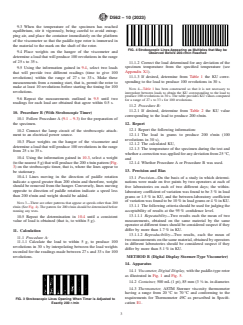
FIG. 4 Stroboscopic Lines Appearing as Multiples that May be
9.4 Place weights on the hanger of the viscometer and
Observed Before 200-r/min Reached
determine a load that will produce 100 revolutions in the range
of 25 s to 35 s.
11.1.2 Correct the load determined for any deviation of the
specimen temperature from the specified temperature (see
9.5 Using the information gained in 9.4, select two loads
Appendix X1).
that will provide two different readings (time to give 100
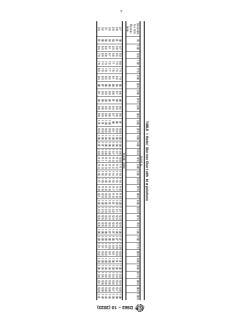
11.1.3 If desired, determine from Table 1 the KU corre-
revolutions) within the range of 27 s to 33 s. Make these
sponding to the load to produce 100 revolutions in 30 s.
measurements from a running start, that is, permit the rotor to
make at least 10 revolutions before starting the timing for 100
NOTE 4—Table 1 has been constructed so that it is not necessary to
revolutions.
interpolate between loads to obtain the KU corresponding to the load to
produce 100 revolutions in 30 s. The table provides KU values computed
9.6 Repeat the measurements outlined in 9.5 until two
for a range of 27 s to 33 s for 100 revolutions.
readings for each load are obtained that agree within 0.5 s.
11.2 Procedure B:
11.2.1 If desired, determine from Table 2 the KU value
10. Procedure B (With Stroboscopic Timer)
corresponding to the load to produce 200 r/min.
10.1 Follow Procedure A (9.1 – 9.3) for the preparation of
12. Report
the specimen.
12.1 Report the following information:
10.2 Connect the lamp circuit of the stroboscopic attach-
12.1.1 The load in grams to produce 200 r/min (100
ment to an electrical power source.
revolutions in 30 s),
10.3 Place weights on the hanger of the viscometer and
12.1.2 The calculated KU,
determine a load that will produce 100 revolutions in the range
12.1.3 The temperature of the specimen during the test and
from 25 s to 35 s.
whether a correction was applied for any deviation from 25 °C,
10.4 Using the information gained in 10.3, select a weight
and
(to the nearest 5 g) that will produce the 200 r ⁄min pattern (Fig.
12.1.4 Whether Procedure A or Procedure B was used.
3) on the stroboscopic timer, that is, where the lines appear to
13. Precision and Bias
be stationary.
10.4.1 Lines moving in the direction of paddle rotation
13.1 Precision—On the basis of a study in which determi-
indicate a speed greater than 200 r/min and therefore, weight
nations were made on five paints by two operators at each of
should be removed from the hanger. Conversely, lines moving
five laboratories on each of two different days; the within-
opposite to direction of paddle rotation indicate a speed less
laboratory coefficient of variation was found to be 3 % in load
than 200 r/min and weight should be ad
...