

ASTM F3682-24
(Terminology)Standard Terminology for Goods Movement Process (GMP) Precise Foundational Definitions
General Information
- Abstract
SIGNIFICANCE AND USE
3.1 The terms defined in this document and the order they are presented illustrate sequential phases of the Goods Movement Process and further subdivide into recognizable definitive milestone statuses for uniform predictable communication.
SCOPE
1.1 During the repetitive Goods Movement Process (GMP), there is a Planning Phase, an Execution Phase, and a Settlement Phase. Each phase has sub-steps that are called Milestone Statuses. The GMP is described as part of ISO 8000-119 and relates to defined transportation needs and the executing of transportation services based on those needs. This standard seeks to precisely define the milestone statuses such that even if the reader is unfamiliar with these terms, the reader will be able to relate to the exact moment of status change described.
1.2 Standardize the Goods Movement Process into Planning, Execution, and Settlement phases.
1.2.1 In the Planning Phase, the milestone steps are Posted, Pre-Booked, and Booked.
1.2.2 In the Execution Phase, the milestone steps are En-Route and Delivered.
1.2.3 In the Settlement Phase, the milestone steps are Invoiced and Archived.
1.3 Logically sequence the terminology represented to align with the sequence in which events will generally occur in practice.
1.4 This international standard was developed in accordance with internationally recognized principles on standardization established in the Decision on Principles for the Development of International Standards, Guides and Recommendations issued by the World Trade Organization Technical Barriers to Trade (TBT) Committee.
- Status
- Published
- Publication Date
- 14-Feb-2024
- Technical Committee
- F49 - Digital Information in the Supply Chain
- Drafting Committee
- F49.01 - Terminology


Overview
ASTM F3682-24: Standard Terminology for Goods Movement Process (GMP) Precise Foundational Definitions provides an internationally recognized and uniform set of definitions for the sequential phases and critical milestone statuses within the Goods Movement Process (GMP). Developed by ASTM, this standard enables clear, consistent, and predictable communication throughout logistics and transportation activities, supporting compliant and effective supply chain management across global industries. By precisely defining terms for each phase and milestone, ASTM F3682-24 facilitates understanding of what status changes represent, even for those unfamiliar with specialized logistics terminology.
Key Topics
Goods Movement Process (GMP) Phases:
- Planning Phase: Involves defining transportation requirements, scheduling, and confirming service agreements.
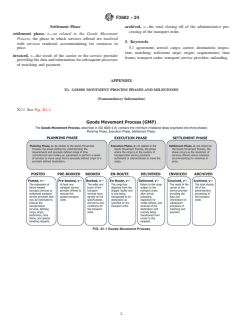
- Milestone Statuses: Posted, Pre-Booked, Booked
- Execution Phase: Covers the physical movement and delivery of goods.
- Milestone Statuses: En-Route, Delivered
- Settlement Phase: Involves the completion of administrative, financial, and record-keeping activities.
- Milestone Statuses: Invoiced, Archived
- Planning Phase: Involves defining transportation requirements, scheduling, and confirming service agreements.
Milestone Statuses Descriptions:
- Posted: Initial expression of transportation needs to selected service providers.
- Pre-Booked: At least one provider offers to execute the posted transport order.
- Booked: Formal agreement reached regarding the terms of the transport order between the parties.
- En-Route: Goods have departed from the origin and are being transported.
- Delivered: Goods have arrived, been unloaded, and transferred to the recipient after inspection.
- Invoiced: Invoice issued for the completed transport service.
- Archived: Final administrative closure of the transport order.
Order and Sequence: Terms and statuses are sequenced to reflect the logical and practical progression of goods movement, supporting transparent tracking and reporting.
Applications
ASTM F3682-24 is designed to bring clarity and harmonization to logistics communication, benefitting a wide range of applications:
- Supply Chain Management: Enables consistent terminology for tracking transportation milestones in end-to-end logistics.
- Freight and Logistics Contracting: Provides a basis for precise agreements between shippers, carriers, and third-party logistics providers.
- Digital Supply Chain Systems: Supports standardized data exchange formats in transportation management software and platforms.
- Regulatory and Compliance Reporting: Assists organizations in meeting international and industry-specific reporting requirements.
- Operational Audits: Enhances auditability and transparency by defining clear status transitions and process phases.
- Onboarding and Training: Facilitates the rapid training of new personnel by standardizing core logistics terminology.
Related Standards
For organizations seeking further interoperability and data quality in logistics operations, ASTM F3682-24 references and aligns with key international standards:
- ISO 8000-119 - Application of ISO 8000-115 to transport unit identifiers: Provides guidance on transport unit data identifiers, supporting data quality in logistics.
- WTO TBT Committee Principles - Ensures the standard is developed according to globally recognized standardization principles.
Keywords: goods movement process, logistics, milestone status, supply chain, transportation, shipment, planning phase, execution phase, settlement phase, invoiced, delivered, archived, digital supply chain, standard terminology, process standardization, ASTM F3682-24
By adopting ASTM F3682-24, organizations can achieve greater efficiency, transparency, and compliance in the management of goods transportation processes, building a foundation for digital transformation and international collaboration in the logistics sector.
Frequently Asked Questions
ASTM F3682-24 is a standard published by ASTM International. Its full title is "Standard Terminology for Goods Movement Process (GMP) Precise Foundational Definitions". This standard covers: SIGNIFICANCE AND USE 3.1 The terms defined in this document and the order they are presented illustrate sequential phases of the Goods Movement Process and further subdivide into recognizable definitive milestone statuses for uniform predictable communication. SCOPE 1.1 During the repetitive Goods Movement Process (GMP), there is a Planning Phase, an Execution Phase, and a Settlement Phase. Each phase has sub-steps that are called Milestone Statuses. The GMP is described as part of ISO 8000-119 and relates to defined transportation needs and the executing of transportation services based on those needs. This standard seeks to precisely define the milestone statuses such that even if the reader is unfamiliar with these terms, the reader will be able to relate to the exact moment of status change described. 1.2 Standardize the Goods Movement Process into Planning, Execution, and Settlement phases. 1.2.1 In the Planning Phase, the milestone steps are Posted, Pre-Booked, and Booked. 1.2.2 In the Execution Phase, the milestone steps are En-Route and Delivered. 1.2.3 In the Settlement Phase, the milestone steps are Invoiced and Archived. 1.3 Logically sequence the terminology represented to align with the sequence in which events will generally occur in practice. 1.4 This international standard was developed in accordance with internationally recognized principles on standardization established in the Decision on Principles for the Development of International Standards, Guides and Recommendations issued by the World Trade Organization Technical Barriers to Trade (TBT) Committee.
SIGNIFICANCE AND USE 3.1 The terms defined in this document and the order they are presented illustrate sequential phases of the Goods Movement Process and further subdivide into recognizable definitive milestone statuses for uniform predictable communication. SCOPE 1.1 During the repetitive Goods Movement Process (GMP), there is a Planning Phase, an Execution Phase, and a Settlement Phase. Each phase has sub-steps that are called Milestone Statuses. The GMP is described as part of ISO 8000-119 and relates to defined transportation needs and the executing of transportation services based on those needs. This standard seeks to precisely define the milestone statuses such that even if the reader is unfamiliar with these terms, the reader will be able to relate to the exact moment of status change described. 1.2 Standardize the Goods Movement Process into Planning, Execution, and Settlement phases. 1.2.1 In the Planning Phase, the milestone steps are Posted, Pre-Booked, and Booked. 1.2.2 In the Execution Phase, the milestone steps are En-Route and Delivered. 1.2.3 In the Settlement Phase, the milestone steps are Invoiced and Archived. 1.3 Logically sequence the terminology represented to align with the sequence in which events will generally occur in practice. 1.4 This international standard was developed in accordance with internationally recognized principles on standardization established in the Decision on Principles for the Development of International Standards, Guides and Recommendations issued by the World Trade Organization Technical Barriers to Trade (TBT) Committee.
ASTM F3682-24 is available in PDF format for immediate download after purchase. The document can be added to your cart and obtained through the secure checkout process. Digital delivery ensures instant access to the complete standard document.
Standards Content (Sample)
This international standard was developed in accordance with internationally recognized principles on standardization established in the Decision on Principles for the
Development of International Standards, Guides and Recommendations issued by the World Trade Organization Technical Barriers to Trade (TBT) Committee.
Designation: F3682 − 24
Standard Terminology for
Goods Movement Process (GMP) Precise Foundational
Definitions
This standard is issued under the fixed designation F3682; the number immediately following the designation indicates the year of
original adoption or, in the case of revision, the year of last revision. A number in parentheses indicates the year of last reapproval. A
superscript epsilon (´) indicates an editorial change since the last revision or reapproval.
1. Scope 3. Significance and Use
1.1 During the repetitive Goods Movement Process (GMP),
3.1 The terms defined in this document and the order they
there is a Planning Phase, an Execution Phase, and a Settlement
are presented illustrate sequential phases of the Goods Move-
Phase. Each phase has sub-steps that are called Milestone
ment Process and further subdivide into recognizable definitive
Statuses. The GMP is described as part of ISO 8000-119 and
milestone statuses for uniform predictable communication.
relates to defined transportation needs and the executing of
transportation services based on those needs. This standard
4. Terminology
seeks to precisely define the milestone statuses such that even
4.1 Definitions:
if the reader is unfamiliar with these terms, the reader will be
able to relate to the exact moment of status change described.
Planning Phase
planning phase, n—as related to the Goods Movement
1.2 Standardize the Goods Movement Process into
Process, the phase defined by understanding the require-
Planning, Execution, and Settlement phases.
ments and precisely defined range of time commitments and
1.2.1 In the Planning Phase, the milestone steps are Posted,
making an agreement to perform a series of services to move
Pre-Booked, and Booked.
cargo from a precisely defined origin to a precisely defined
1.2.2 In the Execution Phase, the milestone steps are En-
destination.
Route and Delivered.
1.2.3 In the Settlement Phase, the milestone steps are
posted, v—the expression of future needed transport services
Invoiced and Archived.
to authorized transport service providers that may be inter-
1.3 Logically sequence the terminology represented to align
ested to execute the transportation services, defining cargo,
with the sequence in which events will generally occur in
origin, destination, time frame, and special handling re-
practice.
quests.
1.4 This international standard was developed in accor-
pre-booked, v—at least one transport service provider offered
dance with internationally recognized principles on standard-
to execute the posted transport order.
ization established in the Decision on Principles for the
Development of International Standards, Guides and Recom-
booked, v—the seller and buyer of the transport services have
mendations issued by the World Trade Organization Technical
agreed on full specifications and terms and conditions for the
Barriers to Trade (TBT) Committee.
transport order.
Execution Phase
2. Referenced Documents
2 execution phase, n—as related to the Goods Movement
2.1 ISO Standards:
Process, the phase where the cargo is in the custody of
ISO 8000-119 Application of ISO 8000-115 to transport unit
transportation servi
...