

ASTM B63-07(2018)
(Test Method)Standard Test Method for Resistivity of Metallically Conducting Resistance and Contact Materials
General Information
- Abstract
SIGNIFICANCE AND USE
4.1 In the case of materials for resistors and heating elements, a knowledge of resistivity is important in determining whether wire or strip of a specified area of cross section and length will have a required resistance. It serves as one basis for the selection of materials for specific applications and its measurement is a necessary acceptance test for resistance materials.
4.2 In the case of materials for electrical contacts, the measurement of resistivity can serve as a test for uniformity of materials of nominally the same composition and structure.
SCOPE
1.1 This test method covers the determination, to a precision of 2 %, of the electrical resistivity of materials used in resistors, heating elements, and electrical contacts, as well as products of powder metallurgy processes which are used for other purposes.
Note 1: For determining the resistivity of electrical conductors, see Test Method B193.
1.2 The values stated in inch-pound units are to be regarded as standard. The values given in parentheses are mathematical conversions to SI units that are provided for information only and are not considered standard.
1.3 This standard does not purport to address all of the safety concerns, if any, associated with its use. It is the responsibility of the user of this standard to become familiar with all hazards including those identified in the appropriate Safety Data Sheet (SDS) for this product/material as provided by the manufacturer, to establish appropriate safety, health, and environmental practices, and determine the applicability of regulatory limitations prior to use.
1.4 This international standard was developed in accordance with internationally recognized principles on standardization established in the Decision on Principles for the Development of International Standards, Guides and Recommendations issued by the World Trade Organization Technical Barriers to Trade (TBT) Committee.
- Status
- Published
- Publication Date
- 31-Oct-2018
- Technical Committee
- B02 - Nonferrous Metals and Alloys
- Drafting Committee
- B02.10 - Thermostat Metals and Electrical Resistance Heating Materials

Overview
ASTM B63-07(2018): Standard Test Method for Resistivity of Metallically Conducting Resistance and Contact Materials is a widely recognized standard developed by ASTM International. This test method outlines precise procedures for determining the electrical resistivity of materials commonly used in resistors, heating elements, and electrical contacts. The methodology is designed for a precision of 2%, making it highly reliable for both acceptance testing and material selection in electrical and electronic applications.
The standard is essential for industries that require strict quality control of metallic materials used in electrical resistance applications and contact interfaces. It covers both ductile and nonductile materials, including products produced through powder metallurgy, ensuring broad applicability across various materials and manufacturing processes.
Key Topics
- Purpose of Resistivity Measurement: Knowing the resistivity of a material is crucial in the design and acceptance of resistors, heating elements, and electrical contacts. It allows for accurate prediction and control of resistance in wire or strip form and serves as a key indicator of material uniformity.
- Test Specimen Requirements: Methods are specified for preparing and measuring both ductile (wire or strip) and nonductile (machinable or non-machinable) materials, ensuring reliable results irrespective of specimen form.
- Measurement Apparatus: The standard describes equipment including micrometers, digital ohmmeters, potentiometers, and Kelvin bridges, specifying the necessary precision and calibration for accurate resistivity testing.
- Precision and Reporting: ASTM B63-07(2018) ensures test results meet a precision of 2% and bias less than 1%. It details what information must be included in test reports, such as specimen identification, material details, length, cross-sectional area, resistance measurement method, and previous treatments.
- Safety and Compliance: The standard reminds users to address relevant safety, health, and environmental concerns, referencing appropriate Safety Data Sheets (SDS) and regulatory limitations.
Applications
ASTM B63-07(2018) is widely used in a variety of industries, notably:
- Resistors and Heating Elements: The test method is critical in confirming that metallic wires or strips used for resistive and heating devices meet the required resistance specifications. This ensures reliable performance in consumer electronics, industrial heating systems, and precision instrumentation.
- Electrical Contact Materials: Uniformity in resistivity is a key acceptance criterion for contact materials in switches, relays, and connectors. Using this standard helps ensure consistent electrical performance and product reliability.
- Powder Metallurgy Products: The standard supports the evaluation of resistivity in materials created via powder metallurgy, common in advanced manufacturing sectors like automotive, aerospace, and electronics.
- Quality Control and Material Certification: Manufacturers and third-party labs use ASTM B63 for quality control, certification, and procurement of metallic resistive materials, assisting in regulatory compliance and meeting customer requirements.
Related Standards
For comprehensive electrical material evaluation and industry compliance, related ASTM standards include:
- ASTM B193 – Standard Test Method for Resistivity of Electrical Conductor Materials: Recommended for measuring the resistivity of conductor materials distinct from those of resistance or contact applications.
- ASTM B601 – Standard Classification for Powder Metallurgy (PM) Materials Containing Ferrous, Nickel, and Cobalt: Useful for specifying PM materials referenced in resistivity testing.
- ASTM E29 – Standard Practice for Using Significant Digits in Test Data to Determine Conformance with Specifications: Ensures consistent reporting and data conformity in resistivity measurements.
By following ASTM B63-07(2018), manufacturers, quality control labs, and product designers ensure the integrity, reliability, and performance of metallically conducting resistance and contact materials used in critical electrical applications. Consistent testing and documentation support compliance with both industry and regulatory standards, enhancing global market acceptance.
Relations
- Effective Date
- 01-Apr-2016
- Effective Date
- 01-Apr-2014
- Effective Date
- 01-Sep-2008
- Effective Date
- 10-Apr-2002
- Effective Date
- 10-Apr-2002
- Effective Date
- 10-Apr-2002
Get Certified
Connect with accredited certification bodies for this standard

Element Materials Technology
Materials testing and product certification.

Inštitut za kovinske materiale in tehnologije
Institute of Metals and Technology. Materials testing, metallurgical analysis, NDT.
Sponsored listings
Frequently Asked Questions
ASTM B63-07(2018) is a standard published by ASTM International. Its full title is "Standard Test Method for Resistivity of Metallically Conducting Resistance and<brk/> Contact Materials". This standard covers: SIGNIFICANCE AND USE 4.1 In the case of materials for resistors and heating elements, a knowledge of resistivity is important in determining whether wire or strip of a specified area of cross section and length will have a required resistance. It serves as one basis for the selection of materials for specific applications and its measurement is a necessary acceptance test for resistance materials. 4.2 In the case of materials for electrical contacts, the measurement of resistivity can serve as a test for uniformity of materials of nominally the same composition and structure. SCOPE 1.1 This test method covers the determination, to a precision of 2 %, of the electrical resistivity of materials used in resistors, heating elements, and electrical contacts, as well as products of powder metallurgy processes which are used for other purposes. Note 1: For determining the resistivity of electrical conductors, see Test Method B193. 1.2 The values stated in inch-pound units are to be regarded as standard. The values given in parentheses are mathematical conversions to SI units that are provided for information only and are not considered standard. 1.3 This standard does not purport to address all of the safety concerns, if any, associated with its use. It is the responsibility of the user of this standard to become familiar with all hazards including those identified in the appropriate Safety Data Sheet (SDS) for this product/material as provided by the manufacturer, to establish appropriate safety, health, and environmental practices, and determine the applicability of regulatory limitations prior to use. 1.4 This international standard was developed in accordance with internationally recognized principles on standardization established in the Decision on Principles for the Development of International Standards, Guides and Recommendations issued by the World Trade Organization Technical Barriers to Trade (TBT) Committee.
SIGNIFICANCE AND USE 4.1 In the case of materials for resistors and heating elements, a knowledge of resistivity is important in determining whether wire or strip of a specified area of cross section and length will have a required resistance. It serves as one basis for the selection of materials for specific applications and its measurement is a necessary acceptance test for resistance materials. 4.2 In the case of materials for electrical contacts, the measurement of resistivity can serve as a test for uniformity of materials of nominally the same composition and structure. SCOPE 1.1 This test method covers the determination, to a precision of 2 %, of the electrical resistivity of materials used in resistors, heating elements, and electrical contacts, as well as products of powder metallurgy processes which are used for other purposes. Note 1: For determining the resistivity of electrical conductors, see Test Method B193. 1.2 The values stated in inch-pound units are to be regarded as standard. The values given in parentheses are mathematical conversions to SI units that are provided for information only and are not considered standard. 1.3 This standard does not purport to address all of the safety concerns, if any, associated with its use. It is the responsibility of the user of this standard to become familiar with all hazards including those identified in the appropriate Safety Data Sheet (SDS) for this product/material as provided by the manufacturer, to establish appropriate safety, health, and environmental practices, and determine the applicability of regulatory limitations prior to use. 1.4 This international standard was developed in accordance with internationally recognized principles on standardization established in the Decision on Principles for the Development of International Standards, Guides and Recommendations issued by the World Trade Organization Technical Barriers to Trade (TBT) Committee.
ASTM B63-07(2018) is classified under the following ICS (International Classification for Standards) categories: 77.040.99 - Other methods of testing of metals. The ICS classification helps identify the subject area and facilitates finding related standards.
ASTM B63-07(2018) has the following relationships with other standards: It is inter standard links to ASTM B193-16, ASTM B193-02(2014), ASTM B193-02(2008), ASTM B193-00, ASTM B193-01, ASTM B193-02. Understanding these relationships helps ensure you are using the most current and applicable version of the standard.
ASTM B63-07(2018) is available in PDF format for immediate download after purchase. The document can be added to your cart and obtained through the secure checkout process. Digital delivery ensures instant access to the complete standard document.
Standards Content (Sample)
This international standard was developed in accordance with internationally recognized principles on standardization established in the Decision on Principles for the
Development of International Standards, Guides and Recommendations issued by the World Trade Organization Technical Barriers to Trade (TBT) Committee.
Designation: B63 − 07 (Reapproved 2018)
Standard Test Method for
Resistivity of Metallically Conducting Resistance and
Contact Materials
This standard is issued under the fixed designation B63; the number immediately following the designation indicates the year of original
adoption or, in the case of revision, the year of last revision.Anumber in parentheses indicates the year of last reapproval.Asuperscript
epsilon (´) indicates an editorial change since the last revision or reapproval.
This standard has been approved for use by agencies of the U.S. Department of Defense.
1. Scope 3. Terminology
1.1 Thistestmethodcoversthedetermination,toaprecision
3.1 Definitions:
of 2 %, of the electrical resistivity of materials used in
3.1.1 resistivity, n—that property of a material which deter-
resistors, heating elements, and electrical contacts, as well as
mines its resistance to the flow of an electric current, expressed
products of powder metallurgy processes which are used for
as:
other purposes.
ρ 5 RA/L (1)
NOTE 1—For determining the resistivity of electrical conductors, see
where R is the resistance in ohms of a specimen of the
Test Method B193.
material of uniform cross section A and of a length L.In
1.2 The values stated in inch-pound units are to be regarded
reporting values of resistivity under this test A shall be ex-
as standard. The values given in parentheses are mathematical
pressed in square centimeters and L in centimeters. Resistiv-
conversions to SI units that are provided for information only
ity is measured in micro ohm-meter. English units of ohms
and are not considered standard.
circular mil per foot are expressed as:
1.3 This standard does not purport to address all of the
ρ 5 12 310 RA/0.7854 L (2)
safety concerns, if any, associated with its use. It is the
responsibility of the user of this standard to become familiar
where:
with all hazards including those identified in the appropriate
R = resistance in ohms
Safety Data Sheet (SDS) for this product/material as provided
A = uniform cross section area in square inches
by the manufacturer, to establish appropriate safety, health,
L = length in inches
and environmental practices, and determine the applicability
of regulatory limitations prior to use.
4. Significance and Use
1.4 This international standard was developed in accor-
4.1 In the case of materials for resistors and heating
dance with internationally recognized principles on standard-
elements, a knowledge of resistivity is important in determin-
ization established in the Decision on Principles for the
ingwhetherwireorstripofaspecifiedareaofcrosssectionand
Development of International Standards, Guides and Recom-
length will have a required resistance. It serves as one basis for
mendations issued by the World Trade Organization Technical
the selection of materials for specific applications and its
Barriers to Trade (TBT) Committee.
measurement is a necessary acceptance test for resistance
2. Referenced Documents
materials.
2.1 ASTM Standards:
4.2 In the case of materials for electrical contacts, the
B193 Test Method for Resistivity of Electrical Conductor
measurement of resistivity can serve as a test for uniformity of
Materials
materials of nominally the same composition and structure.
This test method is under the jurisdiction of ASTM Committee B02 on 5. Apparatus
Nonferrous Metals and Alloys and is the direct responsibility of Subcommittee
5.1 Means for applying current and voltage terminals to the
B02.10 on Thermostat Metals and Electrical Resistance Heating Materials.
Current edition approved Nov. 1, 2018. Published November 2018. Originally
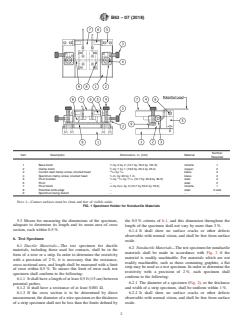
specimen are specified in Section 9. An optional suitable
approved in 1926. Last previous edition approved in 2013 as B63 – 07 (2013). DOI:
specimen holder for nonductile materials is shown in Fig. 1.
10.1520/B0063-07R18.
For referenced ASTM standards, visit the ASTM website, www.astm.org, or
5.2 A suitable bridge, potentiometer, digital ohmmeter, or
contact ASTM Customer Service at service@astm.org. For Annual Book of ASTM
equivalent, with necessary accessories for making resistance
Standards volume information, refer to the standard’s Document Summary page on
the ASTM website. measurements with a limit of error of less than 0.5 %.
Copyright © ASTM International, 100 Barr Harbor Drive, PO Box C700, West Conshohocken, PA 19428-2959. United States
B63 − 07 (2018)
Number
Item Description Dimensions, in. (mm) Material
Required
1 Base block ⁄2 by 3 by 4 (12.7 by 76.2 by 101.6) micarta 1
2 Clamp block ⁄4 by 1 by 1 (19.0 by 25.4 by 25.4) copper 2
10 3
3 Current lead clamp screw, knurled head ⁄32 by ⁄16 brass 2
4 Specimen clamp screw, knurled head ⁄4in.by40by1in. brass 2
1 15 7
5 Pivot bracket ⁄2 by ⁄16 by 1 ⁄16 (12.7 by 23.8 by 36.5) steel 2
6 Pivot . steel 2
1 3
7 Pivot block ⁄2 by 2 ⁄32 by 3 (12.7 by 53.2 by 76.2) micarta 1
8 Potential knife-edge . steel 2 sets
9 Specimen being tested . . .
NOTE 1—Contact surfaces must be clean and free of visible oxide.
FIG. 1 Specimen Holder for Nonductile Materials
5.3 Means for measuring the dimensions of the specimen, the 0.5 % criteria of 6.1, and this dimension throughout the
adequate to determine its length and its mean area of cross length of the specimen shall not vary by more than 3 %.
section, each within 0.5 %.
6.1.4 It shall show no surface cracks or other defects
observable with normal vision, and shall be free from surface
6. Test Specimen
oxide.
6.1 Ductile Materials—The test specimen for ductile
6.2 Nonductile Materials—The test specimen for nonductile
materials, including those used for contacts, shall be in the
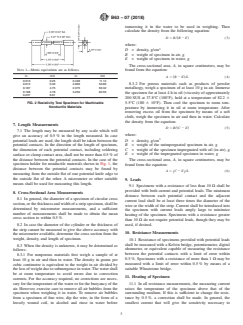
materials shall be made in accordance with Fig. 2 if the
form of a wire or a strip. In order to determine the resistivity
material is readily machinable. For materials which are not
with a precision of 2 %, it is necessary that the resistance,
readily machinable, such as those containing graphite, a flat
cross-sectional area, and length shall be measured with a limit
strip may be used as a test specimen. In order to determine the
of error within 0.5 %. To ensure this limit of error each test
resistivity with a precision of 2 %, each specimen shall
specimen shall conform to the following:
conform to the following:
6.1.1 It shall have a length of at least 0.5 ft (15 cm) between
6.2.1 The diameter of a specimen (Fig. 2), or the thickness
potential probes.
and width of a strip specimen, shall be uniform within 1 %.
6.1.2 It shall have a resistance of at least 0.001 Ω.
6.1.3 If the cross section is to be determined by direct 6.2.2 It shall show no surface cracks or other defects
observable with normal vision, and shall be free from surface
measurement, the diameter of a wire specimen or the thickness
of a strip specimen shall not be less than the limits defined by oxide.
B63 − 07 (2018)
immersing it in the water to be used in weighing. Then
calculate the density from the following equation:
D 5B/ B 2 E (3)
~ !
where:
D = density, g/cm
B = weight of specimen in air, g
E = weight of specimen in water, g
The cross-sectional area, A, in square centimeters, may be
NOTE 1—Metric equivalents are as follows. found from the equation:
in. mm in. mm
A 5 B 2 E /L (4)
~ !
0.010 0.25 0.438 11.12
8.3.2 For porous materials such as products of powder
0.012 0.30 2.000 50.80
0.187 4.75 2.37
...