

ASTM F1358/F1358M-20
(Test Method)Standard Test Method for Effects of Flame Impingement on Materials Used in Protective Clothing Not Designated Primarily for Flame Resistance
General Information
- Abstract
SIGNIFICANCE AND USE
5.1 This test method is intended to determine the ignition resistance and burning characteristics of materials used in protective clothing where flame resistance is not the primary form of protection designated.
5.1.1 Flame resistance is a distinctive property of clothing items designated for isolating parts of the body from anticipated flame hazards. It is possible that protective clothing designated for isolation from other hazards, such as those for chemical or biological protection, neither have flame resistance nor isolate the wearer from flame hazards. This test method can be used to evaluate the effects of flame impingement on protective clothing where flame resistance is not the primary objective of protection.
5.1.2 When flame resistance is the primary protection offered by the protective clothing, alternative test methods can be used. A test method that is useful for evaluating flame resistance of textiles is Test Method D6413/D6413M. Classification Index D4723 contains descriptions and guidance on other flammability test methods for textiles.
5.1.3 This test method is useful to determine the ignition resistance and burning characteristics of materials used in protective clothing not designated for flame resistance when the outer material surface is exposed to the flame. As such, it is particularly suited to protective clothing materials that are composed of different layers such as coated fabrics, laminates, or multilayer clothing systems.
5.2 Alternative procedures for conducting either a 3-s or 12-s exposure are provided where one or the other flame application exposure times are applied. The choice of either the shorter or longer single exposure time is provided to permit an assessment of the effects for flame impingement on materials under short-term and long-term flame exposure conditions.
5.3 Correlation of data from this test method with the ignition resistance and burning characteristics of protective clothing (not designated for fl...
SCOPE
1.1 This test method establishes a small-scale laboratory screening procedure for comparing the ignition resistance and burning characteristics of materials used in protective clothing where flame resistance is not the primary form of protection provided by the clothing.
1.1.1 This test method shall not be used in applications where flame resistance is the primary form of protection offered by the protective clothing. Other flammability test methods are more appropriate for those materials.
1.1.2 This test method provides a means for comparing ease of ignition and burning behavior of materials which include plastic or elastomeric films, coated fabrics, flexible laminates, multilayer material systems, or other protective clothing materials that are not designated for offering flame resistance as their primary form of protection.
1.2 This test method is used to measure and describe the response of materials, products, or assemblies to heat and flame under controlled conditions, but does not by itself incorporate all factors required for fire hazard or fire risk assessment of the materials, products, or assemblies under actual fire conditions.
1.3 Fire testing is inherently hazardous. Adequate safeguards for personnel and property shall be employed in conducting these tests.
1.4 The values stated in SI units or other units shall be regarded separately as standard. The values stated in each system are not exact equivalents; therefore, each system must be used independently of the other. Combining values from the two systems may result in nonconformance with the standard.
1.5 This standard does not purport to address all of the safety concerns, if any, associated with its use. It is the responsibility of the user of this standard to establish appropriate safety, health, and environmental practices and determine the applicability of regulatory limitations prior to use.
1.6 This international standard was d...
- Status
- Published
- Publication Date
- 30-Sep-2020
- Technical Committee
- F23 - Personal Protective Clothing and Equipment
- Drafting Committee
- F23.80 - Flame and Thermal
Buy Documents
ASTM F1358/F1358M-20 - Standard Test Method for Effects of Flame Impingement on Materials Used in Protective Clothing Not Designated Primarily for Flame Resistance
REDLINE ASTM F1358/F1358M-20 - Standard Test Method for Effects of Flame Impingement on Materials Used in Protective Clothing Not Designated Primarily for Flame Resistance
Overview
ASTM F1358/F1358M-20 is a standard test method developed by ASTM International for evaluating the effects of flame impingement on materials used in protective clothing not primarily designed for flame resistance. This laboratory-scale screening procedure enables manufacturers, researchers, and safety professionals to assess and compare the ignition resistance and burning characteristics of various protective clothing materials, such as coated fabrics, flexible laminates, plastic and elastomeric films, and multilayer material systems. The standard is particularly relevant for clothing intended to protect against hazards like chemicals or biological agents, where flame resistance is not the main protective feature, but where incidental exposure to flame is still possible.
Key Topics
- Purpose: The test method is intended to determine how easily materials ignite and how they behave when burning, specifically when exposed to direct flame (flame impingement).
- Material Coverage: Applies to a wide range of protective clothing materials not specifically engineered for flame resistance, including:
- Coated fabrics
- Multilayer clothing systems
- Laminates and films
- Test Procedures: Provides a comparative procedure involving two primary flame exposure intervals:
- 3-second exposure
- 12-second exposure
- Measured Outcomes:
- Ignition occurrence
- Afterflame time
- Afterglow time
- Burn distance
- Burning behavior, including melting or dripping
- Limitations: This standard should not be used for garments where flame resistance is the primary form of protection. Alternate ASTM flammability standards, such as ASTM D6413/D6413M, are recommended for flame-resistant textiles.
- Safety Considerations: Fire testing is inherently hazardous; appropriate safeguards for personnel and property are essential.
Applications
ASTM F1358/F1358M-20 provides practical value to a range of sectors where protective clothing is used, but flame resistance is not the primary protection criterion, including:
- Manufacturing Quality Control: Helps manufacturers verify that non-flame-resistant protective clothing materials offer a minimum level of ignition resistance, enhancing product safety.
- Product Development: Guides designers in selecting materials by comparing their relative burning behaviors, particularly for clothing intended for chemical, biological, or other hazard protection.
- Compliance and Procurement: Assists procurement specialists and regulators in evaluating and specifying protective clothing material performance with respect to flame impingement exposure.
- Research and Development: Supports R&D efforts to measure and document material response to flame exposure during the development of new protective clothing technologies.
- Risk Assessment: Supplements fire risk analysis for protective garments used in environments where incidental flame contact is possible but not the primary risk.
Related Standards
For comprehensive material evaluation, the following ASTM standards are often referenced along with ASTM F1358/F1358M-20:
- ASTM D6413/D6413M: Test Method for Flame Resistance of Textiles (Vertical Test)
- ASTM D123: Terminology Relating to Textiles
- ASTM D4391: Terminology Relating to the Burning Behavior of Textiles
- ASTM D4723: Classification Index of and Descriptions of Textile Flammability Test Methods (Withdrawn)
- ASTM F1494: Terminology Relating to Protective Clothing
By adhering to ASTM F1358/F1358M-20, organizations ensure a standardized, reliable approach for assessing the flammability of protective clothing not specifically designed for flame resistance, supporting safer workplaces, improved material quality, and informed material selection in various protective applications.
Relations
- Effective Date
- 01-May-2018
- Effective Date
- 01-Mar-2017
- Effective Date
- 15-Feb-2016
- Effective Date
- 15-Feb-2016
- Effective Date
- 15-Sep-2015
- Effective Date
- 01-Sep-2015
- Effective Date
- 01-Apr-2015
- Effective Date
- 01-Jul-2013
- Effective Date
- 15-Jun-2013
- Effective Date
- 15-Jun-2013
- Effective Date
- 15-May-2013
- Effective Date
- 01-May-2013
- Effective Date
- 15-Feb-2013
- Effective Date
- 01-Feb-2013
- Effective Date
- 01-Jan-2013
Buy Documents
ASTM F1358/F1358M-20 - Standard Test Method for Effects of Flame Impingement on Materials Used in Protective Clothing Not Designated Primarily for Flame Resistance
REDLINE ASTM F1358/F1358M-20 - Standard Test Method for Effects of Flame Impingement on Materials Used in Protective Clothing Not Designated Primarily for Flame Resistance
Get Certified
Connect with accredited certification bodies for this standard

CIS Institut d.o.o.
Personal Protective Equipment (PPE) certification body. Notified Body NB-2890 for EU Regulation 2016/425 PPE.

Kiwa BDA Testing
Building and construction product certification.
Kmetijski inštitut Slovenije
Agricultural Institute of Slovenia. Soil testing, plant health, agricultural product analysis.
Sponsored listings
Frequently Asked Questions
ASTM F1358/F1358M-20 is a standard published by ASTM International. Its full title is "Standard Test Method for Effects of Flame Impingement on Materials Used in Protective Clothing Not Designated Primarily for Flame Resistance". This standard covers: SIGNIFICANCE AND USE 5.1 This test method is intended to determine the ignition resistance and burning characteristics of materials used in protective clothing where flame resistance is not the primary form of protection designated. 5.1.1 Flame resistance is a distinctive property of clothing items designated for isolating parts of the body from anticipated flame hazards. It is possible that protective clothing designated for isolation from other hazards, such as those for chemical or biological protection, neither have flame resistance nor isolate the wearer from flame hazards. This test method can be used to evaluate the effects of flame impingement on protective clothing where flame resistance is not the primary objective of protection. 5.1.2 When flame resistance is the primary protection offered by the protective clothing, alternative test methods can be used. A test method that is useful for evaluating flame resistance of textiles is Test Method D6413/D6413M. Classification Index D4723 contains descriptions and guidance on other flammability test methods for textiles. 5.1.3 This test method is useful to determine the ignition resistance and burning characteristics of materials used in protective clothing not designated for flame resistance when the outer material surface is exposed to the flame. As such, it is particularly suited to protective clothing materials that are composed of different layers such as coated fabrics, laminates, or multilayer clothing systems. 5.2 Alternative procedures for conducting either a 3-s or 12-s exposure are provided where one or the other flame application exposure times are applied. The choice of either the shorter or longer single exposure time is provided to permit an assessment of the effects for flame impingement on materials under short-term and long-term flame exposure conditions. 5.3 Correlation of data from this test method with the ignition resistance and burning characteristics of protective clothing (not designated for fl... SCOPE 1.1 This test method establishes a small-scale laboratory screening procedure for comparing the ignition resistance and burning characteristics of materials used in protective clothing where flame resistance is not the primary form of protection provided by the clothing. 1.1.1 This test method shall not be used in applications where flame resistance is the primary form of protection offered by the protective clothing. Other flammability test methods are more appropriate for those materials. 1.1.2 This test method provides a means for comparing ease of ignition and burning behavior of materials which include plastic or elastomeric films, coated fabrics, flexible laminates, multilayer material systems, or other protective clothing materials that are not designated for offering flame resistance as their primary form of protection. 1.2 This test method is used to measure and describe the response of materials, products, or assemblies to heat and flame under controlled conditions, but does not by itself incorporate all factors required for fire hazard or fire risk assessment of the materials, products, or assemblies under actual fire conditions. 1.3 Fire testing is inherently hazardous. Adequate safeguards for personnel and property shall be employed in conducting these tests. 1.4 The values stated in SI units or other units shall be regarded separately as standard. The values stated in each system are not exact equivalents; therefore, each system must be used independently of the other. Combining values from the two systems may result in nonconformance with the standard. 1.5 This standard does not purport to address all of the safety concerns, if any, associated with its use. It is the responsibility of the user of this standard to establish appropriate safety, health, and environmental practices and determine the applicability of regulatory limitations prior to use. 1.6 This international standard was d...
SIGNIFICANCE AND USE 5.1 This test method is intended to determine the ignition resistance and burning characteristics of materials used in protective clothing where flame resistance is not the primary form of protection designated. 5.1.1 Flame resistance is a distinctive property of clothing items designated for isolating parts of the body from anticipated flame hazards. It is possible that protective clothing designated for isolation from other hazards, such as those for chemical or biological protection, neither have flame resistance nor isolate the wearer from flame hazards. This test method can be used to evaluate the effects of flame impingement on protective clothing where flame resistance is not the primary objective of protection. 5.1.2 When flame resistance is the primary protection offered by the protective clothing, alternative test methods can be used. A test method that is useful for evaluating flame resistance of textiles is Test Method D6413/D6413M. Classification Index D4723 contains descriptions and guidance on other flammability test methods for textiles. 5.1.3 This test method is useful to determine the ignition resistance and burning characteristics of materials used in protective clothing not designated for flame resistance when the outer material surface is exposed to the flame. As such, it is particularly suited to protective clothing materials that are composed of different layers such as coated fabrics, laminates, or multilayer clothing systems. 5.2 Alternative procedures for conducting either a 3-s or 12-s exposure are provided where one or the other flame application exposure times are applied. The choice of either the shorter or longer single exposure time is provided to permit an assessment of the effects for flame impingement on materials under short-term and long-term flame exposure conditions. 5.3 Correlation of data from this test method with the ignition resistance and burning characteristics of protective clothing (not designated for fl... SCOPE 1.1 This test method establishes a small-scale laboratory screening procedure for comparing the ignition resistance and burning characteristics of materials used in protective clothing where flame resistance is not the primary form of protection provided by the clothing. 1.1.1 This test method shall not be used in applications where flame resistance is the primary form of protection offered by the protective clothing. Other flammability test methods are more appropriate for those materials. 1.1.2 This test method provides a means for comparing ease of ignition and burning behavior of materials which include plastic or elastomeric films, coated fabrics, flexible laminates, multilayer material systems, or other protective clothing materials that are not designated for offering flame resistance as their primary form of protection. 1.2 This test method is used to measure and describe the response of materials, products, or assemblies to heat and flame under controlled conditions, but does not by itself incorporate all factors required for fire hazard or fire risk assessment of the materials, products, or assemblies under actual fire conditions. 1.3 Fire testing is inherently hazardous. Adequate safeguards for personnel and property shall be employed in conducting these tests. 1.4 The values stated in SI units or other units shall be regarded separately as standard. The values stated in each system are not exact equivalents; therefore, each system must be used independently of the other. Combining values from the two systems may result in nonconformance with the standard. 1.5 This standard does not purport to address all of the safety concerns, if any, associated with its use. It is the responsibility of the user of this standard to establish appropriate safety, health, and environmental practices and determine the applicability of regulatory limitations prior to use. 1.6 This international standard was d...
ASTM F1358/F1358M-20 is classified under the following ICS (International Classification for Standards) categories: 13.340.10 - Protective clothing. The ICS classification helps identify the subject area and facilitates finding related standards.
ASTM F1358/F1358M-20 has the following relationships with other standards: It is inter standard links to ASTM D4391-18, ASTM D123-17, ASTM D4391-16, ASTM D4391-16e1, ASTM D123-15b, ASTM D123-15a, ASTM D123-15, ASTM F1494-13, ASTM D123-13ae1, ASTM D123-13a, ASTM D123-13, ASTM D6413/D6413M-13b, ASTM D6413/D6413M-13a, ASTM D6413/D6413M-13, ASTM D4391-93A(2013)e1. Understanding these relationships helps ensure you are using the most current and applicable version of the standard.
ASTM F1358/F1358M-20 is available in PDF format for immediate download after purchase. The document can be added to your cart and obtained through the secure checkout process. Digital delivery ensures instant access to the complete standard document.
Standards Content (Sample)
This international standard was developed in accordance with internationally recognized principles on standardization established in the Decision on Principles for the
Development of International Standards, Guides and Recommendations issued by the World Trade Organization Technical Barriers to Trade (TBT) Committee.
Designation: F1358/F1358M − 20
Standard Test Method for
Effects of Flame Impingement on Materials Used in
Protective Clothing Not Designated Primarily for Flame
Resistance
ThisstandardisissuedunderthefixeddesignationF1358/F1358M;thenumberimmediatelyfollowingthedesignationindicatestheyear
of original adoption or, in the case of revision, the year of last revision. A number in parentheses indicates the year of last reapproval.
A superscript epsilon (´) indicates an editorial change since the last revision or reapproval.
1. Scope priate safety, health, and environmental practices and deter-
mine the applicability of regulatory limitations prior to use.
1.1 This test method establishes a small-scale laboratory
1.6 This international standard was developed in accor-
screening procedure for comparing the ignition resistance and
dance with internationally recognized principles on standard-
burning characteristics of materials used in protective clothing
ization established in the Decision on Principles for the
where flame resistance is not the primary form of protection
Development of International Standards, Guides and Recom-
provided by the clothing.
mendations issued by the World Trade Organization Technical
1.1.1 This test method shall not be used in applications
Barriers to Trade (TBT) Committee.
where flame resistance is the primary form of protection
offered by the protective clothing. Other flammability test
2. Referenced Documents
methods are more appropriate for those materials.
2.1 ASTM Standards:
1.1.2 This test method provides a means for comparing ease
D123 Terminology Relating to Textiles
of ignition and burning behavior of materials which include
D4391 Terminology Relating to The Burning Behavior of
plastic or elastomeric films, coated fabrics, flexible laminates,
Textiles
multilayer material systems, or other protective clothing ma-
D4723 Classification Index of and Descriptions of Textile
terials that are not designated for offering flame resistance as
Flammability Test Methods (Withdrawn 2016)
their primary form of protection.
D6413/D6413M Test Method for Flame Resistance of Tex-
1.2 This test method is used to measure and describe the
tiles (Vertical Test)
responseofmaterials,products,orassembliestoheatandflame
F1494 Terminology Relating to Protective Clothing
under controlled conditions, but does not by itself incorporate
all factors required for fire hazard or fire risk assessment of the
3. Terminology
materials, products, or assemblies under actual fire conditions.
3.1 Definitions:
1.3 Fire testing is inherently hazardous. Adequate safe- 3.1.1 For definitions of terms used in this test method
guards for personnel and property shall be employed in related to the combustion of textiles, refer to the terminology
conducting these tests. contained inTerminology D4391. For definitions of terms used
in this test method related to protective clothing, refer to the
1.4 The values stated in SI units or other units shall be
terminology contained in Terminology F1494. For definitions
regarded separately as standard. The values stated in each
of terms used in this test method related to textile issues, refer
system are not exact equivalents; therefore, each system must
to the terminology contained in Terminology D123.
be used independently of the other. Combining values from the
3.1.2 afterflame, n—persistentflamingofamaterialafterthe
two systems may result in nonconformance with the standard.
ignition source has been removed.
1.5 This standard does not purport to address all of the
3.1.3 afterflame time, n—the length of time for which a
safety concerns, if any, associated with its use. It is the
material continues to flame after the ignition source has been
responsibility of the user of this standard to establish appro-
removed.
1 2
This test method is under the jurisdiction ofASTM Committee F23 on Personal For referenced ASTM standards, visit the ASTM website, www.astm.org, or
Protective Clothing and Equipment and is the direct responsibility of Subcommittee contact ASTM Customer Service at service@astm.org. For Annual Book of ASTM
F23.80 on Flame and Thermal. Standards volume information, refer to the standard’s Document Summary page on
Current edition approved Oct. 1, 2020. Published October 2020. Originally the ASTM website.
approved in 1995. Last previous edition approved in 2016 as F1358 – 16. DOI: The last approved version of this historical standard is referenced on
10.1520/F1358_F1358M-20. www.astm.org.
Copyright © ASTM International, 100 Barr Harbor Drive, PO Box C700, West Conshohocken, PA 19428-2959. United States
F1358/F1358M − 20
3.1.4 afterglow, n—a glow in a material after the removal of ity is based on the relative number of specimens that ignite
an external ignition source or after the cessation (natural or when exposed to flame either for a period of 3 or 12 s.
induced) of flaming of the material (see also glow).
3.1.15 glow, n—visible, flameless combustion of the solid
phase of a material.
3.1.5 anisotropic, adj—having different values for a specific
3.1.15.1 Discussion—Althoughasolidmayglow,itcanalso
property in different directions.
produce combustible discharge that will cause a flame. These
3.1.5.1 Discussion—When this test method is used to evalu-
two phenomena are not necessarily interdependent.
ate textile-based materials, this term refers to warp (wale) and
filling (course) directions. When this test method is used for
3.1.16 ignition, n—the initiation of combustion.
nonwoven materials, this term refers to machine and cross-
3.1.16.1 Discussion—In evaluating the effects of flame im-
machine directions.
pingement of material used in protective clothing, ignition is
determined by the presence of afterflame after the removal of
3.1.6 burning behavior, n—all the changes that take place
the burner flame.
when materials or products are exposed to a specified ignition
source. 3.1.17 melting, n—in testing thermal protective material,a
material response evidenced by softening of the polymer.
3.1.7 burn distance, n—the measurement from the folded
3.1.17.1 Discussion—In evaluating the effects of flame im-
bottom edge of the specimen to the farthest point that shows
pingement of materials used in protective clothing, melting
evidence of damage due to combustion.
may occur at surface layers or in combination with the
3.1.7.1 Discussion—In evaluating the effects of flame im-
substrate fabric(s) or other polymer layers. Melting may be
pingement of materials used in protective clothing, this mea-
observed for protective clothing materials which involve a
surement applies to the folded material specimen when pressed
polymer coating or laminate combined with a normally flame-
flat and includes all areas partially burned, charred, embrittled,
resistant fabric or substrate.
or melted, but not including areas sooted, stained, distorted, or
3.1.18 protective clothing, n—an item of clothing that is
discolored. Damage due to mechanical delamination or split-
specifically designed and constructed for the intended purpose
ting of the specimen is not included in the burn distance unless
of isolating all or part of the body from a potential hazard; or,
the delaminated or split area includes damage due to combus-
isolating the external environment from contamination by the
tion.
wearer of the clothing.
3.1.8 charring, n—the formation of carbonaceous residue as
3.1.18.1 Discussion—In this test method, the potential haz-
the result of pyrolysis or incomplete combustion.
ard is flame impingement on protective clothing where flame
3.1.9 combustion, n—a chemical process of oxidation that
resistance is not the primary form of protection offered by that
occurs at a rate fast enough to produce heat and usually light
clothing.
either as glow or flames.
3.1.19 shrinkage, n—a decrease in one or more dimensions
3.1.10 dripping, n—in testing thermal protective material,a
of an object or material.
material response evidenced by flowing of the polymer.
3.1.19.1 Discussion—In evaluating the effects of flame
3.1.10.1 Discussion—In evaluating the effects of flame im-
impingement, these changes in dimension are caused by heat
pingement of materials used in protective clothing, dripping from the flame source.
may be the formation of liquid droplets from melted surface or
4. Summary of Test Method
substrate material during flame impingement.
3.1.11 embrittlement, n—theformationofabrittleresidueas 4.1 A conditioned specimen of a protective clothing mate-
rial is folded in half and placed in a sample holder with the
the result of pyrolysis or incomplete combustion.
folded edge suspended in a gas flame.
3.1.12 flame, n—as related to ignition of textiles, a con-
4.2 The specimen is exposed to the flame for a 3-s interval.
trolled hot luminous zone of gas or matter in gaseous
suspension, or both, of constant size and shape that is under- 4.2.1 If the material ignites during this exposure, the after-
going combustion as evidenced by a low-intensity heat source flame time, afterglow time, and burn distance of the specimen
are measured and reported. Any observations of burning
of less than 1 kW, such as a candle flame or match flame.
behavior are also reported. The test is then terminated.
3.1.12.1 Discussion—The burner flame in this test method
produces relatively low heat flux and should be constant in size
4.3 Ifthematerialdoesnotigniteafterthefirstexposure,the
and shape.
same specimen is exposed to the flame for a 12-s interval. The
afterflame time, afterglow time, and burn distance of the
3.1.13 flame impingement, n—direct contact between a
specimen are measured and reported. Any observations of
flame and a material.
burning behavior are also reported.
3.1.13.1 Discussion—In testing flame impingement of ma-
terials used in protective clothing, the flame is of a specified
4.4 Alternative procedures are provided for conducting the
type and duration.
3-s or 12-s exposures only.
3.1.14 flammability, n—those characteristics of a material
5. Significance and Use
that pertain to its ignition and support of combustion.
3.1.14.1 Discussion—In evaluating the effects of flame im- 5.1 This test method is intended to determine the ignition
pingement of materials used in protective clothing, flammabil- resistance and burning characteristics of materials used in
F1358/F1358M − 20
protective clothing where flame resistance is not the primary of approximately 3 mm [0.12 in.] when measured from its
form of protection designated. lowest point. Be sure that the tip does not alter shape of the test
5.1.1 Flame resistance is a distinctive property of clothing flame during either the 3-s or the 12-s exposure time.
items designated for isolating parts of the body from antici- 8.1.1 Adjust the burner flame using the needle valve in the
pated flame hazards. It is possible that protective clothing base of the burner to achieve a flame height of 38 mm
designated for isolation from other hazards, such as those for [1.50 in.]. This height is achieved by fully closing the air
chemical or biological protection, neither have flame resistance opening on the burner tube base and fully opening the solenoid
norisolatethewearerfromflamehazards.Thistestmethodcan valve.
be used to evaluate the effects of flame impingement on
NOTE 2—The use of tape is one way to close off the air openings on the
protective clothing where flame resistance is not the primary
burner.
objective of protection.
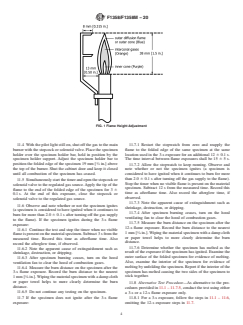
8.1.1.1 The 38-mm [1 ⁄2-in.] flame height is obtained by
5.1.2 When flame resistance is the primary protection of-
adjusting the flame level with the top of the metal prong (see
feredbytheprotectiveclothing,alternativetestmethodscanbe
Fig.1).Itisimportantthattheflameheightbeadjustedwiththe
used. A test method that is useful for evaluating flame
tip of the flame level with the tip of the metal prong. The tip of
resistance of textiles is Test Method D6413/D6413M. Classi-
the methane flame is blue, transparent, and difficult to see; it is
fication Index D4723 contains descriptions and guidance on
more easily seen if there is no light on the flame, for example
other flammability test methods for textiles.
in a darkened room. An easy way to accomplish this is by
5.1.3 This test method is useful to determine the ignition
turning off all nearby lights.
resistance and burning characteristics of materials used in
8.1.2 Position the burner so that the middle of the lower
protective clothing not designated for flame resistance when
edgetothespecimenholderiscentered19mm[0.75in.]above
the outer material surface is exposed to the flame. As such, it
the burner.
is particularly suited to protective clothing materials that are
NOTE 3—It is often necessary to turn off nearby lights to make sure of
composed of different layers such as coated fabrics, laminates,
the accuracy of intersect of the midpoint of the flame with the mounting
or multilayer clothing systems.
clamp.
5.2 Alternative procedures for conducting either a 3-s or
8.2 Adjust the timer to provide a 3 6 0.2-s or 12 6 0.2-s
12-s exposure are provided where one or the other flame
flame to the specimen, depending on the test exposure chosen.
applicationexposuretimesareapplied.Thechoiceofeitherthe
8.2.1 Use an accurate laboratory handheld timer or a stop-
shorter or longer single exposure time is provided to permit an
watch to verify the flame impingement time by measuring the
assessment of the effects for flame impingement on materials
interval between the opening and closing of the solenoid.
under short-term and long-term flame exposure conditions.
5.3 Correlation of data from this test method with the
9. Test Specimens
ignition resistance and burning characteristics of protective
9.1 Prepare ten test specimens 75 mm in width by 400 mm
clothing (not designated for flame resistance) under actual use
in length [3 in. by 16 in.]. If the material is anisotropic, cut five
conditions is not implied.
specimens along each axis.
6. Apparatus
10. Conditioning
6.1 Use the test apparatus as specified in Test Method
D6413/D6413M, including the test cabinet and accessories, 10.1 Unless otherwise specified, condition all samples to be
burner, gas regulator valve system, gas mixture, test specimen tested at a relative humidity of 45 to 70 % and a temperature of
holder, specimen holder clamps, laboratory hood, stopwatch, 20 to 25 °C [67 to 77 °F] for at least
...
This document is not an ASTM standard and is intended only to provide the user of an ASTM standard an indication of what changes have been made to the previous version. Because
it may not be technically possible to adequately depict all changes accurately, ASTM recommends that users consult prior editions as appropriate. In all cases only the current version
of the standard as published by ASTM is to be considered the official document.
Designation: F1358 − 16 F1358/F1358M − 20
Standard Test Method for
Effects of Flame Impingement on Materials Used in
Protective Clothing Not Designated Primarily for Flame
Resistance
This standard is issued under the fixed designation F1358;F1358/F1358M; the number immediately following the designation indicates
the year of original adoption or, in the case of revision, the year of last revision. A number in parentheses indicates the year of last
reapproval. A superscript epsilon (´) indicates an editorial change since the last revision or reapproval.
1. Scope
1.1 This test method establishes a small-scale laboratory screening procedure for comparing the ignition resistance and burning
characteristics of materials used in protective clothing where flame resistance is not the primary form of protection provided by
the clothing.
1.1.1 This test method shall not be used in applicationapplications where flame resistance is the primary form of protection offered
by the protective clothing. Other flammability test methods are more appropriate for those materials.
1.1.2 This test method provides a means for comparing ease of ignition and burning behavior of materials which include plastic
or elastomeric films, coated fabrics, flexible laminates, multilayer-material multilayer material systems, or other protective clothing
materials that are not designated for offering flame resistance as their primary form of protection.
1.2 This test method is used to measure and describe the response of materials, products, or assemblies to heat and flame under
controlled conditions, but does not by itself incorporate all factors required for fire hazard or fire risk assessment of the materials,
products, or assemblies under actual fire conditions.
1.3 Fire testing is inherently hazardous. Adequate safeguards for personnel and property shall be employed in conducting these
tests.
1.4 The values stated in SI units or other units shall be regarded separately as standard. The values stated in each system are not
exact equivalents; therefore, each system must be used independently of the other. Combining values from the two systems may
result in non-conformancenonconformance with the standard.
1.5 This standard does not purport to address all of the safety concerns, if any, associated with its use. It is the responsibility
of the user of this standard to establish appropriate safety safety, health, and healthenvironmental practices and determine the
applicability of regulatory limitations prior to use.
1.6 This international standard was developed in accordance with internationally recognized principles on standardization
established in the Decision on Principles for the Development of International Standards, Guides and Recommendations issued
by the World Trade Organization Technical Barriers to Trade (TBT) Committee.
This test method is under the jurisdiction of ASTM Committee F23 on Personal Protective Clothing and Equipment and is the direct responsibility of Subcommittee
F23.80 on Flame and Thermal.
Current edition approved March 1, 2016Oct. 1, 2020. Published April 2016October 2020. Originally approved in 1995. Last previous edition approved in 20082016 as
F1358 – 08.F1358 – 16. DOI: 10.1520/F1358-16.10.1520/F1358_F1358M-20.
Copyright © ASTM International, 100 Barr Harbor Drive, PO Box C700, West Conshohocken, PA 19428-2959. United States
F1358/F1358M − 20
2. Referenced Documents
2.1 ASTM Standards:
D123 Terminology Relating to Textiles
D4391 Terminology Relating to The Burning Behavior of Textiles
D4723 Classification Index of and Descriptions of Textile Flammability Test Methods (Withdrawn 2016)
D6413D6413/D6413M Test Method for Flame Resistance of Textiles (Vertical Test)
F1494 Terminology Relating to Protective Clothing
3. Terminology
3.1 Definitions—For definitions of terms used in this test method, related to the combustion of textiles, refer to the terminology
contained in Terminology D4391. For definitions of terms used in this test method, related to protective clothing, refer to the
terminology contained in Terminology F1494. For definitions of terms used in this test method, related to textile issues, refer to
the terminology contained in Terminology D123.
3.1 Definitions:
3.1.1 For definitions of terms used in this test method related to the combustion of textiles, refer to the terminology contained in
Terminology D4391. For definitions of terms used in this test method related to protective clothing, refer to the terminology
contained in Terminology F1494. For definitions of terms used in this test method related to textile issues, refer to the terminology
contained in Terminology D123.
3.1.2 afterflame, n—persistent flaming of a material after the ignition source has been removed.
3.1.3 afterflame time, n—the length of time for which a material continues to flame after the ignition source has been removed.
3.1.4 afterglow, n—a glow in a material after the removal of an external ignition source or after the cessation (natural or induced)
of flaming of the material (see also glow).
3.1.5 anisotropic, adj—having different values for a specific property in different directions.
3.1.5.1 Discussion—
When this test method is used to evaluate textile-based materials, this term refers to warp (wale) and filling (course) directions.
When this test method is used for nonwoven materials, this term refers to machine and cross-machine directions.
3.1.6 burning behavior, n—all the changes that take place when materials or products are exposed to a specified ignition source.
3.1.7 burn distance, n—the measurement from the folded bottom edge of the specimen to the farthest point that shows evidence
of damage due to combustion.
3.1.7.1 Discussion—
In evaluating the effects of flame impingement of materials used in protective clothing, this measurement applies to the folded
material specimen when pressed flat and includes all areas partially burned, charred, embrittled, or melted, but not including areas
sooted, stained, distorted, or discolored. Damage due to mechanical delamination or splitting of the specimen is not included in
the burn distance unless the delaminated or split area includes damage due to combustion.
3.1.8 charring, n—the formation of carbonaceous residue as the result of pyrolysis or incomplete combustion.
3.1.9 combustion, n—a chemical process of oxidation that occurs at a rate fast enough to produce heat and usually light either as
glow or flames.
3.1.10 dripping, n—in testing thermal protective material, a material response evidenced by flowing of the polymer.
3.1.10.1 Discussion—
For referenced ASTM standards, visit the ASTM website, www.astm.org, or contact ASTM Customer Service at service@astm.org. For Annual Book of ASTM Standards
volume information, refer to the standard’s Document Summary page on the ASTM website.
The last approved version of this historical standard is referenced on www.astm.org.
F1358/F1358M − 20
In evaluating the effects of flame impingement of materials used in protective clothing, dripping may be the formation of liquid
droplets from melted surface or substrate material during flame impingement.
3.1.11 embrittlement, n—the formation of a brittle residue as the result of pyrolysis or incomplete combustion.
3.1.12 flame, n—as related to ignition of textiles, a controlled hot luminous zone of gas or matter in gaseous suspension, or both,
of constant size and shape that is undergoing combustion as evidenced by a low-intensity heat source of less than 1 kW, such as
a candle flame or match flame.
3.1.12.1 Discussion—
The burner flame in this test method produces relatively low heat flux and should be constant in size and shape.
3.1.13 flame impingement, n—direct contact between a flame and a material.
3.1.13.1 Discussion—
In testing flame impingement of materials used in protective clothing, the flame is of a specified type and duration.
3.1.14 flammability, n—those characteristics of a material that pertain to its ignition and support of combustion.
3.1.14.1 Discussion—
In evaluating the effects of flame impingement of materials used in protective clothing, flammability is based on the relative
number of specimens that ignite when exposed to flame either for a period of 3 or 12 s.
3.1.15 glow, n—visible, flameless combustion of the solid phase of a material.
3.1.15.1 Discussion—
Although a solid may glow, it can also produce combustible discharge that will cause a flame. These two phenomena are not
necessarily interdependent.
3.1.16 ignition, n—the initiation of combustion.
3.1.16.1 Discussion—
In evaluating the effects of flame impingement of material used in protective clothing, ignition is determined by the presence of
afterflame after the removal of the burner flame.
3.1.17 melting, n—in testing thermal protective material, a material response evidenced by softening of the polymer.
3.1.17.1 Discussion—
In evaluating the effects of flame impingement of materials used in protective clothing, melting may occur at surface layers or in
combination with the substrate fabric(s) or other polymer layers. Melting may be observed for protective clothing materials which
involve a polymer coating or laminate combined with a normally flame-resistant fabric or substrate.
3.1.18 protective clothing, n—an item of clothing that is specifically designed and constructed for the intended purpose of isolating
all or part of the body from a potential hazard; or, isolating the external environment from contamination by the wearer of the
clothing.
3.1.18.1 Discussion—
In this test method, the potential hazard is flame impingement on protective clothing where flame resistance is not the primary form
of protection offered by that clothing.
3.1.19 shrinkage, n—a decrease in one or more dimensions of an object or material.
3.1.19.1 Discussion—
In evaluating the effects of flame impingement, these changes in dimension are caused by heat from the flame source.
3.2 afterflame,n—persistent flaming of a material after the ignition source has been removed.
3.3 after-flame time, n—the length of time for which a material continues to flame after the ignition source has been removed.
3.4 afterglow, n—a glow in a material after the removal of an external ignition source or after the cessation (natural or induced)
of flaming of the material (see also glow).
3.5 anisotropic, adj—having different values for a specific property in different directions.
F1358/F1358M − 20
3.5.1 Discussion—When this test method is used to evaluate textile-based materials, this term refers to warp (wale) and filling
(course) directions. When this test method is used for nonwoven materials, this term refers to machine and cross-machine
directions.
3.6 burning behavior, n—all the changes that take place when materials or products are exposed to a specified ignition source.
3.7 burn distance, n—the measurement from the bottom edge of the specimen to the farthest point that shows evidence of damage
due to combustion.
3.7.1 Discussion—In evaluating the effects of flame impingement of materials used in protective clothing, this measurement
applies to the folded material specimen when pressed flat and includes all areas partially burned, charred, embrittled, or melted,
but not including areas sooted, stained, distorted, or discolored. Damage due to mechanical delamination or splitting of the
specimen is not included in the burn distance unless the delaminated or split area includes damage due to combustion.
3.8 charring, n—the formation of carbonaceous residue as the result of pyrolysis or incomplete combustion.
3.9 combustion, n—a chemical process of oxidation that occurs at a rate fast enough to produce heat and usually light either as
glow or flames.
3.10 dripping, n—in testing thermal protective material, a material response evidenced by flowing of the polymer.
3.10.1 Discussion—In evaluating the effects of flame impingement of materials used in protective clothing, dripping may be the
formation of liquid droplets from melted surface or substrate material during flame impingement.
3.11 embrittlement, n—the formation of a brittle residue as the result of pyrolysis or incomplete combustion.
3.12 flame, n—as related to ignition of textiles, a controlled hot luminous zone of gas or matter in gaseous suspension, or both,
of constant size and shape that is undergoing combustion as evidenced by a low-intensity heat source of less than 1 kW, such as
a candle flame or match flame.
3.12.1 Discussion—The burner flame in this test method produces relatively low heat flux and should be constant in size and
shape.
3.13 flame impingement, n—direct contact between a flame and a material.
3.13.1 Discussion—In testing flame impingement of materials used in protective clothing, the flame is of a specified type and
duration.
3.14 flammability, n—those characteristics of a material that pertain to its ignition and support of combustion.
3.14.1 Discussion—In evaluating the effects of flame impingement of materials used in protective clothing, flammability is based
on the relative number of specimens that ignite when exposed to flame either for a period of 3 or 12 s.
3.15 glow, n—visible, flameless combustion of the solid phase of a material.
3.15.1 Discussion—Although a solid may glow, it can also produce combustible discharge that will cause a flame. These two
phenomena are not necessarily interdependent.
3.16 ignition, n—the initiation of combustion.
3.16.1 Discussion—In evaluating the effects of flame impingement of material used in protective clothing, ignition is determined
by the presence of after-flame after the removal of the burner flame.
F1358/F1358M − 20
3.17 melting, n—in testing thermal protective material, a material response evidenced by softening of the polymer.
3.17.1 Discussion—In evaluating the effects of flame impingement of materials used in protective clothing, melting may occur at
surface layers or in combination with the substrate fabric(s) or other polymer layers. Melting may be observed for protective
clothing materials which involve a polymer coating or laminate combined with a normally flame-resistant fabric or substrate.
3.18 protective clothing, n—an item of clothing that is specifically designed and constructed for the intended purpose of isolating
all or part of the body from a potential hazard; or, isolating the external environment from contamination by the wearer of the
clothing.
3.18.1 Discussion—In this test method the potential hazard is flame impingement on protective clothing where flame resistance
is not the primary form of protection offered by that clothing.
3.19 shrinkage, n—a decrease in one or more dimensions of an object or material.
3.19.1 Discussion—In evaluating the effects of flame impingement, these changes in dimension are caused by heat from the flame
source.
4. Summary of Test Method
4.1 A conditioned specimen of a protective clothing material is folded in half and placed in a sample holder with the folded edge
suspended overin a gas flame.
4.2 The specimen is exposed to the flame for a 3-s interval.
4.2.1 If the material ignites during this exposure, the after-flameafterflame time, afterglow time, and burn distance of the specimen
are measured and reported. Any observations of burning behavior are also reported. The test is then terminated.
4.3 If the material does not ignite after the first exposure, the same specimen is exposed to the flame for a 12-s interval. The
after-flameafterflame time, afterglow time, and burn distance of the specimen are measured and reported. Any observations of
burning behavior are also reported.
4.4 Alternative procedures are provided for conducting the 3-s or 12-s exposures only.
5. Significance and Use
5.1 This test method is intended to determine the ignition resistance and burning characteristics of materials used in protective
clothing,clothing where flame resistance is not the primary form of protection designated.
5.1.1 Flame resistance is a distinctive property of clothing items designated for isolating parts of the body from anticipated flame
hazards. It is possible that protective clothing designated for isolation from other hazards, such as those for chemical or biological
protection, neither have flame resistance nor isolate the wearer from flame hazards. This test method can be used to evaluate the
effects of flame impingement on protective clothing where flame resistance is not the primary objective of protection.
5.1.2 When flame resistance is the primary protection offered by the protective clothing, alternative test methods can be used. A
test method that is useful for evaluating flame resistance of textiles is Test Method D6413D6413/D6413M. Classification Index
D4723 contains descriptions and guidance on other flammability test methods for textiles.
5.1.3 This test method is useful to determine the ignition resistance and burning characteristics of materials used in protective
clothing not designated for flame resistance when the outer material surface is exposed to the flame. As such, it is particularly suited
to protective clothing materials that are composed of different layers such as coated fabrics, laminates, or multilayer clothing
systems.
5.2 Alternative procedures for conducting either a 3-s or 12-s exposure are provided where one or the other flame application
...