

ASTM C1620-16(2023)
(Specification)Standard Specification for Aerosol Polyurethane and Aerosol Latex Foam Sealants
General Information
- Abstract
SCOPE
1.1 This specification covers the types, grades, and physical properties of aerosol polyurethane and aerosol latex foams extruded from pressurized containers and intended for building envelope air barrier sealant applications in building construction.
1.2 For specific aerosol foam sealant applications, operational temperature limit criteria shall be as agreed upon between the aerosol sealant manufacturer and the purchaser.
1.3 The values in SI units are to be regarded as standard. The values shown in parentheses are for information and approximation only.
1.4 The committee with jurisdiction over this standard is not aware of any comparable standards published by other organizations.
1.5 This standard does not purport to address all of the safety concerns, if any, associated with its use. It is the responsibility of the user of this standard to establish appropriate safety, health, and environmental practices and determine the applicability of regulatory limitations prior to use.
1.6 This international standard was developed in accordance with internationally recognized principles on standardization established in the Decision on Principles for the Development of International Standards, Guides and Recommendations issued by the World Trade Organization Technical Barriers to Trade (TBT) Committee.
- Status
- Published
- Publication Date
- 31-Dec-2022
- Technical Committee
- C24 - Building Seals and Sealants
- Drafting Committee
- C24.61 - Aerosol Foam Sealants

Overview
ASTM C1620-16(2023) is the internationally recognized standard specification for aerosol polyurethane and aerosol latex foam sealants. Published by ASTM International, this standard details the classification, physical properties, and performance requirements of foam sealants extruded from pressurized containers. These sealants are primarily intended for use as air barrier materials in building construction, where they function as critical components of the building envelope by resisting air, moisture, and heat transfer.
Aerosol foam sealants are available as either polyurethane or latex formulations, supplied in containers up to one liter. They are increasingly chosen for their efficiency in sealing gaps, joints, and penetrations within walls, roofs, and other structural elements. Meeting this standard ensures that the sealant provides reliable performance and meets required safety, handling, and installation practices for air barrier applications.
Key Topics
- Types and Grades:
- Type I: Aerosol polyurethane foam sealants
- Type II: Aerosol latex foam sealants
- Grade 1: Contains flammable propellants (classified as flammable)
- Grade 2: Contains nonflammable propellants (not classified as flammable)
- Physical Property Requirements:
- Air permeability (tested by ASTM methods)
- Open cell content, linear yield, shelf life, tack-free and trim time
- Flame spread and smoke index characteristics
- Post-dispensing expansion and contraction
- Sampling and Testing:
- Standard methods for specimen preparation
- Guidance for inspection, sampling practices, and property verification
- Packaging and Marking:
- Containers must comply with DOT requirements
- Clear labeling for compliance, handling, and product identification
- Performance Criteria:
- Must resist the passage of air, moisture, and heat
- Can serve as fireblocking or be part of firestop assemblies in accordance with building code requirements
Applications
- Building Envelope Air Barriers:
Aerosol foam sealants are specified for sealing joints, cracks, and penetrations in exterior walls, roofs, and floors to minimize air leakage and energy loss in residential, commercial, and industrial buildings. - Fireblocking and Fire Stopping:
When properly tested and qualified, these foam sealants may be used to meet fireblocking requirements, limiting hidden fire movement in wall cavities or as part of tested firestop assemblies. - Moisture and Vapor Control:
By effectively sealing gaps, these products reduce moisture ingress, thus supporting mold control and improving durability. - Energy Efficiency:
Proper use of aerosol foam sealants improves overall energy performance of buildings by minimizing heat transfer and air infiltration/exfiltration. - DIY and Professional Use:
Suitable for both professional contractors and consumers, foam-in-place sealants offer quick, efficient application directly from pressurized containers.
Related Standards
- ASTM C1536: Measuring Yield for Aerosol Foam Sealants
- ASTM C1642: Determining Air Leakage Rates for Aerosol Foam Sealants
- ASTM C1643: Measuring Post Dispensing Expansion of Aerosol Foam Sealants
- ASTM C168, C717, D883: Terminology for Insulation, Building Seals, Sealants, and Plastics
- ASTM E84, UL723: Surface Burning Characteristics of Building Materials
- ASTM E283: Determining Rate of Air Leakage in Building Envelope Products
- ASTM E814, UL1479: Fire Tests of Penetration Firestop Systems
- CAN/CGSB 51.93, CAN/ULC-S710.1/2: Canadian standards for air barrier and sealant foam insulation
- IEEE/ASTM SI 10: Use of International System of Units (SI)
ASTM C1620 compliance signifies reliable performance for aerosol foam sealants in air barrier, energy conservation, and fire protection applications, supporting safer and more efficient building construction.
Relations
- Effective Date
- 15-Apr-2024
- Effective Date
- 01-Mar-2024
- Effective Date
- 01-Feb-2024
- Effective Date
- 01-Dec-2023
- Effective Date
- 01-Nov-2023
- Effective Date
- 01-Sep-2023
- Effective Date
- 01-Aug-2020
- Effective Date
- 01-May-2020
- Effective Date
- 01-Jan-2020
- Effective Date
- 01-Sep-2019
- Effective Date
- 01-Aug-2019
- Effective Date
- 01-Jul-2019
- Effective Date
- 01-May-2019
- Effective Date
- 15-Apr-2019
- Effective Date
- 15-Apr-2019
Get Certified
Connect with accredited certification bodies for this standard

DIBt (Deutsches Institut für Bautechnik)
German Institute for Building Technology.
DIN CERTCO
DIN Group product certification.

Aboma Certification B.V.
Specialized in construction, metal, and transport sectors.
Sponsored listings
Frequently Asked Questions
ASTM C1620-16(2023) is a technical specification published by ASTM International. Its full title is "Standard Specification for Aerosol Polyurethane and Aerosol Latex Foam Sealants". This standard covers: SCOPE 1.1 This specification covers the types, grades, and physical properties of aerosol polyurethane and aerosol latex foams extruded from pressurized containers and intended for building envelope air barrier sealant applications in building construction. 1.2 For specific aerosol foam sealant applications, operational temperature limit criteria shall be as agreed upon between the aerosol sealant manufacturer and the purchaser. 1.3 The values in SI units are to be regarded as standard. The values shown in parentheses are for information and approximation only. 1.4 The committee with jurisdiction over this standard is not aware of any comparable standards published by other organizations. 1.5 This standard does not purport to address all of the safety concerns, if any, associated with its use. It is the responsibility of the user of this standard to establish appropriate safety, health, and environmental practices and determine the applicability of regulatory limitations prior to use. 1.6 This international standard was developed in accordance with internationally recognized principles on standardization established in the Decision on Principles for the Development of International Standards, Guides and Recommendations issued by the World Trade Organization Technical Barriers to Trade (TBT) Committee.
SCOPE 1.1 This specification covers the types, grades, and physical properties of aerosol polyurethane and aerosol latex foams extruded from pressurized containers and intended for building envelope air barrier sealant applications in building construction. 1.2 For specific aerosol foam sealant applications, operational temperature limit criteria shall be as agreed upon between the aerosol sealant manufacturer and the purchaser. 1.3 The values in SI units are to be regarded as standard. The values shown in parentheses are for information and approximation only. 1.4 The committee with jurisdiction over this standard is not aware of any comparable standards published by other organizations. 1.5 This standard does not purport to address all of the safety concerns, if any, associated with its use. It is the responsibility of the user of this standard to establish appropriate safety, health, and environmental practices and determine the applicability of regulatory limitations prior to use. 1.6 This international standard was developed in accordance with internationally recognized principles on standardization established in the Decision on Principles for the Development of International Standards, Guides and Recommendations issued by the World Trade Organization Technical Barriers to Trade (TBT) Committee.
ASTM C1620-16(2023) is classified under the following ICS (International Classification for Standards) categories: 91.100.50 - Binders. Sealing materials. The ICS classification helps identify the subject area and facilitates finding related standards.
ASTM C1620-16(2023) has the following relationships with other standards: It is inter standard links to ASTM C168-24, ASTM C390-08(2024), ASTM D883-24, ASTM E84-23d, ASTM D883-23, ASTM E84-23c, ASTM C1642-20, ASTM C1643-14(2020), ASTM D883-20, ASTM C390-08(2019), ASTM D883-19c, ASTM E84-19b, ASTM C1536-19, ASTM E84-19a, ASTM D883-19a. Understanding these relationships helps ensure you are using the most current and applicable version of the standard.
ASTM C1620-16(2023) is available in PDF format for immediate download after purchase. The document can be added to your cart and obtained through the secure checkout process. Digital delivery ensures instant access to the complete standard document.
Standards Content (Sample)
This international standard was developed in accordance with internationally recognized principles on standardization established in the Decision on Principles for the
Development of International Standards, Guides and Recommendations issued by the World Trade Organization Technical Barriers to Trade (TBT) Committee.
Designation:C1620 −16 (Reapproved 2023)
Standard Specification for
Aerosol Polyurethane and Aerosol Latex Foam Sealants
This standard is issued under the fixed designation C1620; the number immediately following the designation indicates the year of
original adoption or, in the case of revision, the year of last revision. A number in parentheses indicates the year of last reapproval. A
superscript epsilon (´) indicates an editorial change since the last revision or reapproval.
1. Scope C1536 Test Method for Measuring the Yield for Aerosol
Foam Sealants
1.1 This specification covers the types, grades, and physical
C1642 Practice for DeterminingAir Leakage Rates ofAero-
properties of aerosol polyurethane and aerosol latex foams
sol Foam Sealants and Other Construction Joint Fill and
extruded from pressurized containers and intended for building
Insulation Materials
envelope air barrier sealant applications in building construc-
C1643 Test Method to Measuring the Post Dispensing Volu-
tion.
metric Expansion of Aerosol Foam Sealants
1.2 For specific aerosol foam sealant applications, opera-
C1737 Guide for Evaluating Temperature Effects toAerosol
tional temperature limit criteria shall be as agreed upon
Foam Sealant During and After Dispensing
between the aerosol sealant manufacturer and the purchaser.
D883 Terminology Relating to Plastics
1.3 The values in SI units are to be regarded as standard. D6226 Test Method for Open Cell Content of Rigid Cellular
Plastics
The values shown in parentheses are for information and
approximation only. E84 Test Method for Surface Burning Characteristics of
Building Materials
1.4 Thecommitteewithjurisdictionoverthisstandardisnot
E283 Test Method for Determining Rate of Air Leakage
aware of any comparable standards published by other orga-
Through Exterior Windows, Skylights, Curtain Walls, and
nizations.
Doors Under Specified Pressure Differences Across the
1.5 This standard does not purport to address all of the
Specimen
safety concerns, if any, associated with its use. It is the
E814 Test Method for Fire Tests of Penetration Firestop
responsibility of the user of this standard to establish appro-
Systems
priate safety, health, and environmental practices and deter-
E2690 Practice for Specimen Preparation and Mounting of
mine the applicability of regulatory limitations prior to use.
Caulks and Sealants to Assess Surface Burning Charac-
1.6 This international standard was developed in accor-
teristics
dance with internationally recognized principles on standard-
IEEE/ASTM SI 10 American National Standard for Use of
ization established in the Decision on Principles for the
the International System of Units (SI) (The Modernized
Development of International Standards, Guides and Recom-
Metric System)
mendations issued by the World Trade Organization Technical
2.2 Other Documents:
Barriers to Trade (TBT) Committee.
SPFA Document AY119 Glossary of Terms Common to the
Polyurethane Foam Industry
2. Referenced Documents
CAN/CGSB 51.93 Air Barrier Materials
2.1 ASTM Standards:
CAN/ULC-S710.1 Standard for Thermal Insulation-Bead-
C168 Terminology Relating to Thermal Insulation
Applied One-Component PolyurethaneAir Sealant Foam,
C390 Practice for Sampling and Acceptance of Thermal
Part 1, Section 6.5.1, “Air Permeance”
Insulation Lots
CAN/ULC-S710.2 Proposed Standard for Thermal
C717 Terminology of Building Seals and Sealants
Insulation-Bead-Applied One-Component Polyurethane
Air Sealant Foam, Part 2, Product Installation
This specification is under the jurisdiction of ASTM Committee C24 on 49 Code of Federal Regulations 178.33
Building Seals and SealantsandisthedirectresponsibilityofSubcommittee C24.61
on Aerosol Foam Sealants.
Current edition approved Jan. 1, 2023. Published January 2023. Originally
ε1
approved in 2005. Last previous edition approved in 2016 as C1620 – 16 . DOI: Available from the Spray Polyurethane Foam Alliance, 440 Fair Lakes Court,
10.1520/C1620-16R23. Suite 105, Fairfax, VA 22033.
2 4
For referenced ASTM standards, visit the ASTM website, www.astm.org, or Available from the Canadian StandardsAssociation, 5060 SpectrumWay, Suite
contact ASTM Customer Service at service@astm.org. For Annual Book of ASTM 100, Mississauga, ON L4W 5N6 Canada.
Standards volume information, refer to the standard’s Document Summary page on Available from U.S. Government Printing Office, Superintendent of
the ASTM website. Documents, 732 N. Capitol St., NW, Mail Stop: SDE, Washington, DC 20401.
Copyright © ASTM International, 100 Barr Harbor Drive, PO Box C700, West Conshohocken, PA 19428-2959. United States
C1620−16 (2023)
UL723 Test for Surface Burning Characteristics of Building tainers through a nozzle device at the point of application to a
Materials building joint as foamed sealant material. Bead foam drying
UL 1479 Standard for Fire Tests of Through-Penetration then continues over a brief period of time with the loss of
Firestops formulation moisture.
6.3 Aerosol foam sealant can be used as an alternative
3. Terminology
Fireblocking sealing material if it meets all requirements per
3.1 Definitions:
building codes.An evaluation report, such as ICC-ESR report,
3.1.1 Fordefinitionsoftermsusedinthisspecification,refer
can serve as such qualification and will detail the specific
to Terminologies C168, C717, D883, and SPFA Document
sealing applications that are recognized.
AY119. (SPFAstands for Spray Polyurethane FoamAlliance.)
6.3.1 Fireblockingistherestrictionofhiddenfiremovement
3.1.2 tack-free time, n—as defined in 10.2.
via the inside of hollow concealed spaces in wood frame walls.
3.1.3 trim time, n—as defined in 10.2. Itistypicallyaccomplishedbytheconstructionoftopplateand
vertical studs (usuallya2by4)inthe wall. Gaps in the plates
4. Classification
or studs that accommodate wiring or piping could allow the
free passage of flame or hot gases, and should be sealed with
4.1 Type I Aerosol Polyurethane Foam Sealants in contain-
Fireblocking material. These materials can be a prescribed
ers one litre or less.
material or alternative material that meets comparative testing
4.2 Type II Aerosol Latex Foam Sealants in containers one
requirement of building code.
litre or less.
6.3.2 A qualified Fireblocking foam sealant may be only
4.3 Grade 1 Aerosol Foam Sealants contain flammable gas
tested per modified Test Method E814 as a part of comparative
blowing agent or propellant, or both, and are classified as a
testing program; it cannot be used in an Firestop assembly
flammable aerosol by DOT.
unless fully tested per Test Method E814 or UL 1479.
4.4 Grade 2 Aerosol Foam Sealants contain nonflammable
6.4 Aerosol foam sealant can be part of Firestop assembly if
blowing agent or propellants, or both, and are not classified
itisfullytestedperTestMethodE814orUL1479.Theaerosol
flammable.
foam sealant as Firestop component must be installed as
prescribed in the test report or listing program such as
5. Ordering Information
Through-penetration Firestop Systems of Underwriters Labo-
5.1 Orders for materials purchased under this specification ratory.Aqualified Firestop assembly shall be rated in terms of
shall include the following information:
T and F rating.
5.1.1 Manufacturer, 6.4.1 Firestop refers to Through-penetration Firestop Sys-
5.1.2 Product identification information or product name,
tems that must be fully tested per Test Method E814 or UL
5.1.3 ASTM Specification C1620, 1479andtheassemblymustberatedintermsofTandFrating.
5.1.4 Product classification (see Section 4),
6.5 The aerosol foam sealant product shall be suitable for
5.1.5 Certificate of compliance (if required),
shelf-stable pressurized containment, ready to dispense.
5.1.6 Ordering date,
6.6 In most field applications, the aerosol foam sealant is
5.1.7 Target delivery date,
foamed-in-place directly into open joints and cavities in
5.1.8 Special packaging or handling (if required),
building envelope wall and roof areas by consumers or trained
5.1.9 Special markings (if required), and
professionalstoresisttheundesirabletransmissionofmoisture,
5.1.10 Specialcomplianceinformation,asapplicableforthe
conditioned air, heat, and atmospheric air infiltration/
user.
exfiltration of gases and heat energy.
5.2 Purchases for governmental agencies shall comply with
7. Physical Requirements
their special needs.
7.1 Aerosol foam sealants shall have physical property
6. Materials and Manufacture
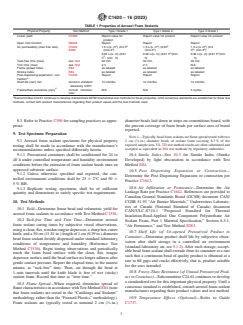
characteristics as shown in Table 1.
6.1 Aerosol polyurethane foam sealants are produced by the
7.2 Other physical properties shall be specified as agreed
catalyzed chemical polymerization reaction of proprietary
upon between the manufacturer and the purchaser, if required
chemical formulations and appropriate blowing agents. The
for engineering design purposes, such as the anticipation of
product of this reaction is bead extruded from pressurized
service temperature extremes, conductive thermal resistance
containersthroughanozzledeviceatthepointofapplicationto
values, or fire resistance requirements.
abuildingjointasafoamedsealantmaterial.Beadfoamcuring
is achieved with moisture from atmosphere and substrates. 8. Sampling
6.2 Aerosol latex foam sealants are produced by the blend-
8.1 For the purposes of sampling, the lot shall consist of all
ing of proprietary formulations and appropriate blowing the single-use containers of sealant purchased and delivered at
agents. This mixture is bead extruded from pressurized con-
one time.
8.2 Sampling for inspection tests, if required, shall be for
phy
...