


ASTM D7686-11
(Test Method)Standard Test Method for Field-Based Condition Monitoring of Soot in In-Service Lubricants Using a Fixed-Filter Infrared (IR) Instrument
Standard Test Method for Field-Based Condition Monitoring of Soot in In-Service Lubricants Using a Fixed-Filter Infrared (IR) Instrument
SIGNIFICANCE AND USE
This test method provides a simple field-based technique for condition monitoring of soot in in-service lubricants associated with combustion engines, machinery, and equipment used in industry and by the military. Critical applications should use laboratory based test methods, such as Thermal Gravimetric Analysis (TGA) described in Test Method D5967, Annex A4. Infrared spectroscopy is a well established laboratory method for evaluating soot levels in lubricants. This test method can be used to monitor soot build-up in lubricants and can indicate whether soot has accumulated to an extent which could significantly degrade the performance of the oil. High soot content can compromise lubricant performance and cause filter and oil passage blockage. Soot concentration should be considered in conjunction with data from other condition monitoring tests as described in Practice E2412 to determine whether the oil should be replaced to minimize machinery wear or failure, or both.
SCOPE
1.1 This test method pertains to field-based monitoring of soot in diesel crankcase engine oils as well as in other types of engine oils where soot may contaminate the lubricant as a result of a blow-by due to incomplete combustion of fuels. It is applicable to oils having soot levels of up to 12%.
1.2 This test method uses filter-based infrared technology for monitoring of soot build-up in in-service petroleum and hydrocarbon-based lubricants as a result of normal machinery operation. Soot levels in engine oils rise as soot particles contaminate the oil as a result of exhaust gas recirculation from blow-by. This test method is designed as a fast, simple and field capable spectroscopic check for soot in in-service hydrocarbon-based lubricants with the objective of helping diagnose the operational condition of the machine based on measuring the level of soot in the oil.
1.3 This test method is intended as a field test only, and should be treated as such. Critical applications should use laboratory based methods, such as Thermal Gravimetric Analysis (TGA) described in Test Method D5967, Annex A4.
1.4 Acquisition of spectral data for measuring soot in in-service oil and lubricant samples with the use of a fixed-filter IR instrument is described in this test method. Calibration against prepared soot standards is also described.
Note 1—It is not the intent of this test method to establish or recommend normal, cautionary, warning or alert limits for any machinery. Such limits should be established in conjunction with advice and guidance from the machinery manufacturer and maintenance group.
1.5 The values stated in SI units are to be regarded as standard. No other units of measurement are included in this standard.
1.6 This standard does not purport to address all of the safety concerns, if any, associated with its use. It is the responsibility of the user of this standard to establish appropriate safety and health practices and determine the applicability of regulatory limitations prior to use.
General Information
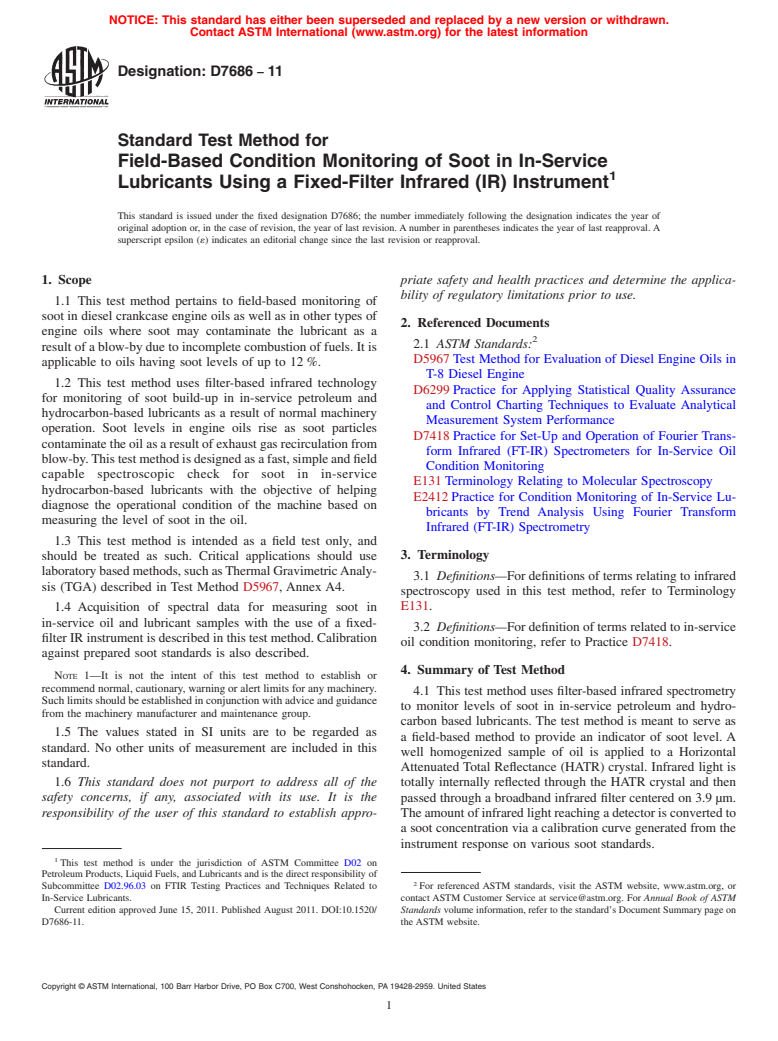
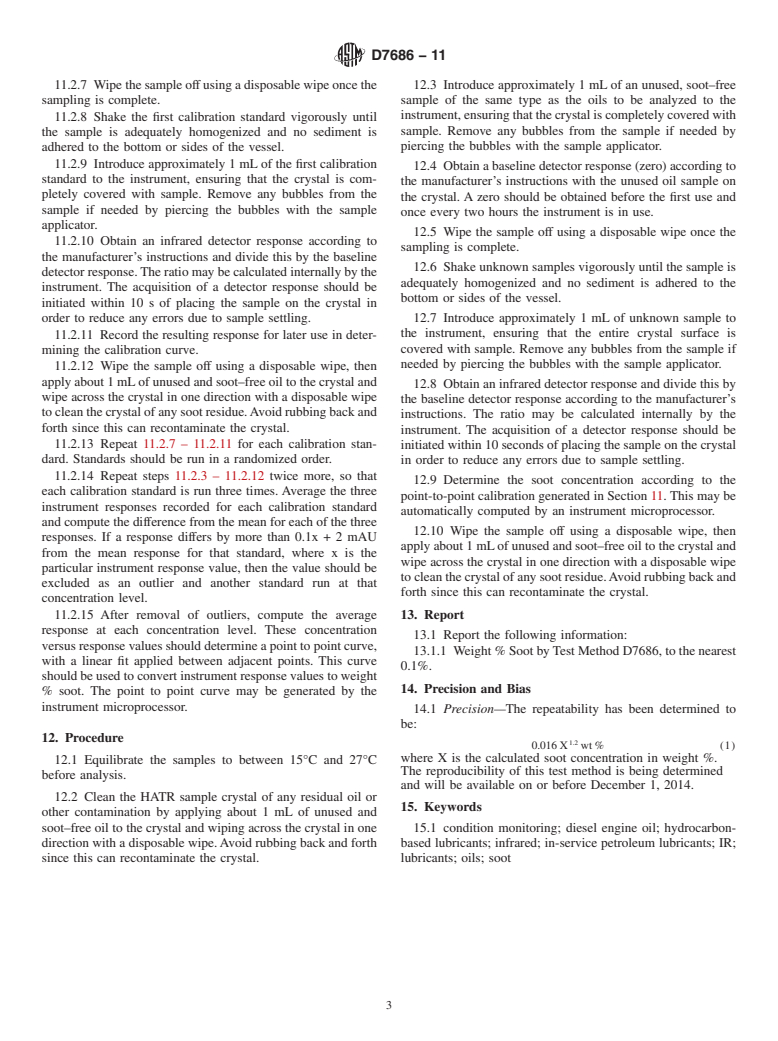
Standards Content (Sample)
NOTICE: This standard has either been superseded and replaced by a new version or withdrawn.
Contact ASTM International (www.astm.org) for the latest information
Designation: D7686 − 11
Standard Test Method for
Field-Based Condition Monitoring of Soot in In-Service
1
Lubricants Using a Fixed-Filter Infrared (IR) Instrument
This standard is issued under the fixed designation D7686; the number immediately following the designation indicates the year of
original adoption or, in the case of revision, the year of last revision. A number in parentheses indicates the year of last reapproval. A
superscript epsilon (´) indicates an editorial change since the last revision or reapproval.
1. Scope priate safety and health practices and determine the applica-
bility of regulatory limitations prior to use.
1.1 This test method pertains to field-based monitoring of
soot in diesel crankcase engine oils as well as in other types of
2. Referenced Documents
engine oils where soot may contaminate the lubricant as a
2
2.1 ASTM Standards:
result of a blow-by due to incomplete combustion of fuels. It is
D5967 Test Method for Evaluation of Diesel Engine Oils in
applicable to oils having soot levels of up to 12 %.
T-8 Diesel Engine
1.2 This test method uses filter-based infrared technology
D6299 Practice for Applying Statistical Quality Assurance
for monitoring of soot build-up in in-service petroleum and
and Control Charting Techniques to Evaluate Analytical
hydrocarbon-based lubricants as a result of normal machinery
Measurement System Performance
operation. Soot levels in engine oils rise as soot particles
D7418 Practice for Set-Up and Operation of Fourier Trans-
contaminatetheoilasaresultofexhaustgasrecirculationfrom
form Infrared (FT-IR) Spectrometers for In-Service Oil
blow-by.Thistestmethodisdesignedasafast,simpleandfield
Condition Monitoring
capable spectroscopic check for soot in in-service
E131 Terminology Relating to Molecular Spectroscopy
hydrocarbon-based lubricants with the objective of helping
E2412 Practice for Condition Monitoring of In-Service Lu-
diagnose the operational condition of the machine based on
bricants by Trend Analysis Using Fourier Transform
measuring the level of soot in the oil.
Infrared (FT-IR) Spectrometry
1.3 This test method is intended as a field test only, and
3. Terminology
should be treated as such. Critical applications should use
laboratorybasedmethods,suchasThermalGravimetricAnaly-
3.1 Definitions—For definitions of terms relating to infrared
sis (TGA) described in Test Method D5967, Annex A4.
spectroscopy used in this test method, refer to Terminology
1.4 Acquisition of spectral data for measuring soot in E131.
in-service oil and lubricant samples with the use of a fixed-
3.2 Definitions—For definition of terms related to in-service
filter IR instrument is described in this test method. Calibration
oil condition monitoring, refer to Practice D7418.
against prepared soot standards is also described.
4. Summary of Test Method
NOTE 1—It is not the intent of this test method to establish or
recommend normal, cautionary, warning or alert limits for any machinery.
4.1 This test method uses filter-based infrared spectrometry
Suchlimitsshouldbeestablishedinconjunctionwithadviceandguidance
to monitor levels of soot in in-service petroleum and hydro-
from the machinery manufacturer and maintenance group.
carbon based lubricants. The test method is meant to serve as
1.5 The values stated in SI units are to be regarded as
a field-based method to provide an indicator of soot level. A
standard. No other units of measurement are included in this
well homogenized sample of oil is applied to a Horizontal
standard.
Attenuated Total Reflectance (HATR) crystal. Infrared light is
1.6 This standard does not purport to address all of the totally internally reflected through the HATR crystal and then
safety concerns, if any, associated with its use. It is the passed through a broadband infrared filter centered on 3.9 µm.
responsibility of the user of this standard to establish appro- Theamountofinfraredlightreachingadetectorisconvertedto
a soot concentration via a calibration curve generated from the
instrument response on various soot standards.
1
This test method is under the jurisdiction of ASTM Committee D02 on
Petroleum Products, Liquid Fuels, and Lubricants and is the direct responsibility of
2
Subcommittee D02.96.03 on FTIR Testing Practices and Techniques Related to For referenced ASTM standards, visit the ASTM website, www.astm.org, or
In-Service Lubricants. contact ASTM Customer Service at service@astm.org. For Annual Book of ASTM
Current edition approved June 15, 2011. Published August 2011. DOI:10.1520/ Standards volume information, refer to the standard’s Document Summary page on
D7686-11. the ASTM website.
Copyright © ASTM International, 100 Barr Harbor Drive, PO Box C700, West Conshohocken, PA 19428-2959. United States
1
---------------------- Page: 1 ----------------------
D7686 − 11
5. Significance and U
...
Questions, Comments and Discussion
Ask us and Technical Secretary will try to provide an answer. You can facilitate discussion about the standard in here.